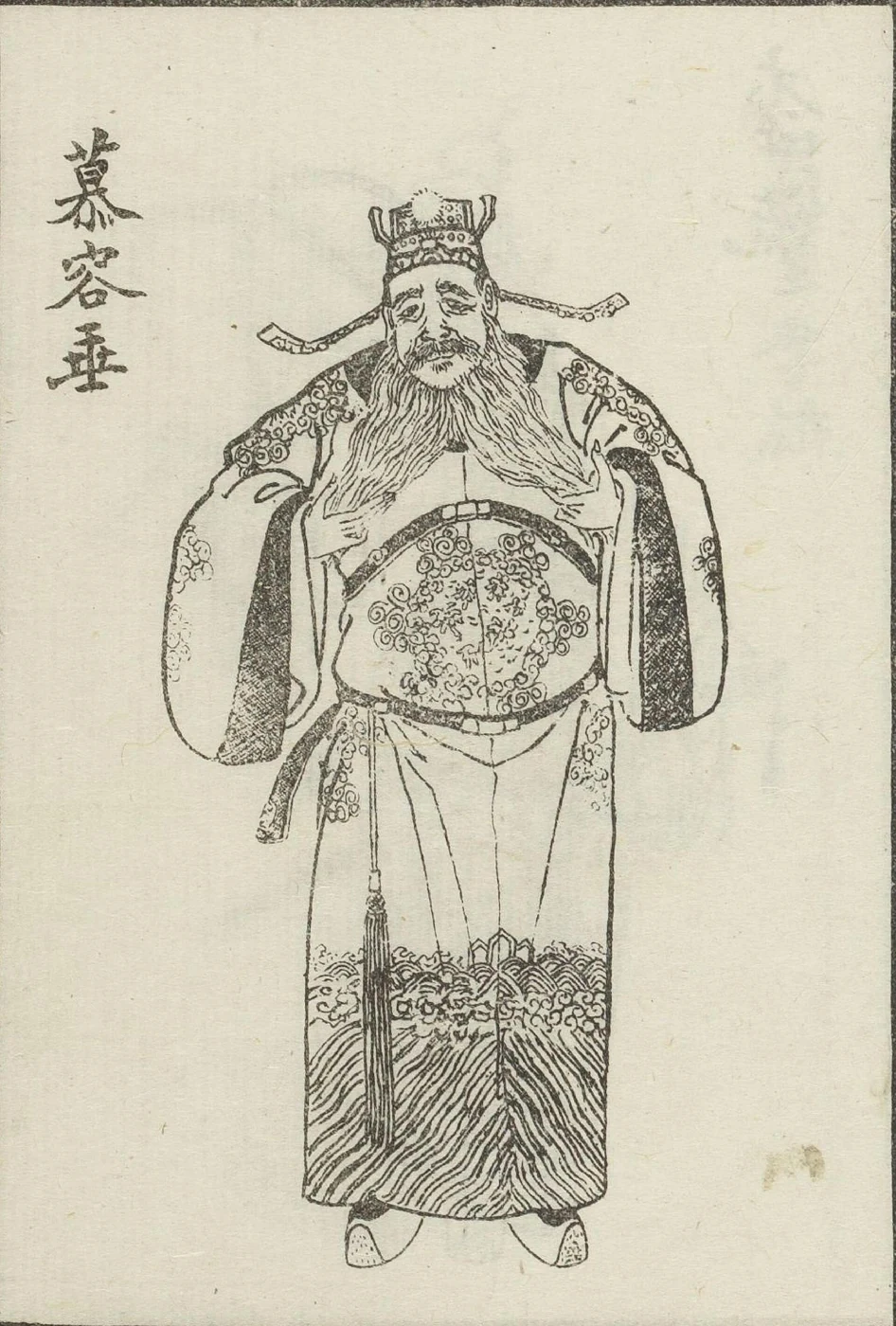
Later Yan (384–407, or according to another reckoning until 409) was one of the Murong Yan regimes of the Sixteen Kingdoms period and was established by the Xianbei ruler Murong Chui. Murong Chui was the fifth son of Murong Huang of Former Yan. After Former Yan fell, he submitted to Former Qin; following Fu Jian's defeat at the Battle of the Fei River, Murong Chui proclaimed himself Prince of Yan at Xingyang in 384 and restored the Yan state. In 386, the first year of Jianxing, he proclaimed…
384 CE–409 CECapital · See entry
ERA OVERVIEW
Later Yan (384–407, or according to another reckoning until 409) was one of the Murong Yan regimes of the Sixteen Kingdoms period and was established by the Xianbei ruler Murong Chui. Murong Chui was the fifth son of Murong Huang of Former Yan. After Former Yan fell, he submitted to Former Qin; following Fu Jian's defeat at the Battle of the Fei River, Murong Chui proclaimed himself Prince of Yan at Xingyang in 384 and restored the Yan state. In 386, the first year of Jianxing, he proclaimed himself emperor at Zhongshan (present-day Dingzhou, Hebei), and the polity is known to history as Later Yan. Its early capital was Zhongshan and it later moved to Longcheng (present-day Chaoyang, Liaoning). At its height its territory extended across large parts of present-day Hebei, Shandong, Shanxi, Henan, and part of Liaoning. From Murong Chui's proclamation as Prince of Yan in 384 to the killing of Murong Xi in 407, the state lasted about twenty-four years; another reckoning extends it to the killing of Gao Yun in 409, for about twenty-six years. The source text describes five rulers—Murong Chui, Murong Bao, Murong Sheng, Murong Xi, and the final ruler Gao Yun (Murong Yun)—and attributes the state's end to Northern Wei pressure and internal coups. The name "Later Yan" appears in the *Spring and Autumn Annals of the Sixteen Kingdoms* to distinguish it from other Murong Yan regimes.
Time span384 CE–409 CE
CapitalSee entry
ERA TIMELINE
Murong Chui proclaimed himself Prince Open
Murong Chui proclaimed himself Prince of Yan at Xingyang and restored the state; Later Yan began.
Fu Pi abandoned Ye and withdrew to JinOpen
Fu Pi abandoned Ye and withdrew to Jinyang; Hebei largely fell under Later Yan.
After the Battle of the Fei River, ForOpen
After the Battle of the Fei River, Former Qin disintegrated and the former Former Yan clansman Murong Chui returned to Ye with Fu Jian's permission.
Later Yan destroyed Western Yan and exOpen
Later Yan destroyed Western Yan and expanded into Qingzhou and Yanzhou.
Later Yan suffered a disastrous defeatOpen
Later Yan suffered a disastrous defeat at the Battle of Canhe Slope against Northern Wei.
Murong De proclaimed himself Prince ofOpen
Murong De proclaimed himself Prince of Yan at Huatai and established Southern Yan.
Murong Sheng was killed and Murong Xi Open
Murong Sheng was killed and Murong Xi took power.
Feng Ba's coup killed Murong Xi and inOpen
Feng Ba's coup killed Murong Xi and installed Gao Yun.
After Gao Yun was killed, Feng Ba replOpen
After Gao Yun was killed, Feng Ba replaced the Murong political line and Northern Yan was established; Later Yan ended under this reckoning.
FULL ENTRY
Overview
Later Yan (384–407, or according to another reckoning until 409) was one of the Murong Yan regimes of the Sixteen Kingdoms period and was established by the Xianbei ruler Murong Chui. Murong Chui was the fifth son of Murong Huang of Former Yan. After Former Yan fell, he submitted to Former Qin; following Fu Jian's defeat at the Battle of the Fei River, Murong Chui proclaimed himself Prince of Yan at Xingyang in 384 and restored the Yan state. In 386, the first year of Jianxing, he proclaimed himself emperor at Zhongshan (present-day Dingzhou, Hebei), and the polity is known to history as Later Yan. Its early capital was Zhongshan and it later moved to Longcheng (present-day Chaoyang, Liaoning). At its height its territory extended across large parts of present-day Hebei, Shandong, Shanxi, Henan, and part of Liaoning. From Murong Chui's proclamation as Prince of Yan in 384 to the killing of Murong Xi in 407, the state lasted about twenty-four years; another reckoning extends it to the killing of Gao Yun in 409, for about twenty-six years. The source text describes five rulers—Murong Chui, Murong Bao, Murong Sheng, Murong Xi, and the final ruler Gao Yun (Murong Yun)—and attributes the state's end to Northern Wei pressure and internal coups. The name "Later Yan" appears in the *Spring and Autumn Annals of the Sixteen Kingdoms* to distinguish it from other Murong Yan regimes.
Historical Development
Restoration and establishment (383–386): After the Battle of the Fei River in 383, Former Qin began to collapse. Murong Chui, a former Former Yan imperial clansman who had submitted to Qin, returned to Ye with Fu Jian's permission. When the Dingling leader Zhai Bin rebelled against Qin, Fu Jian's eldest concubine-born son Fu Pi, who guarded Ye, assigned Murong Chui 2,000 troops and sent the clansman Fu Feilong with more than 1,000 Di soldiers as deputy to suppress the revolt. On the march Murong Chui killed Fu Feilong and broke with Former Qin. In the first month of 384 he crossed the Yellow River and proclaimed himself General-in-Chief, Grand Commander, and Prince of Yan at Xingyang, adopting the era name Yanyuan. He led more than 200,000 men to besiege Ye. Fu Pi held out and the prolonged siege badly damaged the Hebei economy. In 385 Fu Pi abandoned Ye and withdrew to Jinyang, after which Hebei largely came under Later Yan control. In the first month of 386 Murong Chui proclaimed himself emperor at Zhongshan, adopted the Jianxing era, and made Zhongshan the capital.
Height of power (386–394): Murong Chui destroyed Zhai Wei in 392 and, unwilling to tolerate a rival Murong regime, launched a major campaign in 394 that destroyed Western Yan under Murong Yong and brought Hedong under his control. He then took advantage of Eastern Jin instability to seize territory in Qingzhou and Yanzhou, extending south into areas around present-day Linyi and Zaozhuang in Shandong. Later Yan thus reached its height and stood among the major northern powers.
Turning point (394–396): When Later Yan attacked Western Yan in 394, Northern Wei sent 50,000 troops to support Western Yan, worsening Yan–Wei relations. Murong Chui repeatedly sought fine horses from Northern Wei and even detained a Wei envoy while demanding horses, leading to open hostility. In 395 Murong Chui ordered Crown Prince Murong Bao to lead 80,000 infantry and cavalry against Wei, with Murong De commanding a supporting force. Northern Wei ruler Tuoba Gui avoided the main attack, moved tribes and livestock south of the Yellow River, drew the Yan army deep into his territory, and blocked its retreat. In the tenth month, Later Yan suffered a disastrous defeat at the Battle of Canhe Slope. Forty to fifty thousand troops were captured and then killed, and thousands of civil and military officers were taken prisoner. The defeat severely weakened Later Yan.
Decline and fall (396–409): After the defeat at Canhe Slope, Murong Chui personally campaigned again despite advice against it. Although he defeated the Northern Wei Duke of Chenliu Tuoba Qian, his illness worsened and he died in the fourth month of 396. His son Murong Bao succeeded him. That same year Tuoba Gui led a major Northern Wei invasion, captured Jinyang, and besieged Zhongshan. Murong Bao broke out in the third month of 397, and Zhongshan fell in the tenth month, splitting Later Yan territory into northern and southern regions. In 398 Murong De proclaimed himself Prince of Yan at Huatai and established Southern Yan. The same year the imperial in-law Lan Han killed Murong Bao and styled himself Prince of Changli; Murong Sheng then killed Lan Han and took power. Murong Sheng ruled with harsh punishments and was killed by the official Duan Ji in 402, after which Xianbei nobles installed Murong Xi. By then Later Yan held only a corner of Liaoxi, yet Murong Xi launched large construction projects such as the Longteng Garden and imposed heavy burdens on the population. In 407 the Feng Ba brothers staged a coup, killed Murong Xi, and installed Gao Yun (Murong Yun) as Heavenly King; the Murong line had effectively ended, and one account treats this as the fall of Later Yan. In 409 Gao Yun was killed by his attendants Liban and Taoren, after which Feng Ba took the throne and changed the state name to Northern Yan.
Politics and Institutions
Later Yan broadly continued Former Yan and Wei–Jin institutions, using an Imperial Secretariat and other central offices, together with positions such as Defender-in-chief. Whether a separate Secretariat was formally maintained is not clear in the surviving record; given Former Yan precedents, the source text treats the Imperial Secretariat as the main administrative organ. After rebuilding the state, Murong Chui honored Former Qin as an orthodox predecessor, gave Fu Jian's descendants the status of the Three Revered Guests, and offered sacrifices to Former Qin rulers as a gesture of legitimate succession. A form of differentiated administration between non-Han and Han populations is also described for Later Yan, especially under Murong Xi. From Murong Bao onward, however, suspicion of imperial relatives, dependence on close favorites, conflict within the imperial clan, and struggles with imperial in-laws repeatedly destabilized government. The harsh rule of Murong Sheng and Murong Xi further weakened the polity.
Military and Foreign Relations
Later Yan was initially a cavalry power, and Murong Chui was an experienced commander. The state destroyed Zhai Wei and Western Yan and expanded south into Qingzhou and Xuzhou areas. Northern Wei became its principal rival. The Battle of Canhe Slope in 395 was a major defeat, after which the Northern Wei invasion of 396–397 drove Later Yan out of most of the Central Plains. Later Yan's relations with other states were complex: Later Qin was at times an ally, including in joint opposition to Northern Wei, but there were also disputes over Western Yan and borders rather than continuous warfare. Later Yan took advantage of Eastern Jin weakness to seize Qingzhou and Yanzhou. Western Yan, though ruled by the same broader Murong lineage, was treated by Later Yan as an illegitimate rival for Yan political legitimacy and was destroyed. Shifting alliances among Later Yan, Western Yan, Northern Wei, and Later Qin reflected the unstable political environment of the period.
Economy and Commerce
In the early period, Murong Chui attempted to restore society after prolonged war through agricultural settlement, population stabilization, recruitment of displaced people, and lighter burdens, allowing farming and population in Hebei to recover to some degree. Zhongshan and Ye were major northern cities in peaceful periods, and commerce and handicrafts revived with them. Under Murong Bao and Murong Sheng, coinage including issues called "Yanyuan" is described in the source as supporting circulation. Repeated Yan–Wei warfare, the destruction of Ye and Zhongshan, and later retreat to Longcheng again damaged the economy. In the final period, territory and population were small and Murong Xi's large-scale palace and garden construction imposed further burdens.
Culture and Society
The Murong Xianbei had undergone substantial Sinicization since the time of Murong Hui and were strongly influenced by Chinese culture. Later Yan continued Former Yan traditions of Confucian learning and Sinicization, and palace culture and literary practices drew heavily on Jin precedents. Murong Chui is described as intelligent, strategically capable, and interested in literature; he recruited Han Chinese scholars and promoted Confucian learning and writing. Xianbei, Han Chinese, Wuhuan, and other groups lived together. Differentiated administration maintained ethnic distinctions while also permitting continuing cultural integration. After the fall of Later Yan, parts of its Xianbei population and the culture of Northern Yan were absorbed into Northern Wei. At the same time, repeated war, taxation, labor demands, and Murong Xi's extravagant building programs created severe social pressures that contributed to the regime's fall.
> This section describes the position of rulers in the development of the polity; complete biographies are carried by the corresponding person entities.
Historical Assessment and Legacy
Contemporary and later historians have often praised Murong Chui as an able military commander capable of restoring a fallen state. Later assessments also emphasize how repeated internal conflict and the catastrophic defeat at Canhe Slope undermined the regime, criticizing imperial suspicion and harsh rule. Later Yan inherited the political tradition of the Murong Xianbei states and helped shape the transition toward Northern Yan. Its wars with Northern Wei, especially the Battle of Canhe Slope, substantially changed the northern political balance and helped create conditions for Northern Wei's eventual unification of northern China.