Birth in Jicheng
Born as the fifth son of Murong Huang and Lady Lan in Changli Commandery.
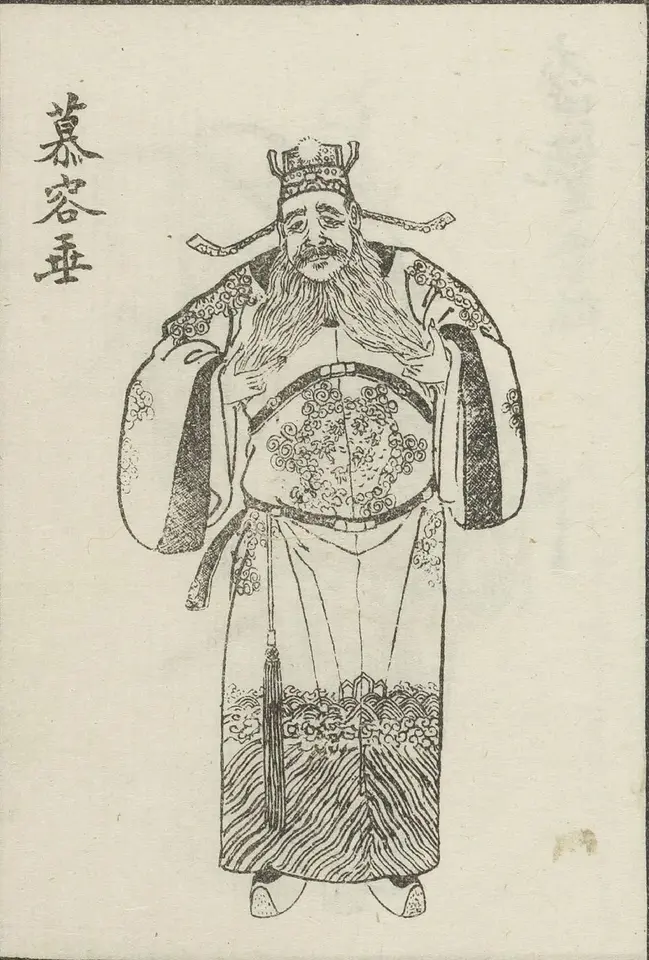
326 CE–396 CE
慕容垂
Emperor Wucheng of Later Yan (后燕成武帝, November 9, 326 – June 2, 396), personal name Murong Chui (慕容垂), courtesy name Daoming (道明) and originally Murong Ba (慕容霸), was the founding sovereign of the Later Yan dynasty during the Sixteen Kingdoms period, reigning from 384 to 396. The fifth son of Murong Huang (Emperor Wenming of Former Yan), he distinguished himself as one of the most formidable military commanders of…
Emperor Wucheng of Later Yan (后燕成武帝, November 9, 326 – June 2, 396), personal name Murong Chui (慕容垂), courtesy name Daoming (道明) and originally Murong Ba (慕容霸), was the founding sovereign of the Later Yan dynasty during the Sixteen Kingdoms period, reigning from 384 to 396. The fifth son of Murong Huang (Emperor Wenming of Former Yan), he distinguished himself as one of the most formidable military commanders of fourth-century China. Commencing his battlefield career at age thirteen, he served as a vanguard general against Goguryeo and the Yuwen tribe, earning renown for tactical daring. Enfeoffed as Prince of Wu under Former Yan, he achieved his most famous military triumph in 369 at the Battle of Fangtou, outmaneuvering and routing the formidable northern expedition of Eastern Jin Grand Marshal Huan Wen. However, his immense military prestige provoked lethal paranoia from the regent Murong Ping and Empress Dowager Kezuhun, compelling him to flee into exile to Former Qin under Fu Jian. In Former Qin, Murong Chui served as Governor of Jingzhao and Champion General, participating in regional pacifications while astutely biding his time. Following Fu Jian's catastrophic defeat at the Battle of Fei River in 383, Murong Chui preserved his thirty-thousand-strong Xianbei contingent intact and gallantly escorted Fu Jian back to Chang'an before marching east to his ancestral power base at Yecheng. In 384, he proclaimed himself King of Yan, officially founding the Later Yan dynasty, and assumed the imperial title in 386 with the era title Jianxing. He unified Hebei and Shandong, extinguished Zhai Wei, and annexed Western Yan in 394 to resurrect Yan hegemony. However, his sunset years were clouded by the disastrous defeat of his crown prince Murong Bao at the Battle of Canhebei against Northern Wei in 395, where tens of thousands of Yan soldiers were slaughtered. Although Murong Chui personally rallied his veterans to take Pingcheng in 396, grief over the massacre at Canhebei caused him to vomit blood on campaign, passing away at age seventy-one. Interred at Xuanping Mausoleum, he remains celebrated as a supreme tactical titan of the Sixteen Kingdoms.
Born as the fifth son of Murong Huang and Lady Lan in Changli Commandery.
Serves as cavalry commandant in the conquest of Goguryeo, displaying extraordinary valor.
Coordinates vanguard columns alongside Murong Ke to annihilate the Yuwen Xianbei.
Accompanies Murong Huang in the expedition against Goguryeo, routing the main enemy army alongside Murong Han.
Appointed General Who Pacifies the Northern Barbarians at Tuhe, deterring Later Zhao commander Deng Heng from advancing.
Leads the Former Yan vanguard into the Central Plains, capturing Ji and persuading Murong Jun to spare the surrendered garrison.
Enfeoffed as Prince of Wu by elder brother Murong Jun following the consolidation of Former Yan.
Commands eighty thousand infantry and cavalry against the Chile tribes north of the desert, capturing over one hundred thousand prisoners and mounts.
Primary consort Lady Duan is falsely accused of witchcraft and dies under torture in prison.
Rout Huan Wen's massive Eastern Jin invasion force at Fangtou and Xiangyi, saving the Former Yan realm.
Flees court assassination plots by Murong Ping, defecting to Fu Jian in Chang'an.
Directs southern assault columns under Fu Pi to capture the strategic Eastern Jin bastion of Xiangyang.
Maintains his division intact during Fu Jian's rout at Fei River; escorts Fu Jian before heading east.
Proclaims himself King of Yan in Xingyang, laying siege to Fu Pi at Yecheng.
Formally ascends the imperial throne at Zhongshan, establishing Later Yan.
Personally commands the crossing of the Yellow River to extinguish Zhai Zhao's regime.
Captures the citadel of Changzi and slays Murong Yong, unifying the ancestral Xianbei realms.
Crown Prince Murong Bao suffers catastrophic rout against Tuoba Gui of Northern Wei at Canhebei.
Takes Pingcheng by surprise, but falls ill from grief upon viewing the bones at Canhebei; dies at Juyang.
Emperor Wucheng was born on November 9, 326, in Jicheng, Changli Commandery, as the fifth son of Murong Huang, the posthumously honored Emperor Wenming of Former Yan, and Lady Lan. The Murong Xianbei had established deep pastoral and agricultural roots across western Liaoning since the Cao Wei era. From his earliest youth, Murong Chui—initially named Murong Ba—exhibited an athletic, commanding physique, towering over seven feet tall with long arms and exceptional archery skills. Murong Huang favored him immensely, often placing his achievements above those of his eldest legitimate son Murong Jun, which sowed bitter seeds of lifelong fraternal enmity.
In 339, at the tender age of thirteen, Murong Ba was commissioned as a cavalry commandant during Murong Huang's punitive expedition against Goguryeo. Operating alongside his renowned elder brother Murong Ke, he spearheaded shock assaults against the Yuwen Xianbei in 344, penetrating enemy battle lines and displaying tactical mastery that won the admiration of veteran commanders across the northern frontier.
Following Murong Huang's demise in 348, Murong Jun succeeded to the headship of Former Yan. Deeply resentful of Murong Ba's military fame and his childhood injury that left a broken tooth, Murong Jun vindictively compelled his brother to alter his name to Murong Que, which was subsequently adjusted to Murong Chui in accordance with astrological divination. Despite royal coldness, Murong Chui proved indispensable on the battlefield. When the Later Zhao empire imploded into catastrophic civil war under Ran Min in 350, Murong Chui served as the vanguard spearhead of the Former Yan invasion, overrunning Hebei and capturing Ji.
In 352, Murong Jun formally assumed imperial dignity in Ji, enfeoffing Murong Chui as Prince of Wu and deploying him to pacify southern Henan and Shandong. Murong Chui cleared local warlords, fortified border garrisons along the Huai River, and cultivated widespread popularity among both Xianbei horsemen and native Han gentry through equitable taxation and rigorous military discipline.
In 358, tragedy struck Murong Chui's domestic life when his primary consort, Princess Duan, was falsely accused of witchcraft by Empress Kezuhun. The proud princess was cast into prison and tortured to death, steadfastly refusing to fabricate false testimony that might implicate her husband. When Murong Chui subsequently married Lady Duan's younger sister, Empress Kezuhun intervened once more, forcing him to divorce her and marry her own sister, the Lady of Chang'an. These escalating domestic humiliations deepened the irreconcilable estrangement between the prince and the imperial palace.
In 369, Eastern Jin Grand Marshal Huan Wen unleashed fifty thousand troops on a massive northern expedition, sweeping through Henan to reach Fangtou. Confronted by impending catastrophe, Emperor Murong Wei and regent Murong Ping panicked, preparing to evacuate the capital at Yecheng and flee to their ancestral home at Helong. Murong Chui volunteered to take command; deploying elite cavalry under his brother Murong De to sever Jin grain transports, he drew Huan Wen into a crushing ambuscade at Xiangyi, slaughtering over thirty thousand southern soldiers. Yet instead of gratitude, his crowning victory brought lethal jealousy: Murong Ping and Empress Dowager Kezuhun secretly plotted his assassination. Realizing that execution was imminent, Murong Chui fled west in November 369 with his sons Murong Ling and Murong Bao, defecting to Former Qin.
In Chang'an, Former Qin heavenly king Fu Jian welcomed Murong Chui with lavish hospitality, appointing him Champion General and Governor of Jingzhao over the strenuous objections of prime minister Wang Meng, who astutely warned that the Xianbei dragon would inevitably seize the first opportunity to reclaim his ancestral realm. When Wang Meng orchestrated the famous Golden Blade Stratagem to frame Murong Chui's eldest son Murong Ling for treason, leading to Ling's murder back in Yan, Murong Chui endured the heartbreak with stoic dissimulation, maintaining absolute deference toward Fu Jian.
In 378, Murong Chui commanded southern strike divisions to assist Fu Pi in taking Xiangyang from Eastern Jin. When Fu Jian mobilized nearly one million soldiers to invade Eastern Jin in 383, Murong Chui participated in the vanguard. During the catastrophic rout of the main Qin host at the Battle of Fei River, Murong Chui's thirty-thousand-man Xianbei division was the sole imperial force that remained completely intact. When a defeated and disgraced Fu Jian fled to his camp with merely a few hundred retainers, Murong Chui's sons and brother urged him to slay the fallen king on the spot. Murong Chui steadfastly refused, citing Fu Jian's past generosity, and safely escorted the Qin monarch back to Chang'an before securing permission to march east to soothe Hebei.
Reaching the environs of Yecheng in early 384, Murong Chui cast off the Qin mantle. Allying with Dingling chieftain Zhai Bin, he adopted the title King of Yan at Xingyang and established a comprehensive civil administration, proclaiming the Yanxing era. Over the next two years, he prosecuted a tenacious siege against Fu Pi at Yecheng, outmaneuvering eastern Jin relief columns under Liu Laozhi at Fangtou and driving Fu Pi into flight toward Shanxi.
In 386, Murong Chui formally assumed the imperial crown at Zhongshan, inaugurating the Later Yan dynasty with the era title Jianxing. Systematically pacifying Hebei, Liaodong, and Henan, he crushed the rebellions of Zhai Liao and Zhai Zhao, completely extinguishing the Zhai Wei kingdom in 392. In 394, he launched seventy thousand veterans across the Taihang passes against the rival regime of Western Yan; through brilliant operational misdirection, he lured Murong Yong's main army to Taibi, annihilating the defenders and capturing Changzi. With the annexation of Western Yan's eight provinces and thirty commanderies, Later Yan reached the zenith of its geopolitical power.
In 395, escalating border friction with the rising Northern Wei dynasty under Tuoba Gui compelled Emperor Wucheng to dispatch Crown Prince Murong Bao with eighty thousand troops on a punitive expedition across the desert. Reaching Wuyuan, Murong Bao was checked along the Yellow River; when false rumors of Murong Chui's death caused panic, the crown prince burned his transport fleet and retreated in disarray. Tuoba Gui exploited a sudden freeze to cross the ice, overtaking the disorganized Yan army at Canhebei. The northern cavalry struck the encamped southern columns at dawn, crushing the army and capturing fifty thousand soldiers, who were subsequently buried alive by the Xianbei of Northern Wei.
Devastated by the annihilation of his empire's youth, the seventy-one-year-old Murong Chui mobilized his remaining veterans in 396 to lead a personal counter-offensive. Marching through secret trails across the Feihu defiles, he caught Northern Wei defenders completely unprepared, storming Pingcheng and slaying Wei commander Tuoba Qian. However, during his triumphal return march, the emperor passed the desolate battleground of Canhebei. Confronted by immense pyramids of bleaching bones belonging to his fallen soldiers, Murong Chui broke into uncontrollable weeping, vomiting blood in violent convulsions. His illness rapidly deteriorated, and he passed away in his imperial carriage at Juyang in June 396. He was interred at Xuanping Mausoleum in Longcheng with the temple name Shizu.
Murong Chui's early martial training under his father Murong Huang forged his reputation as the premier tactician of Former Yan. Operating alongside his brothers Murong Ke and Murong Jun, he participated in the decisive winter expeditions of 342 that overran the Goguryeo mountain strongholds, capturing the ancestral royal tombs and extracting lasting tributary oaths. His command of independent cavalry divisions during the destruction of Ran Min's Ran Wei regime in 352 showcased his capacity to combine shock cavalry charges with methodical logistical fortification, laying the structural groundwork for Former Yan's southern expansion toward the Huai River.
The Battle of Fangtou in 369 stood as the military masterpiece of Murong Chui's career. When Eastern Jin Grand Marshal Huan Wen advanced to the southern bank of the Yellow River with fifty thousand veteran troops, the Former Yan leadership was paralyzed by terror. Taking supreme operational command, Murong Chui recognized that the southern fleet was extended along shallow, drought-stricken canals. Coordinating with cavalry divisions under Murong De, he severed the Jin supply convoys from the Huai River while drawing Huan Wen's retreat columns into a prepared slaughter zone at Xiangyi. Through synchronized multi-directional ambuscades, Murong Chui's horsemen routed the elite southern infantry, inflicting thirty thousand casualties and decisively halting Eastern Jin's northern unification drive.
Murong Chui's defection to Former Qin in late 369 represented a calculated escape from dynastic palace murder. Aware that regent Murong Ping had suborned palace guards to surround his private estate, Murong Chui orchestrated a decoy departure under the guise of an imperial hunting excursion. Accompanied by his loyal sons, brothers, and select retainers, he rode relentlessly day and night across the western passes. Although his eldest son Murong Ling was subsequently driven to suicide through the Machiavellian golden blade stratagem devised by Qin chancellor Wang Meng, Murong Chui maintained unyielding psychological composure, winning the genuine admiration and personal protection of Fu Jian throughout fourteen years of exile.
During the historic catastrophe of the Fei River in 383, Murong Chui's military professionalism prevented the total annihilation of the retreating northern forces. While panic dissolved the multi-ethnic divisions of Former Qin into headless mobs, Murong Chui maintained absolute garrison formation, repulsing Jin pursuits and providing an armed sanctuary for Fu Jian. By choosing honorable protection over opportunistic assassination, he preserved his moral standing while husbanding the entire Xianbei military elite that would form the core striking corps of Later Yan.
The resurrection of Yan between 384 and 392 demonstrated Murong Chui's tenacity in statecraft. Facing hostile Qin garrisons under Fu Pi in Yecheng, aggressive Dingling nomads under the Zhai clan, and advancing Eastern Jin columns under Liu Laozhi, Murong Chui conducted multi-front warfare with supreme finesse. He shifted his administrative capital to Zhongshan, fortified central Hebei, and methodically eliminated the Dingling strongholds. In 392, by personally leading amphibious crossings across the Yellow River to outflank Zhai Zhao's encampments, he extinguished Zhai Wei and secured undisputed control over the central agricultural heartland.
The final decade of Murong Chui's reign was marked by brilliant dynastic unification followed by sudden catastrophe. In 394, he resolved to eliminate Western Yan to unify the divided branches of the Murong royal line. Through masterly operational diversion at Yecheng, he pinned Murong Yong's reconnaissance forces in Zhi Pass before marching his strike columns through the Taibi defile, storming Changzi and annexing thirty commanderies. Yet his inability to impart his tactical brilliance to his heir, Murong Bao, led directly to the tragedy at Canhebei in 395, where fifty thousand veteran Yan soldiers were entrapped and massacred, shattering the foundation of Later Yan.
Driven by fierce imperial duty, the dying Murong Chui led his final army across the northern mountains in 396. Striking like a thunderbolt, he took Pingcheng, dispersed Tuoba Gui's northern cavalry, and avenged his son's disgrace. Yet his physical frame could not endure the psychological trauma of seeing the desolate mounds at Canhebei, where tens of thousands of his warriors lay unburied. Vomiting blood from internal hemorrhaging, he succumbed to illness in his campaign litter, leaving an orphaned empire to navigate the rising storm of Northern Wei.
Murong Chui's supreme historical achievement was resurrecting the Xianbei imperial state fourteen years after the destruction of Former Yan. Operating from the ashes of Former Qin's collapse, he mobilized dispersed Xianbei populations, defeated rival regional warlords, and erected Later Yan as the preeminent superpower of late fourth-century northern China, restoring ancestral imperial prestige.
Throughout a military career spanning six decades, Murong Chui remained virtually invincible on the battlefield. From his youthful skirmishes against Goguryeo to the historic triumph over Huan Wen at Fangtou and the annexation of Western Yan at Taibi, his mastery of cavalry envelopment, tactical deception, and logistical disruption established him as the foremost battlefield tactician of the Sixteen Kingdoms period.
Amidst an era characterized by rampant treachery and parricide, Murong Chui stood out for his profound personal code of honor. His refusal to betray Fu Jian following the Fei River disaster—choosing to escort his benefactor safely to Chang'an rather than executing a treacherous coup—earned him legendary status in Chinese historiography as a chivalric warrior who honored personal debts even when dynastic crowns hung in the balance.
During his twelve-year imperial reign, Emperor Wucheng implemented inclusive administrative frameworks that harmonized traditional Xianbei tribal structures with classical Han bureaucratic systems. By patronizing Confucian literati, establishing administrative schools in Zhongshan, and reducing arbitrary agricultural extractions, he achieved rapid economic and agrarian rehabilitation throughout Hebei and Shandong.
Murong Chui's life intersected with the most legendary figures of the fourth century. He clashed with and defeated Eastern Jin Grand Marshal Huan Wen, formed a legendary dynamic of mutual respect with Former Qin sovereign Fu Jian, outwitted the brilliant strategist Wang Meng, and in his final days checked the rising founder of Northern Wei, Tuoba Gui, leaving an indelible imprint across ancient Chinese annals.
Murong Chui's doctrine of warfare prioritized psychological warfare and operational adaptability over brute force. He emphasized knowing the enemy commander's psychological temperament, employing feigned retreats to stretch opposing columns, and striking concentrated blows against vital logistical choke points, formulating a tactical legacy that influenced medieval Chinese military treatises.
In administering the Later Yan realm, Emperor Wucheng demonstrated exceptional discernment in recruiting talented administrators regardless of ethnic background. He promoted learned scholars such as Feng Fu to high secretariats, encouraged constructive remonstrance from regional magistrates, and instituted light tax schedules that allowed war-torn communities to replenish their populations.
Emperor Wucheng established formal state rituals that reconciled Xianbei ancestral veneration with orthodox Chinese imperial rites. He commissioned state historiographies, standardized court ceremonial music, and formulated dynastic succession protocols, seeking to endow his newly resurrected empire with enduring ideological legitimacy.
Contemporary chroniclers and early historians viewed Murong Chui as a colossal martial figure whose battlefield genius towered over the turbulent Sixteen Kingdoms era. Cui Hong recorded in the Spring and Autumn Annals of the Sixteen Kingdoms that Murong Chui was naturally endowed with heroic stature, unmatched valor, and extraordinary operational vision. Chroniclers emphasized that his victory at Fangtou single-handedly saved the Xianbei state, while his resurgence from prolonged exile demonstrated unyielding strategic patience.
Historians of the Northern and Southern Dynasties and early Tang periods praised Murong Chui's personal honor while analyzing the structural vulnerabilities of his empire. Fang Xuanling observed in the Book of Jin that Murong Chui was a military giant who never suffered defeat when commanding in person, yet his failure to instill discipline within his imperial sons ultimately sowed the seeds of dynastic collapse. Wei Shou commended his battlefield brilliance in the Book of Wei, noting that Northern Wei founder Tuoba Gui regarded Murong Chui as the sole military peer who commanded his profound apprehension.
During the Song and Yuan dynasties, historians evaluated Murong Chui through the lens of ethical governance and strategic resilience. Sima Guang remarked in the Comprehensive Mirror for Aid in Government that Murong Chui's protection of Fu Jian after the Fei River catastrophe stood as a shining example of classical moral rectitude, elevating him far above the treacherous warlords of his age. However, Song philosophers noted that his emotional collapse at Canhebei revealed the tragic limits of an empire sustained solely by the personal charisma of a single aging warrior.
Ming and Qing political thinkers analyzed Murong Chui's career with acute geopolitical realism. The philosopher Wang Fuzhi noted in his Reading the Comprehensive Mirror that Murong Chui was the quintessential warrior-king of antiquity, possessing the rare combination of battlefield invincibility and deep political dissimulation. Qing historians observed that while his final march across the Feihu defiles demonstrated magnificent defiance against mortality, the annihilation of his army at Canhebei demonstrated that nomadic tribal confederations could not permanently withstand the disciplined agrarian militarism of Northern Wei.
Modern historical research views Emperor Wucheng as one of the most brilliant field tacticians and charismatic leaders in classical Chinese history. Historians emphasize that his resilience in surviving court purges, his honorable conduct during dynastic collapse, and his lightning restoration of Later Yan exemplify supreme individual agency amidst intense socio-political fragmentation. Contemporary scholars highlight his tactical maneuvers at Fangtou and Taibi as classic case studies in operational deception, mobile warfare, and strategic concentration of force.
FIGURES ASSOCIATED WITH THIS DYNASTY