Relocation to Huatai
Following the loss of Zhongshan, Murong De led forty thousand households south across the Yellow River, assuming the title King of Yan at Huatai.
398 CE–410 CE
南燕
Southern Yan (南燕; 398–410 AD) was a northern regional regime established in the Shandong peninsula by Xianbei nobleman Murong De (慕容德) during the Sixteen Kingdoms period (十六国), marking the concluding chapter of the Murong Yan dynasties. Following the catastrophic defeat of Later Yan's main field armies at the Battle of Canhe Slope in 395 AD, Northern Wei invaded the Central Plains, encircling and capturing the imperial capital at Zhongshan, severing Later Yan into northern and southern halves.…
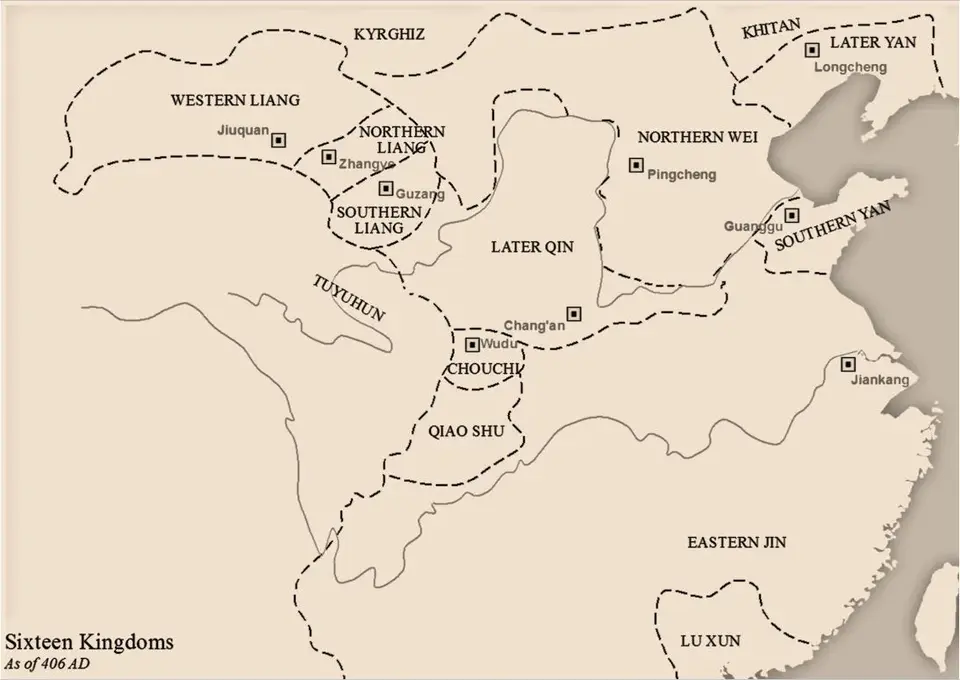
Southern Yan (南燕; 398–410 AD) was a northern regional regime established in the Shandong peninsula by Xianbei nobleman Murong De (慕容德) during the Sixteen Kingdoms period (十六国), marking the concluding chapter of the Murong Yan dynasties. Following the catastrophic defeat of Later Yan's main field armies at the Battle of Canhe Slope in 395 AD, Northern Wei invaded the Central Plains, encircling and capturing the imperial capital at Zhongshan, severing Later Yan into northern and southern halves. Murong De, Prince of Fanyang and younger brother of founding Emperor Murong Chui, retreated south from Ye across the Yellow River to Huatai with forty thousand households, assuming the title King of Yan in 398 AD. When Northern Wei forces attacked Huatai in 399 AD, Murong De marched east into Shandong, destroyed Eastern Jin's regional governor Pi Lühun, and seized the stronghold of Guanggu (Citadel of Guanggu). In 400 AD, Murong De formally ascended the imperial throne at Guanggu, proclaiming the era name Jianxing and founding Southern Yan. During his reign, Murong De implemented comprehensive administrative reforms, accommodated local Han aristocratic clans, established the Imperial Academy, and executed a statewide household audit that registered over fifty-eight thousand concealed tenant families into national tax registers, fostering economic rehabilitation across Shandong. However, following his death in 405 AD, his nephew and successor Murong Chao ruled with tyranny and favoritism, empowering corrupt advisor Gongsun Wulou and executing meritorious founding generals. In 409 AD, regretting having surrendered royal court musicians to Later Qin to ransom his mother, Murong Chao launched predatory raids into Eastern Jin's northern borders to capture musicians and captives. Eastern Jin Grand Commander Liu Yu retaliated by launching a large-scale northern expedition. Murong Chao abandoned the natural mountain defenses of Mount Daxian; Liu Yu crossed the passes, crushed the Southern Yan armored cavalry at Linqu, and besieged Guanggu. In February 410 AD, Guanggu fell; Murong Chao was captured and executed in Jiankang, and three thousand Xianbei nobles were slaughtered, ending the thirteen-year Southern Yan dynasty.
Following the loss of Zhongshan, Murong De led forty thousand households south across the Yellow River, assuming the title King of Yan at Huatai.
When Northern Wei captured Huatai, Murong De marched into Shandong, defeated Pi Lühun, and occupied Guanggu.
Murong De ascended the imperial throne at Guanggu, proclaiming the state of Great Yan and promoting Confucian schooling.
Murong De ordered Han Zhuo to investigate illegal tenant concealment, registering fifty-eight thousand hidden households.
Emperor Xianwu Murong De died; his nephew Murong Chao succeeded to the throne, empowering court favorite Gongsun Wulou.
Gongsun Wulou's intrigues triggered a rebellion by Murong Zhong and Murong Fa; Murong Chao suppressed the revolt, purging military commanders.
Murong Chao submitted as a vassal to Later Qin, delivering one hundred twenty imperial musicians to ransom his mother and wife.
Murong Chao raided Eastern Jin's border at Suyu to abduct civilians for the imperial orchestra, provoking Liu Yu's northern expedition.
Murong Chao abandoned the Mount Daxian passes; Liu Yu crossed the mountains and annihilated the Southern Yan cataphract army at Linqu.
Liu Yu severed Guanggu's water supply and breached the fortress; Murong Chao was captured and executed in Jiankang, ending Southern Yan.
In early 398 AD, facing encirclement by Northern Wei following the fall of Zhongshan, Murong De resolved to evacuate Ye and lead his forces southward across the Yellow River.
The foundation of Southern Yan arose from the military collapse of Later Yan. In 395 AD, Northern Wei annihilated the eighty-thousand-strong Later Yan army at the Battle of Canhe Slope. Emperor Murong Chui died on campaign the following year, triggering rapid dynastic decay. Emperor Huimin Murong Bao faced an invasion of four hundred thousand Northern Wei troops, losing Zhongshan and fleeing northeast to Longcheng. Murong Chui's youngest brother, Murong De, Prince of Fanyang, was stationed at Ye commanding military affairs across the Central Plains.
Cut off from northern relief, Murong De evacuated Ye in January 398 AD with forty thousand households of clan members, soldiers, and civilians, crossing the Yellow River south to Huatai (modern Hua County, Henan). At Huatai, Murong De declared himself King of Yan, adopted the era name Jianping, established civil and military offices modeled on Former Yan, and laid the foundations of the Southern Yan regime.
Initially, Southern Yan occupied a precarious position squeezed between Northern Wei and Eastern Jin, holding fewer than ten cities. In March 399 AD, while Murong De was suppressing a regional rebellion, Northern Wei commander Tuoba Yi launched a surprise assault that captured Huatai, severing Southern Yan's rear base. Minister Pan Cong advised an immediate eastward march into the fertile Shandong peninsula, emphasizing that Guanggu, originally fortified by warlord Cao Ni, was naturally protected by steep ravines and waterways.
Murong De adopted the plan, leading his army east into Shandong. Enforcing strict military discipline and forbidding looting, Murong De secured the submission of local counties across Yanzhou and Langya. He then advanced north against Guanggu, defeating and killing Eastern Jin's regional governor Pi Lühun. By late 399 AD, Murong De entered Guanggu, establishing uncontested authority over the Shandong peninsula.
In January 400 AD, Murong De erected an altar south of Guanggu, formally ascending the imperial throne, changing his personal name to Beide, and adopting the era name Jianping. He appointed Murong Zhong as Chancellor, Feng Fu as Left Vice Director of the Department of State Affairs, and created an academy enrolling two hundred sons of Xianbei nobles and Han gentry clans. He established iron foundries at Mount Shang and appointed salt commissioners at Wuchangze to secure military supplies. To eliminate tax evasion caused by powerful clans harboring hidden tenant farmers, Murong De adopted the proposals of Minister Han Zhuo in 402 AD. Appointing Han Zhuo as traveling commissioner, the state conducted systematic audits across commanderies, uncovering fifty-eight thousand hidden tenant households (yinhu) and integrating them into regular tax and military registers, bolstering national revenue.
Because Murong De's sons had perished during earlier northern wars, he sent emissaries to Chang'an in 405 AD to secretly retrieve his nephew Murong Chao (posthumous son of his brother Murong Na), creating him Crown Prince. In August 405 AD, Murong De died at age seventy, honored with the posthumous title Emperor Xianwu and temple name Shizong. Murong Chao succeeded to the throne, adopting the era name Taishang.
Murong Chao proved vain, erratic, and deeply suspicious of founding ministers, delegating supreme executive power to sycophant Gongsun Wulou. Gongsun Wulou's slanders prompted senior commanders Murong Zhong, Murong Fa, and Duan Hong to launch an armed rebellion. Murong Chao mobilized forces to crush the revolt, capturing Jucheng and Liangfu; Murong Zhong executed his family and fled to Later Qin, while Murong Fa and Duan Hong defected to Northern Wei, severely depleting the regime's military leadership.
In 407 AD, to retrieve his mother and wife from Chang'an, Murong Chao submitted as a tributary vassal to Later Qin Emperor Yao Xing, ceding one hundred twenty master musicians of the imperial court orchestra. Subsequently, Murong Chao lamented the diminished splendor of court banquets and regretted the loss of the musicians. In early 409 AD, ignoring warnings from elder ministers, he dispatched cavalry commanders Gongsun Gui and Hukuti to raid Eastern Jin's northern outposts at Suyu and Jinan, looting supplies and abducting over thirty-five hundred civilians to serve as palace dancers and musicians. This provocative raid provided Eastern Jin Grand Commander Liu Yu with an ideal casus belli. In April 409 AD, Liu Yu mobilized an expeditionary force, launching a combined naval and land offensive northward into Southern Yan.
In summer 409 AD, Eastern Jin armies approached Mount Daxian (modern Linqu, Shandong), a formidable mountain pass guarding entry into central Shandong. Ministers Gongsun Wulou and Murong Zhen implored Murong Chao to fortify the pass and implement a scorched-earth defense. Murong Chao arrogantly rejected their advice, boasting that he would allow Jin forces through the defile so his heavy armored cavalry could trample them on the open plains. Liu Yu traversed the pass unimpeded. In June, the two armies clashed at Linqu; Liu Yu executed a coordinated chariot-and-cavalry pincer attack, stormed the town of Linqu, and killed Yan general Duan Hui, shattering the Southern Yan army. Murong Chao fled to Guanggu. Liu Yu besieged Guanggu for nine months, blocking the Wulongkou water intake to cut off the city's drinking supply and deploying siege towers and battering rams. In February 410 AD, Guanggu collapsed. Murong Chao attempted to break out with dozens of horsemen, was captured, and was escorted to Jiankang where he was executed at age twenty-six. Three thousand Xianbei nobles were executed, and Guanggu's walls were razed, extinguishing Southern Yan after thirteen years across two reigns.
Southern Yan combined the traditional Three Excellencies (Sangong) with the Department of State Affairs (Shangshu Sheng). The Three Excellencies (Chancellor, Grand Commandant, and Minister of Works) were held by venerable Xianbei princes such as Murong Zhong and Murong Zhen as supreme honorary positions. Actual executive administration resided in the Director and Vice Directors of the Department of State Affairs, directing five functional ministries: Revenue, Civil Office, Military Affairs, Population, and Rites. To consolidate absolute imperial authority, the monarchs appointed trusted kin to concurrently supervise executive and military commands. Under Murong Chao, this centralized machinery fell entirely under the control of palace attendant Gongsun Wulou.
Southern Yan governed five provinces (Qing, Qi, Xu, Yan, and You), sixteen commanderies, and eighty-two counties. Regional commands were administered by provincial governors (cishi or zhoumu) supported by military headquarters (kaifu). The capital Guanggu featured a tripartite structure: an inner palace citadel (xiaocheng), a western outer suburb (xiguo) serving as military parade grounds and garrisons, and an eastern outer suburb (dongguo) serving as a commercial and residential district, reflecting the synthesis of steppe encampment and Chinese urban planning.
Decades of war caused massive peasant flight into the fortified estates of local Han gentry and Xianbei lords, resulting in the abuse described as "a hundred families under one door, a thousand adult males sharing a single register". In 402 AD, Murong De enacted sweeping census audits directed by Han Zhuo. State troops sealed border exits to prevent peasant flight while commissioners inspected local registers, uncovering fifty-eight thousand concealed households. This successful reform significantly replenished state grain reserves and conscription rosters, though it provoked enduring friction between the throne and regional magnates.
Murong De was deeply versed in Confucian scholarship. Upon enthronement, he established state ancestral altars, constructed imperial academies, and personally examined two hundred aristocratic students in the classics. The court instituted doctors of the classics (boshi) to adapt ancient Han, Wei, and Jin legal statutes into a codified Yan penal code, actively bridging ethnic distinctions between Xianbei warriors and Han literati.
The political stability of Southern Yan rested upon a coalition between the Murong royal clan and indigenous Han gentry houses of Shandong, including the Cui of Qinghe, Feng of Bohai, and Du of Pingyuan. While Xianbei princes commanded the imperial guards and regional military garrisons, Han statesmen such as Feng Fu and Han Zhuo directed civil administration, fiscal audits, and court rituals, cementing mutual loyalty through political intermarriage.
To defend its borders against neighboring powers, Murong De enfeoffed royal kinsmen—such as Murong Zhong, Murong Fa, and Murong Zhen—as provincial governors commanding strategic garrisons across Qingzhou, Xuzhou, and Qizhou. Although this princely defense network secured the realm during the Jianping era, Murong Chao's later efforts to strip the princes of military authority provoked internal rebellion and fatally weakened frontier defenses.
Recognizing the vulnerability of the lower Yellow River plain to floods, droughts, and locusts, the Southern Yan court established charitable and ever-normal granaries across its five provinces. During severe droughts, Murong De remitted annual field taxes and distributed hundreds of thousands of bushels of state grain to disaster-stricken households, preserving social order across the Shandong peninsula.
The military core of Southern Yan consisted of Xianbei cataphract heavy cavalry (jiaqi juzhuang). Archaeological discoveries in Qingzhou have unearthed gilded bronze horse bitts, decorative plaques, harness fittings, and advanced double stirrups, demonstrating the sophisticated equestrian technology of the era. At its peak, the regime mobilized fifty-three thousand armored cavalry and seventeen thousand war wagons. However, the heavy cavalry required flat terrain and suffered decisive tactical disadvantages in narrow ravines or when confronted by Liu Yu's fortified infantry battle carts.
Central military power was divided between palace guards (Left, Right, Army, and Martial Guards) stationed in the capital and regional military commands directed by princes. In wartime, commanders received grand general titles with full discretionary authority.
The capital fortress of Guanggu was one of the most formidable strongholds in northern China. Situated on a rocky plateau, the fortress was flanked by the South Yang and North Yang rivers (collectively known as the Mian River), forming steep natural moats. Water entered the city through a specialized conduit known as Wulongkou. While the fortress withstood nine months of siege, the failure to secure the outer mountain passes of Mount Daxian allowed Eastern Jin forces to reach the walls and sever the internal water source.
Southern Yan maintained defensive vigilance against Northern Wei along the Yellow River, while pursuing tributary appeasement with Later Qin to recover imperial family members. Towards Eastern Jin, peaceful co-existence was maintained until Murong Chao's ill-fated raids triggered total war.
Occupying the Shandong peninsula along the Bohai and Yellow seas, Southern Yan opened direct maritime routes to the Liaodong and Korean peninsulas to bypass Northern Wei's land blockade. In 408 AD, Goguryeo dispatched a maritime embassy to Guanggu presenting fine steeds and bear pelts, and Murong Chao reciprocated with southern water buffaloes and rare birds, maintaining active Northeast Asian diplomatic exchange.
The economic resilience of Southern Yan rested upon state-managed marine salt and iron industries alongside flourishing urban commerce in Guanggu.
Shandong's abundant marine salt resources formed the fiscal backbone of the state. Murong De established official salt works and salt commissioners at Wuchangze (modern Shouguang) along Laizhou Bay, monopolizing the boiling, transport, and taxation of sea salt to fund the regime's heavy cavalry and administrative apparatus.
In 401 AD, Murong De established large-scale state ironworks at Mount Shang (modern Huantai), mobilizing thousands of skilled metallurgists to produce steel lances, ring-pommel sabers, armor-piercing arrowheads, cataphract horse armor, and iron agricultural tools.
The eastern suburb of Guanggu functioned as a bustling commercial and handicraft marketplace. Regional commodities, including fish, marine salt, raw silk, and lacquerware, were traded extensively alongside luxury goods from Later Qin and Goguryeo. The domestic economy utilized old Jin copper coins alongside raw silk fabrics as mediums of exchange.
Southern Yan provided draft oxen and seed grain to encourage displaced northern refugees to reclaim abandoned farmland across the Shandong plain. Abundant harvests of wheat, millet, and rice supported military campaigns and sustained Guanggu's population during the final siege.
Building upon Shandong's ancient sericulture traditions, the Southern Yan court established a large-scale Weaving and Dyeing Office under the Lesser Treasury, gathering thousands of artisans to produce fine brocades, damasks, and raw silk fabrics while collecting household textile levies that stimulated rural weaving across the peninsula.
With the influx of Central Plains artisans into Guanggu, official kilns near Qingzhou produced hard-paste celadon vessels, four-lugged jars, and lotus-patterned bricks alongside cloud-scroll roof tiles and terracotta cavalry models, demonstrating the resilience of northern ceramic craftsmanship during the Sixteen Kingdoms era.
Southern Yan sponsored a renaissance of classical learning in Shandong. Murong De established the Imperial Academy, selecting sons of the nobility and prominent Han lineages—including the Cui of Qinghe, Feng of Bohai, and Du of Pingyuan—for classical education. Scholars such as Feng Fu and Han Zhuo held high ministerial office, serving as the cultural backbone of the state.
Buddhism received enthusiastic royal patronage. Master Senglang (Lang Gong) established celebrated monastic communities in the Mount Tai region. Murong De consulted Senglang prior to capturing Guanggu, later granting him the honorary title King of Dongqi, founding the Shentong Temple, and assigning revenues from two counties for monastic support. Prominent sites, including Langgong Cave in Qingzhou, preserve stone votive shrines dating to this formative era.
Under the influence of Shandong Confucian traditions, Xianbei social values shifted from nomadic martial heroism toward filial piety, ancestral reverence, and marital fidelity. Murong De commended citizens who demonstrated self-sacrificing fraternal devotion. Xianbei noblewomen embraced classical chastity; when general Duan Feng died, his widow Princess Murong (daughter of Murong De) committed suicide rather than accept an arranged remarriage, receiving universal acclaim as the "Chaste Princess".
Despite ongoing military campaigns, Murong De ordered the rescue of over ten thousand scrolls of classical texts from war-torn ruins, housing them in the palace archives under the supervision of Wang Jinghui and Feng Cheng, while establishing court diarists who compiled the Imperial Diary of Southern Yan and Records of Southern Yan.
Southern Yan inherited the orthodox Han-Wei ritual music orchestra preserved by Former and Later Yan, establishing the Grand Music Office in Guanggu. After Murong Chao surrendered one hundred twenty court musicians to Later Qin in 407 AD to ransom his mother, his subsequent raids on Eastern Jin to abduct replacement performers directly provoked Liu Yu's fatal northern expedition.
Southern Yan represented the final chapter of Xianbei Murong imperial statehood during the Sixteen Kingdoms era. Rising from the ruins of Later Yan, Emperor Xianwu Murong De demonstrated remarkable leadership by establishing an orderly regional state across Shandong. By adopting classical Three Departments administrative models, patronizing Confucian literati, and reviving state monopolies over marine salt and iron metallurgy, Southern Yan stabilized the Lower Yellow River region and facilitated deep assimilation between Xianbei elites and Han gentry clans.
However, the regime's rapid collapse exposed the inherent fragility of regional military autocracies. Under Murong Chao, despotic court favoritism alienated founding commanders, while the abandonment of natural mountain defenses at Mount Daxian during Liu Yu's invasion led directly to the annihilation of the field army at Linqu. Liu Yu's conquest of Southern Yan in 410 AD not only restored Chinese imperial control over Shandong, but also shifted the balance of power between northern and southern regimes, providing the military momentum for the founding of the Liu Song dynasty.
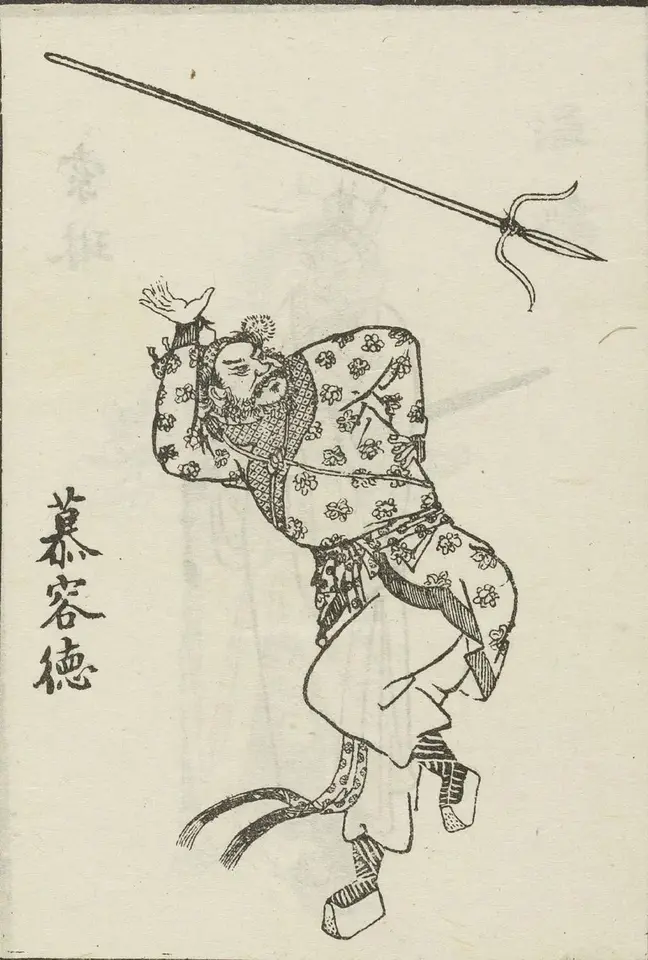 Southern Yan (南燕)
Historical figure
Murong De (慕容德, 336–405), later renamed Murong Beide (慕容备德), courtesy name Xuanming (玄明), was a native of Jicheng in Changli and the founding emperor of the Southern Yan dynasty during the Sixteen Kingdoms period. The youngest son of Murong Huang (Emperor Wenming of Former Yan) and younger brother of Murong Chui (Emperor Chengwu of Later Yan), Murong De was distinguished in his youth for his imposing stature, intellectual breadth, and military command. Serving Former Yan, he distinguished himself alongside Murong Chui in repelling Huan Wen's northern expedition at the decisive Battle of Fangtou. Following the fall of Former Yan, he served under Fu Jian of Former Qin as the governor of Zhangye. When Later Yan was proclaimed in 384, Murong De rallied to his brother's cause and served as General of Chariots and Cavalry and Governor of Ji Province, anchoring the crucial southern defense of the empire. When Northern Wei forces fractured Later Yan territory in 397, Murong De led his remaining hosts south across the Yellow River to Huatai, proclaiming himself Prince of Yan in 398. Faced with mounting pressure from Northern Wei and local uprisings, he boldly executed a strategic eastward migration into the coastal plains of Shandong, capturing Guanggu in 399 and formally declaring himself emperor in 400. During his eight-year rule, he consolidated civil institutions, founded an imperial academy, reformed religious abuses, stabilized state finances through state salt and iron monopolies, and fostered communal peace between Xianbei warriors and Han elites. He passed away in 405 at the age of seventy and was posthumously honored as Emperor Xianwu with the temple name Shizong.
Historical figure
Murong Chao (慕容超, 385–410 CE), courtesy name Zuming (祖明), was a member of the imperial Xianbei Murong clan and the final ruler of the Southern Yan regime during the Sixteen Kingdoms period. He was a grandson of Emperor Wenming of Former Yan (Murong Huang), a son of Prince Mu of Beihai (Murong Na), and the nephew of Murong De (Emperor Xianwu), the founder of Southern Yan. Born in hiding among the Western Qiang following the slaughter of his father by Former Qin authorities, Murong Chao endured severe hardships in his youth. Relocated to Chang'an under the Later Qin dynasty, he feigned madness and begged in the streets to escape political execution. He eventually escaped east to the Southern Yan capital of Guanggu, carrying a gold heirloom dagger given by his grandmother, where Murong De recognized him and designated him crown prince. Following the death of Murong De in 405 CE, Murong Chao ascended the throne, adopting the era name Taishang. His reign was marred by political incompetence, extreme paranoia, and reliance on treacherous sycophants such as Gongsun Wulou, leading to the bloody purge of veteran imperial relatives and ministers. To ransom his mother and wife from Later Qin, he surrendered imperial musicians and submitted as a vassal. Subsequently, seeking entertainment, he launched reckless cross-border raids against Eastern Jin territory, capturing thousands of civilians. This provocation incited the Eastern Jin general Liu Yu to launch a massive northern punitive expedition in 409 CE. Murong Chao arrogantly abandoned the natural choke points of the Daxian Mountains, suffering a devastating defeat at the Battle of Linqu and withdrawing into Guanggu. Following a grueling siege, Guanggu fell in 410 CE; Murong Chao was captured and executed in Jiankang, bringing an end to Southern Yan.