317 CE–420 CE

Eastern Jin Dynasty (东晋)

Unified dynasty

东晋

The Eastern Jin dynasty (东晋; 317–420 CE) was an imperial Chinese dynasty established following the fall of the Western Jin (西晋), founded in southern China by Sima Rui, a prince of the Western Jin imperial house. Spanning eleven emperors over a duration of 104 years, it constitutes one of the Six Dynasties along with Eastern Wu, Liu Song, Southern Qi, Southern Liang, and Southern Chen. In the twilight years of the Western Jin, the Central Plains were ravaged by the War of the Eight Princes and…

317 CE–420 CECapital · See entry
东晋
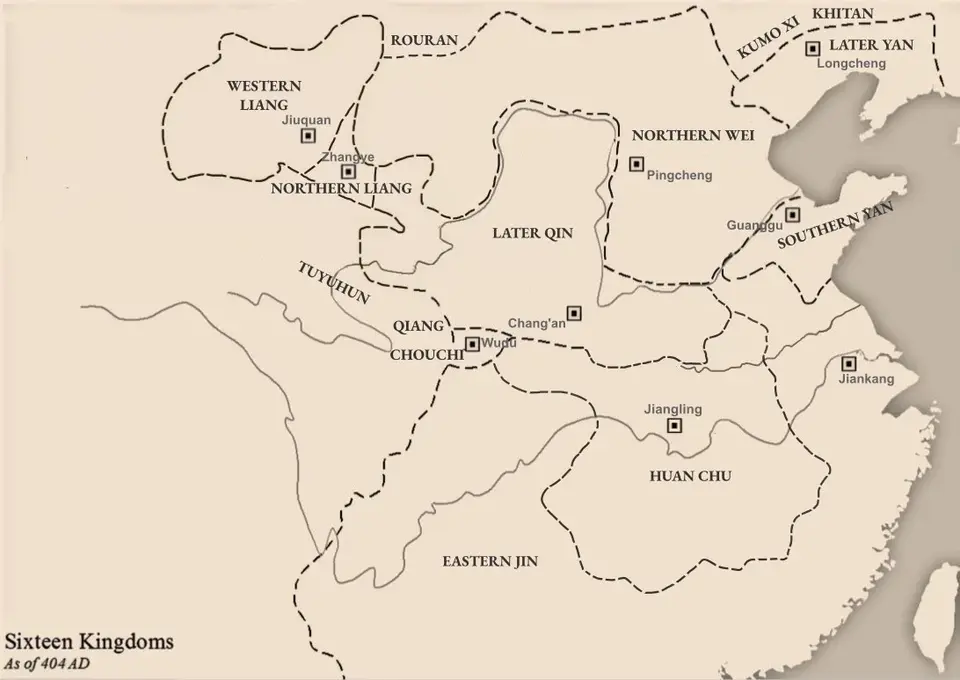
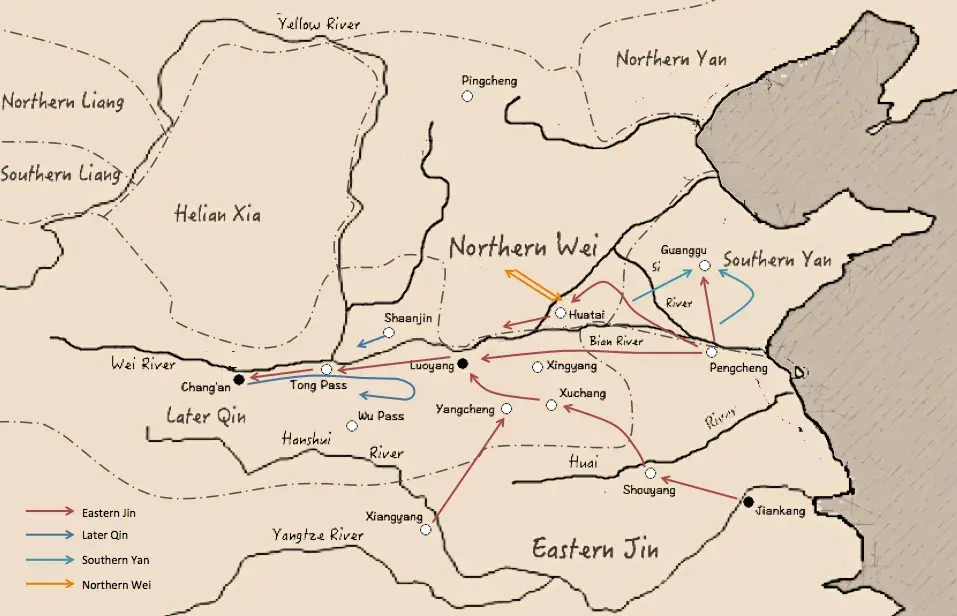
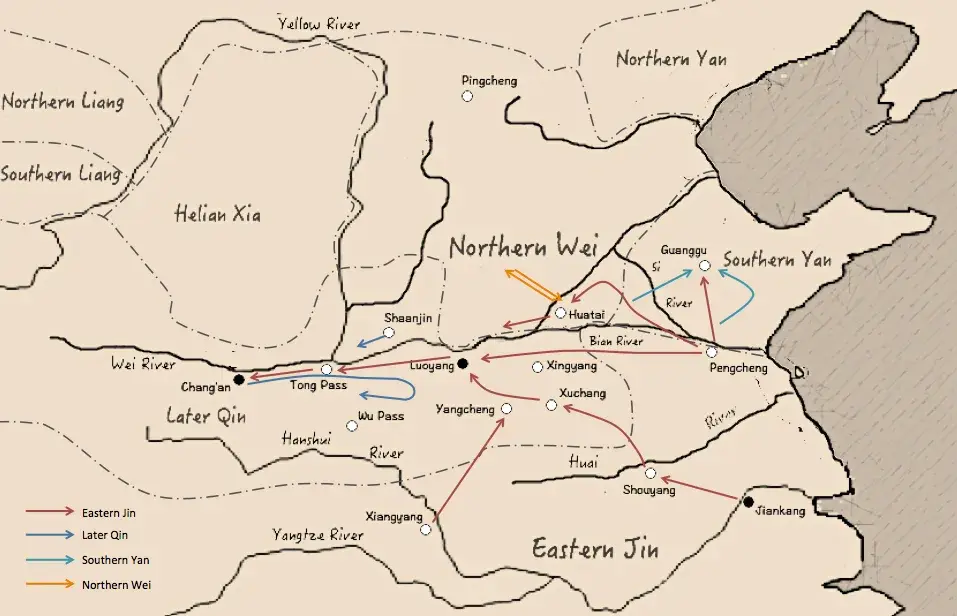
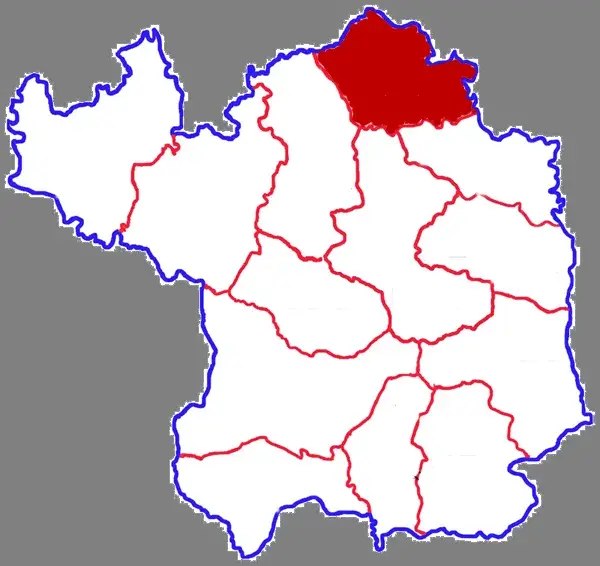
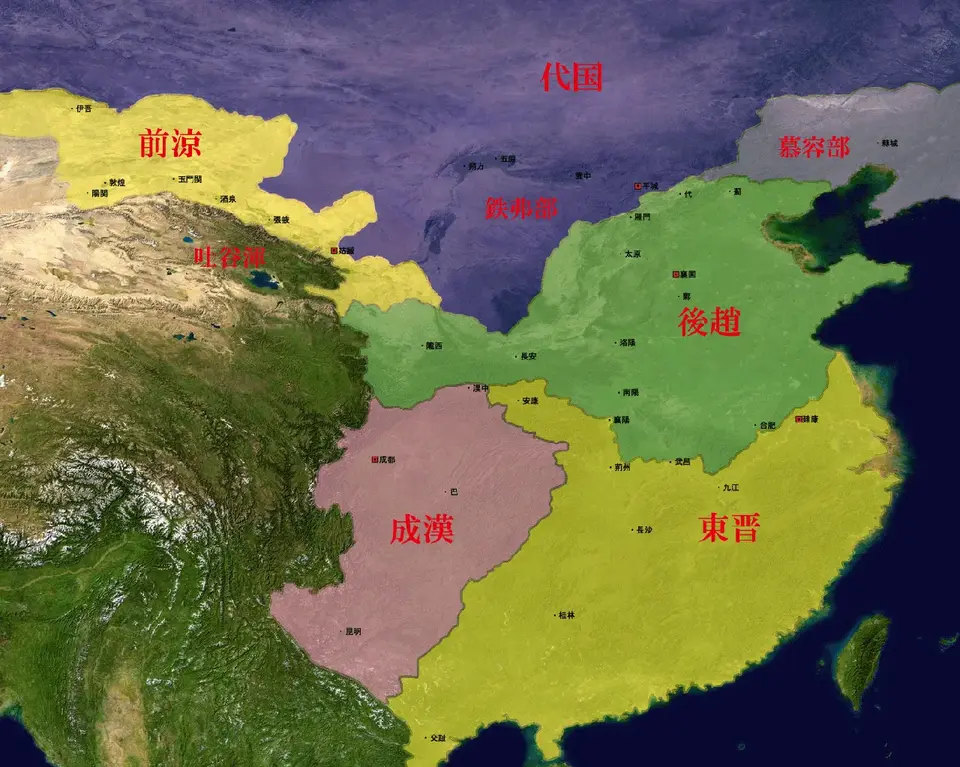
Historical territory map of the Eastern Jin dynasty
Image creditsトムル · Public domainImage source

ERA OVERVIEW

The Eastern Jin dynasty (东晋; 317–420 CE) was an imperial Chinese dynasty established following the fall of the Western Jin (西晋), founded in southern China by Sima Rui, a prince of the Western Jin imperial house. Spanning eleven emperors over a duration of 104 years, it constitutes one of the Six Dynasties along with Eastern Wu, Liu Song, Southern Qi, Southern Liang, and Southern Chen. In the twilight years of the Western Jin, the Central Plains were ravaged by the War of the Eight Princes and the Disaster of Yongjia, culminating in the collapse of the dynasty and plunging northern China into the chaos of the Sixteen Kingdoms. Vast numbers of scholars, commoners, and prominent aristocratic clans migrated across the Yangtze River southward to seek refuge. In 317 CE (Jianwu 1st year), Sima Rui, Prince of Langya stationed at Jianye, ascended the throne with the crucial assistance of Wang Dao and the endorsement of northern and southern aristocratic clans, reviving the imperial ancestral temple of the Jin house as the Eastern Jin. The dynasty developed a distinctive power structure characterized by shared governance between aristocratic clans and the imperial house, popularly epitomized as "the Wangs and the Simas co-rule the realm." The regime launched multiple northern expeditions, securing a miraculous victory against overwhelming odds at the Battle of Fei River in 383 CE (Taiyuan 8th year) against Former Qin, which safeguarded the southern state. In its twilight years, governance decayed amidst imperial prince corruption, the Sun En peasant uprising, and Huan Xuan's usurpation, until Beifu Army general Liu Yu pacified internal revolts and launched two victorious northern expeditions to recapture Luoyang and Chang'an. In 420 CE (Yuanxi 2nd year), Liu Yu forced Emperor Gong to abdicate, establishing the Liu Song dynasty and formally bringing the Eastern Jin to an end. The Eastern Jin preserved the continuity of Chinese civilization while fundamentally catalyzing large-scale agricultural reclamation and economic prosperity throughout the Jiangnan region.

Time span317 CE–420 CE
CapitalSee entry

ERA TIMELINE

Ascending the Throne in Jiangzuo

Supported by Wang Dao and prominent northern and southern aristocratic clans, Sima Rui assumed the title of Prince of Jin at Jiankang, inaugurating the Jianwu era and restoring the ancestral sacrifices of the Jin imperial house.

Formal Imperial Accession

Following confirmation of the death of Emperor Min of Western Jin, Sima Rui formally ascended the throne as Emperor Yuan of Jin, changing the reign era to Daxing and officially establishing the Eastern Jin dynasty.

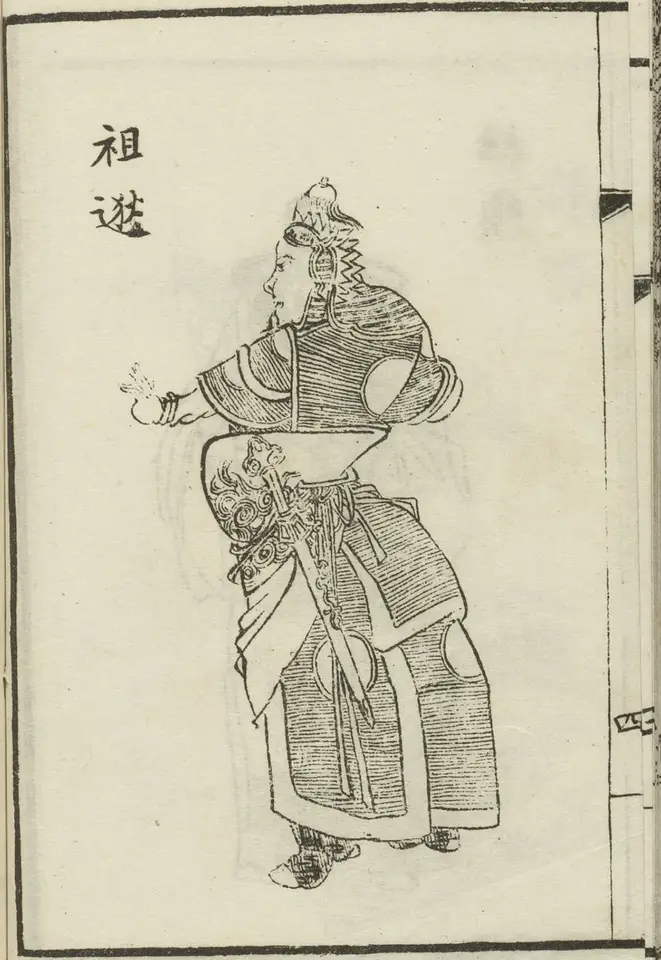
Passing of Zu Ti

General of Inspiring Martial Prowess Zu Ti recovered broad swathes of lost territory south of the Yellow River; thwarted by court suspicions and the dispatch of Dai Yuan to restrain him, Zu Ti succumbed to illness and grief at Yongqiu.

Wang Dun's Armed Insurrection

Grand General Wang Dun mobilized his army from Wuchang under the pretext of purging court sycophants Liu Wei and Diao Xie, storming Jiankang; Emperor Yuan fell gravely ill from humiliation and passed away.

Emperor Ming Suppresses the Rebellion

Taking advantage of Wang Dun's mortal illness, Emperor Ming allied with loyalist commanders to crush Wang Dun's insurgent forces and reclaim imperial authority.

Insurrection of Su Jun

Imperial maternal uncle Yu Liang summoned garrison general Su Jun of Liyang to the capital; Su Jun joined forces with Zu Yue to rebel, capturing Jiankang and laying waste to palace precincts.

Pacification of the Su Jun Rebellion

Inspector of Jingzhou Tao Kan and Inspector of Jiangzhou Wen Qiao mobilized a joint campaign, slaying Su Jun in battle and exterminating the insurgent remnants, allowing Wang Dao to resume governance.

Xianhe Residence Regularization

The imperial court enacted land-measurement rent collection, initiated the inspection of displaced immigrant registers, and reordered the fiscal taxation apparatus.

Huan Wen Conquers Cheng Han

General of Western Pacification Huan Wen led an upstream expedition into Sichuan, capturing Chengdu and annexing the Cheng Han regime, permanently securing the Bashu region for Eastern Jin.

Elegant Gathering at the Orchid Pavilion

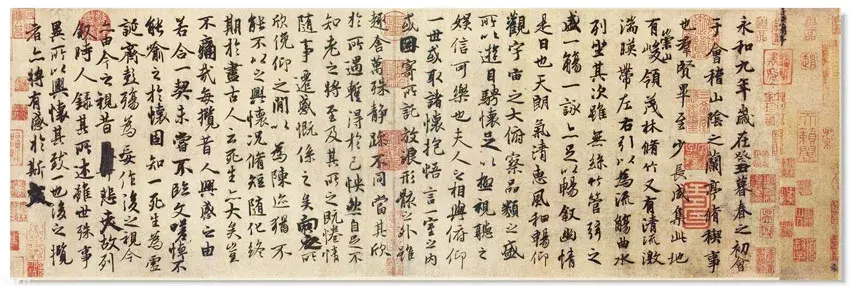
Wang Xizhi, Xie An, and other celebrated literati gathered at the Orchid Pavilion in Shanyin of Kuaiji, where Wang Xizhi composed the immortal calligraphic masterwork Preface to the Poems Collected from the Orchid Pavilion.

Northern Expedition to Guanzhong

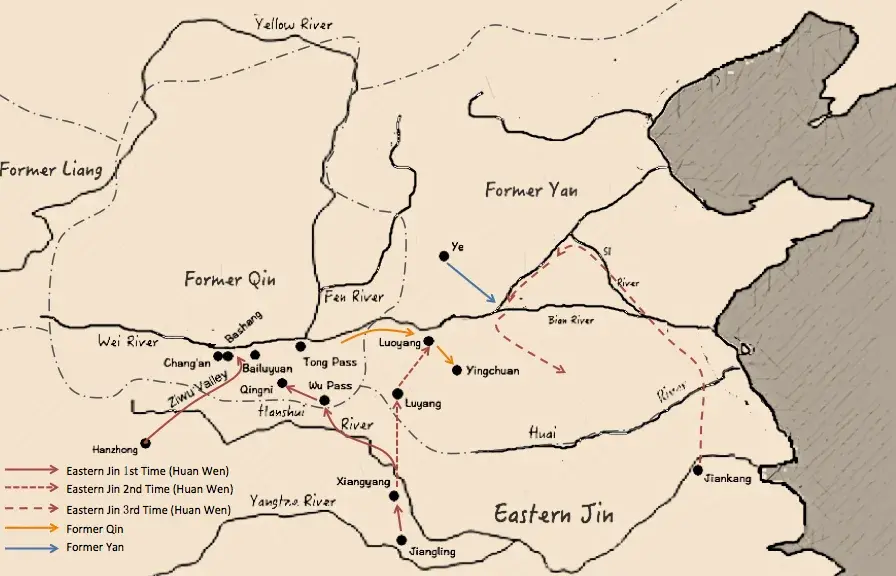
Huan Wen launched his first northern expedition, advancing to Bashang in Guanzhong; forced to withdraw due to Former Qin's scorched-earth defense and severe logistical exhaustion.

Recovery of Luoyang

Huan Wen conducted his second northern expedition, defeating Yao Xiang to liberate the former Western Jin capital of Luoyang and restoring the imperial mausoleums.

Gengxu Residence Regularization

Huan Wen presided over the Gengxu residence regularization, vigorously inspecting household registers and white-register migrants, curbing noble concealment and substantially augmenting state revenue.

Reverse at Fangtou

Huan Wen's third northern expedition targeted Former Yan, reaching Fangtou north of the Yellow River; intercepted and routed by Former Yan general Murong Chui, suffering heavy casualties.

Huan Wen Deposes the Emperor

Seeking to rebuild his tarnished prestige after Fangtou, Huan Wen deposed Emperor Fei (Duke of Haixi) on fabricated charges and installed Sima Yu as Emperor Jianwen.

Death of Huan Wen

Following the passing of Emperor Jianwen, Xie An and Wang Tanzhi resolutely held the court against Huan Wen's usurpation schemes; Huan Wen died of illness, defusing the dynastic crisis.

Creation of the Beifu Army

Recommended by Xie An, Xie Xuan was appointed Inspector of Yanzhou, recruiting valiant northern refugees around Jingkou and Guangling to establish the elite Beifu Army.

Triumph at the Fei River

Former Qin ruler Fu Jian led an immense imperial host southward; Xie Shi and Xie Xuan commanded eighty thousand elite Beifu troops to rout the invading army in a historic triumph against superior numbers.

Victorious Northern Counteroffensive

Following the Fei River victory, Xie An dispatched Xie Xuan across the Huai River, recovering Henan and Shandong and extending Eastern Jin boundaries to the southern bank of the Yellow River.

Tragic End of Emperor Xiaowu

Emperor Xiaowu was smothered to death by palace attendants after drunken jesting; the intellectually disabled Emperor An ascended the throne, and court control fell to Prince Sima Daozi and his son.

Outbreak of the Sun En Uprising

Extortions by Sima Daozi and Sima Yuanxian triggered massive popular fury; Sun En mobilized followers of the Way of the Five Pecks of Rice in revolt across the eight southeastern commanderies.

Huan Xuan Enters Jiankang

Warlord Huan Xuan swept eastward down the Yangtze from Jingzhou, seizing Jiankang, executing Sima Daozi and his son, and monopolizing military and administrative power.

Huan Xuan Usurps the Throne

Huan Xuan deposed Emperor An and proclaimed himself Emperor of Chu at Jiankang, establishing the Huan Chu regime and briefly disrupting the Jin dynastic line.

Righteous Uprising at Jingkou

Beifu Army adjutant Liu Yu rallied loyalist officers at Jingkou, overthrowing Huan Chu, recapturing Jiankang, and restoring Emperor An to the throne.

Northern Expedition against Southern Yan

Liu Yu led an imperial expedition northward, storming the fortress of Guangu the following year, capturing Murong Chao, and eradicating Southern Yan.

Defeat of Lu Xun

Lu Xun led more than one hundred thousand insurgent fighters to besiege Jiankang; Liu Yu rushed back from Shandong and shattered the main rebel fleet outside the Stone Citadel.

Yixie Residence Regularization

Liu Yu orchestrated the Yixie regularization, reforming household registration, abolishing superfluous immigrant counties, and consolidating central revenue.

Northern Expedition to Destroy Later Qin

Liu Yu commanded a multi-pronged northern offensive against Later Qin, capturing Xuchang and Luoyang before storming Chang'an the following year to destroy the regime.

Regicide and Enthronement of Emperor Gong

Returning to Jiangdong, Liu Yu instructed confidants to assassinate Emperor An, elevating Sima Dewen as Emperor Gong to prepare the dynastic transition.

Abdication and Founding of Liu Song

Liu Yu compelled Emperor Gong to issue an abdication edict; Liu Yu ascended the throne at Jiankang to establish the Liu Song dynasty, formally concluding the Eastern Jin.

Relationship graph

FULL ENTRY

Historical Evolution

The Disaster of Yongjia and the Southward Migration

During the twilight of the Western Jin, the imperial ruling house was engulfed in the sixteen-year internecine carnage known as the War of the Eight Princes. Imperial princes butchered one another in ruthless pursuit of supreme authority, inflicting catastrophic devastation upon the economic foundations of the Central Plains and leaving northern frontiers utterly defenseless. Chieftains of non-Han ethnic groups residing within China seized this historic opportunity to launch rebellions. The Xiongnu noble Liu Yuan established the Han Zhao regime in Bingzhou. In 311 CE (Yongjia 5th year), Liu Yuan's generals Liu Yao and Shi Le stormed the Western Jin capital of Luoyang, capturing Emperor Huai, slaughtering imperial officials, and burning imperial palaces and shrines to the ground in what became known as the Disaster of Yongjia. In 316 CE (Jianxing 4th year), Liu Yao led an army to invest Chang'an; starved of provisions, Emperor Min surrendered in humiliation, marking the formal demise of the Western Jin. The Yellow River basin descended into the tumultuous Sixteen Kingdoms era, partitioned among warring regimes founded by Xiongnu, Jie, Xianbei, Di, and Qiang leaders.

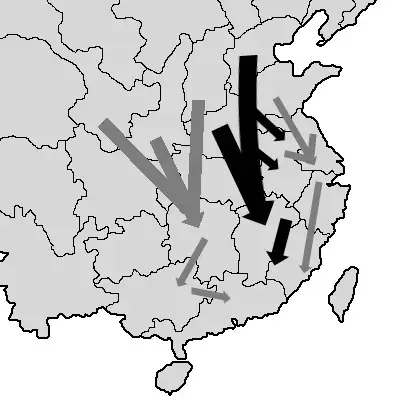
Amid continuous warfare and famine, vast numbers of prestigious Central Plains gentry lineages, regional magnates, and destitute commoners fled south across the Yangtze River with their families. This movement constituted an unprecedented population migration in Chinese history, remembered as the Southward Flight of the Gentry. Prior to these catastrophes, Sima Rui, the Prince of Langya aligned with the political faction of Prince of Donghai Sima Yue, had been stationed at Xiapi. Sima Rui possessed a mild and composed temperament and maintained an exceptionally intimate relationship with his chief adviser Wang Dao, an illustrious scholar-official from Linyi in Langya. Recognizing that northern conditions had become irreparable, Wang Dao urged Sima Rui to transfer his operational center to Jiangdong. In September 307 CE (Yongjia 1st year), Sima Rui relocated his garrison to Jianye (later renamed Jiankang to observe taboo for Emperor Min, present-day Nanjing, Jiangsu Province), assuming the titles of General of Eastern Tranquility and Commander of Military Affairs in Southern Yangzhou.

Upon arriving in Jiangdong, Sima Rui enjoyed limited local prestige. The indigenous gentry clans of Jiangnan regarded this northern refugee regime with deep suspicion and indifference. Among local southern lineages, the Zhou clan of Yixing (led by Zhou Qi) and the Shen clan of Wuxing (led by Shen Chong) wielded preeminent influence, celebrated as the Two Magnates of Jiangdong; prestigious scholar-gentry houses of the Wu Commandery—the Gu (Gu Rong), Lu (Lu Wan), Zhu, and Zhang clans—followed closely behind. Having suffered systematic exclusion and marginalization by the Luoyang court since the fall of Eastern Wu, these southern elites harbored grievances and even contemplated restoring the Wu state. Local uprisings in 303, 305, and 310 CE were all suppressed through the personal martial mobilization of Zhou Qi, demonstrating the formidable regional power of indigenous magnates. Confronting this cool reception, Wang Dao formulated the governing principle of "pacifying with composure, allowing sentiments to settle naturally." During the Double Third Festival, Wang Dao orchestrated a grand imperial progress for Sima Rui in splendid imperial carriages, accompanied closely on horseback by aristocratic northern youths including Wang Dao and Wang Dun. This spectacle deeply impressed the Jiangdong populace. Wang Dao subsequently visited the southern literati leaders Gu Rong and He Xun in person, extending utmost courtesies and conferring prominent ministerial appointments. Guided by Gu Rong and He Xun, the southern aristocratic houses pledged their allegiance. Meanwhile, northern refugee aristocrats rallied around Sima Rui under Wang Dao's coordination, enabling the regime to firmly anchor itself south of the Yangtze River.

Co-Governance of Wang and Sima (The Wang and Sima Clans Share the Realm) and Rise of Aristocratic Politics

Following confirmation in 317 CE that Emperor Min had been murdered in Chang'an, Sima Rui erected an altar at Jiankang and assumed the title Prince of Jin, proclaiming the Jianwu era. In 318 CE (Daxing 1st year), Sima Rui formally ascended the imperial throne as Emperor Yuan of Jin, inaugurating the Daxing era and re-establishing the ancestral continuity of the Jin dynasty, historically designated as the Eastern Jin.

From its inception, the Eastern Jin regime rested entirely upon an elite compromise between northern refugee aristocrats and indigenous southern magnates. During the enthronement ceremony, Emperor Yuan sought to demonstrate boundless veneration for Chancellor Wang Dao by clutching his sleeve and inviting him to sit alongside him on the imperial couch to receive the court's congratulations. Wang Dao repeatedly declined, declaring that if the sun were to share its radiance with ordinary creatures, the common folk would have nothing to revere. Emperor Yuan then took his seat alone. Nevertheless, this symbolic gesture signaled the establishment of a shared ruling arrangement later celebrated as "the Wangs and the Simas co-rule the realm." The Langya Wang clan reached the zenith of power: Wang Dao directed the central government and civil administration, while his cousin Wang Dun commanded the elite military garrisons of Wuchang (present-day Ezhou, Hubei) as Commander of Six Southern Provinces, holding the economic and strategic jugular of the middle and upper Yangtze. Dozens of Wang clan members filled prestigious ministerial posts and provincial commands across the empire.

However, the harmony between the imperial throne and aristocratic lineages was short-lived. As his position stabilized, Emperor Yuan grew increasingly resentful of the suffocating dominance exercised by the Langya Wang house. Seeking to curb the Wangs, Emperor Yuan elevated judicial and administrative technocrats such as Liu Wei, Diao Xie, and Dai Yuan as trusted confidants, gradually distancing Wang Dao. He appointed Dai Yuan to govern Hefei and Liu Wei to govern Huaiyin, nominally to defend against northern nomads but covertly to construct a defensive ring against Wang Dun upstream. Ambitious and defiant, Wang Dun recognized the court's strategy and was infuriated. In January 322 CE (Yongchang 1st year), Wang Dun rose in armed revolt at Wuchang under the banner of "cleansing the court of sycophants Liu Wei and Diao Xie." Sweeping downstream unopposed, Wang Dun struck directly at Jiankang. Emperor Yuan urgently summoned Liu Wei and Dai Yuan to garrison the Stone Citadel, but court commanders harbored sympathies for Wang Dun or feared his host, leading to a swift imperial collapse. Wang Dun's forces seized the Stone Citadel; Liu Wei fled north to Later Zhao, Diao Xie was slain during his escape, and upright ministers like Dai Yuan and Zhou Yi were executed. Emperor Yuan was forced into abject submission, even declaring to Wang Dun's envoy that if Wang Dun desired the throne he need only speak, and he would willingly abdicate to his native Langya. Supreme power fell entirely into Wang Dun's hands, and Emperor Yuan succumbed to illness and grief late that year.

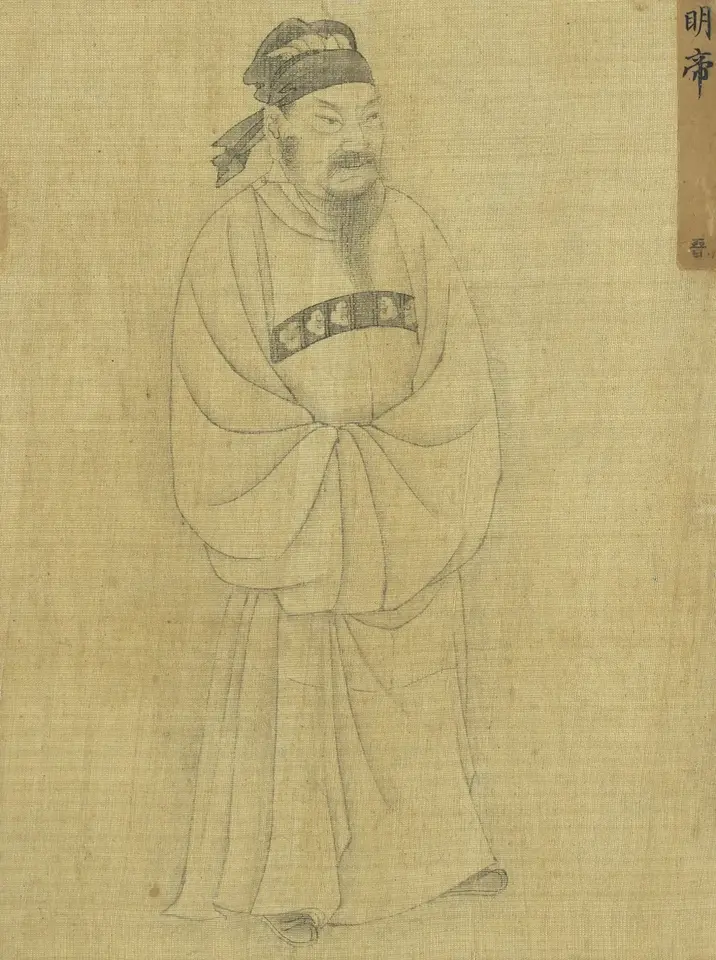
Emperor Yuan was succeeded by Crown Prince Sima Shao, posthumously known as Emperor Ming of Jin. Bold, astute, and militarily resolute, Emperor Ming recognized that Wang Dun's imperial ambitions remained unquenched. Having withdrawn his headquarters to Gushu (present-day Dangtu, Anhui), Wang Dun assumed the titles of Chancellor and Commander of Internal and External Armies, plotting to usurp the throne. In 324 CE (Taining 2nd year), Wang Dun fell critically ill at Gushu, and his adopted son Wang Ying along with general Shen Chong prepared to seize supreme power. Seizing this opportunity, Emperor Ming coordinated secretly with loyalist commanders Xi Jian, Yu Liang, and Wen Qiao, issuing an imperial decree summoning all forces to suppress Wang Dun. Emperor Ming personally reconnoitered Wang Dun's camp in disguise, invigorating loyalist morale. Government troops defeated the rebel vanguards surrounding Jiankang. Wang Dun died of rage and disease amid the campaign, Shen Chong was hunted down and killed, and the rebellion was crushed. Emperor Ming demonstrated masterly statesmanship by pardoning Wang Dao and the Wang kinsmen who had not actively participated in the treason, preserving the aristocratic equilibrium while revitalizing imperial prestige.

The Rebellion of Su Jun and Reconstruction of the Central Court

In 325 CE (Taining 3rd year), Emperor Ming died prematurely at the age of twenty-seven. His five-year-old crown prince Sima Yan succeeded to the throne as Emperor Cheng of Jin. Regency was jointly shared by Director of the Secretariat Yu Liang—elder brother of Empress Dowager Yu—and Minister of Works Wang Dao. Hailing from the prominent Yu lineage of Yingchuan, Yu Liang relied upon his imperial maternal status and adopted a rigid, authoritarian stance, seeking to impose strict legalism to restore imperial authority, directly colliding with Wang Dao's policy of lenient compromise. Yu Liang acted autocratically, sidelining Wang Dao and treating provincial military commanders with deep suspicion. At that time, northern refugee commanders Su Jun stationed at Liyang (present-day Hexian, Anhui) and Zu Yue (younger brother of Zu Ti) stationed at Shouchun (present-day Shouxian, Anhui) commanded tens of thousands of hardened troops who had achieved distinction against Later Zhao, yet had developed semi-autonomous warlord tendencies.

In 327 CE (Xianhe 2nd year), disregarding urgent entreaties from Wen Qiao and Wang Dao, Yu Liang issued an imperial edict summoning Su Jun to the court to serve as Minister of Agriculture, attempting to strip his military command under the guise of promotion. Anticipating execution upon arrival, Su Jun formed an alliance with the disgruntled Zu Yue and openly rebelled, marching upon Jiankang under the banner of executing Yu Liang. In 328 CE (Xianhe 3rd year), Su Jun led his fierce Liyang veterans across the Yangtze, shattering the imperial defensive lines and capturing Jiankang. The insurgents stormed the imperial palace precincts, burned state archives and granaries, slaughtered officials and commoners, looted the treasury, and abducted the five-year-old Emperor Cheng to the Stone Citadel. Before the palace fell, Yu Liang fled in a small boat to Xunyang (present-day Jiujiang, Jiangxi) to seek refuge with General Who Pacifies the South and Inspector of Jiangzhou Wen Qiao. Jiankang was reduced to scorched ruins, placing the Eastern Jin in existential peril.

Confronting this national calamity, Wen Qiao prioritized dynastic survival. Acknowledging that his forces were insufficient to crush the rebellion, he deferred supreme command to Tao Kan, the veteran Inspector of Jingzhou whose military prestige was unsurpassed. Though initially harboring grievances against Yu Liang, Tao Kan was persuaded by Wen Qiao to subordinate personal resentment to state interests, personally leading the Jingzhou naval and land armies eastward to unite with Wen Qiao. Inside the occupied capital, Wang Dao engaged in subtle diplomacy to restrain Su Jun while secretly coordinating with Jiangnan magnates. In September 328 CE, the allied forces under Tao Kan and Wen Qiao engaged Su Jun at Baishi Mountain and the Stone Citadel. During a daring cavalry assault, Su Jun's horse stumbled; he was speared to death by loyalist spearmen and decapitated. The rebel army collapsed, and Su Jun's brother Su Yi retreated into the Stone Citadel. In early 329 CE (Xianhe 4th year), Tao Kan and Wen Qiao stormed the citadel, exterminating the remnants, while Zu Yue fled to Later Zhao where he was executed by Shi Le.

With the capital razed and the court destitute, Wen Qiao and other ministers proposed relocating the dynastic seat to Yuzhang (present-day Nanchang, Jiangxi) or Kuaiji (present-day Shaoxing, Zhejiang). Wang Dao vigorously resisted, arguing that Jiankang had served as an imperial capital since the Eastern Wu, embodying the heart and political legitimacy of Jiangnan. Abandoning it would squander public morale and incite political disintegration. The court adopted Wang Dao's counsel, remaining at Jiankang to reconstruct the palaces and rehabilitate displaced citizens. Yu Liang assumed responsibility for the catastrophe, resigning his central post to garrison Wuhu and subsequently Wuchang, succeeding Tao Kan as military commander of Jiang, Jing, Liang, and Yi provinces; Wang Dao resumed direction of the central administration. Henceforth, a enduring structural balance emerged: the Langya Wang clan directed the central bureaucracy, while the Yingchuan Yu clan (Yu Liang and Yu Yi) held the commanding heights of the upper Yangtze garrisons.

Huan Wen's Ascendancy and the Three Northern Expeditions

In 339 CE (Xiankang 5th year), Chancellor Wang Dao passed away, followed the next year by Yu Liang, marking the departure of the founding generation of aristocratic leaders. Emperor Cheng and Emperor Kang died in rapid succession, elevating the two-year-old Emperor Mu of Jin (Sima Dan) to the throne under the regency of Empress Dowager Chu. In this political vacuum, Huan Wen of the Huan lineage of Qiaoguo emerged as the dominant figure. The son of Xuanzhou Governor Huan Yi, Huan Wen had married Emperor Ming's daughter, Princess Nankang, and possessed boundless martial ambition and political acumen. In 345 CE (Yonghe 1st year), following the death of Yu Yi, Huan Wen was appointed General of Western Pacification and Inspector of Jingzhou, securing control of the upper Yangtze military bastion.

In the winter of 346 CE (Yonghe 2nd year), Huan Wen astutely capitalized on internal strife and the despotic rule of Li Shi within the Cheng Han regime in Sichuan, launching an unauthorized upstream naval expedition into Bashu. In March 347 CE (Yonghe 3rd year), Huan Wen navigated the perilous Yangtze Gorges and arrived beneath the walls of Chengdu. During the climactic battle outside the city, the Jin vanguard faltered; in the chaos, an adjutant mistakenly beat the war drums for an advance instead of sounding the gong for retreat. Believing that their commander had ordered a fight to the death, the Jin soldiers surged forward with desperate fury, crushing the Cheng Han forces. Li Shi surrendered, ending the forty-year existence of Cheng Han. By annexing Bashu, Huan Wen removed the strategic threat to Eastern Jin's western flank, sending his renown soaring across the empire. The court rewarded him with the titles Grand General Who Conquers the West and Duke of Linhe.

Having consolidated absolute civil, military, and financial authority over Jingzhou and Yizhou, Huan Wen rivaled the central court. To accumulate the unassailable prestige necessary to orchestrate an imperial dynastic transition, Huan Wen conducted three major northern expeditions:

  • First Northern Expedition (354 CE, Yonghe 10th year): Leading forty thousand infantry and cavalry from Jiangling, Huan Wen invaded Guanzhong against Former Qin. Jin forces advanced along multiple axes; Huan Wen shattered the elite troops of Fu Xiong (brother of Former Qin ruler Fu Jian) at Lantian, killed Former Qin Chancellor Fu Chang, and pushed his vanguard to Bashang. Northern Han Chinese inhabitants welcomed the Jin armies with gifts of cattle and wine, elderly citizens weeping with joy at beholding the imperial standards once more. The renowned hermit Wang Meng visited Huan Wen's camp in coarse clothing, calmly analyzing continental geopolitics while catching lice in his garments, earning Huan Wen's deep admiration. However, Former Qin carried out a ruthless scorched-earth campaign, burning all wheat fields. Lacking provisions, Huan Wen was forced to retreat, suffering thousands of casualties from Qin ambushes during the withdrawal.
  • Second Northern Expedition (356 CE, Yonghe 12th year): Mobilizing once more from Jiangling, Huan Wen targeted the ancient capital of Luoyang. The Qiang chieftain Yao Xiang, entrenched across Henan, was decisively defeated at the Yi River and fled toward Guanzhong. Huan Wen entered Luoyang, visited and restored the despoiled mausoleums of the Western Jin emperors, and petitioned the court to return the capital to Luoyang. However, the southern scholar-gentry had grown accustomed to the affluent tranquility of Jiangnan and sabotaged the proposal. Huan Wen was obliged to leave a garrison and return south.
  • Third Northern Expedition (369 CE, Taihe 4th year): Exploiting succession crises in Former Yan, Huan Wen led fifty thousand elite troops from Gushu north along the Huai River. Advancing rapidly, Huan Wen ordered the excavation of a three-hundred-li canal connecting the Wen and Qing rivers to facilitate grain transport, reaching Fangtou (present-day Junxian, Henan) north of the Yellow River and directly threatening the Yan capital of Ye. The Yan emperor Murong Wei prepared to abandon the city and flee to Longcheng. However, the venerable Prince of Wu, Murong Chui, assumed command and organized a resolute defense, while Former Qin dispatched twenty thousand cavalry southward to assist Yan. Former Yan cavalry severed Huan Wen's waterborne supply lines, and dropping autumn water levels grounded the Jin fleets. Huan Wen burned his vessels and baggage, ordering a land retreat. Murong Chui pursued with eight thousand elite cavalry, ambushing the exhausted Jin army at Xiangyi (present-day Suixian, Henan), slaying more than thirty thousand soldiers; Former Qin forces struck another blow at Jiaokui. The catastrophe at Fangtou destroyed Huan Wen's finest troops and shattered his military aura.

The disaster at Fangtou dissolved Huan Wen's hopes of achieving a peaceful dynastic abdication through northern conquest. To re-establish his supremacy, Huan Wen resorted to extreme measures. In November 371 CE (Taihe 6th year), he fabricated accusations that Emperor Fei (Sima Yi) was impotent and that the palace was rife with moral corruption, compelling Empress Dowager Chongde to depose the monarch as Duke of Haixi and confine him to Wu County. Huan Wen installed Emperor Yuan's youngest son, the fifty-two-year-old Prince of Kuaiji Sima Yu, as Emperor Jianwen. Huan Wen completely dominated state affairs, executing imperial kinsmen like Sima Xi to enforce terror. Emperor Jianwen reigned for a mere eight months, living under constant dread, and fell mortally ill in July 372 CE (Xian'an 2nd year). On his deathbed, Jianwen drafted an edict appointing Huan Wen regent in the manner of the Duke of Zhou, including a clause stating that if his heir Sima Yao proved incapable, Huan Wen was entitled to assume the imperial throne. Prominent ministers Vice Director of the Department of State Affairs Xie An and Cavalier Attendant-in-Ordinary Wang Tanzhi intervened at the deathbed, forcing Jianwen to alter the wording to follow the precedent of Zhuge Liang and Emperor Wu of Cao Wei, legally barring Huan Wen's usurpation. In 373 CE (Ningkang 1st year), Huan Wen marched to Jiankang with a formidable host, intending an armed coup. Xie An and Wang Tanzhi received him at Xinting; Xie An remained serene and composed in conversation, while Wang Tanzhi adhered firmly to court ritual, causing Huan Wen's hidden assassins to lose their nerve. Shortly thereafter, Huan Wen fell ill and died, defusing a grave dynastic crisis through the astute statesmanship of Xie An and Wang Tanzhi.

The Battle of Fei River and the North-South Equilibrium

Following Huan Wen's death, the Huan family led by his younger brother Huan Chong withdrew to Jingzhou, and direction of the central court passed to Xie An of the prestigious Chenjun Xie lineage. Renowned across the realm for his refined scholarship, Xie An had long lived in scholarly retirement on Mount Dong in Kuaiji, refusing court summons until his forties. Upon assuming leadership, Xie An embraced Wang Dao's policy of conciliation, smoothing relations between the throne and aristocratic lineages while maintaining trust and cooperation with Huan Chong in Jingzhou, ushering in an era of political stability.

However, external military threats escalated rapidly. In the north, Emperor Xuanzhao of Former Qin, Fu Jian, aided by his prime minister Wang Meng, unified northern China by annexing Former Yan, Former Liang, and Dai, conquering Eastern Jin's territories in Hanzhong and Yizhou by 376 CE. With Former Qin at the height of its power, Fu Jian resolved to conquer the south and unite China. Anticipating this crisis, Xie An demonstrated strategic foresight. In 377 CE (Taiyuan 2nd year), Xie An bypassed traditional clan barriers to appoint his nephew Xie Xuan as Inspector of Yanzhou and Commander of Armies North of the Yangtze. Stationed at the strategic hubs of Jingkou (present-day Zhenjiang, Jiangsu) and Guangling (present-day Yangzhou, Jiangsu), Xie Xuan recruited hardy northern refugees and appointed valiant commanders like Liu Laozhi and He Qian to form a well-trained, heavily equipped mobile strike force known as the Beifu Army. The creation of the Beifu Army provided the central court with a dedicated elite field army, reversing decades of military reliance on provincial magnates.

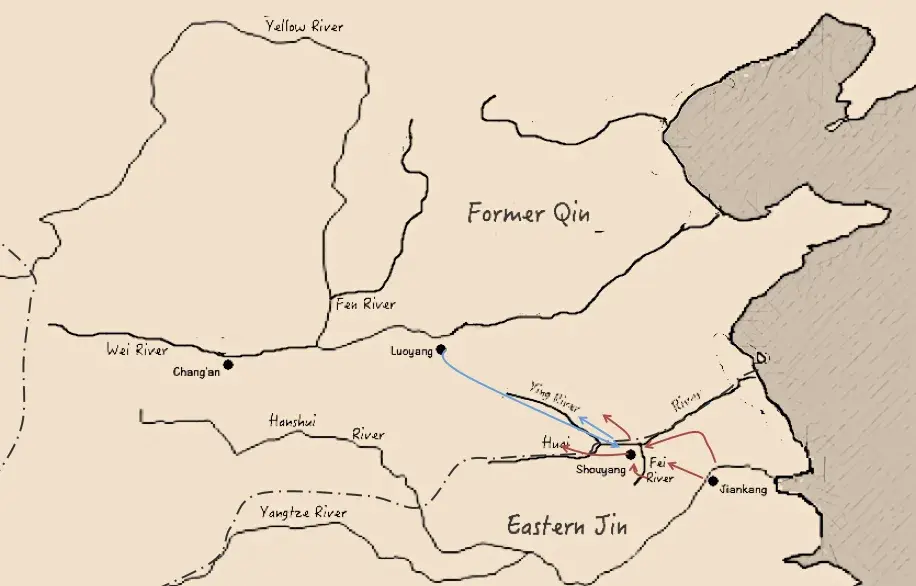
In August 383 CE (Taiyuan 8th year), Fu Jian mobilized a massive host across multiple ethnic groups, fielding six hundred thousand infantry and two hundred and seventy thousand cavalry, claiming an army of one million men. Fu Jian boasted that his army could stem the flow of the Yangtze simply by throwing their horsewhips into the river. The court at Jiankang was gripped with terror. Xie An remained unperturbed, appointing Vice Director of the Department of State Affairs Xie Shi as Supreme Commander and Xie Xuan as Vanguard Commander, dispatching eighty thousand Beifu soldiers alongside Xie Yan, Huan Yi, and Liu Laozhi to meet the invaders in Huainan.

In October, Former Qin vanguard general Fu Rong captured Shouyang (present-day Shouxian, Anhui). Fu Jian rushed forward with eight thousand elite cavalry and dispatched Zhu Xu, a captured Eastern Jin administrator, to the Jin camp to demand surrender. Loyal to the Jin cause, Zhu Xu disclosed that the main Qin force had not yet assembled and that the vanguard was isolated, urging the Jin commanders to attack immediately before the enemy formed battle lines. In November, Xie Xuan sent General of Eagle-like Prowess Liu Laozhi with five thousand Beifu troops on a night raid against the Qin positions at the Luo Torrent. Striking like thunder, Liu Laozhi routed the garrison, slew Qin general Liang Cheng and ten other officers, and wiped out over ten thousand enemy troops, dealing a shattering psychological blow to Former Qin.

The eighty-thousand-strong Jin army then drew up along the eastern bank of the Fei River, confronting the vast Qin host on the opposite shore. Explaining that the terrain prevented a decisive engagement, Xie Xuan proposed that the Qin army retreat slightly to allow Jin forces to cross the river and form ranks for open battle. Overconfident in his overwhelming numbers, Fu Jian planned to crush the Jin forces midway through the river crossing and ordered his legions to step back. However, the Qin army was a hastily assembled coalition of Di, Qiang, Xianbei, and Han levies who possessed no common allegiance and were exhausted by long marches. As the front ranks stepped back, the rear units, unaware of the tactical command, assumed the vanguard had been broken and descended into panic. Xie Xuan and Xie Yan led the Beifu elite across the river in a ferocious charge, while Zhu Xu shouted from behind the Qin lines: "The Qin army is defeated! The Qin army is defeated!" Utter chaos ensued. Fu Rong was thrown from his horse and killed by Jin infantry, and Fu Jian was struck by an arrow, fleeing alone on horseback. Over three hundred thousand Qin soldiers were slain, trampled, or dispersed in the rout. The catastrophic collapse destroyed Former Qin, securing a miraculous victory for Eastern Jin against overwhelming odds.

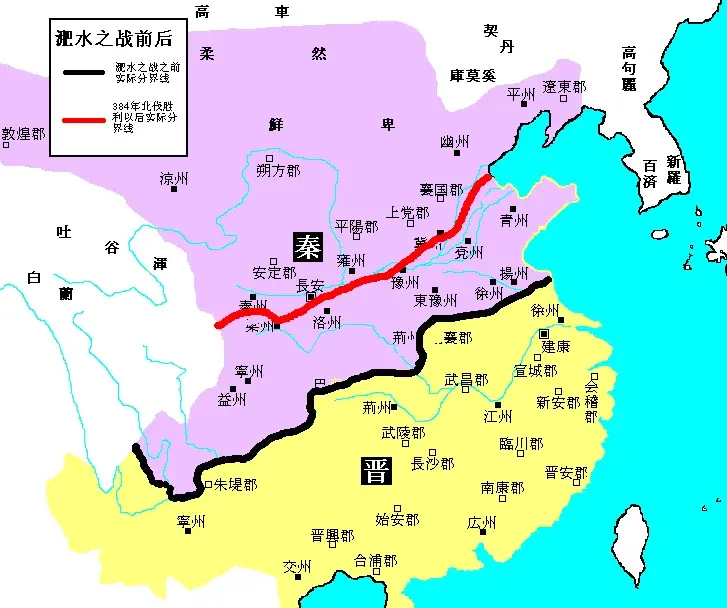
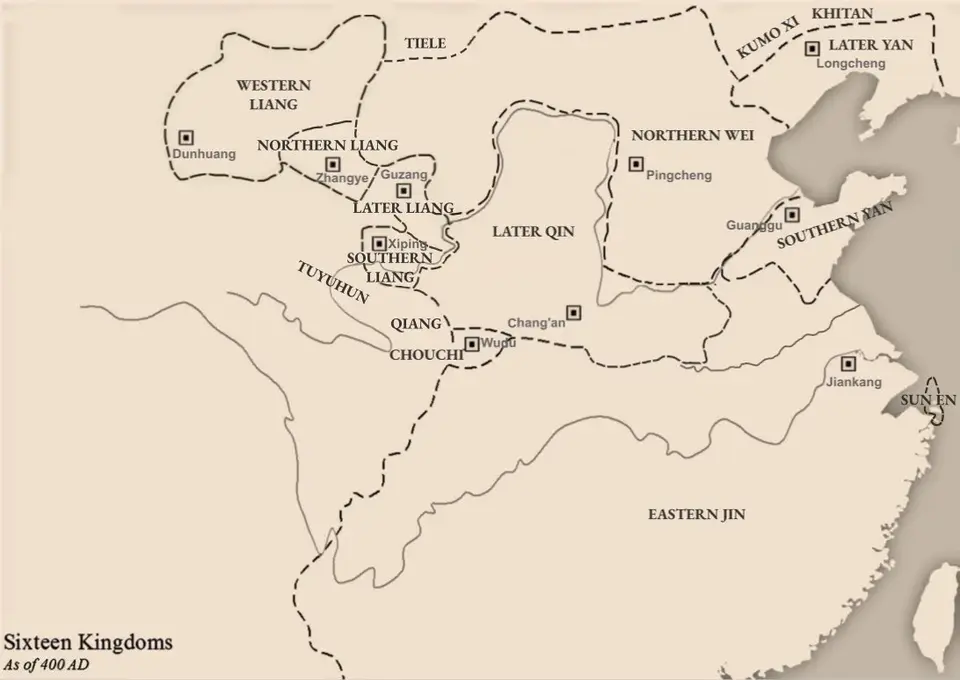
The victory at the Fei River dissolved Former Qin's threat, causing the northern empire to disintegrate into competing regimes such as Later Yan, Later Qin, and Western Yan, securing Jiangnan for generations. In 384 CE (Taiyuan 9th year), Xie An capitalized on the northern collapse by directing Xie Xuan and Huan Shiqian to launch a major northern counteroffensive. Xie Xuan led the Beifu Army across the Huai River, recovering Juancheng, Guangu, and other major cities, excavating the Qingzhou Canal for supplies, and liberating the vast provinces of Xu, Yan, Qing, Si, Yu, and Liang. Eastern Jin borders reached the southern bank of the Yellow River, marking the dynasty's greatest territorial expansion.

Imperial Prince Dominance and the Sun En-Lu Xun Uprising

The triumph at the Fei River elevated the Chenjun Xie clan to the zenith of prestige, provoking intense jealousy and apprehension from Emperor Xiaowu (Sima Yao) and the imperial clan. Determined to reclaim authority from aristocratic lineages, Emperor Xiaowu promoted his younger brother, Prince of Kuaiji Sima Daozi. In 385 CE (Taiyuan 10th year), facing court estrangement and slander, Xie An voluntarily relinquished his central authority to garrison Guangling, passing away later that year. Court control fell into the hands of Sima Daozi, while Xie Xuan was relieved of his northern command, arresting the northern campaigns.

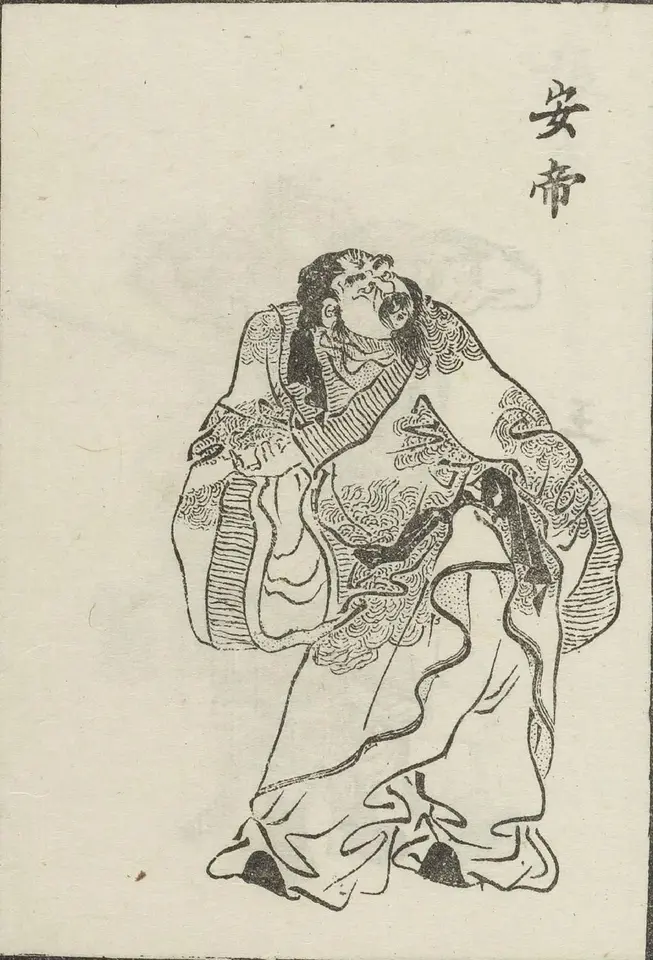
Sima Daozi was dissolute and corrupt, appointing sycophants such as Wang Guobao and Wang Xu, selling offices, and undermining state governance. In 396 CE (Taiyuan 21st year), the thirty-five-year-old Emperor Xiaowu, while intoxicated, jokingly remarked to his consort Lady Zhang that she was growing old and should be replaced. Terrified and enraged, Lady Zhang instructed her palace maids to smother the sleeping emperor with bedding. Following his sudden death, his fifteen-year-old son Sima Dezong, who was intellectually disabled and incapable of speech, ascended the throne as Emperor An of Jin. Power struggles erupted between Sima Daozi and his ambitious son Sima Yuanxian, who established the office of Recorder of the Department of State Affairs, sidelining his father and levying exorbitant taxes and forced labor across the Sanwu region.

In 398 CE (Long'an 2nd year), Inspector of Yanzhou Wang Gong, incensed by the corruption of the Sima father and son, formed an alliance with Inspector of Jingzhou Yin Zhongkan and Inspector of Guangzhou Huan Xuan to launch an armed rebellion. Sima Yuanxian bribed Beifu commander Liu Laozhi to defect, leading to Wang Gong's defeat and execution. However, this conflict severed provincial commands from court control; Huan Xuan seized Jingzhou and Jiangzhou, consolidating an autonomous military bloc across the middle and upper Yangtze, reducing the court's authority to a few commanderies around Sanwu.

To expand court military forces, Sima Yuanxian enacted draconian conscription across Sanwu, forcing tenant farmers and domestic retainers of local gentry into the army as "joyful recruits," igniting bitter socioeconomic resentment. In 399 CE (Long'an 3rd year), Sun En, an adherent of the Way of the Five Pecks of Rice from Langya, raised an armed revolt in Kuaiji. Styling themselves "immortal beings," the insurgents swept across eight southeastern commanderies, joined by hundreds of thousands of impoverished tenants and commoners. The rebels captured Kuaiji, killed Regional Administrator Xie Yan and other high officials, and pillaged aristocratic estates, severely damaging the economic foundations of the Jiangnan gentry.

The court dispatched Liu Laozhi to lead the Beifu Army into Sanwu to suppress the rebellion. Serving as an adjutant under Liu Laozhi was Liu Yu, an impoverished soldier of humble background whose exceptional courage, tactical genius, and strict discipline repeatedly routed Sun En's forces. Under heavy pressure from government troops, Sun En fled with his surviving followers to offshore islands, constructing massive multi-decked warships to mount amphibious raids along the Zhejiang coast. In 401 CE (Long'an 5th year), Sun En sailed up the Yangtze with over one hundred thousand troops to assault Jingkou and threaten Jiankang. Liu Yu mounted a desperate defense, repelling the assault and forcing Sun En to retreat. In 402 CE (Yuanxing 1st year), Sun En was defeated at Linhai and drowned himself in the sea. His brother-in-law Lu Xun assumed leadership, shifting his base southward to capture Guangzhou in 404 CE. In 410 CE (Yixie 6th year), taking advantage of Liu Yu's northern expedition against Southern Yan, Lu Xun led a fleet of over one hundred thousand men toward Jiankang, advancing to the Stone Citadel. Marching over two thousand li back from Shandong, Liu Yu fortified the capital with timber stockades and shattered Lu Xun's armada with fire attacks outside Jiankang. Lu Xun fled to Lingnan and committed suicide in Jiaozhou in 411 CE, ending an eleven-year insurrection that permanently broke the economic supremacy of the traditional aristocratic lineages.

The Rise of Liu Yu and the Fall of Eastern Jin

While the court was embroiled in suppressing Sun En, Huan Xuan expanded his influence along the upper Yangtze. The son of Huan Wen, Huan Xuan had inherited the title Duke of Nanjun and harbored imperial ambitions. In 402 CE (Yuanxing 1st year), Sima Yuanxian launched an offensive against Huan Xuan, but Huan Xuan sailed downstream to assault Jiankang. Liu Laozhi surrendered to Huan Xuan due to court distrust, allowing Huan Xuan to enter the capital, execute Sima Daozi and Sima Yuanxian, and subsequently drive Liu Laozhi to suicide, dissolving the original Beifu command structure.

Huan Xuan assumed the regency but quickly alienated the populace through his extravagance and cruelty. In November 403 CE (Yuanxing 2nd year), Huan Xuan coerced Emperor An into abdicating, proclaiming himself Emperor of Chu (known historically as Huan Chu), changing the reign era to Daheng and banishing Emperor An to Xunyang as Prince of Lingling. However, the Beifu rank-and-file deeply resented Huan Xuan's rule. In February 404 CE (Yuanxing 3rd year), junior Beifu officer Liu Yu allied secretly with He Wuji and Zhuge Changmin, staging a righteous uprising at Jingkou. Liu Yu's forces defeated the Chu armies at Zhuli and marched upon Jiankang. Terrified, Huan Xuan fled upstream to Jiangling, holding Emperor An hostage. Liu Yu captured Jiankang and dispatched an expeditionary force upstream, crushing the Chu armies at Zhengrong Island. Huan Xuan fled toward Sichuan and was slain en route by forces loyal to the Jin court. Liu Yu restored Emperor An to the throne at Jiankang, renewing the Eastern Jin mandate.

Recognized as chancellor for restoring the dynasty, Liu Yu consolidated absolute control over civil and military administration. To solidify his supremacy and prepare for dynastic transition, Liu Yu orchestrated internal unification campaigns and external northern expeditions:

  • Internal Consolidation: Liu Yu eliminated rival warlord Liu Yi at Jiangling in 412 CE (Yixie 8th year); dispatched Zhu Lingshi to conquer Qiao Zong's breakaway regime in Sichuan (Qiao Shu) in 413 CE, restoring Yizhou; and suppressed Inspector of Jingzhou Sima Xiuzhi in 415 CE, eliminating regional warlordism and uniting the realm under central direction.
  • Conquest of Southern Yan (409–410 CE): Following border raids by Murong De's Southern Yan regime, Liu Yu launched a major northern expedition in April 409 CE. Crossing the Daxian pass, Liu Yu deployed the famous Crescent Moon Formation (que yue zhen) to shatter the Southern Yan cavalry at Linqu, subsequently besieging the capital of Guangu (present-day Qingzhou, Shandong). After a multi-month siege, Jin forces took Guangu in February 410 CE, captured emperor Murong Chao, and executed him at Jiankang, annexing the Shandong peninsula.
  • Conquest of Later Qin (416–417 CE): Following the death of Later Qin ruler Yao Xing, Liu Yu mobilized a five-pronged invasion against Later Qin in August 416 CE. Vanguard generals Wang Zhen'e and Tan Daoji seized Xuchang, Huatai, and Luoyang. In July 417 CE, Jin armies reached Tongguan; Wang Zhen'e led a naval flotilla up the Wei River, disembarked along the riverbanks, and stormed the Pingshuo Gate of Chang'an. Later Qin emperor Yao Hong surrendered, bringing an end to the regime. Jin armies recovered the twin capitals of Luoyang and Chang'an, advancing borders beyond the Yellow River.

Following the capture of Chang'an, Liu Yu left his second son Liu Yizhen and generals Wang Zhen'e and Shen Tianzi to defend Guanzhong, hastening back to Jiankang to prepare for his imperial accession. However, internal factional infighting broke out among the garrison commanders; Shen Tianzi murdered Wang Zhen'e, and Helian Bobo of the Xia state launched a devastating invasion, capturing Chang'an. Although Guanzhong was lost, Eastern Jin permanently retained the Central Plains from Tongguan eastward to the Shandong peninsula. In December 418 CE (Yixie 14th year), to facilitate the dynastic transition, Liu Yu dispatched Wang Shaozhi into the palace to smother the incapacitated Emperor An with bedding, elevating his younger brother Sima Dewen as Emperor Gong, adopting the era name Yuanxi. In June 420 CE (Yuanxi 2nd year), having been appointed Chancellor, King of Song, and recipient of the Nine Bestowals, Liu Yu compelled Emperor Gong to issue an abdication decree. Emperor Gong vacated the palace, and Liu Yu ascended the throne in the southern suburbs of Jiankang, establishing the Liu Song dynasty under the reign title Yongchu. Spanning eleven emperors and 104 years, the Eastern Jin dynasty came to an end, inaugurating the Northern and Southern Dynasties period.

Politics and Institutions

Aristocratic Clan Politics and Imperial Co-Governance

The political structure of the Eastern Jin constitutes a unique phenomenon in Chinese imperial history, classified by modern historians Yan Gengwang and Tian Yuqing as classical "aristocratic clan politics" (menfa shizu zhengzhi). The defining characteristic of this system was the relative subordination of imperial authority, giving rise to a power-sharing equilibrium in which the Sima imperial house and dominant northern refugee clans shared political, military, economic, and social privileges, popularly characterized as "the Wangs and the Simas co-rule the realm."

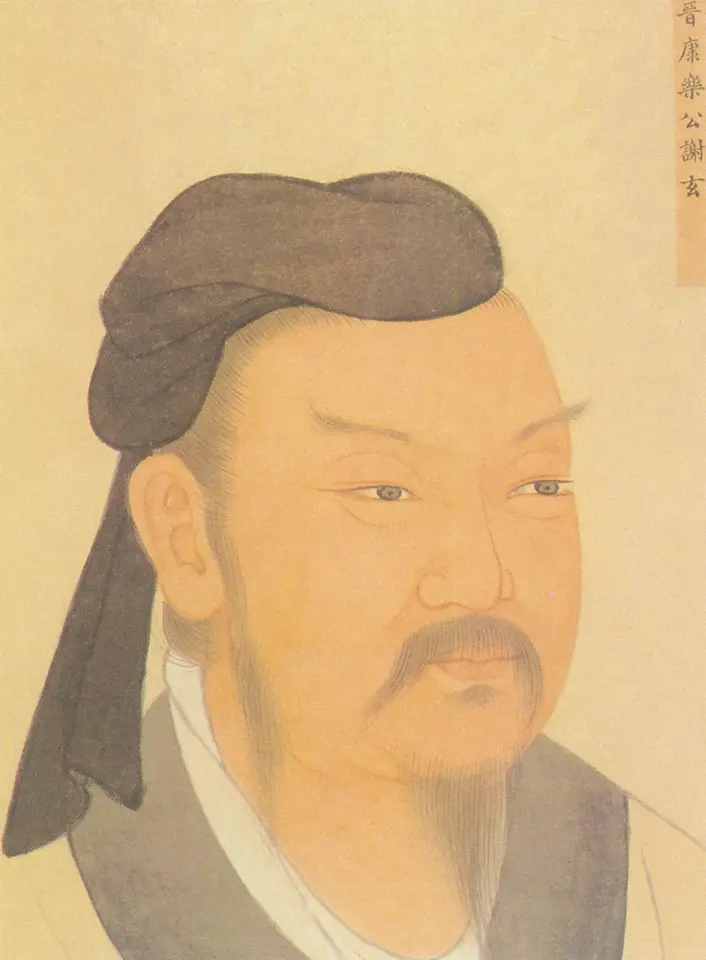
In this administrative architecture, noble lineages relied on family prestige, private armed retinues (buqu), and ancestral social stature established since the Han and Wei dynasties to serve as the pillars of state power. The founding of Eastern Jin rested on the Langya Wang lineage (Wang Dao and Wang Dun); subsequently, the Yingchuan Yu lineage (Yu Liang, Yu Bing, Yu Yi), the Qiaoguo Huan lineage (Huan Wen, Huan Chong, Huan Xuan), and the Chenjun Xie lineage (Xie An, Xie Shi, Xie Xuan) alternately held supreme power, establishing a dynamic mechanism of shared elite governance. Under this framework, any attempt by a single lineage to monopolize supreme power or usurp the throne—such as the revolts of Wang Dun, Huan Wen's imperial designs, or Huan Xuan's usurpation—provoked united resistance from rival aristocratic families, thereby preserving the fragile Sima dynastic line for over a century.

Accompanying this aristocratic monopoly was a rigid genealogical caste hierarchy. Aristocratic families placed paramount emphasis on lineage purity and genealogical records, cultivating the discipline of genealogy (pudie xue). Over one hundred prominent northern lineages that accompanied Emperor Yuan across the Yangtze were cataloged in registers known as the Hundred Clans Register or the Eighteen Provinces Lineage Records. The Jia lineage across three generations (Jia Bizhi, Jia Feizhi, and Jia Yuan) specialized in genealogical scholarship, and the state established specialized registries to safeguard these documents to prevent commoners from claiming elite descent. Aristocratic lineages possessed statutory exemptions from taxation and corvee labor, reserving prestigious civil offices exclusively for their members while enforcing strict segregation from commoners and non-noble landholders (the humble lineages or hanmen) in marriage, officialdom, social gatherings, and daily interaction, producing an entrenched social reality where "the upper ranks held no men of humble birth, and the lower ranks held no men of noble blood."

Central Bureaucracy and Evolution of Civil Selection

The central administration of Eastern Jin maintained the tripartite departmental structure of Cao Wei and Western Jin, comprising the Department of State Affairs (Shangshu Sheng), the Secretariat (Zhongshu Sheng), and the Chancellery (Menxia Sheng). The Department of State Affairs directed civil administration through functional bureaus including Personnel, Sacrifices, Finance, Civil Affairs, Judicial Affairs, and Armaments. The Secretariat drafted imperial decrees, while the Chancellery reviewed and vetted state policies. Aristocratic elites controlled state policy through appointments as Recorder of the Department of State Affairs, Director of the Secretariat, Palace Attendant, or Director of State Affairs, often rendering the emperor a figurehead. The traditional Three Excellencies (Grand Commander, Minister of Education, and Minister of Works) became largely ceremonial honors conferred upon senior statesmen, devoid of routine administrative authority.

In official recruitment, the Eastern Jin operated the Nine-Rank System (Nine-Rank Impartial and Just System). Senior and Junior Arbiters were appointed across provinces and commanderies to assess the qualifications of local scholars. Unlike the original Cao Wei institution that weighed talent and moral virtue, the Eastern Jin Nine-Rank System functioned exclusively as a political instrument to preserve aristocratic privilege. Arbiters were recruited exclusively from prestigious lineages and evaluated candidates strictly by family pedigree, disregarding administrative competence or moral integrity. Youths from noble lineages secured elite rankings upon reaching adulthood, stepping directly into prestigious posts with rapid promotion to ministerial rank; conversely, talented candidates of humble birth were consigned to inferior ranks and burdened with burdensome administrative duties, permanently barred from high central office. This recruitment mechanism stifled social mobility until the late Eastern Jin, when commanders from humble backgrounds within the Beifu Army broke the aristocratic monopoly through military merit.

Immigrant Administrative Units and Residence-Based Regularization

Following the collapse of the Western Jin, hundreds of thousands of northern refugees crossed the Yangtze River into Jiangnan. To settle these displaced populations and safeguard the social prestige and political privileges of northern aristocratic houses, the Eastern Jin court instituted a unique administrative apparatus known as immigrant administrative units (qiaozhou, qiaojun, and qiaoxian).

Under this system, the court established nominal administrative jurisdictions in southern territories bearing the names of the refugees' ancestral northern homelands. For instance, Southern Xuzhou was established around Jingkou, Southern Yanzhou around Guangling, and immigrant commanderies such as Southern Langya and Southern Dongguan were erected in surrounding areas. These units possessed bureaucratic structures and refugee populations but lacked fixed territorial boundaries. Displaced refugees were recorded on specialized white registers (baiji), while indigenous southern inhabitants were recorded on formal yellow registers (huangji). Immigrants on white registers enjoyed substantial tax and corvee exemptions, paying neither standard land taxes nor household levies to the central government.

While effective in stabilizing refugees during the dynasty's early decades, the immigrant administrative system produced severe long-term administrative defects. Immigrant jurisdictions duplicated local administration, fostering bureaucratic bloat; noble lineages systematically harbored unregistered dependents on their estates to evade taxation, causing state-registered taxable households to plummet and treasury receipts to dwindle. Furthermore, the tax privileges enjoyed by white-register immigrants provoked deep resentment among indigenous yellow-register taxpayers who bore the burden of state levies.

To rectify these abuses, bolster state finances, and assert direct census control, the Eastern Jin court launched several residence-based regularizations (tuduan):

  • Xianhe Regularization (330 CE): Directed by Chancellor Wang Dao in the fifth year of Emperor Cheng's Xianhe era, this initiative inspected displaced refugee registers and instituted land-measurement grain taxes, representing the dynasty's first attempt to reform household registration.
  • Gengxu Regularization (364 CE): Conducted in the second year of Emperor Ai's Xingning era (the gengxu year) under Grand Marshal Huan Wen, this was the most extensive and effective regularization in Eastern Jin history. Huan Wen decreed that, with the exception of a few noble lineages residing in Jinling near the capital, all immigrant populations across the realm must be registered on yellow registers based on their current place of residence, subjecting them to standard taxation and corvee duties. Noble concealment of laborers was strictly prohibited. Huan Wen enforced these edicts rigorously; when Prince of Pengcheng Sima Hong concealed fugitives and unregistered households, his retainers were executed according to law. The Gengxu regularization uncovered vast numbers of concealed laborers, significantly enhancing state revenue and military recruitment, earning historical praise for restoring administrative integrity and fiscal prosperity.
  • Yixie Regularization (413 CE): Directed by Grand Commander Liu Yu in the ninth year of Emperor An's Yixie era, this final major regularization abolished most landless immigrant units, merging refugees into regular local jurisdictions with identical fiscal responsibilities to southern residents. It eradicated redundant immigrant offices and centralized administrative power, securing the financial and institutional foundations for the emergence of the Liu Song dynasty.

Military and Foreign Relations

Evolution of Military Organization and Confrontation of the Two Commands

The military system of the Eastern Jin inherited the hereditary soldier system (shibingzhi) of Cao Wei and Western Jin, but evolved into a decentralized regional structure due to ongoing civil upheaval. The central imperial guard armies (zhongjun) maintained by the Western Jin were annihilated during the War of the Eight Princes and the Disaster of Yongjia. When Emperor Yuan established his government at Jiankang, the court possessed negligible standing palace guards and relied on regional garrisons to defend the capital.

In territorial military organization, the Eastern Jin adapted the system of Area Commanders of Military Affairs. Over a century of dynastic history, military power crystallized into a bipolar confrontation between the Western Command (Xifu) along the middle Yangtze and the Northern Command (Beifu) along the lower Yangtze:

  • The Western Command (Xifu): Centered at the Jingzhou Command with headquarters at Wuchang or Jiangling, this command encompassed the vast middle and upper Yangtze regions, including Jing, Jiang, Yong, Liang, and Yi provinces. Occupying a fertile and strategically dominant position, the Western Command controlled more than half of the empire's total military manpower. The command was controlled successively by military magnates including Wang Dun, Tao Kan, Yu Liang, Huan Wen, Huan Chong, and Huan Xuan, functioning as a semi-autonomous military bloc capable of coercing the central court at Jiankang.
  • The Rise of the Beifu Army: To counterbalance the Western Command and counter mounting aggression from Former Qin, Xie An appointed his nephew Xie Xuan in 377 CE (Taiyuan 2nd year) as Inspector of Yanzhou. Operating from Guangling and Jingkou, Xie Xuan recruited hardy northern refugees and appointed officers like Liu Laozhi, He Qian, and Liu Yu to establish a mobile strike force known as the Beifu Army. Forged from battle-hardened northern migrants eager for military merit, the Beifu Army saved the dynasty at the Battle of Fei River and provided the court with a premier field army to counterbalance the Western Command. The late Eastern Jin military trajectory was defined by the Beifu Army under Liu Yu crushing the Huan Chu regime and securing absolute national military control.

Strategic Assessment of the Six Northern Expeditions

Exiled in Jiangnan, the Eastern Jin confronted continuous challenges to its political legitimacy and survival. Reclaiming the twin imperial capitals and liberating ancestral northern territories represented not only the yearning of displaced northern migrants, but served as the primary banner through which ambitious commanders sought political influence. The dynasty launched six major northern expeditions:

  • Zu Ti's Northern Expedition (313–321 CE): On the eve of the Western Jin's fall, general Zu Ti led several hundred households of kinsmen across the Yangtze to join Sima Rui, petitioning for an expedition to recover the north. Reluctant to campaign northward, Emperor Yuan granted Zu Ti nominal titles as General of Inspiring Martial Prowess and Inspector of Yuzhou, providing only one thousand rations and three thousand bolts of silk, refusing weapons and armor. Crossing the Yangtze, Zu Ti struck his oar against the current and swore that if he failed to pacify the Central Plains, he would never recross the river. Operating from Huaiyin, Zu Ti established iron foundries to forge weapons and enlisted over two thousand volunteers. Enforcing strict discipline and winning the support of northern Han fortress magnates, Zu Ti defeated Later Zhao armies under Shi Le, recovering Henan and Huainan south of the Yellow River. However, fearing Zu Ti's rising fame, Emperor Yuan dispatched court confidant Dai Yuan to command northern provinces and restrain him. Recognizing that factional court strife would undermine his achievements, Zu Ti succumbed to illness and grief at Yongqiu in 321 CE, and recovered territories were lost once more.
  • Chu Pou's Northern Expedition (349 CE): Following the death of Later Zhao ruler Shi Hu, northern China descended into civil chaos during the Ran Min massacres. Grand General Who Conquers the North Chu Pou (father of Empress Dowager Chu) led thirty thousand infantry and cavalry northward. Lacking strategic skill, Chu Pou's army was ambushed at Daipo by Later Zhao cavalry under Li Nong, suffering thousands of casualties. Chu Pou retreated to Guangling in disgrace and died of illness.
  • Yin Hao's Northern Expedition (352–353 CE): To balance Huan Wen's prestige following the conquest of Sichuan, the court appointed pure-conversation philosopher and General of the Central Army Yin Hao to direct northern operations. Lacking military experience, Yin Hao engaged Qiang defector Yao Xiang. In 353 CE, while marching against Former Qin, Yin Hao was ambushed by Yao Xiang at Shansang, losing vast quantities of arms and equipment. Huan Wen subsequently impeached Yin Hao, and the court stripped him of office, exiling him as a commoner.
  • Huan Wen's Three Northern Expeditions (354, 356, and 369 CE): Assuming supreme command over northern operations, Huan Wen advanced into Guanzhong in 354 CE, defeating Former Qin forces at Lantian and reaching Bashang, but was forced to withdraw due to grain shortages. In 356 CE, Huan Wen defeated Yao Xiang at the Yi River, entered Luoyang, and restored the imperial tombs. In 369 CE, Huan Wen invaded Former Yan, advancing to Fangtou north of the Yellow River; his waterborne supply routes were severed by Murong Chui's cavalry, and his retreating army was ambushed at Xiangyi, suffering over thirty thousand casualties. While demonstrating military power, the defeat at Fangtou shattered Huan Wen's prestige.
  • Xie Xuan's Northern Expedition (384–386 CE): Following the Fei River victory, Chancellor Xie An directed Xie Xuan to lead a major offensive. Commanding the Beifu Army across the Huai River, Xie Xuan liberated Xu, Yan, Qing, Si, and Yu provinces, opening canal routes and pushing Eastern Jin frontiers to the Yellow River, with vanguard units reaching Ye in Hebei. However, court prince Sima Daozi intervened out of political jealousy, ordering Xie Xuan to halt his advance, preventing further expansion north of the Yellow River.
  • Liu Yu's Two Northern Expeditions (409–410 and 416–417 CE): Liu Yu's campaigns achieved the greatest triumphs in Eastern Jin military history. In 409 CE, Liu Yu invaded Southern Yan, shattered enemy cavalry at Linqu, captured Guangu in 410 CE, and executed Murong Chao, recovering the Shandong peninsula. In 416 CE, Liu Yu launched a five-pronged offensive against Later Qin, capturing Xuchang, Huatai, and Luoyang; in 417 CE, Wang Zhen'e stormed Chang'an, destroying Later Qin and capturing Emperor Yao Hong. These campaigns recovered Huabei, Henan, and Guanzhong, liberating both Luoyang and Chang'an, marking the military zenith of the southern dynasties and providing Liu Yu with the unassailable prestige to found the Liu Song dynasty.

Foreign Relations and Diplomacy with the Sixteen Kingdoms

In regional diplomacy, the Eastern Jin claimed exclusive mantle as the legitimate imperial sovereign of Chinese civilization, condemning northern non-Han regimes as illegitimate rebellions. However, facing geopolitical realities, the court adopted pragmatic diplomatic strategies.

Toward Han-governed northern border regimes, such as Former Liang and Western Liang in the Hexi Corridor, the Eastern Jin maintained intimate tributary and tributary-investiture relations. The court conferred titles as provincial inspectors and dukes upon their rulers, while the Hexi regimes adopted Eastern Jin reign titles and recognized its dynastic legitimacy. Toward non-Han northern states, when unified northern empires (such as Later Zhao, Former Yan, or Former Qin) posed existential invasion threats, the Eastern Jin pursued alliances with rival border states; during northern succession crises, the court conferred military commissions on northern defectors to exploit internal divisions.

In southern border administration, the Eastern Jin solidified control over Ningzhou (present-day Yunnan and Guizhou), Jiaozhou, and Guangzhou (present-day Guangdong, Guangxi, and northern Vietnam), appointing regional inspectors to reinforce defenses and fiscal revenues, ensuring stability in the rear. Internationally, Jiankang served as a leading civilizational metropolis, attracting maritime embassies and merchant fleets. Records show that Goguryeo, Baekje, and Silla on the Korean Peninsula sent regular maritime embassies to Jiankang to seek imperial investiture, through which Chinese characters and Confucian classics spread across East Asia. The Wa state of Japan sent frequent missions to Jiangdong to acquire advanced silk weaving, ceramics, and ironworking technologies. Southeast Asian kingdoms including Linyi (southern Vietnam) and Funan (Cambodia) sent tribute missions bearing elephants, receiving fine silks and lacquerware in return. Furthermore, foreign envoys and merchants from the Roman Empire (Da Qin), Sasanian Persia, Kangju, and the Yuezhi arrived via maritime trade routes at Panyu and Jiankang, enriching economic and cultural exchange.

Economy and Commerce

Agricultural Reclamation of Jiangnan and Southward Shift of Economic Center

Prior to the Western Jin, the center of Chinese economic production resided in the Yellow River basin; ancient records described Jiangnan as a sparsely populated frontier where people cultivated through fire and water weeding without accumulated reserves. However, during the decades of migration following the Disaster of Yongjia, millions of northern Han farmers and aristocratic lineages brought advanced iron tools, cattle-drawn plowing, intensive farming methods, and diverse northern crop varieties south of the Yangtze, permanently altering China's economic landscape.

Spurred by an influx of rural labor, the Jiangnan region engaged in unprecedented land clearance and water conservation initiatives:

  • Encouragement of Agriculture and Land Reclamation: In the dynasty's early years, Emperor Yuan instituted policies incentivizing land clearance and sericulture. Provincial governors and magistrates were assessed based on acreage cleared and grain taxes collected; garrison armies were organized into agricultural colonies (tuntian) to achieve food self-sufficiency. Refugee settlers and local farmers cleared the Taihu, Poyang, and Dongting lake basins and the coastal wetlands of eastern Zhejiang into fertile farmland.
  • Technological Innovations and Crop Diffusion: Northern migrants popularized cattle plowing across southern paddies, employing two-ox and single-ox plow methods that vastly enhanced efficiency. Farmers widely utilized animal manure, night soil, wood ash, and green manure to enrich acidic red soils and increase crop yields. Northern staple crops such as winter wheat, barley, and soybeans were introduced to southern drylands, developing a two-crop annual rotation system of wheat and rice; in warmer Lingnan territories, double-cropping and triple-cropping of rice became common.
  • Hydraulic Engineering and Polder Fields: Water management was vital to wetland farming. Extensive networks of irrigation canals, sluice gates, and dikes were constructed across the Sanwu region. Sluice gates were opened to irrigate fields during dry seasons and shut against floods during monsoons. Farmers constructed earth dikes around lake wetlands to drain marshes, creating exceptionally fertile and flood-resistant polder fields (hutian or weitian). By the Taiyuan era of Emperor Xiaowu, after half a century of peaceful development, the Jiangnan region enjoyed bountiful harvests and full granaries, with the Sanwu region becoming the national storehouse that supplied court finances and military provisions, laying the groundwork for the permanent shift of China's economic center to the Yangtze River basin during the Tang and Song dynasties.

Manorial Economy and Fiscal Tax Evolution

Land tenure in the Eastern Jin was characterized by the dominance of aristocratic manorial estates. Northern refugee lineages and indigenous southern magnates deployed their political influence to occupy uncultivated hills, forests, lakes, and marshes, constructing sprawling estates spanning dozens or hundreds of li. Chancellor Wang Dao owned over eighty qing of arable land near Mount Zhong in Jiankang; the Diao clan possessed vast estates encompassing thousands of qing and hundreds of laborers; while the Xie clan held extensive estates in Shaning in Kuaiji.

Within these aristocratic estates lived hundreds or thousands of dependent laborers converted from displaced northern refugees and bankrupt peasants, functioning as hereditary retainers (buqu), tenants (dianke), and domestic slaves. In addition to intensive rice cultivation and sericulture, these estates conducted diverse sideline production including fruit orchards, livestock husbandry, aquaculture, brewing, tea processing, and iron mining, operating as self-sufficient economic and military units. Manorial lords levied heavy grain rents on their tenants, frequently confiscating over fifty percent of annual yields, exacerbating social inequality. To curb noble encroachment on common lands, Wang Dao instituted land-measurement rents in 330 CE, and the court issued the Renchin Imperial Edict in 336 CE prohibiting magnates from enclosing mountain resources; however, these measures were largely circumvented by aristocratic influence.

State fiscal systems underwent significant transformations throughout the dynasty. Initially adopting the Western Jin system, the court combined land taxes with household cloth levies. In 330 CE (Xianhe 5th year), Emperor Cheng instituted land-measured grain rent, collecting three sheng of grain per mu. Following the victory at the Fei River in 383 CE (Taiyuan 8th year), Prince Sima Daozi abolished land-measured grain taxes under the pretext of fiscal strain, imposing an exorbitant poll tax requiring five dan of grain from every individual regardless of age or wealth. Simultaneously, the court restored the Western Jin household levy, demanding two zhang of cloth and several liang of silk from adult males. This dual burden of poll taxes and corvee labor impoverished independent smallholders, driving widespread abandonment of farms and ultimately igniting the Sun En rebellion across Sanwu.

Epoch-Making Advances in Handicraft Technologies

The southward migration of northern artisans fused northern craftsmanship with southern waterpower, mineral resources, and regional traditions, fostering breakthroughs across diverse industries:

  • Iron Smelting and Steel Production: Iron manufacturing flourished under state-operated metallurgical bureaus and widespread private workshops across the Huai River and Yangtze basins. Major ironworks at Meigen in Guichi, Anhui, and Yetang in Wuchang, Hubei, employed thousands of metalworkers. Craftsmen developed the co-fusion steelmaking method (zhalian shengtou fa, an early form of the co-fusion steel process), pouring molten cast iron over wrought iron bars with repeated heating and forging to balance carbon content, yielding resilient, high-grade steel for durable farm tools, armor, and weaponry.
  • Maturation of Celadon Porcelain: The Eastern Jin represents a golden milestone in ceramic history. Celadon firing reached its apex at Yue ware kilns in Shangyu and Cixi, Zhejiang. Using dragon kilns and high-temperature reducing atmospheres, potters produced dense, durable bodies covered in lustrous, translucent olive-green lime glazes. Artisans created elegant forms including chicken-head ewers, spittoons, water droppers, inkstones, and tea bowls; porcelain decisively supplanted bronze, lacquerware, and pottery vessels across all social strata.
  • Shipbuilding and Textile Industries: Favored by extensive waterways, shipbuilding in the Eastern Jin led the ancient world. Shipyards at Jiankang, Panyu, and Jingkou constructed multi-decked warships (louchuan), ramming vessels, and swift patrol crafts for river warfare, as well as seaworthy ocean-going merchant vessels capable of carrying twenty thousand hu (approximately two thousand tons displacement). In textiles, silk cultivation advanced rapidly; Yuzhang Commandery (Nanchang) harvested silk cocoons four to five times annually, while Yongjia Commandery (Wenzhou) harvested eight times a year (eight-brood silkworms). The court established the Brocade Bureau (Jin Shu) at Jiankang to supervise luxury silk manufacturing, and Yue linen cloth from Kuaiji was distributed across the empire.

Commercial Trade and Jiankang as a Cosmopolitan Metropolis

The growth of agriculture and handicrafts stimulated commodity circulation and urban commercial expansion. Commercial activity flourished, with widespread engagement in trade. Spontaneous periodic rural markets (caoshi) emerged at transport junctions, river fords, and official post roads, serving as early precursors to commercial market towns.

The capital city of Jiankang developed into a premier international metropolis, sustained by the Yangtze River waterway and the Qinhuai River canal network. Jiankang accommodated the imperial palace, administrative organs, and merchants from across China and overseas. Along both banks of the Qinhuai River, more than ten major permanent commercial markets operated, while thousands of cargo vessels from Jingxiang, Bashu, Lingnan, and foreign realms moored along its docks. Commercial shops, taverns, and pleasure boats lined the riverbanks. Beyond Jiankang, regional cities such as Jiangling (Jingzhou), Jingkou (Zhenjiang), Panyu (Guangzhou), Chengdu, and Xiangyang expanded into vibrant commercial hubs.

In monetary exchange, early decades saw a shortage of currency due to wartime disruptions, leading to the mixed use of old coins from Cao Wei and Western Jin, large coins from Eastern Wu, and commodity grain and silk cloth. As commerce expanded, bronze coin circulation revived and regained dominance. Furthermore, the Eastern Jin established official mutual border markets (hushi) along the Huai River and Henan frontiers with northern regimes, permitting the exchange of livestock, silks, hides, and grain, fostering economic interdependence between northern and southern regions.
Culture and Society

The Wei-Jin Demeanor and Xuanxue Neo-Daoist Currents

The Eastern Jin was an era of profound intellectual individualism and aesthetic self-consciousness. The scholar-gentry inherited the Xuanxue (Neo-Daoism or Dark Learning) philosophical framework established during the Zhengshi era of Cao Wei by He Yan and Wang Bi, taking the Three Mysteries (Zhouyi, Laozi, and Zhuangzi) as their core texts, venerating natural spontaneity and spiritual detachment. Having witnessed frequent political massacres and displacement, literati experienced disillusionment with traditional political careers, seeking personal independence and artistic freedom in their intellectual lives, forging the cultural ideal remembered as the Wei-Jin Demeanor.

In social life, literati embraced Pure Conversation (qingtan) as an esteemed intellectual practice. Holding deer-tail fly-whisks (zhuwei), scholars gathered in mountain retreats, monasteries, bamboo groves, or private gardens to engage in subtle logical debates on natural philosophy, the relationship between language and meaning, and the nature of emotion in music. Figures such as Wang Dao, Xie An, Sun Chuo, Xu Xun, and the Buddhist monk Zhi Daolin were renowned masters of metaphysical discourse. While pure conversation cultivated logical analysis and challenged Han-dynasty scholasticism, it fostered escapist attitudes where many noble youths neglected practical administration, inviting stern criticism from pragmatists like Bian Hu and Fan Ning, who penned essays condemning excessive metaphysical indulgence.

Splendid Peaks of Literature, Calligraphy, and Painting

Eastern Jin artistic achievements established enduring paradigms in Chinese classical aesthetics, producing luminaries across literature, calligraphy, and painting:

  • Wang Xizhi and the Calligraphic Paradigm: Hailing from the Langya Wang lineage, Wang Xizhi served as General of the Right Army and was celebrated as General Wang. Synthesizing the archaic styles of Zhong Yao and Zhang Zhi from the Han and Wei eras, Wang Xizhi transformed early clerical and cursive scripts into modern standard (kaishu), running (xingshu), and cursive (caoshu) scripts of ethereal elegance, revered as "floating like clouds and startling like dragons," earning him universal acclaim as the Sage of Calligraphy. On the Double Third Festival of 353 CE (Yonghe 9th year), Wang Xizhi, Xie An, Sun Chuo, and forty-two literati held a purification gathering at the Orchid Pavilion in Shanyin of Kuaiji, where Wang Xizhi composed the Preface to the Poems Collected from the Orchid Pavilion. Comprising twenty-eight lines and 324 characters, with twenty distinct renderings of the character zhi, it is venerated as the Foremost Running Script Under Heaven. His seventh son Wang Xianzhi inherited and developed this legacy with bold and flowing brushwork; known as the Lesser Sage, the father and son are celebrated as the Two Wangs, establishing classical calligraphy's aesthetic canon.
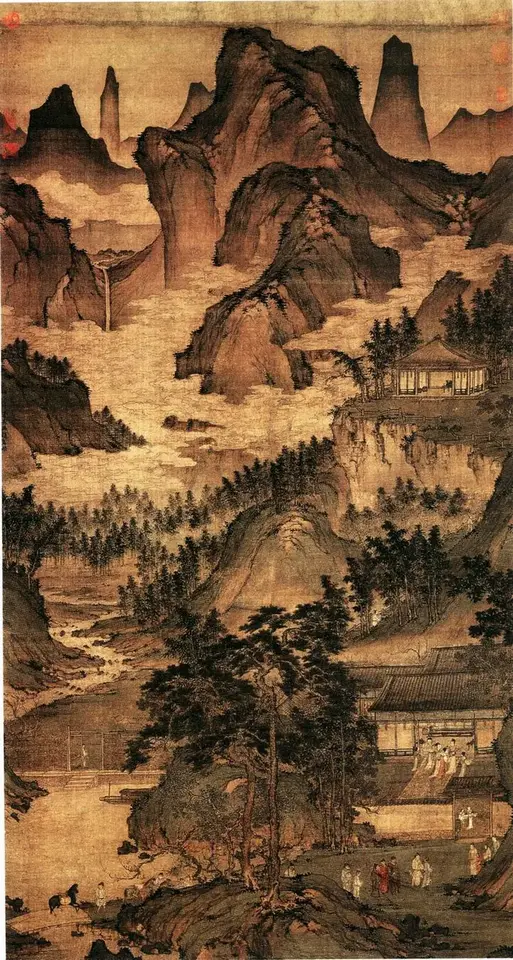
  • Gu Kaizhi and Figure Painting: Gu Kaizhi, courtesy name Changkang from Wuxi in Jinling, served in various court offices and was celebrated for his triple genius: supreme in painting, supreme in intellect, and supreme in eccentricity. The founding master of traditional Chinese figure painting, Gu Kaizhi formulated classical aesthetic theories such as "transmitting spirit through form" (yi xing xie shen) and "attaining subtle inspiration through contemplation" (qian xiang miao de), emphasizing that facial expressions and eye details capture an individual's inner spirit. When painting a Vimalakirti mural at Waguan Monastery in Jiankang, his final dotting of the eyes produced an ethereal brilliance that drew thousands of spectators. His surviving attributed masterworks include Admonitions of the Instructress to the Court Ladies and Ode to the Nymph of the Luo River, featuring delicate, continuous brush lines reminiscent of silkworm threads, capturing refined spiritual consonance.
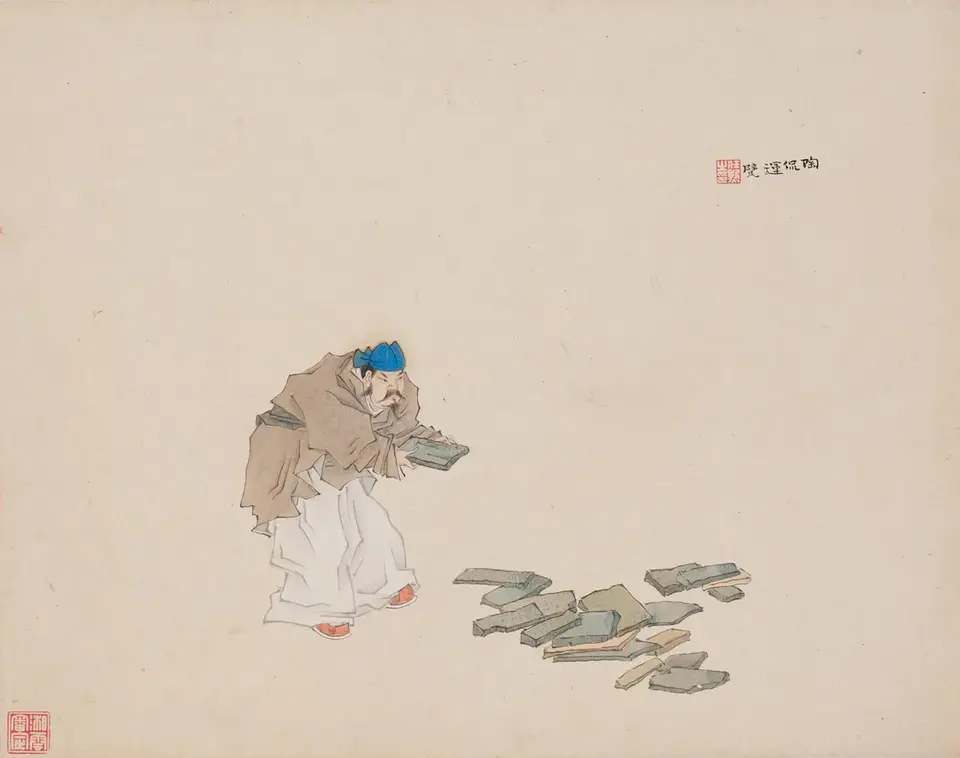
  • Tao Yuanming and Fields and Gardens Poetry: Early Eastern Jin poetry was dominated by abstract metaphysical verse. In the twilight of the dynasty, Tao Yuanming (Tao Qian) transformed the literary landscape. Having served briefly in minor posts such as Libationer of Jiangzhou and Magistrate of Pengze, Tao Yuanming resigned after eighty days, refusing to "bend his waist for five pecks of rice" before corrupt superiors, returning to his rural retreat at Chaisang in Xunyang. Throughout two decades of farming, Tao Yuanming composed masterpieces in simple, natural language reflecting rural life, including Returning Home, Return to the Countryside, and Drinking Wine, establishing the Fields and Gardens poetic tradition. In his immortal prose work The Peach Blossom Spring, he envisioned an egalitarian utopian society isolated from war and exorbitant taxes where "traffic crisscrossed between fields and the crowing of cocks and barking of dogs could be heard," expressing an enduring longing for human harmony. Additionally, Gan Bao compiled In Search of the Supernatural (Soushen Ji), pioneering supernatural fiction; Sun Chuo and Xu Xun cultivated metaphysical poetry, and Xie Lingyun laid the seeds of landscape poetry.

Convergence of Xuanxue and Buddhism and Daoist Reformations

In religious and intellectual life, the Eastern Jin witnessed profound synthesis and mutual enrichment among Xuanxue, Buddhism, and Daoism:

  • Convergence of Xuanxue and Buddhism: Buddhism gained widespread devotion among the imperial house, aristocratic lineages, and common folk. To integrate into southern literati circles, eminent monks such as Zhi Daolin (Zhi Dun) correlated Buddhist prajna emptiness with Xuanxue ontology, actively practicing intellectual synthesis. Monks participated in pure conversation gatherings, allowing Buddhist doctrines to flourish among scholar elites. Later, Master Huiyuan established Donglin Monastery on Mount Lu, advocating the Pure Land tradition and forming the White Lotus Society, harmonizing Buddhist teachings with Confucian ethics and Daoist natural philosophy, steering Buddhism along a path of Sinification.
  • Faxian's Pilgrimage to India: In 399 CE (Long'an 3rd year), distressed by the incomplete state of Buddhist monastic rules in China, the monk Faxian departed Chang'an on a pilgrimage to ancient India with fellow monks. Overcoming deserts and snow-covered Pamir peaks across thirty kingdoms, Faxian reached the Gupta Empire in central India. Faxian studied Sanskrit, transcribed monastic codes for three years, and sailed to Sri Lanka and Sumatra, returning by sea to Jiankang in 414 CE after a fifteen-year journey. Faxian translated over a million words of Buddhist scriptures and authored the Record of Buddhist Kingdoms (A Record of Buddhist Kingdoms) (Foguoji), providing detailed geographical, religious, and historical documentation of Central and South Asia, becoming an internationally renowned traveler and civilizational pioneer.
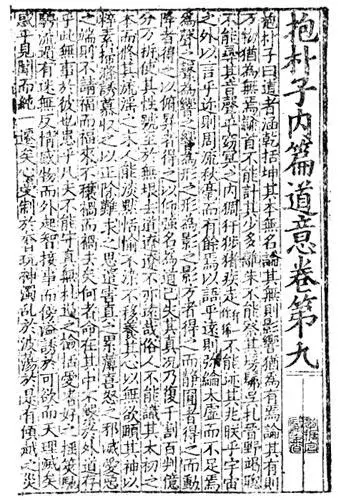
  • Daoist Doctrinal Systematization: Early communal Daoism (the Way of the Five Pecks of Rice and the Way of Great Peace) evolved into an elite, philosophical tradition. The Daoist scholar and physician Ge Hong retired to Mount Luofu in Guangdong, authoring the Baopuzi; the Outer Chapters examined Confucian governance and ethics, while the Inner Chapters analyzed immortality techniques, alchemy, and breathing exercises, reconciling Daoist esoteric practices with Confucian social values. Ge Hong recorded significant chemical and medical observations, documenting the use of sweet wormwood (qinghao) for treating malaria and canine brain tissue for rabies prevention in his Emergency Prescriptions Kept in One's Sleeve (Zhouhou Beijifang). Later, Yang Xi founded the Shangqing school and Ge Chaofu established the Lingbao school, enriching Daoist liturgies and scriptural traditions.

Key Figures

Founding Monarchs, Officials, and Early Administrators

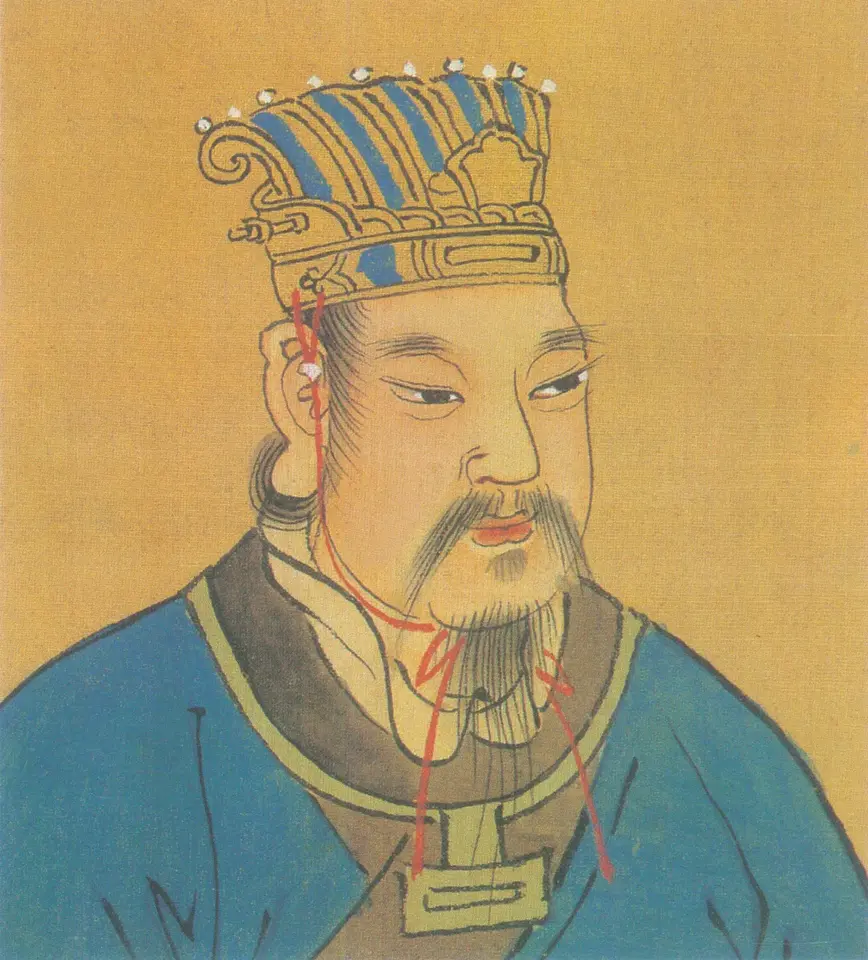
  • Sima Rui: Emperor Yuan of Jin, founding monarch of the Eastern Jin; great-grandson of Sima Yi and son of Prince Gong of Langya Sima Jin. Guided by Wang Dao, he established his government at Jianye, winning over southern lineages such as Gu Rong and He Xun. Proclaimed Prince of Jin in 317 CE and ascended the imperial throne in 318 CE, restoring the dynastic sacrifices. Established the power-sharing arrangement with the Langya Wang clan; attempted in later years to restrain the Wangs using Liu Wei and Diao Xie, provoking Wang Dun's insurrection and dying of illness in grief.
  • Wang Dao: Courtesy name Maohong from Linyi in Langya; founding statesman and chancellor of the Eastern Jin. Advocated the policy of "pacifying with composure, allowing sentiments to settle naturally," harmonizing relations between northern immigrant gentry and southern magnates. Served three emperors (Yuan, Ming, and Cheng) and three times held the chancellorship, consolidating Jiangzuo governance and entrenching aristocratic clan politics.
  • Wang Dun: Courtesy name Chuzhong, cousin of Wang Dao; founding commander and high official. Stationed at Wuchang as Commander of Military Affairs in Six Southern Provinces, controlling the upper Yangtze riverways and legions. Discontented with Emperor Yuan's favoritism toward Liu Wei and Diao Xie, he rebelled in 322 CE and captured Jiankang; plotted to usurp the throne, succumbing to mortal illness in camp during Emperor Ming's counter-campaign in 324 CE.
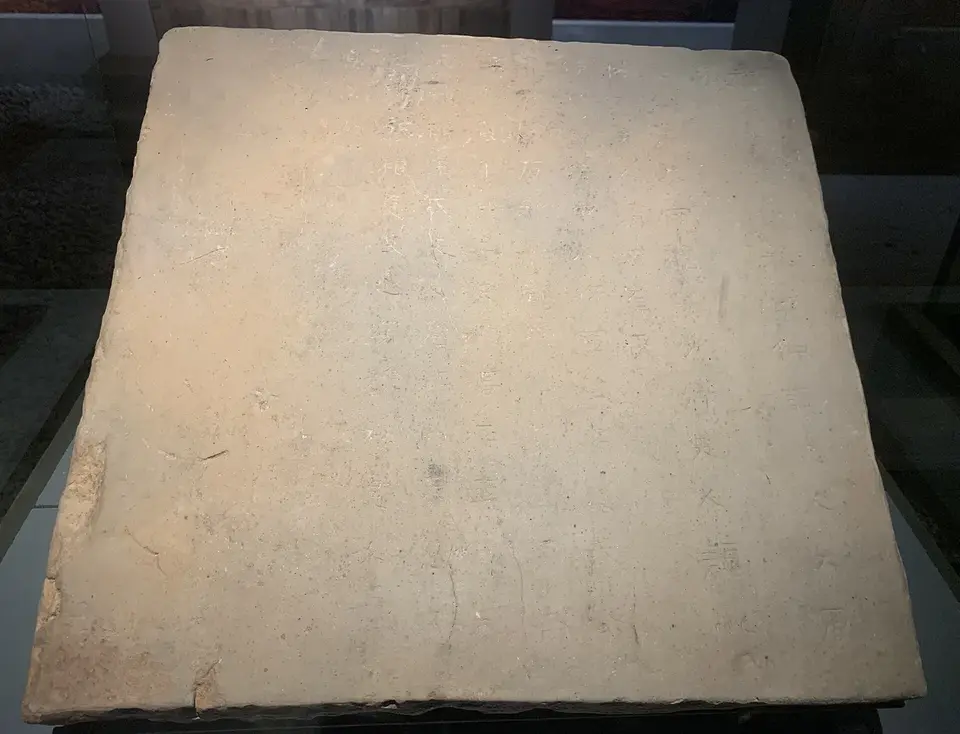
  • Sima Shao: Emperor Ming of Jin, eldest son of Emperor Yuan; resolute, courageous, and politically astute. Allied with loyalist commanders Xi Jian and Yu Liang to crush Wang Dun's rebellion, pardoning the non-rebellious Wang kinsmen to stabilize the realm, restoring imperial prestige during his brief three-year reign.
  • Yu Liang: Courtesy name Yuangui from Yanling in Yingchuan; elder brother of Empress Dowager Yu and regent minister. Following Emperor Ming's death, he directed the court under Emperor Cheng; his aggressive attempt to strip Su Jun of his military command incited the Su Jun rebellion that devastated Jiankang. Following the pacification, he assumed military command at Wuchang, governing the upper Yangtze provinces.
  • Tao Kan: Courtesy name Shixing from Xunyang; celebrated military commander of humble origin, famed for his diligence and moral resolve. Selected by Wen Qiao as supreme commander of loyalist forces during the Su Jun rebellion, he led the joint campaign that retook Jiankang; subsequently governed eight provinces from Jingzhou, preserving peace and stability.
  • Wen Qiao: Courtesy name Taizhen from Qixian in Taiyuan; illustrious statesman and general. Dispatched by Liu Kun to urge Sima Rui to ascend the throne, winning high court trust. Mobilized resistance at Xunyang during the Su Jun rebellion, entreating Tao Kan to lead the campaign, liberating Jiankang and restoring the young emperor.

Powerful Ministers, Generals, and Restorative Statesmen

  • Huan Wen: Courtesy name Yuanzi from Longkang in Qiaoguo; Grand Marshal and Duke of Nanjun, preeminent military magnate of the mid-Eastern Jin. Married Emperor Ming's daughter, Princess Nankang, and governed Jingzhou for three decades. Conquered Cheng Han in Sichuan in 347 CE; conducted three major northern expeditions to Bashang, Luoyang, and Fangtou; presided over the Gengxu residence regularization; deposed Emperor Fei in 371 CE and installed Emperor Jianwen, dominating state affairs until his death.
  • Sima Yu: Emperor Jianwen of Jin, youngest son of Emperor Yuan; devotee of Xuanxue and pure conversation. Held ministerial posts under Emperors Mu, Ai, and Fei; installed as emperor by Huan Wen in 371 CE, reigning for eight months in anxiety, drafting a deathbed edict commanding Xie An and Wang Tanzhi to preserve the dynastic line against Huan Wen's usurpation.
  • Xie An: Courtesy name Anshi from Yangxia in Chenjun; Grand Mentor, chancellor, and celebrated literati leader. Lived in scholarly seclusion on Mount Dong in Kuaiji until his forties before assuming high office. Coordinated with Wang Tanzhi to defuse Huan Wen's coup attempt; directed court administration through broad conciliation, orchestrating the victory at the Fei River against Former Qin to safeguard the southern dynasty.
  • Xie Xuan: Courtesy name Youdu, nephew of Xie An; outstanding military commander. Appointed Inspector of Yanzhou under Xie An's recommendation, creating the legendary Beifu Army at Guangling and Jingkou. Served as vanguard commander at the Fei River in 383 CE, defeating Fu Jian's host; subsequently led the northern expedition that recovered territories south of the Yellow River.
  • Sima Yao: Emperor Xiaowu of Jin, third son of Emperor Jianwen; ascended the throne at age ten. Supported Xie An to win the Battle of Fei River; later sought to centralize imperial power by relying on his brother Sima Daozi, indulging in alcohol and falling victim to regicide by Lady Zhang following a drunken jest.

Late-Period Magnates, Insurgents, and Dynastic Terminators

  • Sima Daozi: Younger brother of Emperor Xiaowu, Prince of Kuaiji. Monopolized state affairs after the Fei River campaign, sidelining the Xie clan, indulging in corruption with his son Sima Yuanxian, imposing onerous levies that incited uprisings across Sanwu, eventually executed by Huan Xuan.
  • Sun En: Native of Langya, leader of the Way of the Five Pecks of Rice. Exploited popular rage against Sima Daozi to launch an armed insurrection in 399 CE, mobilizing hundreds of thousands across eight southeastern commanderies; waged naval warfare along the coast until drowning himself at Linhai in 402 CE. His brother-in-law Lu Xun led the remnants until suppressed by Liu Yu.
  • Huan Xuan: Courtesy name Jingdao, youngest son of Huan Wen, Duke of Nanjun. Seized control of the upper Yangtze, captured Jiankang in 402 CE, and usurped the throne in 403 CE to found the Huan Chu regime; overthrown and executed following Liu Yu's uprising at Jingkou in 404 CE.
  • Liu Yu: Courtesy name Deyu, child name Jinu, from Pengcheng; founding emperor of the Liu Song dynasty (Emperor Wu of Song). Rose from humble origins within the Beifu Army through military merit. Mobilized at Jingkou in 404 CE to overthrow Huan Chu and restore Emperor An; pacified regional warlords, suppressed the Lu Xun rebellion, launched two victorious northern expeditions conquering Southern Yan and Later Qin, recovered Luoyang and Chang'an, conducted the Yixie regularization, and compelled Emperor Gong to abdicate in 420 CE, ending the Eastern Jin.

Masters of Culture, Arts, and Scholarship

  • Wang Xizhi: Courtesy name Yishao from Linyi in Langya; General of the Right Army and Administrator of Kuaiji. Preeminent calligraphic master in Chinese history, mastering regular, running, and cursive scripts, revered as the Sage of Calligraphy, author of the immortal Preface to the Poems Collected from the Orchid Pavilion.
  • Gu Kaizhi: Courtesy name Changkang from Wuxi in Jinling; foundational painter and art theorist. Formulated concepts of "transmitting spirit through form" and "spiritual consonance," creating classical masterpieces including Admonitions of the Instructress to the Court Ladies and Ode to the Nymph of the Luo River.
  • Tao Yuanming: Personal name Qian, courtesy name Yuanliang, from Chaisang in Xunyang; celebrated poet and essayist. Refused to bend for official stipends, retiring to rural seclusion, pioneering the Fields and Gardens poetic tradition, author of Returning Home, Return to the Countryside, and The Peach Blossom Spring.
  • Faxian: Native of Wuyang in Pingyang; renowned Buddhist pilgrim and traveler. Journeyed overland from Chang'an to India in 399 CE, visiting over thirty kingdoms, returning by sea to Jiankang to translate Buddhist scriptures, author of the travelogue Record of Buddhist Kingdoms.
  • Ge Hong: Courtesy name Zhichuan from Jurong in Danyang; prominent Daoist scholar, alchemist, and physician. Authored the Baopuzi to establish Daoist doctrinal theory, and compiled Emergency Prescriptions Kept in One's Sleeve, advancing clinical medical practice.

Emperors and Rulers

The Eastern Jin spanned eleven emperors over 104 years. Constrained by powerful aristocratic houses, monarchs frequently faced coercion from military magnates, reflecting a marked division between nominal imperial authority and actual administrative control:

Chronological List of Emperors

  1. Emperor Yuan (Sima Rui) (reigned 317–322 CE; era names: Jianwu, Daxing, Yongchang): Great-grandson of Sima Yi, son of Prince Gong of Langya Sima Jin. Proclaimed Prince of Jin in 317 CE and Emperor in 318 CE, co-governing with the Langya Wang clan; died in grief following Wang Dun's insurrection.
  2. Emperor Ming (Sima Shao) (reigned 322–325 CE; era name: Taining): Eldest son of Emperor Yuan. Suppressed Wang Dun's rebellion, restoring court prestige; died prematurely after a three-year reign.
  3. Emperor Cheng (Sima Yan) (reigned 325–342 CE; era names: Xianhe, Xiankang): Eldest son of Emperor Ming, ascended the throne at age five. Reigned through the Su Jun rebellion that devastated Jiankang; governance directed by Wang Dao and Yu Liang; conducted the Xianhe regularization.
  4. Emperor Kang (Sima Yue) (reigned 342–344 CE; era name: Jianyuan): Second son of Emperor Ming, younger brother of Emperor Cheng. Enthroned through the support of Yu Bing, reigning for two years.
  5. Emperor Mu (Sima Dan) (reigned 344–361 CE; era names: Yonghe, Shengping): Son of Emperor Kang, ascended the throne at age two under the regency of Empress Dowager Chu, with He Chong and Sima Yu administering the court. Huan Wen conquered Cheng Han and launched northern expeditions; died at age nineteen.
  6. Emperor Ai (Sima Pi) (reigned 361–365 CE; era names: Longhe, Xingning): Eldest son of Emperor Cheng. Devoted to alchemical elixirs, suffered poisoning from cinnabar compounds, with Empress Dowager Chu resuming regency; died after a four-year reign.
  7. Emperor Fei (Sima Yi, Duke of Haixi) (reigned 365–371 CE; era name: Taihe): Younger brother of Emperor Ai. Reigned for six years while Huan Wen dominated state affairs; deposed by Huan Wen in 371 CE on trumped-up charges and confined to Wu County as Duke of Haixi.
  8. Emperor Jianwen (Sima Yu) (reigned 371–372 CE; era name: Xian'an): Youngest son of Emperor Yuan. Installed by Huan Wen following the deposition of the Duke of Haixi; reigned for eight months under intense fear of usurpation, leaving a deathbed edict to preserve the dynastic succession.
  9. Emperor Xiaowu (Sima Yao) (reigned 372–396 CE; era names: Ningkang, Taiyuan): Third son of Emperor Jianwen, ascended the throne at age ten. Supported Xie An to achieve victory at the Fei River; later centralized authority with his brother Sima Daozi; murdered by Lady Zhang following a drunken jest.
  10. Emperor An (Sima Dezong) (reigned 396–418 CE; era names: Long'an, Yuanxing, Daheng, Yixie): Eldest son of Emperor Xiaowu. Intellectually disabled and incapable of governance. Reigned through the Sun En rebellion and Huan Xuan's usurpation; restored by Liu Yu, who monopolized state authority and instructed Wang Shaozhi to murder him in 418 CE.
  11. Emperor Gong (Sima Dewen) (reigned 418–420 CE; era name: Yuanxi): Younger brother of Emperor An. Elevated as a transitional monarch by Liu Yu to prepare dynastic abdication; compelled to abdicate in June 420 CE, enfeoffed as Duke of Lingling, and murdered the following year.

Regent Ministers and Usurpers

  • Wang Dao: Served three emperors (Yuan, Ming, and Cheng) and three times held the chancellorship, establishing the institutional foundation of aristocratic clan co-governance.
  • Huan Wen: Grand Marshal and Duke of Nanjun; governed the upper Yangtze for thirty years, launched three northern expeditions, deposed and installed emperors, contemplating dynastic usurpation until his death.
  • Xie An: Grand Mentor; directed the court under Emperor Xiaowu, orchestrating the victory at the Fei River to safeguard the southern regime.
  • Huan Xuan: Son of Huan Wen; forced Emperor An to abdicate in 403 CE, proclaimed himself Emperor of Chu under the era name Daheng, overthrown and slain by Liu Yu months later.
  • Liu Yu: Emperor Wu of Song; Beifu Army commander who suppressed revolts, led two northern expeditions, directed civil and military governance, and established the Liu Song dynasty.

Major Events

  • Southward Migration and Founding of Jiangzuo (317 CE): Following the fall of Western Jin, Sima Rui established his reign at Jiankang, inaugurating the century-long Eastern Jin dynasty.
  • Rebellion of Wang Dun (322–324 CE): Military commander Wang Dun rebelled under the pretext of purging court sycophants; Emperor Ming suppressed the rebellion, temporarily restoring imperial authority.
  • Rebellion of Su Jun (327–329 CE): Imperial maternal uncle Yu Liang provoked garrison commander Su Jun into revolt, burning Jiankang before Tao Kan and Wen Qiao suppressed the insurgents.
  • Conquest of Cheng Han (346–347 CE): Huan Wen led an upstream naval expedition into Sichuan, conquering Cheng Han under Li Shi and securing the entire Bashu region.
  • Huan Wen's Three Northern Expeditions (354–369 CE): Campaigns into Guanzhong, the liberation of Luoyang, and the advance to Fangtou demonstrated military might despite the tactical setback at Xiangyi.
  • Deposition of the Duke of Haixi and Accession of Jianwen (371 CE): Huan Wen deposed Emperor Fei and installed Emperor Jianwen, marking the pinnacle of aristocratic manipulation of the throne.
  • Battle of Fei River (383 CE): Fu Jian led an imperial host of nearly one million men southward; Xie Shi and Xie Xuan commanded eighty thousand Beifu troops to rout the invaders, solidifying continental equilibrium.
  • Sun En and Lu Xun Uprisings (399–411 CE): Followers of the Way of the Five Pecks of Rice mobilized regional revolts across southeastern commanderies, shattering the economic foundations of the Jiangnan aristocracy.
  • Huan Xuan's Usurpation and the Fall of Chu (403–404 CE): Huan Xuan deposed Emperor An to establish the Huan Chu regime; Liu Yu mobilized Beifu troops at Jingkou to overthrow Huan Xuan and restore the Jin dynasty.
  • Liu Yu's Northern Expeditions against Southern Yan and Later Qin (409–417 CE): Two major northern campaigns conquered Southern Yan and Later Qin, recovering the twin capitals of Luoyang and Chang'an.
  • Liu Yu's Abdication and Founding of Song (420 CE): Compelled to abdicate by Liu Yu, Emperor Gong vacated the throne, inaugurating the Liu Song dynasty and concluding the Eastern Jin.

Historical Assessment and Legacy

Assessments by Dynastic Historians and Classical Texts

The exile status and aristocratic power-sharing of the Eastern Jin provoked nuanced assessments across historical annals. Compiling the Book of Jin during the Tang dynasty, Fang Xuanling observed that while Emperor Yuan concealed his ambitions in Jiangzuo and relied upon prominent lineages such as the Wangs, he ultimately reversed calamity and preserved the ancestral sacrifices of the dynastic founder. Commenting on the Battle of Fei River in the Comprehensive Mirror for Aid in Governance, Sima Guang praised Xie An, noting that his discernment of talent and composed leadership preserved the southern state, causing Fu Jian's host to vanish into dust and safeguarding Chinese civilization south of the Yangtze. In Contrastive Essays on the Comprehensive Mirror, the early Qing philosopher Wang Fuzhi offered sharp criticism of aristocratic governance, noting that since Emperor Yuan's accession, ministers and monarchs sheltered behind the river barrier, noble clans monopolized authority, and military commands lacked unified coordination, causing talented generals to exhaust their energies in factional strife.

Historical Stature and Civilizational Legacy

The Eastern Jin occupies a pivotal position in the evolution of Chinese civilization:

  • Preservation of Chinese Civilizational Continuity: Amid devastating warfare throughout northern China where traditional institutions faced annihilation, the Eastern Jin preserved classical institutional structures, canonical libraries, and aristocratic ritual heritage in the south.
  • Laying the Economic Foundations of Southern China: Through the influx of northern refugee labor and agricultural technologies, the Jiangnan wetlands underwent comprehensive drainage and agricultural development, transforming from an underdeveloped frontier into China's economic breadbasket, initiating the southward shift of the national economic center.
  • Forging Unsurpassed Aesthetic Peaks: The Eastern Jin nurtured the calligraphic aesthetics of Wang Xizhi and his son, the artistic innovations of Gu Kaizhi, and the fields and gardens literature of Tao Yuanming, constructing foundational pillars of classical Chinese aesthetics and cultural identity.

Related Entries

  • Western Jin: Predecessor dynasty whose collapse precipitated the southward migration of gentry and the founding of the Jiangzuo regime.
  • Liu Song: Successor dynasty founded by Liu Yu through imperial abdication, inaugurating the Southern Dynasties period.
  • Former Qin: Major northern adversary that engaged Eastern Jin in the epochal Battle of Fei River to determine continental supremacy.
  • Battle of Fei River: Pivotal defensive victory where Eastern Jin forces defeated overwhelming northern armies, preserving the southern dynasty.
  • Beifu Army: Elite military strike force organized by Xie Xuan, serving as the military foundation of the late Eastern Jin.
  • Sima Rui: Founding monarch of the Eastern Jin who co-governed with Wang Dao to establish the southern dynasty.
  • Wang Dao: Founding chancellor who served three emperors and consolidated aristocratic clan co-governance.
  • Huan Wen: Dominant military magnate who conquered Cheng Han, conducted three northern expeditions, and deposed the emperor.
  • Xie An: Grand Mentor and chancellor who directed state affairs and coordinated the historic victory at the Fei River.
  • Liu Yu: Founding emperor of Liu Song who crushed internal revolts, led two northern expeditions, and concluded the Eastern Jin.
  • Preface to the Orchid Pavilion Gathering

Rulers

司马睿Eastern Jin Dynasty (东晋)

Historical figure

Sima Rui (司马睿)

276 CE–323 CE

Sima Rui (司马睿, 276–323), courtesy name Jingsi (景思), formally honored as Emperor Yuan of Eastern Jin (东晋元帝), was the founding monarch of the Eastern Jin dynasty and the principal architect of early medieval southern dynastic rule. A great-grandson of Sima Yi, grandson of Prince Wu of Langya Sima Zhou, and son of Prince Gong Sima Jin, he inherited the hereditary title of Prince of Langya at age fifteen. Navigating the catastrophic internecine warfare of the War of the Eight Princes, he avoided ruin through calculated discretion and modest conduct. In 307, he was dispatched to govern Jianye in the lower Yangtze River basin, forming an intimate political alliance with statesman Wang Dao and securing the vital support of both northern emigre aristocrats and southern native lineages. Following the cataclysmic fall of Luoyang and Chang'an to northern nomadic forces, Sima Rui proclaimed himself Prince of Jin in 317 at Jiankang, ascending the imperial throne the following year. His elevation preserved the legitimate Han dynastic lineage and orthodox Chinese statecraft south of the Yangtze River. His reign saw the institutionalization of overseas commanderies to resettle millions of northern refugees, alongside aggressive agricultural reclamation that stimulated southern economic development. However, deep-seated mutual suspicion between the imperial throne and military frontier commanders led him to undermine general Zu Ti's valiant northern expeditions, leaving the Central Plains unrecovered. In his later years, Sima Rui sought to curtail the disproportionate hegemony of the Langya Wang clan by elevating legalist bureaucrats Liu Wei and Diao Xie to central offices. This policy provoked senior military magnate Wang Dun to launch an armed insurrection from Wuchang in 322. Wang Dun captured the capital fortress of Shitou, slaughtered imperial favorites, and effectively placed Sima Rui under house arrest. Deeply humiliated and grief-stricken by the collapse of royal prestige, Sima Rui fell gravely ill and died in early 323 at age forty-seven. Despite his tragic end, his state-building laid the structural and cultural foundations that sustained southern Chinese civilization across nearly three centuries.

司马绍Eastern Jin Dynasty (东晋)

Second Emperor of the Eastern Jin Dynasty (东晋第二位皇帝)

Sima Shao (司马绍)

299 CE–325 CE

Sima Shao (司马绍, 299–325), courtesy name Daoji, was a native of Wen County in Henei Commandery (modern Wen County, Henan Province) and the second emperor of the Eastern Jin Dynasty (reigned 323–325). He was the eldest son of the dynastic founder Emperor Yuan (Sima Rui) and Lady Xun. Renowned from childhood for his precocious intellect, resolute demeanor, and literary talent, Sima Shao accompanied his father south to Jiankang amid the chaos of the Yongjia era, being designated heir to the Prince of Jin and later Crown Prince. In 322, powerful warlord Wang Dun rebelled and seized the imperial capital; Emperor Yuan died of grief and outrage, and Sima Shao ascended the throne amid acute national peril. Upon his accession, Sima Shao confronted the overwhelming arrogance of Wang Dun by feigning deference while covertly allying with loyal commanders such as Wen Qiao, Xi Jian, and Yu Liang. When Wang Dun fell terminally ill in 324 and attempted a final insurrection to overthrow the dynastic throne, Sima Shao personally conducted a daring reconnaissance of the rebel camp, proclaimed an imperial punitive campaign, and took command of frontline forces. The imperial armies decisively routed the rebel forces, eliminated rebel leaders Wang Han and Shen Chong, and thoroughly suppressed the rebellion, resolving the gravest crisis in Eastern Jin founding history. Following the victory, Sima Shao demonstrated exceptional magnanimity by pardoning rebel retainers and preserving loyal branches of the Wang clan of Langye under Chancellor Wang Dao. He skillfully balanced northern refugee clans with native southern lineages, restored the National Academy, and fostered scholarly learning, bringing long-sought stability to the southern court. In October 325, Sima Shao passed away of illness at age twenty-seven, receiving the temple name Suzong and posthumous title Emperor Ming. Although his reign lasted only three years, his strategic brilliance solidified the foundations of the Eastern Jin state, earning him enduring acclaim as an exceptional dynastic restorer.

司马衍Eastern Jin Dynasty (东晋)

Third Emperor of Eastern Jin

Emperor Cheng of Jin (司马衍)

Sima Yan (321 AD – 342 AD), posthumously known as Emperor Cheng of Jin (晋成帝), was the third emperor of the Eastern Jin dynasty, reigning from 325 AD to 342 AD. He was the eldest son of Emperor Ming of Jin (Sima Shao) and Empress Mingmu (Yu Wenjun). Ascending the imperial throne at the tender age of five, executive authority was initially wielded under the regency of his mother Empress Dowager Yu, alongside his uncle Secretariat Director Yu Liang and Chancellor Wang Dao. In 327 AD, Yu Liang's rash attempts to strip regional command from warlord Su Jun sparked the devastating Su Jun Rebellion. The rebel armies sacked the capital at Jiankang, burning palatial complexes and causing Empress Dowager Yu to die of grief. Young Sima Yan was taken captive and held under humiliating detention in Shitou City. Provincial leaders Wen Jiao and Tao Kan rallied loyalist armies, defeating and slaying Su Jun at the Battle of Baishi Mountain before liberating Shitou City and restoring Emperor Cheng. In the post-war reconstruction, Wang Dao managed the civil bureaucracy in the capital while Yu Liang defended the upper Yangtze frontier, with Emperor Cheng adeptly balancing the competing aristocratic houses of Wang and Yu to maintain political stability. Upon reaching maturity, Emperor Cheng practiced frugality, instituted agrarian military colonies, reduced burdens on war-torn provinces, and introduced household census reforms to rebuild state finances. Faced with military incursions from the northern Later Zhao empire, he sustained resilient defenses along the Yangtze and Huai rivers. Falling fatally ill at age twenty-two in 342 AD, Emperor Cheng prioritized dynastic continuity over personal dynastic lineage by passing the imperial throne to his younger brother Sima Yue rather than his infant sons, ensuring an orderly transition amidst ongoing external threats.

司马岳Eastern Jin Dynasty (东晋)

Fourth Emperor of Eastern Jin

Sima Yue (司马岳)

322 CE–344 CE

Sima Yue (司马岳, 322–344), courtesy name Shitong, was the fourth emperor of the Eastern Jin dynasty, reigning as Emperor Kang. The second son of Emperor Ming (Sima Shao) and younger biological brother of Emperor Cheng (Sima Yan) by Empress Mingmu (Yu Wenjun), he was initially created Prince of Wu in 326 before being transferred to the historic dynastic fief of Prince of Langya. Rising through civil and military offices to become Grand Situ and Palace Attendant by 339, he was widely admired for his modest, cultured deportment and refined calligraphy, with his cursive masterpiece Lunü Tie celebrated in later dynastic treatises. In the summer of 342, as Emperor Cheng lay dying while his biological infant sons remained in swaddling clothes, maternal uncle Yu Bing successfully urged the sovereign to adopt brother-to-brother succession to confront external barbarian threats. Following his enthronement, Sima Yue observed strict filial silence, delegating executive affairs to Yu Bing and Chancellor He Chong, maintaining a harmonious balance among the southern gentry lineages. Externally, he supported his uncle Yu Yi in mobilizing western forces at Xiangyang to pressure the Later Zhao and secure the Yangtze defense line; domestically, he reduced penal severities and settled northern emigres. In September 344, falling terminally ill at twenty-three, he resisted Yu Bing's partisan plot to pass the crown to adult prince Sima Yu, resolutely following He Chong's loyal advice to invest his two-year-old biological son Sima Dan as Crown Prince, preserving ancestral succession before his demise at Shiqian Hall and interment at Chongpingling Mausoleum.

司马聃Eastern Jin Dynasty (东晋)

Historical figure

Sima Dan (司马聃)

343 CE–361 CE

Sima Dan (343 – July 10, 361), courtesy name Pengzi, was a native of Wen County in Henei. He was the eldest son of Emperor Kang (Sima Yue) and Empress Kangxian (Chu Suanzi), reigning as the fifth monarch of the Eastern Jin dynasty from 344 to 361, known temple-named as Xiaozong and posthumously as Emperor Mu of Jin. Created Crown Prince in the ninth month of 344 AD, he ascended the imperial throne at the tender age of two following Emperor Kang sudden demise, with his mother Empress Dowager Chu assuming the regency from Chongde Palace and inaugurating the Yonghe era the following year. During the initial phase of his reign, central civil administration was steered successively by elder statesmen He Chong, Cai Mo, and Prince of Kuaiji Sima Yu, maintaining domestic equilibrium among aristocratic clans. Benefiting from deep political fractures across the northern non-Han dynasties, Senior General Guarding the West Huan Wen launched an amphibious expedition in 347 AD that conquered the Cheng Han state in Sichuan, fully restoring Yizhou to imperial administration. Furthermore, Huan Wen led two northern campaigns into the Central Plains, routing Former Qin forces at Lantian to reach Ba River and recovering the ancient imperial capital of Luoyang. In 357 AD, upon reaching age fifteen, Emperor Mu celebrated his capping ceremony and assumed direct personal rule, whereupon Empress Dowager Chu formally relinquished the regency. Renowned for his filial devotion and respect for institutional propriety, the sovereign rehabilitated disgraced statesman Cai Mo. However, chronically frail in constitution, Sima Dan died of sudden illness in Xianyang Hall in 361 AD at the age of nineteen. He was interred in the Yongping Mausoleum, and having produced no male heir, the throne passed to his cousin, Prince of Langye Sima Pi.

Eastern Jin Dynasty (东晋)

Sixth Emperor of Eastern Jin (东晋第六位皇帝)

Sima Pi (司马丕)

341 CE–365 CE

Sima Pi (司马丕, 341–365 AD), courtesy name Qianling (千龄), posthumously revered as Emperor Ai of Jin (晋哀帝), was the sixth emperor of the Eastern Jin dynasty. Born in the imperial capital of Jiankang as the eldest son of Emperor Cheng of Jin, he was initially bypassed for succession in 342 AD due to political maneuvering by Regent Yu Bing, who prioritized an adult sovereign, and was instead enfeoffed as Prince of Langya. Following the heirless death of his cousin Emperor Mu in 361 AD, Sima Pi was welcomed onto the throne by Empress Dowager Chu Shuanzi and court grandees. During his reign, he supported Grand Marshal Huan Wen's northern expeditions to recapture Luoyang, and promulgated the landmark Gengxu Land Reform to register northern emigrants and stabilize imperial revenue. However, his obsessive devotion to Daoist longevity elixirs and fasting caused severe mineral poisoning, rendering him mentally incapacitated. He died in 365 AD at age twenty-five and was interred at Anping Mausoleum.

Eastern Jin Dynasty (东晋)

Seventh Emperor of the Eastern Jin Dynasty (Deposed Sovereign) (东晋第七位皇帝)

Sima Yi (司马奕)

342 CE–386 CE

Sima Yi (司马奕, 342–386), courtesy name Yanling, was a native of Wen County in Henei Commandery (modern Wen County, Henan Province) and the seventh emperor of the Eastern Jin Dynasty (reigned 365–371). He was the second son of Emperor Cheng (Sima Yan) and the younger brother of Emperor Ai (Sima Pi) by the same mother, Empress Zhang Zhou. Sima Yi was initially created Prince of Donghai and subsequently transferred to Prince of Langye. In March 365, after Emperor Ai fell gravely ill from consuming Daoist alchemical elixirs, Empress Dowager Chude (Chu Suanzi) issued an imperial decree elevating Sima Yi to the imperial throne, adopting the era name Taihe the following year. Upon his accession, Sima Yi conducted himself with frugality, benevolence, and filial reverence. He issued imperial decrees reducing land taxes and corvee labor across the Huai River basin and granting amnesty to disaster-stricken populations in Liang and Yi provinces to stabilize public order. Nevertheless, genuine authority in the Eastern Jin court was monopolized by Grand Marshal Huan Wen, who maintained commanding military garrisons along the middle Yangtze. Following Huan Wen disastrous defeat at the Battle of Fangtou in 369, the warlord resolved to dethrone the reigning sovereign to reassert supreme personal authority. In November 371, Huan Wen fabricated scandalous allegations questioning the emperor reproductive capability and legitimacy of the imperial sons, coercing the Empress Dowager into deposing Sima Yi as Prince of Donghai. Sima Yi was subsequently demoted to Duke of Haixi and banished under military surveillance to Wu County (modern Suzhou, Jiangsu) for fourteen years. Facing constant suspicion from the ruling authorities, Sima Yi maintained rigorous vigilance, shuttered his gates, avoided outside political intercourse, and indulged in literature and wine to dispel imperial paranoia. He decisively rebuffed an attempted restoration plot led by religious rebel Lu Song. In 386, Sima Yi passed away peacefully of natural causes at age forty-five, achieving survival amid brutal factional upheavals through exceptional political forbearance.

Eastern Jin Dynasty (东晋)

Historical figure

Sima Yu (司马昱)

320 CE–372 CE

Sima Yu (司马昱, 320 – September 12, 372), courtesy name Daowan, was a native of Wen County in Henei Commandery (modern Wen County, Henan Province) and reigned as the eighth emperor of the Eastern Jin dynasty in 372. The youngest son of Emperor Yuan (Sima Rui) and younger half-brother of Emperor Ming (Sima Shao), he was recognized from youth for his refined metaphysical intellect, moral rectitude, and detached disposition. Enfeoffed as the Prince of Langya in 322 and later transferred as the Prince of Kuaiji, he served seven imperial reigns across fifty years. During the minority of Emperor Mu, Empress Dowager Chu Shuanzi appointed him General Pacifying the Army and Manager of the Affairs of the Masters of Writing, placing him at the helm of civil governance for more than two decades. To check the soaring military dominance of supreme warlord Huan Wen, Sima Yu elevated celebrated scholar Yin Hao to high administrative office, though Yin Hao's subsequent northern military defeats eventually left central authority vulnerable to Huan Wen's hegemony. In January 372, following Huan Wen's forced deposition of the reigning Emperor Fei, Sima Yu was reluctantly enthroned as Emperor Jianwen. Surrounded by Huan Wen's armed garrisons, the emperor ruled under intense surveillance and psychological pressure, managing state affairs with deep moral sorrow while striving to preserve the fragile imperial lineage. When Huan Wen fabricated treason charges against Prince Sima Xi to purge the royal house, Jianwen issued a solemn personal testament declaring his willingness to abdicate rather than countenance royal fratricide, successfully deterring further executions. Succumbing to illness after an eight-month reign, Jianwen drafted a testament nearly granting imperial regency to Huan Wen; however, loyal ministers Wang Tanzhi and Xie An intervened at his bedside, tearing up the dangerous decree and ensuring the direct succession of Crown Prince Sima Yao. Entombed in the Gaopingling Mausoleum, Emperor Jianwen was acclaimed as a preeminent master of Neo-Daoist metaphysics whose elegant restraint shielded the dynasty during one of its gravest crises.
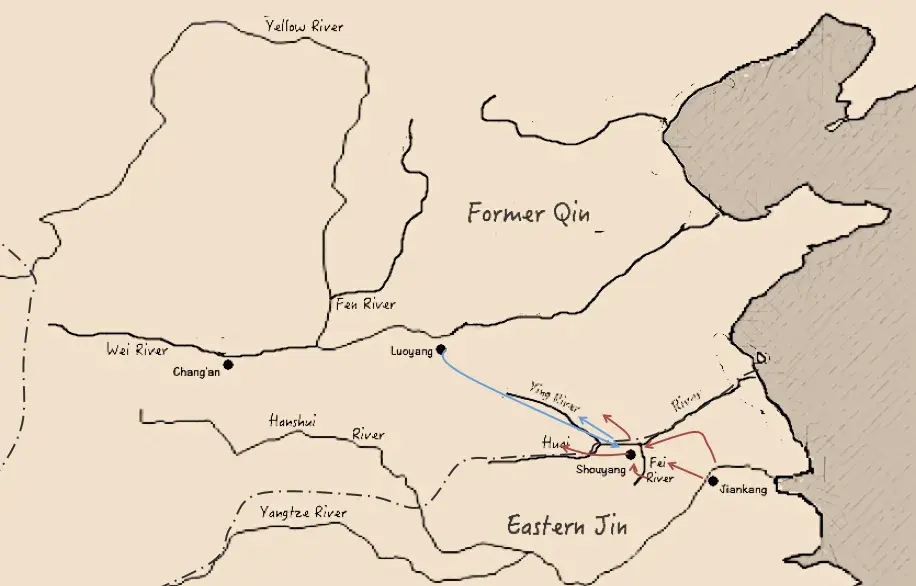
司马曜Eastern Jin Dynasty (东晋)

Historical figure

Sima Yao (司马曜)

362 CE–396 CE

Sima Yao (362 – November 6, 396), courtesy name Changming, was a native of Wen County in Henei. He was the sixth son of Emperor Jianwen (Sima Yu), reigning as the ninth monarch of the Eastern Jin dynasty from 372 to 396, known temple-named as Liezong and posthumously as Emperor Xiaowu of Jin. In 372 AD, as Emperor Jianwen lay critically ill, elder statesmen Wang Tanzhi and Xie An thwarted Grand Marshal Huan Wen plot to usurp the throne, investing eleven-year-old Sima Yao as Crown Prince and sovereign. Following Huan Wen death, Empress Dowager Chu assumed a transitional regency while Xie An guided civil administration. In 376 AD, Emperor Xiaowu celebrated his capping ceremony and assumed direct personal governance. In 383 AD, facing a massive northern invasion by Former Qin, the emperor resolutely supported Xie An and Xie Xuan in directing the Battle of Fei River, achieving a legendary triumph that preserved southern civilization and shattered Former Qin dominance. Capitalizing on this victory, Emperor Xiaowu broke the seventy-year monopoly of aristocratic oligarchs over central power, appointing his younger brother Sima Daozi to oversee the cabinet and successfully returning supreme authority to the imperial house. Furthermore, he instituted vital fiscal reforms replacing land-based grain tithes with per-capita household taxation, reestablished the National Academy, honored Confucius descendants, and promoted classical statecraft alongside Buddhist philosophy. In his later years, political rivalry with Sima Daozi intensified while the emperor indulged in wine. On November 6, 396, after making a drunken jest toward his favored Consort Zhang, he was smothered to death with bed quilts in Qingshu Hall at age thirty-five. He was interred in Longping Mausoleum, succeeded by his son Sima Dezong.

司马德宗Eastern Jin Dynasty (东晋)

Tenth Emperor of the Eastern Jin Dynasty (Puppet Monarch)

Sima Dezong (司马德宗)

382 CE–419 CE

Sima Dezong (司马德宗, 382 – January 28, 419), known historically as Emperor An of Jin, was the tenth emperor of the Eastern Jin Dynasty, reigning from 396 to 419 (with an interruption during the usurpation of Huan Xuan). He was the eldest son of Emperor Xiaowu of Jin (Sima Yao) and Lady Chen Guinu (posthumously Empress Dowager De), and the elder brother of the last Jin sovereign, Sima Dewen. In 387, he was invested as crown prince; in 396, he ascended the throne following Emperor Xiaowu's death, naming Lady Wang Shen'ai as his empress. From infancy, Sima Dezong suffered from severe intellectual disability and complete speechlessness. Historical dynastic annals recorded that he was unable to articulate words, could not distinguish between winter cold and summer heat, lacked awareness of hunger or satiety, and was entirely dependent on palace attendants for daily sustenance and mobility. Throughout his reign, real political authority lay entirely beyond his control. Power initially rested with his uncle Sima Daozi, Prince of Kuaiji, and Sima Yuanxian, whose maladministration precipitated widespread revolts by regional warlords Wang Gong, Yu Kai, and Yin Zhongkan, as well as the devastating Sun En-Lu Xun Daoist rebellion across Jiangdong. In 403, warlord Huan Xuan captured Jiankang, usurped the throne to found Huan Chu, and demoted Sima Dezong to Prince of Pinggu, exiling him to Xunyang. In 404, northern garrison commander Liu Yu launched a loyalist uprising at Jingkou, killing Huan Xuan and restoring Emperor An. For the remainder of his life, Sima Dezong was controlled by Liu Yu. In January 419, seeking to fulfill a dynastic prophecy to legitimize his accession, Liu Yu dispatched Wang Shaozhi to strangle the defenseless emperor at the Eastern Hall of the Jiankang palace. He died at thirty-seven and was buried at Xiupingling.

Eastern Jin Dynasty (东晋)

Eleventh and Last Emperor of the Eastern Jin Dynasty

Sima Dewen (司马德文)

386 CE–421 CE

Sima Dewen (司马德文, 386 – November 421), known historically as Emperor Gong of Jin, was the eleventh and last emperor of the Eastern Jin Dynasty, reigning from January 28, 419 to July 5, 420. He was the second son of Emperor Xiaowu of Jin (Sima Yao), the younger brother of Emperor An of Jin (Sima Dezong), and the son of Lady Chen Guinu (posthumously Empress Dowager De). Initially enfeoffed as Prince of Langye, he served as General of the Guards and General of Chariots and Cavalry. Unlike his disabled elder brother, Sima Dewen was intelligent, gentle, and deeply dutiful. Throughout Emperor An's reign, as the court suffered under warlord rebellions and the usurpation of Huan Xuan, Sima Dewen stayed constantly by his brother's side, personally nursing him and safeguarding his life through multiple crises. In January 419, following the assassination of Emperor An arranged by warlord Liu Yu to fulfill the prophetic saying that "after Changming there shall be two emperors," Sima Dewen was enthroned as a puppet sovereign under the era name Yuanxi. In July 420, when Liu Yu demanded his abdication, Sima Dewen recognized the dynastic transition as inevitable, calmly copying the abdication decree by hand and stating that Jin had already lost the mandate during Huan Xuan's coup, surviving twenty years solely due to Liu Yu's prowess. Following the establishment of the Liu Song Dynasty, he was demoted to Prince of Lingling and confined at Moling under strict military surveillance. In November 421, Liu Yu dispatched soldiers who breached his residence and smothered the thirty-six-year-old former emperor with bedclothes. He received the posthumous title Emperor Gong and was buried at Chongpingling, his murder terminating the centuries-old tradition of sparing abdicated rulers.

KEY PEOPLE

All people
桓玄Eastern Jin Dynasty (东晋)

Founding Emperor of Huan Chu

Huan Xuan (桓玄)

369 CE–404 CE

Huan Xuan (桓玄, 369–404), courtesy name Jingdao and childhood name Lingbao, was the founding emperor of the short-lived Huan Chu dynasty and a paramount military regent of the late Eastern Jin. The youngest, illegitimate son of Grand Marshal Huan Wen, he inherited the title Duke of Nan Commandery at age five and was widely celebrated for his imposing physical stature, poetic talent, and connoisseurship of calligraphy and master paintings. Long held in check by the Xie and Wang lineages in the capital, he retired in frustration to Jiangling, where he mobilized his family's hereditary military networks across the middle Yangtze. During the domestic chaos under Sima Daizi and Sima Yuanxian, Huan Xuan eliminated regional rivals Yin Zhongkan and Yang Quanqi in 399, consolidating control over five western provinces. In 402, he launched a massive naval offensive downstream, subverted Beifu Army commander Liu Laozhi, and occupied Jiankang, executing Sima Yuanxian and seizing supreme authority as Chancellor and Grand Marshal. In December 403, he compelled Emperor An to abdicate, ascending the throne as Emperor of Great Chu with the reign era Yongsui. However, his despotic looting of cultural treasures and military complacency toward Liu Yu swiftly invited doom. In March 404, Liu Yu launched a surprise uprising at Jingkou, routing the imperial vanguard at Jiangcheng and compelling Huan Xuan to flee back to Jiangling. Following catastrophic naval defeats at Sangluozhou and Zhengrongzhou, he fled toward Sichuan but was intercepted at Meihuizhou in Badong by commanders under Mao Qu, where he was run through with a spear and decapitated at thirty-six. His severed head was hung at the Zhuque Bridge in Jiankang, bringing an ignominious end to the Huan Chu state.

张骏Former Liang Dynasty (前凉)

Fourth Ruler of Former Liang

Zhang Jun (张骏)

Zhang Jun (张骏, 307–346), courtesy name Gongting (公庭), was a native of Wushi County, Anding Commandery (modern northwest of Pingliang, Gansu Province). He was the fourth ruler of the Former Liang regime during the Sixteen Kingdoms period, the son of King Ming Zhang Shi, and the designated successor of his uncle King Cheng Zhang Mao. From early childhood, Zhang Jun displayed extraordinary intelligence, extensive mastery of classical literature, and exceptional poetic talent, composing elegant prose by age ten while maintaining a dashing and magnanimous demeanor. In 324, upon the death of Zhang Mao, the eighteen-year-old Zhang Jun succeeded as Duke of Xiping and Pastoral Overseer of Liangzhou. He governed for twenty-two years, combining military acumen with statecraft, and elevated Former Liang to the greatest territorial extent and economic prosperity in its history. Militarily and diplomatically, Zhang Jun maintained regional autonomy by retaining the Western Jin Jianxing calendar internally to preserve local cohesion. Externally, he skillfully balanced relations with dominant northern rival empires Former Zhao and Later Zhao, offering nominal tribute to secure peace while seizing strategic opportunities to recover the territory south of the Yellow River and conquer Longxi, dividing his realm into Shazhou and Hezhou. Furthermore, Zhang Jun dispatched General Yang Xuan across the Taklamakan Desert, subduing the ancient kingdoms of Kucha and Shanshan to reopen the Silk Road. Domestically, he promoted agriculture, adjusted corvee burdens, patronized Confucian scholarship, and welcomed candid criticism from loyal officials like Suo Xun and Liu Qing. In 346, Zhang Jun passed away in Guzang at the age of forty and was interred in the Daling Mausoleum. Eastern Jin posthumously bestowed the title Grand Marshal and Duke Zhongcheng, and his son Zhang Zuo later elevated him as Shizu King Wen.

张寔Former Liang Dynasty (前凉)

Second Ruler of Former Liang

Zhang Shi (张寔)

Zhang Shi (张寔, 271–320), courtesy name Anxun (安逊), was a native of Wushi County, Anding Commandery (modern northwest of Pingliang, Gansu Province). He served as the second ruler of the Former Liang regime during the Sixteen Kingdoms period and was the eldest son of Former Liang's founding patriarch Zhang Gui. In his youth, Zhang Shi was renowned for his profound scholarship, keen perception, and genuine reverence for talented scholars. During the early Yongjia era of Western Jin, as the Central Plains fell into catastrophic turmoil, Zhang Shi resigned from his prestigious imperial post as General of the Agile Cavalry in Luoyang and returned to Liangzhou. He assisted his father in pacifying the rebellion of Cao Qu and administering the Hexi Corridor, progressively rising to Gentleman Consultant, General of the West Center, Colonel Who Protects the Qiang, and Marquis of Fulu County. In 314, upon Zhang Gui's death, Zhang Shi succeeded to the governance of Liangzhou and received official appointment from Emperor Min of Western Jin as Commander-in-Chief of Liangzhou Military Affairs, Inspector of Liangzhou, and Duke of Xiping. Facing the collapse of the Western Jin dynasty and the fragmentation of northern China, Zhang Shi upheld the Jianxing era name of Emperor Min, repeatedly dispatching relief armies eastward to aid Chang'an and Guanlong, while sheltering refugees, encouraging honest counsel, and preserving peace and classical civilization in the Hexi Corridor. In 318, Emperor Yuan of Eastern Jin ascended the imperial throne in Jiankang. Zhang Shi dispatched envoys with congratulatory memorials, yet internally continued to observe the Western Jin Jianxing calendar, establishing a de facto autonomous regional state. In 320, Liu Hong, a sorcerer from Mount Tianti, plotted rebellion and corrupted Zhang Shi's trusted palace guards. In May, guards Yan She and Zhao Yang assassinated Zhang Shi in his sleeping pavilion at the age of fifty. His brother Zhang Mao suppressed the rebellion and succeeded him. Zhang Shi was initially honored with the posthumous title Duke Zhao, received the imperial posthumous title Duke Yuan from Eastern Jin, and was later elevated to Gaozu King Ming by his grandson Zhang Zuo.

李歆Western Liang (西凉)

Second Ruler of Western Liang

Li Xin (李歆)

Li Xin (李歆, c. 385–420), courtesy name Shiye (士业) and childhood name Tongzhui (桐椎), was a native of Didao County, Longxi Commandery (modern Lintao County, Gansu Province). He was the second ruler of the Western Liang regime during the Sixteen Kingdoms period, the second son of founding monarch King Wuzhao Li Gao, and a prominent patrilineal ancestor of the Tang dynasty imperial house. In his youth, Li Xin served in military campaigns alongside his father, earning renown for martial valor and operational decisiveness. In 399, he spearheaded the defeat of Northern Liang commander Suo Si, securing Dunhuang as the territorial cradle for the Li family. In 404, following the premature death of his elder brother Li Tan, Li Xin was formally invested as Crown Prince. In 410, when Juqu Mengxun of Northern Liang breached the peace covenant and raided border districts, Li Xin routed the invaders and captured rebel commander Qiequ Bainian. In 417, following Li Gao's demise, Li Xin succeeded to regional leadership, promulgated the Jiaxing era, honored his mother Lady Yin as Empress Dowager, and received official confirmation from the Eastern Jin court as General Who Defends the West and Duke of Jiuquan. Early in his reign, he unmasked Juqu Mengxun's feigned defection plot and achieved a crushing triumph at the Battle of Jiezhijian, decapitating over seven thousand hostile warriors. However, Li Xin gradually developed an autocratic and reckless disposition, enforcing harsh criminal statutes and exhausting state revenues to construct luxurious palatial compounds while dismissing candid admonitions from officials such as Zhang Xian. In 420, Juqu Mengxun feigned an expedition westward toward Haowei to lure Li Xin into the field. Disregarding Empress Dowager Yin's weeping entreaties from the palace ramparts and the urgent remonstrances of Senior Adviser Song Yao, Li Xin mobilized all available provincial units to assault Zhangye. Falling into an ambush at Liaoquan, his army was utterly surrounded and annihilated at Huaiquan. Overcome by remorse and refusing to retreat toward Dunhuang, Li Xin charged into enemy formations and died in combat at the age of approximately thirty-five. Northern Liang subsequently overran Jiuquan, bringing about the collapse of the Western Liang state.

谢安Eastern Jin Dynasty (东晋)

Statesman

Xie An (谢安)

320 CE–385 CE

Xie An (320–385 CE), courtesy name Anshi, was a native of Yangxia in Chen Commandery (modern Taikang, Henan). He was an illustrious statesman, military strategist, Grand Chancellor, calligrapher, and cultural patriarch of the Eastern Jin Dynasty, standing alongside the Wang clan as the supreme leader of the southern aristocratic gentry. He rose to the highest imperial offices of Grand Guardian, Minister over the Masses, and Manager of the Masters of Writing, was created Duke of Luling Commandery, and was posthumously honored as Grand Tutor and Marquis Wenjing. Endowed with aristocratic poise and literary genius from his youth, Xie An harbored a profound aversion to official factionalism, living in idyllic seclusion in the Eastern Mountains (Dongshan) of Kuaiji for over two decades alongside master calligrapher Wang Xizhi, creating the timeless proverb: "If Anshi refuses to come forth, what shall become of the common people?" At age forty, following family misfortunes, he entered public service, an event that coined the idiom "making a comeback from the Eastern Mountains" (Dongshan Zaiqi). In 373 CE, when the ambitious warlord Huan Wen fell mortally ill and attempted to usurp the throne by demanding the Nine Bestowals, Xie An faced down armed assassins with cool serenity, tactfully delaying the imperial edicts until Huan Wen died, preserving the Jin dynasty without bloodshed. Appointed prime minister, Xie An guided the youthful Emperor Xiaowu, reconciling rival clans and directing his nephew Xie Xuan to organize and drill the elite "Beifu Army." In 383 CE, when Former Qin ruler Fu Jian launched a colossal invasion with an army of nearly one million men, Xie An assumed supreme command as Grand Commander of Expeditions. Directing operations from Jiankang with absolute equanimity, he deployed Xie Xuan's eighty thousand Beifu veterans to achieve a miraculous victory at the Battle of Fei River, repelling the northern host and preserving southern Chinese civilization. Retiring to Guangling in his final years to escape imperial jealousy, Xie An passed away in 385 CE at sixty-six years of age, celebrated across Chinese history as the supreme embodiment of the effortless, high-minded statesman.

臧爱亲Eastern Jin Dynasty (东晋)

First Wife of Emperor Wu of Liu Song (Liu Yu)

Zang Aiqin (臧爱亲)

361 CE–408 CE

Zang Aiqin (臧爱亲, 361–408), a native of Ju County in Dongwan (modern Ju County, Rizhao, Shandong), was the granddaughter of Secretarial Court Gentleman Zang Wang and daughter of Commandery Officer Zang Jun, and the primary wife and posthumously honored founding empress (Empress Jing) of Emperor Wu of Liu Song (Liu Yu). Originating from a celebrated northern aristocratic lineage that migrated south, she married Liu Yu when he was an impoverished commoner in Jingkou. Despite her husband's initial penury and debts, Lady Zang rejected aristocratic conceit, managing household chores, spinning hemp, caring devotedly for her stepmother-in-law Xiao Wenshou, and raising Liu Yu's younger brothers Liu Daolian and Liu Daogui, providing the crucial domestic stability that enabled Liu Yu to enter military service. During the anti-Huan Xuan uprising in 404, she firmly safeguarded the family in Jingkou while Liu Yu mobilized troops. As Liu Yu rose to paramount military chancellor and Duke of Yuzhang, Lady Zang presided over his official residence in the Eastern Mansion, maintaining an unyielding policy of personal thrift, rejecting all private bribes from ambitious courtiers, and strictly forbidding her maternal relatives from seeking office through patronage. She passed away in 408 at the age of forty-eight. Following Liu Yu's imperial enthronement in 420 as founder of the Liu Song Dynasty, he posthumously honored her as Empress Jing and enshrined her in the imperial temple, taking a solemn personal vow never to elevate another empress during his lifetime out of lifelong devotion to his deceased first wife.

王敦Western Jin, Eastern Jin

Supreme Warlord

Wang Dun (王敦)

266 CE–324 CE

Wang Dun (266 – July 324), courtesy name Chuzhong, was a paramount aristocratic warlord, grand general, and de facto co-founder of the Eastern Jin dynasty. Belonging to the supreme Langya Wang clan, he married Princess Xiangcheng, daughter of Emperor Wu of Jin, and demonstrated striking personal charisma, literary distinction, and military boldness from youth. Following the catastrophic collapse of Western Jin during the Disaster of Yongjia in 311, Wang Dun collaborated closely with his cousin Wang Dao to escort Prince Sima Rui across the Yangtze River. While Wang Dao orchestrated civilian gentry alliances at Jiankang, Wang Dun commanded the military legions in the middle Yangtze as Regional Inspector of Jingzhou and Grand General, establishing the historic dynastic condominium celebrated as "The Wangs and the Simas share the empire". However, when Emperor Yuan sought to curb the Wang family's overweening power by patronizing confidants Liu Wei and Diao Xie, Wang Dun launched an armed rebellion from his headquarters at Wuchang in 322. Proclaiming to "cleanse the court of treacherous sycophants," his armies swept into Jiankang, routing imperial loyalists and forcing the humiliated Emperor Yuan to succumb to grief. When Emperor Ming ascended the throne and prepared imperial counter-offensives, an ailing Wang Dun launched a second assault on the capital in 324. He died of illness in camp amidst military defeats at age fifty-eight, whereupon imperial forces exhumed and desecrated his corpse.

谢晦Eastern Jin Dynasty (东晋)

Founding statesman

Xie Hui (谢晦)

390 CE–426 CE

Xie Hui (谢晦, 390 – May 22, 426), courtesy name Xuanming (宣明), was a prominent founding statesman, regent, and military governor of the Liu Song Dynasty during the Southern and Northern Dynasties period. Belonging to the illustrious Xie clan of Chen Commandery—one of the paramount aristocratic houses of the Eastern Jin along with the Wang clan—Xie Hui was recruited into the personal staff of Liu Yu (the future Emperor Wu of Song) through the recommendation of chief strategist Liu Muzhi. Renowned for his quick political wit, strategic versatility, and administrative competence, Xie Hui became Liu Yu's most trusted civilian counselor during the northern expedition against Later Qin in 416–417. On his deathbed in 422, Emperor Wu appointed Xie Hui, alongside Xu Xianzhi, Fu Liang, and Tan Daoji, as testamentary regents to guide the youthful Emperor Shao (Liu Yifu). In 424, alarmed by Emperor Shao's frivolous disregard for imperial duties, Xie Hui and his fellow regents executed a palace coup, deposing and murdering Emperor Shao along with his capable brother Liu Yizhen, and enthroning the Prince of Yidu, Liu Yilong (Emperor Wen of Song). Following the succession, Xie Hui assumed military command over the vital upstream province of Jingzhou as its Governor. In 426, Emperor Wen resolved to reassert sovereign imperial authority by eradicating the regents. After Xu Xianzhi and Fu Liang were executed in Jiankang, Xie Hui mobilized a massive fleet at Jiangling to wage civil war. Defeated at the Battle of Jiangjin by imperial forces commanded by Tan Daoji and Dao Yanzhi, Xie Hui was captured while fleeing and executed in Jiankang alongside his sons and brothers at the age of thirty-seven.

陶侃Eastern Jin Dynasty (东晋)

Grand Marshal

Tao Kan (陶侃)

259 CE–334 CE

Tao Kan (陶侃, 259 – July 30, 334), courtesy name Shixing (士行), was an eminent military commander, provincial administrator, and Grand Marshal of the Eastern Jin Dynasty. Arising from a humble indigenous southern background in Poyang, he lost his father in early childhood and was raised under the strict moral tutelage of his mother, Lady Zhan—who entered Chinese cultural history as one of the "Four Exemplary Mothers of Ancient China" for cutting off her hair to sell for food to host her son's guests. Overcoming severe aristocratic discrimination against southern lineages, Tao Kan rose through meticulous administrative competence and battlefield bravery during the late Western Jin. Under Emperor Yuan of Jin (Sima Rui), Tao Kan served as Governor of Jingzhou, pacifying the menacing peasant uprisings led by Du Tao and securing the middle Yangtze river basin. During the catastrophic Su Jun Rebellion (327–328) that destroyed Jiankang and held the young Emperor Cheng hostage, Tao Kan was appointed Supreme Allied Commander by Wen Qiao and Yu Liang, coordinating land and amphibious assaults that crushed the rebel armies, slew Su Jun, and restored the Eastern Jin imperial house. Holding the offices of Grand Marshal (Da Sima), Grand Commandant (Taiwei), and Commander-in-Chief of Eight Provinces, Tao Kan maintained naval vigilance and economic prosperity throughout southern China for decades without ever abusing his paramount military authority. Celebrated in cultural folklore for his legendary personal discipline—such as carrying one hundred bricks every morning and evening to maintain bodily fitness, treasuring every inch of daylight, and collecting discarded woodchips and bamboo shavings for municipal engineering—Tao Kan passed away in 334 at the age of seventy-six. His great-grandson was the immortal pastoral poet Tao Yuanming.

谢玄Eastern Jin Dynasty (东晋)

Supreme military commander

Xie Xuan (谢玄)

343 CE–388 CE

Xie Xuan (谢玄, 343–388), courtesy name Youdu (幼度), was a preeminent military commander, strategist, and national savior of the Eastern Jin Dynasty. A core luminary of the illustrious Chenjun Xie clan, he was the son of General Xie Yi, the younger brother of the celebrated poetess Xie Daoyun, and the nephew of Grand Chancellor Xie An. Exhibiting profound strategic vision, physical composure, and tactical boldness from his youth, Xie Xuan served as a senior staff officer under the hegemon Huan Wen. In 377, with northern China unified under the formidable Former Qin dynasty ruled by Fu Jian and threatening an invasion of the south, Chancellor Xie An appointed Xie Xuan as Governor of Yanzhou to organize the northern defenses. Mobilizing battle-hardened northern refugee migrants who had fled into the lower Yangtze basin around Jingkou and Guangling, Xie Xuan rigorously trained and equipped the legendary "Beifu Army" (Beifu Bing), transforming northern emigre pioneers into the most lethal shock infantry in Chinese military history. In 379, Xie Xuan achieved brilliant defensive victories at the Battle of San'a, shattering Former Qin invasion columns under Peng Chao and Ju Nan. In the autumn of 383, when Fu Jian mobilized an immense multi-ethnic invasion host of several hundred thousand troops to extinguish the Eastern Jin, Xie Xuan was appointed Vanguard Commander-in-Chief. Commanding eighty thousand elite Beifu troops at the epochal Battle of Fei River (Feishui Zhi Zhan), Xie Xuan executed a masterclass in tactical deception and shock assault: he persuaded Fu Jian to withdraw slightly to permit a river crossing, then unleashed heavy amphibious charges while secret agents incited panic in the enemy rear, turning Fu Jian's retreat into a catastrophic rout and saving southern Chinese civilization from annihilation. He subsequently spearheaded northern expeditions that recovered Henan, Shandong, and lands south of the Yellow River. Sidelined in his later years due to factional jealousy from imperial prince Sima Daozi, Xie Xuan passed away in 388 at the age of forty-six, being posthumously honored as General of Chariots and Cavalry and Duke Xianwu of Kangle. His grandson was the celebrated founder of Chinese landscape poetry, Xie Lingyun.

Eastern Jin Dynasty (东晋)

Imperial Grand Councilor

Wang Hong (王弘)

东晋末–南朝宋

Wang Hong (王弘, 379–432), courtesy name Xiuyuan (休元), was a native of Linyi in Langya Commandery (modern Linyi, Shandong). He was a distinguished statesman, grand chancellor, and pivotal dynastic architect during the Eastern Jin and early Liu Song Dynasty. A scion of the paramount aristocratic house of Langya Wang, he was the great-grandson of Eastern Jin Chancellor Wang Dao and the eldest son of Minister over the Masses Wang Xun. Celebrated from his youth for brilliant administrative acumen, literary refinement, and composure, Wang Hong joined the headquarters of Liu Yu (Emperor Wu of Song) in the late Eastern Jin, becoming his foremost political confidant and diplomatic advisor. Following Liu Yu's founding of the Liu Song Dynasty, Wang Hong was ennobled as the Duke of Huarong. Under Emperor Wen of Song, Wang Hong governed as Chief Minister (Zaixiang), holding the supreme offices of Grand Protector (Taibao) and Director of the Imperial Secretariat, where he partnered with Prince Liu Yikang to formulate laws, alleviate taxation, and inaugurate the celebrated "Prosperity of Yuanjia" (Yuanjia Zhi Zhi).

刘道规Eastern Jin Dynasty (东晋)

Prominent general of the late Eastern Jin

Liu Daogui (刘道规)

东晋末

Liu Daogui (刘道规, 370–412), courtesy name Daoze (道則), ancestral native of Suiyu Ward in Pengcheng County, Pengcheng Commandery (present-day Xuzhou, Jiangsu Province) who resided in Jingkou Ward, Dantu County, Jinling Commandery (present-day Zhenjiang, Jiangsu Province), was an outstanding military commander of the late Eastern Jin and the youngest half-brother of Liu Yu (the founding Emperor Wu of the Liu Song dynasty). Bold and ambitious from youth, he was deeply trusted by Liu Yu. In the second month of the third year of Yuanxing (404), responding to Liu Yu's uprising against the usurper Huan Xuan, Liu Daogui joined Liu Yi and Meng Chang in killing Huan Xuan's Regional Inspector of Qingzhou, Huan Hong, to seize Guangling before crossing the Yangtze to help recapture Jiankang. Pursuing Huan Xuan westward alongside Liu Yi and He Wuji, he routed enemy forces at Sangluozhou and spearheaded the decisive victory against overwhelming odds at Zhengrongzhou, recovering Jiangling in early 405 and restoring Emperor An of Jin. Appointed Regional Inspector of Jingzhou and enfeoffed as Duke of Huarong County, he governed the middle Yangtze region for seven years with spotless integrity. During the Lu Xun rebellion in 410, when Jiangling was besieged from multiple directions by Huan Qian, Qiao Daofu, Gou Lin, and Xu Daofu, Liu Daogui threw open the city gates to calm wavering residents, rode out alone to welcome ally Lu Zongzhi, slew Huan Qian and burned all treasonous correspondence unread, and annihilated Xu Daofu's 30,000-man fleet at Yuzhangkou. He died of illness in the intercalary sixth month of 412 at the age of forty-three, was posthumously named Duke Liewu of Nan Commandery, and was elevated to Prince Liewu of Linchuan after the founding of the Liu Song dynasty.

KEY EVENTS

01
《肘后备急方》
《肘后备急方》CHIST · Credits in entry

Eastern Jin Dynasty (东晋) · 317 CE–343 CE

Compilation of the Handbook of Prescriptions for Emergency ((肘后备急方))

The compilation of the *Handbook of Prescriptions for Emergency* (*Zhouhou Beijifang*) ((肘后备急方)), originally titled *Zhouhou Jiuzufang* (*Handy Prescriptions for Emergencies*), refers to the creation of a landmark clinical emergency manual by the eminent Eastern Jin physician and alchemist Ge Hong between 317 and 343 CE (from the first year of the Jianwu era to the first year of the Jianyuan era) during his seclusion at Mount Luofu and Danyang. Amid widespread war and virulent epidemics, commoners and travelers frequently perished due to lack of medical aid. Recognizing that ancient medical treatises were bulky and prescribed unobtainable luxury ingredients, Ge Hong condensed his 100-volume encyclopedia *Jin Gui Yu Han Fang* into a compact, easily portable handbook containing affordable, accessible remedies and moxibustion techniques that could be carried in one's sleeve or behind the elbow (*zhouhou*). The treatise was later supplemented by Tao Hongjing of the Southern Liang with 101 formulas and retitled *Buque Zhouhou Baiyifang*, and subsequently expanded during the Jin Dynasty by Yang Yongdao, resulting in the extant eight-volume, seventy-three chapter edition known as *Zhouhou Beijifang*. The work contains China's earliest clinical accounts of smallpox, scrub typhus, rabies, and beriberi, pioneering the application of rabid dog brain tissue to wounds as an early immunization concept, and establishing the cold extraction of artemisia juice for treating malaria, an observation that directly inspired modern artemisinin therapies.

Jurong, Danyang, and Mount Luofu (modern Jurong, Jiangsu Province; Boluo County, Guangdong Province)
02
兰亭雅集
兰亭雅集CHIST · Credits in entry

Eastern Jin Dynasty (东晋) · 353 CE–353 CE

The Orchid Pavilion Gathering (兰亭雅集)

The Orchid Pavilion Gathering was a celebrated literati summit and spring purification ceremony convened on April 22, 353 (the third day of the third lunar month in the ninth year of the Yonghe era of Eastern Jin Emperor Mu) by Wang Xizhi, General of the Right Army and Internal Administrator of Kuaiji. Held at the Orchid Pavilion in Shanyin, the assembly brought together forty-two eminent figures from prominent northern aristocratic exile families—including the Wangs of Langya, the Xies of Chenjun, the Suns of Taiyuan, and the Xis of Gaoping—alongside regional Jiangnan elites. Seated alongside winding streams, the scholars performed ancient purification rituals and pioneered the game of floating wine cups along the current to stimulate spontaneous poetic composition. Twenty-six literati composed thirty-seven poems that were compiled into an anthology. While pleasantly intoxicated, Wang Xizhi used a mouse-whisker brush on cocoon paper to draft the immortal *Preface to the Orchid Pavilion Poems* (*Lantingji Xu*), celebrated throughout Chinese history as the "Foremost Running Script under Heaven." The gathering elevated archaic spring rituals into a pinnacle of Wei-Jin romanticism and calligraphic artistry, profoundly molding Chinese literati aesthetics for millennia.

Orchid Pavilion, Shanyin County, Kuaiji Commandery (modern Lanting Town, Keqiao District, Shaoxing, Zhejiang)
03
刘裕两次北伐
刘裕两次北伐CHIST · Credits in entry

Eastern Jin Dynasty (东晋) · 409 CE–418 CE

Liu Yu's Two Northern Expeditions (刘裕两次北伐)

Liu Yu's Two Northern Expeditions (刘裕两次北伐) were two strategic military campaigns conducted between 409 and 418 CE by the supreme commander of the Beifu Army and future founding Emperor of the Liu Song dynasty, Liu Yu. Having endured decades of humiliation and military reverses under earlier generals, the Eastern Jin seized upon northern factionalism to launch offensive operations. In 409 CE, Liu Yu mobilized to punish Southern Yan's incursions into Huaibei, traversing the Daxian defiles, shattering the enemy host at Linqu, and capturing Guanggu in 410 CE to extinguish Southern Yan. In 416 CE, following the death of Later Qin ruler Yao Xing, Liu Yu mounted his second campaign with a five-pronged amphibious offensive. Eastern Jin forces liberated the ancient capital of Luoyang, repelled tens of thousands of Northern Wei cavalry along the Yellow River using the revolutionary Crescent Array (queyue zhen), and forced the capitulation of Emperor Yao Hong in Chang'an in 417 CE. Although Chang'an was relinquished to Helian Bobo's Xia cavalry following the untimely death of prime minister Liu Muzhi and internal garrison mutinies, the campaigns permanently secured Shandong, Henan, and Huaibei for the south, establishing Liu Yu's paramount authority and laying the bedrock for the founding of the Liu Song dynasty.

Huaibei, Shandong (Guanggu, Linqu), Henan (Luoyang, Xuchang), Shaanxi-Shanxi border (Tongguan, Yellow River), Guanzhong (Chang'an)
04
刘裕北伐
刘裕北伐CHIST · Credits in entry

Eastern Jin Dynasty (东晋) · 409 CE–418 CE

Liu Yu's Northern Expeditions (刘裕北伐)

Liu Yu's Northern Expeditions (刘裕北伐) were two large-scale strategic military campaigns conducted between 409 and 418 CE by the supreme commander of the Beifu Army and founding sovereign of the Liu Song dynasty, Liu Yu. Having endured decades of passive defense following the loss of the north, the Eastern Jin capitalized on northern factionalism to launch offensive operations. In 409 CE, Liu Yu mobilized to punish Southern Yan incursions into Huaibei, traversing the Daxian defiles, shattering the enemy host at Linqu, and taking Guanggu in 410 CE to extinguish Southern Yan and recover Shandong. In 416 CE, following the death of Later Qin ruler Yao Xing, Liu Yu mounted his second campaign with a five-pronged amphibious offensive. Eastern Jin forces liberated the ancient capital of Luoyang, repelled tens of thousands of Northern Wei cavalry along the Yellow River using the revolutionary Crescent Array (queyue zhen), and forced the capitulation of Emperor Yao Hong in Chang'an in 417 CE. Although Chang'an was relinquished to Helian Bobo's Xia cavalry following the untimely death of prime minister Liu Muzhi and internal garrison mutinies, the campaigns permanently secured Shandong, Henan, and Huaibei for the south, establishing Liu Yu's paramount authority and laying the bedrock for the founding of the Liu Song dynasty.

Huaibei, Qing-Qi (Linqu, Guanggu), Central Plains (Xuchang, Luoyang), Yellow River corridor (Sanmenxia, Shan City), Guanzhong (Tongguan, Chang'an)
05
北府兵建立
北府兵建立CHIST · Credits in entry

Eastern Jin Dynasty (东晋) · 377 CE–377 CE

Formation of the Beifu Army (北府兵建立)

The formation of the Beifu Army was a pivotal military milestone in 377 (the 2nd year of Taiyuan) during the Eastern Jin dynasty, executed amidst severe military threats from Former Qin and internal political rivalries between the imperial capital and the upstream commanderies. Following the Disaster of Yongjia, millions of northern refugees fled south, forming massive settlements at Jingkou (modern Zhenjiang, Jiangsu) and Guangling (modern Yangzhou, Jiangsu). In the early Taiyuan era, Fu Jian of Former Qin unified northern China and mobilized massive forces against the Jianghuai frontier, while Eastern Jin military authority remained concentrated in the hands of the Huan clan at Jingzhou, leaving the central capital of Jiankang defenseless. Confronting this crisis, Grand Councilor Xie An appointed his nephew Xie Xuan as Regional Inspector of Yanzhou stationed at Guangling. Xie Xuan established expansive recruitment depots across Jingkou and Guangling, enlisting hardened northern migrants and recruiting formidable commanders such as Liu Laozhi and He Qian to build a disciplined, elite fighting force known as the Beifu Army. The creation of the Beifu Army provided the Eastern Jin court with its first directly controlled strike army, achieving miraculous victories at Junchuan and the Battle of Fei River to shatter Former Qin ambitions, while eventually nurturing the martial clique under Liu Yu that transformed Southern Dynasties governance.

Jingkou (modern Zhenjiang, Jiangsu), Guangling (modern Yangzhou, Jiangsu), and the Jianghuai corridor
06
孙恩卢循起义
孙恩卢循起义CHIST · Credits in entry

Eastern Jin Dynasty (东晋) · 399 CE–411 CE

Rebellion of Sun En and Lu Xun (孙恩卢循起义)

The Rebellion of Sun En and Lu Xun was an unprecedented, long-lasting agrarian and religious insurrection that severely shaken the foundation of the Eastern Jin Dynasty for over a decade. In 399, taking advantage of internal court strife and widespread popular resentment caused by the forced conscription of recently emancipated tenant farmers, Sun En, a prominent leader of the Way of the Celestial Masters, launched an armed uprising from maritime bases in Kuaiji. The movement rapidly mobilized tens of thousands of impoverished peasants, tenant farmers, and disenfranchised coastal inhabitants across eight commanderies in southeastern China. Following Sun En's battlefield defeat and suicide by drowning in 402, his brother-in-law Lu Xun and key commander Xu Daofu withdrew remnants of their fleet south across the mountain ranges into Lingnan, taking Guangzhou and consolidating their military strength for several years. In 410, seizing the opportunity while top general Liu Yu led a northern expedition against the Southern Yan, Lu Xun and Xu Daofu launched an ambitious naval campaign northward along the river networks, crushing royal armies at Yuzhang and Sangluozhou to reach the gates of the capital Jiankang. General Liu Yu raced back to marshal imperial defenses, mounting an immovable perimeter at Stone Fortress and subsequently routing the rebel flotillas in decisive amphibious battles at Dalei and Zuoli. The rebellion was completely extinguished in 411 following Lu Xun's defeat in Jiaozhou. The protracted conflict fundamentally dismantled the socioeconomic hegemony of aristocratic emigre clans, precipitated the collapse of elite oligarchic politics, and catalyzed the meteoric rise of Liu Yu's militaristic coalition, thereby directly paving the way for the establishment of the Liu Song Dynasty.

Kuaiji, Wuxing, Jiankang, Guangzhou, Jiaozhou
07
建康定都(东晋建立)
建康定都(东晋建立)CHIST · Credits in entry

Eastern Jin Dynasty (东晋) · 317 CE–318 CE

Founding of the Eastern Jin Dynasty and Capital at Jiankang (建康定都/东晋建立)

The Founding of the Eastern Jin Dynasty and Capital at Jiankang (建康定都/东晋建立) was a pivotal historical epoch unfolding between 317 and 318, in which Sima Rui, the Prince of Langya and a scion of the Western Jin imperial house, re-established the Jin dynasty in Jiankang (modern Nanjing) following the catastrophic collapse of the Western Jin in northern China. Exhausted by the internecine War of the Eight Princes, the Western Jin court was overrun during the Disaster of Yongjia in 311 when Han Zhao forces seized Luoyang and captured Emperor Huai, followed by the fall of Chang'an and the execution of Emperor Min in 316. Confronting dynastic annihilation, Sima Rui relied upon the visionary counsel of Wang Dao, having established an administrative base in the former Eastern Wu capital of Jianye in 307. By reconciling prominent northern immigrant lineages with indigenous southern gentry leaders such as Gu Rong and He Xun, and absorbing millions of northern refugees, Sima Rui took the title Prince of Jin in 317 and ascended the imperial throne in 318 under the reign title Daxing. The establishment of Jiankang institutionalized the historic power-sharing compact known as "the Wang and Sima clans jointly share the realm," created emigrant administrative divisions, preserved Chinese cultural transmission, and inaugurated Jiankang's two-century legacy as the grand metropolis of the Southern Dynasties.

Jiankang (modern Nanjing, Jiangsu; former Eastern Wu capital Jianye) (建康)
08
桓温北伐
桓温北伐CHIST · Credits in entry

Eastern Jin, Former Qin, Former Yan · 354 CE–369 CE

Northern Expeditions of Huan Wen (桓温北伐)

The Northern Expeditions of Huan Wen (桓温北伐) were three major military campaigns conducted between 354 and 369 by Eastern Jin Grand Marshal Huan Wen to recover northern territories and forge personal prestige for dynastic succession. In 349, the demise of Later Zhao tyrant Shi Hu plunged northern China into devastating civil war. Having conquered Cheng Han in Sichuan in 346, Huan Wen entrenched himself along the middle Yangtze, repeatedly petitioning to lead northern campaigns, though met with persistent obstruction by the suspicious imperial court in Jiankang. After sidelining court rival Yin Hao, Huan Wen launched three grand offensives. In 354, he led 40,000 troops through the Wu Pass, crushing Qin divisions at Lantian and reaching the Ba River outside Chang'an, where he conferred with renowned recluse Wang Meng before food shortages forced a costly retreat. In 356, Huan Wen routed warlord Yao Xiang at the Yi River, triumphantly entering the historic Western Jin capital of Luoyang and repairing ancestral tombs. In 369, Huan Wen mobilized 50,000 elite troops against Former Yan, advancing to Fangtou near Ye, only for dry waterways to paralyze his supply fleet. Former Yan Prince Murong Chui combined with Former Qin reinforcements to stage a lethal ambush at Xiangyi, annihilating 30,000 Jin troops. The campaigns revealed the logistical limits of southern armies while extinguishing Huan Wen's hopes of formal imperial usurpation.

Guanzhong Plain (Lantian, Ba River), Central Plains of Luoyang (Yi River, Mount Mang), Yellow River Basin at Fangtou (modern Xun County, Henan) and Xiangyi
09
桓玄之乱
桓玄之乱CHIST · Credits in entry

Eastern Jin Dynasty (东晋) · 398 CE–404 CE

Rebellion of Huan Xuan (桓玄之乱)

The Rebellion of Huan Xuan (桓玄之乱) was a catastrophic civil conflict and dynastic usurpation between 398 and 404 that brought an end to the aristocratic political order of the Eastern Jin Dynasty. During the Long'an era, with the cognitively incapacitated Emperor An on the throne, court authority fell to Prince of Kuaiji Sima Daozi and his arrogant son Sima Yuanxian. Meanwhile, Huan Xuan, Duke of Nan County and son of legendary Grand Marshal Huan Wen, eliminated regional rivals Yin Zhongkan and Yang Quanqi to consolidate military hegemony over eight western circuits along the middle Yangtze. In 402, Sima Yuanxian mobilized the imperial armies to subdue Huan Xuan. Exploiting universal hatred of the court, Huan Xuan swept down the Yangtze, seduced Beifu Army commander Liu Laozhi into defection, seized Jiankang, executed Sima Yuanxian, and purged royal princes. In December 403, Huan Xuan forced Emperor An to abdicate, establishing the Huan Chu Dynasty. However, his despotic and capricious administration rapidly alienated the populace. In February 404, veteran Beifu officer Liu Yu initiated a surprise insurrection at Jingkou, annihilating Chu forces outside Jiankang. Huan Xuan fled west to Jiangling and suffered a decisive naval defeat at Zhengrongzhou. In May 404, Huan Xuan was intercepted and decapitated while attempting to flee to Sichuan, restoring Emperor An and placing Eastern Jin under Liu Yu's undisputed leadership.

Jiankang (modern Nanjing, Jiangsu), Jiangling (modern Jingzhou, Hubei), Xunyang, Gushu, Jingkou (modern Zhenjiang, Jiangsu), Zhengrongzhou
10
淝水之战
淝水之战CHIST · Credits in entry

Eastern Jin Dynasty (东晋) · 383 CE–383 CE

Battle of Fei River (淝水之战)

The Battle of Fei River (淝水之战) was a historic military engagement fought in 383 CE between the Di-led Former Qin Empire and the Han-led Eastern Jin dynasty. Having unified northern China, Emperor Fu Jian of Former Qin assembled a multi-ethnic invasion force numbering hundreds of thousands to annex the Eastern Jin, declaring his army could halt the flow of the Yangtze River by casting their whips into it. Facing national destruction, Eastern Jin Grand Chancellor Xie An coordinated military defenses from Jiankang, dispatching Xie Shi and Xie Xuan with eighty thousand elite Beifu soldiers northward to the Huai River front. General Liu Laozhi opened the campaign with a nighttime raid at Luojian, wiping out Qin forward positions. In November, as the two armies confronted each other across the Fei River, Xie Xuan proposed that Qin forces withdraw slightly to allow Jin troops to cross the river for a pitched engagement. Fu Jian ordered a retreat to attack the Jin troops mid-crossing, but the diverse Qin formations dissolved into uncontrollable panic. Former Jin defector Zhu Xu shouted from behind the lines that the Qin army was routed, triggering a stampede across the battlefield. Field Commander Fu Rong was killed, and Fu Jian fled wounded with remnants of his cavalry, inspiring idioms such as mistaking trees for enemy soldiers and dreading the cry of cranes. The victory preserved the southern dynasty and Han civilization, precipitating the collapse of the Former Qin Empire into fractured rival kingdoms.

Fei River (east of modern Shou County, Anhui), Shouyang, Luojian, Mount Bagong
11
王与马共天下
王与马共天下CHIST · Credits in entry

Eastern Jin Dynasty (东晋) ·

Co-governance of the Wang and Sima Lineages (王与马共天下)

The Co-governance of the Wang and Sima Lineages (王与马共天下) was a distinctive constitutional and political arrangement established during the transition between the Western and Eastern Jin dynasties, characterized by a formal balance of power between the Sima imperial house and the preeminent Langya Wang aristocratic clan. In the wake of the devastating War of the Eight Princes and the catastrophic fall of the northern capitals to nomadic confederations, mass migrations of northern gentry and displaced commoners fled south across the Yangtze River. Sima Rui, the Prince of Langya and a distant imperial scion, relocated to Jiankang under the strategic guidance of cousins Wang Dao and Wang Dun. Through exquisite political diplomacy, Wang Dao reconciled the mutual suspicions separating the emigre northern grandees from the native Jiangnan landowning lineages, winning the allegiance of southern leaders such as Gu Rong and Ji Zhan. Upon his formal imperial coronation as Emperor Yuan in 318, Sima Rui conspicuously invited Prime Minister Wang Dao to ascend the imperial throne and share the sovereign dais before the assembled civil assembly. While Wang Dao respectfully declined, the popular saying "The Wangs and the Simas rule the realm together" came to define the supreme power structure of the age. Under this dual hegemony, Wang Dao directed civil administration within the central ministries while Wang Dun exercised autonomous military command over the crucial upper Yangtze garrisons, inaugurating a golden era of aristocratic oligarchy in imperial China.

12
王敦之乱
王敦之乱CHIST · Credits in entry

Eastern Jin Dynasty (东晋) · 322 CE–324 CE

Rebellion of Wang Dun (王敦之乱)

The Rebellion of Wang Dun (王敦之乱) was a profound internal civil conflict that rocked the Eastern Jin dynasty between 322 and 324 (Yongchang 1 to Taining 2). During the foundational era of the dynasty, Emperor Yuan (Sima Rui) relied heavily on the eminent Langya Wang clan, establishing a joint political hegemony popularly known as "Wang and the Sima share the realm beneath Heaven." To reassert absolute imperial authority and curtail the clan's monopolistic influence, Emperor Yuan elevated non-aristocratic legalist bureaucrats, notably Liu Wei and Diao Xie, who launched aggressive suppression campaigns against powerful lineages and posted loyalist armies along northern frontiers to encircle the Wang family's military command in the middle Yangtze. Provoked by this encirclement, General-in-Chief Wang Dun mobilized his seasoned forces in Wuchang in early 322 under the pretext of eliminating treacherous courtiers. He advanced rapidly down the Yangtze, captured the strategic Stone Fortress, routed imperial forces, and subjugated the court. Following Emperor Yuan's death in despair and the accession of Emperor Ming (Sima Shao), the new monarch quietly organized loyalist commanders and refugee warlords. When an ailing Wang Dun launched a second bid for usurpation in 324, imperial troops crushed the rebel armies near Mount Fuzhou. Wang Dun died of illness during the campaign, and his faction was dismantled. The suppression restored imperial dignity while consolidating a collaborative equilibrium among rival aristocratic families.

Wuchang, Stone Fortress (Shitoucheng), Jiankang (modern Nanjing, Jiangsu), Gushu (modern Dangtu, Anhui), Changsha
13
祖逖北伐
祖逖北伐CHIST · Credits in entry

Eastern Jin Dynasty (东晋) · 313 CE–321 CE

Zu Ti's Northern Expedition (祖逖北伐)

Zu Ti's Northern Expedition (祖逖北伐) was an inspiring early military counteroffensive launched during the founding years of the Eastern Jin Dynasty. Following the collapse of the Western Jin in the Disaster of Yongjia, General Zu Ti petitioned Sima Rui (later Emperor Yuan of Jin) in 313 to launch an expedition to recover the Central Plains. Granted minimal rations and no weapons, Zu Ti crossed the Yangtze River, striking his oar in midstream and vowing never to return without cleansing the north of barbarian invaders. Through discipline, strategic cunning, and benevolent diplomacy that won over local walled fortresses (Wubao), Zu Ti repeatedly defeated the formidable armies of Later Zhao rulers Shi Le and Shi Hu. By 320, his forces had recaptured all territories south of the Yellow River. However, imperial jealousy and impending civil rebellion led the court to dispatch Dai Yuan to supervise him, causing Zu Ti to die in anguish in 321 at Yongqiu.

Huainan, Yuzhou, Qiaocheng, Pengguan, Yongqiu, and territories south of the Yellow River
14
苏峻之乱
苏峻之乱CHIST · Credits in entry

Eastern Jin Dynasty (东晋) · 327 CE–329 CE

Rebellion of Su Jun (苏峻之乱)

The Rebellion of Su Jun (苏峻之乱) was a catastrophic political and military crisis from 327 to 329 CE that nearly extinguished the Eastern Jin Dynasty. Following Emperor Ming's early death in 325 CE, the child Emperor Cheng ascended the throne, and imperial uncle Yu Liang monopolized court authority. Pursuing rigorous legalist centralism, Yu Liang purged imperial kinsmen and targeted autonomous frontier commanders. Liyang Governor Su Jun, a veteran northern refugee commander (*liuminshuai*) who held substantial military forces from pacifying Wang Dun's revolt, resisted court interference. In 327 CE, Yu Liang forcibly summoned Su Jun to the capital as Minister of Agriculture. Fearing execution, Su Jun allied with Yuzhou Governor Zu Yue to rebel under the slogan of executing Yu Liang. In 328 CE, the rebels seized Jiankang, killing Chancellor Bian Hu, confining Emperor Cheng in the Stone Fortress, and sacking the city. Jiangzhou Governor Wen Qiao persuaded Jingzhou Governor Tao Kan to lead a loyalist coalition. Joined by Yu Liang and Xi Jian, the loyalists erected the Baishi Ramparts and killed Su Jun in October 328 CE, recapturing Stone Fortress in February 329 CE. The rebellion forced Yu Liang into provincial exile and consolidated the power-sharing equilibrium between court aristocrats and western military commands.

Jiankang (modern Nanjing, Jiangsu), Stone Fortress (Shitoucheng), Baishi Ramparts, Liyang (modern He County, Anhui), Shouchun (modern Shou County, Anhui), and Xunyang (modern Jiujiang, Jiangxi)
15
衣冠南渡
衣冠南渡CHIST · Credits in entry

Eastern Jin Dynasty (东晋) · 307 CE–318 CE

Southward Migration of the Nobility (衣冠南渡)

Southward Migration of the Nobility (衣冠南渡) was a monumental historical migration during the transition between the Western and Eastern Jin dynasties (307–318), wherein the imperial family, prominent aristocratic clans, and millions of northern civilians fled the Yellow River basin across the Yangtze River to escape devastation following the War of the Eight Princes and the Disaster of Yongjia. The term refers metaphorically to the scholar-gentry elite and the ceremonial heritage of classical civilization. The conquest of Luoyang and Chang'an by the Xiongnu Han Zhao state terminated the Western Jin Dynasty, leaving northern China a war-torn frontier. Guided by the prominent statesman Wang Dao and military marshal Wang Dun, the Prince of Langya (Sima Rui) established his government at Jiankang (modern Nanjing), forging a coalition with indigenous Jiangnan gentry to found the Eastern Jin Dynasty and inaugurating the aristocratic governance model known as the joint rule of Wang and Sima. The court introduced emigrant commanderies and counties to administer displaced populations. This relocation not only preserved Chinese cultural and dynastic continuity in the south, but also transferred advanced metallurgy, ox-plowing, and hydraulic methods alongside millions of laborers, providing the institutional foundation for the economic and cultural flourishing of Jiangnan and the southward shift of China's economic center.

Originating in the Yellow River basin (Luoyang, Chang'an, and northern commanderies) and terminating in the Middle and Lower Yangtze River basins (Jiankang, Jingkou, Gushu, Kuaiji, and Jingzhou)
16
谢安淝水之捷
谢安淝水之捷CHIST · Credits in entry

Eastern Jin / Former Qin · 383 CE–383 CE

Xie An's Victory at the Fei River (谢安淝水之捷)

Xie An's Victory at the Fei River (谢安淝水之捷) was a celebrated defensive campaign in ancient Chinese military history that occurred in the autumn of 383 along the Fei River basin in modern Anhui. Following his unification of northern China, Emperor Fu Jian of Former Qin boastfully declared that his vast army could sever the flow of the Yangtze River simply by casting their riding whips into its waters. Disregarding the dying counsels of Prime Minister Wang Meng and the unanimous cautions of court ministers, Fu Jian mobilized an imperial host of over eight hundred thousand troops to conquer Eastern Jin. Confronting impending subjugation and widespread panic, Eastern Jin Chancellor Xie An maintained unruffled composure, appointing his younger brother Xie Shi as supreme commissioner and nephew Xie Xuan as vanguard commander over eighty thousand elite Beifu troops. In the initial stage, Qin vanguards captured the citadel of Shouyang, but former Jin officer Zhu Xu, sent by Fu Jian to demand surrender, secretly relayed intelligence to Jin lines. In November, Jin vanguard general Liu Laozhi executed a nocturnal commando raid across Luojian, decapitating Qin general Liang Cheng. Confronting Qin masses entrenched along the opposite bank of the Fei River, Xie Xuan challenged Fu Jian to withdraw slightly to allow Jin forces to cross for open battle. As Qin divisions retreated, lack of coordination triggered panic, magnified when Zhu Xu shouted that the army was routed. The Qin host collapsed into catastrophic stampede, during which commander Fu Rong was slain and Fu Jian escaped wounded. Receiving the victory dispatch while playing weiqi in Jiankang, Xie An remained outwardly serene, yet famously broke the wooden tooth of his clogs in euphoric haste upon entering his private chambers.

Fei River Basin (modern Shou County, Wabu Lake, and Huainan region, Anhui)

Bibliography

  • Book of Jin, Zhonghua Book Company punctuated edition, Basic Annals 6–10, Biographies 35–60.
  • Book of Song, Zhonghua Book Company punctuated edition, Basic Annals 1–3.
  • Comprehensive Mirror for Aid in Governance, Zhonghua Book Company punctuated edition, Volumes 88–119.
  • Spring and Autumn Annals of the Sixteen Kingdoms, Records of Later Zhao, Former Yan, Former Qin, and Later Qin.