Consolidation of Western Hegemony
Huan Xuan secures Jingzhou, subsequently conquering Yin Zhongkan and Yang Quanqi to monopolize eight circuits.
Eastern Jin Dynasty (东晋) · HISTORICAL EVENT
桓玄之乱
The Rebellion of Huan Xuan (桓玄之乱) was a catastrophic civil conflict and dynastic usurpation between 398 and 404 that brought an end to the aristocratic political order of the Eastern Jin Dynasty. During the Long'an era, with the cognitively incapacitated Emperor An on the throne, court authority fell to Prince of Kuaiji Sima Daozi and his arrogant son Sima Yuanxian. Meanwhile, Huan Xuan, Duke of Nan County and son of legendary Grand Marshal Huan Wen,…
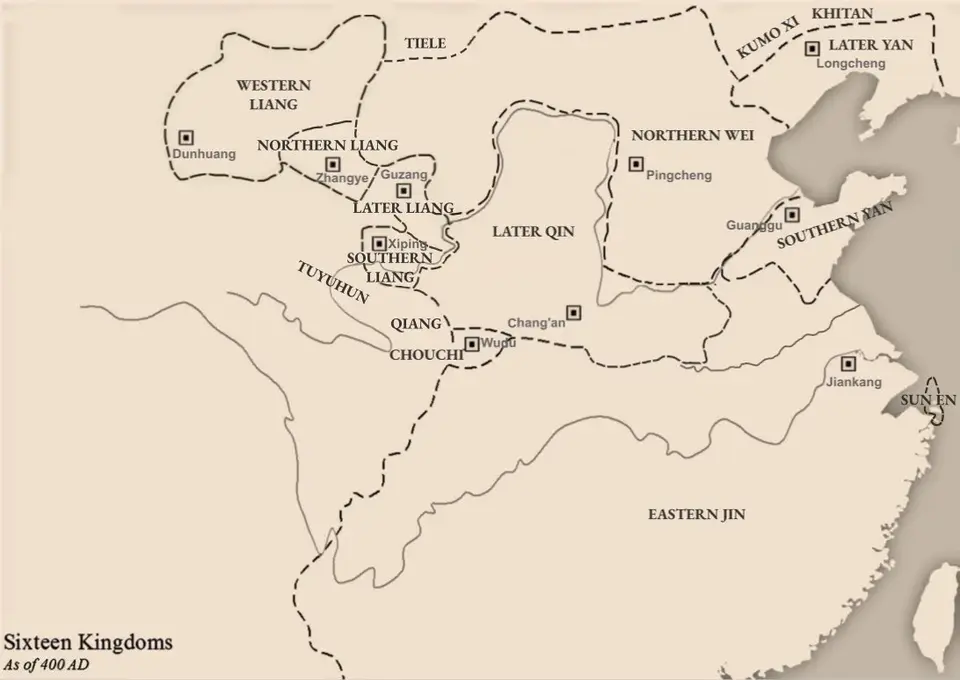
The Rebellion of Huan Xuan (桓玄之乱) was a catastrophic civil conflict and dynastic usurpation between 398 and 404 that brought an end to the aristocratic political order of the Eastern Jin Dynasty. During the Long'an era, with the cognitively incapacitated Emperor An on the throne, court authority fell to Prince of Kuaiji Sima Daozi and his arrogant son Sima Yuanxian. Meanwhile, Huan Xuan, Duke of Nan County and son of legendary Grand Marshal Huan Wen, eliminated regional rivals Yin Zhongkan and Yang Quanqi to consolidate military hegemony over eight western circuits along the middle Yangtze. In 402, Sima Yuanxian mobilized the imperial armies to subdue Huan Xuan. Exploiting universal hatred of the court, Huan Xuan swept down the Yangtze, seduced Beifu Army commander Liu Laozhi into defection, seized Jiankang, executed Sima Yuanxian, and purged royal princes. In December 403, Huan Xuan forced Emperor An to abdicate, establishing the Huan Chu Dynasty. However, his despotic and capricious administration rapidly alienated the populace. In February 404, veteran Beifu officer Liu Yu initiated a surprise insurrection at Jingkou, annihilating Chu forces outside Jiankang. Huan Xuan fled west to Jiangling and suffered a decisive naval defeat at Zhengrongzhou. In May 404, Huan Xuan was intercepted and decapitated while attempting to flee to Sichuan, restoring Emperor An and placing Eastern Jin under Liu Yu's undisputed leadership.
Huan Xuan secures Jingzhou, subsequently conquering Yin Zhongkan and Yang Quanqi to monopolize eight circuits.
Yuanxian declares war on Huan Xuan; Huan Xuan sails downriver and seduces Liu Laozhi into defection.
Huan Xuan occupies the capital, executes Sima Yuanxian, forces Liu Laozhi into suicide, and seizes supreme power.
Huan Xuan forces Emperor An to abdicate, ascending the throne as Emperor of Huan Chu.
Liu Yu and fellow Beifu officers launch a surprise uprising, crushing Chu divisions at Fuzhoushan; Huan Xuan flees west.
Liu Yi shatters the Chu armada with fire; Huan Xuan is decapitated at Meihuizhou by Feng Qian, restoring Eastern Jin.
Following the Battle of Feishui in 383, external northern military threats eased, but domestic tensions between the imperial house and noble families intensified. In 396, Emperor Xiaowu was murdered, elevating fifteen-year-old crown prince Sima Dezong (Emperor An), who was mentally disabled and incapable of speaking or dressing himself. Supreme authority was seized by the emperor's uncle, Prince of Kuaiji Sima Daozi.
Sima Daozi indulged in chronic alcoholism, entrusting government affairs to corrupt favorites who openly auctioned offices. In 397, regional governors Wang Gong and Yin Zhongkan mobilized armies, forcing Daozi to execute his cronies. Sima Daozi's son Sima Yuanxian subsequently eclipsed his father, ruling as Grand Marshal with reckless arrogance. Simultaneously, Sun En launched the devastating Daoist agrarian rebellion in 399, devastating the wealthy agrarian circuits of Zhejiang and depleting the empire's military reserves.
Huan Xuan, youngest son of Grand Marshal Huan Wen, inherited the title Duke of Nan County. Ambitious and possessing literary flair, he resented the imperial court for marginalizing his family due to his father's previous usurpation attempts. Taking advantage of regional unrest, Huan Xuan acquired military commands in Jingzhou, capitalizing on his clan's longstanding regional prestige to expand his personal retinues.
In 399, Huan Xuan formed an opportunistic alliance with Jingzhou Governor Yin Zhongkan and Yongzhou Governor Yang Quanqi against Jiankang. However, driven by boundless ambition, Huan Xuan soon turned on his allies. Employing superior tactical maneuvering, he forced Yang Quanqi into suicide, surrounded Jiangling, and executed Yin Zhongkan. By consolidating control over eight major circuits, Huan Xuan dominated the entire middle and upper Yangtze basin. The terrified Jiankang court was forced to recognize his fait accompli, naming him Supreme Military Commander of the Western Circuits.
In January 402, Sima Yuanxian resolved to eliminate Huan Xuan before his power became insurmountable. Proclaiming Huan Xuan a traitor to the state, Yuanxian appointed himself Supreme Commander and deployed veteran general Liu Laozhi commanding the elite Beifu Army as vanguard.
Recognizing the court's military fragility and widespread popular disaffection, Huan Xuan mobilized his western fleet from Jiangling and sailed east down the Yangtze. Advancing rapidly, Huan Xuan captured Xunyang and reached Gushu outside the capital. Understanding the formidable battlefield repute of the Beifu shock infantry, Huan Xuan dispatched He Mu, Liu Laozhi's maternal uncle, to secretively subvert the general. He Mu argued that Yuanxian's erratic tyranny guaranteed that a victorious Liu Laozhi would eventually be purged. Swayed by ambition and mutual distrust, Liu Laozhi defected to Huan Xuan despite fierce objections from his nephew He Wuji and lieutenant Liu Yu.
Liu Laozhi's defection shattered the capital's defense. In March 402, Huan Xuan's armies marched uncontested into Jiankang. Sima Yuanxian was captured and executed alongside prominent court officials, while Sima Daozi was exiled and poisoned. Huan Xuan subsequently forced the untrustworthy Liu Laozhi into suicide, disarmed the Beifu commanders, and declared himself Chancellor and Prince of Chu with the Nine Bestowals.
In December 403, Huan Xuan orchestrated the formal usurpation. Directing advisor Bian Fanzhi to draft abdication documents, he coerced the disabled Emperor An into yielding the imperial seal. Huan Xuan formally ascended the throne as Emperor of Chu, establishing the reign era Daheng and banishing Emperor An to Xunyang as Prince of Pinggu.
Upon attaining the throne, Huan Xuan revealed disastrous administrative ineptitude. Obsessed with extravagant palace construction, calligraphy, and luxury, he enforced erratic and micro-managed decrees while imposing oppressive levies upon southern landholders, thoroughly alienating all levels of society.
Observing Huan Xuan's growing vulnerability, veteran Beifu officer Liu Yu forged a clandestine conspiracy with Liu Yi, He Wuji, and Zhuge Changmin to restore imperial Jin.
On March 24, 404, under cover of a hunting party at Jingkou, Liu Yu and He Wuji decapitated Huan Xuan's regional governor Huan Xiu, initiating an armed rebellion. Liu Yi simultaneously seized Guangling, and the combined insurrectionary columns marched directly on Jiankang. Liu Yu spearheaded the assault with renowned personal bravery, routing Chu generals Wu Fuzhi and Huangfu Fu at Jiangcheng. On March 27, Liu Yu engaged a 20,000-man Chu defense force outside the capital at Mount Fuzhou. Attacking downwind with incendiary weapons, Liu Yu's infantry routed the demoralized Chu legions.
Terrified by the sudden collapse, Huan Xuan abandoned the imperial regalia and fled Jiankang by boat toward Jiangling accompanied only by concubines and close retainers. Liu Yu entered Jiankang in triumph, proclaimed imperial restoration, and reestablished Eastern Jin authority.
Reaching Jiangling, Huan Xuan regrouped tens of thousands of western troops, took custody of Emperor An, and sailed east to reclaim the capital.
In May 404, Liu Yu dispatched General Liu Yi and He Wuji with a naval fleet to confront the usurper. The opposing fleets engaged at Zhengrongzhou on the Yangtze. A violent northeast gale enabled Liu Yi to launch fireships into the Chu armada, igniting hundreds of vessels and sending thousands of enemy soldiers into watery graves. Defeated and panic-stricken, Huan Xuan abandoned his fleet and fled toward Jiangling in a small skiff.
Seeing his collapse, regional garrisons rose in revolt. Attempting to escape toward Sichuan via the Three Gorges, Huan Xuan's boat was intercepted at Meihuizhou by regional commander Feng Qian. Desperately waving his jade imperial seal, Huan Xuan demanded: "Who are you to dare execute the Son of Heaven?" Feng Qian replied coldly: "I am merely the servant who slays the traitor of Heaven!" and decapitated Huan Xuan. Huan Xuan was thirty-six years old. Liu Yu restored Emperor An to the throne, bringing the six-year disturbance to an end.
The Rebellion of Huan Xuan shattered the aristocratic equilibrium that sustained Eastern Jin for nearly a century. Huan Xuan's initial purges decimated both the Sima royal clan and traditional noble families like the Wangs and Yins. The subsequent collapse of Huan Chu destroyed the western military nobility, permanently ending aristocratic dominance over the state.
The suppression of the rebellion elevated the Beifu Army, led by men of humble origin, to the center of political gravity. Liu Yu's decisive role in reclaiming the capital and restoring Emperor An earned him unchallenged control over the military and bureaucracy. This power shift effectively concluded the age of noble oligarchy and paved the way for Liu Yu's peaceful deposition of the Jin dynasty sixteen years later to establish the Liu Song Dynasty in 420.