Imperial Birth
Born in the palaces of Jiankang as the firstborn son of Emperor Xiaowu and Lady Chen Guinu.
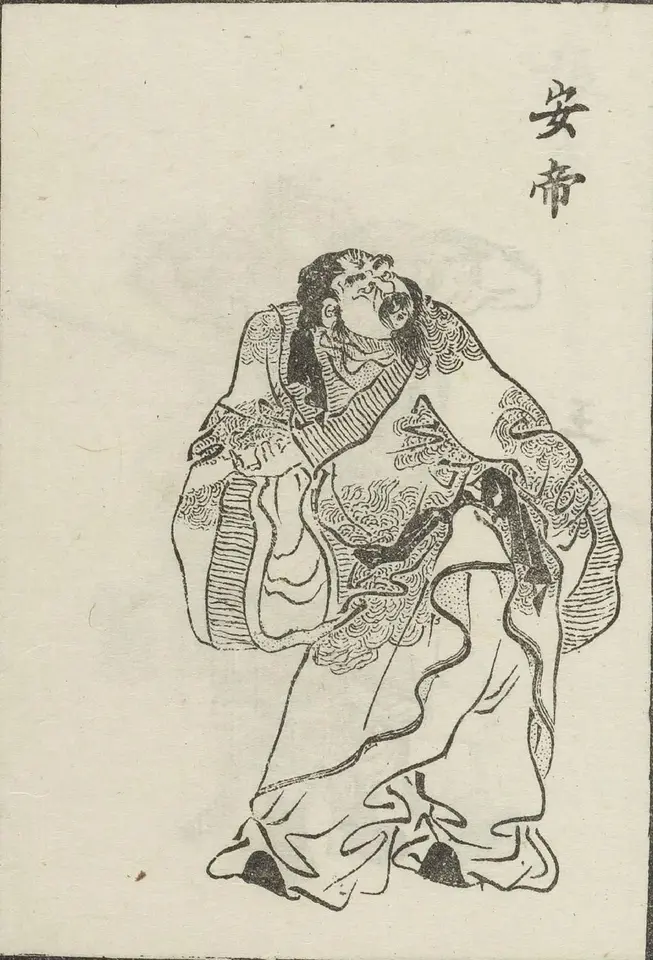
382 CE–419 CE
司马德宗
Sima Dezong (司马德宗, 382 – January 28, 419), known historically as Emperor An of Jin, was the tenth emperor of the Eastern Jin Dynasty, reigning from 396 to 419 (with an interruption during the usurpation of Huan Xuan). He was the eldest son of Emperor Xiaowu of Jin (Sima Yao) and Lady Chen Guinu (posthumously Empress Dowager De), and the elder brother of the last Jin sovereign, Sima Dewen. In 387, he was invested as crown…
Sima Dezong (司马德宗, 382 – January 28, 419), known historically as Emperor An of Jin, was the tenth emperor of the Eastern Jin Dynasty, reigning from 396 to 419 (with an interruption during the usurpation of Huan Xuan). He was the eldest son of Emperor Xiaowu of Jin (Sima Yao) and Lady Chen Guinu (posthumously Empress Dowager De), and the elder brother of the last Jin sovereign, Sima Dewen. In 387, he was invested as crown prince; in 396, he ascended the throne following Emperor Xiaowu's death, naming Lady Wang Shen'ai as his empress. From infancy, Sima Dezong suffered from severe intellectual disability and complete speechlessness. Historical dynastic annals recorded that he was unable to articulate words, could not distinguish between winter cold and summer heat, lacked awareness of hunger or satiety, and was entirely dependent on palace attendants for daily sustenance and mobility. Throughout his reign, real political authority lay entirely beyond his control. Power initially rested with his uncle Sima Daozi, Prince of Kuaiji, and Sima Yuanxian, whose maladministration precipitated widespread revolts by regional warlords Wang Gong, Yu Kai, and Yin Zhongkan, as well as the devastating Sun En-Lu Xun Daoist rebellion across Jiangdong. In 403, warlord Huan Xuan captured Jiankang, usurped the throne to found Huan Chu, and demoted Sima Dezong to Prince of Pinggu, exiling him to Xunyang. In 404, northern garrison commander Liu Yu launched a loyalist uprising at Jingkou, killing Huan Xuan and restoring Emperor An. For the remainder of his life, Sima Dezong was controlled by Liu Yu. In January 419, seeking to fulfill a dynastic prophecy to legitimize his accession, Liu Yu dispatched Wang Shaozhi to strangle the defenseless emperor at the Eastern Hall of the Jiankang palace. He died at thirty-seven and was buried at Xiupingling.
Born in the palaces of Jiankang as the firstborn son of Emperor Xiaowu and Lady Chen Guinu.
Invested as Crown Prince at age six despite congenital cognitive disability and complete muteness.
Ascended the imperial throne following Emperor Xiaowu's demise; Sima Daozi assumed central regency.
Warlords Wang Gong and Yu Kai marched toward Jiankang; the court executed Wang Guobao to appease them.
The Sun En religious rebellion erupted across the coastal commanderies, causing widespread famine and panic in Jiankang.
Huan Xuan advanced from Jiangling, capturing Jiankang and executing Sima Yuanxian while poisoning Sima Daozi.
Huan Xuan deposed Emperor An, demoted him to Prince of Pinggu, and declared himself Emperor of Chu.
Liu Yu raised troops at Jingkou; Huan Xuan fled toward Jiangling with the emperor and was killed in battle.
Following the suppression of Huan Chu remnants by Liu Yu, Emperor An was restored to the capital; Liu Yu took command.
Liu Yu returned from his northern expedition against Southern Yan, routing Lu Xun's rebel army outside Jiankang.
Liu Yu was enfeoffed as Chancellor and Duke of Song, receiving nine imperial bestowments, signaling imminent dynastic transition.
In January 419, Wang Shaozhi entered the Eastern Hall under Liu Yu's orders and smothered Emperor An with garments.
Sima Dezong was born in 382 in the imperial palaces of Jiankang as the eldest son of Emperor Xiaowu of Jin and palace consort Chen Guinu. From his earliest days, Sima Dezong suffered from congenital brain damage, developmental stunting, and severe motor-speech aphasia. As he grew into adolescence, he remained incapable of recognizing kin or uttering spoken words. Contemporary histories recorded that he could not perceive the physical extremes of summer heat or winter frost, could not sense hunger or thirst, and was unable to manage even basic physiological functions, requiring continuous caretaking from eunuchs and nursemaids.
Under the rigid dynastic succession rules of the Eastern Jin house, Emperor Xiaowu failed to replace his disabled firstborn son with his intelligent younger son, Sima Dewen. In September 387, the six-year-old Sima Dezong was formally invested as Crown Prince. In November 396, Emperor Xiaowu was suffocated to death in his sleep by Lady Zhang following a drunken dispute in the inner quarters. The fifteen-year-old mute prince was ushered to the front hall by court grandees to assume the throne as Emperor An, adopting the era name Long'an.
Upon his accession, the court arranged his marriage to Lady Wang Shen'ai, a daughter of Wang Xianzhi and granddaughter of celebrated calligrapher Wang Xizhi. Because the sovereign was mentally incapable of comprehending imperial memorials and had to be physically supported by attendants during formal audiences, executive authority fell completely to his paternal uncle, Sima Daozi, and cousin, Sima Yuanxian. The two regents indulged in rampant bribery, auctioning public offices and alienating aristocratic clans, precipitating catastrophic instability across southern China.
Between 397 and 398, regional military governors Wang Gong of Qing-Yan and Yu Kai of Yuzhou allied with Yin Zhongkan of Jingzhou and Huan Xuan of Guangzhou, launching dual rebellions under the pretext of purging court favorites. Terrified of military conquest, Sima Daozi executed his intimate advisor Wang Guobao to negotiate a truce. Soon afterward, Sun En ignited a massive popular rebellion among adherents of the Way of the Five Pecks of Rice across the coastal commanderies, overrunning eight prefectures and subjecting the capital at Jiankang to severe sieges and devastating famines.
In 402, Huan Xuan mobilized his Western Army from Jiangling, navigating down the Yangtze River to crush Sima Yuanxian's forces and seize Jiankang. Huan Xuan executed Sima Yuanxian, exiled Sima Daozi, and assumed dictatorial control over the civil administration and military commands. In December 403, Huan Xuan forced the helpless emperor to surrender his imperial seals, abolishing the Jin dynasty and establishing the Huan Chu regime. Sima Dezong was stripped of his imperial dignity, demoted to Prince of Pinggu, and transported under armed escort to confinement at Xunyang.
In March 404, Northern Army veteran Liu Yu launched a loyalist uprising at Jingkou alongside He Wuji and Liu Yi, defeating Huan Chu field armies in successive engagements. Panicking, Huan Xuan abandoned Jiankang and fled westward toward Jiangling, dragging Sima Dezong and his brother Sima Dewen along as hostages. Following Huan Xuan's defeat and death at Zhengrongzhou, Emperor An was rescued by loyalist troops, only to be captured again by Huan Zhen before finally being liberated and escorted back to the capital in early 405.
In March 405, following years of displacement and military imprisonment, Emperor An re-entered the palaces of Jiankang under the armed protection of Liu Yu. From this point onward, executive state power was consolidated in Liu Yu's hands, reducing the emperor once more to a ritual cipher. Operating in the emperor's name, Liu Yu suppressed Lu Xun's insurgent forces, eliminated rival warlords Liu Yi and Zhuge Changmin, and launched triumphant northern expeditions that destroyed Southern Yan and Later Qin, recovering the ancient capitals of Luoyang and Chang'an.
By 418, Liu Yu returned to Jiankang laden with imperial honors, receiving appointment as Chancellor, creation as Duke of Song, and the award of the Nine Bestowments, making his usurpation an open certainty. However, widespread popular belief in the prophecy that "after Changming there shall be two emperors" (Changming being Emperor Xiaowu's courtesy name) troubled Liu Yu. Fearing that deposing Emperor An directly would violate astrological portents, Liu Yu concluded that he had to enthrone Sima Dewen briefly before receiving the abdication. Meanwhile, Sima Dewen remained constantly at his disabled brother's bedside, testing his food and shielding him from poison.
On January 28, 419, Sima Dewen was briefly absent from the palace quarters due to a sudden cold. Seizing the opening, Liu Yu's henchman Wang Shaozhi slipped into the Eastern Hall of the Jiankang palace with a squad of assassins. Confronting the mute and defenseless thirty-seven-year-old monarch, Wang Shaozhi wrapped heavy bedclothes and garments around Sima Dezong's head, suffocating him to death. Following the murder, Liu Yu installed Sima Dewen as Emperor Gong, burying Sima Dezong at Xiupingling and concluding the life of an unfortunate figurehead.
Sima Dezong's twenty-two-year reign represents the ultimate manifestation of aristocratic oligarchy subordinating imperial sovereignty in early medieval China. The Eastern Jin dynastic system, characterized by the maxim that the Wang and Sima clans shared the world, had evolved to a stage where individual monarchical competence was irrelevant to bureaucratic operation. A ruler afflicted with total aphasia and profound cognitive disability provided prominent houses such as the Wang, Xie, and Huan clans with an ideal, uncontested imperial seal.
Throughout his reign, the statutory apparatus of the Three Departments and Six Ministries was converted into an administrative facade for whichever warlord held military dominance over Jiankang. Whether in Sima Daozi's corrupt decrees, Huan Xuan's usurpation instruments, or Liu Yu's punitive imperial edicts, official policy was invariably proclaimed in the name of a ruler who could not perceive the change of seasons. Sima Dezong's bodily presence underscored the tragic degradation of monarchical authority during the late Eastern Jin.
The murder of Emperor An illustrated the brutal intersection between superstitious millenarianism and imperial usurpation. In late Jin society, esoteric prophecies functioned as ideological weapons for political legitimacy. The widespread circulation of the prophecy predicting two rulers after Emperor Xiaowu compelled Liu Yu to execute a sovereign who posed zero physical or political threat, merely to satisfy numerological conditions for his own dynastic accession.
The assassination in the Eastern Hall shattered the traditional pretense of peaceful, voluntary abdication established since the Han and Cao Wei periods. It initiated a precedent of violent regicide that characterized the Southern Dynasties, where military strongmen seized supreme power through naked physical force rather than ritual consent. Sima Dezong, who had never issued a genuine command in his lifetime, perished as a helpless sacrificial victim to the bloody transition between the Jin and Song empires.
FIGURES ASSOCIATED WITH THIS DYNASTY