Imperial Incursion
Emperor Fu Jian mobilizes hundreds of thousands of multi-ethnic cavalry and infantry to conquer Eastern Jin
Eastern Jin Dynasty (东晋) · HISTORICAL EVENT
淝水之战
The Battle of Fei River (淝水之战) was a historic military engagement fought in 383 CE between the Di-led Former Qin Empire and the Han-led Eastern Jin dynasty. Having unified northern China, Emperor Fu Jian of Former Qin assembled a multi-ethnic invasion force numbering hundreds of thousands to annex the Eastern Jin, declaring his army could halt the flow of the Yangtze River by casting their whips into it. Facing national destruction, Eastern Jin Grand…
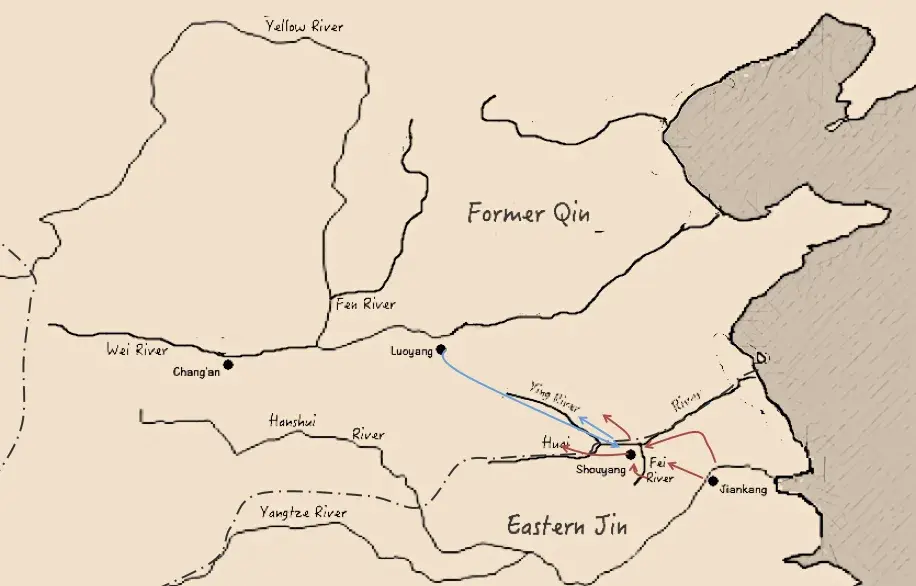
The Battle of Fei River (淝水之战) was a historic military engagement fought in 383 CE between the Di-led Former Qin Empire and the Han-led Eastern Jin dynasty. Having unified northern China, Emperor Fu Jian of Former Qin assembled a multi-ethnic invasion force numbering hundreds of thousands to annex the Eastern Jin, declaring his army could halt the flow of the Yangtze River by casting their whips into it. Facing national destruction, Eastern Jin Grand Chancellor Xie An coordinated military defenses from Jiankang, dispatching Xie Shi and Xie Xuan with eighty thousand elite Beifu soldiers northward to the Huai River front. General Liu Laozhi opened the campaign with a nighttime raid at Luojian, wiping out Qin forward positions. In November, as the two armies confronted each other across the Fei River, Xie Xuan proposed that Qin forces withdraw slightly to allow Jin troops to cross the river for a pitched engagement. Fu Jian ordered a retreat to attack the Jin troops mid-crossing, but the diverse Qin formations dissolved into uncontrollable panic. Former Jin defector Zhu Xu shouted from behind the lines that the Qin army was routed, triggering a stampede across the battlefield. Field Commander Fu Rong was killed, and Fu Jian fled wounded with remnants of his cavalry, inspiring idioms such as mistaking trees for enemy soldiers and dreading the cry of cranes. The victory preserved the southern dynasty and Han civilization, precipitating the collapse of the Former Qin Empire into fractured rival kingdoms.
Emperor Fu Jian mobilizes hundreds of thousands of multi-ethnic cavalry and infantry to conquer Eastern Jin
Fu Rong captures Shouyang, and Fu Jian dispatches Zhu Xu to solicit surrender; Zhu Xu delivers vital military intelligence to Jin commanders
Liu Laozhi leads five thousand Beifu soldiers across the river, routing Liang Cheng and securing forward positions
Fu Jian climbs Shouyang walls, mistaking the swaying foliage of Mount Bagong for hidden Jin divisions
Fu Jian orders a retreat to strike during the crossing; Zhu Xu cries defeat, triggering a catastrophic panic; Fu Rong is slain
Fu Jian flees wounded to northern bases, Eastern Jin recaptures Shouyang and the Huai basin, and Former Qin fractures
In the mid-fourth century CE, Emperor Fu Jian of Former Qin, advised by his Han prime minister Wang Meng, instituted bureaucratic and legal reforms, annexing Former Yan, Former Liang, and the Tuoba Dai state to unify northern China.
However, the rapid expansion concealed deep ethnic divisions. Subjugated Murong Xianbei and Yao Qiang aristocracies yielded formal obedience while awaiting opportunities to re-establish independence. On his deathbed in 375, Wang Meng had warned Fu Jian that although the Jin regime was geographically confined to the south, it retained legitimate dynastic succession; he urged Fu Jian never to attack Eastern Jin, cautioning that the Xianbei and Qiang within the empire constituted the genuine internal danger. Following Wang Meng's demise, Fu Jian succumbed to imperial hubris, dismissing his counselor's warning to pursue the unification of China.
In August 383, Fu Jian ordered universal conscription across northern China, mobilizing an expeditionary force comprising 600,000 infantry and 270,000 cavalry. The vanguard deployed southward along thousands of leagues, threatening the Huai River defense line.
Confronted by imminent destruction, Eastern Jin Chancellor Xie An preserved composure. He assigned his brother Xie Shi as Commander-in-Chief and his nephew Xie Xuan as vanguard field general, deploying the Beifu Army. Formed by refugees and displaced veterans who had fled northern warfare to settle in Jingkou (modern Zhenjiang, Jiangsu), the Beifu Army was characterized by rigorous tactical discipline, offensive aggression, and an ideological commitment to defending their adopted homeland. Eighty thousand Beifu soldiers advanced northward along waterways to meet the numerically superior northern army.
In October 383, Former Qin vanguard commander Fu Rong captured the strategic bastion of Shouyang (modern Shou County, Anhui), taking Jin defender Xu Yuanxi prisoner. Jin general Hu Bin retreated to Xiashi, where Qin units besieged his force and cut communication corridors.
Believing victory was assured, Fu Jian covertly rode with eight thousand elite cavalry from Xiangcheng to Shouyang, seeking to intimidate the Jin court into capitulation through his imperial presence. Fu Jian dispatched Zhu Xu, a captured former Jin commander serving as a Qin administrative official, into the Jin camp to persuade Xie Shi to surrender. Retaining his loyalty to Eastern Jin, Zhu Xu disclosed the exact disposition of Qin forces to Xie Shi and Xie Xuan, warning them that if the entire Qin army assembled, Jin would be annihilated. He advised Xie Xuan to mount an immediate offensive against the forward army before the main body arrived. Zhu Xu's intelligence shaped Jin operational planning.
To break the stalemate and relieve the siege of Xiashi, Xie Xuan dispatched eagle-soaring general Liu Laozhi with five thousand elite Beifu troops on a nighttime raid against Luojian.
Qin commander Liang Cheng held the river crossing with fifty thousand troops behind fortified palisades, underestimating Jin forces. Liu Laozhi directed his cavalry and shock infantry across the waters, launching an assault against the defensive lines. The Beifu troops breached the perimeter, killing Liang Cheng and his deputy Wang Yong. The Qin vanguard collapsed, and over fifteen thousand soldiers drowned attempting to cross the river. The victory at Luojian eliminated Qin forward defenses, relieved the garrison at Xiashi, and elevated Jin morale, allowing Xie Xuan's army to advance along the eastern bank of the Fei River.
News of the defeat at Luojian alarmed Fu Jian, dispelling his contempt for southern forces. The emperor climbed the ramparts of Shouyang alongside his brother Fu Rong to inspect Jin dispositions across the Fei River.
Observing the opposite shore, Fu Jian beheld the Beifu formations standing in rank with disciplined banners and spearheads. Looking northward toward Mount Bagong, strong autumn winds shook the trees and undergrowth; in his shaken state, Fu Jian mistook the swaying vegetation for advancing Jin infantry. Turning to Fu Rong, he exclaimed that their adversaries were formidable rather than weak, originating the Chinese idiom describing paranoid terror as seeing soldiers in every bush and tree on Mount Bagong.
In November 383, observing that the broad, muddy channel of the Fei River separated the opposing armies, Xie Xuan sent an envoy to Fu Rong with an invitation to engage: "Your Excellency has led armies deep into our territory, yet your lines cling to the water's edge to prolong the campaign. If you withdraw your lines slightly, allowing our soldiers to cross and meet you in open combat, we may settle this contest without delay." Qin commanders advised against relinquishing the riverbank, but Fu Jian intended to feign retreat and strike the Jin army with cavalry while they were halfway across. Fu Rong signaled the retreat.
However, the Qin army was an unintegrated assembly of diverse tribes and forced conscripts lacking tactical cohesion. Once the order to withdraw was communicated, the rear lines mistook the movement for a general retreat. At that moment, Zhu Xu rode behind the retreating ranks, shouting repeatedly that the Qin army was defeated. Believing the front lines had collapsed, the soldiers broke ranks, dropping their armaments and trampling their comrades. Fu Rong rode into the melee attempting to restore order, but his mount stumbled in the mud, and advancing Beifu shock troops killed him on the ground.
Xie Xuan, Xie Yan, and Huan Yi directed the Beifu Army across the Fei River, launching a pursuit against the broken northern forces. Denied command leadership, the Qin army disintegrated into headlong flight, fleeing day and night under harsh winter conditions. Freezing and starving soldiers panicked at the whistle of the wind and the cry of cranes, mistaking the sounds of nature for pursuing Jin cavalry, originating the idiom of trembling at the wind and cranes. Fu Jian was struck by an arrow and fled on horseback toward Huaibei. Eastern Jin secured a total victory, capturing the imperial chariot, imperial regalia, and abandoned armaments.
The Battle of Fei River preserved the geopolitical boundary between northern and southern regimes in fourth-century China. By repelling a vast invasion with an army of eighty thousand men, the Eastern Jin preserved the survival of the Han imperial court in Jiankang, sheltering the agricultural economy, urban centers, and Confucian intellectual traditions of the south from northern devastation.
Following the victory, Eastern Jin forces under Xie Xuan launched northern expeditions, reclaiming territories across Henan, Shandong, and southern Shaanxi, securing the Huai River boundary that sheltered the subsequent Song, Qi, Liang, and Chen dynasties of the Southern Dynasties period.
The military defeat exposed the fragility of the Former Qin imperial construct. The destruction of Di tribal forces shattered Fu Jian's coercive authority over subject populations, inciting non-Di leaders to revolt.
Murong Chui rebelled in the east to establish Later Yan, Yao Chang established Later Qin in the Guanzhong basin and assassinated Fu Jian in 385, Tuoba Gui revived the Northern Wei state in the northern steppes, Qifu Guoren founded Western Qin, and Lu Guang established Later Liang in the Gansu corridor. Within months, the unified northern empire disintegrated, returning northern China to a prolonged period of fragmentation and warfare during the Sixteen Kingdoms era.
The Book of Jin records in the Biography of Xie An: "Although Xie An bore the trust of the court, his detachment remained steadfast. When Xie Xuan crushed Fu Jian, an urgent dispatch arrived while An was playing chess with a guest. He read the letter, placed it beside him, and displayed no joy. When the guest inquired, An replied calmly: 'The younger boys have defeated the enemy.' The game concluded, and as he crossed the threshold into his inner chambers, his joy was so great that he broke the wooden teeth of his clogs without noticing."
Sima Guang evaluates in the Comprehensive Mirror in Aid of Governance: "Although Fu Jian enjoyed divine favor in unifying the warlords, he grew arrogant and squandered his achievements. Disregarding the counsel of Wang Meng and the exhaustion of his subjects, his boast of throwing whips to sever the river revealed his vanity. The panic inspired by the vegetation of Bagong led directly to his destruction; from antiquity, no catastrophe among non-Han rulers surpassed that of Fu Jian."
The historian continues: "Xie An's appointment of worthy talents and Xie Xuan's decisive leadership, meeting eighty thousand disciplined soldiers against eight hundred thousand fierce adversaries to strike them mid-crossing, was not accomplished by mortal effort alone, but reflected Heaven preserving the rites and culture of the realm."