Sima Rui Dispatched to Jianye
Sima Rui is appointed Military Governor of Jiangnan, accompanied by Wang Dao and Wang Dun, initiating the governance of Jiangdong.
Eastern Jin Dynasty (东晋) · HISTORICAL EVENT
衣冠南渡
Southward Migration of the Nobility (衣冠南渡) was a monumental historical migration during the transition between the Western and Eastern Jin dynasties (307–318), wherein the imperial family, prominent aristocratic clans, and millions of northern civilians fled the Yellow River basin across the Yangtze River to escape devastation following the War of the Eight Princes and the Disaster of Yongjia. The term refers metaphorically to the scholar-gentry elite and…
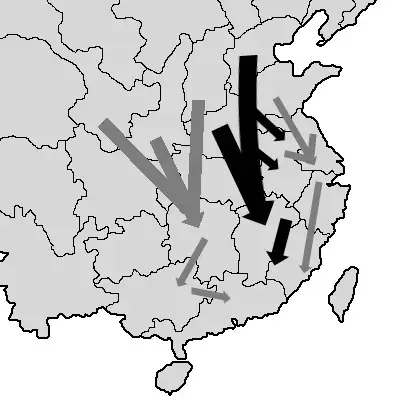
Southward Migration of the Nobility (衣冠南渡) was a monumental historical migration during the transition between the Western and Eastern Jin dynasties (307–318), wherein the imperial family, prominent aristocratic clans, and millions of northern civilians fled the Yellow River basin across the Yangtze River to escape devastation following the War of the Eight Princes and the Disaster of Yongjia. The term refers metaphorically to the scholar-gentry elite and the ceremonial heritage of classical civilization. The conquest of Luoyang and Chang'an by the Xiongnu Han Zhao state terminated the Western Jin Dynasty, leaving northern China a war-torn frontier. Guided by the prominent statesman Wang Dao and military marshal Wang Dun, the Prince of Langya (Sima Rui) established his government at Jiankang (modern Nanjing), forging a coalition with indigenous Jiangnan gentry to found the Eastern Jin Dynasty and inaugurating the aristocratic governance model known as the joint rule of Wang and Sima. The court introduced emigrant commanderies and counties to administer displaced populations. This relocation not only preserved Chinese cultural and dynastic continuity in the south, but also transferred advanced metallurgy, ox-plowing, and hydraulic methods alongside millions of laborers, providing the institutional foundation for the economic and cultural flourishing of Jiangnan and the southward shift of China's economic center.
Sima Rui is appointed Military Governor of Jiangnan, accompanied by Wang Dao and Wang Dun, initiating the governance of Jiangdong.
Xiongnu Han Zhao forces sack Luoyang and capture Emperor Huai, setting off a massive refugee migration southward.
Emperor Min establishes a beleaguered court in Chang'an, while Sima Rui consolidates aristocratic alliances in the south.
Chang'an falls to Liu Yao and Emperor Min surrenders, ending the Western Jin and leaving northern China in chaos.
Sima Rui assumes the title of King of Jin at Jiankang, restoring ancestral altars and establishing a dynastic government.
Zu Ti leads volunteer militias across the Yangtze, striking his oars in solemn pledge and reclaiming lands south of the Yellow River.
Following the murder of Emperor Min, Sima Rui accedes as Emperor Yuan of Jin, establishing the aristocratic power-sharing system.
The Eastern Jin court establishes emigrant administrative units under white register rolls, settling millions of displaced northern refugees.
Zu Ti dies of illness amid court factionalism, leading to the loss of reclaimed Henan territories and entrenching the southern status quo.
During the Taikang era of the Western Jin Dynasty, Emperor Wu (Sima Yan) unified the Three Kingdoms, restoring temporary peace across the realm. However, to safeguard the throne, Emperor Wu invested imperial imperial princes with expansive fiefdoms and military commands, planting the seeds of factional violence. In 291, under the reign of the intellectually impaired Emperor Hui and palace intrigues led by Empress Jia, the Prince of Zhao, Prince of Qi, Prince of Chengdu, Prince of Hejian, and Prince of Donghai engaged in a sixteen-year civil conflict known as the War of the Eight Princes.
The conflict devastated Luoyang, Chang'an, Ye, and surrounding agrarian river valleys. Mobilizing hundreds of thousands of conscripts, rival princes laid waste to major cities, burned state granaries, and caused widespread abandonment of farmland. Across northern China, famine and epidemics wiped out broad swathes of the population, completely dismantling the centralized administrative machinery and border defenses of the Western Jin state.
From the Eastern Han through the Three Kingdoms periods, pastoralist non-Han confederacies—principally the Xiongnu, Jie, Xianbei, Di, and Qiang—migrated into Shanxi, Shaanxi, and Hebei to live among Han populations. Western Jin aristocrats subjected these communities to harsh taxation, forced labor, and enslavement, generating explosive ethnic grievances.
During the War of the Eight Princes, competing royal factions recruited nomadic cavalry as auxiliary shock troops. This practice revealed the military bankruptcy of the imperial legions to tribal leaders. In 304, the southern Xiongnu chieftain Liu Yuan declared independence in Bingzhou, styling himself King of Han; simultaneously, the Jie commander Shi Le launched revolts across Hebei, igniting the era of the Sixteen Kingdoms.
In June 311, Liu Yuan's son Liu Cong dispatched commanders Huyan Yan, Liu Yao, and Shi Le to encircle the Western Jin capital of Luoyang. Suffering from famine and desertion, imperial defenses crumbled. Xiongnu forces breached the city, massacring over thirty thousand officials, courtiers, and civilians, desecrating imperial mausoleums, and capturing Emperor Huai, in a catastrophe remembered as the Disaster of Yongjia. In 316, Liu Yao captured Chang'an, compelling Emperor Min to surrender, thereby extinguishing the fifty-one-year-old Western Jin Dynasty and plunging northern China into prolonged warfare.
In September 307, prior to the fall of Luoyang, the astute aristocratic leader Wang Dao foresaw that northern China was doomed to catastrophic collapse. He urged his companion Sima Rui, the Prince of Langya, to relocate his military headquarters to the southern Yangtze basin to establish an enduring sanctuary.
Accepting Wang Dao's counsel, Prince of Donghai Sima Yue memorialized the throne to commission Sima Rui as Senior General Pacifying the East and Military Governor of Jiangnan, dispatching him to garrison Jianye (modern Nanjing). Wang Dao accompanied him as chief advisor alongside his cousin, army commander Wang Dun. Upon their arrival, indigenous southern aristocratic clans—including the Gu, Lu, Zhu, and Zhang families of Wu—held the northern refugee princes in contempt and shuttered their gates. For over a month, no local dignitary visited the prince's residence.
To resolve this impasse, Wang Dao staged a calculated political display during the traditional Spring Purification Festival in 308. Wang Dao arranged for Sima Rui to process through the streets of Jianye in magnificent imperial regalia, while Wang Dao, Wang Dun, and northern aristocratic luminaries rode reverently behind his carriage. Observing this display, prominent southern gentry leaders Gu Rong and Ji Zhan concluded that the prince possessed imperial stature and led local aristocrats to offer formal submission. Wang Dao immediately appointed Gu Rong and Ji Zhan to senior administrative positions, creating a coalition between northern refugee lineages and indigenous elites that stabilized the southern realm.
Following the sack of Luoyang in 311, the Central Plains were reduced to ruins. Facing massacre and enslavement, citizens across northern China—from royal princes and aristocratic clans to common peasants and tenant farmers—embarked upon the massive southward migration known as the Southward Migration of the Nobility.
Historical records indicate that between one-sixth and one-third of northern China's total population migrated south across the Huai and Yangtze rivers during this transition, totaling millions of refugees. This demographic shift flowed through three principal routes:
The eastern route originated in Shandong, Hebei, and northern Jiangsu, where refugees crossed the Huai River and journeyed along ancient waterways toward Yangzhou, Jingkou (modern Zhenjiang), and Jiankang. The central route began in Luoyang, Xuchang, and Henan commanderies, with migrants moving along river valleys toward Runan and Xiangyang before proceeding down the Han River into Jianghan and Hunan. The western route originated in Chang'an, Bingzhou, and Liangzhou, with refugees navigating mountain passes into Sichuan or moving eastward into Hubei.
Prominent northern clans—including the Langya Wang, Chenjun Xie, Yingchuan Xun, Longkang Huan, Gaoping Xi, and Taiyuan Wang lineages—joined the flight alongside hundreds of thousands of master blacksmiths, stone masons, farmers, and weavers. Clans traveled as unified village communities under local patriarchs, maintaining armed retainers and establishing fortified camps along their journey until arriving in the south.
Upon reaching Jianye, northern emigrant scholars assembled in their new southern home. Haunted by the collapse of their northern homeland, refugee elites frequently succumbed to sorrow. During a famous gathering at Xinting overlooking the Yangtze, Secretariat Attendant Zhou Yi lamented: "The scenery remains as fair as ever, yet the mountains and rivers belong to another realm!" The assembled guests wept uncontrollably. Thereupon, Wang Dao sternly rebuked them: "We ought to unite our strength to aid the royal house and recover the sacred heartland; why sit like helpless captives shedding futile tears?" This admonition rallied the courtiers and inspired dynastic restoration.
Wang Dao established a policy of domestic tranquility to conciliate diverse interests. He designed an administrative division of labor: northern immigrant clans commanded supreme executive and military positions at the imperial court, while indigenous southern families were integrated as senior advisors, court ministers, and commandery governors. This distribution alleviated friction between northern newcomers and established southern landholders, forging a unified ruling coalition.
In late 316, news of Emperor Min's capture at Chang'an reached Jiangnan, confirming the extinguishment of the Western Jin line. Over three thousand southern leaders and northern refugee commanders submitted petitions urging Sima Rui to assume imperial authority. In April 317, Sima Rui declared himself King of Jin, proclaimed the Jianwu era, restored dynastic ancestral temples, and established a civil bureaucracy.
In April 318, upon receiving word that Emperor Min had been murdered in captivity, Sima Rui formally ascended the throne as Emperor Yuan of Jin at Jiankang, proclaiming the Taixing era and founding the Eastern Jin Dynasty. During the coronation ceremony, an extraordinary scene transpired: Emperor Yuan grasped Chancellor Wang Dao by the sleeve, entreating him to sit alongside him on the imperial throne to receive the homage of the assembled court.
Wang Dao declined, declaring: "If the sun were to share its radiance with lesser creatures, how could the world look up to its majesty?" Nevertheless, this episode underscored the reality of Eastern Jin governance: imperial authority was tempered by powerful aristocratic lineages, with the Langya Wang clan directing the imperial cabinet and controlling provincial military commands, leading contemporaries to characterize the state as the joint rule of Wang and Sima. This foundation preserved Chinese dynastic legitimacy and ritual continuity in the south.
The arrival of millions of northern refugees created severe administrative strains across Jiangnan. Immigrant families spoke northern dialects, suffered from unfamiliar subtropical diseases, and lacked land, while indigenous landowners resisted encroachment on their estates.
To administer the arriving populations without alienating southern gentry, the court introduced the emigrant commanderies system. The administration established virtual administrative units named after northern homelands on vacant southern public lands. Displaced populations from Xuzhou and Yanzhou were settled near Jingkou under the jurisdiction of Emigrant Xuzhou (later Southern Xuzhou), while other enclaves received titles like Emigrant Langya or Emigrant Dantou. Historical texts record the creation of over twenty emigrant provinces, nearly one hundred emigrant commanderies, and more than two hundred emigrant counties across the south.
The court registered northern refugees under specialized white registers. White register households enjoyed exemption from onerous imperial corvée labor, military conscription, and standard poll taxes, remaining under the jurisdiction of their own northern magistrates. Conversely, established southern residents were registered under yellow registers and remained subject to traditional fiscal obligations.
This policy provided displaced populations with social cohesion and legal protection, averting major rural insurrections. Furthermore, northern refugees introduced advanced iron ploughshares, ox-plowing techniques, and hydraulic irrigation wheels to the south. Integrating northern agricultural discipline with abundant southern water resources, farmers cleared coastal swamps and lake deltas, transforming the Taihu plain and the Yangtze Delta into wealthy agricultural zones.
Having established themselves south of the river, patriotic soldiers and displaced scholars harbored ambitions to reclaim their northern homelands from nomadic conquerors.
The most renowned champion of restoration was General Zu Ti. In his youth, Zu Ti had shared quarters with his compatriot Liu Kun, rising at the sound of the cock's crow to practice swordsmanship in dedication to the realm. Following the Disaster of Yongjia, Zu Ti led hundreds of refugee households southward. At Jiankang, he repeatedly petitioned Emperor Yuan for forces to launch a northern campaign. Hesitant to see a general amass overwhelming military power, the court provided him with only one thousand soldiers and three thousand bushels of grain, withholding all weapons and armor.
In 317, Zu Ti led his small force across the Yangtze from Jingkou. Striking the oars against the river waters, he proclaimed: "If Zu Ti cannot clear the Central Plains of invaders, may he perish in the waters of this river!" Inspiring his followers, Zu Ti established an armory along the Huai River, forged weapons, and mobilized local refugee militias.
Demonstrating tactical brilliance, Zu Ti repeatedly defeated the armies of Shi Le across Henan, recovering all territory south of the Yellow River. Northern fortress chieftains submitted to his command. However, as he prepared to cross the Yellow River, political factionalism between Emperor Yuan and Grand Marshal Wang Dun erupted in the south. The court dispatched an imperial supervisor to contain Zu Ti's advance. Frustrated by court intrigue, Zu Ti fell ill and died at his military camp at Yongqiu in September 321. Following his death, his territorial gains south of the Yellow River were lost, and the refugee community settled permanently into life south of the Yangtze.
The Southward Migration of the Nobility preserved the civilizational continuity of the Chinese core during a period of foreign occupation. The fall of the Western Jin destroyed imperial libraries, ancestral temples, and administrative institutions across the Yellow River basin. By transferring court archives, ritual traditions, classical literature, and legal institutions to Jiankang, Sima Rui and the immigrant gentry preserved Chinese cultural heritage behind the natural barrier of the Yangtze River, establishing the cultural foundation for the reunification of China under the Sui and Tang dynasties.
The migration reshaped Chinese governance by producing the aristocratic system of the Six Dynasties. Confronting an enfeebled monarchy, illustrious northern lineages like the Langya Wang, Chenjun Xie, and Yingchuan Xun clans directed state affairs in collaboration with the imperial house. This elite culture fostered achievements in literature, calligraphy, landscape painting, and philosophy, producing figures such as calligrapher Wang Xizhi, painter Gu Kaizhi, and poet Tao Yuanming, marking an epoch of creative flourishing.
The influx of millions of northern immigrants resolved the chronic labor shortages that had historically hindered southern agriculture. Northern refugees introduced advanced iron ploughshares, ox-plowing techniques, and waterworks management to the Yangtze basin, replacing primitive slash-and-burn practices with sophisticated multi-crop agriculture. Immigrants constructed extensive dikes, polders, and irrigation networks across the Taihu basin, converting coastal marshes into fertile rice paddies and transforming Jiangnan into the agrarian heartland of China.
The migration initiated an enduring integration between northern Han immigrants, southern indigenous populations, and local minority groups. More fundamentally, it initiated the southward relocation of China's economic and cultural center of gravity. Prior to the Eastern Jin, national wealth and population were concentrated in the Yellow River valley. The colonization of Jiangnan demonstrated that southern agriculture could rival the north. This economic momentum expanded through the Southern Dynasties, Tang, and Song periods, culminating in the permanent establishment of the Yangtze basin as China's economic center.