Birth
Born into an indigenous southern household in Poyang
259 CE–334 CE
陶侃
Tao Kan (陶侃, 259 – July 30, 334), courtesy name Shixing (士行), was an eminent military commander, provincial administrator, and Grand Marshal of the Eastern Jin Dynasty. Arising from a humble indigenous southern background in Poyang, he lost his father in early childhood and was raised under the strict moral tutelage of his mother, Lady Zhan—who entered Chinese cultural history as one of the "Four Exemplary Mothers of Ancient…
Tao Kan (陶侃, 259 – July 30, 334), courtesy name Shixing (士行), was an eminent military commander, provincial administrator, and Grand Marshal of the Eastern Jin Dynasty. Arising from a humble indigenous southern background in Poyang, he lost his father in early childhood and was raised under the strict moral tutelage of his mother, Lady Zhan—who entered Chinese cultural history as one of the "Four Exemplary Mothers of Ancient China" for cutting off her hair to sell for food to host her son's guests. Overcoming severe aristocratic discrimination against southern lineages, Tao Kan rose through meticulous administrative competence and battlefield bravery during the late Western Jin. Under Emperor Yuan of Jin (Sima Rui), Tao Kan served as Governor of Jingzhou, pacifying the menacing peasant uprisings led by Du Tao and securing the middle Yangtze river basin. During the catastrophic Su Jun Rebellion (327–328) that destroyed Jiankang and held the young Emperor Cheng hostage, Tao Kan was appointed Supreme Allied Commander by Wen Qiao and Yu Liang, coordinating land and amphibious assaults that crushed the rebel armies, slew Su Jun, and restored the Eastern Jin imperial house. Holding the offices of Grand Marshal (Da Sima), Grand Commandant (Taiwei), and Commander-in-Chief of Eight Provinces, Tao Kan maintained naval vigilance and economic prosperity throughout southern China for decades without ever abusing his paramount military authority. Celebrated in cultural folklore for his legendary personal discipline—such as carrying one hundred bricks every morning and evening to maintain bodily fitness, treasuring every inch of daylight, and collecting discarded woodchips and bamboo shavings for municipal engineering—Tao Kan passed away in 334 at the age of seventy-six. His great-grandson was the immortal pastoral poet Tao Yuanming.
Born into an indigenous southern household in Poyang
Educated by his widowed mother Lady Zhan amidst extreme poverty
Appointed county clerk; recommended by Yang Fang to become an officer in Luoyang
Served under Grand General Liu Hong, defeating rebel general Zhang Chang in Jingzhou
Defeated the insurgent warlord Chen Min in Jiangxia, stabilizing the middle Yangtze
Defended southern outposts following the fall of Luoyang to the Xiongnu
Appointed Governor of Jingzhou; crushed Du Tao's widespread rebellion across the middle Yangtze
Banished to remote Guangzhou due to aristocratic jealousy from Chancellor Wang Dun
Crushed southern rebel forces in Jiaozhou and Guangzhou, securing the southern coast for Eastern Jin
Recalled north by Emperor Ming to pacify the aftermath of Wang Dun's rebellion
Reappointed Governor of Jingzhou, holding supreme military command over the western frontier
Appointed Supreme Allied Commander alongside Wen Qiao, launching the campaign to retake Jiankang
Annihilated the rebel armies of Su Jun and Zu Yue; elevated to Grand Commandant and Duke of Changsha
Appointed Grand Marshal, Commander-in-Chief of Eight Provinces
Resigned military seals and died peacefully aboard his boat at Fankou at age seventy-six
Tao Kan belonged to an indigenous southern non-Han lineage (Xinan) native to Poyang. His father, Tao Dan, had served as a minor naval officer in Eastern Wu before submitting to the Jin Dynasty. Tao Dan died when Tao Kan was an infant, leaving his family in dire poverty.
Tao Kan was raised entirely by his mother, Lady Zhan (Zhan Shi). Lady Zhan was renowned for her fierce moral standards and unwavering dedication to her son's education. When Tao Kan held a minor post managing public fishing nets in Boyang and sent his mother a jar of salted fish as an imperial perk, Lady Zhan sealed the jar and returned it with a stern rebuke: "You are an official of the state; to send me goods derived from public trust does not honor me, but heaps anxiety upon my heart!" Tao Kan was deeply shaken by the reprimand, resolving never to touch a penny of public funds throughout his career.
During a bitter winter blizzard, the prominent northern magistrate Fan Kui sought shelter at the dilapidated Tao cottage. The family lacked wine, food, and fodder for Fan Kui's horses.
Without hesitation, Lady Zhan cut off her long, lustrous black hair to sell to wig-makers in town to purchase wine and meat. She then chopped up the wooden pillars of their humble house for firewood and tore out the straw mattresses to feed the horses. When Fan Kui learned of this sacrifice the following morning, he was overcome with emotion, declaring: "Only such an extraordinary mother could rear a son destined for supreme statecraft!" Fan Kui praised Tao Kan before senior governors in Luoyang, opening the path for Tao Kan's administrative breakthrough.
Military Exploits in Jingzhou and the Canton Exile
In 303, the catastrophic rebellion of Zhang Chang engulfed the middle Yangtze. The senior Western Jin commander in Jingzhou, Liu Hong, recognized Tao Kan's military genius and appointed him vanguard commander.
Tao Kan led local militia to smash Zhang Chang's armies at Jiangling, securing total victory. Liu Hong was delighted, telling Tao Kan: "I once served under Yang Hu, and you remind me of that noble commander."
Following the collapse of the Western Jin in 311, massive peasant rebellions led by Du Tao ravaged Jingzhou and Xiangzhou. In 313, Sima Rui (the future Emperor Yuan) appointed Tao Kan as Governor of Jingzhou.
Tao Kan waged mobile amphibious warfare along the Xiang and Yangtze rivers, winning dozens of engagements and capturing Du Tao's mountain fortresses, restoring peace to the entire central valley.
However, Tao Kan's humble indigenous lineage and soaring military prestige incited the deep jealousy of the supreme aristocratic oligarch, Chancellor Wang Dun. Fearing Tao Kan's control over the western armies, Wang Dun stripped Tao Kan of his Jingzhou governorship in 315, banishing him to the subtropical, malaria-ridden southern outpost of Guangzhou.
Rather than complaining of political injustice, Tao Kan accepted his southern post with serene equanimity. He pacified local tribal feuds, cleared pirate havens along the Pearl River delta, and maintained unwavering administrative diligence.
Legendary Personal Discipline: Bricks and Daylight
While stationed in Guangzhou, Tao Kan observed that many exiled northern officials fell into despair, alcoholism, and physical degradation. Resolved to preserve his body and martial spirit for future service to the realm, Tao Kan instituted a rigorous daily regimen.
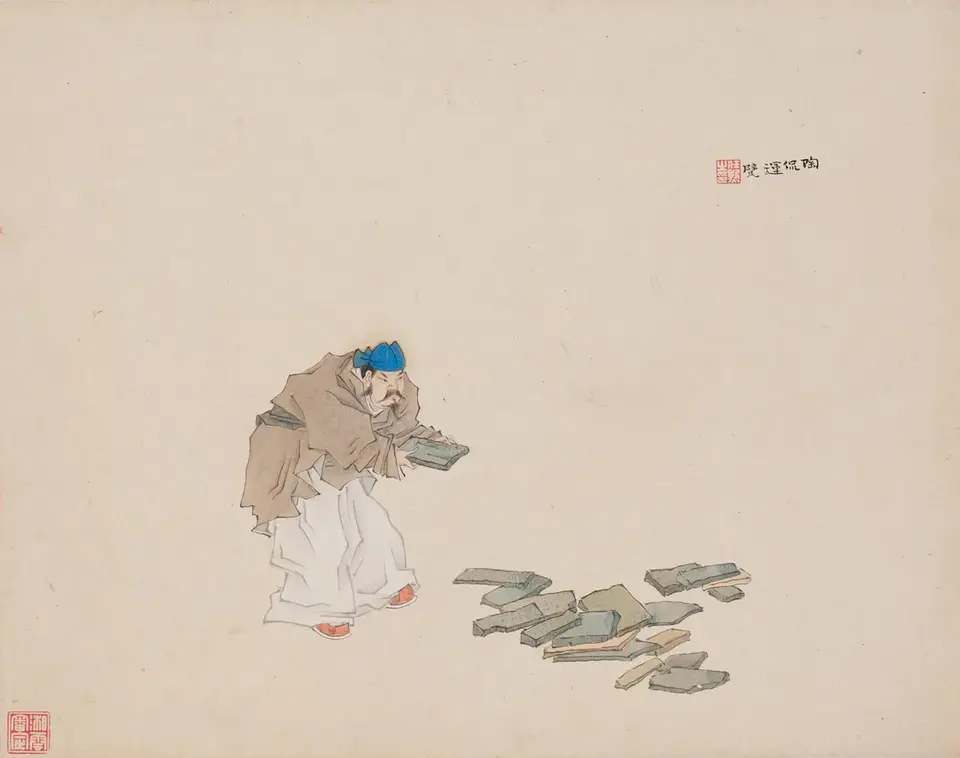
Every morning, Tao Kan would personally carry one hundred heavy construction bricks from his study to his garden courtyard. Every evening, he would carry the one hundred bricks back into the study.
When perplexed subordinates asked why the supreme governor engaged in manual labor, Tao Kan replied with grave earnestness: "I am dedicated to reclaiming the Central Plains and restoring our ancestral empire. If I become soft, indolent, and accustomed to comfort in this tropical climate, I will be useless when the state summons me to battle." This famous practice entered Chinese folklore as "Tao Kan Carrying Bricks" (Tao Kan Yun Pi).
Tao Kan maintained relentless administrative oversight throughout his career. He rose before dawn, reviewed judicial archives until midnight, and personally supervised local shipyards, tax registers, and granaries.
He famously admonished young scholars and officials: "The great sage Yu the Great treasured even a single inch of time on the sundial; ordinary men like ourselves must treasure every tenth of an inch of daylight! How can anyone waste their sacred years on drinking, gossiping, and gambling, only to accomplish nothing for the state?"
While directing naval construction in Jingzhou, Tao Kan instructed carpenters to collect and store every scrap of discarded wood shavings and bamboo cuttings inside dry warehouses. Many officials mocked the governor as pathologically stingy.
Years later, during a severe winter, sudden blizzards glazed the stone highways of the capital with sheet ice, paralyzing all transport horses and military dispatches. Tao Kan ordered the stored wood shavings spread across the highways, instantly restoring safe traffic.
Later, when Grand Marshal Huan Wen launched his naval expedition against Cheng Han in Sichuan, the shipyard ran out of iron nails to assemble the warships. Tao Kan directed the artisans to open the bamboo storehouses, using the aged bamboo cuttings as hardened timber pegs to secure the hull timbers, enabling the armada to sail on schedule.
The Rescue of the Eastern Jin: The Su Jun Rebellion
In 327, General Su Jun and warlord Zu Yue rose in armed rebellion, overrunning the capital of Jiankang. The imperial palace was sacked, young Emperor Cheng was held hostage at Stone Fortress (Shitou Cheng), and high ministers were slaughtered.
Chancellor Yu Liang fled in humiliation to Xunyang, where he and General Wen Qiao sought Tao Kan's military intervention. Because Yu Liang had previously blocked Tao Kan's promotion, Tao Kan initially hesitated.
Wen Qiao, however, rode in person to Tao Kan's camp, appealing to his patriotism: "The imperial ancestral shrines are in ashes, and the Son of Heaven is bound by traitors. Without your command of the western armies, the House of Jin is extinguished!" Tao Kan wept, mobilized his entire river armada of several thousand warships, and accepted the appointment of Supreme Allied Commander.
In 328, Tao Kan deployed his naval armada along the Yangtze River outside Jiankang, coordinating with Wen Qiao's land forces to fortify Baishe and Mount Zijin.
During a fierce cavalry counterattack, the rebel leader Su Jun charged recklessly into the allied formations; his horse stumbled in the marsh, and allied spearmen struck Su Jun down, decapitating him on the field.
Tao Kan then directed the encirclement of Stone Fortress, storming the bastions, executing the rebel remnants under Zu Yue, and rescuing Emperor Cheng unharmed. For saving the dynasty from total ruin, Tao Kan was elevated to Grand Commandant (Taiwei), created Duke of Changsha (Changsha Jun Gong), and granted the ultimate military title of Grand Marshal (Da Sima).
Despite commanding eight provinces—stretching from Sichuan to the southern seas—and controlling the entirety of the Eastern Jin navy, Tao Kan remained scrupulously loyal to the imperial throne. When sycophantic courtiers whispered that he held the power to unseat the young monarch and declare his own dynasty, Tao Kan rebuked them fiercely, reaffirming that the legitimacy of the Sima royal house was inviolable.
In June 334, sensing that his terminal illness was approaching, Tao Kan submitted a moving valedictory memorial resigning all offices and military seals. He distributed his personal arms and wealth to the state, boarded an ordinary boat at Changsha, and sailed toward Fankou.
He passed away peacefully aboard the vessel on July 30, 334, at the age of seventy-six. Emperor Cheng suspended court for three days, conferring upon him the posthumous title Duke Huan of Changsha (Changsha Huan Gong). Decades later, his great-grandson, the celebrated poet Tao Yuanming, inherited his grandfather's serene moral independence, walking away from bureaucratic office to celebrate pastoral truth in immortal verse.
FIGURES ASSOCIATED WITH THIS DYNASTY