Imperial Birth
Born in the Prince of Kuaiji residence in Jiankang as the sixth son of Sima Yu and Lady Li Lingrong.
362 CE–396 CE
司马曜
Sima Yao (362 – November 6, 396), courtesy name Changming, was a native of Wen County in Henei. He was the sixth son of Emperor Jianwen (Sima Yu), reigning as the ninth monarch of the Eastern Jin dynasty from 372 to 396, known temple-named as Liezong and posthumously as Emperor Xiaowu of Jin. In 372 AD, as Emperor Jianwen lay critically ill, elder statesmen Wang Tanzhi and Xie An thwarted Grand Marshal Huan Wen plot to usurp…
Sima Yao (362 – November 6, 396), courtesy name Changming, was a native of Wen County in Henei. He was the sixth son of Emperor Jianwen (Sima Yu), reigning as the ninth monarch of the Eastern Jin dynasty from 372 to 396, known temple-named as Liezong and posthumously as Emperor Xiaowu of Jin. In 372 AD, as Emperor Jianwen lay critically ill, elder statesmen Wang Tanzhi and Xie An thwarted Grand Marshal Huan Wen plot to usurp the throne, investing eleven-year-old Sima Yao as Crown Prince and sovereign. Following Huan Wen death, Empress Dowager Chu assumed a transitional regency while Xie An guided civil administration. In 376 AD, Emperor Xiaowu celebrated his capping ceremony and assumed direct personal governance. In 383 AD, facing a massive northern invasion by Former Qin, the emperor resolutely supported Xie An and Xie Xuan in directing the Battle of Fei River, achieving a legendary triumph that preserved southern civilization and shattered Former Qin dominance. Capitalizing on this victory, Emperor Xiaowu broke the seventy-year monopoly of aristocratic oligarchs over central power, appointing his younger brother Sima Daozi to oversee the cabinet and successfully returning supreme authority to the imperial house. Furthermore, he instituted vital fiscal reforms replacing land-based grain tithes with per-capita household taxation, reestablished the National Academy, honored Confucius descendants, and promoted classical statecraft alongside Buddhist philosophy. In his later years, political rivalry with Sima Daozi intensified while the emperor indulged in wine. On November 6, 396, after making a drunken jest toward his favored Consort Zhang, he was smothered to death with bed quilts in Qingshu Hall at age thirty-five. He was interred in Longping Mausoleum, succeeded by his son Sima Dezong.
Born in the Prince of Kuaiji residence in Jiankang as the sixth son of Sima Yu and Lady Li Lingrong.
Succeeded his father as Prince of Kuaiji at age four; Grand Marshal Huan Wen subsequently engineered palace coups.
As Emperor Jianwen lay dying, Wang Tanzhi tore the abdication testament; Sima Yao crowned emperor at age eleven.
Huan Wen entered Jiankang with an army; Xie An composed demeanor averted crisis; Huan Wen died in Gushu; Chu regency restored.
Formally assumed direct rule upon capping at fifteen; Empress Dowager retired, and Xie An directed metropolitan civil affairs.
Commissioned Xie Xuan to recruit northern emigre soldiers at Guangling, establishing the elite Beifu field army.
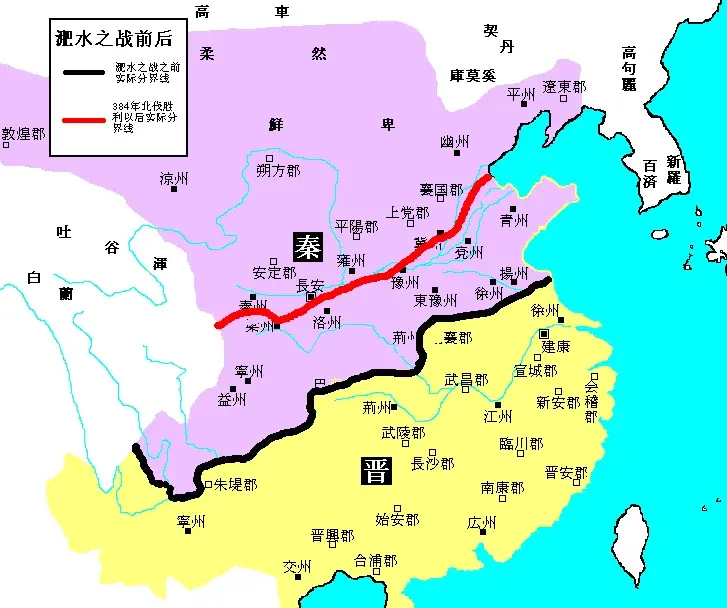
Former Qin mobilized one million troops south; Beifu army scored an overwhelming victory at Fei River, saving Eastern Jin.
Dismantled aristocratic monopoly; Xie An retired to Guangling and died; Sima Daozi appointed chancellor to concentrate royal power.
Promulgated per-capita taxation and inspected household registers across southern commanderies to replenish state grain reserves.
Made a drunken jest to Consort Zhang; smothered to death with bed quilts in Qingshu Hall at age thirty-five; buried in Longping Mausoleum.
Emperor Xiaowu of Jin, Sima Yao, was born in the first year of the Longhe era (362 AD), courtesy-named Changming, as the sixth son of Emperor Jianwen (Sima Yu) and Lady Li Lingrong. Prior to Sima Yao birth, his father had fathered five sons who all died in infancy, threatening the direct lineage of the princely household with extinction. The birth of Sima Yao, followed by his younger biological brother Sima Daozi, ensured the continuity of Sima Yu lineage, earning the young prince extraordinary parental affection and imperial devotion within the court.
In the third year of Xingning (365 AD), when Emperor Fei Sima Yi ascended the imperial throne, Sima Yu was transferred to the prestigious title of Prince of Langye, while four-year-old Sima Yao inherited his father former appanage as Prince of Kuaiji. Throughout his childhood years, Eastern Jin imperial authority remained thoroughly marginalized, with civil governance dominated by powerful emigre aristocratic lineages and frontier military forces commanded by autonomous regional warlords along the middle Yangtze corridor.
At the time, Grand Marshal Huan Wen wielded supreme military dominance over Jingzhou and Jiangzhou, harboring long-standing ambitions to usurp the imperial throne and establish his own dynasty. In November 371 AD, Huan Wen marched elite field legions directly into Jiankang, staging a palace coup under the manufactured pretext of imperial misconduct and using the imperial prestige of Empress Dowager Chu to depose Emperor Fei. Huan Wen installed the compliant Sima Yu as Emperor Jianwen, through which nine-year-old Sima Yao became an imperial son.
Following his enthronement, Emperor Jianwen found himself completely subordinated to Huan Wen autocratic will, to the extent that senior ministers like Xie An bowed low upon greeting the general. Distressed by his position as a helpless puppet, Emperor Jianwen fell critically ill after reigning for merely eight months. Confronting the imminent collapse of the dynastic altars, the dying sovereign prepared an abdication testament intending to surrender imperial governance entirely to Huan Wen, bringing the Jin mandate to the brink of extinction.
At this critical crossroads, Palace Attendant Wang Tanzhi tore up the draft testament in the sovereign presence, joining forces with Minister of Personnel Xie An to block the abdication. Wang Tanzhi and Xie An argued passionately that the Jin realm was founded by the sacred sacrifices of Emperors Yuan and Ming and could never be arbitrarily surrendered to an overbearing subject. Moved to tears by their unwavering loyalty, Emperor Jianwen altered his final decree, officially designating eleven-year-old Prince of Kuaiji Sima Yao as Crown Prince.
On September 12, 372 AD, Emperor Jianwen died in Jiankang Palace. Learning that the emperor had not abdicated in his favor, Huan Wen reacted with incandescent fury. Intimidated by the warlord potential retaliation, several ministers suggested dispatching emissaries to Huan Wen military headquarters at Gushu to consult him before proclaiming the succession. Vice Director Wang Biaozhi intervened resolutely, arguing that upon a monarch death the crown prince must succeed immediately, rallying the court to enthrone Sima Yao.
On September 14, 372 AD, eleven-year-old Crown Prince Sima Yao ascended the imperial throne in Taiji Hall, becoming Emperor Xiaowu of Jin, and adopting the era title Ningkang the following year. Following the coronation ceremonies, the imperial court issued a general amnesty and elevated the sovereign biological mother Lady Li to Consort Xian. However, Grand Marshal Huan Wen remained encamped at Gushu with tens of thousands of veteran soldiers, casting a menacing military shadow over the young emperor and the metropolitan government.
In February 373 AD, Huan Wen marched his massive land and naval forces into Jiankang to make a public show of supreme authority. The capital was engulfed in terror, with widespread rumors alleging that the general intended to execute senior members of the Wang and Xie clans and usurp the throne. Displaying extraordinary composure, Wang Biaozhi and Xie An coordinated metropolitan defenses, while Xie An personally led the civil bureaucracy to welcome Huan Wen along the avenue at Xinting, neutralizing the armed confrontation through impeccable diplomatic etiquette.
Entering the capital, Huan Wen observed that the metropolitan bureaucracy stood firm and the forbidden precinct was securely defended. Compounded by severe physical illness and failing vitality, the general hesitated to execute an armed coup. After paying formal homage to the young emperor, Huan Wen returned to his base at Gushu, where he incessantly pressured the court to bestow the Nine Bestowals. Xie An and Wang Tanzhi deployed delaying tactics, continually revising the ceremonial text until Huan Wen died of illness at Gushu in July 373 AD.
The death of Grand Marshal Huan Wen lifted the existential threat of usurpation that had imperiled the Eastern Jin imperial house for two decades. However, his younger brother Huan Chong assumed command of the Jingzhou armies, continuing to dominate the strategic middle Yangtze reaches. To prevent imperial authority from being compromised once more by military strongmen, Xie An and Wang Biaozhi petitioned the sovereign cousin-in-law, Empress Dowager Chu Suanzi, to assume a transitional regency behind the screen.
In July 373 AD, Empress Dowager Chu formally established her seat in Taiji Hall, hanging a white silk curtain to oversee state business. Modest and respectful of constitutional limits, the Empress Dowager guided the young emperor education in classical history and statecraft while delegating executive administration entirely to Xie An and Wang Biaozhi. This harmonious collaboration between the maternal court and civil ministers stabilized central governance, allowing the infant emperor to mature in safety.
During this regency period, Xie An was promoted to Director of the Imperial Secretariat, becoming the principal architect of Eastern Jin domestic and foreign policy. Renowned for his refined elegance and strategic insight, Xie An harmonized the interests of rival high-born clans including the Xie, Wang, and Huan families, achieving a peaceful equilibrium between the capital and the western garrisons that provided vital political breathing room for Emperor Xiaowu.
In May 375 AD, senior statesman Wang Tanzhi died of illness, leaving Xie An as the preeminent minister of state. Recognizing the gathering military storm in northern China under the surging Former Qin dynasty, Xie An realized that regional forces alone were inadequate to protect the capital. In January 376 AD, upon Emperor Xiaowu reaching age fifteen, the sovereign celebrated his capping ceremony in Taiji Hall. Empress Dowager Chu promulgated an imperial decree retiring her regency, officially returning supreme authority to the emperor.
Assuming personal rule, Emperor Xiaowu adopted the era title Taiyuan and rewarded metropolitan civil and military officials, entrusting Xie An with the office of Vice Director of the Imperial Secretariat to direct state affairs. Though exercising executive dominance, Xie An adhered scrupulously to ministerial protocols, presenting all critical state policies to Emperor Xiaowu for imperial sanction. During this period, the young sovereign developed advanced political acumen under Xie An scholarly tutelage.
In 377 AD, Former Qin sovereign Fu Jian, guided by Prime Minister Wang Meng, completed the conquest of Former Yan, Former Liang, and Dai, achieving the total unification of northern China. With overwhelming military forces massing along the northern frontier, Eastern Jin faced an unprecedented existential threat. Overcoming factional skepticism, Xie An promoted his nephew Xie Xuan to General Establishing Martial Virtue and Inspector of Yanzhou, commissioning him to recruit an elite field force to defend the Huai River basin.
Establishing his headquarters at Guangling and Jingkou, Xie Xuan recruited hardy northern refugees and skilled fighters, appointing veteran commanders including Liu Laozhi and He Qian to train them in strict tactics and heavy infantry combat. This newly forged strike force became historically renowned as the Beifu Army. The emergence of the Beifu Army broke the regime long-standing military reliance on the Jingzhou garrison, providing the central government with an elite standing strike corps.
Beginning in 378 AD, Former Qin launched coordinated offensives against southern border bastions, besieging Xiangyang, Huainan, and Hanzhong. Though Xiangyang fell after a heroic defense, Xie Xuan led the Beifu Army into Huainan, routing Former Qin forces at Junchuan and halting their advance toward the Yangtze River. Emperor Xiaowu issued imperial commendations, bolstering frontier morale and consolidating the forward defensive perimeter.
Simultaneously, Emperor Xiaowu and Xie An reinforced the imperial bodyguard regiments in Jiankang. Xie An stationed trusted family members across critical military postings, with Xie Shang, Xie Shi, and Xie Xuan directing field operations. While this concentration of military authority secured the dynasty against northern invasion, the meteoric ascent of the Chen Commandery Xie clan also aroused the watchful suspicion of the maturing Emperor Xiaowu, planting the seeds of future political friction.
Between 381 and 382 AD, Former Qin completed empire-wide military mobilization, with Fu Jian determined to deploy his vast multinational armies to conquer southern China and unify the world. The northern offensive encompassed a massive multi-pronged front stretching across thousands of miles, with western divisions pressing down the Han River toward Jiangling while the main imperial force led by Fu Jian marched toward Xiangcheng and Shouchun, confronting Eastern Jin with its supreme historical crisis.
When news of the impending invasion reached Jiankang, widespread panic seized the capital, with faint-hearted officials urging flight across the southern mountains. The twenty-two-year-old Emperor Xiaowu demonstrated extraordinary resolve and royal dignity. Presiding over emergency court sessions, he firmly rejected appeasement, endorsing Xie An military strategy and leading solemn ceremonies in Taiji Hall to inspire the armed forces with absolute resolve.
Emperor Xiaowu commissioned Xie An as Supreme General for Punitive Campaigns to coordinate imperial strategy. He appointed Xie An brother Xie Shi as Field Commander-in-Chief and Xie Xuan as Vanguard Commander, directing eighty thousand elite Beifu troops to confront the northern legions; concurrently, Xie Yan garrisoned Jingkou as strategic reserve, while Huan Chong mobilized one hundred thousand troops in Jingzhou to secure the upper Yangtze, forming an integrated defensive network.
Confronting this formidable peril, Chief Commander Xie An remained composed and serene in Jiankang. Discharging daily administrative duties with calm detachment, he famously played chess and strolled through his garden, exuding an unruffled confidence that quelled metropolitan panic. Reassured by their supreme minister tranquility, front-line commanders Xie Xuan and Liu Laozhi marched north resolved to sacrifice their lives to defend the realm.
In October 383 AD, Former Qin vanguard commander Fu Rong captured Shouchun, dispatching captured Jin general Zhu Xu to persuade Xie Shi to surrender. Loyal to the Jin house, Zhu Xu secretly disclosed to the Jin commanders that the main Qin army was still strung out along northern roads, advising Xie Xuan to strike the isolated northern vanguard before their main forces could consolidate.
Acting on Zhu Xu intelligence, Xie Xuan dispatched vanguard commander Liu Laozhi with five thousand elite cavalry on a daring nighttime assault across the Luo River. Striking with lightning speed, Liu Laozhi overran the Former Qin forward camp, slaying northern general Liang Cheng and ten thousand troops while capturing extensive supplies. The brilliant victory at Luojian shattered northern aura of invincibility, setting the stage for the decisive clash at the Fei River.
In November 383 AD, Former Qin sovereign Fu Jian and Fu Rong massed their main forces along the western bank of the Fei River, confronting eighty thousand Jin troops drawn up along the eastern shore. The northern legions stretched for hundreds of miles, displaying immense military grandeur. Xie Xuan dispatched an emissary to Fu Jian, proposing that the northern army withdraw slightly from the riverbank to allow the Jin forces to cross and engage in open battle.
Overconfident in his numerical superiority, Fu Jian planned to launch a crushing cavalry assault while the Jin columns were half-way across the river, readily agreeing to order a tactical withdrawal. However, the Former Qin army was a fragile coalition composed of diverse ethnic groups who had suffered decades of ceaseless warfare. Once the command to withdraw was issued, the vast, poorly coordinated formations mistook the maneuver for a general retreat, descending into chaotic stampedes.
At this precise moment of tactical confusion, former Jin commander Zhu Xu shouted from behind the lines that the Qin army was defeated. Hearing this cry, the panic-stricken northern troops broke into uncontrollable flight. Seizing the moment, Xie Xuan, Xie Yan, and Huan Yi led eighty thousand elite Beifu troops across the Fei River, launching a ferocious assault against the disintegrating northern ranks.
Under the relentless Jin onslaught, the Former Qin host collapsed entirely. General Fu Rong horse stumbled in the melee and he was slain by Jin cavalry, while Fu Jian was wounded by an arrow and fled on horseback toward the Huai River. Thousands of fleeing soldiers trampled one another in the dark, with casualties from exhaustion and exposure numbering in the hundreds of thousands, resulting in one of the most celebrated asymmetric victories in world military history.
When the victory dispatch reached Jiankang, Prime Minister Xie An was playing chess with a guest. Reading the courier report, Xie An displayed no outward emotion, quietly placing the letter beside his seat and resuming the game. When the guest inquired about the war, Xie An calmly replied that the young boys had thoroughly defeated the enemy. Only after the guest departed did Xie An display his joy, dancing into his private quarters so vigorously that he broke the wooden teeth of his clogs without noticing.
The triumph at Fei River not only preserved the southern dynastic altars and safeguarded Chinese cultural continuity, but also triggered the rapid dissolution of the Former Qin empire. Northern polities including Later Yan, Later Qin, and Western Yan erupted in rebellion, plunging northern China into renewed fragmentation. Xie Xuan capitalized on the momentum, advancing north to liberate the Huai basin, Henan, and Shandong, elevating Eastern Jin international prestige to unprecedented heights.
Following the victory at Fei River, the prestige of the Chen Commandery Xie clan reached its zenith, with Xie An standing as an imperial guardian and his family dominating regional commands. Now twenty-two years old and endowed with administrative ambition, Emperor Xiaowu refused to remain an imperial figurehead, resolving to terminate the seventy-year monopoly of aristocratic lineages over state affairs and reclaim supreme authority for the imperial lineage.
To counterbalance Xie An preeminent influence, Emperor Xiaowu elevated his younger biological brother, Prince of Langye Sima Daozi. The emperor appointed Sima Daozi as Minister of Works and Director of the Secretariat, drawing him directly into ministerial policy-making. Astute and adept at flattering the sovereign, Sima Daozi formed an alliance with aristocratic careerists including Wang Guobao, creating an imperial faction that aggressively contested Xie An administration.
Wang Guobao, who was Xie An son-in-law but despised by the chancellor for his unscrupulous conduct, allied himself with Sima Daozi, persistently whispering slanderous accusations into the emperor ear, warning that the Xie clan military power posed a latent threat to the throne. Increasingly wary of the Xie family ascendancy, Emperor Xiaowu systematically diminished Xie An executive authority. In April 385 AD, recognizing his delicate position, Xie An requested to leave the capital to inspect Guangling, dying shortly thereafter.
Xie An departure and subsequent death marked the definitive conclusion of Eastern Jin aristocratic dominance, ending the historic era where emperors shared power with noble houses. Emperor Xiaowu successfully centralized imperial authority, becoming the first Eastern Jin monarch to wield autocratic executive governance. However, the dismantling of aristocratic checks soon produced an equally destabilizing internal conflict between the emperor and his brother Sima Daozi.
Dominating the cabinet, Sima Daozi grew arrogant and corrupt, turning his princely residence into a bustling marketplace of bribery. In league with Wang Guobao and Wang Xu, Sima Daozi sold offices, embezzled public revenues, and permitted Buddhist clergy to interfere in governance, causing administrative standards to deteriorate rapidly. Troubled by his brother overreaching ambition, Emperor Xiaowu relationship with Sima Daozi deteriorated into bitter political confrontation.
To restrain Sima Daozi growing hegemony, Emperor Xiaowu cultivated independent political and military allies. He appointed his trusted relative Wang Gong to command the Beifu troops at Jingkou and placed Yin Zhongkan over the strategic middle Yangtze at Jiangling, creating an external pincers to counterbalance Sima Daozi in Jiankang. This factional division plunged the central government into prolonged political intrigue, laying the groundwork for subsequent rebellions.
Since the founding of Eastern Jin by Emperor Yuan and Wang Dao, great families including the Wang of Langye, the Yu of Yingchuan, the Huan of Qiaoguo, and the Xie of Chenjun had monopolized civil and military offices, reducing successive emperors to virtual figureheads whose decrees could rarely cross the palace gates. Utilizing the historic opportunity presented by the Fei River victory, Emperor Xiaowu executed a determined political campaign that effectively dismantled the seventy-year oligarchy of aristocratic houses over the imperial throne.
Exploiting Xie An modest self-restraint and internal rivalries among the nobility, Emperor Xiaowu substituted royal prince Sima Daozi for the Xie leadership, shifting the institutional decision-making center from noble mansions back to the Eastern Hall of Taiji Hall. The emperor personally reviewed memorials, appointed lower-tier scholars to secretarial offices, and restored direct monarchical oversight over administrative appointments, reviving sovereign dignity.
This restoration of monarchical leadership revitalized dynastic central authority. Throughout Emperor Xiaowu reign, provincial governors were compelled to obey central edicts, and regional warlords were strictly forbidden from mobilizing troops without imperial authorization, ending the era where frontier commanders like Huan Wen could march on the capital at will. Despite Sima Daozi subsequent corruption, the imperial autonomy established during this era was unprecedented in Eastern Jin history.
Emperor Xiaowu reign witnessed foundational fiscal and agrarian reforms that fundamentally restructured southern Chinese taxation. Since early Eastern Jin times, the state had levied grain taxes based on cultivated acreage. However, powerful noble families systematically concealed estate lands and absorbed peasant holdings, producing fraudulent land registers that deprived the state treasury of revenue while shifting onerous tax burdens onto landless peasants.
In 377 AD, Emperor Xiaowu adopted proposals to execute a historic taxation reform, abolishing the acreage-based tax system and instituting a per-capita levy that required every taxable subject to pay three bushels of grain annually, while exempting conscripted males from personal labor taxes. This reform eliminated the nobility ability to evade taxes through hidden landholdings, enabling the treasury to extract reliable revenue directly from census rolls and alleviating the fiscal exploitation of impoverished tenant farmers.
Following the Fei River victory in 383 AD, to finance northern military campaigns, Emperor Xiaowu adjusted the tax rate to five bushels per person. Thanks to strict census inspections and the per-capita tax system, central granaries accumulated unprecedented grain reserves, fully provisioning northern expeditionary armies and bringing state finances to their historical zenith. Concurrently, strict regulation of internal transit tariffs and salt monopolies stimulated domestic commerce and long-term agricultural prosperity.
In cultural governance, Emperor Xiaowu achieved notable distinction by championing classical education and spiritual patronage. Following the disaster of Yongjia, the imperial academies of the Central Plains had been destroyed, and classical Confucian learning in the south suffered decades of neglect amidst ceaseless wars. In 384 AD, following the stabilization of the northern frontier, Emperor Xiaowu commissioned the reconstruction of the National Academy and the erection of a grand Temple of Confucius in Jiankang.
In the autumn of 385 AD, Emperor Xiaowu personally visited the Temple of Confucius to perform solemn sacrificial rituals, promulgating an imperial decree that conferred the aristocratic title of Marquis of Fengsheng upon the direct male heir of Confucius, accompanied by an appanage of one hundred households. The emperor then ascended the academy dais to examine student scholars on classical texts, generously rewarding eminent doctors and restoring prestige to Confucian statecraft.
Endowed with literary talent and scholarly appreciation, Emperor Xiaowu composed poetry and commissioned the compilation of contemporary administrative annals. Simultaneously, he was a devoted patron of Buddhism, erecting private shrines within the imperial palace and inviting eminent monks including Zhi Dun to discourse on Buddhist philosophy. This synthesis of Confucian statecraft, Buddhist compassion, and Daoist self-cultivation came to characterize the vibrant intellectual culture of the late Eastern Jin era.
In his later years, with external perils resolved and sovereign authority secure, Emperor Xiaowu grew weary of administrative burdens, succumbing to palace indulgence and heavy wine consumption. The sovereign spent evenings drinking late with palace consorts, delegating routine affairs to palace secretaries. Among his consorts, Lady Zhang earned supreme favor through her extraordinary beauty and attentiveness, wielding commanding influence within the inner court.
On the evening of November 6, 396 AD (the day of Gengshen in the ninth month of Taiyuan 21st Year), Emperor Xiaowu hosted an intimate drinking banquet in Qingshu Hall. As the sovereign became thoroughly intoxicated, he noticed that his favorite Consort Zhang was approaching age thirty, jesting lightly that she was growing old and that he intended to replace her with younger women. Though uttered in drunken jest, the insecure and ruthless consort was consumed by terror and vindictive fury, fearing impending abandonment.
Waiting until Emperor Xiaowu fell into deep drunken slumber upon the royal couch, Consort Zhang dismissed the palace guards and summoned trusted maidservants into the royal bedchamber. Taking advantage of the emperor defenseless state, the conspirators smothered the thirty-five-year-old monarch with thick bed quilts, executing one of the most shocking and bizarre regicides in Chinese imperial history.
Following the murder, Consort Zhang bribed palace attendants to proclaim that the emperor had died suddenly of a nightmare in his sleep. Prime Minister Sima Daozi and Wang Guobao, who were locked in bitter rivalry with the late sovereign, chose to conceal the crime rather than investigate the assassination, swiftly installing the developmentally disabled Crown Prince Sima Dezong as Emperor An. The sudden death of this capable monarch plunged the dynasty into rapid disintegration.
During early Eastern Jin, the political framework was defined by an aristocratic partnership where the imperial house governed jointly with the Langye Wang clan. Over subsequent generations, the Yu, Huan, and Xie lineages rotated control over the imperial chancellery, maintaining regional armies to protect their clan interests while reducing the emperor to a constitutional symbol. Emperor Xiaowu early experiences under Huan Wen domination impressed upon him the necessity of breaking this oligopoly to ensure dynastic survival.
The victory at Fei River elevated the Chen Commandery Xie family to unprecedented heights of glory, threatening to create another military dynasty that could overshadow the throne. Recognizing this danger, Emperor Xiaowu moved decisively, utilizing lower-tier aristocratic families such as the Taiyuan Wang and Hongnong Yang clans to dilute the influence of the premier noble houses, transitioning Eastern Jin from an oligarchy into a multi-factional court subordinate to the monarch.
In military administration, Emperor Xiaowu prohibited provincial governors from recruiting private retainers without central sanction, concentrating taxation and military conscription firmly within the Imperial Secretariat. By dismantling the institutional privileges of the great noble houses, Emperor Xiaowu restored central legal authority, reestablishing the majesty of the imperial throne across the southern provinces.
Following the collapse of Western Jin, millions of northern refugees migrated south, prompting the government to establish special emigre commanderies where populations were registered on white rosters and exempted from regular taxation. In contrast, indigenous southern populations were listed on yellow rosters, bearing crushing tax obligations that generated acute social friction.
Powerful aristocratic families systematically exploited these policies, harboring northern refugees as private tenants and servants to evade taxation. Emperor Xiaowu addressed this systemic abuse by launching sweeping census inspections across Yang, Jing, and Jiang provinces, aggressively penalizing noble houses that concealed taxable laborers and returning thousands of hidden subjects to official tax registers.
The 377 AD per-capita tax reform replaced convoluted acreage assessments with a clear head tax of three bushels of grain annually, exempting conscripted laborers from personal taxes. This simplified administrative oversight and ensured reliable revenues for the central treasury. Following the Fei River victory, the tax was adjusted to five bushels per head, providing abundant logistical reserves that supported northern military campaigns and enriched the national treasury.
Furthermore, Emperor Xiaowu regulated river tolls and market tariffs, prohibiting regional commanders from establishing unauthorized check-posts. These comprehensive fiscal measures stimulated agrarian recovery, revived regional trade along the Yangtze basin, and provided the material foundation for late Eastern Jin stability.
The Eastern Jin era was marked by dynamic philosophical developments, with aristocratic intellectuals heavily devoted to Neo-Daoist metaphysics and free-spirited discourse. While culturally refined, this intellectual detachment led to administrative neglect among governing elites. Emperor Xiaowu recognized these governance defects, actively promoting practical Confucian studies to revitalize bureaucratic ethics.
To cultivate qualified administrative talent, the emperor rebuilt the National Academy in Jiankang, endowing it with generous stipends and appointing distinguished classical scholars to instruct students from both noble and humble backgrounds. The emperor frequently attended academic lectures, making classical comprehension a prerequisite for official promotions.
Simultaneously, Emperor Xiaowu was a devoted patron of Buddhism, maintaining private sanctuaries within the palace and hosting eminent monks for philosophical symposia. By harmonizing Confucian social duty with Buddhist spiritual ethics, the emperor sought to heal societal fractures and cultivate moral consensus, leaving a lasting imprint on the cultural synthesis of the Southern Dynasties.
The concluding years of Emperor Xiaowu reign were characterized by bitter factional warfare between the monarch and his brother Sima Daozi. Supported by corrupt advisors like Wang Guobao, Sima Daozi monopolized central patronage, selling judicial favors and permitting Buddhist nuns to influence state affairs, which alienated reform-minded ministers.
To check his brother influence, Emperor Xiaowu placed trusted allies Wang Gong and Yin Zhongkan over the Beifu Army and the Jingzhou garrison, creating external military counterweights against Sima Daozi. This dangerous factional polarization brought the central government to the brink of armed conflict.
Against this explosive political backdrop, the sudden assassination of Emperor Xiaowu in Qingshu Hall has invited enduring scrutiny. While transmitted annals attribute the murder to Consort Zhang vindictive rage over a drunken jest, modern historians argue that an isolated consort lacked the means to execute the sovereign without external collusion. Given that Sima Daozi faced imminent political disgrace, the emperor sudden demise directly shielded the prince from ruin, suggesting the assassination was an orchestrated political conspiracy. Sima Daozi subsequent refusal to prosecute the crime further reinforces the probability of high-level treason.
FIGURES ASSOCIATED WITH THIS DYNASTY