Fu Jian Mobilizes Grand Southern Invasion
Fu Jian marshals over eight hundred thousand troops, declaring his army's whips can sever the flow of the Yangtze.
Eastern Jin / Former Qin · HISTORICAL EVENT
谢安淝水之捷
Xie An's Victory at the Fei River (谢安淝水之捷) was a celebrated defensive campaign in ancient Chinese military history that occurred in the autumn of 383 along the Fei River basin in modern Anhui. Following his unification of northern China, Emperor Fu Jian of Former Qin boastfully declared that his vast army could sever the flow of the Yangtze River simply by casting their riding whips into its waters. Disregarding the dying counsels of Prime Minister Wang…
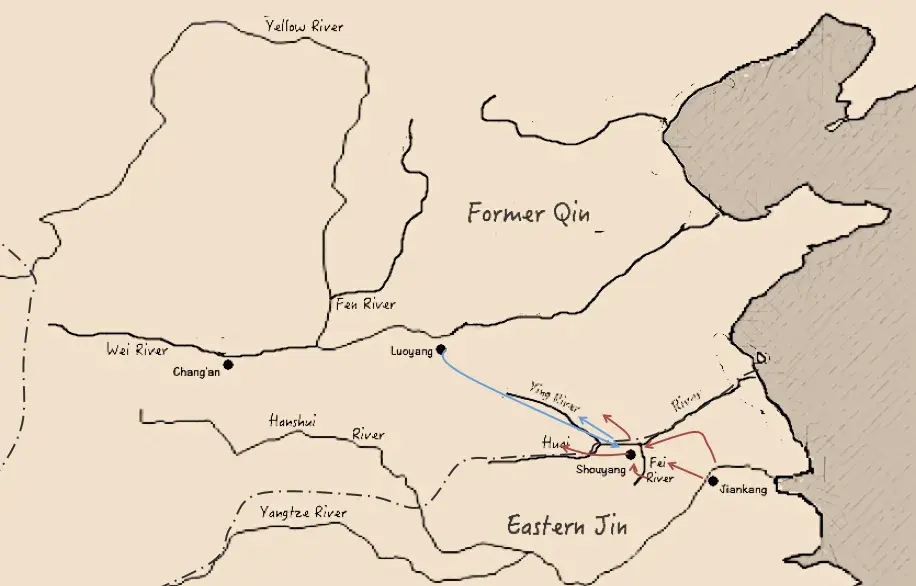
Xie An's Victory at the Fei River (谢安淝水之捷) was a celebrated defensive campaign in ancient Chinese military history that occurred in the autumn of 383 along the Fei River basin in modern Anhui. Following his unification of northern China, Emperor Fu Jian of Former Qin boastfully declared that his vast army could sever the flow of the Yangtze River simply by casting their riding whips into its waters. Disregarding the dying counsels of Prime Minister Wang Meng and the unanimous cautions of court ministers, Fu Jian mobilized an imperial host of over eight hundred thousand troops to conquer Eastern Jin. Confronting impending subjugation and widespread panic, Eastern Jin Chancellor Xie An maintained unruffled composure, appointing his younger brother Xie Shi as supreme commissioner and nephew Xie Xuan as vanguard commander over eighty thousand elite Beifu troops. In the initial stage, Qin vanguards captured the citadel of Shouyang, but former Jin officer Zhu Xu, sent by Fu Jian to demand surrender, secretly relayed intelligence to Jin lines. In November, Jin vanguard general Liu Laozhi executed a nocturnal commando raid across Luojian, decapitating Qin general Liang Cheng. Confronting Qin masses entrenched along the opposite bank of the Fei River, Xie Xuan challenged Fu Jian to withdraw slightly to allow Jin forces to cross for open battle. As Qin divisions retreated, lack of coordination triggered panic, magnified when Zhu Xu shouted that the army was routed. The Qin host collapsed into catastrophic stampede, during which commander Fu Rong was slain and Fu Jian escaped wounded. Receiving the victory dispatch while playing weiqi in Jiankang, Xie An remained outwardly serene, yet famously broke the wooden tooth of his clogs in euphoric haste upon entering his private chambers.
Fu Jian marshals over eight hundred thousand troops, declaring his army's whips can sever the flow of the Yangtze.
Chancellor Xie An maintains tranquil composure, assigning Xie Shi and Xie Xuan to lead eighty thousand troops to the front.
Fu Rong takes Shouyang; Fu Jian arrives secretly and sends Zhu Xu to demand surrender, but Zhu Xu reveals Qin vulnerabilities.
Liu Laozhi leads five thousand elite commandos across Luojian, killing Liang Cheng and shattering Qin vanguard morale.
Xie Xuan induces Qin retreat; Zhu Xu shouts of defeat; Jin forces charge across the river, routing Qin and slaying Fu Rong.
Xie An receives the report while playing weiqi, remaining calm outwardly while breaking his clog tooth in joy upon entering his chamber.
During the mid-fourth century, northern China endured decades of turmoil throughout the Sixteen Kingdoms period. Ascending as ruler of Former Qin, Di aristocrat Fu Jian partnered with Chinese chancellor Wang Meng to enact wide-ranging administrative reforms, suppress official corruption, and promote agricultural revitalization. Between 370 and 376, Former Qin annexed Former Yan, Former Liang, and Dai, while stripping Liangzhou and Yizhou from Eastern Jin. This rapid expansion established unified governance across the Yellow River basin and northern territories, concluding half a century of fragmentation.
However, the foundation of this unification was fragile, encompassing diverse ethnic elements including Xianbei, Qiang, Jie, and Han aristocrats who retained latent loyalties to their fallen dynasties. Prior to his death in 375, Chancellor Wang Meng had earnestly implored Fu Jian: "The Eastern Jin represents orthodox imperial lineage; its leadership is united and the Yangtze River barrier is impregnable. The Xianbei and Qiang within our borders are our ancestral rivals and will become internal perils. Your Majesty must never campaign against Jin, but should first eliminate internal subversion." Yet eight years later, inflated by territorial mastery, Fu Jian brushed aside these warnings and resolved to conquer the south.
Since Sima Rui established the Eastern Jin court at Jiankang, imperial authority had been chronically weakened by aristocratic factional rivalries. In 377, with Former Qin armies pressing south of the Huai River, the court elevated eminent scholar-statesman Xie An of the prestigious Chenjun Xie clan to paramount chancellorship. Possessing profound foresight, Xie An recognized that existing aristocratic and dynastic forces were undisciplined and corrupt, necessitating a dedicated, highly trained field army. Xie An sponsored his nephew Xie Xuan to govern Guangling, enlisting hardy refugees and displaced northern migrants into an elite striking force designated as the "Beifu Army."
Commanded by battle-hardened veterans such as Liu Laozhi and He Qian, Beifu soldiers possessed exceptional ferocity and shared personal vendettas against northern barbarian conquerors, burning with desire to protect their homesteads and reclaim northern lands. In the eighth month of 383, when Fu Jian issued his grand decree of invasion and directed hundreds of thousands of troops toward Shouyang, terror swept through Jiankang. Xie An remained resolute, assuming supreme civil and military direction, deploying Xie Shi, Xie Xuan, Xie Yan, and Huan Chong across riverine lines to coordinate a disciplined defense.
In the eighth month of 383, Fu Jian mobilized six hundred thousand infantry and two hundred seventy thousand heavy cavalry from across northern realms, their banners stretching across hundreds of li along the highways toward the Huai River. Addressing courtiers who warned of the Yangtze River barrier, Fu Jian haughtily declared: "With my multitudes casting their whips into the river, it would suffice to sever its flow; what natural barrier remains to be feared?" He assigned his brother Fu Rong, Prince of Yangping, as vanguard marshal commanding two hundred fifty thousand elite troops under Zhang Hao, Liang Cheng, and Murong Chui, while directing the main host behind them.
In October, Fu Rong's vanguard captured the strategic southern redoubt of Shouyang (modern Shou County, Anhui), encircling Jin General Hu Bin at Xiashi and severing his supply lines. In Jiankang, Senior General Huan Chong worried deeply about the capital's safety and dispatched three thousand elite soldiers from Jingzhou to reinforce the court. Xie An calmly declined the auxiliary troops, reminding Huan Chong that the middle Yangtze was equally vital and could not be exposed, assuring him that central forces were prepared. Huan Chong initially lamented that Xie An's philosophical detachment would doom the dynasty; yet Xie An held clear strategic designs, dispatching Supreme Commander Xie Shi, Vanguard Commander Xie Xuan, and General Xie Yan with eighty thousand Beifu troops to march toward the Huai-Fei corridor. Meanwhile, Fu Jian arrived secretly in Shouyang with eight thousand elite cavalry from Xiangcheng, hoping to compel an immediate surrender.
Upon reaching Shouyang, Fu Jian learned that Beifu forces had deployed along the Luojian River. He dispatched captured Jin officer Zhu Xu, former Governor of Xiangyang, to persuade Jin commanders to capitulate. Though residing within the Qin military camp, Zhu Xu remained staunchly loyal to Eastern Jin. Meeting Xie Shi and Xie Xuan, Zhu Xu withheld the surrender summons and revealed vital intelligence: "Although Qin boasts a million soldiers, their main divisions are strung out across vast distances. If their entire army gathers, Jin cannot prevail; but if you strike aggressively now before their rearguards arrive, shattering their vanguard will trigger total panic throughout their ranks!"
Heeding Zhu Xu's advice, the Jin leadership decided to seize the tactical initiative. In November, Xie Xuan ordered fierce general Liu Laozhi to lead five thousand elite Beifu troops across the Luojian under cover of darkness, launching a ferocious surprise assault against the Qin camps defended by Liang Cheng. Charging directly into the enemy tents, Liu Laozhi broke the defense, decapitating Liang Cheng and Governor Wang Yong, slaying over ten thousand enemy soldiers and capturing thousands. The victory at Luojian electrified Jin morale. Xie Shi and Xie Xuan advanced along water and land routes to the eastern banks of the Fei River, deploying directly opposite the grand Qin camp outside Shouyang.
Shaken by the disaster at Luojian, Fu Jian and Fu Rong ascended the parapets of Shouyang to survey the Jin deployment across the Fei River. Gazing across the water, Fu Jian observed the impeccable formations of the Beifu Army; glancing toward Mount Bagong, the windblown pines and thickets resembled legions of hidden soldiers, prompting Fu Jian to utter in alarm: "These are formidable adversaries; how could anyone call them weak?" This moment generated the enduring historical idiom of seeing enemy soldiers in every bush and tree (caomu jiebing).
With both armies entrenched along opposite banks for several days, Jin commanders realized that prolonged standoff would exhaust their meager rations. Xie Xuan dispatched an emissary to deliver a provocative challenge to Fu Rong: "Your Excellency has marched deep into southern territory yet remains encamped along the water, which is ill-suited for prolonged warfare. If you will withdraw your battalions slightly to yield open ground so our forces may cross to join battle, would that not be a magnificent test of arms?" Qin veterans recognized the danger and urged against yielding ground; however, Fu Jian and Fu Rong believed they could lure Jin troops into midstream and unleash their cavalry to ride them down, issuing an immediate order for the vast army to withdraw.
Unbeknownst to the imperial leadership, the Qin host comprised diverse ethnic conscripts who were weary of perpetual warfare and harbored deep grievances. When the command to step backward was issued, the rearguard divisions, unaware of the operational design, assumed that the frontline had been broken. Within moments, the backward movement degenerated into chaotic retreat. Seizing the opening, eighty thousand Beifu shock troops surged across the Fei River aboard assault vessels, charging directly into the disorganized Qin masses.
As the retreating ranks wavered, Zhu Xu raised a thunderous shout from within the rear columns: "The Qin army is defeated! The Qin army is defeated!" Hearing the cry, panic spread like wildfire through the multi-ethnic host, cascading into an uncontrollable stampede. Fu Rong rode furiously into the melee brandishing his blade to restore order, but his mount was knocked down by fleeing conscripts, and he was surrounded and cut down by Jin pursuit cavalry. With the commander dead, total collapse ensued. Hundreds of thousands discarded weapons and armor, trampling each other until valleys and rivers were choked with corpses. Fleeing through freezing nights without food, the survivors mistook the whistle of the wind and the screech of cranes for pursuing cavalry, fleeing without pause in absolute terror.
In the rout, Jin forces took tens of thousands of casualties, seized over one hundred thousand pack horses and cattle, and captured Fu Jian's imperial carriage and regalia. Struck by an errant arrow, Fu Jian fled toward Luoyang with only Murong Chui's intact Xianbei division providing escort.
Earlier, while the realm faced peril, Xie An's nephew Yang Tan and renowned scholar Zhang Xuan had been paralyzed by dread. Although Zhang Xuan was considered the superior weiqi player, fear disrupted his concentration; Xie An calmly laid out a board, wagering his scenic countryside villa on the contest. Playing with tranquil detachment while dictating military orders, Xie An easily bested his distracted opponent, instilling serenity throughout his household. When the dispatch rider arrived from the front, Xie An was engaged in a game with guests. Scanning the courier's report without changing expression, he tossed it onto the couch and continued playing. When an anxious guest asked for news, Xie An replied with serene composure: "The younger boys have crushed the invaders." Upon concluding the game and seeing off his visitors, Xie An hurried into his private chambers, unable to suppress his ecstatic elation; crossing the threshold in uncharacteristic haste, he sheared off the projecting wooden tooth of his clog against the doorframe, epitomizing the lofty composure of Wei-Jin statesmanship.
The triumph at the Fei River obliterated the Former Qin field army, destroying tens of thousands of invaders and precipitating the immediate collapse of the northern empire. In the wake of the catastrophe, former vassal chieftains rebelled across northern territories: Murong Chui proclaimed Later Yan, Yao Chang founded Later Qin, and Western Yan and Later Liang declared independence. Fu Jian was captured and strangled by Yao Chang at Xinping Temple two years later.
In civilizational terms, the victory saved the Eastern Jin state from annihilation, preserving Chinese classical culture, administrative systems, and economic growth south of the Yangtze River. Institutionally, the glory of the Beifu Army cemented the alliance between aristocratic lineages and professional military power, creating the martial foundation that later allowed Liu Yu to establish the Liu Song dynasty. Geopolitically, the engagement cemented the bipartite North-South division for over two centuries, earning universal acclaim as an unmatched paragon of strategic calm and tactical opportunism.