Disaster of Yongjia
Luoyang falls; Western Jin collapses, and Zu Ti leads hundreds of refugee families across the Yangtze.
Eastern Jin Dynasty (东晋) · HISTORICAL EVENT
祖逖北伐
Zu Ti's Northern Expedition (祖逖北伐) was an inspiring early military counteroffensive launched during the founding years of the Eastern Jin Dynasty. Following the collapse of the Western Jin in the Disaster of Yongjia, General Zu Ti petitioned Sima Rui (later Emperor Yuan of Jin) in 313 to launch an expedition to recover the Central Plains. Granted minimal rations and no weapons, Zu Ti crossed the Yangtze River, striking his oar in midstream and vowing…
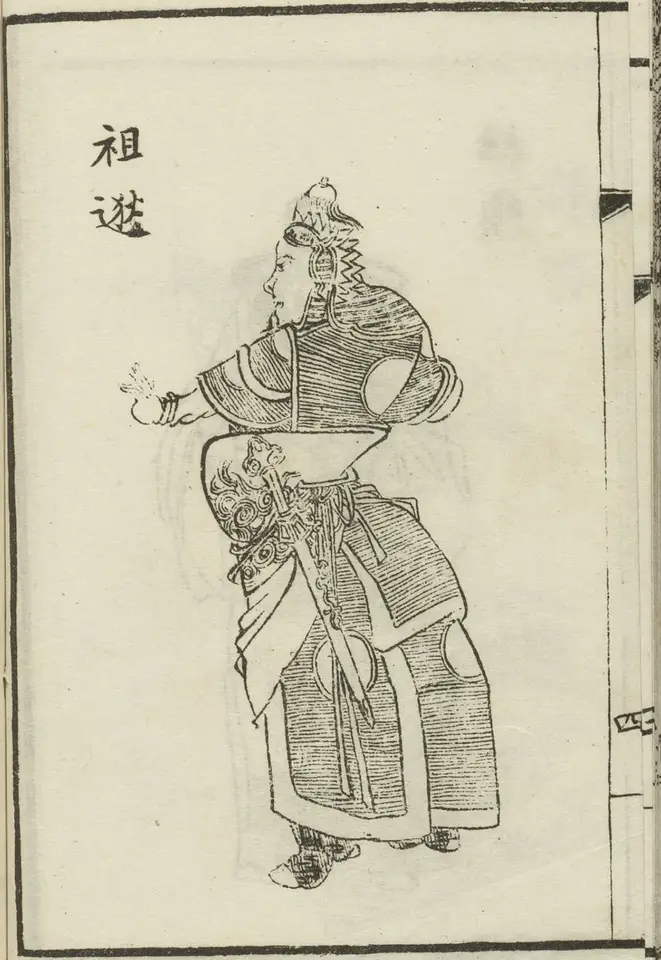
Zu Ti's Northern Expedition (祖逖北伐) was an inspiring early military counteroffensive launched during the founding years of the Eastern Jin Dynasty. Following the collapse of the Western Jin in the Disaster of Yongjia, General Zu Ti petitioned Sima Rui (later Emperor Yuan of Jin) in 313 to launch an expedition to recover the Central Plains. Granted minimal rations and no weapons, Zu Ti crossed the Yangtze River, striking his oar in midstream and vowing never to return without cleansing the north of barbarian invaders. Through discipline, strategic cunning, and benevolent diplomacy that won over local walled fortresses (Wubao), Zu Ti repeatedly defeated the formidable armies of Later Zhao rulers Shi Le and Shi Hu. By 320, his forces had recaptured all territories south of the Yellow River. However, imperial jealousy and impending civil rebellion led the court to dispatch Dai Yuan to supervise him, causing Zu Ti to die in anguish in 321 at Yongqiu.
Luoyang falls; Western Jin collapses, and Zu Ti leads hundreds of refugee families across the Yangtze.
Zu Ti petitions Sima Rui to lead a northern expedition, swearing an oath as he crosses the Yangtze.
Zu Ti marches north to Qiaocheng, subduing recalcitrant local warlords and pacifying southern Yuzhou.
Zu Ti uses sandbags to demoralize Tao Bao, ambushes Later Zhao supply donkeys, and recaptures Pengguan.
Enclaves south of the Yellow River submit to Jin; Shi Le requests peace and repairs Zu Ti's ancestral tombs.
Emperor Yuan dispatches Dai Yuan to oversee northern military affairs, paralyzing Zu Ti's authority.
Stricken with grief over court intrigue and impending rebellion, Zu Ti dies at Yongqiu; northern lands are subsequently lost.
The internal devastation of the War of the Eight Princes fatally weakened the Western Jin Dynasty, allowing nomadic northern tribes to invade the imperial heartland in the Disaster of Yongjia. In 311, armies of Han Zhao captured the imperial capital of Luoyang, capturing Emperor Huai and slaughtering tens of thousands of officials and civilians. In 316, Chang'an fell and Emperor Min surrendered, extinguishing the Western Jin. Across the Yellow River basin, cities lay in ruins, driving millions of refugees and elite clans southward across the Yangtze in the mass migration known as the Crossing of the Robes and Caps.
Among the northern refugees was Zu Ti, a scion of an eminent gentry lineage from Fanyang. Early in his career, Zu Ti had served as master of records alongside his close companion Liu Kun. Stationed at remote outposts, the two young patriots slept under the same quilt, rising to practice sword fighting whenever they heard the midnight rooster crow, pledging to unite the realm when chaos erupted—an episode immortalized in the idiom "Rising at Cockcrow to Practice the Sword" (Wen Ji Qi Wu).
Following the fall of the northern capitals, Prince Sima Rui established a southern imperial regime at Jiankang with the backing of aristocratic clans led by Wang Dao and Wang Dun. Satisfied with securing the southern Yangtze refuge, Sima Rui and the emigre gentry were reluctant to mount costly northern campaigns, fearing that victorious frontier commanders would challenge court hegemony.
Distressed by the abandonment of the northern population, Zu Ti repeatedly petitioned Sima Rui: "The fall of the Jin house was not caused by popular rebellion, but by imperial princes destroying one another, allowing foreign invaders to devastate the realm. Today, the northern populace yearns for liberation. If Your Highness commissions an army with myself as vanguard, heroic patriots across the commanderies will rally to our banners!" Reluctantly bowing to public sentiment, Sima Rui appointed Zu Ti as General Inspiring Fierceness and Inspector of Yuzhou, but provided only rations for one thousand men and three thousand bolts of silk, refusing to supply a single suit of armor or weapon.
In August 313, Zu Ti led hundreds of his clan members and refugee followers across the Yangtze River. As the fleet reached the middle of the river, Zu Ti stood at the prow, struck his wooden oar against the water, and swore: "If Zu Ti cannot cleanse the Central Plains and recover our homeland, may I be swept away like this mighty river!" Inspired by his resolve, his soldiers wept with devotion.
Landing at Huaiyin, Zu Ti confronted severe equipment shortages. He established foundries to smelt iron, forge weapons, and manufacture armor, while recruiting more than two thousand hardy volunteers from refugee encampments. Through rigorous drilling and strict discipline, Zu Ti forged a formidable, battle-hardened vanguard force within three years.
In 317, Zu Ti marched north to Lunu and advanced into the strategic Yuzhou center of Qiaocheng. The region was fractured by autonomous walled enclaves whose chieftains frequently shifted allegiance between Eastern Jin and Later Zhao out of opportunism. Enclave warlords Zhang Ping and Fan Ya commanded thousands of troops and resisted Zu Ti's authority.
Besieged in Qiaocheng for over a year, Zu Ti employed deceptive stratagems and nocturnal ambushes to defeat the recalcitrant warlords. He captured and pacified the enclaves, re-establishing imperial administration throughout southern Yuzhou. In 319, Governor Chen Chuan of Chenliu defected to Later Zhao. Shi Le dispatched general Tao Bao with a relief army to occupy Pengguan, posing an immediate threat to Zu Ti's forward bases.
To counter the Later Zhao threat, Zu Ti dispatched commander Han Qian to establish fortified positions in the eastern sector of Pengguan, directly confronting Tao Bao entrenched in the western sector. The two forces engaged in an attritional standoff lasting over forty days, pushing both sides toward starvation.
Recognizing the enemy's logistical vulnerability, Zu Ti devised a ruse: he filled hundreds of sacks with sand, dusting only the top openings with white rice, and marched this convoy conspicuously into Han Qian's camp. He then ordered several robust soldiers carrying freshly cooked rice baskets to walk slowly along muddy tracks. When Zhao scouts ambushed the porters, the carriers abandoned their loads and fled. Examining the mountain of sacks and tasting the fragrant rice, Tao Bao concluded that the Jin garrison possessed boundless provisions, severely demoralizing his troops.
Shortly thereafter, Shi Le sent a supply convoy of over a thousand pack donkeys to reinforce Tao Bao. Having scouted the route, Zu Ti positioned ambushes along the Bian River defiles under Han Qian and Feng Tie. When the convoy entered the gorge, Jin forces attacked, wiping out the escort and capturing all thousand donkeys and supplies. Starving and terrified, Tao Bao abandoned Pengguan under cover of darkness, allowing Zu Ti to secure the entire bastion.
Following the victory at Pengguan, Zu Ti advanced his headquarters to Yongqiu. Shi Le dispatched his ferocious kinsman Shi Hu with massive cavalry armies to dislodge him, but Zu Ti repeatedly repulsed their assaults through tactical mobility and concealed counterattacks.
Understanding that lasting conquest required winning the civilian population, Zu Ti adopted a magnanimous policy toward regional enclaves. He permitted chieftains who covertly submitted to Jin to maintain nominal relations with Later Zhao to avoid slaughter, and whenever enemy prisoners were captured, he released them with gifts of food and clothing. Deeply touched by his benevolence, Han commanders serving under Later Zhao covertly fed intelligence to the Jin expeditionary force.
By 320 (the third year of Daxing), walled enclave leaders across Chenliu, Yingchuan, Xiangcheng, Runan, and Qiao abandoned Later Zhao and swore fealty to Eastern Jin. All territories south of the Yellow River were liberated. Acknowledging that he could not overcome Zu Ti by force, Shi Le adopted a conciliatory posture: he ordered the repair and protection of Zu Ti's ancestral tombs in Fanyang and sent diplomatic letters requesting cross-border trade, ushering in a decade of frontier peace.
As Zu Ti made preparations to repair Chenggao Fort, expand agrarian colonies, and launch a grand crossing of the Yellow River into Hebei, political factionalism in Jiankang intervened.
Emperor Yuan and Chancellor Wang Dao grew increasingly apprehensive that Zu Ti's soaring renown and independent military power would threaten the throne, while also dreading an imminent revolt by General Wang Dun in Wuchang. In the autumn of 321, Emperor Yuan appointed his confidant, Vice Director of the Secretariat Dai Yuan, as General Who Subdues the West, placing him in Hefei to oversee military affairs across six northern provinces, effectively subordinating Zu Ti.
Recognizing that Dai Yuan was sent to constrain him and that internal civil war in Jiangnan was inevitable, Zu Ti realized that his hard-won northern gains would be abandoned. Stricken with despair and grief at the realization that his life's mission was doomed, Zu Ti fell gravely ill.
In September 321, Zu Ti died in his camp at Yongqiu at the age of fifty-six. Soldiers and civilians across Yuzhou wept openly in the streets, erecting shrines to mourn him like a parent. Soon afterward, Wang Dun launched his rebellion, Dai Yuan was killed, and Later Zhao armies swept south to reclaim the territories Zu Ti had liberated.
Zu Ti's campaigns liberated the Central Plains south of the Yellow River, stabilizing the northern boundary of Eastern Jin. However, his premature death and the subsequent civil strife of the Wang Dun rebellion allowed Later Zhao to reoccupy the region within years.
First, the expedition proved that the northern population remained loyal to the Han imperial tradition and that northern nomad cavalry could be defeated through superior strategy and cohesion. Second, it provided Eastern Jin with essential buffer territories along the Huai River that shielded the southern capital during its vulnerable formative decades. Third, Zu Ti's symbolic oath—striking the oar in midstream—became one of the most celebrated exemplars of patriotic dedication in Chinese history, inspiring generations of scholars and commanders including Xie An, Liu Yu, Yue Fei, and Xin Qiji.
In the Book of Jin (Jinshu), Fang Xuanling recorded: "Zu Ti galloped through military perils, achieving immortal renown. Striking the oar in midstream, his spirit was transcendent and unyielding! Though thwarted by domestic factionalism, his heroic aura forever blesses the Yellow and Luo rivers."
In the Zizhi Tongjian, Sima Guang observed: "Zu Ti led an isolated force to reclaim the lands south of the Yellow River, ensuring barbarian cavalry dared not graze their horses southward. He was indeed an extraordinary hero! Alas that Emperor Yuan obstructed his ambition and Dai Yuan restricted his power, causing him to perish with his work unfinished."
Philosopher Wang Fuzi remarked: "Zu Ti was not merely brave; his command of tactical maneuvers and generous treatment of enemies showed the genius of a true master general. Had he received full support from Jiankang, restoring the Central Plains would not have been difficult."