First Expedition and Crossing Daxian
Responding to raids on Huaibei, Liu Yu marches from Jiankang, disembarks at Xiapi, and traverses the undefended Daxian Pass.
Eastern Jin Dynasty (东晋) · HISTORICAL EVENT
刘裕北伐
Liu Yu's Northern Expeditions (刘裕北伐) were two large-scale strategic military campaigns conducted between 409 and 418 CE by the supreme commander of the Beifu Army and founding sovereign of the Liu Song dynasty, Liu Yu. Having endured decades of passive defense following the loss of the north, the Eastern Jin capitalized on northern factionalism to launch offensive operations. In 409 CE, Liu Yu mobilized to punish Southern Yan incursions into Huaibei,…
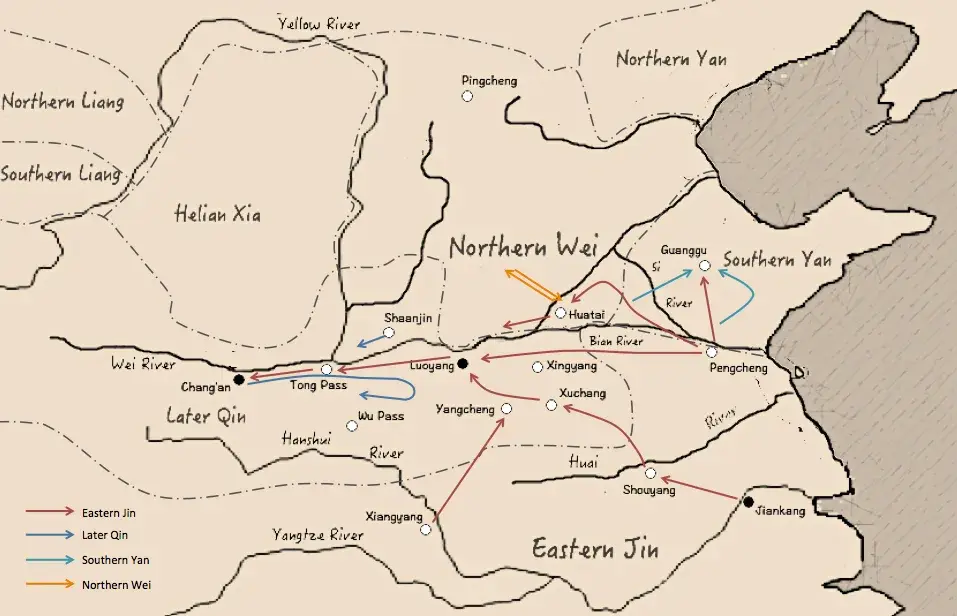
Liu Yu's Northern Expeditions (刘裕北伐) were two large-scale strategic military campaigns conducted between 409 and 418 CE by the supreme commander of the Beifu Army and founding sovereign of the Liu Song dynasty, Liu Yu. Having endured decades of passive defense following the loss of the north, the Eastern Jin capitalized on northern factionalism to launch offensive operations. In 409 CE, Liu Yu mobilized to punish Southern Yan incursions into Huaibei, traversing the Daxian defiles, shattering the enemy host at Linqu, and taking Guanggu in 410 CE to extinguish Southern Yan and recover Shandong. In 416 CE, following the death of Later Qin ruler Yao Xing, Liu Yu mounted his second campaign with a five-pronged amphibious offensive. Eastern Jin forces liberated the ancient capital of Luoyang, repelled tens of thousands of Northern Wei cavalry along the Yellow River using the revolutionary Crescent Array (queyue zhen), and forced the capitulation of Emperor Yao Hong in Chang'an in 417 CE. Although Chang'an was relinquished to Helian Bobo's Xia cavalry following the untimely death of prime minister Liu Muzhi and internal garrison mutinies, the campaigns permanently secured Shandong, Henan, and Huaibei for the south, establishing Liu Yu's paramount authority and laying the bedrock for the founding of the Liu Song dynasty.
Responding to raids on Huaibei, Liu Yu marches from Jiankang, disembarks at Xiapi, and traverses the undefended Daxian Pass.
Meng Longfu secures the Jumeshui river, Hu Fan storms Linqu from the rear, and Jin forces surround Guanggu with triple trenches.
Employing Zhang Gang's assault engines, Jin troops breach Guanggu in March, capture Murong Chao, and extinguish Southern Yan.
As Lu Xun's rebels threaten the capital, Liu Yu rides south with light cavalry, routing the insurgent fleet outside Stone Fortress.
Exploiting Yao Xing's death, Liu Yu launches a five-pronged campaign; Tan Daoji and Wang Zhen'e liberate Luoyang on October 22.
In April, Jin infantry deploy in the Crescent Array along the Yellow River, crushing tens of thousands of Northern Wei cavalry.
Shen Linzi breaches Tongguan, Wang Zhen'e burns his boats on the Wei River, and Emperor Yao Hong surrenders on September 20.
Following the death of his chancellor Liu Muzhi, Liu Yu departs Chang'an, leaving his young son Liu Yizhen to hold Guanzhong.
Shen Tianzi murders Wang Zhen'e, Helian Bobo's cavalry destroys the retreating Jin army at Qingni, and Chang'an is lost to the Xia.
Leveraging the immense prestige of his northern conquests, Liu Yu deposes the Jin emperor, inaugurating the Southern Dynasties.
Following the collapse of the Western Jin in 316 CE and the establishment of Eastern Jin in Jiankang by Emperor Yuan (Sima Rui), the southern court faced relentless military pressure from northern non-Han states. The loss of the central plains was felt as an enduring wound among northern emigres and southern lineages alike. Over the fourth century, renowned commanders including Zu Ti, Yu Liang, Yin Hao, and Huan Wen mounted multiple northern expeditions, with Huan Wen advancing to the Ba River within sight of Chang'an.
However, endemic factional rivalry among aristocratic clans, mutual suspicion between emperors and chancellors, and precarious logistical supply chains repeatedly undermined these endeavors. Disasters at Fangtou and Xiangyi decimated elite southern regiments, forcing Eastern Jin into a passive defensive posture along the Huai and Yangtze rivers.
In 383 CE, the elite Beifu Army raised in Jingkou under Xie An and Xie Xuan crushed Fu Jian's massive Former Qin host at the Battle of the Fei River, establishing the formation as the military vanguard of the southern regime. Born of humble origins, Liu Yu enlisted in the Beifu ranks and distinguished himself during the suppression of the Sun En rebellion, rising rapidly through exceptional tactical skill and personal combat prowess.
In 404 CE, when aristocratic general Huan Xuan usurped the imperial throne, Liu Yu rallied Beifu veterans at Jingkou, overthrew the usurper, and restored Emperor An to the throne. Assuming the posts of General of the Center and Manager of the Affairs of the Masters of Writing, Liu Yu seized supreme military and civil authority. Aware that powerful lineages dominated court politics, Liu Yu recognized that only the prestige of reclaiming ancient imperial capitals could legitimize a dynastic transition.
By the early fifth century, northern China remained divided among warring Sixteen Kingdoms regimes. The Murong Xianbei held Southern Yan across modern Shandong, controlling coastal salt and mountain passes while raiding southward into Huaibei. In Guanzhong and Henan, the Qiang dynasty of Later Qin held the imperial capitals of Chang'an and Luoyang, yet suffered constant raids from Helian Bobo's Xia state to the north.
Beyond the Yellow River, the Tuoba Xianbei of Northern Wei were expanding rapidly across the northern steppe, threatening to intervene in the central plains. These multi-sided rivalries and ethnic contradictions presented Liu Yu with a strategic opportunity to defeat his northern adversaries in detail.
In early 409 CE, Murong De, the founding Emperor of Southern Yan, died and was succeeded by his nephew Murong Chao. Murong Chao was an extravagant ruler devoted to music and theatrical entertainments. To procure palace musicians and dancers, Murong Chao dispatched Xianbei cavalry to plunder the Huaibei commanderies of Eastern Jin.
The Southern Yan forces overran Suyu, captured Huaiyang administrator Ding Wu and Yangping administrator Liu Qianzai, and carried off several thousand households into northern captivity. This unprovoked aggression shattered the frontier peace, exposing the northern approaches of Jiangnan to immediate military threat.
When reports of the Huaibei raid reached Jiankang, the imperial court was seized by panic. Aristocratic grandees such as Xie Hun and Meng Chang argued against offensive operations, citing earlier disasters and the formidable reputation of Xianbei horsemen. They advocated passive defensive containment along the Huai River.
Liu Yu vehemently rejected appeasement. He argued that Murong Chao was politically insecure, erratic, and alienated from his subjects, presenting an opportunity to eliminate the threat once and for all. Convinced that an audacious strike would shatter Southern Yan, Liu Yu secured imperial approval and was designated Supreme Commander of the Expeditionary Forces.
Liu Yu conducted thorough logistical preparations, assembling over a thousand transport vessels and warships at Jingkou and Guangling. Recognizing that naval transport along the Huai and Si waterways was essential to support operations deep in Shandong, he massed hundreds of thousands of bushels of grain along the canals.
For his frontline command, Liu Yu selected trusted Beifu veterans including Meng Longfu, Liu Daolian, Hu Fan, Tan Shao, and Liu Jingxuan. Enforcing iron discipline that prohibited pillaging and the destruction of civilian crops, Liu Yu mobilized an army of tens of thousands of hardened infantry and cavalry.
In April 409 CE, Liu Yu's expeditionary fleet sailed from Jiankang, entering the Si River from Huaiyin. By May, the vanguard reached the logistical depot of Xiapi. Here, Liu Yu executed an audacious operational maneuver: he ordered all warships and heavy transport vessels anchored in Xiapi and directed his soldiers to disembark for a rapid overland advance.
Carrying minimal dry rations, the Jin columns marched northward into Langye and traversed the rugged mountain defiles of Dongguan. Engineers cleared mountain tracks and constructed pontoon bridges. Observing the strict conduct of the southern troops, Chinese fortress chieftains and displaced communities welcomed the army, providing guides and supplies.
In Guanggu, Murong Chao summoned his council to devise a defensive strategy. Veteran commander Gongsun Wulou urged the Emperor to occupy the Daxian defiles immediately, fortify the mountain passes, and implement a scorched-earth policy by burning the wheat crops across the plains while severing the Jin supply lines toward Xiapi.
However, young Xianbei aristocrats dismissed the advice as cowardly. Overconfident in the shock power of their heavy cavalry, Murong Chao insisted on luring the southern infantry onto the open plains where they could be surrounded and annihilated. He ordered the Daxian Pass left undefended. Informed by scouts that the mountain gates were clear, Liu Yu clapped his hands in joy, declaring that Southern Yan had fallen into his trap.
Liu Yu ordered forced marches through the abandoned Daxian defiles. Emerging onto the fertile plains of central Shandong, the Jin army bore down upon Linqu, the southern bastion protecting Guanggu. Shocked that the enemy had traversed the mountains unhindered, Murong Chao mobilized his entire field army to Linqu.
To secure tactical supremacy, Murong Chao dispatched Gongsun Wulou with elite cavalry to seize the strategic water sources along the upper Jumeshui river. Anticipating this move, Liu Yu sent vanguard officer Meng Longfu with elite cavalry to contest the river. In a ferocious engagement along the riverbanks, Meng Longfu drove off the Xianbei horsemen, securing the water supply and enabling the Jin main body to deploy outside Linqu.
On July 12, 409 CE, the decisive Battle of Linqu commenced. Murong Chao deployed tens of thousands of armored Xianbei cataphracts in the center, flanked by archers and light infantry, seeking to break the Jin battle lines through massed cavalry charges.
Liu Yu countered with combined-arms tactics, interlocking heavy transport wagons and tall shields to create fortified barricades. Behind the wagons, crossbowmen discharged synchronized volleys, supported by long-spearmen. The Xianbei horsemen mounted repeated charges from dawn until afternoon, but failed to breach the barrier, resulting in severe casualties on both sides.
Observing from a ridge that the defenders had stripped Linqu of its garrison to reinforce the battle line, Liu Yu dispatched staff officer Hu Fan, Tan Shao, and Xiang Mi with a thousand commandos to execute a flanking mountain march around the enemy rear.
Scaling the cliffs behind Linqu, Hu Fan's commandos breached the undefended gates, occupied the citadel, and torched the military depots while raising Eastern Jin battle flags over the battlements. Seeing their base engulfed in flames, the Southern Yan cavalry panicked and broke ranks. Liu Yu ordered an all-out advance, shattering the enemy host and killing tens of thousands. Murong Chao fled on horseback back to Guanggu.
Following the victory at Linqu, where vast stores of horses and weapons were captured, Liu Yu pressed forward to Guanggu. On July 14, Jin vanguard units reached the city walls. Guanggu was a formidable double-walled fortress equipped with deep wells and granaries, enabling Murong Chao to prepare for an extended defense.
During the initial skirmishes, vanguard commander Meng Longfu overextended his pursuit into the suburbs and was killed in an ambush. Grieved by the loss, Liu Yu resolved to avoid reckless assaults, adopting a strategy of total circumvallation and attrition to starve the garrison into capitulation.
Liu Yu directed extensive engineering works around Guanggu, excavating three concentric trenches thirty feet deep and twenty feet wide, reinforced by high earthen ramparts and wooden watchtowers. The siege works isolated the citadel completely from the outside world.
Simultaneously, Jin soldiers harvested the surrounding wheat fields to feed the expeditionary army. Liu Yu also directed psychological operations, firing pardon proclamations into the city and offering honors to defectors. High-ranking Yan officers, including general Duan Hong, slipped over the walls to surrender, while starvation and disease decimated the defenders inside.
Trapped within the besieged capital, Murong Chao dispatched envoys Zhang Gang and Han Fan to solicit military intervention from Yao Xing, the ruler of Later Qin. Yao Xing sent envoys to Liu Yu threatening war if the siege was not lifted.
Liu Yu dismissed the threats, retorting that once Southern Yan was pacified, he would march on Chang'an to recover the ancient western capital. Aware that Later Qin was pinned down by Helian Bobo's Xia raids, Liu Yu ignored the warnings. Shortly afterward, Zhang Gang was intercepted and captured by Jin patrols on his return journey, extinguishing all hope of external relief among the defenders.
Recognizing Zhang Gang as an engineering genius, Liu Yu treated him with honor, appointing him to direct the construction of advanced siege machinery. Mobilizing carpenters and timber from local forests, Zhang Gang oversaw the fabrication of towering assault towers (feilou), battering rams, armored mantlets (muman), and counterweight trebuchets.
These engines surpassed the height of the Guanggu ramparts. Armored mantlets protected sappers filling the moats, while elevated archery platforms swept the battlements with continuous crossbow fire, depriving the defenders of cover.
By early 410 CE, the siege engines were moved within yards of the walls. Trebuchets shattered the battlements with boulders, while catapults launched incendiary projectiles into the palace compound. The defenders were paralyzed, unable to man the walls by day or light fires by night.
Internal discord fractured what remained of the Southern Yan administration. Murong Chao executed senior ministers who advocated surrender, while commanders secretly plotted to open the gates. An attempted breakout by Gongsun Wulou was intercepted and crushed by Jin cavalry patrols, leaving the citadel without hope.
On March 25, 410 CE, Liu Yu ordered a general assault. Supported by assault towers and mantlets, Jin infantry breached the walls and poured into the city. Murong Chao attempted to flee with a dozen bodyguards through the western gate, but was captured in the nearby woods.
Refusing to grant clemency to a monarch who had repeatedly raided imperial borders, Liu Yu had Murong Chao conveyed in a cage to Jiankang, where he was beheaded in the marketplace. To punish the prolonged resistance that had cost many Jin lives, Liu Yu ordered the execution of three thousand Southern Yan nobles and leveled the walls of Guanggu, ending the twelve-year existence of Southern Yan.
With the fall of Guanggu, commanderies across modern Shandong submitted to the Eastern Jin. Liu Yu issued proclamations granting three-year tax exemptions to war-torn populations, appointed respected local scholars such as Yang Muzhi to administrative offices, and restored agricultural production across the Qing-Qi region.
Liu Yu planned to garrison Xiapi and prepare further thrusts into Henan. However, urgent dispatches from Jiankang reported a catastrophic domestic crisis, forcing him to alter his strategic schedule.
Taking advantage of the Beifu Army's absence in Shandong, religious insurgent leaders Lu Xun and Xu Daofu led over a hundred thousand Daoist rebels down the Yangtze from Guangzhou. The rebels routed provincial armies at Sangluozhou and Yuzhang, killing imperial commanders and sailing directly toward undefended Jiankang.
Realizing that the dynasty hung by a thread, Liu Yu left Han Fan and Tan Shao to oversee Shandong and rode south with a few thousand light cavalry. Conducting forced marches day and night, Liu Yu reached Jiankang just as the rebel fleets appeared on the horizon, instantly restoring public morale.
In Jiankang, Liu Yu organized the defense of Stone Fortress (Shitoucheng) and established fortified positions at Baishi and Chapu. When Lu Xun attempted an amphibious assault, Liu Yu counterattacked with fire ships and shock infantry, burning the rebel fleet and inflicting heavy casualties.
Pursuing the routed insurgents across southern China, imperial forces destroyed the remaining rebel detachments. In 411 CE, Lu Xun drowned himself in Jiaozhou, concluding the rebellion. The double triumph over Southern Yan and Lu Xun elevated Liu Yu's domestic stature to an unassailable height.
Between 412 and 415 CE, Liu Yu consolidated his political hegemony across southern China. He eliminated rival generals, including Liu Yi in Jingzhou and Sima Xiuzhi, and dispatched Zhu Lingshi to conquer the Qiao Zong regime in Sichuan, bringing the entire Yangtze basin under his direct command.
Domestically, Liu Yu enacted the Yixi Land Resettlement (Yixi tuduan), registering undocumented emigres and reclaimable lands to expand the state tax base and military conscription. By curbing aristocratic privileges and promoting talented figures from modest backgrounds, Liu Yu revitalized state finances, assembling the resources required for a second northern campaign.
In February 416 CE, Yao Xing, the paramount ruler of Later Qin, died in Chang'an. His successor Yao Hong was immediately challenged by brothers and cousins who launched armed revolts across Guanzhong. Simultaneously, Helian Bobo's Xia armies ravaged the northern territories of Later Qin, plunging the state into systemic collapse.
Recognizing the opportunity to liberate the ancient Han capitals of Luoyang and Chang'an, Liu Yu formally petitioned the throne in August 416 CE to launch the second northern expedition.
Liu Yu formulated a coordinated amphibious plan dividing his forces into five axes: Tan Daoji and Wang Zhen'e commanded the first land vanguard advancing from Huainan toward Xuchang and Luoyang; Shen Linzi and Liu Zunkao led the second naval wing into the Yellow River via Qingzhou; Wang Shennian pushed along the third axis toward Wuyang; Wang Zhongde commanded the fourth wing along the Si and Qing rivers; and Liu Yu led the hundred-thousand-strong fifth main body from Jiankang.
This vast multi-pronged offensive coordinated riverine transport with cavalry and heavy infantry, advancing simultaneously across hundreds of miles of operational depth.
In September 416 CE, the advance columns under Tan Daoji and Wang Zhen'e swept across the Huai River. Qin garrisons collapsed in panic. At Xuchang, Qin administrator Yao Xi abandoned the city without resistance.
Tan Daoji pushed northward, capturing Xiangcheng and Yangdi, slaying rebel officer Zhao Xuan and carrying the Hulao Pass by storm. Coordinated with Shen Linzi's naval advance along the Yellow River, the Jin vanguard cleared all defensive outposts and deployed outside Luoyang.
Confronting the Jin siege lines without hope of reinforcement, Later Qin commander Yao Guang surrendered Luoyang on October 22, 416 CE. After half a century of non-Han rule, the ancient Eastern Han and Western Jin capital returned to southern governance.
Tan Daoji enforced strict discipline, prohibiting plundering and posting guards over the Western Jin imperial mausoleums. The commanders held solemn ancestral sacrifices at the imperial temple, moving the local population to tears and sending shockwaves of enthusiasm across China.
Elated by the recovery of Luoyang, Liu Yu advanced with the main fleet to Pengcheng in late 416 CE. At Pengcheng, he coordinated the distribution of grain, weapons, and reinforcements for the western push into the mountain redoubts of Guanzhong.
Aware that success depended on opening the Yellow River navigation routes past the Sanmenxia gorges to supply the armies outside Tongguan, Liu Yu boarded his flagship in the spring of 417 CE, leading a armada of a thousand warships upstream toward the western passes.
As Liu Yu's flotilla sailed up the Yellow River, the court of Northern Wei viewed the southern expansion with alarm. Emperor Mingyuan (Tuoba Si) dispatched Situ Changsun Han with a hundred thousand Xianbei horsemen to monitor the Jin fleet from the northern riverbank.
Because the river currents were fierce, Jin sailors were frequently forced to disembark on the northern shore to pull the tow-ropes. Whenever vessels drifted toward the northern bank, Xianbei horsemen galloped down the bluffs to shoot down the trackers and cut the ropes, severely impeding the western advance.
To neutralize the cavalry threat without abandoning the river, Liu Yu devised the tactical formation known as the Crescent Array (queyue zhen). On April 9, 417 CE, he ordered Ding Wu with seven hundred elite infantry and a hundred heavy war wagons to cross covertly to the northern bank.
The troops deployed on a flat terrace about a hundred yards from the riverbank, arranging the war wagons end-to-end in a semicircular arc whose flanks anchored firmly against the river cliffs. The formation resembled a crescent moon, with the river to its back, deliberately creating a tactical dead-ground to ensure absolute commitment from the defenders.
Believing that the small southern detachment had trapped itself against the river, Northern Wei commander Changsun Han hurled thirty thousand heavy cavalry into an all-out assault against the wagon rampart. In response, Liu Yu dispatched Zhu Lingshi with three thousand fresh troops equipped with powerful crossbows and heavy armor to reinforce the array.
As the cavalry charged, coordinated crossbow volleys penetrated the front ranks. When the horsemen reached the wagons, Jin soldiers thrust long lances (shuo) broken into short sections through the wagon gaps, driving them forward with heavy iron mallets. The heavy spears impaled both riders and horses, shattering the cavalry assault. General A'baogan was slain, thousands of Xianbei horsemen were killed, and the survivors routed northward, demonstrating the capacity of disciplined infantry to defeat elite steppe cavalry.
With Northern Wei deterred from further intervention, Liu Yu's naval forces reached the approaches to Guanzhong. Meanwhile, the advance land armies under Tan Daoji, Wang Zhen'e, and Shen Linzi converged on the Shan City defiles, defended by Qin princes Yao Hui and Yao Zan.
Shen Linzi conducted nocturnal infiltrations across mountain paths, storming fortified outposts and slaying Qin general Yao Luan. The Shan City defenses buckled under these relentless flank attacks, forcing the remaining Qin forces to withdraw inside the fortifications of Tongguan.
Tongguan was the paramount strategic gateway guarding the Guanzhong basin, anchored between the Yellow River and Mount Hua. Later Qin Grand General Yao Shao concentrated the empire's remaining veteran formations in entrenched camps outside the pass.
Tan Daoji and Shen Linzi mounted sustained assaults against the defensive works. Shen Linzi executed mountain bypasses to strike Yao Shao's rear depots, setting the camps on fire. Encircled and humiliated by repeated defeats, Yao Shao suffered a stroke and died in camp, shattering the morale of the defenders and allowing Jin forces to breach the pass.
In August 417 CE, with Tongguan breached, Wang Zhen'e executed a decisive naval advance. Sailing light war vessels from the Yellow River into the Wei River, Wang Zhen'e led his fleet upstream toward Chang'an. Yao Hong mustered the remaining tens of thousands of garrison troops on the northern bank of the Wei to block the landing.
Reaching the outskirts of the capital, Wang Zhen'e ordered his soldiers ashore and immediately commanded his sailors to push the transport boats into the rushing river, letting them drift away. Addressing his troops, Wang Zhen'e declared that with Chang'an thirty li ahead and no boats behind, victory was their only salvation. Inspired by his resolve, the soldiers charged the Qin lines with irresistible fury, routing the defenders and advancing directly to the Pingshuo Gate of Chang'an.
As Wang Zhen'e's infantry breached the outer gates, the overland columns under Tan Daoji and Shen Linzi arrived from Tongguan, encircling the inner palace citadel. The remaining Qin commanders fled or surrendered, leaving Yao Hong isolated and without provisions.
On September 20, 417 CE, Yao Hong rode out of the Pingshuo Gate in a simple cart, bare-chested and carrying the imperial seals, formally surrendering to Wang Zhen'e. Imperial officials took custody of the archives and regalia, marking the total extinction of the Later Qin dynasty after thirty-four years of rule.
In October 417 CE, Liu Yu entered Chang'an in triumph. A century after Emperor Min surrendered to the Xiongnu in 316 CE, both Western and Eastern Jin imperial capitals were reunited under southern rule. Liu Yu ascended the podiums of the Weiyang and Changle palaces, inspecting the ancient dynastic halls.
Generations of Guanzhong residents gathered from across hundreds of miles to view the imperial standards, weeping tears of joy at the return of Chinese civil administration. Liu Yu distributed rewards from the Qin treasury, executed treacherous collaborators, and dispatched Yao Hong under guard to Jiankang, establishing order across Guanzhong.
Liu Yu harbored grand ambitions to remain in Chang'an, pacify the northwest, and extend his authority toward Liangzhou and the Ordos. However, in December 417 CE, catastrophic news arrived from Jiankang: prime minister Liu Muzhi had died of exhaustion.
Liu Muzhi had served as Liu Yu's indispensable administrative partner, managing civil governance and suppressing aristocratic opposition while the general campaigned abroad. His death threatened to destabilize the regime in Jiankang. Compelled to secure his political base, Liu Yu abandoned his northwestern projects and resolved to return east immediately, leaving behind a flawed garrison administration.
Upon his departure, Liu Yu left his twelve-year-old second son Liu Yizhen as Commander-in-Chief of Guanzhong, with Wang Zhen'e serving as Chief of Staff and Shen Linzi's brother Shen Tianzi as military commissioner. This personnel arrangement proved fatal. Wang Zhen'e was a northern defector whose military fame aroused jealousy, while southern general Shen Tianzi harbored deep suspicion toward him.
Shortly after Liu Yu's departure, Xia ruler Helian Bobo launched an invasion of Guanzhong. While on the frontline, Shen Tianzi murdered Wang Zhen'e inside his camp under false accusations of treason. In retaliation, Liu Yizhen's chief secretary Wang Xiu executed Shen Tianzi, before Liu Yizhen was manipulated into executing Wang Xiu. The high command of the garrison destroyed itself in factional slaughter, leaving the troops demoralized and leaderless.
Capitalizing on the chaos, Helian Bobo led a hundred thousand Xia cavalry southward, overrunning peripheral commanderies and cutting off Chang'an. In Pengcheng, Liu Yu dispatched Zhu Lingshi to relieve Liu Yizhen and ordered the garrison to evacuate Guanzhong.
However, Liu Yizhen encumbered the withdrawal with looted treasures and palace retainers, causing the column to crawl at a snail's pace. In December 418 CE, Xia cavalry overtook the retreating column at Qingni (modern Lantian, Shaanxi). The Jin army was wiped out, Zhu Lingshi was captured and killed, and Liu Yizhen barely escaped alone on horseback. Chang'an fell to Helian Bobo, and Guanzhong was lost barely a year after its liberation.
Although the loss of Guanzhong was a tragic setback, Liu Yu's two northern expeditions represented the most successful military campaigns mounted by a southern dynasty. Liu Yu extinguished Southern Yan and Later Qin, neutralized Northern Wei and Xia offensives, pushed the imperial frontier northward to the Yellow River, and permanently incorporated Shandong, Henan, and Huaibei into southern territory.
Domestically, these conquests crushed the political monopoly of the aristocratic emigre clans. In 420 CE, Liu Yu accepted the abdication of Emperor Gong of Jin, founding the Liu Song dynasty and inaugurating the Southern Dynasties era. Xin Qiji's famous verse—"In those bygone years, golden spears and armored steeds devoured ten thousand leagues like a tiger"—remains an enduring tribute to the grandeur of Liu Yu's northern expeditions.
Liu Yu's expeditions accomplished the destruction of two major Sixteen Kingdoms states, Southern Yan and Later Qin. Southern armies captured both ancient imperial capitals of Luoyang and Chang'an, executed their monarchs, and advanced the northern boundary of the southern empire from the Huai River to the Yellow River. The recovery of Shandong, Henan, and Huaibei provided an expansive geographic and demographic shield for southern civilization.
The untimely death of chancellor Liu Muzhi forced Liu Yu to withdraw prematurely to preserve his political base in Jiankang. Flawed personnel decisions resulted in garrison fratricide, enabling Helian Bobo to capture Chang'an and annihilate the retreating forces. This failure prevented a complete reunification of China, allowing the Yellow River basin to be consolidated under the Northern Wei and cementing the century-long division between the Southern and Northern Dynasties.
The military triumphs of the northern expeditions provided Liu Yu with absolute political legitimacy, breaking the hundred-year monopoly exercised by northern emigre aristocratic families like the Wang and Xie clans. In 420 CE, Liu Yu formally accepted the abdication of Emperor Gong of Jin, establishing the Liu Song dynasty and opening the Southern Dynasties era (Song, Qi, Liang, Chen).