Collapse of Later Zhao
Shi Hu dies; fratricidal civil war among barbarian regimes opens reclamation prospects for Eastern Jin.
Eastern Jin, Former Qin, Former Yan · HISTORICAL EVENT
桓温北伐
The Northern Expeditions of Huan Wen (桓温北伐) were three major military campaigns conducted between 354 and 369 by Eastern Jin Grand Marshal Huan Wen to recover northern territories and forge personal prestige for dynastic succession. In 349, the demise of Later Zhao tyrant Shi Hu plunged northern China into devastating civil war. Having conquered Cheng Han in Sichuan in 346, Huan Wen entrenched himself along the middle Yangtze, repeatedly petitioning to…
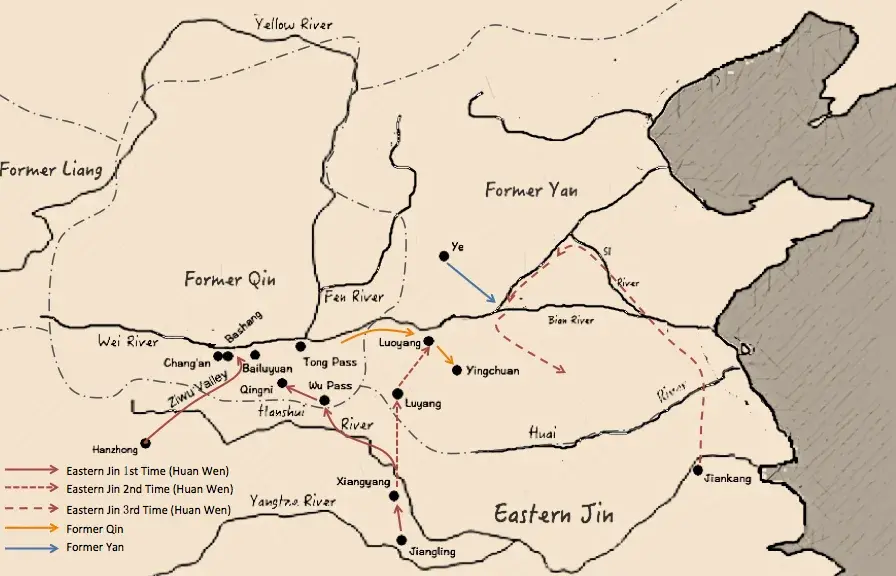
The Northern Expeditions of Huan Wen (桓温北伐) were three major military campaigns conducted between 354 and 369 by Eastern Jin Grand Marshal Huan Wen to recover northern territories and forge personal prestige for dynastic succession. In 349, the demise of Later Zhao tyrant Shi Hu plunged northern China into devastating civil war. Having conquered Cheng Han in Sichuan in 346, Huan Wen entrenched himself along the middle Yangtze, repeatedly petitioning to lead northern campaigns, though met with persistent obstruction by the suspicious imperial court in Jiankang. After sidelining court rival Yin Hao, Huan Wen launched three grand offensives. In 354, he led 40,000 troops through the Wu Pass, crushing Qin divisions at Lantian and reaching the Ba River outside Chang'an, where he conferred with renowned recluse Wang Meng before food shortages forced a costly retreat. In 356, Huan Wen routed warlord Yao Xiang at the Yi River, triumphantly entering the historic Western Jin capital of Luoyang and repairing ancestral tombs. In 369, Huan Wen mobilized 50,000 elite troops against Former Yan, advancing to Fangtou near Ye, only for dry waterways to paralyze his supply fleet. Former Yan Prince Murong Chui combined with Former Qin reinforcements to stage a lethal ambush at Xiangyi, annihilating 30,000 Jin troops. The campaigns revealed the logistical limits of southern armies while extinguishing Huan Wen's hopes of formal imperial usurpation.
Shi Hu dies; fratricidal civil war among barbarian regimes opens reclamation prospects for Eastern Jin.
Huan Wen marches through the Wu Pass to Lantian and encamps at the Ba River; Wang Meng visits before grain shortages force a retreat.
Huan Wen smashes Yao Xiang at the Yi River, recovers Luoyang, and repairs imperial tombs, reaching the peak of his glory.
Huan Wen leads 50,000 troops north to Fangtou, but the failure to open the Shimen canal cuts off logistical transport.
Murong Chui and Former Qin reinforcements crush Huan Wen's retreating army at Xiangyi, killing over 30,000 soldiers.
Humiliated by the Fangtou defeat, Huan Wen deposes Emperor Feidi and elevates Emperor Jianwen to intimidate court rivals.
Since fleeing south following the Disaster of Yongjia in 311, the Eastern Jin dynasty maintained a defensive existence along the Yangtze, burdened by barbarian domination over northern China. In 321, patriot general Zu Ti died of grief with his reclamation campaign unfinished. However, in 349, Later Zhao ruler Shi Hu passed away, prompting his sons to engage in fratricidal warfare. General Ran Min massacred the Jie population and founded Ran Wei, throwing northern China into violent turmoil.
Di tribal leader Fu Jian marched west into Guanzhong to establish the Former Qin dynasty at Chang'an in 351, while Murong Jun led Xianbei forces south to overthrow Ran Wei and establish the Former Yan capital at Ye. With Han elites and displaced refugees looking southward for liberation, this chaotic transitional window offered Eastern Jin its most favorable strategic opportunity in decades to recover the northern heartland.
In 346, General Huan Wen audaciously invaded Sichuan without explicit imperial authorization, annihilating the Cheng Han regime and incorporating the upper Yangtze into his personal sphere of influence. Huan Wen's surging military stature sparked deep anxiety among Chief Minister Sima Yu and the entrenched noble families of Jiankang, who feared Huan Wen would emulate Cao Cao or Sima Yi in seizing the imperial throne.
To neutralize Huan Wen, the court appointed scholar-official Yin Hao to supervise northern campaigns while ignoring Huan Wen's memorials. However, Yin Hao's inept offensive in 353 collapsed following the betrayal of Qiang chieftain Yao Xiang. Huan Wen seized this fiasco to impeach Yin Hao, forcing the court to demote him to commoner status. Having eliminated all political resistance at court, Huan Wen assumed supreme commander status and initiated his long-planned northern expeditions.
In the second month of 354, Huan Wen mobilized 40,000 elite infantry and cavalry from Jiangling, advancing through the Wu Pass toward Guanzhong, while Sima Xun pushed from Hanzhong via the Ziwu Pass. In April, Jin vanguard divisions encountered Qin crown prince Fu Chang and Fu Xiong at Lantian. Huan Wen's younger brother Huan Chong spearheaded a ferocious charge, routing the Qin defense and killing multiple enemy generals.
Exploiting his victory, Huan Wen advanced directly to the Ba River east of Chang'an. Emperor Fu Jian barricaded himself inside the Weiyang Palace with barely 6,000 defenders, while prefectures throughout Guanzhong submitted to Jin authority. Elderly residents who had endured foreign rule for four decades wept with joy, presenting wine and livestock to welcome the imperial forces.
During this encampment, renowned scholar Wang Meng visited Huan Wen's headquarters wearing coarse hemp garments. Wang Meng unceremoniously picked lice from his clothing while delivering a penetrating assessment of the realm's geopolitical balance. Impressed, Huan Wen asked why northern elites had not rallied en masse. Wang Meng replied incisively: "You have marched thousands of li into Guanzhong, yet with Chang'an before your eyes, you refuse to cross the Ba River. The elders cannot perceive your true intentions and dare not commit!" Wang Meng accurately pinpointed Huan Wen's reluctance to risk his core armies.
As Former Qin troops burned unharvested wheat across the plains, Jin provisions rapidly expired. Unwilling to mount a costly assault on Chang'an, Huan Wen ordered a withdrawal in May, deporting 3,000 Guanzhong households southward. Qin Prince Fu Chang ambushed the retreating columns at Bailuyuan, inflicting over 10,000 casualties and concluding the campaign in disappointment.
In 356, rebel general Yao Xiang occupied Mount Mang north of Luoyang, raiding Henan prefectures. In July, Huan Wen mounted his Second Expedition from Jiangling, driving north along the Han River toward Luoyang.
In August, Jin forces engaged Yao Xiang's army along the Yi River south of Luoyang. Yao Xiang entrenched his troops against the riverbank. Donning heavy armor, Huan Wen personally directed assault columns brandishing large shields and short blades to smash the rebel breastworks. Jin soldiers shattered Yao Xiang's formations, killing several thousand rebels and forcing Yao Xiang to flee toward Shanxi with a few horsemen.
Following the victory, Luoyang's garrison opened the gates, returning the historic Western Jin capital to imperial control forty-five years after its fall in 311. Huan Wen strictly forbade looting, consoled local elders, and led civilian and military officials to repair and venerate the desolate mausoleums of the Western Jin emperors. Huan Wen proposed returning the imperial capital from Jiankang to Luoyang, but southern aristocrats, unwilling to abandon their luxurious Jiangnan estates, firmly rejected the initiative. In October, leaving garrison commanders to hold Luoyang, Huan Wen withdrew his main force south, earning elevation to Grand Marshal.
In April 369, following the death of Former Yan regent Murong Ke, the fifty-eight-year-old Grand Marshal Huan Wen launched his final grand expedition to conquer Former Yan and secure the imperial throne. Mobilizing 50,000 veterans from Gushu, Huan Wen sailed north along the Huai and Si rivers.
Despite opening victories, the onset of the northern dry season threatened river transport. Strategic advisor Xi Chao urged Huan Wen: "Former Yan possesses formidable cavalry while our lines rely on delicate waterways. We should either march directly overland to Ye with rapid speed, or establish fortified granaries along the Yellow River. Drifting indecisively will leave our forces stranded!" Confident in his strength, Huan Wen dismissed Xi Chao's counsel.
In July, Huan Wen ordered General Yuan Zhen to dredge the Shimen canal to connect the Bian and Yellow rivers. However, severe drought left the canal dry, severing the southern grain fleet. When Huan Wen encamped at Fangtou near the Yellow River, Former Yan Prince Murong Chui blocked his advance with 80,000 veteran cavalry, stalling the invasion.
Cornered, Former Yan ceded western territories to Former Qin in exchange for relief. Qin ruler Fu Jian dispatched General Gou Chi with 20,000 troops to assist Yan. In September, completely devoid of food and threatened by coalition forces, Huan Wen burned his transport fleet, abandoned heavy siege equipment, and began a desperate overland retreat south.
Anticipating that Jin vanguards would maintain vigilance, Murong Chui shadowed the retreat with 8,000 elite horsemen. At Xiangyi, after Jin troops had marched hundreds of li exhausted and off-guard, Murong Chui and his brother Murong De struck from both flanks with armored shock cavalry. Supported by Qin troops, the coalition routed the Jin columns, slaughtering over 30,000 soldiers. Huan Wen escaped south with a handful of retainers, sealing his expedition in complete disaster.
Huan Wen's campaigns demonstrated the absolute limits of southern military power during the Six Dynasties. Constrained by the immense difficulty of sustaining riverine supply lines into the arid Central Plains, southern infantries proved structurally vulnerable against mobile northern cavalries once severed from waterways.
The crushing disaster at Xiangyi shattered Huan Wen's military aura, denying him the glorious triumphs necessary to orchestrate a peaceful dynastic abdication. To restore his political dominance, Huan Wen resorted to raw force, deposing Emperor Feidi in 371. However, steadfast political resistance from aristocratic statesmen Xie An and Wang Tanzhi prevented him from ascending the throne before his death in 373, perpetuating the deep factional divide between the Jingzhou military and the Jiankang court.