Establishment of Shangsi Purification
The Zhou court institutes seasonal water purification rituals under royal shamans, embedding spring purification in early Chinese culture
Eastern Jin Dynasty (东晋) · HISTORICAL EVENT
兰亭雅集
The Orchid Pavilion Gathering was a celebrated literati summit and spring purification ceremony convened on April 22, 353 (the third day of the third lunar month in the ninth year of the Yonghe era of Eastern Jin Emperor Mu) by Wang Xizhi, General of the Right Army and Internal Administrator of Kuaiji. Held at the Orchid Pavilion in Shanyin, the assembly brought together forty-two eminent figures from prominent northern aristocratic exile…
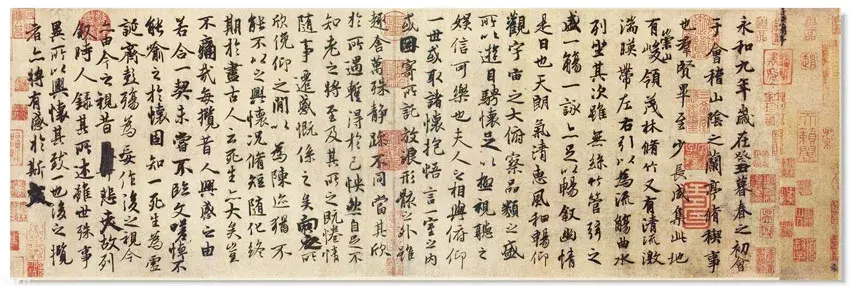
The Orchid Pavilion Gathering was a celebrated literati summit and spring purification ceremony convened on April 22, 353 (the third day of the third lunar month in the ninth year of the Yonghe era of Eastern Jin Emperor Mu) by Wang Xizhi, General of the Right Army and Internal Administrator of Kuaiji. Held at the Orchid Pavilion in Shanyin, the assembly brought together forty-two eminent figures from prominent northern aristocratic exile families—including the Wangs of Langya, the Xies of Chenjun, the Suns of Taiyuan, and the Xis of Gaoping—alongside regional Jiangnan elites. Seated alongside winding streams, the scholars performed ancient purification rituals and pioneered the game of floating wine cups along the current to stimulate spontaneous poetic composition. Twenty-six literati composed thirty-seven poems that were compiled into an anthology. While pleasantly intoxicated, Wang Xizhi used a mouse-whisker brush on cocoon paper to draft the immortal Preface to the Orchid Pavilion Poems (Lantingji Xu), celebrated throughout Chinese history as the "Foremost Running Script under Heaven." The gathering elevated archaic spring rituals into a pinnacle of Wei-Jin romanticism and calligraphic artistry, profoundly molding Chinese literati aesthetics for millennia.
The Zhou court institutes seasonal water purification rituals under royal shamans, embedding spring purification in early Chinese culture
Wang Xizhi convenes Xie An, Sun Chuo, and 40 scholars at Shanyin for spring purification and the winding-stream contest
Twenty-six scholars compose 37 classical poems, while Wang Xianzhi and fifteen others drink penalty wine
Wang Xizhi drafts the Preface to the Orchid Pavilion Poems in running script on cocoon paper using a mouse-whisker brush
Emperor Taizong of Tang dispatches Xiao Yi to obtain Wang Xizhi's original manuscript from Monk Biancai for the imperial collection
Taizong decrees that the original Lantingji Xu scroll be buried with him in Zhaoling, leaving only stone rubbings and traceable copies to posterity
Bao Fang and 35 scholars hold an Orchid Pavilion gathering introducing linked-verse composition
Scholar Liu Renben hosts an assembly in Yuyao to compose posthumous verses for the sixteen guests penalized in 353
The cultural core of the Orchid Pavilion Gathering was the seasonal purification ritual known as xiuxi. This observance dates to the Western Zhou dynasty, as recorded in the Rites of Zhou (Zhouli), which prescribed seasonal herbal baths conducted by female shamans to ward off illness and misfortune. Originally celebrated on the first si day of the third lunar month (and later standardized to the third day of the third month), this festival was termed the Spring Purification (Chunxi). In intercalary leap months, the purification was occasionally held twice, with autumn purifications (Qiuxi) also observed.
The ritual was solemn yet refreshing. Participants gathered at riverbanks to wash face and hands, symbolic of cleansing away accumulated winter impurities. Following ablutions, wine was poured into the stream as a libation, and fresh fragrant thoroughwort (lan) was dipped into the infused water and sprinkled over participants to disperse malevolent spirits and invite auspicious blessings.
Following the Disaster of Yongjia and the collapse of the Western Jin in 316, aristocratic families fled southward across the Yangtze River, assisting the Sima imperial house in establishing the Eastern Jin Dynasty at Jiankang (modern Nanjing). Under the reign of Emperor Mu during the Yonghe era (345–356), southern China enjoyed an interval of political stability and economic flourishing often termed the "Rule of Yonghe." The émigré elite exercised immense political hegemony while immersing themselves in Neo-Daoist metaphysics (Xuanxue) and Zhuangzian philosophical contemplation.
Kuaiji Commandery (modern Shaoxing) was renowned for sublime topography featuring the Kuaiji mountains and Mirror Lake. Sheltered from factional court intrigue in Jiankang, Kuaiji became an ideal sanctuary for retired statesmen and reclusive intellectuals. Wang Xizhi, serving as Internal Administrator of Kuaiji, combined administrative competence with uninhibited philosophical detachment, prompting him to convene this gathering in the spring of 353.
On April 22, 353 (the third day of the third month of Yonghe 9), Wang Xizhi convened his distinguished guests at the Orchid Pavilion nestled along the foothills of Mount Kuaiji. The surrounding landscape offered dramatic scenery, marked by soaring peaks, lush bamboo groves, and crystal-clear mountain currents.
The forty-two attendees represented the cultural and social elite of the Eastern Jin. Prominent attendees included Xie An (then Senior Clerk to the Minister over the Masses and future architect of the Battle of Fei River); General Xie Wan; Vice Minister of the Court of Judicature Sun Chuo; Inspector of Yangzhou Xi Tan; Cavalier Regular Attendant Sun Tong; Wang Xizhi's sons Wang Ningzhi, Wang Suzhi, Wang Huizhi, and the young Wang Xianzhi; and eminent scholars Yuan Qiaozhi, Bian Di, Yu You, and Yu Yun. Monastic scholar Zhi Dun and recluse Xu Xun were likewise associated with this intellectual circle.
The assembly commenced with the formal purification rite alongside the stream. Having cleansed themselves and sprinkled wine and thoroughwort essence across their bodies, the scholars initiated a refined cultural recreation: the winding stream wine cup contest (qushui liushang).
The procedure was exquisitely choreographed. The forty-two guests sat along the grassy banks flanking a meandering canal. Attendants placed wooden winged goblets (yushang) filled with wine onto floating scoops and gently released them into the upper current. Whenever a floating cup stalled in an eddy before a seated scholar, attendants retrieved the vessel and presented it to him. The scholar was required to drink the wine and immediately compose a four-character or five-character poem. If his wit failed and he was unable to produce verse within the designated interval, he was penalized by drinking three large measures (dou) of wine.
In this atmosphere of convivial libation and scenic delight, twenty-six literati successfully authored thirty-seven classical poems. Eleven senior figures—including Wang Xizhi, Xie An, Xie Wan, Sun Chuo, Sun Tong, Wang Ningzhi, Wang Suzhi, Wang Huizhi, Yuan Qiaozhi, Xi Tan, and Wang Fengzhi—composed both a four-character and a five-character poem. Fifteen others, including Xu Fengzhi and Cao Maozhi, composed one poem each. These works reflected on cosmic order, the fleeting transience of worldly ambition, and tranquil immersion in natural serenity.
Conversely, sixteen attendees—including Wang Xizhi's youngest son, the ten-year-old Wang Xianzhi, alongside Bian Di, Qiu Mao, Yang Mo, Kong Chi, Liu Mi, Yu Gu, Lao Yi, Hou Mian, Hua Qi, Xie Teng, Ren Ni, Lü Xi, Lü Ben, and Cao Li—failed to compose verses before the cup drifted past. In accordance with the contest rules, each was merrily penalized with three measures of wine, infusing the gathering with joyous laughter.
With thirty-seven poems collected, the attendees requested their host Wang Xizhi to compose an overarching preface for the compilation, while Sun Chuo was tasked with drafting the postscript. In an exhilarated state of mild inebriation, inspired by gentle breezes and brilliant spring sunshine, Wang Xizhi took up a resilient mouse-whisker brush and smoothed out a sheet of fine cocoon paper.
With uninhibited spontaneity, Wang brushed the 324-character Preface to the Orchid Pavilion Poems (Lantingji Xu) in twenty-eight columns of running script. The calligraphic execution was peerless: fluid yet muscular, balancing structural vigor with graceful kinetic rhythms. Remarkably, among the twenty occurrences of the character zhi, each exhibited an entirely distinct brushwork and dynamic architecture. The work achieved an unrepeatable fusion of emotion, literature, and calligraphic genius.
Historical anecdotes record that upon sobering the following morning, Wang Xizhi attempted to recopy the preface dozens of times, yet confessed that none approached the sublime spontaneity of the original draft. Sun Chuo subsequently completed his elegant afterword, cementing The Orchid Pavilion Collection in literary history.
The paradigm established at the Orchid Pavilion became an enduring ritual for subsequent Chinese literati. During the Dali era (766–779) of the Tang Dynasty, regional inspector Bao Fang and thirty-five scholars reconvened at the Orchid Pavilion, introducing linked-verse (lianju) poetic forms. In the Yuan Dynasty, Gong Shitai and fellow scholars held gatherings using assigned rhyme systems (fenyun), while Liu Renben organized the "Continued Orchid Pavilion Gathering" in Yuyao, where poets composed verses on behalf of the sixteen participants who had been penalized under Wang Xizhi.
Large-scale assemblies continued this tradition through the Qing Dynasty, when Du Jia compiled forty-two poems into an anthology prefaced by Wu Gaozeng. In 2004, a commemorative gathering in Shaoxing generated a modern anthology prefaced by calligrapher Qi Gong. Since the 1980s, the Shaoxing Orchid Pavilion Calligraphy Festival has perpetuated this heritage, drawing masters worldwide to practice calligraphy alongside the historic winding canal.
The Orchid Pavilion Gathering represents an unexcelled landmark in traditional Chinese culture. It transformed an ancient archaic purification rite into the definitive archetypal model of Chinese literati aesthetic gathering. The idyllic imagery of winding streams, floating wine cups, and poetic reflection amid bamboo groves became the supreme spiritual emblem of philosophical freedom and creative fellowship. Later assemblies—from the Song Dynasty's Western Garden Gathering to Ming and Qing scholarly banquets—consistently looked to Lanting as their spiritual homeland.
Philosophically, Wang Xizhi's reflective lament in the preface—"Birth and death are indeed profound matters, how could one not mourn?"—rejected superficial Neo-Daoist escapism that equated life and death as indistinguishable illusions. By synthesizing an acute consciousness of mortality with passionate engagement in the present moment, Wang endowed the Chinese intellectual class with a profound, compassionate humanist spirit.
Wang Xizhi's brushwork in the Preface to the Orchid Pavilion Poems attained the undisputed pinnacle of Chinese calligraphic art, revered across generations as the "Foremost Running Script under Heaven." Its twenty-eight lines achieve absolute harmony between bone structure, fluid dynamism, and expressive ink tones. Emperor Taizong of Tang was so enraptured by the manuscript that he acquired it through his emissary Xiao Yi, ordered master court calligraphers Ouyang Xun, Yu Shinan, and Chu Suiliang to execute precision tracings, and had the original entombed within his Zhaoling mausoleum.
Though the original ink manuscript was buried, exquisite tracings—most notably the Shenlong and Dingwu stone rubbings—served as the universal foundation for Chinese calligraphic pedagogy and aesthetic theory for over a thousand years. Su Shi, Huang Tingjian, Mi Fu, and Zhao Mengfu drew foundational inspiration from Wang's brushwork. Consequently, the Orchid Pavilion Gathering functioned not merely as a temporary social event, but as the foundational aesthetic cornerstone of Chinese cultural identity.