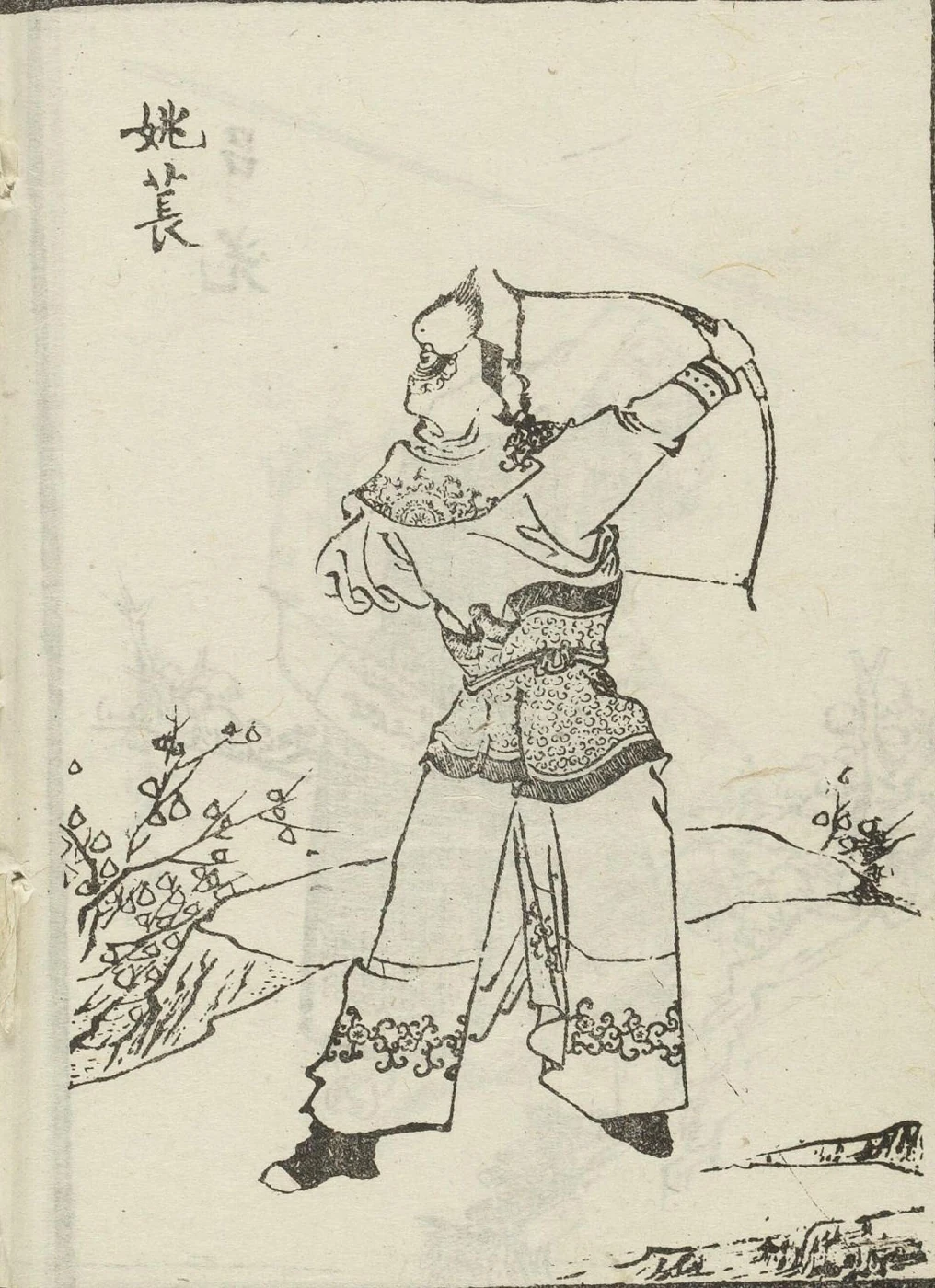
The Later Qin (384–417), also known as Yao Qin, was a regional regime of the Sixteen Kingdoms period established by the Yao clan of the Qiang people. Its state name derived from its rule over the former territory of the Qin state of the Warring States period. The *Spring and Autumn Annals of the Sixteen Kingdoms* used the designation “Later Qin” to distinguish it from Former Qin and Western Qin, while the ruling house's surname gave rise to the alternative name Yao Qin. The regime was founded…
384 CE–417 CECapital · See entry
ERA OVERVIEW
The Later Qin (384–417), also known as Yao Qin, was a regional regime of the Sixteen Kingdoms period established by the Yao clan of the Qiang people. Its state name derived from its rule over the former territory of the Qin state of the Warring States period. The *Spring and Autumn Annals of the Sixteen Kingdoms* used the designation “Later Qin” to distinguish it from Former Qin and Western Qin, while the ruling house's surname gave rise to the alternative name Yao Qin. The regime was founded by Yao Chang in the first year of Baique (384, the ninth year of Eastern Jin Taiyuan), when he raised troops north of the Wei River. It later established its capital at Chang'an. Three rulers—Yao Chang, Yao Xing, and Yao Hong—held power over a period of thirty-four years before the regime was destroyed by the northern expedition of Liu Yu, Defender-in-chief of the Eastern Jin. Later Qin controlled the fertile Guanzhong region. Under Yao Xing it reached the height of its power and stood alongside Eastern Jin in the south and Later Yan and Northern Wei in the north. It also became a major center of Buddhist culture during the Sixteen Kingdoms period through its patronage of eminent monks and large-scale translation of Buddhist scriptures.
Time span384 CE–417 CE
CapitalSee entry
ERA TIMELINE
Yao Chang styled himself Prince of QinOpen
Yao Chang styled himself Prince of Qin for Ten Thousand Years and inaugurated the Baique era, establishing the Later Qin regime.
Yao Chang captured and killed Fu Jian,Open
Yao Chang captured and killed Fu Jian, emperor of Former Qin.
Yao Chang proclaimed himself emperor aOpen
Yao Chang proclaimed himself emperor and inaugurated the Jianchu era.
Yao Chang died and Yao Xing succeeded Open
Yao Chang died and Yao Xing succeeded him.
Later Qin took Luoyang and other terriOpen
Later Qin took Luoyang and other territories and extended its influence into the western Central Plains.
Yao Xing's forces were defeated by NorOpen
Yao Xing's forces were defeated by Northern Wei at the Battle of Chaibi, causing heavy losses among Later Qin's elite troops.
Helian Bobo broke away from Later Qin Open
Helian Bobo broke away from Later Qin and established Hu Xia, weakening Later Qin's northern position.
Liu Yu launched a northern expedition,Open
Liu Yu launched a northern expedition, and the Later Qin defensive system rapidly collapsed.
Eastern Jin forces under Liu Yu capturOpen
Eastern Jin forces under Liu Yu captured Chang'an; Yao Hong surrendered, and the Later Qin was destroyed.
FULL ENTRY
Overview
The Later Qin (384–417), also known as Yao Qin, was a regional regime of the Sixteen Kingdoms period established by the Yao clan of the Qiang people. Its state name derived from its rule over the former territory of the Qin state of the Warring States period. The *Spring and Autumn Annals of the Sixteen Kingdoms* used the designation “Later Qin” to distinguish it from Former Qin and Western Qin, while the ruling house's surname gave rise to the alternative name Yao Qin. The regime was founded by Yao Chang in the first year of Baique (384, the ninth year of Eastern Jin Taiyuan), when he raised troops north of the Wei River. It later established its capital at Chang'an. Three rulers—Yao Chang, Yao Xing, and Yao Hong—held power over a period of thirty-four years before the regime was destroyed by the northern expedition of Liu Yu, Defender-in-chief of the Eastern Jin. Later Qin controlled the fertile Guanzhong region. Under Yao Xing it reached the height of its power and stood alongside Eastern Jin in the south and Later Yan and Northern Wei in the north. It also became a major center of Buddhist culture during the Sixteen Kingdoms period through its patronage of eminent monks and large-scale translation of Buddhist scriptures.
Historical Development
Establishment: After Fu Jian, Emperor Xuanzhao of Former Qin, was defeated at the Battle of the Fei River, Guanzhong was left vulnerable. Yao Chang, a noble of the Qiang people who had earlier submitted to Former Qin, took the opportunity to rebel. In the first year of Baique (384, the ninth year of Eastern Jin Taiyuan), he styled himself General-in-Chief, Chanyu, and Prince of Qin for Ten Thousand Years, inaugurated the Baique era, and based himself at Beidi (southeast of present-day Yaozhou, Shaanxi). More than 100,000 Qiang and other non-Han households north of the Wei River reportedly joined him, rapidly expanding his power. The next year (385), Yao Chang captured and killed Fu Jian after Fu fled to Wujang Mountain. In the third year of Baique (386, the eleventh year of Eastern Jin Taiyuan), Yao Chang took Chang'an, proclaimed himself emperor there, inaugurated the Jianchu era, adopted Great Qin as the state name, and established the regime later known as the Later Qin. He also changed the written form of the city name Chang'an by substituting a homophonous first character.
Height: Yao Chang died in 393 (the seventh year of Jianchu), and Crown Prince Yao Xing succeeded him. In the following year (394), Yao Xing defeated and killed Fu Deng, who had continued to claim the Former Qin imperial title, thereby eliminating the remaining Former Qin forces. After Later Yan destroyed Western Yan in 394, Later Qin also took over the former Western Yan territories in Hedong. In the first year of Hongshi (399, the third year of Eastern Jin Long'an), Yao Xing took advantage of internal disorder in Eastern Jin to capture Luoyang, and many cities north of the Huai and Han rivers submitted. Later Qin then entered its height of power, comparable in strength to Later Yan. In the fifth year of Hongshi (403), Later Qin destroyed the Later Liang (Sixteen Kingdoms) and brought the eminent monk Kumārajīva to Chang'an, which became a major northern center of Buddhism.
From Height to Decline: In the later years of Yao Xing's reign, Later Qin's expansion faltered. In the fourth year of Hongshi (402, the first year of Eastern Jin Yuanxing), Later Qin fought Northern Wei at the Battle of Chaibi, where it suffered a severe defeat at the hands of Emperor Daowu of Northern Wei and lost elite troops. After these military setbacks, Yao Xing returned the twelve commanderies of Nanxiang to Eastern Jin during the Hongshi era; according to the *Comprehensive Mirror in Aid of Governance*, this was done under pressure rather than as a voluntary territorial concession. From the ninth year of Hongshi (407, the third year of Eastern Jin Yixi), Helian Bobo established Hu Xia in Shuofang and repeatedly raided Later Qin's northern frontier. Meanwhile, Yao Xing's strong commitment to Buddhism and increasingly lenient administration were accompanied by weakening official discipline and military preparedness, contributing to the regime's decline.
Decline: In Yao Xing's final years, Later Qin faced mounting internal and external pressure. Hu Xia steadily encroached in the west and north, Western Qin under the Xianbei Qifu clan constrained it in the northwest, and members of the ruling house became increasingly divided. In the eighteenth year of Hongshi (416, the twelfth year of Eastern Jin Yixi), Yao Xing died and Crown Prince Yao Hong succeeded. At the beginning of Yao Hong's reign, Western Qin, Hu Xia, and other previously subordinate forces took advantage of the succession crisis, leaving Later Qin under pressure from several directions.
Fall: In the eighth month of 416, the eighteenth year of Hongshi, Liu Yu, Defender-in-chief of Eastern Jin, personally launched a northern expedition soon after Yao Xing's death. Generals including Wang Zhene, Tan Daoji, and Shen Tianzi advanced along several routes and successively captured Xuchang and Luoyang. In the same year, members of the Later Qin ruling house, including Duke of Taiyuan Yao Yi and Duke of Qi Yao Hui, rebelled in attempts to seize the throne. Yao Hong's forces suppressed both uprisings, but the fighting severely weakened the regime. In the thirteenth year of Yixi (417), Eastern Jin forces broke through Tong Pass, Wang Zhene and others surrounded Chang'an, and Yao Hong surrendered with his household. The Later Qin was destroyed. Yao Hong was sent to Jiankang, where Liu Yu, considering him a potential threat, ordered his execution in the marketplace; many members of the Later Qin ruling clan were also killed.
Politics and Institutions
Later Qin's political system broadly inherited the centralized monarchical model of the Wei-Jin period and Former Qin. The emperor, or earlier the Prince of Qin, held supreme authority. The central government maintained offices such as the Secretariat and Chancellery, while local administration followed the prefecture-commandery-county system and largely imitated Han and Wei precedents. Yao Xing placed importance on administration. According to the “Account of Yao Xing” in the *Book of Jin*, he encouraged remonstrance, recruited reclusive scholars, established legal studies, promoted education, and at times took measures to address popular hardship. His rule was therefore comparatively orderly. In his later years, however, excessive tolerance and weakened enforcement were criticized as internal causes of political decline.
Military and Foreign Relations
Later Qin relied heavily on the military power of the Qiang people and used the strategic advantages of Guanzhong to compete with surrounding states. During the founding period, Yao Chang fought prolonged wars in Guanzhong and Longdong against Fu Deng, the Former Qin emperor, eventually defeating and killing him. Under Yao Xing, Later Qin cavalry advanced east to Luoyang and campaigned north in Hedong, for a time making the regime one of the major northern powers. In the fourth year of Hongshi (402), however, Yao Xing's brother Yao Ping was surrounded and destroyed by Northern Wei at the Battle of Chaibi, costing Later Qin many elite troops and limiting further expansion into the Central Plains. Helian Bobo's Hu Xia cavalry also repeatedly raided the northwest frontier. Diplomatically, Later Qin at times maintained friendly relations with Northern Wei, and after military setbacks it returned the twelve commanderies of Nanxiang to Eastern Jin in search of respite. The regime ultimately collapsed under Liu Yu's northern expedition.
Economy and Commerce
Later Qin controlled Guanzhong, one of the richest agricultural regions of the Sixteen Kingdoms period, where irrigation in the Wei River basin supported productive farming. During a substantial portion of Yao Xing's reign, Guanzhong experienced relatively limited warfare, allowing agriculture and commerce to recover. Luoyang at one point became an important center attracting merchants and population under Later Qin rule. The regime also resettled and recruited displaced people to increase its registered population. Nevertheless, continuing warfare and Hu Xia raids prevented full stabilization of the Guanzhong economy, and by the final years state resources could no longer sustain the regime's heavy military burdens.
Culture and Society
Later Qin was historically renowned for its patronage of Buddhism. Yao Xing invited the Kucha monk Kumārajīva to Chang'an, treated him as a state preceptor, and sponsored major translation work at Caotang Temple. Kumārajīva presided over translations of numerous scriptures and treatises, including the *Large Perfection of Wisdom Sutra* and the *Lotus Sutra*, while Sengzhao and other important disciples emerged from his circle. Chang'an became a major center of northwestern Buddhist learning. Faxian departed from Chang'an to seek Buddhist texts in the Western Regions and India; the mainstream chronology in the source places his departure in the first year of Hongshi (399, the third year of Eastern Jin Long'an), while another view places it in 409 (the fifth year of Yixi), reflecting the wider flourishing of Buddhism under Later Qin. Socially, the ruling group centered on the Yao clan of the Qiang people but also employed many Han Chinese elites and Buddhist monks. Qiang, Han, and other affiliated populations lived together, giving the regime a visibly multiethnic social structure.
> This section explains the rulers' positions in the evolution of the regime; full biographies are provided in the corresponding person entries.
Historical Assessments and Legacy
Contemporary and near-contemporary accounts often praised the relative order of Later Qin under Yao Xing, especially its control of Guanzhong and its major cultural achievements in honoring eminent monks and sponsoring Buddhist translation in Chang'an. Criticism also focused on Yao Xing's later indulgence in abstract religious and intellectual pursuits, the loosening of penal and administrative discipline, and succession struggles within the ruling house, all of which were seen as contributing to decline.
Later historians have generally regarded Later Qin as one of the more culturally significant regimes of the Sixteen Kingdoms, particularly because of its achievements in Buddhism. Kumārajīva's systematic translation work in Chang'an had a direct and lasting influence on Chinese Buddhist thought far beyond the regime's thirty-four-year existence. At the same time, later assessments emphasize the limits of Later Qin's military and political resources: it could not effectively withstand the combined pressure of Northern Wei and Hu Xia, and internal conflict weakened it before Liu Yu's northern expedition destroyed the regime. Its rise and fall are therefore often treated as a representative example of the political volatility of the Sixteen Kingdoms.