With Former Qin in disorder after Fu Jian's defeat at the Battle of the Fei River, Lü Guang occupied Liangzhou, appointed himself General-in-Chief and Governor of Liangzhou, established his capital at Guzang, and formally founded the Later Liang, gradually taking control of the Hexi Corridor.
386 CE–403 CE
Later Liang (Sixteen Kingdoms)
Regional polity后凉
The Later Liang (Sixteen Kingdoms) (the eleventh year of Taiyuan, 386, to the second year of Yuanxing, 403) was a regional regime of the Sixteen Kingdoms period founded in Liangzhou in the Hexi region by the noble Lü Guang of the Di people. Its state name derived from Liangzhou, and it became known historically as the “Later Liang” to distinguish it from Western Liang, Southern Liang, and Northern Liang, which likewise used “Liang” as a state name. The designation first appeared in the *Spring…
386 CE–403 CECapital · See entry
ERA OVERVIEW
The Later Liang (Sixteen Kingdoms) (the eleventh year of Taiyuan, 386, to the second year of Yuanxing, 403) was a regional regime of the Sixteen Kingdoms period founded in Liangzhou in the Hexi region by the noble Lü Guang of the Di people. Its state name derived from Liangzhou, and it became known historically as the “Later Liang” to distinguish it from Western Liang, Southern Liang, and Northern Liang, which likewise used “Liang” as a state name. The designation first appeared in the Spring and Autumn Annals of the Sixteen Kingdoms and was retained by later historians. The Later Liang passed through two generations and four rulers—Lü Guang, Lü Shao, Lü Zuan, and Lü Long—and lasted for about eighteen years. Lü Guang had been a Former Qin general. After being sent west on campaign into the Western Regions, he took advantage of disorder in the Central Plains to occupy Guzang (present-day Wuwei, Gansu) and establish an independent power base. At its height, the regime extended eastward into Longyou and westward beyond the desert, controlling the Hexi Corridor and reaching into parts of present-day western Gansu, Ningxia, Qinghai, and Xinjiang. Its military base among the Di people was comparatively weak, however, and internal conflict was frequent. Under repeated pressure from Later Qin, Southern Liang, and Northern Liang, the regime finally submitted to Later Qin in 403 (the second year of Yuanxing), after which its former territory was divided among Later Qin, Southern Liang, and Northern Liang.
Time span386 CE–403 CE
CapitalSee entry
ERA TIMELINE
Lü Guang assumed the title Prince of Sanhe; he later styled himself Heavenly King, and the regime became known historically as the Later Liang.
Lü Guang assumed the title Heavenly King of Great Liang and formally established the corresponding state institutions; thereafter the regime increasingly turned from strength toward decline.
Lü Guang, gravely ill, transferred the throne to Crown Prince Lü Shao, took the title Retired Emperor, and appointed his son Lü Zuan Defender-in-chief.
After Lü Chao killed Lü Zuan, he installed his elder brother Lü Long, the son of Lü Guang's younger brother Lü Bao.
In the seventh month, Lü Long was forced to surrender to Later Qin. The Later Liang was destroyed and its former territories were divided among Later Qin, Southern Liang, and Northern Liang.
FULL ENTRY
Overview
The Later Liang (Sixteen Kingdoms) (the eleventh year of Taiyuan, 386, to the second year of Yuanxing, 403) was a regional regime of the Sixteen Kingdoms period founded in Liangzhou in the Hexi region by the noble Lü Guang of the Di people. Its state name derived from Liangzhou, and it became known historically as the “Later Liang” to distinguish it from Western Liang, Southern Liang, and Northern Liang, which likewise used “Liang” as a state name. The designation first appeared in the Spring and Autumn Annals of the Sixteen Kingdoms and was retained by later historians. The Later Liang passed through two generations and four rulers—Lü Guang, Lü Shao, Lü Zuan, and Lü Long—and lasted for about eighteen years. Lü Guang had been a Former Qin general. After being sent west on campaign into the Western Regions, he took advantage of disorder in the Central Plains to occupy Guzang (present-day Wuwei, Gansu) and establish an independent power base. At its height, the regime extended eastward into Longyou and westward beyond the desert, controlling the Hexi Corridor and reaching into parts of present-day western Gansu, Ningxia, Qinghai, and Xinjiang. Its military base among the Di people was comparatively weak, however, and internal conflict was frequent. Under repeated pressure from Later Qin, Southern Liang, and Northern Liang, the regime finally submitted to Later Qin in 403 (the second year of Yuanxing), after which its former territory was divided among Later Qin, Southern Liang, and Northern Liang.
Historical Development
Establishment: Lü Guang's father Lü Polou was an important founding official of Former Qin. As a young man, Lü Guang was considered steady and self-controlled and won the appreciation of Wang Meng, who recommended him for office. He served successively as magistrate of Meiyang (in present-day Wugong, Shaanxi), General Who Spreads Might, and in other posts, following Fu Jian on campaign and earning the regard of Former Qin officials. In 383 (the eighth year of Eastern Jin Taiyuan, also the nineteenth year of Former Qin's Jianyuan), Fu Jian sought to extend control over the Western Regions and appointed Lü Guang Bearer of the Tally, Chief Controller of Military Affairs for the Conquest of the Western Regions, General Who Pacifies the West, and Colonel of the Western Regions, commanding an army said to number 100,000 infantry and cavalry. Lü Guang first pacified Yanqi and then defeated Kucha and its allied forces, bringing the Western Regions under his control. In March 385 (the tenth year of Taiyuan), he began his return east with 20,000 camels carrying treasures from the Western Regions and more than 10,000 fine horses. By then Fu Jian had already suffered a disastrous defeat at the Battle of the Fei River and the Central Plains were in turmoil. Lü Guang therefore occupied Liangzhou. In 386 (the eleventh year of Taiyuan), he appointed himself General-in-Chief and Governor of Liangzhou, made Guzang his capital, formally established the Later Liang, and gradually suppressed opposing forces to control the Hexi Corridor.
Height: During Lü Guang's reign, the Later Liang defeated or absorbed the various commanderies and powers of the Hexi region. Its influence extended eastward into Longyou and westward toward the Western Regions, marking the regime's greatest territorial extent. It continued aspects of Former Qin administration, brought the four commanderies of Hexi and part of Longxi under its rule, and used wealth brought back from the Western Regions to supplement its treasury. Guzang, a major city on the eastern section of the Silk Road, was for a time prosperous, and the Later Liang became a major Hexi power competing with Later Qin, Southern Liang, and Northern Liang.
Turning Point: In 396 (the twenty-first year of Taiyuan), Lü Guang assumed the title of Heavenly King of Great Liang and formally established royal institutions. Thereafter signs of decline increasingly appeared. In 399 (the third year of Long'an), Lü Guang became gravely ill and transferred the throne to Crown Prince Lü Shao, while taking the title Retired Emperor and appointing his son Lü Zuan as Defender-in-chief. After Lü Shao succeeded, real military and political authority was held by his elder brother Lü Zuan. Before long, Lü Zuan forced Lü Shao into a desperate position, and Lü Shao hanged himself. This began a period of destructive conflict within the ruling house.
Decline: After taking the throne, Lü Zuan neglected government affairs, imposed harsh punishments, and faced growing social instability and widespread rebellion. Meanwhile, the Juqu clan of Northern Liang and the Tufa clan of Southern Liang took advantage of the situation to seize territory, steadily reducing Later Liang lands. In 401 (the fifth year of Long'an), Lü Chao killed Lü Zuan and installed Lü Long, the son of Lü Guang's younger brother Lü Bao. The regime weakened further. In the same year, Yao Shuode of Later Qin attacked. Lü Long sent an envoy to submit, and Yao Xing, ruler of Later Qin, appointed him General Who Guards the West, Inspector of Liangzhou, and Duke of Jiankang, allowing him to continue guarding Guzang.
Fall: Years of warfare and pressure from Later Qin, Southern Liang, and Northern Liang devastated the Later Liang economy. Grain prices rose sharply, and conditions deteriorated to the point that cannibalism was reported. In the seventh month of 403 (the second year of Yuanxing), Lü Long was forced to surrender to Later Qin. The Later Liang came to an end, and its former territories were divided among Later Qin, Southern Liang, and Northern Liang.
Politics and Institutions
The Later Liang inherited institutions from the Wei-Jin tradition and Former Qin. Lü Guang and his successors used the official and noble ranks of Central Plains regimes, assuming titles such as Chief Controller, General-in-Chief, Governor of Liangzhou, and eventually Heavenly King, and appointing offices such as Grand Councilor and Defender-in-chief. The political core relied heavily on military forces of the Di people, imperial relatives, and members of the ruling house. Because the regime occupied the ethnically diverse Hexi region, where the Di people, Qiang people, Xianbei, Han, and other groups lived together, its rule depended heavily on military government and garrison administration. Harsh punishment and uneven rewards and penalties contributed to social tensions and repeated rebellion. Institutionally, the Later Liang showed little major innovation and largely remained a hastily consolidated regional regime.
Military and Foreign Relations
The Later Liang relied heavily on Hexi cavalry and military formations. Lü Guang had extensive experience in western campaigns and was skilled in combined infantry-cavalry operations. During the campaign against Kucha, for example, his forces concentrated the central army and used long hooks to counter the enemy's rope-loop and padded-armor tactics. In foreign relations, the Later Liang competed for years in Longyou and Hexi with Later Qin under Yao Xing, Southern Liang under Tufa Wugu and Tufa Rutan, Northern Liang under Juqu Mengxun, and Western Qin. Fighting on multiple fronts exhausted the regime. After Lü Guang's death, internal strife among the ruling family destroyed much of its military strength, Guzang repeatedly came under siege, and pressure from Northern Liang and Southern Liang left the regime with little diplomatic room other than submission to Later Qin.
Economy and Commerce
Since the Han period, the Hexi region had supported developed irrigated agriculture, while Guzang stood at a major junction on the eastern section of the Silk Road and benefited from east-west trade. Lü Guang returned from his western campaign with large quantities of goods and horses, providing an important material foundation for his regime. Continued warfare, however, devastated households and emptied granaries. In the final years, Guzang suffered famine, grain prices rose dramatically, and cannibalism was reported. The resulting social and economic collapse became an important internal cause of the regime's fall.
Culture and Society
Hexi was a major Silk Road corridor where Han and non-Han populations lived together, and it became an important stage in the eastward transmission of Buddhism from the Western Regions. During his western campaign, Lü Guang brought the eminent monk Kumārajīva eastward. Buddhist translation activity gradually developed within Later Liang territory, making the regime an important link in the spread of Buddhist learning during the Sixteen Kingdoms period. At the same time, the multiethnic society of Hexi continued to use commandery-county administration and prefectural and garrison institutions inherited from the Wei-Jin period. Buddhism and long-distance communications together formed distinctive features of Later Liang regional culture.
Rulers and Political Leadership
Lü Guang, Lü Shao, Lü Zuan, Lü Long.
> This section explains the rulers' positions in the evolution of the regime; full biographies are provided in the corresponding person entries.
Historical Assessments and Legacy
Later assessments often characterize the Later Liang as a strong Hexi regional power destroyed by internal conflict: militarily formidable for a time, but weak in civil administration and unable to reconcile competing groups, it held the natural advantages of Hexi while the ruling house remained locked in internal struggle. Later historians also treated harsh punishments and widespread rebellion as major causes of its downfall. Modern scholarship has additionally emphasized the regime's role as a bridge in Silk Road communications and in the eastward transmission of Buddhism. Kumārajīva's later movement toward Luoyang and Chang'an passed through this broader process, so although the Later Liang was short-lived, it remains important to the history of the Sixteen Kingdoms, the Hexi region, and the transmission of Buddhism.
Rulers
 Later Liang (Sixteen Kingdoms)
Emperor
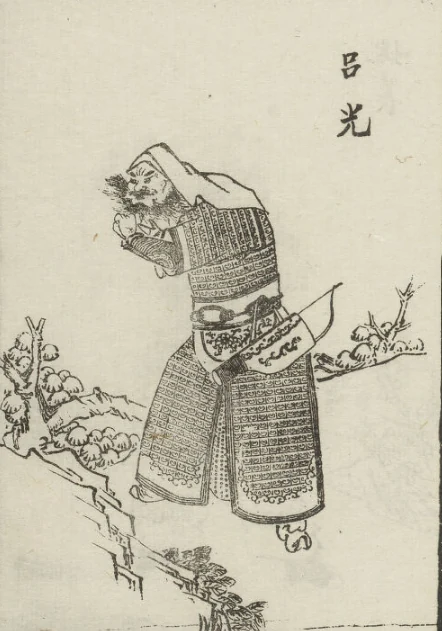
Lü Guang
Lü Guang (337–400), courtesy name Shiming, was a Di native whose ancestral home was Linwei County in Lüeyang Commandery (present-day Qin'an, Tianshui, Gansu). He was born at Fangtou (present-day Xun County, Henan). A celebrated general of Former Qin, he later became the founding ruler of Later Liang. He was the son of Lü Polou, who held the office of Grand Commandant. Lü Guang was recognized early by Wang Meng, enter
Later Liang (Sixteen Kingdoms)
Historical figure
Lü Shao
Lü Shao (?–399), courtesy name Yongye, was a native of Lueyang and a member of the Di people. He was the second ruler of the Later Liang regime during the Sixteen Kingdoms period and the legitimate eldest son of Lü Guang, the founding ruler of Later Liang (Emperor Yi). Lü Shao's reign was extremely brief, lasting only a few months. In the twelfth month of Longfei 4 (399), Lü Guang died of a severe illness, and Lü Sha
Later Liang (Sixteen Kingdoms)
Historical figure
Lü Zuan
Lü Zuan (?–401), courtesy name Yongxu, was a native of Lueyang Commandery and belonged to the Di people. As the third ruler of the Later Liang regime during the Sixteen Kingdoms period, he was the eldest illegitimate son of the founding emperor Lü Guang and the half-brother of the legitimate son Lü Shao. Lü Zuan was proficient in horsemanship and archery from a young age and possessed a bold temperament, though he la
KEY PEOPLE
Related entries
Bibliography
- 《晋书》
- 《十六国春秋》
- 《资治通鉴》