Birth | Born at Fangtou, southwest of present-day Xun County in Henan; according to tradition he was named Guang because "a divine light appeared at night" when he was born.
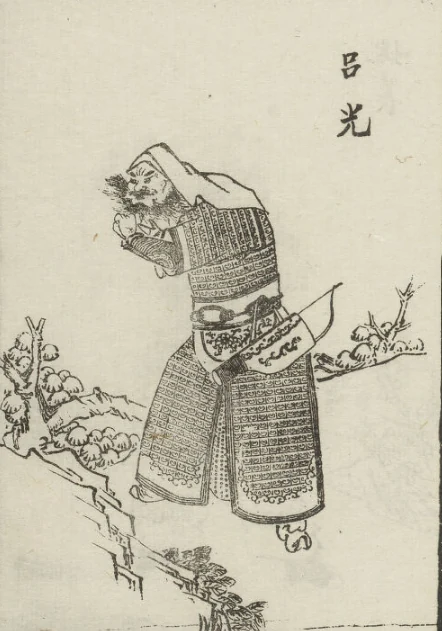
337 CE–400 CE
Emperor
Lü Guang
吕光
Lü Guang (337–400), courtesy name Shiming, was a Di native whose ancestral home was Linwei County in Lüeyang Commandery (present-day Qin'an, Tianshui, Gansu). He was born at Fangtou (present-day Xun County, Henan). A celebrated general of Former Qin, he later became the founding ruler of Later Liang. He was the son of Lü Polou, who held the office of Grand Commandant. Lü Guang was recognized early by Wang Meng, entered…
337 CE–400 CELater Liang (Sixteen Kingdoms)
PROFILE
Lü Guang (337–400), courtesy name Shiming, was a Di native whose ancestral home was Linwei County in Lüeyang Commandery (present-day Qin'an, Tianshui, Gansu). He was born at Fangtou (present-day Xun County, Henan). A celebrated general of Former Qin, he later became the founding ruler of Later Liang. He was the son of Lü Polou, who held the office of Grand Commandant. Lü Guang was recognized early by Wang Meng, entered official service through recommendation for worthiness, and served successively as magistrate of Meiyang and General of the Soaring Eagle. He fought Zhang Ping, helped suppress the Rebellion of the Five Dukes, participated in the conquest of Former Yan, suppressed Li Yan's uprising in Shu, and helped defeat Fu Luo's rebellion. In 383, the nineteenth year of the Jianyuan era, he was ordered to campaign in the Western Regions, where he received the submission of Yanqi, defeated Kucha, and brought more than thirty western states under his authority. After the Battle of the Fei River, Former Qin disintegrated. Lü Guang led his army eastward, defeated Liang Province Inspector Liang Xi, and occupied Guzang. In 386, after learning of Fu Jian's death, he adopted his own era name and established Later Liang. In 399, gravely ill, he transferred power to Crown Prince Lü Shao and styled himself Retired Emperor. He died early the following year. His temple name was Taizu, his posthumous name Emperor Yiwu, and he was buried at Gaoling.
- Alternate Name
- Lü Shiming
- Courtesy Name
- Shiming
- Period
- Later Liang (Sixteen Kingdoms)
- Date of Birth
- 337
- Date of Death
- 400
- Dynasty/Regime
- Later Liang
- Identity
- Emperor
- Ethnicity/Ethnic Affiliation
- Di
- Native Place
- Linwei County, Lüeyang Commandery (present-day Qin'an, Tianshui, Gansu)
- Place of Birth
- Not recorded in historical sources
- Reign
- Not specified
- Predecessor
- Not applicable (founding ruler)
- Successor
- Lü Shao
- Era Names
- The Chinese source table gives “Nineteen; self-proclaimed”; the biography separately records Taian, Linjia, and Longfei.
- Temple Name
- Taizu
- Posthumous Name
- Emperor Yiwu
- Major Achievements
- A Former Qin general who campaigned in the Western Regions and, after Fu Jian's death, established an independent regime in Liang Province that became Later Liang.
LIFE TIMELINE
Age 20 | Recommended by Wang Meng as a worthy man and appointed magistrate of Meiyang.
Age 21 | Accompanied Fu Jian against Zhang Ping and unhorsed Zhang Hao, famed as a "match for ten thousand men," at the Battle of Tongbi, gaining wide renown.
Age 30 | Accompanied Wang Jian in suppressing the Rebellion of the Five Dukes and defeated the rebel forces of Fu Shuang and Fu Wu.
Age 33 | Accompanied Wang Meng in the conquest of Former Yan and was enfeoffed as Marquis of Duting.
Age 41 | Ordered by Fu Jian to arrest the rebel Fu Chong; promoted to Right Commander of the Crown Prince's Guards.
Age 42 | Entered Shu as General Who Breaks the Caitiffs, suppressed Li Yan's uprising, and was promoted to Infantry Commandant.
Age 43 | Accompanied Dou Chong in suppressing the rebellions of Fu Luo and Fu Chong; pursued and killed Fu Chong and was promoted to General of Agile Cavalry.
Age 46 | Sent west to campaign in the Western Regions; received the submission of Yanqi, defeated Kucha, and brought more than thirty states under control.
Age 48 | Led his army east, defeated Liang Province Inspector Liang Xi, occupied Guzang, and assumed the office of Inspector of Liang Province.
Age 49 | Learned of Fu Jian's death, adopted his own era name, styled himself Duke of Jiuquan, and established Later Liang.
Age 52 | Assumed the title King of Sanhe and changed the era name to Lin Jia.
Age 59 | Assumed the title Heavenly King, called his state Great Liang, and changed the era name to Longfei.
Age 62 | Gravely ill, transferred the throne to Crown Prince Lü Shao and styled himself Retired Emperor.
Age 63 | Died; temple name Taizu and posthumous name Emperor Yiwu.
BIOGRAPHY
Biography
Family Background and Early Life
Lü Guang came from a prominent Di chieftain family originally based in Lüeyang Commandery, whose seat lay northeast of present-day Qin'an in Gansu. His lineage, like the Fu clan, belonged to the Lüeyang Di. During Later Zhao, both families were moved east of the passes and settled at Fangtou, southwest of present-day Xun County in Henan. His father Lü Polou was a founding contributor of Former Qin, assisted Fu Jian's rise to power, and became Grand Commandant. Lü Guang was born at Fangtou. According to later accounts, a strange divine light appeared at night when he was born, giving rise to the name Guang. He was also said to have double pupils and a fleshy mark on his left elbow. As a child he liked arranging other children in military formations. As an adult he disliked book learning and preferred hunting and martial pursuits. He was said to stand eight chi four cun tall, be calm and composed, broad-minded, and slow to show either joy or anger. His ability was not widely recognized, but Wang Meng alone valued him, calling him an extraordinary man and recommending him to Fu Jian. In 357 Lü Guang entered official service through recommendation and became magistrate of Meiyang. His administration was described as effective: local Han and non-Han inhabitants both feared and respected him, and neighboring districts became orderly. He was promoted to General of the Soaring Eagle and granted the title Marquis Within the Passes.
Repeated Military Successes
In 358, Fu Jian campaigned against Zhang Ping, a warlord in Bing Province. Zhang Ping's adopted son Zhang Hao was famed as a "match for ten thousand men" and fought Former Qin's vanguard commander Deng Qiang for more than ten days without a clear result. Fu Jian personally reached Tongbi, west of present-day Xinzhou in Shanxi, where Zhang Ping committed his full army. Zhang Hao repeatedly charged the Qin formations alone on horseback. When Fu Jian offered rewards for a champion, Lü Guang volunteered, struck Zhang Hao from his horse, and Deng Qiang then captured him. Zhang Ping was defeated and surrendered, and Lü Guang's fame spread.
In 367, Former Qin was shaken by the Rebellion of the Five Dukes. Fu Shuang occupied Shanggui, Fu Liu held Puba, Fu Sou controlled Shancheng, and Fu Wu held Anding, threatening Chang'an from several directions. The following year Lü Guang, then General Who Pacifies the North, joined Wang Jian's western campaign. The rebel vanguard Gou Xing had defeated Yang Chengshi and advanced toward Yumei. Wang Jian wanted an immediate battle, but Lü Guang advised waiting until the enemy exhausted its supplies and withdrew. Twenty days later Gou Xing retreated as predicted. Lü Guang and Wang Jian pursued, killed fifteen thousand enemy troops, captured Shanggui, and killed Fu Shuang and Fu Wu, ending the western branch of the rebellion.
In 370 Lü Guang followed Wang Meng in the conquest of Former Yan and was made Marquis of Duting. In 378, when Fu Chong, Duke of Beihai, rebelled at Luoyang, Lü Guang was serving as chief clerk on Fu Chong's staff. Fu Jian trusted Lü Guang's loyalty and ordered him to arrest Fu Chong. Lü complied and sent Fu Chong to Chang'an in a prison cart. He was soon promoted to Right Commander of the Crown Prince's Guards. The following year he entered Shu as General Who Breaks the Caitiffs, suppressed Li Yan's uprising, and became Infantry Commandant.
In 380 Fu Luo, Duke of Xingtang, rebelled in You Province. Lü Guang accompanied Left General Dou Chong with forty thousand infantry and cavalry. Fu Chong rose again in support of his elder brother, and the two gathered one hundred thousand men at Zhongshan. Dou Chong and Lü Guang advanced there, defeated the rebels, and captured Fu Luo. Fu Chong fled toward Ji but was overtaken and killed by Lü Guang, who was promoted to General of Agile Cavalry.
Dominating the Western Regions
In the ninth month of 382, King Mitian of Former Cheshi and King Xiumituo of Shanshan came to Chang'an and offered tribute, saying they would help Qin conquer the Western Regions. Former Qin had already unified northern China, and Fu Jian wished to extend his influence westward. He therefore appointed Lü Guang bearer of the imperial tally and commander-in-chief of the western expedition. Together with Jiang Fei, Peng Huang, Du Jin, and Kang Sheng, Lü led seventy thousand troops, while the Comprehensive Mirror in Aid of Governance gives one hundred thousand, as well as five thousand armored cavalry.
In the first month of 383, Lü Guang left Chang'an. Fu Jian ordered the states of Former Cheshi and Shanshan to guide the army and personally held a farewell banquet at Jianzhang Palace. At Gaochang, Lü learned that Fu Jian was launching a major southern campaign against Eastern Jin and considered halting, but continued west at Du Jin's insistence. After crossing several hundred li of desert, the army reached Yanqi in the twelfth month. King Niliu of Yanqi and neighboring rulers surrendered. Kucha resisted. Lü camped south of its capital Yancheng, dug deep trenches, built high ramparts, and placed armored wooden figures on the walls as decoys. King Bo Chun moved the population inside the city and relied on its defenses.
In the seventh month of 384, Bo Chun purchased aid from the state of Xiehu. Xiehu joined Wensu, Weitou, and other states and raised a force said to number seven hundred thousand. The western coalition was skilled in archery and horsemanship and in the use of spears, and its armor was described as resistant to arrows; horsemen also used ropes to lasso enemies. Lü Guang's officers were alarmed and wanted each camp to form separately. Lü instead concentrated the army, trained it in hooked-chain tactics, and used elite cavalry as a mobile force. In the battle west of the city, he decisively defeated the coalition and killed more than ten thousand men. Bo Chun abandoned the city by night, and Lü occupied Kucha. He then pacified the surrounding states and received the submission of more than thirty kingdoms. Fu Jian, on hearing of the conquest, appointed Lü bearer of the imperial tally, Regular Mounted Attendant, commander of military affairs west of Yumen, General Who Pacifies the West, and Commandant of the Western Regions, and enfeoffed him as Marquis of Shunxiang. Because Former Qin had already fallen into civil war and communications were cut, the appointments never reached Lü. He considered remaining in Kucha, but the monk Kumārajīva advised against it and his soldiers wished to return home, so he led the army east.
Establishing Power in Liang Province
In 385, the first year of Tai'an, Lü Guang's army reached Yihe. Yang Han, Administrator of Gaochang, advised Liang Province Inspector Liang Xi to close the strategic passes and keep Lü outside, but Liang Xi refused. When Lü reached Gaochang, Yang Han surrendered. As Lü approached Yumen, Liang Xi issued a proclamation accusing him of returning without authorization and sent his son Liang Yin with fifty thousand troops toward Jiuquan. Lü replied with his own proclamation, condemning Liang Xi for failing to aid Former Qin during its crisis and for blocking a returning army. He sent Jiang Fei and others as the vanguard, defeated Liang Yin at Anmi, and captured him. Neighboring non-Han groups then submitted. Peng Ji, Administrator of Wuwei, seized Liang Xi and defected to Lü Guang. Lü had Liang Xi killed, entered Guzang, and assumed the offices of Inspector of Liang Province and Protector of the Qiang.
In 386, after learning of Fu Jian's death, Lü Guang adopted the era name Tai'an and styled himself bearer of the imperial tally, Palace Attendant, Grand Commander-in-Chief of armies inside and outside the court, commander of military affairs in Longyou and Hexi, Grand General, Governor of Liang Province, and Duke of Jiuquan, thereby establishing Later Liang. Early in his rule he favored Wei You because Wei had helped Peng Ji seize Liang Xi. Under Wei's slanders, Lü killed more than ten noted men, including Yao Hao and Yin Jing, causing disaffection. Grain prices reportedly rose to five hundred cash per dou, and famine became so severe that cannibalism occurred. During a banquet Lü raised the question of governing through severe punishments. On the advice of his staff officer Duan Ye, he issued an order of self-criticism and adopted a more lenient policy.
Suppressing Rebellions and Final Years
In 387 Lü Guang killed Zhang Dayu, son of Former Liang's last ruler Zhang Tianxi, who had threatened Guzang, but Wang Mu still held Jiuquan and Kang Ning, Administrator of Xiping, also rebelled. Soon Lü's officer Xu Jiong and Zhangye Administrator Peng Huang plotted rebellion in alliance with Wang Mu and Kang Ning. Lü rejected advice to proceed cautiously and personally led thirty thousand troops against Peng Huang, capturing Zhangye after twenty days and killing him. He then took advantage of Wang Mu's attack on Lü's officer Suo Gu and led twenty thousand troops in a surprise attack on Jiuquan. Wang Mu marched east but his army disintegrated on the way; he fled alone and was killed by Guo Wen, magistrate of Xingma.
In 389 Lü Guang assumed the title King of Sanhe and changed the era name to Lin Jia. In the sixth month of 396 he styled himself Heavenly King, called his state Great Liang, and adopted the era name Longfei. He repeatedly campaigned against Western Qin. During an expedition in 397, his younger brother Lü Yan was defeated and killed. Lü Guang accepted slanderous accusations and blamed two officers who had accompanied the campaign, Shangshu Juqu Luochou and Administrator of Sanhe Juqu Quzhou, and had them executed. Juqu Luochou's nephew Juqu Mengxun then rebelled; Mengxun's cousin Juqu Nancheng joined him and promoted Jiankang Administrator Duan Ye as leader, establishing Northern Liang in opposition to Later Liang. The same year, Chamberlain for Ceremonials Guo Nen and Director of the Secretariat Wang Xiang believed that Lü Guang was old, Crown Prince Lü Shao was weak, and Lü Zuan and others were fierce and dangerous; they predicted disorder after Lü Guang's death and plotted to seize the eastern and western garden fortresses at Guzang. Wang Xiang's plot was exposed and he was killed, while Guo Nen occupied the Eastern Garden and rebelled. Lü Guang recalled Lü Zuan to suppress the rebellion. Lü Zuan repeatedly defeated Guo Nen, who fled to Western Qin in 398.
In 399, the fourth year of Longfei, Lü Guang became gravely ill. He made Crown Prince Lü Shao Heavenly King and styled himself Retired Emperor. He warned Lü Shao that the state could remain secure only if he relied on Lü Zuan and Lü Hong and allowed them to manage major military and political affairs. He likewise warned Lü Zuan and Lü Hong that only unity with Lü Shao could preserve the state, otherwise disaster would follow. Lü Guang died soon afterward at age sixty-three. His posthumous name was Emperor Yiwu, his temple name Taizu, and he was buried at Gaoling.
The Western Campaign, the Return, and the Founding of Liang
When Fu Jian had pacified Shandong and his troops and horses were strong, he conceived the ambition of the western regions and made Lü Guang commissioner holding the staff of authority and commander of the western expedition, with the generals Jiang Fei, Peng Huang, Du Jin and Kang Sheng, "seventy thousand troops and five thousand armoured horse" to subdue the western regions, with Dong Fang of Longxi, Guo Bao of Fengyi, Jia Qian of Wuwei and Yang Ying of Hongnong as his four headquarters officers; the king of Shanshan was made commander of the western regions and the king of the front division of Jushi protector of the western regions, "leading the troops of their states as guides for Lü Guang." When the army reached Gaochang Lü Guang, hearing that Fu Jian had attacked Jin, wished to halt and await orders, and his officer Du Jin said: "The commissioner has received his charge in the west; opportunity should be seized at once — what is unsettled, that you should delay?" So he advanced. At the moving sands "for more than three hundred li there was no water, and officers and men turned pale"; Lü Guang said: "I have heard that Li Guangli's sincerity moved heaven and a spring gushed out — are we alone without such power? Heaven will surely bring us through; let none of you worry." Presently a great rain fell, a foot deep on the level ground, and advancing to Karashahr its king Niliu came with his neighbouring states to submit.
The battle at Kucha was the decisive action of the campaign. The king of Kucha, Bochun, with his dependent states, held the city, and Lü Guang, gathering his army south of the city of Yan, "set a camp every five li, dug deep ditches and built high ramparts," and set armoured wooden figures on the ramparts as a show of force. As the siege pressed, Bochun emptied his treasury to seek help from the Huaihu, whose brother Nalong and the marquis-general Kui came with more than two hundred thousand horse and brought the kings of Wensu, Weitou and others, "to a total of more than seven hundred thousand, to rescue him." The western confederates "were good with bow and horse and skilled with spear and lance," their armour "impenetrable to arrows," and they could cast leather lassoes from horseback with many a catch, so that the generals of the expedition were afraid and wished each camp to form on its own and hold still. Lü Guang held that "they are many and we few, and the camps are far apart; to divide is to scatter our strength, and no good plan," and so "moved the camps together into one line, practised the linked-hook formation, and kept picked cavalry as a flying force to close the gaps." Soon the two armies fought west of the city, and the expedition broke the confederates heavily, taking more than ten thousand heads; Bochun fled from the city by night, "and the marquises and kings who surrendered were more than thirty states." Lü Guang entered Yan city in triumph, feasted his officers and wrote verse to express his ambition, "pacified the western regions, and his awe and kindness were much renowned," the states sending envoys with tribute in a stream, and even chiefs never before subject came from ten thousand li to submit, "handing up the tallies and commissions given them by Han," while Lü Guang gave them commissions of Former Qin in exchange. He set Bochun's younger brother Zhen as king to soothe Kucha. In the city the Hu "valued the nourishing of life," keeping houses of grape wine "sometimes to a thousand hu, unspoiled after ten years," so that "soldiers drowned in the wine stores one after another." Having taken Kucha he thought of staying in the west, but Kumarajiva, newly taken, urged his return east.
In the first month of 385 Lü Guang feasted his officers and "consulted all on advance or return," and all asked to go home, and he agreed; in the third month he set out with more than twenty thousand camels carrying a thousand kinds of foreign treasures and more than ten thousand fine horses, and in the ninth month entered Guzang. The obstacle on the road was Liang Xi, governor of Liangzhou: Yang Han, prefect of Gaochang, urged him to hold the two passes of Gaowu and Yiwu and cut off their water, and Liang Xi refused; when Lü Guang reached Gaochang, Yang Han surrendered the commandery to him. Only when Lü Guang's troops reached Yumen did Liang Xi feel the danger, issuing a proclamation accusing him of "withdrawing the army without orders" and sending his son Liang Yin with fifty thousand men to block him at Jiuquan; Lü Guang in turn proclaimed to the commanderies of Liangzhou, reproaching Liang Xi for failing to come to the rescue in the state's peril and for barring the returning army, then advanced with Peng Huang, Du Jin and Jiang Fei as vanguard, defeating and capturing Liang Yin at Anmi, "and so the Hu and Yi of the four mountains all came to submit," and Peng Ji, prefect of Wuwei, arrested Liang Xi and opened the city to him. Lü Guang entered Guzang, styled himself governor of Liangzhou and colonel protecting the Qiang, made Du Jin general of the state's support and prefect of Wuwei, marquis of Wushi, and so established his rule in Liangzhou. Among the Former Qin officers one, Suo Pan, "held his commandery and would not submit" even after Guzang fell, and being taken, reproached Lü Guang to his face that "the general received orders to punish the rebellious Hu; does he also have orders to ravage Liangzhou?" and went to execution in the market without changing countenance. Afterwards Lü Guang learned that Fu Jian had been killed by Yao Chang, and "in fury and grief cried aloud, put the three armies in white, and wailed in the south of the city," giving him the posthumous name emperor Wenzhao, with officers of a hundred bushels and above wearing the unhemmed mourning for three months and commoners weeping three days, and proclaimed a general amnesty, taking the era name Tai'an and styling himself commissioner with the staff of authority, attendant, grand commander at home and abroad, commander of the military affairs of Longyou and Hexi, grand general, colonel protecting the Xiongnu, governor of Liangzhou and duke of Jiuquan.
Kingship and the Troubles of His Last Years
He raised his title twice thereafter. When "a unicorn appeared in Jinze county and a hundred beasts followed it," Lü Guang took it for a sign of himself and in 389 took the title of king of Sanhe, appointing officials down to the assistants and secretaries, proclaiming an amnesty in his territory, with the era name Linjia; he received his wife Lady Shi, his son Lü Shao and his brother Lü Deshi from Chouchí, made Lady Shi his queen and Lü Shao his heir, feasted his ministers in the new hall of the inner garden, and on completing the ancestral temple honoured his great-grandfather as duke Jing, his grandfather as duke Gong, his father as king Jingzhao and his mother as consort Zhaolie; at the proposal of Yang Ying, vice-minister of the secretariat, he honoured Lü Wang as founding ancestor with a temple never to be removed. In the sixth month of 396 he took the title of heavenly king, "with the state named Great Liang, proclaimed a general amnesty and changed the era to Longfei," set up the full apparatus of offices, made his heir Lü Shao crown prince, enfeoffed twenty of his sons and brothers as dukes and marquises, made Wang Xiang president of the secretariat of the left and five men including the court author Duan Ye secretaries.
His last years saw collapse within and without at once. In the twelfth month of 399, gravely ill, he made the crown prince Lü Shao heavenly king, styled himself retired emperor, made Lü Zuan duke of Taiyuan grand commandant and Lü Hong duke of Changshan minister of education, and said to Lü Shao: "The state is now beset with difficulties and our three neighbours watch for an opening. After I am gone let Zuan command the six armies and Hong manage the government, and do you keep yourself reverent and inactive, giving weight to your two elder brothers, and perhaps it may be brought through. If you suspect one another within, the quarrel behind the screen will come in a day." And to Lü Zuan and Lü Hong: "Yongye's ability is not to master disorder; only because the rule of primogeniture is fixed has he been set at the head. With strong enemies without and men's hearts not yet settled, if you brothers keep peace the throne will flow for ten thousand generations; if you plot against one another, disaster will follow on the heel." They wept and said they dared not. That day Lü Guang died; Lü Shao kept the death secret, Lü Zuan pushed through the door and wailed and came out, Lü Shao in fear offered him the throne and was refused, and Lü Zuan that night led several hundred braves over the north wall to attack the Guangxia gate while Lü Hong brought the host of the eastern garden against the Hongfan gate; the troops, long in awe of Lü Zuan, broke without fighting, Lü Shao climbed the purple tower and killed himself, and Lü Zuan took the throne of heavenly king, changing the era to Xianning and giving Lü Guang the posthumous name emperor Yiwu with the temple name Taizu. The internal disorder of Later Liang could not afterwards be stayed.
Major Activities
Military Campaigns
Lü Guang spent most of his life in military service and was noted for battlefield ability. As a young officer he fought Zhang Ping in Bing Province and became famous by unhorsing Zhang Hao at Tongbi. He later helped suppress the Rebellion of the Five Dukes, correctly advising that the rebels be allowed to exhaust their supplies before pursuit, and participated in the conquest of Former Yan and the suppression of Fu Luo's rebellion. During his western expedition, he faced a coalition said to number seven hundred thousand, rejected a defensive plan based on separate camps, concentrated his forces, trained them in hooked-chain tactics, and used elite cavalry as a mobile reserve to defeat the coalition, capture Kucha, and receive the submission of more than thirty states. On returning east he defeated Liang Xi and took Guzang, then later suppressed the rebellions of Zhang Dayu, Wang Mu, Peng Huang, and others, consolidating his rule in Liang Province.
Campaign in the Western Regions
Lü Guang's campaign in the Western Regions was the most celebrated military achievement of his career. Sent west in 383, he received Yanqi's surrender, captured Kucha, and brought more than thirty states under authority. The source states that this restored control from a Central Plains regime over portions of the Western Regions and reopened the Silk Road. Fu Jian appointed him commander of military affairs west of Yumen, General Who Pacifies the West, and Commandant of the Western Regions, and enfeoffed him as Marquis of Shunxiang. During the campaign Lü encountered the monk Kumārajīva, who advised him not to remain in Kucha. Lü brought Kumārajīva back to Liang Province, where the monk stayed for years and later became highly important to the spread and translation of Buddhism.
Establishing Later Liang
After Former Qin collapsed following the Battle of the Fei River, Lü Guang led his army east, defeated Liang Province Inspector Liang Xi, occupied Guzang, and consolidated the Hexi region. In 386, after learning of Fu Jian's death, he adopted an era name and ruled independently, establishing Later Liang. Later Liang became an important Sixteen Kingdoms regime in Hexi. Lü successively styled himself Duke of Jiuquan, King of Sanhe, and, in 396, Heavenly King of Great Liang. The regime survived into the reign of Lü Long before being destroyed by Later Qin in 403.
Relations with Contemporaries
Lü Guang had a close relationship with Wang Meng, who recognized his ability, called him an extraordinary man, and recommended him for office. Fu Jian trusted him deeply and described him as loyal, filial, upright, and correct. Lü also had contact with Kumārajīva during the western campaign, and the monk advised him not to remain in Kucha. In his later years, Lü accepted slander and killed Juqu Luochou and Juqu Quzhou, directly provoking Juqu Mengxun's rebellion and the establishment of Northern Liang.
The Rebellions and Campaigns of Hexi
Lü Guang had taken Hexi by force of arms and had put to death more than ten noted men of Liangzhou, Yao Hao and Yin Jing among them, and was therefore never acknowledged or supported by the great families of Hexi, so that he had to put down one rising after another by arms. First came the revolt of Wei You: originally a follower of Liang Xi who had "plotted with Peng Ji to seize Liang Xi," he became Lü Guang's secretary and was much trusted; he first prompted Lü Guang to kill Yao Hao, Yin Jing and more than ten other noted men, and after being made governor of Jincheng rose at Yunwu, taking the outer city, his cousin Wei Sui holding Yanyin in support. Lü Guang sent Wei Zhen and then Jiang Fei against them and defeated them; Wei You fled to Xingcheng and stirred up the people, "and the Yi and the Xia followed him in numbers," while his officers Zhang Xiang and Guo Ya plotted to kill Jiang Fei and, discovered, fled. Then came the revolt of Zhang Dayu, heir of the last ruler of Former Liang, who after Fu Jian's defeat escaped back to Hexi and hid at Wei'an, and in 386 was raised by the men of Wei'an, Jiao Song, Qi Su and Zhang Ji, who rose with several thousand and took Changsong commandery. Wang Mu advised him to "sweep the country west of the ridge, train troops and store grain, and contend eastward" rather than press on Guzang, but Zhang Dayu would not, advanced west of Guzang, was broken by Lü Guang with more than twenty thousand of his men killed, and falling back on Jucheng with five thousand households of plunder he was defeated and killed the next year. Third came the revolt of Peng Huang and Xu Jiong: Peng Huang, made prefect of Zhangye after destroying Zhang Dayu, rose in his commandery, and Xu Jiong, defeated after rising with him, fled to him; meanwhile Wang Mu, a remnant of Zhang Dayu's party, seized Jiuquan and styled himself governor of Liangzhou, and Kang Ning, prefect of Xiping, styled himself king of the Xiongnu, so that Peng Huang "joined Kang Ning in the east and Wang Mu in the west" against Lü Guang. Lü Guang overrode all counsel, and before the rebels could join forces marched in person with thirty thousand foot and horse by double stages and invested Zhangye; Peng Huang's officer Kou Yi opened the city to him and Peng Huang was killed. Afterwards Wang Mu, suspecting his officer Suo Gu, attacked him, and Lü Guang, seizing the moment when "the two rebels attack each other," took Jiuquan with twenty thousand men, and Wang Mu, his following scattering on the road, was beheaded by Guo Wen, magistrate of Xingma, and his head sent. There was also the rising of Guo Nun, casual attendant and grand master of ceremonies, who "understood astronomy and was skilled in divination" and plotted with Wang Xiang to burn the Hongfan gate by night, whereupon the people of the two gardens joined them; discovered, Wang Xiang was killed and Guo Nun held the eastern garden in revolt, raising the rear general Yang Gui as his leader. Yang Gui styled himself grand general and governor of Liangzhou and came north with twenty thousand foot and horse to camp north of Guzang, but the two forces could not act together, Yang Gui was beaten by Lü Zuan, and Guo Nun fled east to Western Qin while Yang Gui went south to Southern Liang.
Campaigns against Western Qin are also on record. Lü Guang once marched south with five thousand foot and horse against Peng Xinian and was badly beaten at Panyi; afterwards he led the main army himself against Qifu Qiangui and Peng Xinian, massing his troops at Zuonan, while Peng Xinian built stone dykes at the Baitü ferry to protect his camp with water and posted ten thousand light horse at the fords. Lü Guang sent the general Wang Bao secretly upstream to cross the Huang at night and advance east; Peng Xinian, hearing of it, was thrown into confusion, and Lü Guang stormed Baitü, broke the dykes, crossed and took Fuhan, while Peng Xinian fled alone to Gansong — a victory won by changing the direction of attack, avoiding a frontal battle and crossing by surprise. In 397 he proclaimed a personal campaign against Qifu Qiangui, saying that "Qiangui is a wolf's cub with a wild heart, turning back and forth... and his brothers are at odds among themselves; no better chance will come than this," while Qifu Qiangui judged that "in war victory lies in skill, not in numbers. Lü Guang's troops are many but without method, and his brother Lü Yan is brave but without counsel, and not to be feared." Lü Guang sent Lü Yan in pursuit, and though his officers warned him that "they show us only weak forces to lure us... and the informant looked up and his colour changed, which must be a trick," Lü Yan would not listen, pursued with light horse and was defeated and killed. In government as well his minister Duan Ye once said to him: "My lord has received the charge of heaven and is about to rule the four seas; to walk in the footsteps of Yao and Shun he would still fear faults — how can he govern the sacred land of right and righteousness with the base law of Shang Yang and Shen Buhai?" and Lü Guang changed countenance, thanked him, reproached himself by edict and lightened the penalties, governing with leniency and simplicity. Later writers judged him severely, one saying that "Lü Guang's ability reached only to that of a general... the fall of Later Liang truly began with Guang," and another that "had Lü Guang kept his government and punishments clear and not slackened in his rule, Wugu could not have risen and Mengxun would not have turned so suddenly" — both pointing to a man strong in battle and weak in government.
Personal Relations
- Father: Lü Polou, Grand Commandant of Former Qin.
- Wife: Empress Shi.
- Sons: Lü Zuan, eldest son by a concubine who later seized the throne; Lü Hong; Lü Shao, crown prince; Lü Wei; Lü Fu.
- Younger brother: Lü Yan, killed after defeat in an attack on Western Qin in 397.
- Fu Jian: Heavenly King of Former Qin, whom Lü Guang served for many years.
- Wang Meng: Senior Former Qin minister who recognized and recommended Lü Guang.
- Kumārajīva: Celebrated Buddhist monk whom Lü met during the western campaign and later brought to Liang Province.
- Zhang Hao: Adopted son of Zhang Ping, unhorsed by Lü at Tongbi.
- Liang Xi: Inspector of Liang Province, defeated and killed by Lü Guang.
- Zhang Dayu: Son of Zhang Tianxi of Former Liang, killed by Lü Guang.
- Juqu Mengxun: Founder of Northern Liang, who rebelled after Lü Guang killed his uncle.
Historical Assessment
Contemporary
- Wang Meng called Lü Guang "an extraordinary man." (Book of Jin, "Record of Lü Guang")
- Fu Jian said of Lü Guang that he was "loyal, filial, upright, and correct" and would not join rebellion. (Book of Jin, "Record of Lü Guang")
- Staff officer Duan Ye advised Lü to adopt lenient government and criticized his harsh use of punishment. (Book of Jin, "Record of Lü Guang")
Northern and Southern Dynasties to Sui and Tang
- The Book of Jin describes Lü Guang as calm, resolute, broad-minded, and slow to display emotion. It recognizes his military ability while also noting the damage caused in his later years by believing slander and killing distinguished men.
- The Book of Wei says that Lü Guang led seven thousand men to campaign in the Western Regions and that the states he passed submitted to him, praising his western achievements.
- Cui Hong's Spring and Autumn of the Sixteen Kingdoms, as cited in the Taiping Yulan, states that while Lü served as magistrate of Meiyang, local Han and non-Han people both feared and respected him and neighboring areas became orderly, praising his administrative ability.
Song and Yuan Periods
- The Comprehensive Mirror in Aid of Governance gives detailed accounts of Lü Guang's western campaign and his seizure of Liang Province. Its narrative is reserved about his use of Former Qin's collapse to establish an independent state but recognizes his military skill.
- The Cefu Yuangui, juan 219, classifies Lü Guang among usurping or non-legitimate rulers while still recording his achievements in the Western Regions.
Modern Period
- Lü Simian, in History of the Jin and Northern and Southern Dynasties, regards Lü Guang as an able Former Qin general whose western campaign was significant but whose Later Liang regime rested on a weak foundation and could not endure.
- Tian Yuqing, in Aristocratic Politics of the Eastern Jin, mentions Lü Guang's seizure of Liang Province and treats Later Liang as one of the regimes produced by northern fragmentation after the Battle of the Fei River.
- Modern scholarship generally recognizes Lü Guang's role in campaigns in the Western Regions and the reopening of transregional routes while also noting the severe internal conflicts that weakened Later Liang and prevented its long-term survival.
FIGURES ASSOCIATED WITH THIS DYNASTY
Bibliography
- Book of Jin, juan 122, "Record of Lü Guang"
- Book of Wei, juan 95, "Biography of Lü Guang of the Lüeyang Di"
- Lü Simian, History of the Jin and Northern and Southern Dynasties