Birth in Beihai
Born in Ju County, Beihai Commandery; moved to Weijun amid war and sold wicker dustpans in poverty.
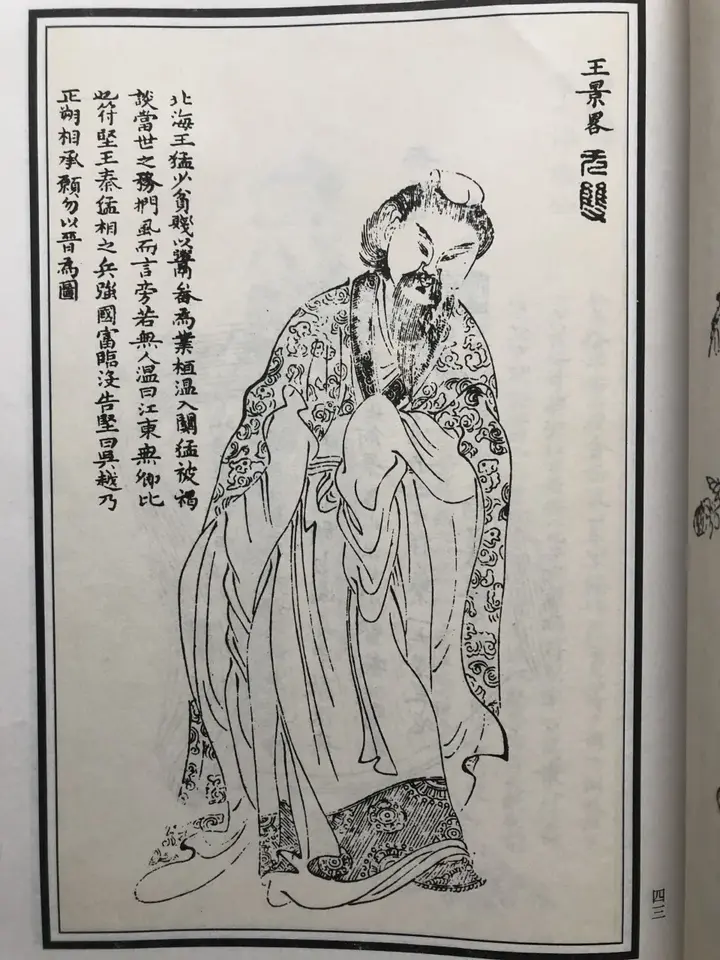
王猛
Wang Meng (王猛, 325–375 AD), courtesy name Jinglue, was a native of Ju County, Beihai Commandery (present-day Shouguang, Shandong) who settled in Weijun (present-day Wei County, Hebei). The foremost statesman, military commander, and reformer of the Former Qin Dynasty during the Sixteen Kingdoms period, he rose to Prime Minister, Director of the Chancellery, Director of the Imperial Secretariat, Grand Tutor to the Crown…
Wang Meng (王猛, 325–375 AD), courtesy name Jinglue, was a native of Ju County, Beihai Commandery (present-day Shouguang, Shandong) who settled in Weijun (present-day Wei County, Hebei). The foremost statesman, military commander, and reformer of the Former Qin Dynasty during the Sixteen Kingdoms period, he rose to Prime Minister, Director of the Chancellery, Director of the Imperial Secretariat, Grand Tutor to the Crown Prince, Colonel Director of Retainers, and Commander-in-Chief of All Military Affairs, ennobled as Marquis of Qinghe Commandery with the posthumous title "Marquis Wu." A descendant of the royal Tian house of Qi, Wang moved to Weijun in childhood after Later Zhao conquered Qingzhou, supporting his impoverished family by selling wicker dustpans (benji). Rewarded tenfold by a white-haired hermit on Mount Song and declining an appointment from Later Zhao official Xu Tong, he studied military treatises in seclusion on Mount Hua. When Eastern Jin commander Huan Wen camped at Bashang in 354 AD, Wang visited him in coarse hemp clothes, catching lice while discussing state affairs, exposing Huan Wen's hesitation to cross the Ba River, and declining to go south. Recommended by Lu Polou to Fu Jian, he helped eliminate the tyrant Fu Sheng in 357 AD. Serving as Magistrate of Shiping and rising five times in a single year (359 AD), he cooperated with Censor-in-Chief Deng Qiang to execute lawless Di nobles Fan Shi, Qiang De (younger brother of Empress Dowager Qiang), and over twenty other aristocrats, instituting recommendation and evaluation reforms, promoting agriculture, and reviving the Imperial Academy. Militarily, he crushed rebel Lian Qi, routed Former Liang ruler Zhang Tianxi, captured Li Yan, and quelled the rebellion of the Four Dukes led by Fu Liu. Proposing the strategy of "rescuing Yan first and seizing it afterward" in 369 AD, he took Luoyang and used the "Gold Knife Stratagem" to eliminate Murong Ling. In 370 AD, leading 60,000 troops east, he took Huguan, tunneled into Jinyang, pardoned Xu Cheng, promised Deng Qiang the post of Colonel Director of Retainers, routed Murong Ping's 300,000-strong army at Luchuan, and captured Ye to extinguish Former Yan. Dying in the seventh month of 375 AD, he earnestly warned Fu Jian not to attack the legitimate Eastern Jin and to gradually eliminate surrendered Xianbei and Qiang nobles.
Born in Ju County, Beihai Commandery; moved to Weijun amid war and sold wicker dustpans in poverty.
Received tenfold payment for dustpans from an old hermit on Mount Song; declined Later Zhao official Xu Tong's offer and retired to Mount Hua.
Met Huan Wen at Bashang in hemp clothes, catching lice while analyzing the realm and declining Huan Wen's invitation to go south.
Recommended by Lu Polou to Fu Jian; helped overthrow Fu Sheng in the sixth month, becoming Secretarial Attendant and Magistrate of Shiping.
Promoted five times in one year at age thirty-six; engineered the execution of Fan Shi, beheaded Empress Dowager Qiang's brother Qiang De, and purged over twenty corrupt nobles with Deng Qiang.
Raided northern Jingzhou; in 367 AD quelled Qiang rebel Lian Qi, routed Zhang Tianxi of Former Liang (beheading 17,000), and captured Li Yan at Fuhan.
Defeated the rebellion of Fu Liu, Fu Shuang, Fu Sou, and Fu Wu by luring Fu Liu out of Puban toward Chang'an and ambushing him with Deng Qiang.
Proposed rescuing Yan to defeat Huan Wen at Fangtou; led 30,000 troops in the twelfth month to take Luoyang and used Murong Chui's dagger to trick Murong Ling into defecting.
Led 60,000 troops in the sixth month to capture Huguan and Jinyang; burned Yan baggage at Luchuan in the tenth month, pardoned Xu Cheng, inspired Deng Qiang, routed Murong Ping's 300,000 troops, and took Ye in the eleventh month.
Returned from governing Jizhou at Ye to become Prime Minister in Chang'an; wrote a letter inducing Zhang Tianxi of Former Liang to submit as a vassal.
Fell ill in the sixth month; warned Fu Jian in the seventh month not to attack Eastern Jin and to eliminate Xianbei and Qiang nobles; died at fifty-one and was buried with the honors of Huo Guang.
Wang Meng's ancestors had lived in the Haidai region since the late Warring States period; originally surnamed Tian, they were called "descendants of the royal house" after Qin Shi Huang conquered Qi and thus adopted the surname Wang. Born in 325 AD in Ju County, Beihai Commandery, Qingzhou (present-day Shouguang, Shandong) two years after Shi Le's Later Zhao conquered Qingzhou and slaughtered 30,000 Jin troops, Wang moved with his family to Weijun (present-day Wei County, Hebei). Impoverished in childhood, he sold wicker dustpans (benji) to support his family. Once, while selling dustpans in Luoyang, a buyer offered a high price but claimed to have no money with him, leading Wang deep into the mountains before a white-haired old man attended by servants. When Wang bowed, the old man said, "Lord Wang, how can you bow to me!" and paid him ten times the usual price before having him escorted out; looking back, Wang realized it was Mount Song.
Studying tirelessly amid war with a special passion for military treatises, Wang grew grave, resolute, and far-sighted. When he visited the Later Zhao capital of Ye, wealthy nobles looked down on him, and only Palace Attendant Xu Tong recognized his extraordinary talent and offered him the post of Merit Officer, which Wang declined to live in seclusion on Mount Hua. After the death of Later Zhao tyrant Shi Hu in 349 AD, the Di leader Fu Hong rose in Guanzhong.
In the tenth year of the Yonghe era (354 AD), Eastern Jin general Huan Wen marched north, defeated Former Qin governor Guo Jing, and encamped at Bashang (east of Xi'an). Wearing a short coarse hemp garment, Wang went to Huan Wen's camp. Asked about the political situation, Wang reached into his clothes to catch lice while discoursing eloquently on the affairs of the empire as if no one else were present. Astonished, Huan Wen asked why none of the heroes of Guanzhong had come to welcome his 100,000 righteous troops.
Wang replied frankly that although Huan Wen had marched a thousand li into the north and Chang'an lay just across the Ba River, he refused to cross the river to take it, leaving the people uncertain of his true intentions. Pierced to the heart—since Huan Wen sought only reputation to enhance his standing at court—Huan Wen fell silent before sighing: "In all of Jiangdong, there is no one who can match your talent!" When Huan Wen retreated after Qin troops scorched the wheat fields and Fu Xiong defeated him at Bailuyuan, he offered Wang fine carriages, horses, and the high office of Protector-General to go south; consulting his teacher on Mount Hua and realizing he could not thrive in the aristocratic Eastern Jin court or aid Huan Wen's usurpation, Wang remained in seclusion.
After Former Qin founder Fu Jian died in 355 AD, his successor Fu Sheng ruled with sadistic cruelty. Fu Jian's nephew Fu Jian (Prince of Donghai) consulted Minister Lu Polou on overthrowing Fu Sheng, and Lu recommended Wang Meng. Meeting Wang, Fu Jian felt like Liu Bei finding Zhuge Liang. In the third year of the Shouguang era (357 AD), Fu Jian eliminated Fu Sheng, took the title Heavenly King of Great Qin, and appointed Wang Secretarial Attendant.
Because Shiping County, the northwestern gateway to Chang'an, was plagued by powerful bullies and bandits, Fu Jian appointed Wang Magistrate of Shiping. Upon taking office, Wang enforced strict laws and publicly flogged a notorious corrupt clerk to death. When complaints led to Wang being brought back in a prisoner's cart before the Commandant of Justice, Fu Jian reproached him for killing so soon instead of ruling through moral virtue.
Wang calmly replied that while a peaceful state could be governed by ritual, a chaotic state required law; if punished for failing to eradicate all the thousands of remaining villains he would gladly accept it, but he could not accept the charge of "cruel governance." Admiringly comparing him to Guan Zhong and Zichan before his ministers, Fu Jian pardoned him.
Promoted to Left Aide of the Secretariat, Wang rose five times in a single year at age thirty-six (359 AD), serving as Administrator of Xianyang, Palace Attendant, Director of the Secretariat, Governor of Jingzhao, Left Vice Director of the Secretariat, General Assisting the State, and Colonel Director of Retainers. Fan Shi, Marquis of Guzang and a Di veteran who had helped found the state, publicly insulted Wang: "We established the great enterprise with the late Emperor yet have no share in secret affairs; you have no martial merit—why do you monopolize state matters? Is this not us planting the crops while you gather the grain for nothing!" Wang retorted with a cold laugh: "Not only do you plant and I harvest, I shall also make you cook the rice and serve it to me!"
Enraged, Fan Shi vowed to hang Wang's head on the gate of Chang'an. Soon afterward, when Fu Jian told Fan Shi he intended to marry a princess to Yang Bi (who was already betrothed to Fan's daughter) and Fan objected, Wang accused Fan of competing with the sovereign for a marriage; when Fan lunged to strike Wang and cursed him, Fu Jian had Fan Shi executed, and later expelled officials Qiu Teng and Xi Bao for slandering Wang.
Hearing that Qiang De, the younger brother of Empress Dowager Qiang, was drunkenly murdering and seizing women, Wang immediately arrested and executed him without waiting to memorialize; by the time Fu Jian's courier galloped up with a pardon for the Empress Dowager's sake, Qiang De's corpse was already displayed in the marketplace. Cooperating with Censor-in-Chief Deng Qiang, Wang executed over twenty lawless nobles within weeks, inspiring Fu Jian to exclaim: "Only today do I know that the empire has laws and the Son of Heaven is exalted!"
Balancing strict punishment with meritocratic promotion, Wang recommended Fu Rong, Ren Qun, and Zhu Rong, and later appointed eastern scholars Fang Mo, Fang Kuang, Hao Lue, Cui Cheng, Han Yin, Tian Xie, and unyielding former Yan envoy Liang Chen. He helped Fu Jian establish a recommendation and evaluation system to break the monopoly of the nine-rank system, promoted agriculture and waterworks, reopened the Imperial Academy, and pursued the policy of "comforting the common people and harmonizing the tribes."
So efficient was his administration that when official Ma Si requested leave to bury his mother in Guangping, Wang told him to set out immediately, and by the time Ma Si exited Tongguan Pass that night, every county along the route had already received orders to verify his passport and provide lodging. Fu Jian likened Wang to Jiang Taigong serving King Wen of Zhou and ordered Crown Prince Fu Hong to serve Wang as he would his own father.
In the fifth month of the second year of the Jianyuan era (366 AD), the Xiongnu Liu clan, Wuhuan Dugu clan, and Xianbei Moyigan clan submitted to Qin; in the seventh month, Wang and Yang An attacked northern Jingzhou and brought back over 10,000 households. In the second month of 367 AD, Wang quelled Qiang rebel Lian Qi, and in the fourth month routed Former Liang ruler Zhang Tianxi, beheading 17,000 soldiers, capturing general Yin Ju with 5,000 armored men, and bloodlessly capturing Li Yan at Fuhan.
In the tenth month of 367 AD, Fu Sheng's younger brothers—Fu Liu (Duke of Jin) at Puban, Fu Shuang (Duke of Zhao), Fu Sou (Duke of Wei) at Shancheng, and Fu Wu (Duke of Yan)—simultaneously rebelled. Marching east in the spring of 368 AD, Wang encamped thirty li from Puban and refused Fu Liu's challenges. Believing Wang was afraid, Fu Liu left his heir Fu Liang to guard Puban and led 20,000 troops toward Chang'an in a surprise raid. Feigning ignorance, Wang secretly sent Deng Qiang with 7,000 elite troops to ambush Fu Liu's column by night, and as Fu Liu retreated, Wang struck with his main force, capturing the entire 20,000-man army except for Fu Liu and a few hundred riders who fled back into Puban. Wang soon stormed Puban, beheaded Fu Liu, and eliminated the remaining rebel dukes.
When Huan Wen invaded Former Yan and reached Fangtou in the seventh month of 369 AD, Yan emperor Murong Wei promised Former Qin territory west of Hulao in exchange for aid. Overruling ministers who opposed helping Yan, Wang secretly advised Fu Jian to "rescue Yan first and seize it afterward," lest Huan Wen conquer the Central Plains. After Qin and Yan forces routed Huan Wen in the ninth month and Yan broke its promise to cede land, Wang led 30,000 troops against Yan in the twelfth month.
Before departing, Wang drank with defected Yan prince Murong Chui—whom Wang had warned Fu Jian was an untamable dragon and tiger—and received Murong Chui's personal dagger as a gift. Since Murong Chui's eldest son Murong Ling was serving on Wang's staff, Wang bribed Murong Chui's confidant Jin Xi to carry the dagger as a token and falsely tell Murong Ling that his father had rebelled in Chang'an and returned east. Unable to verify the message, Murong Ling fled back to Yan during a hunt; Wang immediately memorialized Murong Ling's defection, causing Murong Chui to flee in panic to Lantian (though Fu Jian pardoned Murong Chui, Murong Ling was distrusted and killed in Yan). In the first month of 370 AD, Wang induced Luoyang commander Murong Zhu to surrender and defeated Murong Zang at Shimen and Xinle.
In the sixth month of the sixth year of the Jianyuan era (370 AD), bidding farewell to Fu Jian at Bashang, Wang assured him that sweeping away the remnant Yan was like wind scattering autumn leaves and asked only that residences be prepared in advance for the captured Yan ruler and ministers. Commanding ten generals and 60,000 troops against Yan regent Murong Ping's 300,000-strong army, Wang stormed Huguan on the southern route, capturing Prince Murong Yue. When Yang An's siege of Jinyang stalled for two months, Wang rushed to Jinyang, had his soldiers dig tunnels into the city at night, and sent hundreds of warriors inside to open the gates, capturing Jinyang and Prince Murong Zhuang.
In the tenth month, advancing to Luchuan, Wang faced Murong Ping, who sought to wear down the outnumbered Qin army while greedily taxing his own soldiers for water and firewood. Wang sent Guo Qing with 5,000 horsemen by night to burn the Yan baggage train, the flames visible all the way to Ye, prompting a terrified Murong Wei to order Murong Ping to distribute his wealth and fight immediately. On the eve of battle, scout officer Xu Cheng returned late at dusk and faced execution under martial law; when Deng Qiang pleaded for him and was refused, Deng marshaled his troops to attack Wang's camp.
Recognizing Deng's valor and loyalty to his comrade, Wang pardoned Xu Cheng. At dawn, after delivering a rousing speech that inspired his troops to smash their cauldrons and discard their rations, Wang ordered Deng Qiang to charge the Yan center. When Deng demanded the office of Colonel Director of Retainers as a reward and went back to sleep in his tent upon Wang's hesitation, Wang rode into Deng's camp and granted the request. Leaping up to drink a jar of wine, Deng Qiang charged into the Yan lines alongside Xu Cheng and Zhang Hao; by noon, the Yan army was shattered with over 50,000 killed or captured, and over 100,000 more were annihilated in the pursuit.
Besieging Ye under strict discipline, Wang privately met Fu Jian at Anyang in the eleventh month—explaining that Zhou Yafu's rigid refusal to greet Emperor Wen at Xiliu was petty obstinacy unworthy of imitation—and captured Ye, Murong Wei, and Murong Ping, extinguishing Former Yan. Created Marquis of Qinghe and declining fifty-five beauties, Wang governed the six provinces from Ye as Governor of Jizhou before returning to Chang'an in 372 AD as Prime Minister, sending back captive general Yin Ju with a letter that frightened Zhang Tianxi of Former Liang into submitting as a vassal.
Falling gravely ill from overwork in the sixth month of the eleventh year of the Jianyuan era (375 AD), Wang was prayed for by Fu Jian, who declared an amnesty when Wang briefly rallied. Wang submitted a memorial urging Fu Jian to remember that "he who is good at initiating does not necessarily complete, and he who begins well does not necessarily end well."
In the seventh month, when Fu Jian visited his deathbed to ask about state affairs after his passing, Wang opened his eyes and delivered his final admonition: "Although the Jin Dynasty resides in a remote corner south of the Yangtze, it holds the legitimate succession of China and enjoys harmony between ruler and people. After my death, Your Majesty must never seek to destroy Jin. The surrendered aristocrats of the Xianbei and Western Qiang harbor undying treachery and are our mortal enemies; sooner or later they will become a disaster, and you should gradually eliminate them for the good of the state." Having spoken, he breathed his last at age fifty-one. Weeping over his coffin three times, Fu Jian lamented to Crown Prince Fu Hong that Heaven did not wish him to unify the world, buried Wang with the supreme honors accorded to Han Grand Marshal Huo Guang, and conferred the posthumous title "Marquis Wu."
Selling wicker dustpans in youth, Wang Meng received tenfold payment from an old hermit on Mount Song, retired to Mount Hua, and met Huan Wen at Bashang in 354 AD in coarse hemp clothes, catching lice while exposing Huan Wen's reluctance to cross the Ba River. Helping Fu Jian overthrow Fu Sheng in 357 AD, he flogged a corrupt clerk to death in Shiping, engineered the execution of Fan Shi in 359 AD, beheaded Empress Dowager Qiang's brother Qiang De before a pardon could arrive, and purged over twenty lawless nobles with Deng Qiang, while creating a meritocratic recommendation system, promoting agriculture, and reopening the Imperial Academy.
Between 366 and 368 AD, Wang Meng routed Former Liang ruler Zhang Tianxi (beheading 17,000), captured Li Yan at Fuhan, and lured and ambushed Fu Liu outside Puban to crush the rebellion of the Four Dukes. In 369 AD, he proposed rescuing Yan first to defeat Huan Wen, captured Luoyang, and used Murong Chui's dagger in the "Gold Knife Stratagem" to eliminate Murong Ling.
In 370 AD, Wang led 60,000 troops east to take Huguan, tunnel into Jinyang, pardon Xu Cheng, inspire Deng Qiang, and rout Murong Ping's 300,000 troops at Luchuan, capturing Ye to extinguish Former Yan; he later sent back captive Yin Ju with a letter compelling Zhang Tianxi of Former Liang to submit. On his deathbed in 375 AD, he warned Fu Jian never to attack Eastern Jin and to gradually eliminate surrendered Xianbei and Qiang nobles.
FIGURES ASSOCIATED WITH THIS DYNASTY