Life and Career
Lineage of a Renowned Chancellor and Early Hardships
Wang Zhen'e was born into a celebrated aristocratic lineage of northern China. His grandfather was Wang Meng, the preeminent prime minister who had engineered the unification of northern China under Emperor Xuanzhao (Fu Jian) of Former Qin, while his father Wang Xiu served as Prefect of Hedong. Wang Zhen'e was born on the fifth day of the fifth lunar month in 373 CE. According to ancient Han folklore, the fifth month was considered an inauspicious "evil month" plagued by venomous spirits, and children born on the fifth day were superstitiously believed to bring disaster upon their families. Kinfolk urged the parents to adopt the infant out to distant relatives to avert misfortune.
Hearing of the dispute, Prime Minister Wang Meng personally inspected his grandson. Struck by the infant's extraordinary bone structure and steady gaze, Wang Meng intervened, declaring: "Lord Mengchang of the Warring States was likewise born on the fifth day of the fifth month, yet he rose to become Chancellor of Qi and brought immense glory to his lineage. This child is no ordinary boy; he will elevate our house!" He named the boy "Zhen'e", signifying the subjugation of all evils and adversities.
However, during Wang Zhen'e's adolescence, Former Qin suffered catastrophic disintegration following the Battle of Fei River in 383 CE. In 386 CE, at age thirteen, Wang Zhen'e found himself an orphaned refugee amidst the chaos of the Central Plains. Wandering destitute between the Xiao and Mian mountains, he was taken in by a generous commoner named Li Fang in Mianchi, who provided food and shelter. Moved by his kindness, Wang Zhen'e declared: "Though I am an impoverished wanderer today, if I encounter an enlightened sovereign and secure a marquisate of ten thousand households, I shall richly repay your virtue!" Recognizing the boy's noble bearing, Li Fang treated him with profound respect. Wang Zhen'e subsequently accompanied his uncle Wang Yao south across the Yangtze, settling in Jingzhou.
During his years in southern exile, Wang Zhen'e pursued intense self-education. Physically, he was slender, lacking strength to draw heavy bows or prowess in cavalry charges. However, he immersed himself in pre-Qin military treatises, demonstrating an exceptional grasp of terrain and operational deception. In scholarly gatherings across Jingzhou, his penetrating analyses of regional geopolitics and military logistics commanded universal admiration among contemporaries.
Meeting an Enlightened Sovereign and Early Brilliance
In March 409 CE, Liu Yu, paramount military leader of Eastern Jin, launched a major northern expedition against the Southern Yan regime based in Shandong. Learning that imperial forces had reached Xiapi, the thirty-seven-year-old Wang Zhen'e rode alone to Liu Yu's military camp seeking an audience. Recognizing talent, Liu Yu received him in his command tent. The two men conversed throughout the night, analyzing northern fortresses, enemy dispositions, troop coordination, and riverine logistics.
Enraptured by his strategic brilliance, Liu Yu exclaimed to his staff: "Chancellor Wang Meng possessed genius that dominated his age; I often grieved that I could not deliberate military affairs alongside him. Seeing his grandson today, with his daring stratagems and decisive judgment, is truly like witnessing Wang Meng reincarnated!" Liu Yu immediately commissioned Wang Zhen'e as Military Adjutant, integrating him into his inner operational planning circle. During the prolonged siege of Guanggu, Wang Zhen'e contributed essential siegecraft strategies that facilitated the capture of Murong Chao and the complete annexation of Southern Yan.
In 412 CE, a grave civil conflict erupted within the Eastern Jin hierarchy. General of the Guards Liu Yi, an influential veteran commander governing Jingzhou from Jiangling, openly amassed armaments and private legions to challenge Liu Yu's supreme authority. Resolving to eliminate his rival before preparations matured, Liu Yu devised a covert plan for a rapid amphibious raid across hundreds of miles, selecting Wang Zhen'e to spearhead the strike force.
The Surprise Assault on Jiangling and Pacification of Jingzhou
Liu Yu allocated Wang Zhen'e barely two thousand shock troops and approximately one hundred light river craft, instructing him to sail up the Yangtze from Jiankang directly into the heart of Jiangling. To achieve complete tactical surprise, Wang Zhen'e employed consummate operational deception. He lowered all military standards, stripped his troops of formal regalia, and hoisted civilian merchant pennants, concealing his soldiers beneath woven mats and declaring that his flotilla carried imperial tribute and administrative mail.
The stratagem succeeded brilliantly. Sailing day and night against the current, the flotilla bypassed all regional outposts and watchtowers without raising an alarm. After ten days of rapid navigation, Wang Zhen'e's force arrived undetected at Yuzhangkou outside Jiangling. Finding the garrison completely unprepared and engaged in banquets, Wang Zhen'e led his soldiers ashore in a sudden assault, storming the outer fortifications.
Panicking amidst the sudden onset, Liu Yi's troops scattered in confusion. Wang Zhen'e advanced through the gates, setting fire to the opposing naval fleet and granaries while broadcasting imperial pardons to reassure the populace. Paralyzed by terror, Liu Yi scaled the palace walls in his nightclothes, fleeing to the Niumu Buddhist Monastery where he hanged himself. With a modest force of two thousand men, Wang Zhen'e pacified the vast province of Jingzhou without major casualties, earning enfeoffment as Viscount of Hanshou. In 415 CE, he defeated the allied forces of Sima Xiuzhi and Lu Zongzhi along the Han River, securing the southern interior for Liu Yu.
The Campaign to Destroy Later Qin and Subjugation of Guanzhong
In August 416 CE, having consolidated southern China, Liu Yu launched a monumental campaign against the Qiang-led Later Qin regime that dominated the Central Plains and Guanzhong. Liu Yu mobilized five separate armies, assigning the supreme vanguard strike force to Wang Zhen'e and Tan Daoji. Marching northward from the Huai River, their combined legions advanced directly into the heart of Henan.
Wang Zhen'e maintained iron discipline, strictly prohibiting looting. Heartened by the arrival of an army led by the grandson of Wang Meng, local populations offered enthusiastic logistical support. At Luoyang, the Later Qin commander Yao Guang was trapped by subterranean sapping and fierce fire attacks directed by Wang Zhen'e, eventually emerging from the city gates to surrender, returning the ancient capital to imperial control after a century of foreign domination.
Without pausing to rest, Wang Zhen'e insisted on pressing westward toward Tongguan, the formidable gateway to Guanzhong. Yao Hong, sovereign of Later Qin, dispatched over one hundred thousand elite troops under imperial kinsmen Yao Shao and Yao Zan to fortify the pass behind deep trenches and stone redoubts. Confronted by impassable cliffs, Wang Zhen'e deployed infiltration units through treacherous southern defiles, cutting off the enemy's water and supply routes while launching coordinated assaults that broke the defensive lines.
The Decisive Battle at Qingni and Crushing the Qin Bastion
During the grueling march toward Guanzhong, Yao Shao regrouped tens of thousands of elite Qin defenders at Qingni, seeking to trap the imperial advance in rugged mountain defiles. With supply lines along the Yellow River strained by treacherous rapids, Wang Zhen'e shared rations with his men and personally scouted the front. He devised a feint, directing Tan Daoji to conduct frontal skirmishes while leading elite strike detachments up precipitous cliffs under cover of darkness to seize the enemy's rear water reservoirs.
Thrown into disarray, Qin commander Yao Pi led several thousand cavalry in an attempt to dislodge the ambushers, but Wang Zhen'e unleashed coordinated crossbow volleys, slaying over a thousand defenders and capturing dozens of senior officers. Crushed by repeated reversals, Yao Shao vomited blood and perished in camp. With their commanding general dead, the Qin garrison collapsed, enabling Wang Zhen'e to seize Qingni and clear the final barrier before the Wei River.
Burning the Boats at Wei Bridge and the Liberation of Chang'an
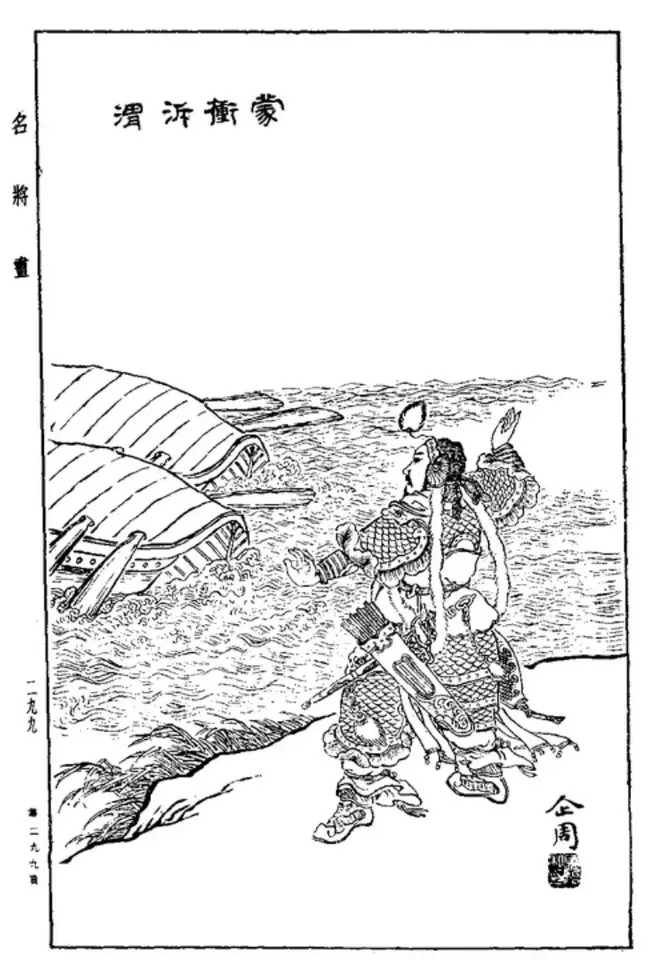
Following the fall of Tongguan, Yao Hong deployed his final strategic reserves along the northern bank of the Wei River. Aware that delay would allow Qin to mobilize regional garrisons and summon Northern Xia cavalry, Wang Zhen'e executed one of the most audacious amphibious maneuvers in Chinese military annals.
He commissioned several hundred specialized covered assault craft (mengchong) encased in thick rawhide to deflect missiles. Inside the hulls, concealed rowers operated internal paddle-wheel mechanisms, enabling the vessels to surge up the turbulent Wei River without visible oars. Observing these unmanned vessels gliding against the currents, terrified Qin defenders fled, believing supernatural spirits aided the southern army.
In September 417 CE, Wang Zhen'e's fleet reached the strategic Wei Bridge outside Chang'an. The moment his troops disembarked, Wang Zhen'e severed the moorings, allowing every vessel to drift down the raging torrent. Facing his trapped soldiers, he unsheathed his blade and shouted: "Warriors! We stand deep inside barbarian territory without boats or supplies! Before us lies the home of my grandfather Wang Meng and the ancient glories of Chang'an; behind us lies watery death! Forward lies honor, backward lies destruction!"
Electrified by his speech, two thousand soldiers charged like desperate tigers, overwhelming Yao Hong's imperial guards in hand-to-hand combat. Wang Zhen'e pursued the retreating garrison to the Pingshuo Gate. Acknowledging total defeat, Yao Hong surrendered the following morning, delivering the imperial seal and ending thirty-three years of Later Qin rule. Exactly one hundred and one years after Chang'an fell in 316 CE, imperial forces reclaimed the ancient capital under Wang Zhen'e's leadership.
Fulfilling Old Pledges with Honorable Magnanimity
Following the capture of Chang'an, Wang Zhen'e preserved civic discipline, sealing the palace archives, preventing pillaging, and reassuring the populace. At the zenith of his military renown, his immediate priority was tracking down Li Fang, the peasant who had sheltered him in Mianchi thirty years earlier.
Escorted to the headquarters, the elderly Li Fang was received with filial deference. Wang Zhen'e bowed before him, hosted celebratory feasts, and presented him with fine horses, carriages, and hundreds of bolts of silk, fulfilling his youthful pledge to richly repay the debt of life. This noble act of loyalty and gratitude resonated throughout northern China, earning Wang Zhen'e enduring acclaim for his chivalric character.
Restoring Order in the Ancient Capital and Pacifying Diverse Peoples
Confronted with an ancient metropolis scarred by decades of ethnic strife, Wang Zhen'e displayed remarkable administrative wisdom. He prohibited victor's retribution, enforced strict curfews, and preserved tens of thousands of classical manuscripts and astronomical archives.
Furthermore, he appointed capable Han scholars alongside cooperative Qiang and Di tribal chieftains to administer regional counties, abolished burdensome Qin levies, and opened imperial granaries to feed hundreds of thousands of starving refugees. Local citizens celebrated the return of traditional civilization, praising the righteous restoration of Han administrative decorum and cementing regional stability.
Factional Jealousies and Assassination at Fuhao
However, Wang Zhen'e's peerless achievements provoked fatal court intrigues. Recognizing that Wang Zhen'e commanded immense prestige across Guanzhong as the grandson of Wang Meng, Liu Yu harbored private suspicions that his general might establish an independent northern realm. Preparing to return south to usurp the Jin throne, Liu Yu left his twelve-year-old son Liu Yizhen in nominal command, appointing Wang Zhen'e as General of Pacifying the North and Director of Retainers, while secretly empowering southern commander Shen Tianzi to balance his authority.
Deep-seated cultural and regional friction separated northern gentry officers from southern Beifu veterans. Envious of Wang Zhen'e's singular role in conquering Chang'an, Shen Tianzi continually warned the young prince that Wang Zhen'e plotted usurpation.
In February 418 CE, Emperor Helian Bobo of Northern Xia invaded Guanzhong with massive cavalry forces. As Wang Zhen'e prepared defensive maneuvers, Shen Tianzi invited him to an emergency council at the military encampment of Fuhao. As Wang Zhen'e entered the tent to explain his troop deployments, hidden assassins burst forth and murdered the unarmed general upon his seat at age forty-six.
Wang Zhen'e's murder precipitated total panic throughout the army. Deprived of supreme leadership, the garrison fragmented into factional fighting, allowing Helian Bobo's cavalry to massacre the retreating southern legions. Liu Yizhen barely escaped alone, and Guanzhong was completely lost. Overcome with grief and fury, Liu Yu executed Shen Tianzi for treason, composing eulogies to mourn Wang Zhen'e and posthumously elevating him to General of the Left and Marquis of Longyang.