Birth at Chiting
Born into the prominent Qiang aristocratic house of Yao Yizhong at Chiting in Nan'an.
384 CE–394 CE
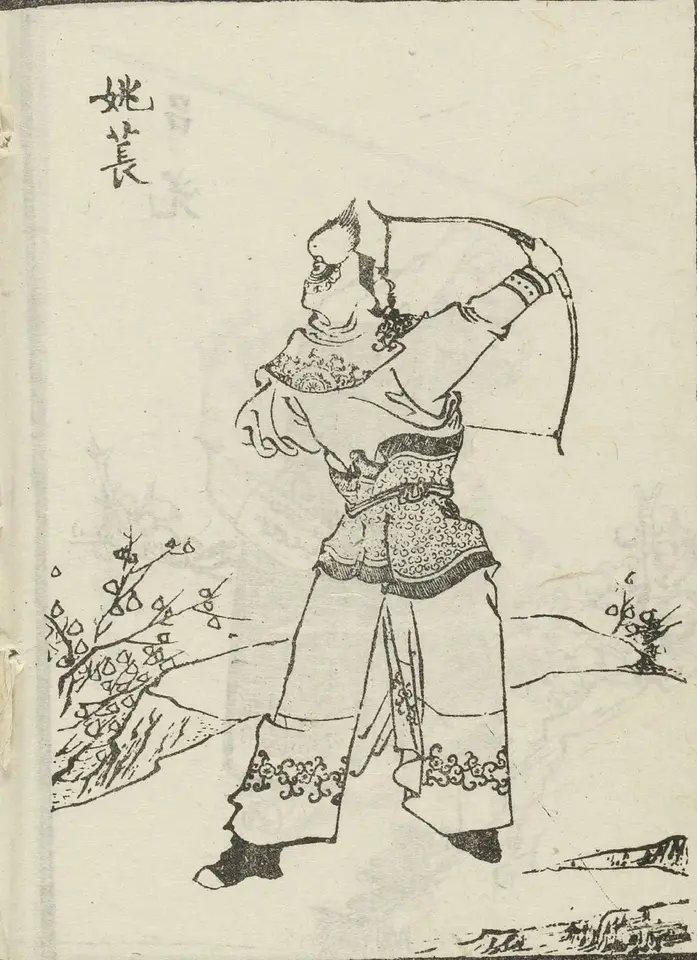
姚苌
Yao Chang (姚苌, 330–394), courtesy name Jingmao, was a native of Chiting, Nan'an (west of modern Longxi, Gansu Province), and the twenty-fourth son of the prominent Qiang leader Yao Yizhong and younger brother of Yao Xiang. He was the founding emperor of the Later Qin dynasty during the Sixteen Kingdoms period, reigning from 384 to 394. In his early years, he campaigned across the Central Plains alongside his brother Yao…
Yao Chang (姚苌, 330–394), courtesy name Jingmao, was a native of Chiting, Nan'an (west of modern Longxi, Gansu Province), and the twenty-fourth son of the prominent Qiang leader Yao Yizhong and younger brother of Yao Xiang. He was the founding emperor of the Later Qin dynasty during the Sixteen Kingdoms period, reigning from 384 to 394. In his early years, he campaigned across the Central Plains alongside his brother Yao Xiang. Following Yao Xiang's defeat and death in 357, Yao Chang surrendered his followers to Former Qin, serving Emperor Fu Jian as General of Yangwu, Administrator of Longdong, and Inspector of Ningzhou, earning distinction in western campaigns and being appointed General of Longxiang. Following Former Qin's disastrous defeat at the Battle of Fei River in 383, Yao Chang served under Fu Rui to suppress Murong Hong's rebellion, but retreated to the northern pastures along the Wei River after Fu Rui was killed and Fu Jian executed Yao's emissaries. In 384, supported by over fifty thousand Qiang households, Yao Chang established Later Qin, declaring himself Grand General, Great Chanyu, and King of Wannian Qin with the era name Baique. In 385, he captured and executed Fu Jian at Xinping, and in 386 entered Chang'an to declare himself emperor, adopting the era name Jianchu. Adopting a strategic policy of securing northern passes before taking the central plains, Yao Chang engaged Fu Deng in a protracted nine-year war, employing mobile ambush warfare to capture Fu Deng's base at Dajie and pacify regional warlords. He passed away in Chang'an in 394 at the age of sixty-five, receiving the temple name Taizu and the posthumous title Emperor Wuzhao.
Born into the prominent Qiang aristocratic house of Yao Yizhong at Chiting in Nan'an.
Following Yao Yizhong's death, campaigned alongside Yao Xiang, famously giving his warhorse to his brother.
Following Yao Xiang's death in battle at Sanyuan, led remaining troops to surrender to Former Qin.
Campaigned alongside Wang Meng and Yang An against Eastern Jin in Nansiang, capturing ten thousand households.
Subjugated rebel general Lian Qi with Wang Meng; Lian Qi's troops defected to Yao Chang upon his arrival.
Appointed Inspector of Ningzhou garrisoned at Dianjiang, repelling local incursions before strategic withdrawal.
Advanced into the Hexi Corridor with Gou Chang, bringing the Liang territory under Former Qin control.
Appointed General of Longxiang by Fu Jian to command western forces during the Fei River campaign.
Fled to northern pastures after Fu Rui's defeat; acclaimed King of Wannian Qin by Qiang chieftains.
Besieged Xinping; torrential rains ended water shortages in his camp, halting Fu Jian's counter-attack.
Captured Fu Jian at Mount Wujiang and executed him at Xinping Buddhist temple after demanding the imperial seal.
Marched into Chang'an following Western Yan's withdrawal and assumed the imperial title, establishing the Jianchu era.
Engaged in fierce warfare against Emperor Fu Deng of Former Qin, suffering initial setbacks before regrouping.
Launched a surprise nocturnal raid on Former Qin's supply hub at Dajie, capturing Empress Mao and state officials.
Defeated rebel Qiang commander Lei E'di and pardoned him, securing his lifelong loyalty through clemency.
Instructed Crown Prince Yao Xing to execute treacherous minister Gou Yao while defeating Fu Deng east of Anding.
Marched while ill to confront Fu Deng, executing a phantom nocturnal retreat that caused Fu Deng's forces to withdraw.
Formed an alliance with Later Yan against Western Yan ruler Murong Yong, consolidating the eastern frontier.
Entrusted state affairs to Crown Prince Yao Xing on his deathbed; passed away in Chang'an at sixty-five.
Yao Chang was born in 330 at Chiting in Nan'an as the twenty-fourth son of Yao Yizhong, the hereditary paramount chieftain of the Nan'an Qiang people under Later Zhao rule. His family had long governed Qiang tribes along the Gansu-Shaanxi borders, commanding substantial cavalry hosts amidst the turmoil of the Sixteen Kingdoms. From his youth, Yao Chang exhibited an astute and cautious intellect, demonstrating keen psychological insight and a calm demeanor under pressure, which earned him the affection and respect of his father and elder brothers. When Yao Yizhong relocated his tribal followers toward the Central Plains during Shi Hu's reign, Yao Chang accompanied the army, acquiring intimate knowledge of strategic terrain and factional rivalries across northern China.
In 352, Yao Yizhong passed away at his military camp in Liyang. Amidst the chaos of the Ran Min rebellion, Yao Chang's elder brother Yao Xiang kept their father's death secret and mobilized over sixty thousand households to march south into Henan. At the battle of Matian, Yao Xiang's vanguard was ambushed by Former Qin generals Li Li and Gao Chang, and Yao Xiang's battle charger was struck down by arrows. In this desperate crisis, the twenty-two-year-old Yao Chang dismounted immediately, offering his own mount to his brother. When Yao Xiang hesitated, Yao Chang urged him to escape, declaring that enemy troops would spare him, allowing both brothers to fight their way out through incoming relief forces.
Following their escape, Yao Xiang praised Yao Chang's extraordinary composure and farsighted character before the gathered commanders, predicting that his younger brother would eventually bring great glory to the Yao lineage. Over the following years, Yao Xiang and Yao Chang operated between the Huai River and the Guanzhong passes, seeking to carve out an autonomous territorial base. Yao Chang took charge of logistical transport, supply depots, and tribal alliances, earning a stellar reputation for prudence and equity among Qiang chieftains and Han gentry elites, establishing networks that proved vital for his later rise.
In May 357, Yao Xiang launched an ill-fated offensive into the Guanzhong basin against Xingcheng, where he was intercepted by Former Qin commanders Deng Qiang and Fu Huangmei. During the engagement at Sanyuan, Former Qin cavalry sprang an ambush, felling Yao Xiang and routing his army. Recognizing that further resistance would result in the extermination of his people, Yao Chang led the remaining tens of thousands of Qiang followers to surrender to Former Qin. Emperor Fu Jian treated the Yao family with magnanimity, initiating Yao Chang's twenty-six-year career as a distinguished imperial commander under Former Qin.
During his brother's campaigns in Henan, Yao Chang had paid meticulous attention to agricultural logistics and military subsistence. Facing widespread famine and rampant banditry across the war-torn Central Plains, he directed military personnel to cultivate abandoned fields north of the Huai River while forbidding unauthorized plundering of peasant settlements. By exchanging horses and salt for textiles and iron from southern merchants, Yao Chang maintained stable provisions for the Qiang army, providing Yao Xiang with reliable material support throughout their northern expeditions.
Following his submission to Former Qin, Yao Chang found himself serving under Emperor Fu Jian, who had recently seized power from the tyrannical Fu Sheng. Fu Jian practiced benevolent governance and patronized non-Di ethnic leaders, appointing Yao Chang as General of Yangwu. Yao Chang served with distinction in numerous frontier pacification campaigns. In 366, he accompanied Prime Minister Wang Meng and General Yang An with twenty thousand troops to attack the Eastern Jin border commandery of Nanxiang, securing over ten thousand households before conducting an orderly withdrawal to Guanzhong.
In 367, Former Qin veteran general Lian Qi revolted at Lueyang. When Wang Meng and Yao Chang advanced with seventeen thousand soldiers to suppress the insurrection, Lian Qi's troops—many of whom had previously served under Yao Yizhong—immediately defected to Yao Chang. Lian Qi fled alone to Baima, allowing Wang Meng to secure the region without bloodshed. Impressed by Yao Chang's charisma among the Qiang populace, Fu Jian promoted him to Administrator of Longdong, where he encouraged sericulture, lowered taxes, and governed with leniency, winning broad local acclaim.
In 371, Yao Chang participated in the expedition against Yang Zuan of Chouchi alongside Yang An and Fu Ya, successfully subjugating the Di and Qiang tribes. In 373, he was promoted to Inspector of Ningzhou and stationed at Dianjiang to oversee Sichuan defenses. When Eastern Jin generals Zhu Yao and Huan Shiqian counterattacked with thirty thousand men, Yao Chang conducted a fighting retreat to Wucheng. Later, he accompanied General Gou Chang across the northern desert to conquer Former Liang, playing a vital role in integrating the Hexi Corridor into Former Qin's expanding empire.
Throughout his service under Former Qin, Yao Chang navigated court politics with circumspection and humility. Although Prime Minister Wang Meng repeatedly warned Fu Jian that Yao Chang harbored hidden ambitions and was too calculating to remain a permanent subordinate, Fu Jian dismissed these suspicions, trusting Yao Chang implicitly. Aware of the surveillance around him, Yao Chang kept a low profile and cultivated an image of loyal deference, consolidating influence quietly among regional military officers and frontier gentry.
While serving as Administrator of Longdong and Inspector of Ningzhou, Yao Chang displayed remarkable administrative adaptability in governing diverse frontier communities. Recognizing the complex mixture of Han, Qiang, and Di populations, he streamlined cumbersome criminal penal codes, respected customary tribal traditions, and recruited local Han scholars alongside minority chieftains into provincial administrations. This balanced policy fostered communal harmony and endeared him to local populations, laying deep grassroots foundations for his eventual sovereign bid.
In 383, having consolidated northern China, Fu Jian resolved to launch a massive southern campaign to conquer Eastern Jin and unify the realm. While prominent courtiers such as Fu Rong vigorously opposed the expedition, Murong Chui and Yao Chang enthusiastically endorsed the war. Loyal statesmen warned Fu Jian that Xianbei and Qiang leaders supported the campaign solely to destabilize Former Qin so they could revive their own states, but Fu Jian dismissed these warnings and mobilized over eight hundred thousand troops.
In August 383, Fu Jian appointed Fu Rong as vanguard commander over two hundred and fifty thousand men, simultaneously granting Yao Chang the prestigious title of General of Longxiang and Commander-in-Chief of Yizhou and Liangzhou. Fu Jian remarked that he had once ascended the throne from the position of General of Longxiang, a title he had never bestowed upon anyone else, urging Yao Chang to exert his utmost loyalty. Although General Dou Chong warned that such imperial comparisons were an ill omen, Fu Jian proceeded with the appointment.
In November, Former Qin suffered a catastrophic defeat at the Battle of Fei River against the Eastern Jin forces of Xie Xuan. Fu Rong perished in the chaos, and Fu Jian was wounded by an arrow as the imperial army disintegrated. The collapse shattered Former Qin's centralized authority, plunging northern China into widespread rebellion as Xianbei, Qiang, and Dingling leaders seized military arsenals and declared independence across the empire.
In January 384, Murong Chui rebelled in the east to found Later Yan, while his nephew Murong Hong raised several thousand Xianbei cavalry in Guanzhong, declaring himself Prince of Jibei and advancing toward Chang'an. Fu Jian dispatched his son Fu Rui as commander and Yao Chang as military advisor to suppress Murong Hong. Yao Chang advised shadowing the retreating Xianbei host without forcing a pitched battle, but Fu Rui recklessly attacked and was killed in action along with his vanguard.
Following Fu Rui's demise, Yao Chang recognized that Fu Jian would hold him responsible for his son's death. He dispatched Chief Clerk Zhao Du and Military Advisor Jiang Xie to Chang'an to beg for forgiveness, but the grieving and furious emperor ordered both emissaries summarily executed. Learning of their deaths, Yao Chang fled northward into the desolate horse-breeding pastures along the northern banks of the Wei River to evade imperial cavalry.
At this juncture, Former Qin's collapse left hundreds of thousands of Qiang tribesmen in Guanzhong without leadership. Hearing of Yao Chang's arrival at the northern pastures, regional Qiang chieftains including Yin Wei, Yin Xiang, and Pang Yan assembled over fifty thousand households to offer him their allegiance. Encouraged by widespread support, Yao Chang formally declared himself Grand General, Great Chanyu, and King of Wannian Qin at Beidi in April 384, adopting the era name Baique.
Yao Chang immediately established an administrative bureaucracy to govern his nascent regime. He appointed Yin Xiang and Pang Yan as Left and Right Chief Clerks, Yao Huang and Yin Wei as Left and Right Adjutants, Di Bozhi as Attendant Officer, and Wang Qinlu and Yao Fangcheng as field commanders. News of his rebellion triggered massive defections, as Qiang communities across Huayin, Beidi, Xinping, and Anding joined his banner, swelling his forces to over one hundred thousand men within months.
In June 384, Fu Jian personally led twenty thousand elite cavalry north to crush Later Qin, dispatching General Yang Bi on a multi-pronged assault that killed Yao Chang's brother Yao Yinmai. Former Qin troops dammed the Angong Valley and severed the Tongguan River, cutting off Later Qin's water supply and leaving Yao Chang's soldiers near dehydration. At this critical moment, a torrential cloudburst flooded the Later Qin camp with three feet of water while leaving surrounding areas dry. Reinvigorated, Yao Chang's troops counterattacked fiercely, forcing Fu Jian to withdraw in despair.
In autumn 384, the Western Yan army under Murong Chong laid siege to Chang'an, subjecting the capital to severe famine and street fighting. Later Qin generals urged Yao Chang to storm Chang'an directly, but he formulated a patient grand strategy of securing the northern plateau before taking Guanzhong. Yao Chang reasoned that the Western Yan Xianbei desired only plunder before returning eastward to Liaodong, and that Later Qin should let Western Yan and Former Qin exhaust each other before occupying the evacuated capital.
In May 385, facing starvation in Chang'an, Fu Jian fled with several thousand guards to Mount Wujiang to gather supplies. Yao Chang dispatched General Wu Zhong with elite cavalry to intercept the emperor, capturing Fu Jian and escorting him under guard to the Later Qin camp at Xinping. Yao Chang attempted to coerce Fu Jian into surrendering the imperial hereditary seal and performing a ceremonial abdication, seeking legal legitimacy for his sovereign ambitions.
However, Fu Jian steadfastly refused, rebuking Yao Chang as an ungrateful rebel who had betrayed imperial benevolence. On August 26, 385, realizing that Fu Jian would never yield and fearing rescue attempts by loyalist Di forces, Yao Chang ordered his officers to strangle Fu Jian inside a Buddhist temple in Xinping. The execution of Fu Jian aroused fierce hatred among Former Qin loyalists, instigating a bitter cycle of retaliatory warfare that lasted for over a decade.
In 386, after sacking Chang'an, Murong Chong's Xianbei army withdrew eastward along the Yellow River, leaving the metropolis in ruins. Yao Chang entered the devastated capital with his main army, ascending the imperial throne in April 386 and adopting the era name Jianchu. He created his son Yao Xing crown prince and ennobled his generals, completing his transformation from an exile into the sovereign ruler of Later Qin.
Following Yao Chang's coronation, Former Qin royal Fu Deng was acclaimed emperor in Longxi, launching a ferocious war of vengeance against Later Qin. Fu Deng's army carried a carved wooden statue of Fu Jian into battle, and his soldiers tattooed vows of vengeance upon their arms, displaying fanatical ferocity in combat. For nine years, from 386 to 394, Yao Chang and Fu Deng clashed repeatedly across Anding, Xinping, and Longdong in a series of grueling campaigns.
During initial engagements, Fu Deng's impassioned troops repeatedly pushed back Later Qin forces, besieging Yao Chang on multiple occasions and seizing several outposts around Chang'an. Recognizing that Fu Deng's army possessed superior shock combat power but lacked secure agricultural supply lines, Yao Chang shifted from direct frontal engagements to mobile warfare, utilizing deep ambushes, strategic withdrawals, and raids against enemy supply convoys to wear down Former Qin's momentum.
In August 389, learning that Fu Deng had advanced his main strike force toward Anding, Yao Chang personally led thirty thousand light cavalry on a covert forced march, launching a devastating nocturnal raid on Former Qin's supply hub at Dajie. Later Qin troops overran the encampment, capturing Empress Mao, several dozen high-ranking ministers, and fifty thousand personnel, alongside vast stores of grain and ordnance. This catastrophic defeat shattered Fu Deng's logistical base, permanently forcing Former Qin onto the strategic defensive.
By late 393, physical exhaustion and festering wounds suffered in continuous warfare caused Yao Chang to fall critically ill in Chang'an. From his sickbed, he issued detailed directives to Crown Prince Yao Xing and Chancellor Yin Wei on defending against remaining Former Qin holdouts. In December 394, Yao Chang passed away at the age of sixty-five, receiving the temple name Taizu and the posthumous title Emperor Wuzhao. Yao Xing subsequently carried out his father's strategic plans, decisively defeating and killing Fu Deng to complete the unification of Guanzhong.
Yao Chang's success in carving out an empire amidst the collapse of Former Qin stemmed from his exceptional strategic patience and realistic geopolitical assessment. When Western Yan besieged Chang'an with overwhelming cavalry forces, Yao Chang resisted the temptation to rush into the capital, adhering instead to his maxim of securing northern passes before taking the central plains. Knowing that the Xianbei had no intention of remaining permanently in Guanzhong, he consolidated his agrarian and tribal base in Beidi, taking control of Chang'an only after his rivals had departed.
In organizing his fledgling state, Yao Chang bridged tribal traditions with classical Chinese bureaucratic administration. He allied with influential regional Han clans, appointing scholars such as Yin Wei and Pang Yan to establish civil governance while maintaining cohesive military discipline over diverse Qiang and Di tribal units. This harmonious institutional synthesis provided Later Qin with resilient administrative efficiency and military cohesion during protracted regional wars.
In diplomatic and military pacification, Yao Chang practiced broad magnanimity toward surrendered foes. When rebel commander Lei E'di revolted and was subsequently captured, Yao Chang treated him with unwavering trust, reinstating him to senior rank. Similarly, when Former Qin governor Qiang Jinchui surrendered Xinping, Yao Chang visited his camp with only a handful of guards to demonstrate sincere goodwill. This bold clemency won the hearts of regional chieftains, dismantling resistance networks across Guanzhong.
During the initial phase of state-building, Yao Chang carried out an extensive land redistribution and refugee resettlement program. He designated tens of thousands of hectares of abandoned arable land along the Wei River for state-sponsored military farming settlements, granting three-year tax exemptions to returning peasant households. Within a few years, agricultural productivity was restored across the Guanzhong plains, providing Later Qin with dependable grain supplies to sustain its prolonged military campaigns.
The nine-year duel between Yao Chang and Emperor Fu Deng stands as a classic historical study in asymmetric mobile warfare overcoming fanatical frontal aggression. Facing an enemy driven by fervent vengeance, Yao Chang avoided costly siege battles, using the rugged terrain of eastern Gansu and central Shaanxi to conduct extensive fluid encirclements, cutting off supply lines and isolating enemy outposts.
The nocturnal assault on Dajie in 389 represented the pinnacle of Yao Chang's operational brilliance. By exploiting Fu Deng's overextended advance, Yao Chang marched hundreds of li through the night to strike the enemy's rear supply hub, capturing Empress Mao and state officials while seizing critical provisions. This decisive operation broke the psychological resolve of Fu Deng's veterans, turning the tide of the war irretrievably in Later Qin's favor.
At the standoff near Anding in 392, Yao Chang demonstrated masterful psychological warfare. Confronting Fu Deng while severely ill, he ordered his army to silently evacuate their fortified positions under cover of night. When Former Qin scouts discovered the abandoned camp the next morning, Fu Deng was unnerved by Yao Chang's unpredictable maneuvers, ordering an immediate retreat that cemented Later Qin's strategic mastery over the region.
To support his frontline armies, Yao Chang constructed a sophisticated military intelligence network and beacon courier system across the passes of Longdong. He deployed multi-lingual reconnaissance agents disguised as nomadic traders into Fu Deng's territory to monitor troop movements and supply schedules. This early warning apparatus enabled Later Qin forces to preempt ambushes and consistently outmaneuver Former Qin armies at minimal cost.
As a Qiang monarch ruling the historical heartland of Chinese civilization, Yao Chang recognized that raw nomadic force could never ensure long-term stability. Upon declaring himself emperor in Chang'an, he immediately founded the Imperial Academy (Taixue) and regional state schools, inviting esteemed Han scholars to lecture on Confucian statecraft and ordering young Qiang and Di aristocrats to study classical Chinese texts. This cultural initiative integrated non-Han elites into Chinese administrative traditions.
To legitimize Later Qin's dynastic authority within traditional Chinese cosmological theory, Yao Chang directed court scholars to align the regime with the Five Elements succession cycle. Later Qin claimed the fire element, succeeding Former Qin's wood element, while tracing the genealogical ancestry of the Qiang Yao clan to the ancient sage king Shun. This ideological framing bridged ethnic divides and presented Later Qin as an authentic successor to the classical Chinese imperium.
In institutional appointments, Yao Chang restored Han and Jin administrative conventions, governing with legal restraint and administrative transparency. He prohibited bureaucratic extortion, safeguarded farming seasons, and extended imperial pardons to displaced refugees. Trusted Confucian ministers such as Yin Wei and Di Bozhi exercised major policy influence, creating an open and meritocratic court that laid the foundation for the prosperous Hongshi era under Emperor Yao Xing.
Furthermore, Yao Chang placed great emphasis on restoring classical ancestral rites and state sacrifices. He ordered ritual officers to construct the Altar of Heaven south of Chang'an and the Altar of Earth to the north, personally presiding over seasonal imperial sacrifices. He also posthumously honored his father Yao Yizhong as Emperor Jingyuan and his brother Yao Xiang as King of Wei Wu, constructing ancestral shrines that projected the full majesty of legitimate Chinese imperial statecraft.
In contrast to the rampant luxury and architectural extravagance common among contemporary Sixteen Kingdoms rulers, Yao Chang was renowned for his austere personal lifestyle. During the bitter winter campaigns against Fu Deng, he ordered all silks, jewels, and luxuries within the imperial palace confiscated and converted into soldier bounties, forbidding palace consorts from wearing embroidered gowns and eating coarse grain himself alongside his troops.
To maintain high military morale, Yao Chang instituted generous tax-exempt welfare guarantees for military families. Under Later Qin law, households of active soldiers and officers serving in field encampments were permanently exempt from state land taxes, corvee labor, and miscellaneous levies. This farsighted policy eliminated domestic anxieties for frontline troops, imbuing Later Qin armies with exceptional cohesion and resilience even during desperate military reversals.
In judicial administration, Yao Chang cracked down severely on false accusations and malicious slander. He established an open petition system at the imperial court, decreeing that anyone who made fabricated allegations against ministers or generals would suffer the exact punishment intended for the accused under the principle of retaliatory punishment. This equitable judicial administration prevented internecine palace purges, preserving domestic political stability and unity.
FIGURES ASSOCIATED WITH THIS DYNASTY