Proclamation of Great Xia at Gaoping
Helian Bobo revolts against Later Qin, assumes the titles of Heavenly King of Great Xia and Grand Chanyu at Gaoping, and founds the state of Hu Xia.
407 CE–431 CE
胡夏
The Hu Xia (胡夏; 407–431 CE), officially proclaimed as the Great Xia (大夏) and historically designated Helian Xia (赫连夏), was a regional imperial dynasty established in the Ordos steppe and northern Shaanxi by Helian Bobo, supreme chieftain of the Tiefu (Tiefu tribe) branch of the Southern Xiongnu, during the late Sixteen Kingdoms period. To distinguish it from the ancient legendary Xia dynasty and the later Western Xia (Tangut) empire, traditional historiographers designated it "Hu…
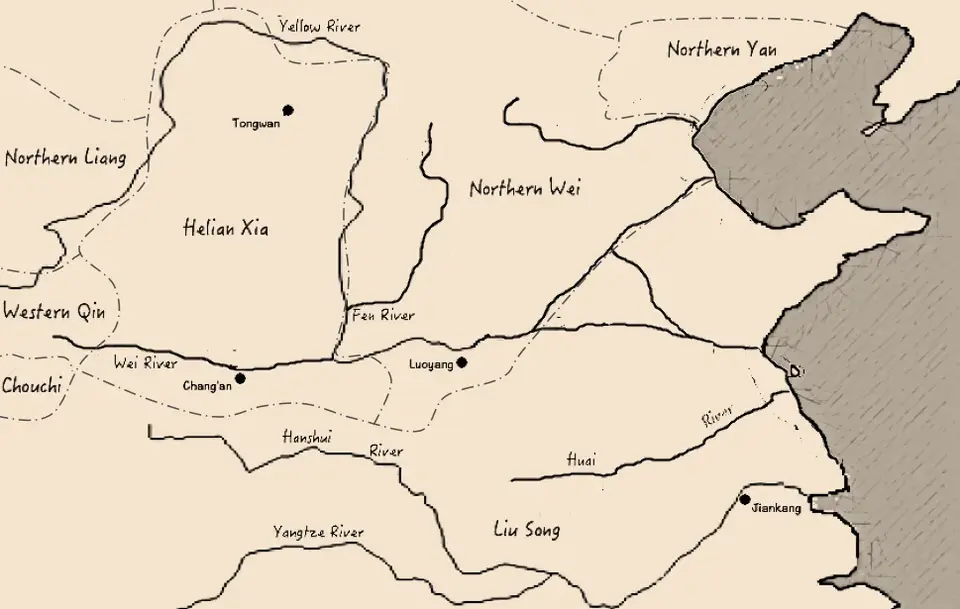
The Hu Xia (胡夏; 407–431 CE), officially proclaimed as the Great Xia (大夏) and historically designated Helian Xia (赫连夏), was a regional imperial dynasty established in the Ordos steppe and northern Shaanxi by Helian Bobo, supreme chieftain of the Tiefu (Tiefu tribe) branch of the Southern Xiongnu, during the late Sixteen Kingdoms period. To distinguish it from the ancient legendary Xia dynasty and the later Western Xia (Tangut) empire, traditional historiographers designated it "Hu Xia" due to the Xiongnu origins of its ruling house. In 407 CE (Yixi 3 of Eastern Jin), seizing upon the geopolitical decline of Later Qin and growing pressure from Northern Wei, Helian Bobo broke away from the service of Yao Xing, proclaiming himself Heavenly King of the Great Xia and Grand Chanyu at Gaoping. In 413 CE, declaring his royal house the legitimate descendant of Yu the Great of the ancient Xiahou clan, he changed his surname to "Helian" ("uniting with high heaven") and conscripted one hundred thousand laborers to build the impregnable white capital of Tongwancheng along the Sheyan River in Shuofang. Utilizing rapid cavalry mobility, Helian Bobo devastated Later Qin's northern territories. In 418 CE, following Grand Marshal Liu Yu's northern conquest and return south, Helian Bobo launched an offensive into Guanzhong, annihilating the retreating Southern Dynasties garrisons at Qingni and capturing Chang'an, establishing an imperial domain extending across Guanlong and the Ordos. Enduring across twenty-five years under three successive rulers—Helian Bobo, Helian Chang, and Helian Ding—Hu Xia possessed elite shock cavalry and celebrated fortifications, but suffered from extreme penal cruelty, political instability, and an economy heavily reliant on raiding. Following Helian Bobo's death, Emperor Taiwu of Northern Wei launched a massive expedition, capturing Tongwancheng in 427 CE and subsequently taking Helian Chang prisoner. His brother Helian Ding retreated to Pingliang, assumed the imperial title, and annexed the Western Qin dynasty in Longyou. Attempting to cross the Yellow River to conquer Northern Liang, Helian Ding was ambushed and captured by the Tuyuhun in 431 CE, who delivered him to Northern Wei for execution, extinguishing Hu Xia.
Helian Bobo revolts against Later Qin, assumes the titles of Heavenly King of Great Xia and Grand Chanyu at Gaoping, and founds the state of Hu Xia.
Helian Bobo employs fluid guerrilla mobility, ambushing Later Qin general Yao Shao and subduing the northern Qiang tribes, capturing tens of thousands of prisoners.
Helian Bobo adopts the surname Helian and conscripts one hundred thousand laborers to construct the white fortress of Tongwancheng under brutal supervision.
Liu Yu of Eastern Jin destroys Later Qin, occupying Chang'an; Helian Bobo positions his cavalry along the northern passes, severing southern supply routes.
Taking advantage of factional infighting among the southern garrison, Helian Bobo ambushes Liu Yizhen at Qingni, destroys the southern army, and captures Chang'an.
Helian Bobo ascends the imperial throne at Bashang, establishes Chang'an as the southern capital, and returns to Tongwancheng, reaching the peak of dynastic power.
Helian Bobo dies in the Jiafu Hall at Tongwancheng; Crown Prince Helian Chang ascends the throne, as Northern Wei prepares a southern offensive.
Emperor Taiwu of Northern Wei crosses the frozen Yellow River at Puban; General Xi Jin captures Chang'an, driving Xia forces out of Guanzhong.
Emperor Taiwu lures Helian Chang out of Tongwancheng with feigned retreats, routing the Xia cavalry; Tongwancheng falls, and Helian Chang flees to Shanggui.
Northern Wei captures Helian Chang at Anding; his brother Helian Ding ascends the throne at Pingliang under the era name Shengguang.
Helian Ding destroys Western Qin at Nan'an, but is ambushed and captured by the Tuyuhun while crossing the Yellow River to attack Northern Liang; Hu Xia is extinguished.
The Tiefu branch of the Southern Xiongnu had resided across the northern steppe for generations. Chieftains Liu Hu and Liu Wuhuan commanded Shuofang before suffering severe defeats against the Tuoba Xianbei. When Northern Wei forces killed Helian Bobo's father, Liu Weichen, the young Bobo fled to Later Qin, where Emperor Yao Xing appointed him General Pacifying the North and General of Agile Cavalry, garrisoning Gaoping.
In 407 CE (Yixi 3 of Eastern Jin), Helian Bobo intercepted eight thousand tribute warhorses sent by the Rouran Khaganate to Later Qin, mutinied against Yao Xing, and proclaimed himself Heavenly King of the Great Xia and Grand Chanyu at Gaoping, establishing the era name Longsheng. Proclaiming descent from Yu the Great, he adopted the dynastic title "Great Xia." Leading his veteran Tiefu cavalry, Helian Bobo swept across Longyou and northern Shaanxi, storming Later Qin commanderies, capturing civilian populations and livestock, and laying the territorial foundation of his state.
In 413 CE (Fengxiang 1), Helian Bobo changed his surname from Liu to Helian, interpreting it as "uniting majestically with high heaven," and declared the era name Fengxiang. He commissioned General Chigan Ali to conscript one hundred thousand Han and nomadic laborers north of the Ling range to erect the capital city of Tongwancheng along the northern bank of the Sheyan River in Shuofang. The fortress was constructed using a technique of steaming white clay, sand, and sticky rice juice, compacted so densely that if an iron awl could penetrate one inch, the supervising artisan was executed and buried within the wall. This produced an exceptionally solid white citadel, celebrated as "white as jade."
In 417 CE, Grand Marshal Liu Yu of Eastern Jin conquered Later Qin, leaving his young second son Liu Yizhen and generals Wang Zhen'e and Shen Tianzi to defend Chang'an. Soon, factional infighting broke out within the southern garrison. Seizing the opportunity, Helian Bobo led his cavalry south in 418 CE, ambushing Liu Yizhen's retreating divisions at Qingni, annihilating the elite troops of the future Liu Song dynasty, and storming Chang'an. In 419 CE, Helian Bobo erected an imperial altar at Bashang, ascending the imperial throne under the era name Zhenxing. Designating Tongwancheng as the northern capital and Chang'an as the southern capital, Hu Xia commanded an empire stretching from Gaoping in the west, across the Qin River valley in the south, to the Ordos steppe in the north.
In 425 CE (Zhenxing 7), Helian Bobo died of illness in the Jiafu Hall at Tongwancheng, posthumously honored as Emperor Wulie with the temple name Shizu. Crown Prince Helian Chang succeeded him, establishing the era name Chengguang. By this time, Northern Wei had unified Hebei under Emperor Taiwu Tuoba Tao, who regarded the conquest of the Ordos and Guanzhong as the key to unifying northern China.
In 426 CE (Chengguang 2), capitalizing on Helian Chang's recent succession, Emperor Taiwu led fifty thousand light cavalry to cross the frozen Yellow River at Puban, dispatching General Xi Jin directly against Chang'an. The Xia garrison abandoned the southern capital, and Northern Wei annexed the fertile Wei River valley. Hu Xia lost its rich agricultural base in Guanzhong, falling back to northern Shaanxi and Longdong in a strategic defensive posture.
In 427 CE (Chengguang 3), Emperor Taiwu led another expedition directly against Tongwancheng. The Northern Wei emperor deployed feigned retreats and ambushes outside the fortress. Overconfident and hot-tempered, Helian Chang led his elite cavalry out of the gates to give chase. Northern Wei hidden divisions surged out, shattering the Xia lines. Helian Chang fled west toward Shanggui, and the outer city of Tongwancheng fell. Northern Wei cavalry captured the inner citadel, seizing the imperial archives, court consorts, and hundreds of thousands of horses and livestock.
In 428 CE (Chengguang 4), Northern Wei general An Jie captured Anding; Helian Chang engaged in combat, was thrown when his warhorse stumbled, and was captured alive, sent to Pingcheng where he was granted aristocratic rank. His younger brother Helian Ding, Duke of Pingyuan, rallied tens of thousands of retreating troops, fortified Pingliang, and mounted the imperial throne under the era name Shengguang, desperately defending Longdong and Shanggui as Northern Wei forces closed in.
In 430 CE (Shengguang 3), Northern Wei armies encircled Pingliang. His supplies exhausted, Helian Ding broke through the lines to retreat to Lintao. In the spring of 431 CE, seeking a territorial base to revive the dynasty, Helian Ding marched west against Qifu Mumo of Western Qin. Overrunning Nan'an, he captured and executed the entire Western Qin royal family, absorbing more than one hundred thousand retreating troops across Longyou.
Helian Ding subsequently attempted to cross the Yellow River to march through Zhangye and conquer Northern Liang under Juqu Mengxun. In the sixth lunar month of 431 CE, as the Xia army was halfway across the Yellow River, the Tuyuhun chieftain Murong Gui led an elite cavalry strike against the exposed crossing columns. The Xia army was routed, and Helian Ding was captured alive. He was transported in chains to Pingcheng and executed by Northern Wei, bringing the twenty-five-year rule of Hu Xia to an end.
The administrative structure of Hu Xia reflected an extreme synthesis of nomadic steppe hierarchy, family autocracy, and classical Chinese civil offices. At the capital, the court established the Three Preceptors, Three Excellencies, Department of State Affairs, Secretariat, and Chancellery, appointing Grand Preceptors, Directors of the Secretariat, and Ministers. However, all executive decision-making was held by the Helian royal family and Tiefu Xiongnu commanders.
In regional administration, Hu Xia operated a dual system combining the Chanyu Directorate (Shanyu Tai) with traditional commanderies and counties. For the nomadic Xiongnu populations of the Ordos, administration was exercised through the Grand Chanyu and the Left and Right Wing Military Commands. Over settled Han farming populations in Guanzhong and Longyou, administration was conducted through provinces including Youzhou, Qinzhou, and Yongzhou.
In jurisprudence, Hu Xia relied on terror and severe corporal penalties. Helian Bobo established the "Artisan Admonitions" (Baigong Zhen), superintending weapon manufacturing and fortification construction. If an iron breastplate could be pierced by an arrow, the armorer was beheaded; if the arrow failed to pierce the armor, the bowmaker was executed. At court, weapons were kept beside the throne, and courtiers who looked sideways were subjected to eye-gouging and tongue-plucking. This arbitrary cruelty bred widespread fear, preventing the state from cultivating institutional loyalty.
Hu Xia's military power was anchored in the exceptional mobility of Tiefu Xiongnu shock cavalry. At the founding of the dynasty, Helian Bobo articulated an operational doctrine of asymmetric warfare: "If we defend a single fortress, the enemy will concentrate their forces against us; if we disperse our horsemen in mobile raiding columns, when they advance to the front we strike their rear, and when they turn to protect their rear we strike their front." This fluid doctrine exhausted the regular field armies of Later Qin. The state's armor and weaponry were forged with exceptional metallurgical care, and the fortifications of Tongwancheng represented a peak of military architecture during the Sixteen Kingdoms.
In diplomacy, Hu Xia initially submitted to Later Qin to evade Northern Wei aggression, subsequently rebelling when opportunity arose. Toward Southern Liang and Northern Liang, Helian Bobo alternated between marriage treaties and extortionate demands. Toward Eastern Jin, he feigned submission to Liu Yu before cutting off the southern retreat and seizing Chang'an. Throughout its existence, Hu Xia's primary adversary was Northern Wei. In this prolonged struggle, Hu Xia was eventually overwhelmed by Northern Wei's superior population, resources, and strategic depth.
Geographically straddling the Ordos steppe and the loess plateau of northern Shaanxi, Hu Xia's economy combined nomadic pastoralism with settled agriculture. In its formative decades, the state relied primarily on horse breeding, livestock pastoralism, and predatory raids against Later Qin agricultural settlements.
Following the conquest of Guanzhong, Hu Xia gained access to the irrigation networks of the Wei River valley. However, continuous warfare, draconian tax extraction, and forced conscription severely damaged agricultural productivity. The construction of Tongwancheng conscripted one hundred thousand laborers for several years, devastating agricultural labor in northern Shaanxi. Trade was confined to transit commerce conducted by Central Asian merchants between Tongwancheng and Chang'an, lacking a stable state monetary system.
The ruling elite of Hu Xia exhibited a blend of steppe tribal pride and classical imperial aspirations. Helian Bobo claimed descent from Yu the Great of the ancient Xiahou clan to assert imperial legitimacy, while adopting the surname Helian ("uniting with high heaven") to honor his steppe lineage.
Despite his reputation for cruelty, Helian Bobo prioritized imperial ritual display. Following the capture of Chang'an, he summoned Han Confucian scholars, appointing Secretariat Drafter Wei Zusi and scholar Cui Hui to compose court ceremonial protocols. He commissioned Secretariat Supervisor Hu Yizhou to compose the famous parallel prose monument Inscription for Tongwancheng (Tongwancheng Ming), carved on a massive stone stele erected south of the capital, celebrated as a masterpiece of Sixteen Kingdoms literature. Buddhism was tolerated, and disciples of Kumārajīva found refuge within Xia territory, though the state never developed deep alliances with the northern literati.
Helian Bobo (Emperor Shizu), Helian Chang (Deposed Emperor), Helian Ding (Last Sovereign).
| Monarch | Reign Period | Temple Name / Posthumous Name | Core Reign Achievements and Historical Significance |
|---|---|---|---|
| Helian Bobo | 407–425 CE | Emperor Shizu / Emperor Wulie | Founding emperor. Rebelled against Later Qin, established Great Xia, constructed Tongwancheng, and destroyed the southern army at Qingni to take Chang'an. |
| Helian Chang | 425–428 CE | No temple name / Deposed Emperor (Prince of Qin) | Third son of Helian Bobo. Lost Chang'an to Northern Wei, lured into an ambush outside Tongwancheng, and was captured at Anding. |
| Helian Ding | 428–431 CE | No temple name / Last Sovereign (Duke of Pingyuan) | Fifth son of Helian Bobo. Reorganized resistance at Pingliang, conquered Western Qin, but was captured by Tuyuhun while crossing the Yellow River. |
In the Book of Jin (Jin Shu, vol. 130, "Chronicles of Helian Bobo"), Tang historians wrote: "Helian Bobo was cunning and shrewd from his youth, resolute and brave in action. Exploiting the decline of the Yao clan, he annexed the lands of Qin and Yong. Steaming earth to build his city, he named it Tongwancheng, adorned with intricate sculptures resembling a heavenly dwelling. Yet he was violent, tyrannical, and bloodthirsty, indulging in ceaseless warfare and arbitrary executions until corpses lay piled upon one another." In the Comprehensive Mirror in Aid of Governance (Zizhi Tongjian), Sima Guang observed: "Helian Bobo relied upon his raw martial vigor, indulging in unbridled luxury and brutalizing his subjects without compassion... When his fortune waned, the people of Wei capitalized upon his decline; in a single battle Tongwancheng was lost, in another his family was taken captive, and his state was extinguished."
Although Hu Xia endured for only twenty-five years, the ruins of Tongwancheng survive today along the southern edge of the Mu Us Desert in northern Shaanxi. Its sophisticated construction techniques—compacting steamed white chalk, sand, and sticky rice juice—alongside its angled bastion towers (Mamian) and multi-layered defensive ramparts, stand as an extraordinary monument of military architecture from the Sixteen Kingdoms period.