Birth | Born into a military household at Huaishuo Garrison; his mother Han Qiji died after childbirth.
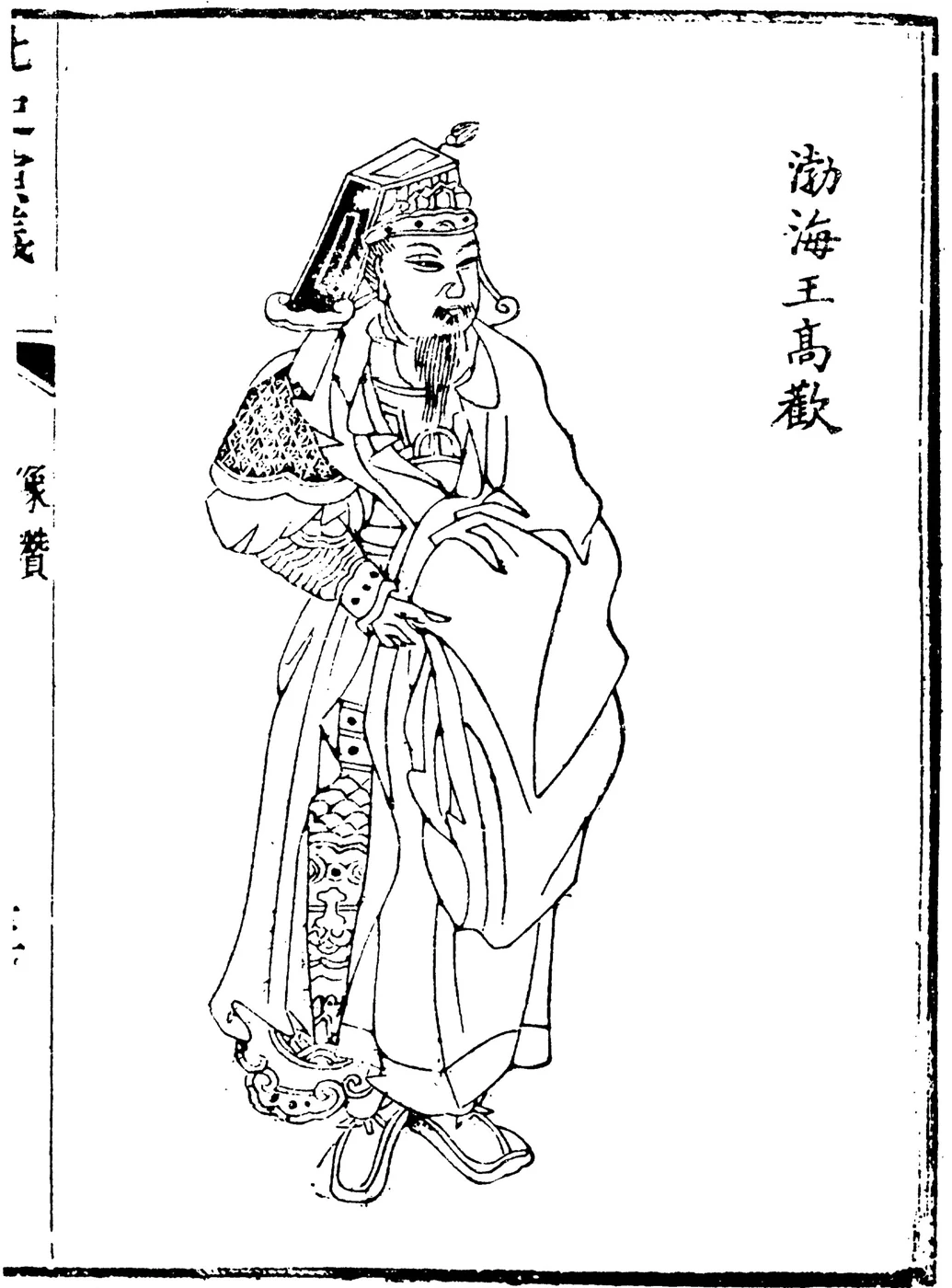
496 CE–547 CE
Powerful minister of Eastern Weifounder of Northern Qi
Gao Huan
高欢
Gao Huan (496–February 13, 547), whose Xianbei name was Helouhun, had his ancestral home in Tiao County, Bohai Commandery (present-day Jing County, Hebei) and was born at Huaishuo Garrison (present-day Guyang County, Inner Mongolia). He was the dominant minister of Eastern Wei during the Northern and Southern Dynasties and the founder of the political power later inherited by Northern Qi.
496 CE–547 CENorthern Dynasties
PROFILE
Gao Huan (496–February 13, 547), whose Xianbei name was Helouhun, had his ancestral home in Tiao County, Bohai Commandery (present-day Jing County, Hebei) and was born at Huaishuo Garrison (present-day Guyang County, Inner Mongolia). He was the dominant minister of Eastern Wei during the Northern and Southern Dynasties and the founder of the political power later inherited by Northern Qi.
- Other name
- Shenwu (posthumous title)
- Period
- Northern Dynasties · Northern Qi
- Date of Birth
- 496
- Date of Death
- February 13 547
- Dynasty/State
- Northern Dynasties · Northern Qi
- Identity
- Powerful minister of Eastern Wei; founder of Northern Qi
- Ethnicity/Group
- Not recorded in historical sources
- Native place
- Ancestral home in Tiao County, Bohai Commandery (present-day Jing County, Hebei)
- Place of birth
- Not recorded in historical sources
- Principal achievements
- Rose from the military society of the Six Garrisons, became the dominant minister behind Eastern Wei, and controlled northern power for more than two decades.
LIFE TIMELINE
Age 17 | Around age twenty-seven. The Six Garrisons Rebellion broke out; Gao Huan successively joined the rebel forces of Du Luozhou and Ge Rong.
Age 10 | Around age thirty. Left Ge Rong and joined Erzhu Rong at Xiurong, becoming a trusted commander.
Age 32 | Age thirty-two. During the Heyin Incident he unsuccessfully urged Erzhu Rong to become emperor and was enfeoffed as Count of Tongdi.
Age 34 | Age thirty-four. Emperor Xiaozhuang killed Erzhu Rong; Erzhu Zhao installed Yuan Ye and enfeoffed Gao Huan as Duke of Pingyang Commandery.
Age 35 | Age thirty-five. Reached Xindu in the second month and occupied Ji Province; in the sixth month raised troops against the Erzhu clan and installed Yuan Lang as emperor.
Age 36 | Age thirty-six. Defeated Erzhu Zhao decisively at the Battle of Hanling, entered Luoyang, installed Emperor Xiaowu Yuan Xiu, and became Grand Chancellor and Prince of Bohai.
Age 37 | Age thirty-seven. Destroyed the remaining Erzhu forces; Erzhu Zhao committed suicide after defeat.
Age 38 | Age thirty-eight. Emperor Xiaowu fled to Guanzhong; Gao Huan installed Emperor Xiaojing Yuan Shanjian, moved the capital to Ye, and established the Eastern Wei political order.
Age 41 | Age forty-one. Dou Tai was defeated and killed at the Battle of Tong Pass; Gao Huan then suffered a major defeat by Yuwen Tai at the Battle of Shayuan and lost 70,000 troops.
Age 42 | Age forty-two. At the Battle of Hebei Bridge, Hou Jing recovered Luoyang; Gao Ang was defeated and killed.
Age 47 | Age forty-seven. Defeated Yuwen Tai at the Battle of Mangshan and reportedly beheaded more than 30,000 enemy soldiers.
Age 50 | Age fifty. Besieged Wei Xiaokuan at the Battle of Yubi for more than fifty days without success and fell ill from grief and frustration.
Age 52 | Nominal age fifty-two. Died at Jinyang on the bingwu day of the first month (February 13); buried at Yiping Mausoleum.
BIOGRAPHY
Biography
Family Background and Early Years
Gao Huan's sixth-generation ancestor Gao Yin had served as Administrator of Xuantu Commandery under Western Jin. His fifth-generation ancestor Gao Qing, great-great-grandfather Gao Tai, and great-grandfather Gao Hu all served the Murong states of Yan. Gao Hu surrendered to Northern Wei when Murong Bao's state collapsed. Gao Huan's grandfather Gao Mi rose to Palace Censor under Northern Wei but was exiled to Huaishuo Garrison after committing an offense. By the time of Gao Huan's father Gao Shusheng, the family had declined; Gao Shusheng himself did not engage in productive work and lived idly. Gao Huan's mother Han Qiji died when he was born, so he was raised by his elder sister Gao Loujin, Lady of Changshan, and her husband Yujing.
Gao Huan grew up in a frontier garrison surrounded by soldiers and gradually adopted Xianbei customs. The History of the Northern Dynasties, "Annals of Qi, Part One," states that after Gao Huan's mother died he was raised in the household of his sister's husband, an officer at the garrison prison, and that generations of life on the northern frontier led the family to adopt local customs and become like the Xianbei. Gao Huan was poor at the time. Only after marrying Lou Zhaojun, a Xianbei woman, and receiving a horse from her dowry did he have the means to serve as a squad leader in the garrison forces, commanding roughly one hundred men.
As a squad leader, Gao Huan formed relationships with a range of people, including fellow officers Sima Ziru and Sun Teng and the itinerant merchant Liu Gui. The garrison commander Duan Chang believed Gao Huan possessed an unusual appearance and exceptional talent and told him that he had the ability to rescue his age from disorder, though Duan himself would not live to see his future success, and asked him to care for his descendants. Gao Huan never forgot the words. After gaining control of the Northern Wei government he posthumously honored Duan Chang as Minister over the Masses and promoted Duan's son Duan Ning.
Joining the Rebellions and Entering Erzhu Rong's Service
At the end of Northern Wei, the Six Garrisons Rebellion erupted. Gao Huan first joined Du Luozhou's rebel army, but despised Du's conduct. He privately plotted with Yujing, Duan Rong, and Cai Jun to kill Du Luozhou. The plot failed, and Gao Huan fled to Ge Rong. He later left Ge Rong as well and joined Erzhu Rong at Xiurong.
Gao Huan told Erzhu Rong that the emperor was weak and foolish, the empress dowager was disorderly, favorites monopolized power, and government no longer functioned; with Erzhu Rong's martial ability, he argued, one could seize the moment, eliminate Zheng Yan and Xu He, clear the emperor's side, and establish hegemony. Erzhu Rong greatly admired Gao Huan's ability and made him a trusted commander.
In the fourth month of 528, the first year of Wutai, the Heyin Incident occurred and Erzhu Rong advanced on Luoyang. Gao Huan took the opportunity to urge Erzhu Rong to become emperor. Erzhu hesitated. Heba Yue argued against the proposal, warning that claiming the throne before great achievements had been secured would bring disaster. Erzhu Rong reconsidered and continued to recognize Emperor Xiaozhuang. Heba Yue then urged Erzhu Rong to kill Gao Huan to satisfy public opinion, but other generals argued that the realm was in chaos and still required military men, and requested that Gao Huan be spared. Erzhu Rong pardoned him.
Absorbing the Six Garrisons Remnants and Raising Troops at Xindu
In 530, the third year of Yong'an, Emperor Xiaozhuang killed Erzhu Rong. The Erzhu clan rose against the emperor and killed him after his defeat. They installed Yuan Ye, Prince of Changguang, as emperor and enfeoffed Gao Huan as Duke of Pingyang Commandery. Gao Huan did not participate in the action and instead preserved his strength, leading more than 200,000 people back toward Hebei.
Surrendered troops from the Six Garrisons were relocated to Bing and Si provinces, where they were repeatedly abused by the Erzhu clan's tribal soldiers. They rebelled twenty-six times in large and small uprisings, and more than half were killed. Erzhu Zhao, troubled by the situation, asked Gao Huan for advice. Gao Huan suggested placing the surrendered garrison troops under a trusted commander and punishing their commander rather than the whole force when offenses occurred. When Erzhu Zhao asked who could do the job, Heba Yun suggested Gao Huan. Gao Huan pretended to become furious, struck Heba Yun in the mouth hard enough to knock out his front teeth, and berated him for speaking beyond his authority. Erzhu Zhao took this performance as proof of loyalty and, while drunk, declared Gao Huan commander of the surrendered Six Garrisons troops.
Once outside the camp, Gao Huan immediately announced that he had been ordered to command the garrison troops and that they should assemble east of the Fen River. The troops already hated the Erzhu clan and quickly gathered around him. Gao Huan then memorialized Erzhu Zhao that frost and drought had struck Shanxi and there was no grain for the soldiers, requesting permission to move toward Shandong. Erzhu Zhao's chief secretary Murong Shaozong opposed the plan, warning that allowing Gao Huan to leave was like lending a dragon clouds and rain: he would become uncontrollable. Erzhu Zhao ignored him, imprisoned Murong Shaozong, and ordered Gao Huan to move east.
On the journey Gao Huan took three hundred fine horses belonging to Erzhu Rong's wife, Princess Beixiang. Erzhu Zhao became enraged and personally pursued him to Xiangyuan. Floodwaters on the Zhang River had destroyed the bridge, and Gao Huan explained from the opposite bank that he had borrowed the horses to prepare against bandits in Shandong. Erzhu Zhao and Gao Huan killed a white horse and swore brotherhood. Gao Huan's subordinate Yujing had hidden strongmen in an ambush intending to kill Erzhu Zhao, but Gao Huan judged that his strength was insufficient and stopped the attempt.
In the second month of 531, the first year of Putai, Gao Huan reached Xindu. Gao Qian and Feng Longzhi opened the gates, allowing him to occupy Ji Province. Erzhu Dulu deposed Yuan Ye and installed Emperor Jiemin Yuan Gong, who enfeoffed Gao Huan as Prince of Bohai and summoned him to court. Gao Huan declined. Seeking to leave his soldiers no avenue of retreat, he forged an order in Erzhu Zhao's name commanding all surrendered garrison troops to return to Shanxi and become dependents of the Erzhu tribal forces. The soldiers became anxious and frightened. Gao Huan used the fear to persuade them to rebel against the Erzhu clan and, in the sixth month of 531, raised troops at Xindu and installed the Northern Wei imperial clansman and Administrator of Bohai Yuan Lang as emperor.
Destroying the Erzhu Clan and Controlling the Court
In 532, the second year of Zhongxing, Gao Huan fought the Erzhu forces in a decisive battle at Hanling. Gao Huan had fewer than two thousand warhorses and no more than thirty thousand troops, while Erzhu Zhao was said to have two hundred thousand. Gao Huan tied cattle and donkeys together to block retreat, formed a circular battle formation, and left his soldiers no escape so that all would fight to the death. Gao Huan personally led the center forward, Gao Aocao commanded the left, and Gao Yue the right. Gao Huan's center initially fared badly and Erzhu Zhao's troops rushed forward. Gao Yue led five hundred cavalry to meet them; Hulü Dun gathered scattered troops and struck from Erzhu Zhao's rear, while Gao Aocao charged in with more than one thousand cavalry. Erzhu Zhao's army collapsed.
Grand Commander Husi Chun and others hurried back to Luoyang, killed the Erzhu partisans left there, and installed the imperial clansman Yuan Xiu as Emperor Xiaowu of Northern Wei. Gao Huan was appointed Grand Chancellor and Prince of Bohai, with the hereditary post of Inspector of Ding Province. In the fifth month Emperor Jiemin was poisoned. Emperor Xiaowu married Gao Huan's eldest daughter as empress. In 533, the second year of Yongxi, Erzhu Zhao was defeated at Chihong Ridge and forced to hang himself. His commander Murong Shaozong brought Erzhu Zhao's wife and surviving followers to surrender, and Gao Huan treated him generously because of his loyalty.
Eastern-Western Wei Confrontation and Later Years
In 534, the third year of Yongxi, Emperor Xiaowu Yuan Xiu and Husi Chun secretly planned to remove Gao Huan, and Gao Huan's close ally, Minister over the Masses Gao Qian, was ordered to die by the emperor. Gao Huan instructed Houmochen Yue to eliminate Heba Yue and sent Hou Jing to take over Heba Yue's forces, but Heba Yue's followers chose Yuwen Tai as their leader and Hou Jing returned without success. Emperor Xiaowu fled to Guanzhong and joined Yuwen Tai. Gao Huan installed Yuan Shanjian as Emperor Xiaojing and moved the capital to Ye, beginning Eastern Wei. In the twelfth month Yuwen Tai killed Emperor Xiaowu and installed Yuan Baoju at Chang'an, beginning Western Wei.
In the spring of 537, the fourth year of Tianping, Gao Huan, Gao Ang, and Dou Tai advanced against Western Wei in three columns. Dou Tai rushed toward Tong Pass as the vanguard. Yuwen Tai took elite troops through a smaller pass to the side of Tong Pass and struck the Eastern Wei army unprepared; the army collapsed and Dou Tai killed himself. In the tenth month Gao Huan led 200,000 troops to Pujin to attack Western Wei, seeking revenge. Yuwen Tai reached Weinan and deployed at a bend of the Wei River, ordering his soldiers to hide their weapons among reeds. The Eastern Wei troops saw that the Western Wei force was small and apparently exhausted, advanced carelessly, and lost formation. Yuwen Tai sounded the drums and attacked; Li Bi led armored cavalry in a flank charge, and the Eastern Wei army collapsed with 70,000 losses in the Battle of Shayuan.
In 538, the first year of Yuanxiang, Gao Huan's commander Hou Jing recovered the Jinyong fortress at Luoyang, prompting Yuwen Tai to bring relief forces. Hou Jing was defeated; Gao Ang pursued Yuwen Tai but was himself defeated and killed.
In 543, the first year of Wuding, Gao Zhongmi surrendered Yu Province to Western Wei. Gao Huan led an army of 100,000 against him. Gao Huan's commander Peng Le charged the Western Wei northern army with several thousand cavalry, won a major victory, and reportedly took more than 30,000 heads. Peng Le pursued Yuwen Tai, who pleaded that Peng would gain nothing from killing him and should instead return to take the gold and valuables left in the camp. Peng stopped the pursuit. The next day the two sides fought again; Western Wei gained the upper hand and Eastern Wei was defeated. Heba Sheng pursued Gao Huan with three thousand troops and shouted Gao Huan's Xianbei name, Helouhun, declaring that he would kill him that day. Gao Huan escaped only after his men shot Heba Sheng's horse.
In 546, the fourth year of Wuding, Gao Huan led 100,000 troops against Yubi, where the Western Wei commander Wei Xiaokuan defended vigorously. The Eastern Wei army assaulted Yubi for more than fifty days without breaking the defenses, losing more than 70,000 men to combat and disease. Gao Huan fell ill from grief and frustration and withdrew. Western Wei spread rumors that he had been hit by an arrow and was dying. During the retreat, the seriously ill Gao Huan gathered his officials and asked the veteran general Hulü Jin to sing the Song of Chile: "The Chile plain beneath the Yin Mountains; the sky like a domed tent covers the four wilds. The sky is vast, the fields boundless; when the wind bends the grass, cattle and sheep appear." Gao Huan joined the song himself and wept.
Final Arrangements and Death
When Gao Huan became gravely ill, Gao Cheng wrote to summon Hou Jing in Gao Huan's name. Hou Jing and Gao Huan had earlier agreed that genuine letters would carry a tiny black dot on the reverse. Gao Cheng's letter lacked the dot, and Hou Jing refused to come.
Gao Huan summoned his heir Gao Cheng and warned him that Hou Jing had exercised unchecked power south of the Yellow River for fourteen years and had long been arrogant and ambitious; Gao Huan could control him, but Gao Cheng might not. Because the realm was not yet settled, Gao Huan instructed him not to hurry the public mourning. He then reviewed senior supporters whom Gao Cheng could trust. Gao Huan said that Kudi Gan and Hulü Jin were respected elders of their peoples and were upright and unlikely to betray Gao Cheng; that Kezhuhun Daoyuan and Liu Fengsheng had come to him from afar and would not harbor disloyalty; that Heba Ren was simple and honest; that Pan Xiangle was deeply virtuous and mild; that Han Gui was somewhat blunt and should be treated with tolerance; that Peng Le was a rare trusted supporter and should be protected; and that only Murong Shaozong was capable of checking Hou Jing. Gao Huan explained that he had deliberately kept Murong from great favor so that Gao Cheng could later employ him with exceptional courtesy for major affairs.
On February 6, 547, the first day of the first month of the fifth year of Wuding, a solar eclipse occurred. Gao Huan remarked that if the eclipse were for him, he would have no regret in dying. On the bingwu day of that month, February 13, Gao Huan died at Jinyang at the nominal age of fifty-two and was buried at Yiping Mausoleum. After Gao Yang seized the Eastern Wei throne and founded Northern Qi, he posthumously honored Gao Huan as Emperor Xianwu, temple name Taizu; under the Later Lord, the temple name was changed to Gaozu and the posthumous imperial title to Emperor Shenwu.
His Family and Early Years
Gao Huan came of a military household that had lived for generations on the northern frontier, its customs gradually becoming Xianbei. His great-great-grandfather Gao Qing, his great-grandfather Gao Tai and his grandfather Gao Hu all served the Murong; a later forebear rose to be attendant censor of the Northern Wei and was exiled to the Huaishuo garrison for breaking the law; and by the time of his father Gao Shusheng, who was an idle and dissolute man who did not attend to his livelihood, the family had declined. Gao Huan's mother, the lady Han Qiji, died when he was born, and he was brought up by his elder sister, the lady of Changshan, Gao Loujin, and her husband Wei Jing; and growing up in a frontier garrison town among Xianbei, he learned their customs and became as one of them. Such a ruined household's son had no prospects and his life was in every way unsatisfactory, until he married the Xianbei woman Lou Zhaojun, when things improved: from his bride's dowry Gao Huan got a horse, and only with a horse could he be a troop commander of about a hundred men in the frontier garrison. Being a troop commander gave him the chance to know men of all kinds, both his fellows who flew hawks and ran dogs and the merchants who came and went; and the garrison commander Duan Chang, thinking Gao Huan of uncommon appearance and outstanding gifts, told him that he had the ability to bring order to the times and would not live in vain, and that he himself would not live to see his rise but hoped he would look after his sons and grandsons. These few words of encouragement Gao Huan never forgot in his life, and when he held the government of the Northern Wei he honoured Duan Chang posthumously. In the last years of the Northern Wei the people of Hebei rose, and Gao Huan first joined the rebel army of Du Luozhou, but despising Du Luozhou's conduct he plotted secretly with Wei Jing, Duan Rong and Cai Jun to kill him; failing, he fled, and went to Ge Rong and afterwards to Erzhu Rong.
Under Erzhu Rong, His Urging of the Throne, and the Taking over of Ge Rong's Men
Gao Huan told Erzhu Rong that the Son of Heaven was foolish and weak, the empress dowager lewd, favourites usurping command and the government unworkable; and that with his heroic valour he might seize the time and rise, punish Zheng Yan and Xu He and cleanse the ruler's side, and that the hegemony might be won as one cracks a whip. Erzhu Rong much admired Gao Huan's ability and made him commander of his trusted guards. In the fourth month of the first year of Yongan a disturbance broke out north of Luoyang, and Gao Huan, then a commander, took the chance to urge Erzhu Rong to take the throne, and Erzhu Rong hesitated; and Heba Yue said calmly that the general had raised righteous arms to remove the wicked and traitorous, and that with his merit not yet achieved to hasten to take the throne would be to invite disaster rather than fortune; and Erzhu Rong, awakening, supported Emperor Xiaozhuang. Heba Yue then urged Erzhu Rong to kill Gao Huan to answer the realm, and the generals all said that though Gao Huan was stupid and coarse and spoke without considering his difficulties, the realm was still in disorder and soldiers were needed, and begged that he be spared to serve him hereafter; and Erzhu Rong desisted. After Emperor Xiaozhuang came to the throne Gao Huan was enfeoffed as earl of Tongdi for his service in settling the succession. When Erzhu Rong went against Ge Rong he led in person seven thousand picked horsemen with spare mounts, and Ge Rong, whose force was strong and who thought nothing of Erzhu Rong's seven thousand, ordered his men each to prepare a long rope, meaning to bind them when they came; but Erzhu Rong hid part of his force in the valleys as a flying column, and his preparations were thorough, while Ge Rong's many men were too scattered for Ge Rong himself to control, and he was heavily beaten. After Ge Rong's defeat Gao Huan took over his remnant and made the north of Shandong his base, and afterwards with the travelling office was advanced to be chief of the third garrison's men; and Erzhu Rong, thinking Gao Huan abler than the others, said that the one who could take his place as master of the host was He Liuhun alone, and made him leader of his own men. When the Erzhu house rose against Emperor Xiaozhuang, the emperor was beaten and killed, and the Erzhu set up the prince of Changguang, Yuan Ye, changing the era to Jianming and enfeoffing Gao Huan as duke of Pingyang; but Gao Huan took no part in that affair, choosing to preserve his strength, and led more than two hundred thousand back to Hebei. The Erzhu house being cruel and hated, Gao Huan conceived the design of attacking it: the more than two hundred thousand of Ge Rong's men who had drifted into Bingzhou and Sizhou were oppressed by the Qihu soldiers of the Erzhu, so that they could not live, and rose twenty-six times great and small, half of them being killed, and still plotted disorder. Erzhu Zhao, who had just strangled Emperor Xiaozhuang and held the government, was troubled and asked Gao Huan's advice; and Gao Huan said that the rebels of the six garrisons could not all be killed, and that he should choose men of his own confidence to command them privately, so that if any offended only their leader should be punished, and the guilty few. Erzhu Zhao thought it good and asked who could go; and Heba Yun, then at the drinking, unwittingly proposed Gao Huan; and Gao Huan, feigning rage, rose and struck him so that his mouth bled and a front tooth fell, cursing him, saying that while the prince of Taiyuan lived his word was law, and that now the prince was dead and the realm's affairs were all the king's, and asking what he was that he should speak out of turn before the king had spoken. Erzhu Zhao was moved and thought Gao Huan wholly loyal, and in his cups declared him commander of the surrendered men of the six garrisons. Gao Huan rejoiced greatly, for what he had lacked all along under the Erzhu was an army he could command himself; and fearing that Erzhu Zhao would repent when sober, he proclaimed at once that he had been charged with the command of the surrendered men of the six garrisons and that all should come to the east of the Fen to receive his orders, and galloped to Yangqu river to set up his headquarters, and the surrendered men, who hated the Erzhu and their Qihu soldiers, gathered to him in the shortest time.
The Move into Shandong and the Rising at Xindu
At that time there were frequent frosts and droughts and the soldiers had no grain, and Gao Huan asked to move the army into Shandong to solve the problem of provisions, his true intent being to get away from Erzhu Zhao and free himself from his threat and control; and Erzhu Zhao's chief secretary Murong Shaozong advised at once against it, holding that to let Gao Huan go out to command was like lending a dragon clouds and rain, so that he could never be controlled. But Erzhu Zhao, brave without guile, imprisoned Murong Shaozong and ordered Gao Huan's army into Shandong. On the way, when Erzhu Zhao was returning from Luoyang with cartloads of goods and three hundred good horses, Gao Huan sent troops to exchange all the horses; and Erzhu Zhao, hearing his aunt's complaint, was enraged and released Murong Shaozong to ask his advice, and pursued in person to the Zhang river, where the river had risen and broken the bridge. Gao Huan explained across the water that he had taken the horses to guard against robbers in Shandong, and had no other design; and Erzhu Zhao threw his sword to the ground and slaughtered a white horse with Gao Huan in covenant, swearing to be brothers, and lodged the night and drank with him. In the night Gao Huan's officers hid strong men to kill Erzhu Zhao, and Gao Huan, thinking his strength insufficient, stopped them at once; the next morning Erzhu Zhao returned to his camp and again ordered Gao Huan to cross to his camp, and Gao Huan would have gone and was dissuaded by his officer Sun Teng, and Erzhu Zhao cursed him across the water and went back to Jinyang. On the march Gao Huan kept his army strictly, not allowing the least thing to be taken, and when about to pass through wheat fields he would dismount and lead his horse on foot, so that near and far all said that the duke Gao kept his troops in order and turned their hearts to him the more. In the second month of the first year of Putai Gao Huan arrived at a certain place, and the Erzhu, wishing to control him, in the third month asked Emperor Jiemin to enfeoff him as prince of Bohai and summon him to audience, which Gao Huan declined; and in the fourth month he was given also the eastern circuit great travelling office and made chief of the first garrison's men. To leave his soldiers no way back and make them rise with him, Gao Huan sent men to forge an order of Erzhu Zhao that all the surrendered men of the six garrisons under Gao Huan should return to Shanxi to serve as retainers of the Qihu soldiers for an attack on a certain place; and Gao Huan pretended that the order was urgent and picked more than ten thousand men from the army to set out at once, while his officers Sun Teng and Wei Jing also pretended to plead for the soldiers and obtained five days' delay, and the soldiers being anxious and afraid he pretended to grant five days more; and as their commander Gao Huan held a farewell ceremony with this van of more than ten thousand and stirred his men to rise against the Erzhu, and in the sixth month of the first year of Putai rose at Xindu. To give it legitimacy Gao Huan set up the imperial kinsman and grand administrator of Bohai, Yuan Lang, as emperor, and Gao Huan was made great chancellor, pillar of state and grand general and grand tutor.
The Battle of Hanling and His Entry into Luoyang
In the second year of Zhongxing Gao Huan first met the Erzhu in battle and won against odds. At that time Gao Huan had fewer than two thousand horses and not more than thirty thousand men, while Erzhu Zhao had two hundred thousand; and with the forces so unequal Gao Huan had oxen and donkeys tied together to block his own army's retreat and formed a circular array at Hanling, so that the men had no way back and all had the mind to die. Gao Huan led the centre himself and charged, with the great general Gao Yue commanding the right; and the centre, meeting the enemy, was worsted and forced back, and Erzhu Zhao's troops came straight on, when Gao Yue with five hundred horse charged forward against them, and another of Gao Huan's officers, Hulü Dun, gathered the scattered fugitives and reformed and fell on Erzhu Zhao from behind, and the great general Gao Aocao with more than a thousand horse charged across into their array, so that Erzhu Zhao's army broke utterly and the Erzhu scattered and fled. Husi Chun and the other great commanders, who had been of two minds all along, got back to Luoyang first and killed all the Erzhu party left there, and set up the imperial kinsman Yuan Xiu as emperor, that is Emperor Xiaowu of the Northern Wei; and Gao Huan was made great chancellor and prince of Bohai and given the hereditary governorship of Dingzhou. Emperor Jiemin was poisoned, and afterwards Yuan Xiu at once married Gao Huan's eldest daughter as empress. Murong Shaozong came over with Erzhu Zhao's wife and the remnant of his men, and Gao Huan, esteeming his loyalty, treated him very well, understanding also that each served his own master, and not bearing a grudge because Murong Shaozong had once advised Erzhu Zhao to kill him.
His Breach with Emperor Xiaowu and the Move of the Capital to Ye
Husi Chun, who had been a subject of Emperor Jiemin and had hurried back to Luoyang and killed all the Erzhu party, was displeased to see Gao Huan's power, and plotted with the prince of Nanyang and others to remove him: he rearranged the commandants within the palace and increased the guards, choosing several hundred brave warriors as Emperor Xiaowu's guard; and the emperor several times under the pretext of hunting drilled and arrayed troops with Husi Chun and plotted with him in secret, and sent men to make secret contact with Heba Yue and his brothers, who held troops abroad, to answer from within and without. The master of works of the Northern Wei, Gao Qian, had been Gao Huan's sworn partisan, and Emperor Xiaowu wished to win him over, and at a drinking in the Hualin park suddenly wished to swear brotherhood with him; and it being so sudden, Gao Qian had no time to think and said that he had given himself to the state and dared not be of two minds. Afterwards, seeing the emperor increase the guards and repeatedly make contact with the outer minister Heba Yue and others, he knew the change was at hand and secretly urged Gao Huan to prepare. Gao Huan summoned Gao Qian to Bingzhou to discuss it, and Gao Qian urged him to make himself emperor; and Gao Huan, thinking the time not yet ripe, feigned great fear and refused. Gao Qian, between two stools and unable to guess Gao Huan's mind, was uneasy in the capital between the two parties, and so secretly asked Gao Huan for a provincial post and was made inspector of Xuzhou. Emperor Xiaowu, learning that Gao Qian was to take a post abroad, feared he would disclose his secret design against Gao Huan and had him put to death, decreeing to Gao Huan that Gao Qian had sworn a covenant with him and was double-dealing. Gao Huan, hearing of the covenant between Gao Qian and the emperor, was also angered and, to test it, informed the emperor of Gao Qian's urging him to take the throne, and the emperor summoned Gao Qian to the hall and questioned him; and matters having come to this, Gao Qian had no recourse and was given death. Emperor Xiaowu also sent men to put Gao Qian's younger brother Gao Shen to death, and Gao Aocao seized the decree for his own execution and with a dozen men fled to Jinyang to Gao Huan, who embraced him and wept; and Gao Qian's other brother Gao Shen too came over to Gao Huan. In the third year of Yongxi of the Northern Wei Emperor Xiaowu prepared to attack Gao Huan, who was camped at Jinyang, and reviewed his troops in the suburbs; and to lull Gao Huan he sent him a secret decree saying he would lead troops against a certain place. Gao Huan at once replied that his five columns, two hundred and twenty thousand in all, had set out to aid the emperor's expedition and clear the wicked from the court. Emperor Xiaowu then had to lay his cards on the table and had the palace secretary Wen Zisheng write Gao Huan a letter in his own name, disclosing all at once the emperor's anxiety and helplessness, his refusal to show weakness, his appeal to the great right, and, under an outward depreciation of himself, a threat. Gao Huan was wholly unmoved and memorialised at length on the crimes of Husi Chun and the rest, and advanced without stopping. Wang Sizheng, the general of the central army and a confidant of the emperor, urged him to avoid Gao Huan's edge and go into the passes to rely on Yuwen Tai; and so Emperor Xiaowu made a certain man inspector of the passes and gave him a princess in marriage, and issued a decree proclaiming Gao Huan's crimes; and Gao Huan with Gao Aocao as van attacked Yuwen Tai, while Yuwen Tai too sent proclamations everywhere declaring Gao Huan's crimes, and both watched and waited. In the seventh month of that year Emperor Xiaowu in person led a hundred thousand troops and camped at a certain place, and Yuwen Tai, hearing of it, told those about him that Gao Huan in a few days had marched eight or nine hundred li at speed to meet the enemy with a weary army, which was a great fault in war, and that this was the moment to strike him by surprise while he was exhausted; and that the emperor, going on campaign in person with the dignity of the ten thousand chariots, had not taken the offensive and crossed the river to fight, but had held the bank, which was a great error, for the long river being ten thousand li, once any one place were broken through, defeat was certain. Before the armies met, Tian Hu and others on the emperor's side had secretly agreed to surrender, and Gao Huan soon crossed the river with his army. Emperor Xiaowu hastily gathered his ministers to consider what to do, and opinions were many and no decision could be made; and a minister quarrelling with Husi Chun for power ran from the army to the emperor and falsely told him that Gao Huan's troops were already near, at which the emperor, alarmed and urgent, sent to recall Husi Chun while with several princes of the clan and five thousand troops he prepared to flee. Gao Aocao, eager to avenge his brother Gao Qian, led strong horse in pursuit of Emperor Xiaowu all the way to the passes; and the emperor, hungry and thirsty and short of food, at last met Yuwen Tai, who had come with troops to welcome him, at the Dongyang post station east of Chang'an. Gao Huan, since setting out from Jinyang, had sent Yuan Xiu more than forty memorials without answer, and he also led troops himself in pursuit of the emperor, though in the end he did not accomplish his wish. At last, returning to Luoyang, Gao Huan set up the son of the prince of Qinghe, Yuan Shanjian, as emperor, that is Emperor Xiaojing of the Eastern Wei. At that time the prince of Qinghe, Yuan Dan, had already prepared himself to be emperor, and Gao Huan, fearing he would be hard to control later, chose this youth to set on the throne so as not to repeat the past; and from this the Northern Wei was divided into the Eastern and the Western Wei. Having changed the emperor, Gao Huan further considered that Luoyang was close to the Western Wei in the west and to Liang in the south, and decided to move the capital to Ye; and the order being given, it was carried out within three days, and four hundred thousand households took the road in confusion.
The Battle of Shayuan
In the fourth year of Tianping of the Eastern Wei Gao Huan himself led two hundred thousand troops from the Hukou toward Pujin. Yuwen Tai, because of the great drought and famine in the passes, had rested his army of fewer than ten thousand men at the Hongnong granary for more than fifty days, barely restoring the soldiers who were almost skin and bone; and hearing that Gao Huan was crossing the river to fight, he hurried into the passes to prepare. Gao Aocao with thirty thousand men invested Hongnong, and Gao Huan's adviser urged that the Western Wei had suffered famine for years and that Yuwen Tai's army had come at risk to seize the granary grain, and that now Gao Aocao had invested the Hongnong granary so that the grain could not be carried out, and that it was best to divide the troops among the roads and not engage the enemy, waiting until the wheat harvest, when most of Yuwen Tai's soldiers and people would starve and he would have to surrender; and the great general Hou Jing also advised that with several hundred thousand men coming at once, if they were beaten they could not be gathered again, and that the army should be divided in two and advance in succession, so that if the van won the rear could press on and if the van lost the rear could meet it. Gao Huan, eager for revenge and despising the enemy, took neither advice and crossed the Yellow River at Pujin. Yuwen Tai held south of the Wei and called out the troops of the provinces, none of which had arrived; and his generals, thinking the forces too unequal, advised waiting until Gao Huan's army had gone further west; but Yuwen Tai insisted that they could not, saying that if Gao Huan reached a certain place the hearts of men and people would all submit to him, and that now, while he was newly come from afar, they might break him at one blow. So he made a floating bridge and crossed the Wei, ordering his soldiers to carry only three days' grain and camping sixty li from Gao Huan's army. He sent his officer Daxi Wu with three riders disguised as Eastern Wei soldiers to slip into Gao Huan's camp at dusk and learn the watchword, and raising their heads and flourishing their whips as if they were inspecting officers they went round every camp, and seeing any Eastern Wei soldier slovenly or breaking the law they rode up and beat him with their whips, and so went the whole night and having made out all Gao Huan's dispositions returned to report. Gao Huan, learning that Yuwen Tai's army had come, led his troops to meet him. Yuwen Tai's officer Li Bi held that with the enemy many and themselves few they could not form on the plain, but might lie in ambush ten li away in the reedy marsh of the Wei bend; and Yuwen Tai thought it workable and ordered the soldiers to lay down their spears among the reeds and rise together at the drum. Gao Huan's commander Hulü Qiangju advised that Yuwen Tai meant only to fight to the death and would bite like a cornered beast, that the Wei bend was thick with reeds and muddy so that soldiers could not use their full strength, and that it was better to stand off and secretly send picked troops to surprise Chang'an and destroy the enemy's lair, whereby Yuwen Tai could be taken alive. Gao Huan, hearing that the Wei bend was thick with reeds, had the idea of setting fire and burning the enemy to death; but Hou Jing held that they should take Yuwen Tai alive and show him to the people, for if he were burned to a cinder who would believe Gao Huan had truly won; and while they hesitated the great general Peng Le pressed hotly for battle, shouting that being many they could take one in a hundred and how could they fail. Gao Huan ordered the attack. The Eastern Wei troops, seeing the Western Wei few, each pressed forward for merit, so that their ranks fell out of shape; and as the two armies met Yuwen Tai beat the drum in person and the soldiers hidden in the reeds rose in courage, while Li Bi's armoured horse charged out from the flank, and the Eastern Wei army was cut in two and the men were greatly afraid. Seeing the ranks disordered, Gao Huan wished to gather his troops before attacking again; and the roll-caller, returning after a while, reported that every camp was empty, the soldiers dead or scattered, and no one answered. Gao Huan would not give up and still hesitated, and the great general urged that the hearts of the men being scattered they could not be used again and that they should flee at once east of the Yellow River; and Gao Huan sat on his saddle sighing and would not move, and Hulü Jin struck the horse with his whip and the party fled, and coming to the river they could hardly find a boat and crossed in confusion. In that battle Gao Huan lost eighty thousand armoured men and abandoned a hundred and eighty thousand sets of armour and weapons; and Gao Aocao, hearing of the defeat, raised the siege of Hongnong and fell back to guard Luoyang. But Yuwen Tai of the Western Wei, by this one victory, had fine troops and plenty of grain and became the great trouble of Gao Huan's heart.
The Battles of Heqiao and Mangshan
The two Wei then fought at Heqiao: Gao Huan's army burned many houses and government temples in Luoyang, and Yuwen Tai, who had brought Emperor Wen of the Western Wei back to Luoyang to sweep the tombs of the Northern Wei emperors, hastened to the relief and killed Gao Huan's great general Modoulou Daiwen in the field; and Hou Jing broke out by night and Yuwen Tai pursued him, and Hou Jing drew up a great array holding the river bridge in the north and fought Yuwen Tai's great army, and in the mêlée Yuwen Tai's horse was struck by a stray arrow and bolted and threw him, and he was at last rescued by Li Mu. The Western Wei rear coming up in force, Hou Jing's army was heavily beaten. Gao Aocao, proud of spirit, rode to the lines, and the Western Wei moved their best troops to surround him, so that his whole force was destroyed and he fled to the southern city of Heyang; and it happened that the defending general was Gao Huan's cousin's son Gao Yongle, who had long been at odds with Gao Aocao and shut the gate against him, and then the Western Wei main force came up and Gao Aocao was killed by countless arrows, and the soldier who cut off his head was given ten thousand bolts of silk on returning to the Western Wei. Gao Huan, hearing of Gao Aocao's death, was as one whose liver and gall were torn out, and had Gao Yongle beaten two hundred strokes of the army staff and gave Gao Aocao posthumously the rank of grand tutor and command of the military affairs of five provinces. In this great battle the two Wei armies were vast and their ends far apart, and from morning to night they fought several tens of engagements in a fog, with everything changing and killing on every side, and none knew who had won. Dugu Xin and others of the Western Wei fought at a disadvantage and, not knowing in the confusion where Yuwen Tai and the emperor were, abandoned their troops and went home first, and the other generals seeing it went off with them, and Yuwen Tai burned his camp and fled. In the second month of the first year of Wuding Gao Shen, inspector of Beiyuzhou, rebelled at Wulao and went over to the west, and in the third month Yuwen Tai led troops to support Gao Shen and invested the southern city of the river bridge; and Gao Huan in person led a hundred thousand troops across the Yellow River from the north bank and held Mount Mang in array and did not fight for days, while Yuwen Tai left all his baggage and climbed Mount Mang by night meaning to surprise Gao Huan. The scouts told Gao Huan at once that the Western Wei had come with nothing but weapons and rations and were forty li off, which suited Gao Huan exactly, and he ordered his troops divided into array to await them. At dawn the two armies met, and Gao Huan's great general Peng Le with several thousand horse charged straight into the northern army of the Western Wei and broke all before them, going deep into their camp; and someone ran to tell Gao Huan that Peng Le had turned traitor in the field, at which Gao Huan was enraged; and presently dust rose in the northwest and Peng Le sent word of victory, having taken the Western Wei prince of Lintao, Yuan Jian, and four other princes of the clan with forty-eight commanders and staff; and Gao Huan ordered the drums to advance and beheaded more than thirty thousand, and sent word to Peng Le to pursue Yuwen Tai hard. At that time Yuwen Tai in sorry case begged Peng Le from horseback as he fled, and Peng Le, a rough man, was taken in by him and let him go, going back to the camp Yuwen Tai had abandoned and putting a great bag of gold and jewels on his horse to report to Gao Huan; and Peng Le told Gao Huan that Yuwen Tai had escaped by luck and was frightened out of his wits. Gao Huan, glad of the merit of the van and furious that he had let Yuwen Tai go, made Peng Le lie on the ground and seizing his head dashed it against the ground again and again, grinding his teeth for a long while and raising his sword several times to cut it off, but could not bring himself to do it; and Peng Le, his face covered with blood, raised his head and begged Gao Huan for five thousand more men to go back and pursue Yuwen Tai, and Gao Huan cursed him, asking how he could speak of pursuing when he had let the man go, and had three thousand bolts of silk brought and piled on Peng Le's back as the reward of his victory. The next day the two armies fought again, and because a soldier of the centre who had killed a donkey privately was beaten with the staff by the law officer and in his resentment betrayed the secret, Yuwen Tai learned where Gao Huan himself was, and the three armies went round the Eastern Wei main force and struck together at the central tent, so that Gao Huan had no time to meet the enemy and his infantry outside the camp were almost all taken; and Gao Huan's own horse was shot dead, and Helian Yangshun dismounted and gave him his own horse, and with seven men guarded him behind. The pursuers gathered, and Gao Huan's trusted commander Wei Xingqing said that the king should go at once, for he had a hundred arrows at his waist and could shoot a hundred men to cover his retreat; and Gao Huan, moved, said that if they both lived he would make him inspector of Huaizhou, and if he died the post should go to his son; and Wei Xingqing said his son was too young and asked that his elder brother be made inspector, and Gao Huan promised. Wei Xingqing held the rear alone, and his arrows being spent he was cut down by the Western Wei soldiers. A surrendered Eastern Wei soldier, to win merit, told the Western Wei the direction of Gao Huan's flight, and Yuwen Tai, to avenge the day before, at once called out three thousand desperadoes with short weapons under the great commander Heba Sheng to pursue hard; and in the confusion Heba Sheng saw Gao Huan galloping and came after him with a lance and thirteen riders, and after several li his lance point several times nearly reached Gao Huan, when in that instant Duan Shao galloped up, drew his bow and shot Heba Sheng's horse from under him, and then shot two more Western Wei riders, and by the time the spare horses came up Gao Huan and his party were out of sight. Because Gao Huan, once back, at once led his main force to return, the field changed again and the Eastern Wei attacked in force, and Yuwen Tai's array was broken and he fled in defeat, with the Eastern Wei pursuing hard; but the other Eastern Wei generals had no spirit and no heart to fight again, and Yuwen Tai was then at the end of his strength, so that had Gao Huan come he must have died, and it was only that Gao Huan, seeing most of his generals disheartened, ordered the army home and lost the perfect chance to unite east and west and then the whole realm.
The Defeat at Yubi and His Death
In the tenth month of the fourth year of Wuding of the Eastern Wei Gao Huan, then past fifty, led a hundred thousand men to invest Yubi of the Western Wei on the lower Fen, with Wei Xiaokuan holding the city, the garrison being but a few thousand men; and Gao Huan's hundred thousand attacked day and night without pause, while Wei Xiaokuan never closed his eyes and directed the defence. The Western Wei drew water from the Fen for men and horses, and Gao Huan had the channel diverted and it was done in a night; and he raised an earthen hill south of the city meaning to charge down into it from the height, and Wei Xiaokuan bound timbers between the two high pavilions on the old wall, keeping the wooden bridge always above the hill, and threw stones and fire so that the Eastern Wei could not come near. Gao Huan's men then dug tunnels underground to break into the city from the foot of the wall, and Wei Xiaokuan dug a long ditch round the city, so that the Eastern Wei soldiers falling into it at the tunnel's end were killed where they lay; and he filled the ditch with firewood, so that whenever a tunnel mouth showed they stuffed grass into it and thrust in torches and blew the smoke back into the tunnel, and the Eastern Wei soldiers in the tunnel were burned to charred bones. Gao Huan also used a ram with a great timber point shod with iron to break the wall, and being very heavy and sharp it shattered whatever it struck; and Wei Xiaokuan sewed many great cloths into a huge curtain, which the soldiers held by both ends and moved with the ram's direction, and the curtain hanging free, the hard ram met softness and its force was spent before it struck. That failing, the Eastern Wei bound pine and hemp to long poles, soaked them in oil and set them alight to burn the curtain and the gate, and Wei Xiaokuan bound sharp blades to long poles and cut the poles. At a loss, Gao Huan had twenty tunnels driven about the city with beams and posts within, and burned them with fierce fire, so that the beams collapsed and many stretches of wall fell; and Wei Xiaokuan set great wooden palisades at the breaches with sharp lances and crossbows behind, and the Eastern Wei still could not get in; and presently Wei Xiaokuan sent men to seize the height of the earthen hill. Gao Huan sent the military adviser Zu Ting to persuade Wei Xiaokuan to surrender, saying that he held a lone city with no relief on any side and would surely not hold out, and had best surrender early; and Wei Xiaokuan answered that his city was strong, his troops and food more than enough, that the attacker laboured and the defender rested, and that what he feared was that their army would not get home; and that he, Wei Xiaokuan, a man of the passes, would never be a surrendering general. Gao Huan then cried to the city that whoever killed Wei Xiaokuan would be made grand commandant, enfeoffed as duke of a state and given ten thousand bolts of silk, and shot the offer of reward into the city; and Wei Xiaokuan wrote on the back of it in his own hand that whoever killed Gao Huan would be rewarded on the same terms, and shot it back. The Eastern Wei attacked Yubi bitterly for more than fifty days, and plague breaking out, beyond remedy, more than seventy thousand died of wounds or sickness, and Gao Huan had them all buried in one great pit. Yubi not falling and his army having suffered heavily, Gao Huan fell ill with grief and anger and took to his bed; and one night a great star fell in the camp, at which Gao Huan in fear raised the siege and went off. On the way a rumour spread in the army that the Western Wei had killed the chancellor with a great crossbow, and the Western Wei, hearing of it, sent troops everywhere shouting that the rat Gao Huan had come in person against Yubi and that a single bolt had struck his wicked body dead; and to keep the army's spirit from breaking, Gao Huan, despite his grave illness, gathered the generals to feast in the open camp and had Hulü Jin sing the Song of Chile: by the Chile river under the Yin mountains, where the sky is like a dome covering the four quarters, the sky blue and the wilds vast, and the wind bends the grass and the cattle and sheep appear. Gao Huan joined in the song himself and wept. On the first day of the first month of the fifth year of Wuding there was an eclipse of the sun, and Gao Huan, at the point of death, said that the eclipse was for him and that having to die he had no more regret; and he died soon after at fifty-two and was buried in the Yiping tomb. Early in Tianbao he was honoured as emperor Xianwu with the temple name Taizu and the tomb called Yiping, and in the first year of Tiantong his posthumous name was changed to emperor Shenwu with the temple name Gaozu. His eldest son Gao Cheng, having borne the burden of the Eastern Wei alone, was murdered by a kitchen slave, and his second son Gao Yang succeeded; and in the eighth year of Wuding of the Eastern Wei Gao Yang deposed Emperor Xiaojing, Yuan Shanjian, and founded the state of Qi, known in history as the Northern Qi.
Major Activities
Political Activities
Gao Huan's political career began under Erzhu Rong. After the Heyin Incident he urged Erzhu Rong to take the throne. Though unsuccessful, the proposal revealed his political ambition. Following Erzhu Rong's death, Gao Huan used Erzhu Zhao's trust to obtain command of the surrendered Six Garrisons troops and then used them as the foundation for his uprising at Xindu, eventually destroying the Erzhu forces and taking control of Northern Wei politics.
A core feature of Gao Huan's rule was indirect control of the central court. He spent long periods at Jinyang, sent his heir Gao Cheng to manage affairs at court, and personally retained military command. This pattern helped shape the later political structure of Northern Qi. Gao Huan was also skilled at winning loyalty. He treated the surrendered Murong Shaozong generously and posthumously honored his old benefactor Duan Chang as Minister over the Masses, reflecting a mature ability to cultivate supporters.
Military Activities
Gao Huan spent much of his life at war. His main campaigns included absorbing the remnants of the Six Garrisons, defeating the Erzhu clan at Hanling, and repeated wars against Yuwen Tai of Western Wei. Hanling was his great breakthrough: with around thirty thousand troops he defeated an Erzhu army claimed to number two hundred thousand, demonstrating outstanding command.
His wars with Western Wei brought mixed results. At Shayuan he suffered a severe defeat after advancing carelessly, losing 70,000 men; at Mangshan he won a major victory and reportedly took more than 30,000 enemy heads. Yubi was his final campaign. After more than fifty days of unsuccessful attacks on Wei Xiaokuan's defenses, he became ill from frustration and ultimately died after the withdrawal.
Travels and Campaign Geography
Gao Huan's activities were concentrated in present-day Shanxi, Hebei, Henan, and Shaanxi. He grew up at Huaishuo Garrison, now in Guyang County, Inner Mongolia, and later moved through Hebei with rebel forces. After joining Erzhu Rong he was based around Xiurong, in the area of present-day Xinzhou, Shanxi. After taking command of the Six Garrisons troops he moved east and used Xindu, in present-day Jizhou, Hebei, as the base of his uprising. Once in control, he based himself at Jinyang, present-day Taiyuan, and repeatedly led armies west against Western Wei, reaching Tong Pass, Shayuan south of present-day Dali in Shaanxi, and Yubi near present-day Jishan in Shanxi.
Relations with Contemporaries
Gao Huan associated with people from many social levels. In youth he befriended Sima Ziru, Sun Teng, Liu Gui, and others who later became important supporters. His relationship with Erzhu Rong was complex: Erzhu recognized his abilities, yet after Erzhu's death Gao Huan ultimately displaced his family. Yuwen Tai was his lifelong rival in the East-West Wei confrontation. Gao Huan was close to the brothers Gao Qian and Gao Aocao; after Emperor Xiaowu forced Gao Qian to die, Gao Huan wept and declared that the emperor had unjustly harmed the Minister over the Masses. Hou Jing was one of Gao Huan's generals, but Gao Huan understood his ambitions and specifically warned Gao Cheng to guard against him.
His Strict Military Discipline
On the march Gao Huan kept his army strictly and restrained his soldiers greatly, not allowing them to take the least thing of the people along the way; and whenever he was about to pass through wheat fields he would dismount and lead his horse on foot, lest the horse break loose and trample the people's wheat, so that near and far all said that the duke Gao kept his troops in order and turned their hearts to him the more. In sharp contrast, Gao Huan's former master Erzhu Rong and his like did not treat the common soldiers and people as men: after Erzhu Rong took and killed Ge Rong he drove the two hundred thousand men Ge Rong had ruled to Bingzhou and Sizhou by coaxing and deceit, and Erzhu Rong and his Qihu soldiers oppressed and exploited them cruelly; and Ge Rong's men, unable to bear the Erzhu tyranny, rose twenty-six times in all, and though more than half were slaughtered they still fought on, and at least a hundred thousand lost their lives. Erzhu Tianguang, relying on Heba Yue, won the campaign in the passes, and yet ordered seventeen thousand soldiers who had long since surrendered to be buried alive and carried off their kinsfolk as slaves. In the three years that Erzhu Rong held power he and his kin acted at will without measure, cruel and harsh, never caring whether the people lived or died, so that Erzhu Rong lost all men's hearts and the people hated the Erzhu to the bone; and when word came out that Erzhu Rong, having failed to usurp the throne, had been cut down by Emperor Xiaozhuang's own hand, the princes of the clan, the court officers and the people of Luoyang all clapped their hands and shouted for joy so that the sound filled Luoyang. Gao Huan, an outstanding statesman, took the lesson of Erzhu Rong's ferocity and of his sudden rise and sudden ruin, and to keep from the same end of being despised by all he deliberately did the opposite, keeping his army strictly and doing no harm to the people along the way, and so won much goodwill.
His Headquarters at Jinyang and His Guest Provinces
For a long period Gao Huan concentrated on a considerable reorganization and reform of his army. He found that the region of Jinyang was excellently placed, ringed by high mountains and hard to attack, and an ideal place to lodge troops; and so he set up the great chancellor's office at Jinyang and lived there long, directing Luoyang from afar. He moved the Xianbei of Hebei to Bingzhou and Fenzhou, and set up guest-province governments of Heng, Yan and Yun at Xiurong commandery, Shouyang city and Shouyang county; and changed the six garrisons into the three provinces of Shuo, Xian and Wei, setting up guest-province governments at Liubi city, Wu county and elsewhere. The guest-province governments were not subject to the local government but directly to the great chancellor's office. Besides this, many of Gao Huan's officers were grasping and oppressed the people, and Gao Huan once warned Wei Jing that he might refrain from greed; and Wei Jing, not in the least abashed, answered carelessly that he and Gao Huan might be compared for greed, for he but stripped wealth from common men while Gao Huan took it from the Son of Heaven. That Gao Huan held the emperor to command the realm was the fact, but that Wei Jing should speak so when reproved shows the temper of the lords of that time.
Personal Relations
- Gao Yin: sixth-generation ancestor
- Gao Qing: fifth-generation ancestor
- Gao Tai: great-great-grandfather
- Gao Hu: great-grandfather
- Gao Mi: grandfather
- Gao Shusheng: father
- Han Qiji: mother
- Gao Loujin: elder sister
- Yujing: brother-in-law
- Lou Zhaojun: wife
- Gao Cheng: eldest son
- Gao Yang: second son
- Duan Chang: commander at Huaishuo who recognized Gao Huan's ability
- Sima Ziru: early colleague
- Sun Teng: early colleague
- Liu Gui: merchant befriended in Gao Huan's early years
- Erzhu Rong: early lord
- Erzhu Zhao: Erzhu Rong's nephew
- Yuan Xiu: Emperor Xiaowu of Northern Wei
- Yuan Shanjian: Emperor Xiaojing of Eastern Wei
- Gao Aocao: senior general
- Gao Yue: cousin and general
- Hou Jing: general
- Murong Shaozong: surrendered general
- Hulü Jin: general
- Peng Le: general
- Dou Tai: general
- Yuwen Tai: powerful minister of Western Wei
- Heba Yue: Northern Wei general
- Heba Sheng: Northern Wei general
- Wei Xiaokuan: Western Wei defending general
Historical Assessment
Northern Dynasties and Contemporaries
- The Book of Northern Qi, "Imperial Annals One: Shenwu, Part One," described Gao Huan as having bright eyes, a long head and high cheekbones, teeth white as jade, and signs of unusual distinction from youth; it also called him deep, magnanimous, generous with wealth, respectful of talented men, and widely followed by men of martial spirit.
- Erzhu Rong reportedly said that the only man capable of replacing him in command of the army was Gao Huan, whom he referred to by the Xianbei name Helouhun.
- Hou Jing reportedly told Sima Ziru that while "King Gao" lived he would not dare harbor disloyalty, but after Gao's death he could not serve with the young Gao Cheng, illustrating Hou Jing's fear and respect for Gao Huan.
Tang Period
- Emperor Taizong of Tang, Li Shimin, was later reported to have said, "Gao Huan's talent was not beneath mine." The statement appears in sources such as the Essentials of Government in the Zhenguan Era; the Chinese source notes that the exact attribution may be uncertain but sees it as reflecting Tang recognition of Gao Huan's ability.
- The early Tang historian Li Baiyao criticized Gao Huan in several places in the Book of Northern Qi but also acknowledged his depth, magnanimity, and stature as an outstanding man.
Song and Yuan Periods
- Sima Guang's Comprehensive Mirror in Aid of Governance records many episodes involving Gao Huan. Although it does not provide a single direct overall judgment, its narrative presents a complex image of him as a dominant minister.
- Hu Sanxing, annotating the Comprehensive Mirror in Aid of Governance during the Southern Song, frequently commented on Gao Huan's political maneuvers and regarded him as skilled in the use of men and in power politics.
Modern Period
- Chen Yinke, in Draft Essays on the Origins of Sui and Tang Institutions, discussed Gao Huan as a man of Han ancestry who had become culturally Xianbei, treating him as an example of ethnic integration in the Northern Dynasties.
- Zhou Yiliang, in Notes on the History of the Wei, Jin, and Northern and Southern Dynasties, discussed the problem of Gao Huan's ethnic background and argued that his family may not have been purely Han.
- Wang Zhongluo, in History of the Wei, Jin, and Northern and Southern Dynasties, described Gao Huan as skilled in employing men and adapting to changing circumstances and regarded him as an important statesman of the period.
- The Japanese scholar Hamaguchi Shigekuni, in a study on Gao Qi's origins, questioned the traditional account of Gao Huan's family background and proposed that the family may have belonged to a Xianbei Lou lineage, contributing to a long-running scholarly debate over Gao Huan's ethnicity.
FIGURES ASSOCIATED WITH THIS DYNASTY
Bibliography
- Book of Northern Qi, "Imperial Annals One: Shenwu, Part One"
- History of the Northern Dynasties, "Annals of Qi, Part One"
- Book of Wei, vol. 11, "Imperial Annals Eleven"
- Book of Zhou, "Biography of Heba Yue"
- Zhou Yiliang, Notes on the History of the Wei, Jin, and Northern and Southern Dynasties
- Wang Zhongluo, History of the Wei, Jin, and Northern and Southern Dynasties