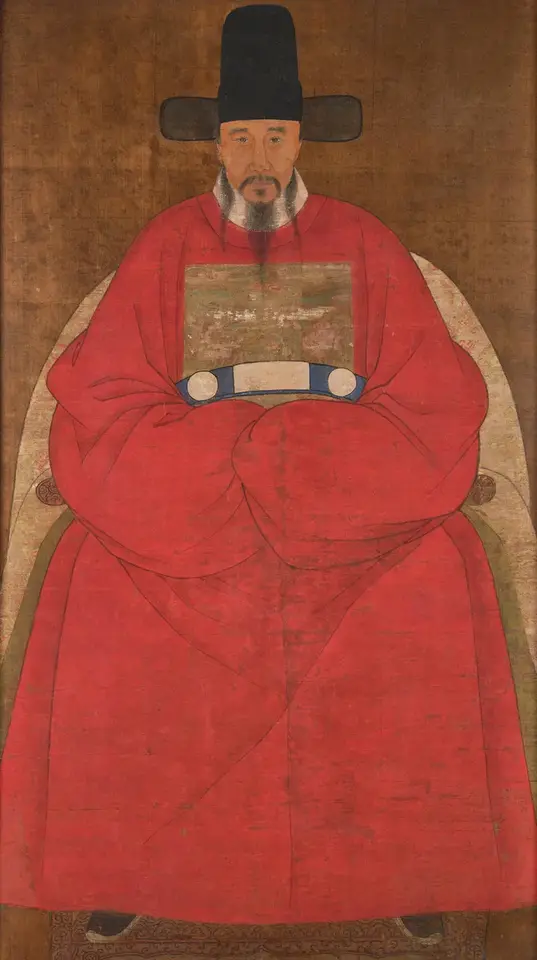
Biography
Noble Lineage and Entry into the Chancellor's Headquarters
Su Chuo, courtesy name Lingchuo and respectfully referred to by contemporaries as Su Lingchuo, hailed from the prestigious Su clan of Wugong in Jingzhao Commandery and was a ninth-generation descendant of Su Ze, Palace Attendant of Cao Wei during the Three Kingdoms period. His family had served in two-thousand-bushel offices for generations; his father Su Xie served as Administrator of Wugong Commandery, and in his youth Su Chuo shared equal literary fame with his cousin Su Liang, with whom he was jointly acclaimed as the "Two Sus." From childhood Su Chuo was studious, widely read in the classics and histories, and exceptionally proficient in arithmetic. When his cousin Su Rang was appointed Regional Inspector of Fenzhou, the Western Wei chancellor Yuwen Tai hosted a farewell banquet for him outside the eastern capital gate of Chang'an. Before parting, Yuwen Tai asked Su Rang which of his younger kinsmen was fit for official employment; Su Rang seized the opportunity to recommend Su Chuo, whereupon Yuwen Tai summoned him to serve as Gentleman of the Mobile Imperial Secretariat.
After Su Chuo had served in that post for more than a year, Yuwen Tai did not yet know him intimately, yet whenever the various bureaus of the Mobile Secretariat encountered perplexing matters, they invariably consulted Su Chuo before reaching a decision, and Su Chuo also drafted the formal regulations for official correspondence among government offices, earning universal praise within the secretariat. Later, when Yuwen Tai discussed state affairs with Vice Director of the Imperial Secretariat Zhou Huida, Zhou Huida was unable to answer and asked leave to step outside for consultation. He summoned Su Chuo and explained the matter, and Su Chuo immediately weighed the issues and formulated a resolution. When Zhou Huida re-entered and presented the plan, Yuwen Tai praised it warmly and asked who had devised the counsel. Zhou Huida named Su Chuo and lauded him as possessing the talent to assist a true king, prompting Yuwen Tai to remark that he too had long heard of him and to appoint Su Chuo forthwith as Assistant Editorial Director.
Discourse at Kunming Pool and Counsel during the Tong Pass Campaign
On one occasion, Yuwen Tai accompanied his dukes and ministers to Kunming Pool west of Chang'an to watch fishing. Passing the site of a former Han dynasty granary and pond west of the city, Yuwen Tai turned to ask his attendants about its historical origins, but none could answer. Someone suggested summoning Su Chuo on account of his encyclopedic learning. When Su Chuo was called forward and explained the history of the site in full detail, Yuwen Tai was delighted and proceeded to question him on the origins of heaven and earth and the rise and fall of past dynasties. Eloqent and quick-witted, Su Chuo answered every question without hesitation. Overjoyed, Yuwen Tai rode side by side with Su Chuo slowly to Kunming Pool and returned without even casting a fishing net, detaining Su Chuo into the night and reclining as he asked him about the principles of governing the realm.
Su Chuo expounded upon the way of emperors and kings while also summarizing the Legalist essentials of Shen Buhai and Han Fei. Deeply moved, Yuwen Tai rose, straightened his robes, and sat upright, unconsciously edging his knees forward on the mat as he listened; their conversation continued until dawn without Yuwen Tai showing the slightest fatigue. The next morning, Yuwen Tai declared to Zhou Huida: "Su Chuo is truly an extraordinary man; I am about to entrust him with the administration of the state!" He immediately appointed Su Chuo Left Aide of the Grand Mobile Imperial Secretariat to participate in confidential military and state decisions. Su Chuo initiated new procedural rules for official documents, mandating red ink for outgoing dispatches and black ink for incoming records, and established strict laws governing state accounting ledgers (jizhang) and household registration (huji).
In the first month of the third year of the Datong era (537 CE), the Eastern Wei chancellor Gao Huan launched a three-pronged invasion of Western Wei, sparking the Battle of Tong Pass. Yuwen Tai judged that the Eastern Wei general Dou Tai, who was advancing on Tong Pass, commanded elite troops grown arrogant from repeated victories, and that if Western Wei struck Dou Tai by surprise with concentrated force, Gao Huan would retreat without a fight. While most generals favored dividing their forces in defense, only Su Chuo and the general Daxi Wu agreed with Yuwen Tai. Concentrating its elite cavalry, the Western Wei army secretly marched through Xiaoguan to ambush Dou Tai at Tong Pass, capturing him alive and forcing the other two Eastern Wei columns to withdraw. In the fourth year of Datong (538 CE), Su Chuo was given the added titles of General of the Guards and Grandee of the Eighteenth Order of the Right and enfeoffed as Viscount of Meiyang County with a fief of three hundred households; soon afterward he was made Regular Cavalier Attendant with Comprehensive Duty and elevated to Earl of Meiyang County with two hundred additional households.
The Edict of Six Articles and Institutional Reforms
As Yuwen Tai sought to reform contemporary administration and enrich the state and military, Su Chuo devoted his full intellect to assisting him—reducing superfluous officials, establishing the local "Two Chiefs" (erzhang, clan and neighborhood heads), and expanding military-agricultural colonies (tuntian). In the seventh year of Datong (541 CE), Su Chuo synthesized traditional Chinese administrative statecraft into six principles and submitted them for promulgation as the Edict of Six Articles (Liutiao Zhaoshu): first, "Rectifying the Mind and Person" (xian zhixin), requiring officials to cultivate a pure heart and upright conduct; second, "Promoting Moral Instruction" (dun jiaohua), transforming customs and fostering frugality and harmony among the populace; third, "Maximizing the Yield of the Land" (jin dili), encouraging agriculture and sericulture without violating farming seasons; fourth, "Selecting the Worthy and Capable" (zhuo xianliang), recruiting genuine talent regardless of seniority or pedigree while eliminating redundant posts; fifth, "Showing Compassion in Judicial Cases" (xu yusong), adjudicating lawsuits fairly and matching punishments to offenses; and sixth, "Equalizing Taxes and Corvée" (jun fuyi), balancing burdens so that powerful families could not evade levies at the expense of the poor. Yuwen Tai kept the Edict of Six Articles beside his seat, ordered all officials to memorize it, and decreed that no commandery administrator or county magistrate who failed to master the six articles and accounting laws could hold office.
In the tenth year of Datong (544 CE), Su Chuo was promoted to Minister of Revenue of the Grand Mobile Imperial Secretariat, concurrently serving as Director of the Editorial Service and Acting Chamberlain for the National Treasury. Because state revenues were chronically insufficient amid ongoing warfare, Su Chuo instituted relatively heavy tax laws, afterward sighing that his tax code was like a fully drawn bow—an expedient for a time of war rather than a law for an era of peace—and expressing hope that a gentleman of a future peaceful age would relax the bowstring, a charge his son Su Wei took to heart and fulfilled under the Sui dynasty. Seeking to eradicate the ornate and frivolous literary style prevalent since the Six Dynasties, Su Chuo drafted the Grand Announcement (Dagao) in the eleventh year of Datong (545 CE) in imitation of the archaic prose of the Book of Documents, establishing a new austere model for official compositions; when Northern Yongzhou presented a white deer, he likewise instructed Gentleman of the Bureau of Military Organization Liu Qing to compose a plain congratulatory memorial to reform southern literary excesses. Yuwen Tai also commissioned Su Chuo to overhaul the Western Wei bureaucracy in accordance with the Rites of Zhou (Zhouli), a task completed after Su Chuo's death by Lu Bian.
Exhaustion in Office and Posthumous Honors
Frugal and unpretentious throughout his life, Su Chuo never acquired private estates and left no surplus wealth at home. Taking the pacification of the war-torn realm as his personal duty, he actively sought out worthy men, and all whom he recommended rose to high office. Yuwen Tai trusted him implicitly; whenever Yuwen Tai went on excursions or campaigns, he routinely pre-signed dozens of blank sheets of paper and handed them to Su Chuo so that urgent state business could be enacted immediately and merely reported upon his return. Whenever Su Chuo deliberated with dukes and ministers, he worked from dawn until late at night, mastering every detail large and small, until chronic exhaustion brought on a respiratory ailment (qiji). He died in office in the twelfth year of Datong (546 CE) at the age of forty-nine.
Stricken with grief upon hearing of Su Chuo's death, Yuwen Tai followed the advice of Clerk of the Imperial Secretariat Ma Yao to honor Su Chuo's lifelong frugality by conducting a simple funeral, conveying his coffin back to Wugong in a single white cloth-covered carriage. Yuwen Tai and his ministers walked on foot to escort the hearse outside the city walls of Tongzhou, where Yuwen Tai personally poured a libation of wine behind the carriage and wept aloud: "In all that Minister Su did throughout his life, even what his wife, children, and brothers did not know, I knew in full. Only you understood my heart, and only I understood your mind. Just as we were about to pacify the realm together, you have tragically left me—what am I to do!" Weeping uncontrollably, he dropped his wine goblet from his hand without realizing it, and on the day of burial he sent envoys to sacrifice a full tailao offering of ox, sheep, and pig with a eulogy composed by his own hand. In the twelfth month of the second year of Emperor Ming of Northern Zhou (558 CE), Su Chuo was enshrined alongside Heba Sheng and eleven other meritorious ministers in the ancestral temple of Yuwen Tai; in the first year of the Kaihuang era (581 CE), Emperor Wen of Sui posthumously created him Duke of Pi with a fief of two thousand households, inherited by his son Su Wei.