Western Flight of Emperor Xiaowu and Proclamation of Eastern Wei
Emperor Xiaowu fled westward to Chang'an, prompting Gao Huan to enter Luoyang and enthrone Yuan Shanjian as Emperor Xiaojing; the capital was relocated to Ye, establishing Eastern Wei.
534 CE–550 CE
东魏
The Eastern Wei (东魏; 534–550 CE), officially designated as Wei (魏), was a major imperial dynasty of the Northern Dynasties period established following the fracture of Northern Wei, designated Eastern Wei in historiography due to its capital at Ye and its territorial domain situated east of Luoyang. Following the Six Garrisons Rebellion at the close of Northern Wei, paramount general Gao Huan consolidated control over the imperial court. In 534 CE, Emperor Xiaowu fled westward to…
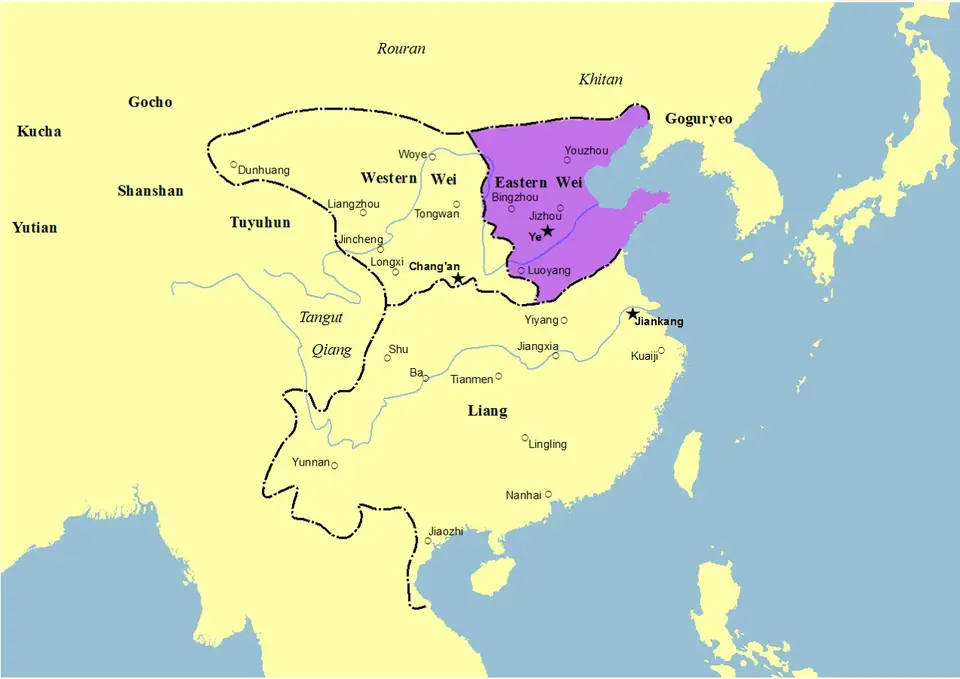
The Eastern Wei (东魏; 534–550 CE), officially designated as Wei (魏), was a major imperial dynasty of the Northern Dynasties period established following the fracture of Northern Wei, designated Eastern Wei in historiography due to its capital at Ye and its territorial domain situated east of Luoyang. Following the Six Garrisons Rebellion at the close of Northern Wei, paramount general Gao Huan consolidated control over the imperial court. In 534 CE, Emperor Xiaowu fled westward to Chang'an to join the rival military leader Yuwen Tai. Gao Huan subsequently occupied Luoyang and enthroned the eleven-year-old Yuan Shanjian as Emperor Xiaojing, promulgating the Tianping reign era and transferring the imperial court to Ye, which formalized the division of Northern Wei into Eastern Wei and Western Wei. Following the relocation of the capital, Gao Huan established his paramount hegemon headquarters at the secondary capital of Jinyang, exercising supreme authority over state and military operations while leaving routine civil administration to the imperial court at Ye. Eastern Wei controlled the populous and fertile agricultural basins of the Central Plains, commanding an economic base and military manpower far superior to those of Western Wei. The two rival empires fought a succession of massive campaigns, including the clashes at Shayuan, Heqiao, Mount Mang, and Yubi. In 550 CE, Grand Chancellor and Prince of Qi Gao Yang coerced Emperor Xiaojing into abdicating the throne and founded the Northern Qi dynasty, bringing the sixteen-year rule of Eastern Wei to its close.
Emperor Xiaowu fled westward to Chang'an, prompting Gao Huan to enter Luoyang and enthrone Yuan Shanjian as Emperor Xiaojing; the capital was relocated to Ye, establishing Eastern Wei.
Yuwen Tai poisoned Emperor Xiaowu in Chang'an and elevated Yuan Baoju to the throne as Emperor Wen, completing the formal partition of the Northern Wei domain into rival states.
Vanguard general Dou Tai committed suicide after an ambush at Xiaoguan; in the autumn, Gao Huan's army of two hundred thousand was shattered by Yuwen Tai at Shayuan, losing eighty thousand men.
Western Wei besieged the Jinyong stronghold; Eastern Wei generals Hou Jing and Gao Yue won a major victory at Heqiao, routing Western Wei forces and reclaiming Luoyang.
Gao Zhongmi defected to Western Wei; Gao Huan commanded the counteroffensive at Mount Mang, capturing sixty thousand troops; fifty thousand laborers were mobilized to build the Sizhou Great Wall.
Gao Huan invested the Western Wei stronghold of Yubi for fifty days; repulsed by Wei Xiaokuan and losing seventy thousand men to combat and plague, Gao Huan withdrew in despair after hearing the Chile Song.
Gao Huan died at Jinyang; his eldest son Gao Cheng succeeded as Grand Chancellor; Minister of Education Hou Jing rebelled in Henan across thirteen commanderies, prompting an imperial campaign.
Murong Shaozong routed Hou Jing at Guoyang, forcing him to flee into southern Liang territory; Eastern Wei armies advanced south to absorb extensive commanderies between the Huai and Yangtze rivers.
Grand Chancellor Gao Cheng was slain by his domestic servant Lan Jing in Ye; his younger brother Gao Yang took command of the state apparatus and pacified public anxieties.
Gao Yang marched on Ye and coerced Emperor Xiaojing to abdicate, inaugurating the Northern Qi dynasty and concluding the sixteen-year tenure of Eastern Wei.
The terminal decades of Northern Wei witnessed violent upheavals sparked by the Six Garrisons Rebellion, leading to the Heyin Incident orchestrated by Erzhu Rong. Following the collapse of the Erzhu faction, general Gao Huan rallied the displaced soldiers of the northern frontier and gained the support of prominent Han aristocratic lineages in Hebei. Gao Huan eliminated the remnants of the Erzhu clan and installed Yuan Xiu as Emperor Xiaowu. However, Emperor Xiaowu resented his status as an imperial puppet and fled westward to Chang'an in July 534 CE to ally with Yuwen Tai. Gao Huan entered Luoyang and elevated the eleven-year-old Yuan Shanjian, son of Prince of Qinghe Yuan Dan, to the imperial throne as Emperor Xiaojing, initiating the Tianping era and finalizing the dissolution of Northern Wei into two separate regimes.
Having suffered extensive physical destruction during repeated military conflicts, Luoyang was strategically vulnerable to western cavalry incursions from the Guanzhong passes. Overriding divergent views among civil courtiers, Gao Huan resolved to transfer the imperial seat northeastward to Ye, the core bastion of his northern power base. In October 534 CE, Emperor Xiaojing issued an imperial decree mandating the relocation of the capital, compelling four hundred thousand households of officials, aristocrats, and commoners to migrate east. Although the hurried transit caused substantial logistical disruption and property loss, the establishment of the court at Ye anchored the regime firmly in the agricultural heartland of the Hebei plain, with Ye functioning as the formal dynastic capital and Jinyang operating as the paramount military headquarters.
In 535 CE, Yuwen Tai executed Emperor Xiaowu by poison in Chang'an and elevated Yuan Baoju to the throne as Emperor Wen of Western Wei, formalizing the permanent partition of northern China. Although Eastern Wei controlled a vastly larger population and the wealthiest agricultural basins of the Yellow River valley, it confronted an agile and determined adversary across the western frontier. Operating from Jinyang, Gao Huan launched recurring campaigns designed to overwhelm Guanlong and reunify northern China. In early 537 CE, Gao Huan deployed a three-pronged offensive against Western Wei; however, his vanguard general Dou Tai advanced prematurely and suffered a catastrophic ambush at Xiaoguan, where Dou Tai committed suicide on the field, forcing Gao Huan to withdraw his primary force.
In the autumn of 537 CE, Gao Huan personally mobilized an army of two hundred thousand soldiers across the Yellow River to execute the decisive Battle of Shayuan. Plagued by complacency and disordered movement through dense reed marshes, the Eastern Wei army was thoroughly outmaneuvered by Yuwen Tai's compact ambush force. Eastern Wei suffered catastrophic losses, with over eighty thousand troops killed or captured and immense stockpiles of weaponry abandoned, forcing Gao Huan to escape by small boat under cover of darkness. The catastrophe at Shayuan severely depleted the seasoned Six Garrisons veteran core of Eastern Wei, prevented the immediate subjugation of Western Wei, and fundamentally solidified the two-state balance of power in northern China.
In the aftermath of Shayuan, Eastern Wei reorganized its regional defenses along the Henan perimeter to resist western counteroffensives. In 538 CE, Western Wei forces besieged the Jinyong fortress at Luoyang; Eastern Wei commanders Hou Jing and Gao Yue responded swiftly, winning a decisive engagement at the Battle of Heqiao, crushing the enemy contingent under Li Bi and reclaiming Luoyang. In 543 CE, Gao Zhongmi, Regional Inspector of North Yuzhou, defected to Western Wei, triggering the massive Battle of Mount Mang. Gao Huan personally directed the counterattack, inflicting a crushing defeat on Yuwen Tai's primary army and capturing or slaying over sixty thousand Western Wei soldiers, which restored Eastern Wei military ascendancy throughout the eastern Central Plains.
In the autumn of 546 CE, Gao Huan marshaled more than one hundred thousand elite troops to lay siege to the strategic Western Wei stronghold of Yubi. Western Wei defender Wei Xiaokuan exhibited extraordinary tactical resourcefulness, systematically repulsing earthen ramps, subterranean tunnels, assault engines, and incendiary strikes deployed by Eastern Wei. After fifty days of relentless assaults resulting in seventy thousand casualties from combat and epidemic disease, Eastern Wei failed to breach the fortress walls. Exhausted and afflicted by a critical relapse of illness, Gao Huan ordered his general Hulü Jin to lead the singing of the Chile Song (Song of the Chile) to steady the troops, lifted the siege in despair, and passed away at his Jinyang headquarters in early 547 CE.
Following Gao Huan's demise, his eldest son Gao Cheng succeeded as Grand Chancellor and Commander-in-Chief of Internal and External Military Affairs, assuming absolute control over the paramount headquarters and state administration. Minister of Education Hou Jing, who served as Chief Executive of the Regional Branch Secretariat of Henan and commanded nearly one hundred thousand veteran troops, deeply feared the ambitious and domineering young heir. In early 547 CE, Hou Jing initiated a massive insurrection across thirteen commanderies in Henan, pledging fealty successively to Western Wei and the southern Liang dynasty. Emperor Wu of Liang dispatched Xiao Yuanming with over one hundred thousand soldiers to Hanshan to reinforce Hou Jing, threatening to encircle Eastern Wei from both south and west.
Gao Cheng confronted the crisis with remarkable speed, dispatching seasoned general Murong Shaozong and Gao Yue with one hundred thousand elite troops to suppress the rebellion. At Hanshan, Eastern Wei breached river dams to flood the southern camp, completely destroying the Liang army and capturing its commander Xiao Yuanming along with tens of thousands of prisoners. Murong Shaozong then converged on Guoyang to engage Hou Jing in a decisive battle, utilizing heavy infantry armed with long-bladed polearms to shatter Hou Jing's cavalry. Hou Jing fled southward with only a few hundred retainers into Liang territory, where he ignited the devastating Hou Jing Rebellion in Jiangnan; meanwhile, Eastern Wei reclaimed Henan and absorbed extensive Liang commanderies across the Huai River basin.
Having crushed the Henan insurrection, Gao Cheng substantially augmented his personal prestige and instituted sweeping internal reforms within the civil bureaucracy. He abolished the rigid seniority system of Northern Wei, which had determined promotions solely by length of service regardless of administrative capability, and promoted prominent scholars and legalists such as Cui Xian and Cui Jishu. While according conspicuous respect to Han aristocratic lineages before Xianbei military commanders, Gao Cheng systematically consolidated power to prepare for dynastic usurpation. He compelled the court to enfeoff him as Chancellor of State and Prince of Qi with the Nine Bestowals, subjecting Emperor Xiaojing to intense surveillance until imperial sovereignty was entirely extinguished.
In August 549 CE, while convening a private council in the Eastern Cypress Hall at Ye to finalize the formal protocols of imperial abdication, the twenty-nine-year-old Gao Cheng was caught unprepared by a sudden domestic revolt. Lan Jing, an enslaved domestic kitchen attendant whom Gao Cheng had repeatedly humiliated and threatened with execution, drew concealed daggers alongside his conspirators during a meal presentation and assassinated the Grand Chancellor. Amid sudden chaos, Gao Huan's second son Gao Yang acted with formidable composure, leading palace guards to slay the assassins while publicly announcing that the Grand Chancellor was only slightly wounded. Gao Yang maintained complete discipline throughout the capital and smoothly consolidated supreme command over Ye and Jinyang.
Upon assuming the chancellorship and military authority, Gao Yang expedited the dynastic transition without delay. In May 550 CE, Gao Yang mobilized his elite host from Jinyang to Ye and dispatched confidants to compel Emperor Xiaojing to relinquish the imperial seal. Left with no political alternative, Emperor Xiaojing issued a formal edict of abdication, terminating the sixteen-year existence of Eastern Wei. Gao Yang mounted the altar at the southern suburbs of Ye to proclaim himself emperor, establishing the dynastic title of Qi, known historically as Northern Qi. Although Gao Yang initially enfeoffed Yuan Shanjian as Prince of Zhongshan with superficial honors, he secretly ordered the former monarch poisoned in late 551 CE at the age of twenty-eight.
The defining institutional hallmark of Eastern Wei was the dual-capital political architecture characterized by absolute paramount hegemon rule. As the founding patriarch of the regime, Gao Huan established his primary military headquarters at Jinyang as Grand Chancellor, Commander-in-Chief of Internal and External Military Affairs, and Prince of Bohai, transforming Jinyang into the secondary capital. Veteran Six Garrisons cavalry and elite infantry were stationed around Jinyang, where all critical state policies, high-level civil and military appointments, and strategic deployment decisions were formulated. Conversely, the imperial palace and the Department of State Affairs at Ye were primarily relegated to handling formal rituals, routine documentation, and local revenue extraction.
This structural separation enabled Gao Huan to retain uncompromised command over the military machine while insulating his headquarters from the political intrigues of the eastern aristocracy. Courtiers and magistrates at Ye routinely deferred to the directives emanating from Jinyang, while Gao Huan deployed close confidants like Sima Ziru and Gao Yue to Ye to oversee the court. Emperor Xiaojing was renowned for intellectual erudition and martial archery, yet under the comprehensive oversight of the hegemon administration he functioned strictly as a ceremonial sovereign. While this dual system preserved internal stability against external threats, it eroded central statutory authority and fostered the institutional transition toward dynastic usurpation.
The governing elite of Eastern Wei was confronted with deeply entrenched ethnic and socioeconomic tensions between northern military settlers and indigenous Han populations. Gao Huan recognized that while the military prowess of the Six Garrisons Xianbei formed the indispensable coercive pillar of the state, the administrative expertise of prominent Hebei Han aristocratic clans was vital for governing the populous Central Plains. Consequently, Gao Huan implemented a pragmatic policy of dual accommodation: he addressed Xianbei troops in their native tongue as their comrade from the northern frontier, safeguarding their warrior privileges, while presenting himself to Han subjects as a scion of the Bohai Gao lineage in spoken Chinese.
Gao Huan actively formed political alliances with leading eastern aristocratic lineages, including the Gao of Bohai, Cui of Qinghe, Li of Zhaojun, and Lu of Fanyang. He married his daughter to prominent statesman Yang Yin and appointed Han commanders such as Gao Gan and Gao Aocao to senior military and civil posts. However, in his eagerness to retain the loyalty of both Xianbei commanders and Han magnates, Gao Huan deliberately tolerated widespread financial corruption, embezzlement, and private land annexation. When upright minister Du Bi repeatedly urged strict judicial crackdowns against corrupt officials, Gao Huan demurred, contending that severe enforcement would alienate essential commanders while the mortal threat of Western Wei remained unvanquished.
When Gao Cheng took charge of the administration, he initiated concerted efforts to rectify the administrative laxity of the previous decade and consolidate centralized autocratic authority under the Gao clan. In the late Northern Wei period, civil service promotions had degenerated into an automatic seniority track based strictly on time served, regardless of virtue or administrative talent. Gao Cheng abolished this entrenched practice, instituting an merit-based evaluation framework that favored substantive administrative competence and literary brilliance, elevating legalist and classical scholars such as Cui Xian and Cui Jishu to key positions.
In the sphere of jurisprudence, the Gao administration recognized that existing Northern Wei statutes were fragmented, contradictory, and ill-suited to governance. In 543 CE, Gao Cheng commissioned Grand Guardian Sun Teng, Palace Attendant Cui Xian, and Senior Attendant of the Cavalry Du Bi to undertake a comprehensive codification of legal precedents since the Han and Wei dynasties at the Linzhi Pavilion in Ye, culminating in the twenty-two-volume Linzhi Statutes. Characterized by systematic organization and concise legal phraseology, the statutes protected the vital legal privileges of eastern aristocratic lineages while enhancing central statutory adjudication, establishing the foundational legal architecture inherited by Northern Qi.
The survival and military prowess of Eastern Wei were anchored in the formidable martial manpower inherited from the Six Garrisons of Northern Wei. In his initial campaigns, Gao Huan incorporated more than one hundred thousand displaced Xianbei soldiers and frontier garrison families, molding them into the core striking force of the regime. Gao Huan settled these battle-hardened cavalry forces in the environs of Jinyang, instituting a segregated military administration that granted them hereditary warrior status exempt from agrarian production, with their provisions entirely supplied by the grain taxes of the Han peasantry. This professional standing army provided Eastern Wei with an unmatched concentration of armored cavalry.
Alongside the central Xianbei cavalry divisions, Eastern Wei effectively mobilized local militia units and private retinues organized by prominent Hebei aristocratic families. Elite Han infantry units commanded by general Gao Aocao exhibited extraordinary tactical cohesion, fighting alongside Xianbei cavalry across central battlefields and demonstrating exceptional combat resilience. The armed forces were formally organized into three principal echelons: the paramount headquarters guards, regional provincial garrisons, and frontier outpost detachments, all answering directly to the Jinyang supreme command. Despite lax discipline among noble commanders, Eastern Wei sustained a military apparatus that remained the largest and best-equipped among the contemporary northern regimes.
Throughout its sixteen years of existence, Eastern Wei engaged in uninterrupted existential warfare with Western Wei. During the initial phase, Gao Huan sought to exploit his numerical superiority through aggressive western offensives aimed at the rapid conquest of Chang'an. However, following the ambush at Xiaoguan and the catastrophic defeat in the reed marshes of Shayuan, Eastern Wei lost eighty thousand veteran troops, enabling Western Wei to seize strategic areas in Hedong and compelling Gao Huan to adopt a defensive posture. Subsequent engagements at Heqiao and Mount Mang enabled Eastern Wei to decisively defeat Western Wei field armies, securing its undisputed control over the Yellow River crossings and the approaches to Luoyang.
The protracted siege of Yubi in 546 CE marked the final culmination of Eastern Wei's strategic offensive capability toward the western frontier. After losing seventy thousand men during fifty days of unsuccessful assaults against Wei Xiaokuan's fortified defense, Gao Huan retreated in despair, foreclosing future invasions of Guanlong through the Fen River valley. Consequently, Eastern Wei reoriented its grand strategy southward toward the Huai River basin. When Hou Jing rebelled, general Murong Shaozong crushed the rebel army at Guoyang, and Eastern Wei capitalized on the internal disintegration of the southern Liang dynasty to annex extensive fertile territories between the Huai and Yangtze rivers, achieving its greatest geographic expansion.
While embroiled in intense hostilities against Western Wei, Eastern Wei faced persistent border incursions from the Rouran Khaganate and Shanhu tribal confederations along its northern marches. Rouran raiding columns frequently exploited Eastern Wei's western deployments to strike deep into Youzhou and Bingzhou, subjecting the state to dangerous two-front pressure. To secure his northern frontier, Gao Huan pursued an active diplomatic policy centered on dynastic marriages, tribute exchanges, and lavish imperial subsidies, marrying imperial princesses to Rouran khagans and personally wedding Princess Ruru, daughter of Khagan Anagui, to purchase enduring northern border tranquility.
Complementing its diplomatic overtures, the regime invested heavily in physical frontier defense infrastructure along key mountain corridors. In 543 CE, Eastern Wei mobilized more than fifty thousand Han laborers across Sizhou to construct defensive fortifications between Mount Guancen and Mount Heng, completing sixty kilometers of the Sizhou Great Wall in approximately forty days. Traversing rugged terrain across Ningwu and Yuanping, this fortified barrier blocked the primary invasion routes used by nomadic horsemen striking toward Jinyang, providing vital strategic depth that allowed Eastern Wei to concentrate its armies on the western and southern fronts.
Eastern Wei controlled the fertile alluvial plains of the Yellow and Huai river basins, inheriting the agricultural granaries of Shandong, Henan, and Hebei. The state commanded agrarian resources and peasant populations far superior to those of arid Guanlong or the southern Liang dynasty. Following the establishment of the capital at Ye, the court actively promoted agricultural production and repaired irrigation networks along the Zhang River, facilitating rapid agricultural recovery across the Central Plains. Consecutive bountiful harvests of wheat, millet, and grain sustained the state's massive standing armies, providing the economic resilience required to replenish military losses after major battlefield reverses.
Beneath this agrarian prosperity lay severe socioeconomic inequalities driven by unchecked land annexation and the illicit concealment of rural households. Xianbei military nobles and powerful Han gentry exploited legal privileges to seize arable lands, constructing fortified private estates and absorbing hundreds of thousands of displaced farmers as dependent tenants. Because Gao Huan pursued a policy of accommodation toward aristocratic allies, local magnates openly defied imperial census inspections, leading to substantial erosion of registered taxpayer rolls. Consequently, the Equal-Field and Three Elders systems inherited from Northern Wei deteriorated, causing significant losses to central tax revenues and labor reserves.
Industrial production and mineral extraction formed another indispensable pillar of the Eastern Wei economy. The state controlled the expansive coastal salt marshes of the Bohai Gulf, supporting an immense state-supervised salt industry. Official historical records document that the coastal commanderies of Cangzhou operated one thousand four hundred and eighty-four state-run salt boiling facilities. The salt monopoly generated vast fiscal revenues for both the central treasury and the hegemon administration, with large quantities of salt illicitly smuggled across borders into Western Wei and southern Liang to finance state expenditures. Coastal fisheries and marine commerce similarly stimulated regional commercial networks across Jizhou, Qingzhou, and Youzhou.
In manufacturing, Eastern Wei maintained superior capabilities in iron metallurgy and ceramic production relative to contemporary regimes. State-operated iron foundries situated around Ye and Cixian operated on an industrial scale, casting heavy cavalry armor, reinforced helmets, master-crafted polearms, and complete sets of horse barding that equipped tens of thousands of elite cavalrymen. Simultaneously, northern celadon porcelain manufacturing attained notable technical refinement, producing dense, finely glazed ceramic wares discovered across aristocratic tombs and urban centers, reflecting the sophisticated metallurgical and artisanal standards achieved under Eastern Wei rule.
Uninterrupted warfare against Western Wei and the colossal civil engineering projects undertaken at Ye imposed an overwhelming fiscal burden on the agrarian populace. To fund recurring military mobilizations and the construction of the turtle-shaped Southern Ye metropolis, the imperial government frequently levied arbitrary surtaxes and emergency labor corvée beyond statutory tax obligations. Common agricultural households suffered severe deprivation under continuous conscription, prompting many impoverished peasants to abandon their holdings to become nomadic wanderers or indentured servants on aristocratic manors, which sharpened class antagonisms across northern society.
Monetary circulation was plagued by monetary debasement and fragmented coinage. While the state officially maintained the circulation of Northern Wei Yong'an Wuzhu coins, acute treasury deficits and weak regulatory oversight allowed private elites and provincial officials to cast clipped, debased coins blended with tin and lead. This rampant counterfeit casting triggered steep inflation and eroded public confidence in metallic currency. To insulate themselves from monetary volatility, merchants and commoners across the Central Plains increasingly reverted to traditional barter transactions utilizing silk textiles and grain as primary media of exchange, constraining the growth of interregional trade.
To accommodate the hundreds of thousands of officials, soldiers, and civilians relocated from Luoyang, Eastern Wei initiated the ambitious construction of Southern Ye in 538 CE adjacent to the historic northern city. Urban planners broke with traditional square layout conventions, designing the outer perimeter walls into a distinctive turtle-shaped silhouette symbolizing dynastic endurance and architectural strength. The city introduced a rigorous north-south central axis, placing the imperial palace precinct at the northern apex with bureaucratic quarters and commercial wards aligned in strict symmetry, establishing a pioneering urban model that directly influenced the design of Sui and Tang Chang'an and Luoyang.
Southern Ye exemplified the pinnacle of late Northern Dynasties architectural engineering. Field excavations by archaeological teams along the northern axis of the palace complex uncovered the rammed-earth foundations of Hall 206, identified as the imperial living quarters of Eastern Wei and Northern Qi emperors. Facing southward, the palatial hall was bordered by covered corridors and courtyards paved with intricate pebble mosaics arranged in elaborate geometric rosettes, providing tangible material evidence of the sophisticated engineering, structural refinement, and palatial grandeur of the Eastern Wei court.
The relocation of aristocratic elites and literati from Luoyang transformed Ye into a vibrant intellectual center dominated by the prestigious Ye literary circle, spearheaded by renowned scholars Wei Shou, Wen Zisheng, and Xing Shao. Erudite in classical exegesis and literary composition, these scholars championed refined parallel prose and melodious poetic genres, gaining renown as the foremost literary figures of northern China. Gao Cheng and other imperial patrons cultivated literary arts, regularly convening lavish literary banquets in Ye that accelerated the transition of northern literature from unadorned rustic expression toward intricate stylistic elegance.
Historical scholarship and the compilation of state archives flourished under official patronage. During this period, Wei Shou commenced the systematic collection of Northern Wei imperial records and institutional archives, laying the documentary groundwork for his monumental standard history, the Book of Wei. Wen Zisheng composed the celebrated Stele of Hanling Mountain Temple, widely acclaimed as a masterpiece of Northern Dynasties epigraphic literature characterized by grandiose phraseology and stylistic majesty. The intellectual culture of Ye successfully preserved classical Han and Wei traditions amid regional fragmentation, transmitting ancient historiographical and Confucian lineages to subsequent eras.
The Eastern Wei imperial house and governing aristocracy exhibited fervent devotion to the Buddhist faith. High-ranking nobility, including Gao Huan and Gao Cheng, dedicated massive resources to the construction of Buddhist temples and monasteries. Ye and its surrounding districts housed more than four thousand monasteries, including the renowned Dazhuangyan Temple and Dinguo Temple, supporting over eighty thousand ordained monks and nuns. The ruling elite utilized doctrines of karmic retribution to legitimate dynastic authority and pacify social unrest, while commoners burdened by corvée sought solace in Buddhist piety, resulting in the rapid expansion of monastic estates.
In the craggy limestone cliffs along the border of Cixian and Shexian near Ye, the imperial family initiated the excavation of the celebrated Xiangtangshan Caves. The sculptural achievements at Xiangtangshan achieved a harmonious synthesis of northern Xianbei vigor and traditional Han linear grace. The seated and standing bodhisattva figures feature fluid, cascading drapery and dignified facial expressions, combined with architectural relief carvings that place Xiangtangshan among the supreme artistic treasures of sixth-century Chinese Buddhist art alongside the grottoes of Yungang and Longmen.
Beneath its cultural and military vitality, Eastern Wei society was perpetually unsettled by deep ethnic divisions and social stratification. The Six Garrisons Xianbei military nobility viewed themselves as conquerors entitled to dominant social privileges, frequently looking down upon Han civil bureaucrats. Conversely, Han aristocratic lineages prided themselves on cultural ancestry, privately despising the Xianbei ruling class as unrefined warriors. Although Gao Huan sought to bridge these divides through dual ethnic self-identification and strategic intermarriages, unequal distribution of power and divergent judicial treatment kept ethnic relations under persistent friction.
Simultaneously, severe socioeconomic exploitation of the peasantry generated volatile class grievances. While Xianbei commanders and wealthy aristocrats indulged in conspicuous luxury, rural cultivators bore the full brunt of onerous military conscription, crushing corvée, and private debt servitude, sparking localized peasant unrest and banditry. The perennial constitutional struggle between the imperial court and the hegemon headquarters, punctuated by dramatic political violence such as Gao Cheng's sudden assassination, underscored the brittle foundations of the state and foreshadowed its inevitable transition to Northern Qi.
Eastern Wei bequeathed significant institutional and material legacies that profoundly shaped medieval Chinese history. Structurally, the dual-capital architecture established by Eastern Wei, wherein a secondary military headquarters directed national security while an imperial civil capital administered daily governance, provided a direct precedent for the administrative arrangements of Northern Qi, the Tang dynasty, and the dual-capital systems of Liao and Jin. In urban design, Southern Ye introduced the earliest archaeologically documented turtle-shaped city wall and an uncompromising central axis that positioned the imperial palace at the northern terminus, serving as the immediate architectural blueprint for the Sui and Tang imperial capitals at Chang'an and Luoyang.
In religious art and statutory law, Eastern Wei achievements attained enduring cultural prominence. The grotto carvings at Xiangtangshan achieved a harmonious synthesis of northern Xianbei monumental power and traditional Han linear grace, representing the artistic apex of sixth-century Chinese Buddhist sculpture alongside Yungang and Longmen. Furthermore, the compilation of the Linzhi Statutes unified fragmented legal precedents into a coherent code that directly inspired Sui and Tang legal codification, while the systematic collation of northern historical records under the Ye literary circle ensured the preservation and transmission of classical Chinese historiographical traditions during an era of division.
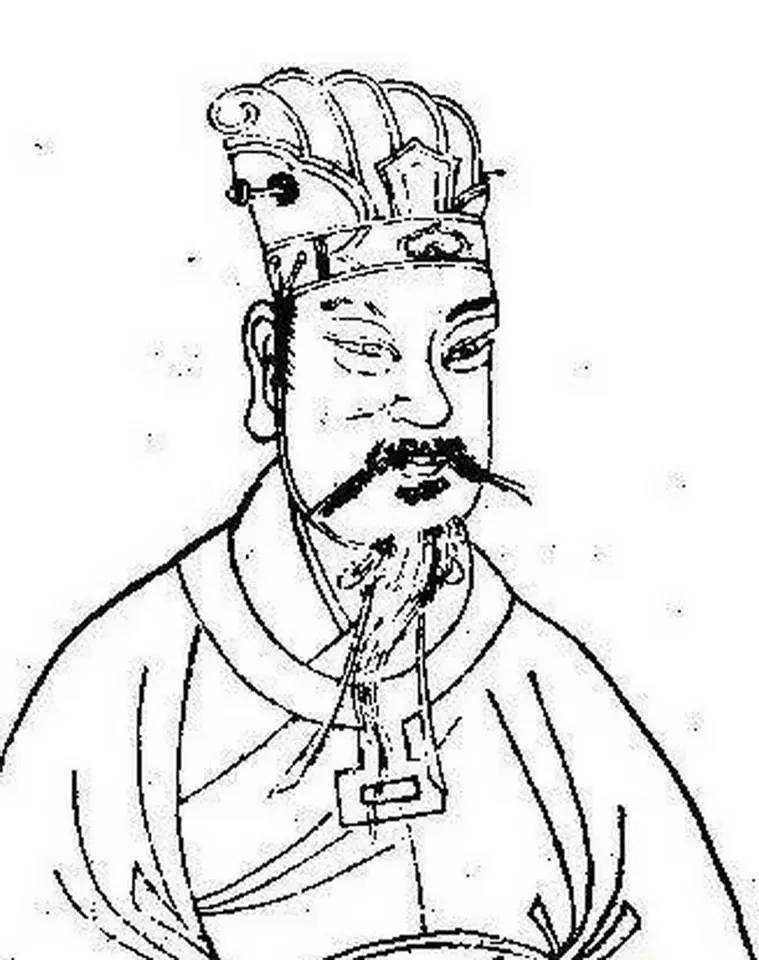 Northern Wei, Eastern Wei (Founding Father of Northern Qi)
Paramount Regent of Eastern Wei
Gao Huan (496 – February 13, 547), Xianbei name Heliuhun, hailing ancestrally from Bohai Commandery and born in the northern frontier garrison of Huaishuo, was the paramount military dictator and regent of Eastern Wei, serving as the de facto founding father of the Northern Qi dynasty. Born into an impoverished frontier military household, he joined northern rebel armies during the Six Garrisons Rebellion before submitting to Erzhu Rong, rising to become his most astute strategic advisor. Following Erzhu Rong's death in 530, Gao Huan skillfully rallied and organized over a hundred thousand displaced Six Garrisons soldiers in Hebei, raising his banner at Xindu in 531. In 532, he decisively crushed the superior Erzhu clan coalition at the Battle of Hanling, entered Luoyang, and installed Emperor Xiaowu (Yuan Xiu) as a figurehead, assuming the supreme offices of Grand Chancellor and Prince of Bohai. When Emperor Xiaowu fled west to join Yuwen Tai in 534, Gao Huan established Emperor Xiaojing (Yuan Shanjian) and relocated the imperial capital to Ye, inaugurating the Eastern Wei dynasty. Operating from his military headquarters at Jinyang, Gao Huan conducted fierce multi-year campaigns against Western Wei, fighting historic battles at Shayuan, Heqiao, and Mangshan. Following his grueling siege of Weizhou at the Battle of Yubi in 546, where he composed the immortal steppes anthem Song of the Chile, he fell ill and died in Jinyang in 547 at age fifty-one. His son Gao Yang subsequently established Northern Qi, elevating Gao Huan as Emperor Shenwu with the temple name Taizu.
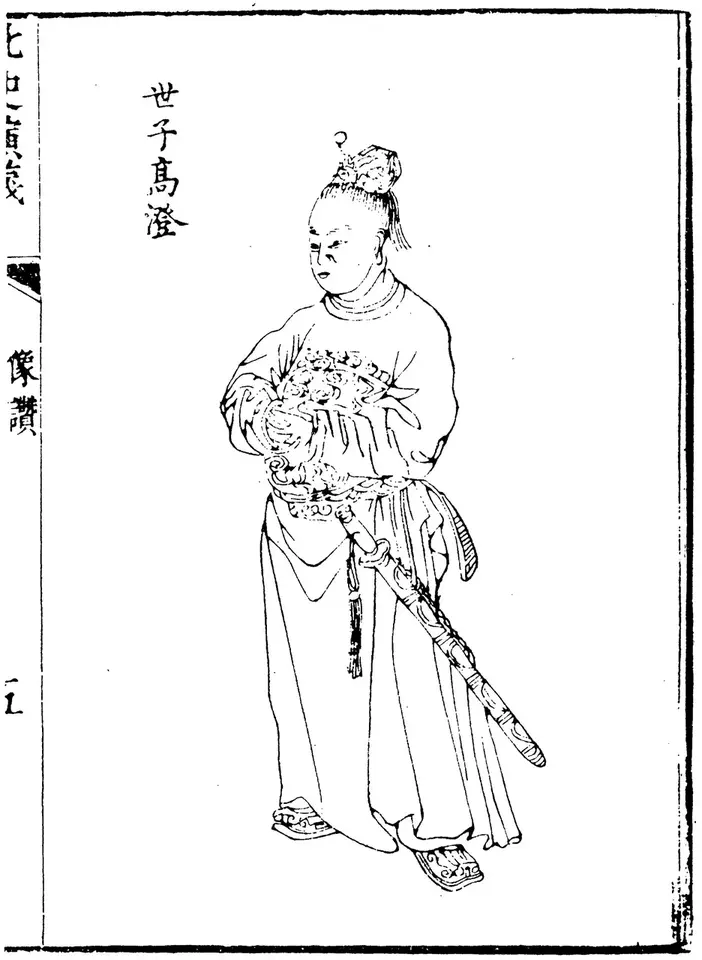 Eastern Wei (东魏)
Imperial Chancellor
Gao Cheng (高澄, 521–549), courtesy name Zihui (子惠), originally from Bohai Commandery (modern Jing County, Hebei) and born in Huaishuo garrison (modern Guyang, Inner Mongolia), was an extraordinary statesman, military commander, and the de facto ruler of the Eastern Wei dynasty. As the eldest son and designated political heir of Gao Huan, Gao Cheng entered high state administration during his teenage years, exhibiting brilliant political calculation, strict administrative discipline, and ruthless ambition. Following Gao Huan's death in 547 CE, Gao Cheng smoothly took control of the imperial government, holding the supreme offices of Chancellor of the Realm (Xiangguo) and Prince of Qi. Facing the catastrophic rebellion of frontier warlord Hou Jing, Gao Cheng coordinated military strategy with General Murong Shaozong to shatter Hou Jing's insurgent forces and routed a massive Southern Liang intervention force at the Battle of Hanshan, capturing Liang commander Xiao Yuanming. Gao Cheng overhauled bureaucratic taxation, suppressed aristocratic corruption, and centralized military authority in preparation to formally seize the throne. However, on the eve of his imperial usurpation in 549 CE, Gao Cheng was assassinated by his kitchen slave Lan Jing at age twenty-nine. His younger brother Gao Yang completed the dynastic transition, founding the Northern Qi and posthumously honoring Gao Cheng as Emperor Wenxiang (Wenxiang Huangdi) with the temple name Shizong (Shizong).
 Eastern Wei, Northern Qi
Founding aristocrat
Kezhuhun Yuan (可朱浑元, ?–559), courtesy name Daoyuan (道元), a native of Dina in Tai'an Commandery (modern Xinzhou, Shanxi) of Xianbei ethnicity, was an illustrious founding general, senior aristocrat, and Grand Defender (Taiwei) of the Eastern Wei and Northern Qi dynasties. Born into the noble Kezhuhun tribal lineage that had served Northern Wei for generations, he was renowned for immense physical stature, supreme martial archery, and unshakeable personal loyalty. In his youth, he established close comradeship with Gao Huan. Following the political split between Eastern and Western Wei in 534 CE, Kezhuhun Yuan initially served in Chang'an under Yuwen Tai. However, yearning to rejoin Gao Huan, Kezhuhun Yuan orchestrated a daring, legendary thousand-li escape through hostile mountainous territory, bringing his family and veteran warriors safely to Jinyang. Welcomed with tears of joy by Gao Huan, he was appointed General of the Palace Guards and ennobled as the Prince of Fufeng (Fufeng Wang). Kezhuhun Yuan rendered distinguished martial service in major campaigns against Western Wei and Southern Liang, repulsing Hou Jing's forces and governing the northern frontiers with celebrated calm. Following the foundation of Northern Qi, he was elevated to the highest civil honors of Grand Tutor (Taifu) and Grand Defender.
 Northern and Southern Dynasties
Founding meritorious statesman
Sun Teng (孙腾, 481–548), courtesy name Longque (龙雀), was a native of Shi'an, Xianyang Commandery (present-day Xianyang, Shaanxi Province). He was an illustrious founding statesman, political strategist, and paramount grand chancellor of the Eastern Wei regime during the Northern and Southern Dynasties, standing as the foremost leader of the powerful "Four Nobles" (Si Gui). Descending from a prominent Northern Liang bureaucratic lineage whose grandfather Sun Tong served as Secretariat Drafter under the Juqu royal house before relocating to the northern frontier under Northern Wei, Sun Teng was versed in administrative law and governance from his youth. Fleeing frontier rebellions during the late Zhengguang era, he joined the forces of Erzhu Rong before becoming an indispensable chief clerk in the private headquarters of Gao Huan. Sun Teng rendered monumental services in the rise of Gao Huan and the establishment of Eastern Wei. He participated in the expedition against Xing Gao, astutely unmasked Erzhu Zhao's ambush at Xiangyuan to save Gao Huan's life, and championed the historic Xindu Uprising against the tyrannical Erzhu clan, orchestrating the coronation of Yuan Lang and the capture of Yecheng. Following the western flight of Emperor Xiaowu and the foundation of Eastern Wei in 534, Sun Teng managed the relocation of the imperial capital from Luoyang to Ye. Over the next fifteen years, he occupied the supreme ministerial offices of Left Vice Director of the Department of State Affairs, Minister of Works, Minister of Education, Grand Protector, and Overseer of the Department of State Affairs. Partnering with Gao Yue, Gao Longzhi, and Sima Ziru as the "Four Nobles" (Si Gui), he dominated civil governance and fiscal coordination. He passed away in 548 at the age of sixty-eight, posthumously honored as Grand Preceptor and granted the posthumous name Wen, subsequently enshrined in the imperial ancestral temple of Gao Huan under the Northern Qi Dynasty.
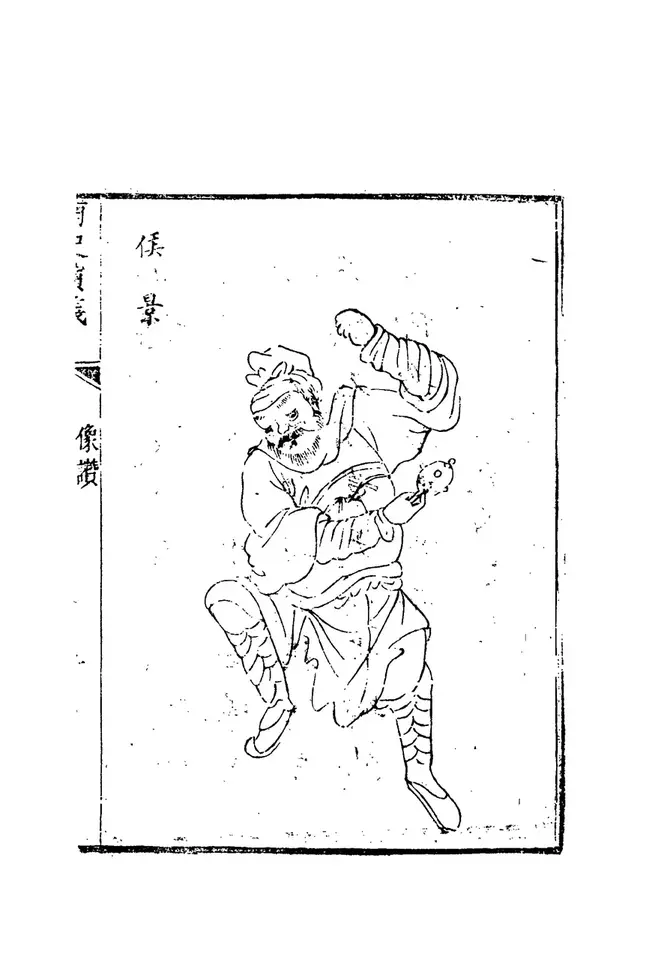 Northern and Southern Dynasties (Northern Wei, Eastern Wei, Liang)
Frontier Military Commander
Hou Jing (侯景, 503–552), courtesy name Wanjing (万景), was a prominent military commander, warlord, and rebel leader during the Northern and Southern Dynasties, hailing from Huaishuo Garrison in Shuozhou (present-day Guyang County, Baotou, Inner Mongolia). Born into a frontier hereditary military family, he was renowned for his equestrian archery, cunning tactical mind, and ruthless temperament. In the chaotic twilight of Northern Wei, Hou served as vanguard under Erzhu Rong and captured rebel chieftain Ge Rong at the Battle of Fukou, earning promotion to Inspector of Dingzhou. Following the demise of the Erzhu clan, he submitted to Gao Huan, who placed immense trust in him and appointed him Grand Branch Department of State Affairs of Henan Circuit and Minister of Education, granting him supreme control over Henan with an army of one hundred thousand troops. After Gao Huan's death, Hou rebelled against Eastern Wei due to deep mutual hostility with Gao Huan's heir Gao Cheng. Failing to secure firm Western Wei support, he offered Henan to the Liang Dynasty. Emperor Wu of Liang (Xiao Yan) welcomed him, enfeoffing him as Prince of Henan and appointing him General-in-Chief. In 548, Eastern Wei commander Murong Shaozong inflicted a crushing defeat on Hou at the Battle of Woyang. Hou fled south of the Huai River to Shouyang. Terrified that Liang would extradite him to Eastern Wei as part of peace negotiations, Hou conspired with Prince of Linhe Xiao Zhengde and launched a devastating rebellion. His army crossed the Yangtze River, encircled the imperial citadel of Taicheng in Jiankang, and starved Emperor Wu to death after a brutal siege. Hou enthroned Crown Prince Xiao Gang (Emperor Jianwen) as a puppet before deposing him in 551 to proclaim himself Emperor of Han with the era name Taishi. His brutal depredations decimated the aristocratic lineages of Jiangnan. In 552, loyalist armies led by Wang Sengbian and Chen Baxian recaptured Jiankang; Hou fled and was slain by his subordinate Yang Kun, ending the cataclysmic four-year uprising.
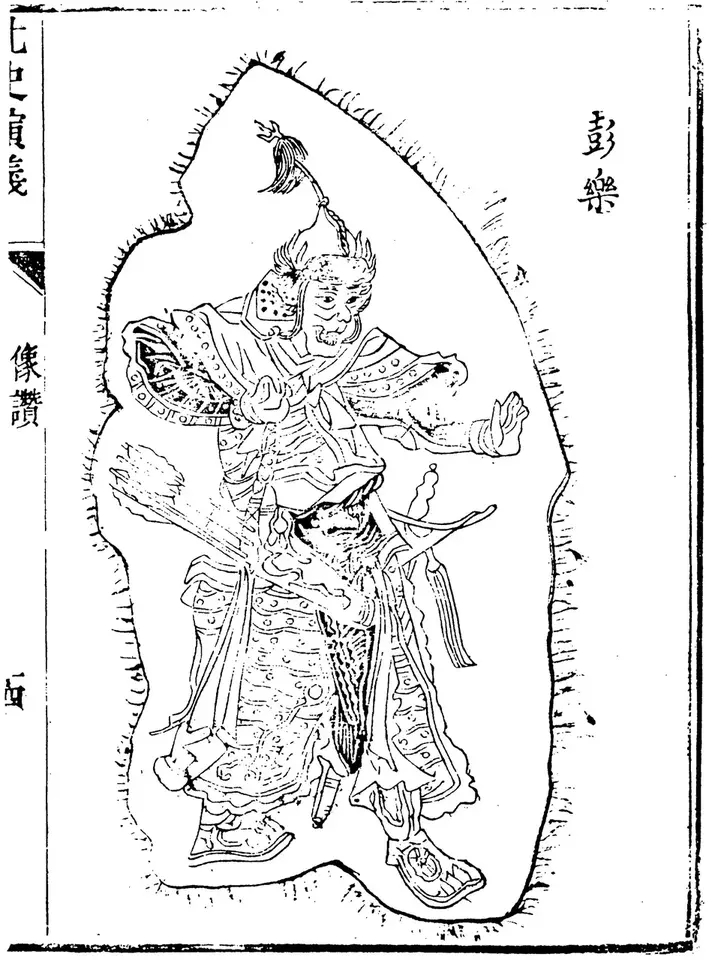 Northern Wei / Eastern Wei / Northern Qi
Founding General of Northern Qi and Premier Fierce Warrior of Eastern Wei
Peng Le (彭乐) (died 551), courtesy name Zixing, was a native of Gaoping in Anding Commandery (present-day Guyuan, Ningxia), and a renowned founding military commander spanning the late Northern Wei, Eastern Wei, and early Northern Qi dynasties, widely recognized as the preeminent champion warrior of Eastern Wei. Endowed with immense physical stature, formidable strength, and exceptional skill in mounted archery, Peng Le initially joined the Northern frontier garrison rebellion led by Du Luozhou during the chaos of late Northern Wei. Discerning Du Luozhou's inevitable collapse, he surrendered to Erzhu Rong and campaigned against Ge Rong and Yang Kan. After briefly siding with Han Lou in Youzhou where he was titled Prince of Beiping, he submitted to Hou Yuan. In 531, he pledged allegiance to Gao Huan in Jinzhou, executing a lightning ambush that captured Erzhu Yusheng. During the decisive Battle of Hanling in 532, Peng Le led the vanguard assault that shattered the massed armies of Erzhu Zhao, for which he was ennobled as Duke of Lecheng County. In the protracted wars between Eastern Wei and Western Wei, Peng Le performed extraordinary battlefield feats: at the Battle of Shayuan in 537, he charged deep into enemy lines while intoxicated, suffered a severe abdominal wound that exposed his intestines, severed the protruding organ with his own blade, and bound his wound to continue fighting. During the Battle of Mount Mang in 543, he led several thousand heavy cavalry in a frontal breakthrough into Western Wei headquarters, capturing five imperial princes including Prince of Lintao Yuan Jian and forty-eight officers, before relentlessly pursuing Western Wei regent Yuwen Tai and obtaining his golden belt. Following the founding of Northern Qi, he was appointed Grand Commandant and created Prince of Chenliu Commandery. In 551, he was falsely accused of treason by Liu Zhang and executed under Emperor Wenxuan of Northern Qi.
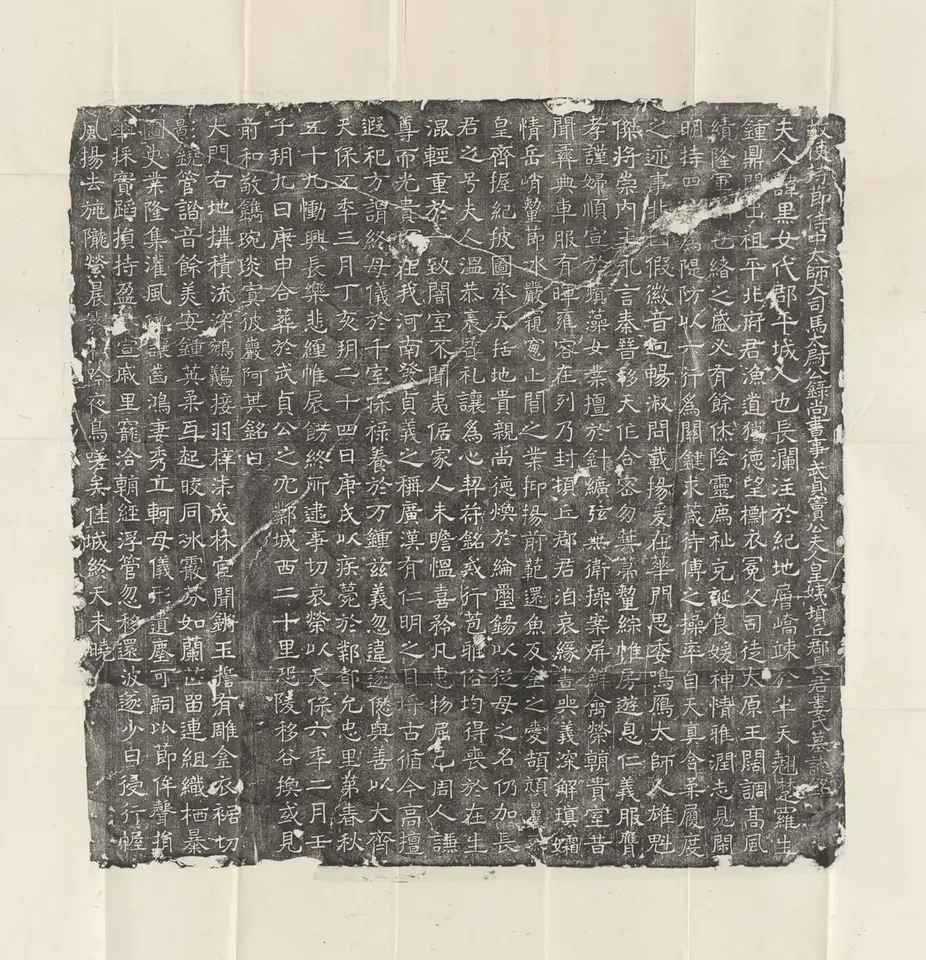 Northern Wei / Eastern Wei
Founding General of Eastern Wei
Dou Tai (窦泰) (500–537), courtesy name Ningshi (recorded as Shining in the Book of Northern Qi), was a native of Hanshu in Da'an Commandery (present-day Shouyang, Shanxi) and a paramount founding general and key military strategist under Gao Huan during the Northern Wei and Eastern Wei dynasties. Originating from a northern frontier garrison military family, Dou Tai excelled in equestrian archery and possessed profound strategic acumen. During the early chaos of the Six Garrisons Rebellion, his father and elder brother were killed in combat; carrying their skeletal remains on his back, Dou Tai made his way to the camp of Erzhu Rong, later participating in the suppression of Xing Gao's uprising and being ennobled as Viscount of Guang'a County. In 531, when Gao Huan launched his uprising at Xindu, Dou Tai was appointed Town Garrison Commander and devised a stratagem of estrangement that compelled the coalition armies of Erzhu Dulu and Erzhu Zhongyuan to withdraw without battle, enabling Gao Huan to crush Erzhu Zhao at Guang'a. In 533, Dou Tai led several thousand elite cavalry across three hundred li in a single day and night, catching Erzhu Zhao completely unprepared at Xiurong and driving him to hang himself. Following the partition of the empire and the founding of Eastern Wei, Dou Tai attained the high offices of Attendant Without Portfolio, Grand Commander of the Metropolitan Area, and Censor-in-Chief, advancing to Duke of Guang'a County. Although married to Lou Henu, the younger sister of Gao Huan's primary consort Lou Zhaojun, Dou Tai established his stature entirely upon battlefield merit and enforced strict administrative discipline within the imperial censorship. In late 536, Gao Huan launched a three-pronged western expedition against Western Wei, appointing Dou Tai as forward commander to advance through Tongguan toward Chang'an. In the first month of 537, Western Wei chancellor Yuwen Tai launched a concentrated ambush against his isolated columns at Xiaoguan. Trapped in a narrow mountain defile, Dou Tai fought to the last before committing suicide with his own sword at the age of thirty-eight. He was posthumously honored as Grand Minister of War and granted the posthumous title Wuzheng, later receiving the supreme honor of enshrinement within Gao Huan's imperial ancestral temple.
Founding merit general of Northern Qi
Qilian Meng (綦连猛) (died 577), courtesy name Wu'er, was a native of Dai Commandery (present-day southwest of Yu County, Zhangjiakou, Hebei Province). He was an illustrious founding commander, paramount imperial guard general, and high civil minister of the Northern Qi dynasty, bearing the noble title Prince of Shanyang. Emerging from a distinguished martial lineage on the northern frontier, he was the son of Qilian Yuancheng, Northern Wei's Administrator of Yan Commandery. Renowned for his extraordinary physical prowess and archery skills, he could simultaneously draw four heavy three-dan bows and hit targets while riding in either direction, earning renown for tactical fearlessness, personal incorruptibility, and unswerving institutional loyalty. In the final years of Northern Wei, Qilian Meng was initially recruited into the personal guard of regent Erzhu Rong, later accompanying Erzhu Zhao across the Central Plains. Following Erzhu Zhao's downfall, his refusal to betray his fallen master won the deep admiration of chancellor Gao Huan, who appointed him commander. Under Eastern Wei, he fought bravely beside Gao Huan at the Battle of Mount Mang, earning ennoblement as Marquis of Guangxing. Following the founding of Northern Qi, he served successive emperors including Emperor Wenxuan (Gao Yang), Emperor Xiaozhao (Gao Yan), Emperor Wucheng (Gao Zhan), and the Last Lord (Gao Wei). He distinguished himself in northern campaigns against the Khitans and Rouran, subjugated the Xi tribes, and personally cut down a champion Turkic general in single combat before Jinyang, advancing to Senior General of the Palace Guard, Director of the Bing Branch Secretariat, and Prince of Shanyang. During Gao Wei's reign, Qilian Meng's uncompromising hatred of corruption and close collaboration with Minister over the Masses Zhao Yanshen provoked the jealousy of palace favorite Zu Ting. Falsely implicated in court intrigue, he was briefly imprisoned and stripped of his princely rank before being dispatched as Inspector of Guang and Jiao provinces. In regional administration, he governed with mild benevolence, financial integrity, and compassion for commoners, winning the universal affection of the populace. In Northern Qi's final hours, Gao Wei recalled him to the capital as Senior General. Following the fall of Northern Qi in 577, Qilian Meng relocated to the Northern Zhou capital of Chang'an, where he passed away shortly afterward.
Historical figure
Hulu Xian (斛律羡, 518–572), courtesy name Fengle, also written as Fengluo, was a native of Dina County in Tai'an Commandery (modern Shouyang, Shanxi Province). Originating from the noble Chile tribal elite, he was an eminent military general and supreme commander of the northern frontier defenses during the Eastern Wei and Northern Qi dynasties, rising to the positions of Senior General of Agile Cavalry, Director of the Branch Department of State Affairs, and Inspector of You Province, and was ennobled as the Prince of Jingshan Commandery. Born into a hereditary military family, he was the second son of Hulu Jin, Grand Preceptor and Left Chancellor of Eastern Wei, and the younger brother of Hulu Guang, the foremost marshal of Northern Qi. From early youth, Hulu Xian displayed sharp tactical discernment and preeminent archery skills, earning high praise from Grand Chancellor Gao Huan. Gao Cheng subsequently appointed him military adjutant, employing him in southern campaigns around Huainan and promoting him to Inspector of Tong Province and Viscount of Daxia. In 550, with the founding of Northern Qi under Emperor Wenxuan (Gao Yang), Hulu Xian was promoted to General of Conquering the West and joined his father in a victorious northern expedition against the Rouran Khaganate. In 564, he was appointed Area Commander-in-Chief of Six Provinces and Inspector of You Province, directing the northern border defenses for over a decade. Facing an invasion by over one hundred thousand Göktürk cavalry, he deployed his divisions in formidable battle array, forcing the nomadic horde to withdraw without fighting and compelling Mugan Khagan to send yearly tribute embassies to Northern Qi. Along the frontier, he constructed over two hundred li of stone ramparts and rampart towers along a two-thousand-li mountain corridor from Kuidui to the Bohai Sea, establishing over fifty border garrisons. He also channeled the Gaoliang River to irrigate agricultural land, creating self-sufficient border granaries and drastically reducing state transport expenses, earning such dread and respect that the nomadic tribes acclaimed him as the Southern Khagan. Serving several Northern Qi emperors with unbending modesty, he feared the perils of excessive familial prestige and repeatedly petitioned to resign his offices, which the court denied. In 572, following the tragic execution of his brother Hulu Guang, the erratic sovereign Gao Wei dispatched emissaries who seized and executed Hulu Xian in the provincial headquarters at age fifty-five. Following the fall of Northern Qi, Emperor Wu of Northern Zhou officially exonerated him, posthumously appointing him inspector across four provinces and Founding Duke of Fuyang Commandery.
Historical figure
Hulu Jin (斛律金, 488–567), courtesy name Aliudun, was a native of Shuozhou (modern Shuozhou, Shanxi Province). Originating as an eminent noble chieftain of the Chile tribal federation, he was a paramount founding contributor and military commander of the Eastern Wei and Northern Qi dynasties, rising to the supreme offices of Grand Preceptor, Left Chancellor, and Grand Marshal, and was ennobled as the Prince of Xianyang Commandery. Descended from the celebrated frontier chieftain Hulu Beihouli, who submitted to Northern Wei under Emperor Daowu, Hulu Jin was renowned for his straightforward integrity, equestrian archery, and mastery of nomadic warfare. In tactical operations, he could accurately determine the numbers of cavalry and infantry by observing dust clouds, and discern the time elapsed since an army's departure by sniffing the soil. Beginning his career during the Six Garrisons rebellions, he served under Erzhu Rong and achieved renown in suppressing Ge Rong and Yuan Hao. Amid the collapse of the Erzhu faction, Hulu Jin recognized Gao Huan's destined rise, joining Lou Zhao and Shendi Gan in supporting the uprising at Xindu to capture Ye and Jinyang, laying the foundations of Eastern Wei. Guarding the strategic crossing of Fengling with thirty thousand troops, he campaigned at Shayuan and Mangshan, advancing to Grand Marshal and Duke of Shicheng Commandery. In 546, when Gao Huan's siege of Yubi stalled with heavy casualties, plunging the dying regent into despair, Hulu Jin sang the immortal Song of Chile in the Xianbei language. Gao Huan wept and joined the chorus, steadying the army's morale and immortalizing the northern grassland ballad across centuries. Under Northern Qi, Hulu Jin was ennobled as Prince of Xianyang, appointed Grand Preceptor and Left Chancellor, and led victorious campaigns against the Rouran and Xi tribes. His family achieved peerless preeminence, producing an empress, two crown princess consorts, and three imperial princesses. Mindful of history, Hulu Jin maintained strict vigilance against the perils of consort clan arrogance, repeatedly petitioning to decline additional honors. Passing away in 567 at age eighty, he received posthumous honors as Chancellor of State, Grand Commandant, and Area Commander-in-Chief of Twelve Provinces, with the posthumous title Wu.
Founding statesman of Eastern Wei
Duan Rong (段荣, 478–538), courtesy name Zimao (子茂), was a prominent statesman and founding general of the Eastern Wei dynasty, recognized as an honored minister in the ancestral temple of Northern Qi and father of the famous general Duan Shao. Descending from an illustrious aristocratic lineage of Wuwei in Liangzhou, Duan Rong was well-versed in calendar calculations, astronomy, and divination from his youth, accurately predicting the outbreak of the Six Frontier Garrisons Rebellion during the Zhengguang era. Amid the turmoil of the late Northern Wei, he fled south with his family to Pingcheng, where he conspired unsuccessfully with Gao Huan to eliminate rebel leader Du Luozhou before taking refuge under Erzhu Rong, serving as Legal Section Assistant of Sizhou. As Duan Rong married Lou Xinxiang, the elder sister of Gao Huan's wife Lou Zhaojun, the two became brothers-in-law and formed an enduring political partnership. In 531, when Gao Huan raised righteous troops at Xindu against the Erzhu clan, Duan Rong served as a vital strategic advisor and was appointed Right Vice Director of the Grand Branch Department and Pacification Ambassador of the Northwest Circuit, securing widespread provincial submissions. When Gao Huan besieged Ye, Duan Rong was entrusted with guarding the base at Xindu, managing supply lines and ensuring ample provisions for the frontline armies. Following the pacification of the region, he was enfeoffed as Founding Marquis of Guzang County. Duan Rong subsequently served as inspector across Yingzhou, Xiangzhou, Jizhou, and Taizhou, and as Grand Branch Department Director of Shandong. In all administrative posts, he practiced benevolent and forgiving governance, earning profound popular affection. He astutely advised Gao Huan against a premature western offensive into Guanzhong, a strategic foresight Gao Huan later lamented ignoring following his defeat at Weiqu. In 538, Duan Rong passed away in Zhongshan at the age of sixty-one. Northern Qi later posthumously elevated him to Grand Marshal and Director of the Imperial Secretariat, conferred the title Prince of Wuwei with the posthumous designation Zhaojing, and enshrined his spirit tablet in the ancestral temple of Emperor Gaozu (Gao Huan).
Historical figure
[!NOTE] Xiong Ansheng (c. 500–578), courtesy name Zhizhi, was a preeminent Confucian classicist, ritual theorist, and educator of the Northern Dynasties during the Northern and Southern Dynasties period. Hailing from Fucheng in Changle Commandery (modern Fucheng County, Hebei Province), he studied classical texts under renowned Northern masters Xu Zunming and Li Baoding, achieving peerless mastery across the Confucian canon and specializing in the Three Ritual Classics: the Rites of Zhou, the Book of Etiquette and Ceremonial, and the Book of Rites. Teaching in Hebei for decades under Eastern Wei and Northern Qi, his private academy attracted over a thousand disciples from distant provinces, reviving classical learning across northern China. Appointed Erudite of the National University under Northern Qi, he famously resolved dozens of obscure institutional disputes over the Rites of Zhou during intellectual debates with Northern Zhou envoy Yin Gongzheng. Following the conquest of Northern Qi in 577, Emperor Wu of Northern Zhou personally visited his residence, granted him the venerated title "Old Master," and appointed him Scholar of the Lumen Hall. His monumental commentaries Zhouli Yishu and Liji Yishu provided foundational structural models for the early Tang dynasty state canon Liji Zhengyi (Correct Meanings of the Book of Rites, part of the Correct Meanings of the Five Classics or Wujing Zhengyi) compiled by Kong Yingda.
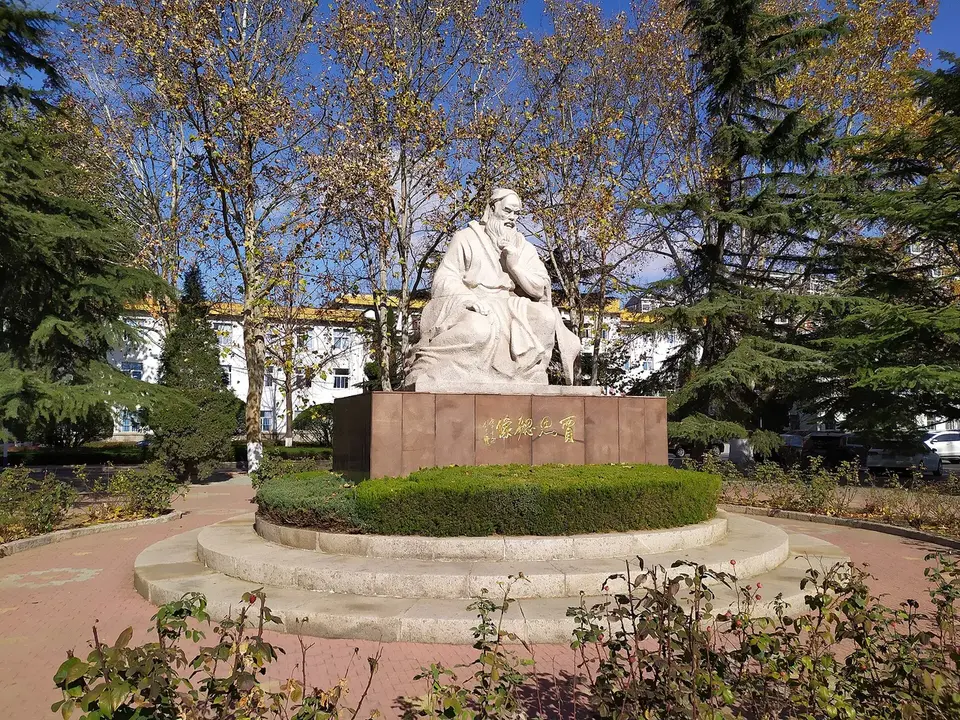
The compilation of Qimin Yaoshu (Essential Techniques for the Welfare of the People; 《齐民要术》成书) refers to the historic codification of China's preeminent ancient agronomic treatise, authored by Jia Sixie, former Governor of Gaoyang Commandery in Northern Wei, between 533 and 544. Driven by the mission of guiding common people toward self-sufficiency and securing state prosperity, Jia Sixie conducted exhaustive literature surveys, personal field experiments, and interviews with seasoned rural farmers across the Yellow River Valley. The resulting ten-volume masterwork encompasses soil preparation, grain cultivation, horticulture, arboriculture, sericulture, animal husbandry, veterinary treatments, fermentation chemistry, and domestic food preservation. By integrating moisture-preserving plowing systems and preserving lost pre-Qin and Han treatises, it established an enduring foundation for Chinese agricultural civilization.
Yidu County, Qi Commandery, Qing Province (modern Shouguang City, Shandong Province) (青州齐郡益都县·今山东省寿光市)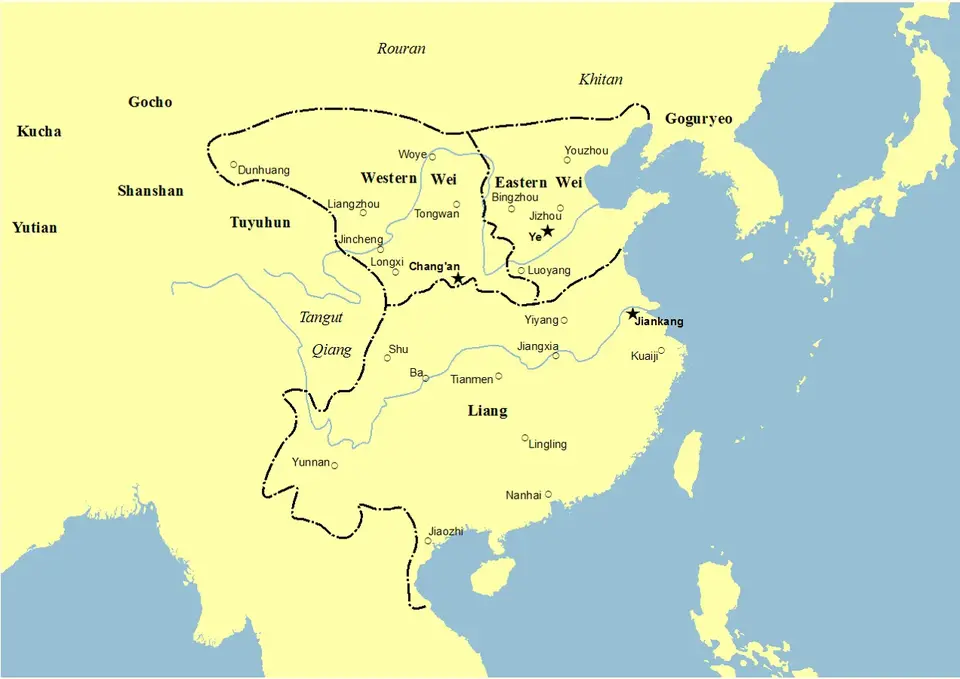
The Battle of Shayuan (沙苑之战) was a pivotal military clash in October 537 CE during the Northern and Southern Dynasties in which Western Wei Chancellor Yuwen Tai, commanding an outnumbered force of under 10,000 soldiers, routed an invading Eastern Wei host of 200,000 led by Chancellor Gao Huan at Shayuan (modern Dali, Shaanxi). Following the partition of the Northern Wei, Eastern Wei possessed the fertile agricultural heartland of the Central Plains, commanding formidable cavalry hosts, whereas Western Wei was hemmed into mountainous Guanzhong and devastated by protracted famine. Seeking to eradicate his rival and seize the Western Wei capital of Chang'an, Gao Huan launched an all-out western offensive across the Yellow and Luo rivers. Rejecting counsel to abandon Guanzhong, Yuwen Tai marched to Shayuan, where wetlands and dense reed beds restricted the deployment of massive cavalry lines. Concealing his troops within the tall marshes, Yuwen Tai waited until the overconfident Eastern Wei vanguard surged forward in disorder before sounding the battle drums. Generals Li Bi and Zhao Gui spearheaded flank cavalry strikes that severed Gao Huan's battle lines. Eastern Wei forces collapsed into mass panic, suffering 6,000 casualties and losing 70,000 captured troops as Gao Huan fled on a bareback horse. The victory preserved the Western Wei state and established the foundation for the Guanlong aristocracy, which eventually produced the Sui and Tang empires.
Shayuan (modern south of Dali County, Shaanxi), Xuyuan