Commencement of Compilation
Jia Sixie retires from official service to his ancestral estate in Qi Commandery, gathering classical treatises and planting trial plots.
Eastern Wei (东魏) · HISTORICAL EVENT
《齐民要术》成书
The compilation of Qimin Yaoshu (Essential Techniques for the Welfare of the People; 《齐民要术》成书) refers to the historic codification of China's preeminent ancient agronomic treatise, authored by Jia Sixie, former Governor of Gaoyang Commandery in Northern Wei, between 533 and 544. Driven by the mission of guiding common people toward self-sufficiency and securing state prosperity, Jia Sixie conducted exhaustive literature surveys, personal field…
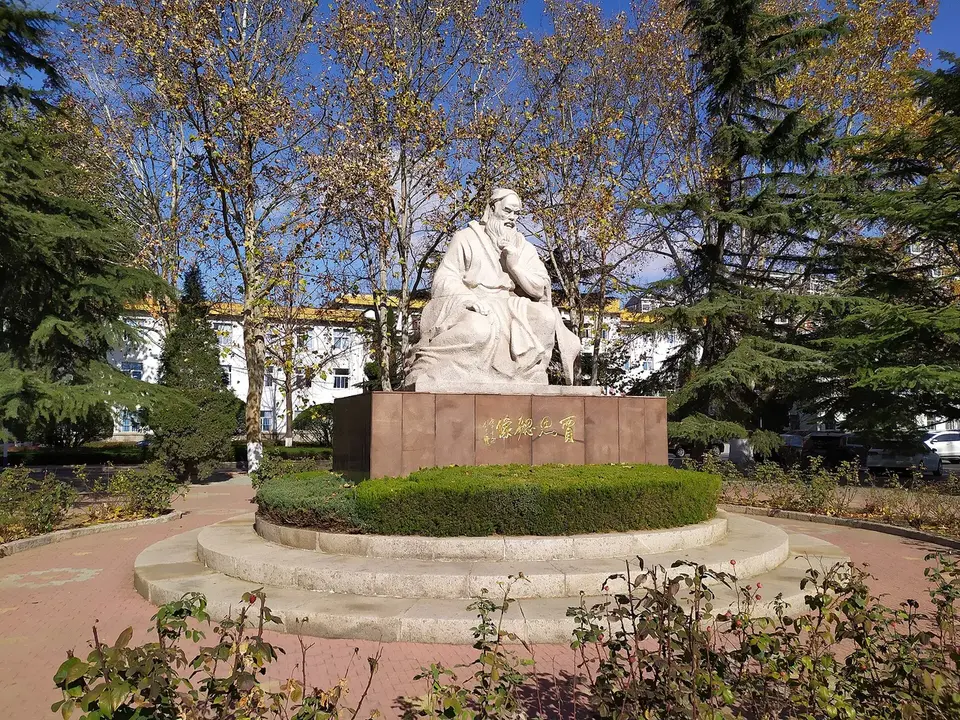
The compilation of Qimin Yaoshu (Essential Techniques for the Welfare of the People; 《齐民要术》成书) refers to the historic codification of China's preeminent ancient agronomic treatise, authored by Jia Sixie, former Governor of Gaoyang Commandery in Northern Wei, between 533 and 544. Driven by the mission of guiding common people toward self-sufficiency and securing state prosperity, Jia Sixie conducted exhaustive literature surveys, personal field experiments, and interviews with seasoned rural farmers across the Yellow River Valley. The resulting ten-volume masterwork encompasses soil preparation, grain cultivation, horticulture, arboriculture, sericulture, animal husbandry, veterinary treatments, fermentation chemistry, and domestic food preservation. By integrating moisture-preserving plowing systems and preserving lost pre-Qin and Han treatises, it established an enduring foundation for Chinese agricultural civilization.
Jia Sixie retires from official service to his ancestral estate in Qi Commandery, gathering classical treatises and planting trial plots.
Jia Sixie journeys across the lower Yellow River plains, interviewing village elders and compiling living agricultural proverbs.
Jia Sixie concludes ten years of synthesis, producing the final standardized manuscript of Qimin Yaoshu in ten volumes and ninety-two chapters.
Following the political unification of northern China, the Northern Wei dynasty consolidated centralized administrative governance through Emperor Xiaowen's comprehensive reforms, enacting the Equal-Field System, the Three-Chief System, and the unified land-tax regulations. The Equal-Field System legally distributed abandoned arable lands to returning refugees and peasant households, incentivizing intensive cultivation and transforming war-torn landscapes into flourishing agricultural plains.
As grain yields stabilized and rural populations expanded, the systematic collation and technical dissemination of dry-farming practices became urgent priorities for both regional state stability and peasant household sustainability.
Jia Sixie belonged to an educated gentry lineage in Yidu County, Qi Commandery, which maintained a long family tradition of scholarly pursuits alongside practical land stewardship. Entering administrative service under the Northern Wei court, Jia served as Governor of Gaoyang Commandery, traveling widely across Shandong, Hebei, and Henan while inspecting farming conditions.
Disturbed by the escalating political chaos in Luoyang toward the end of Northern Wei, Jia Sixie relinquished his official post to retire to his family estate in Yidu. Observing frequent harvest failures caused by seasonal droughts and improper cultivation methods, he resolved to harmonize classical textual learning with living rural wisdom into an authoritative manual for the common folk.
Jia Sixie initiated his monumental enterprise by establishing rigorous methodological criteria. Over several years, he systematically mined over three hundred historical chronicles, philosophical treatises, medical formularies, and geographic gazetteers dating from the pre-Qin, Han, and Wei-Jin periods.
During this philological investigation, Jia excised superstitious apocrypha while faithfully transcribing substantial fragments of vanished masterpieces, most notably Fan Shengzhi Shu from the Western Han and Simin Yueling from the Eastern Han, preserving invaluable primary documentation for future generations.
Transcending mere scholarly book-learning, Jia Sixie anchored his investigations in hands-on empirical inquiry. For over a decade, he traveled extensively throughout the Shandong peninsula, the Taihang foothills, and both banks of the lower Yellow River, seeking out seasoned cultivators, orchardists, and stockbreeders to transcribe oral folk proverbs and technical wisdom.
Moreover, Jia constructed experimental plots and seed nurseries on his own estate, testing seed soaking solutions, planting depth, grafting techniques, and pruning schedules against varying seasonal conditions, refusing to incorporate any method that failed empirical verification.
Synthesizing his voluminous textual records and empirical experimental logs, Jia Sixie labored continuously in Yidu from approximately 533 (second year of the Yongxi era of Northern Wei) until the final manuscript was copied and proofread in 544 (second year of the Wuding era of Eastern Wei).
The finalized treatise spanned ten volumes and ninety-two chapters, organized systematically across the annual agrarian calendar. The opening three volumes expounded soil conditioning, plowing, harrowing, and field crops; volumes four and five covered horticulture, orchard grafting, and timber forestry; volume six detailed livestock breeding and veterinary cures; volumes seven through nine codified brewing, fermentation, oil pressing, and culinary preservation; while volume ten recorded southern exotic flora and famine-relief foraging plants.
The completion of Qimin Yaoshu bequeathed to medieval China its first exhaustively detailed, structurally rigorous encyclopedia of applied agronomy. The masterpiece decisively purged agricultural discourse of astrological fatalism and apocryphal divination, grounding farming in observable natural laws, soil chemistry, and systematic technical standards.
Across subsequent centuries, the widespread dissemination of Qimin Yaoshu provided an indispensable technical foundation for agricultural productivity during the Sui, Tang, Song, and Yuan dynasties, permanently standardizing dry-field rotation across the Yellow River basin.
In global agrarian history, its comprehensive breadth and experimental precision substantially outpaced contemporary Byzantine and early medieval European treatises. Charles Darwin later examined its accounts of artificial selection and animal breeding during his formulation of the theory of evolution, lauding it as an extraordinary ancient encyclopedia.
Jia Sixie articulated his overarching editorial purpose in the Author's Preface: "Collecting from classical scriptures and oral ballads, inquiring from experienced elders, and verifying through actual practice. Beginning with basic tillage and concluding with brewing and pickling, all livelihoods for the people are fully recorded, hence named Essential Techniques for the Welfare of the People."
The Siku Quanshu Zongmu Tiyao (Annotated Catalog of the Complete Imperial Library) recorded in its Agricultural Section: "Jia Sixie's treatise cites texts with vast erudition, blending classics with folk songs and living elders' wisdom. Its structural pathways are meticulously nuanced and exhaustive, establishing a perimeter that subsequent agricultural writers could never surpass."