Victory at Xiaoguan
Yuwen Tai ambushes and slays Eastern Wei commander Dou Tai at Xiaoguan, provoking Gao Huan's anger.
Eastern Wei (东魏) · HISTORICAL EVENT
沙苑之战
The Battle of Shayuan (沙苑之战) was a pivotal military clash in October 537 CE during the Northern and Southern Dynasties in which Western Wei Chancellor Yuwen Tai, commanding an outnumbered force of under 10,000 soldiers, routed an invading Eastern Wei host of 200,000 led by Chancellor Gao Huan at Shayuan (modern Dali, Shaanxi). Following the partition of the Northern Wei, Eastern Wei possessed the fertile agricultural heartland of the Central Plains,…
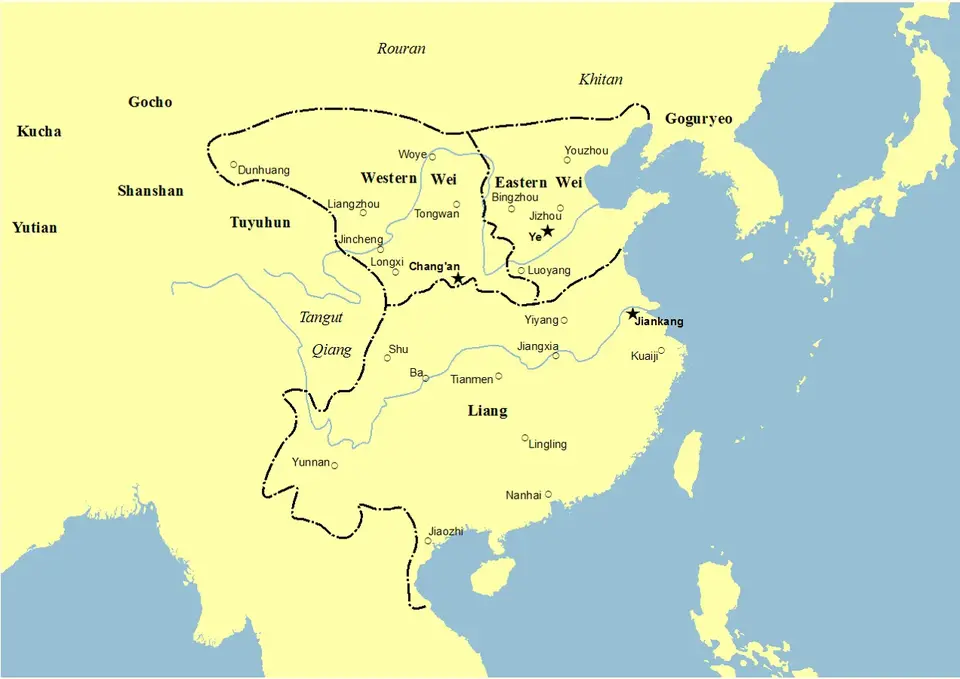
The Battle of Shayuan (沙苑之战) was a pivotal military clash in October 537 CE during the Northern and Southern Dynasties in which Western Wei Chancellor Yuwen Tai, commanding an outnumbered force of under 10,000 soldiers, routed an invading Eastern Wei host of 200,000 led by Chancellor Gao Huan at Shayuan (modern Dali, Shaanxi). Following the partition of the Northern Wei, Eastern Wei possessed the fertile agricultural heartland of the Central Plains, commanding formidable cavalry hosts, whereas Western Wei was hemmed into mountainous Guanzhong and devastated by protracted famine. Seeking to eradicate his rival and seize the Western Wei capital of Chang'an, Gao Huan launched an all-out western offensive across the Yellow and Luo rivers. Rejecting counsel to abandon Guanzhong, Yuwen Tai marched to Shayuan, where wetlands and dense reed beds restricted the deployment of massive cavalry lines. Concealing his troops within the tall marshes, Yuwen Tai waited until the overconfident Eastern Wei vanguard surged forward in disorder before sounding the battle drums. Generals Li Bi and Zhao Gui spearheaded flank cavalry strikes that severed Gao Huan's battle lines. Eastern Wei forces collapsed into mass panic, suffering 6,000 casualties and losing 70,000 captured troops as Gao Huan fled on a bareback horse. The victory preserved the Western Wei state and established the foundation for the Guanlong aristocracy, which eventually produced the Sui and Tang empires.
Yuwen Tai ambushes and slays Eastern Wei commander Dou Tai at Xiaoguan, provoking Gao Huan's anger.
Gao Huan leads 200,000 troops across the Yellow River at Pujin, directly menacing Chang'an.
Yuwen Tai moves fewer than 10,000 troops to Shayuan, concealing them within dense reed marshes.
Gao Huan rejects tactical caution; his troops pour into the marshlands in disarray.
Yuwen Tai strikes the drums; Li Bi and Zhao Gui rout the enemy, capturing 70,000 men as Gao Huan flees.
Western Wei returns victorious with prisoners, establishing permanent parity against Eastern Wei.
In 534 CE, Emperor Xiaowu fled westward to Chang'an to join general Yuwen Tai, while regent Gao Huan installed Emperor Xiaojing at Ye, cementing the split of the Northern Wei into Eastern and Western rival states. Eastern Wei inherited the populous Yellow River plain, possessing immense agricultural wealth and over 100,000 veteran Xianbei cavalry.
Conversely, Western Wei was confined to the rugged Guanzhong and Longyou frontiers. Its territory was impoverished and gripped by a severe famine in which contemporary chronicles recorded that "people ate one another, and seventy to eighty percent perished." Deprived of resources, Yuwen Tai had to raid east of Tongguan to secure grain, leaving Western Wei vulnerable to immediate annihilation.
Earlier in 537 CE, Western Wei forces defeated Eastern Wei general Dou Tai at the Battle of Xiaoguan. Stung by this humiliation, Gao Huan mobilized a massive punitive army of 200,000 in autumn, crossing the Yellow River at Pujin and advancing past the Luo River to encamp at Xuyuan near Huayin, aiming directly at Chang'an.
As the Eastern Wei host advanced, regional Western Wei commanders in Xiazhou and Lingzhou defected, leaving only Wang Pi defending Huazhou. Panic engulfed Chang'an, and civilian and military officials urged Yuwen Tai to abandon Guanzhong and retreat into the western mountains of Longyou.
Confronting calls for retreat, Chancellor Yuwen Tai maintained exceptional strategic clarity. Addressing his commanders, he argued: "Gao Huan marches 200,000 men deep into our heartland; his supply lines are overextended and his officers are blinded by arrogance. If we retreat into Longyou, Guanzhong will dissolve in terror and our state will fall without a fight!"
Gathering fewer than 10,000 elite horsemen and infantry in Chang'an, each equipped with merely three days of rations, Yuwen Tai pushed rapidly to Huayin and established camp at Shayuan, situated between the Wei and Luo rivers. The terrain at Shayuan was choked with dense reed beds, waterlogged ditches, and muddy silt, preventing the deployment of large cavalry formations. Yuwen Tai hid General Li Bi's cavalry in the right reeds and Zhao Gui's infantry in the left marshes, ordering total silence until his central war drums gave the command to strike.
On the morning of October 2, 537 CE, the Eastern Wei army arrived at the outskirts of Shayuan. Observing that Western Wei had deployed with its back to the water, veteran officer Hülü Qiangju warned Gao Huan: "Western Wei soldiers are fighting for survival with their backs to the marsh; they will battle like trapped beasts. We should detach mobile divisions to sever their supplies and starve them without direct assault." Strategist Hou Jing similarly urged dividing the army into two wings.
However, Gao Huan and his tribal chieftains dismissed these cautions, laughing at the diminutive size of the enemy: "They are like scattered ants; we need only trample them underfoot!" Eager for plundering glory, the 200,000-man army broke into an undisciplined rush into the marshlands. Soldiers abandoned their formations, scattered among the mud to cut reed fodder for their horses, and advanced without tactical coherence.
As the vanguard crowded into the muddy bottleneck, Yuwen Tai personally struck the war drums. Ten thousand Western Wei warriors erupted from the reeds with thunderous roars, thrusting spears into the crowded enemy ranks.
General Li Bi led an armored cavalry charge slicing straight into the Eastern Wei center, while Zhao Gui pressed hard from the left. Cut into disorganized pockets, Eastern Wei infantry and cavalry could neither advance nor retreat, trampling their own comrades in panic. Fighting with desperation, Western Wei troops shattered the enemy vanguard, precipitating an uncontrollable rout across the battlefield. Thousands drowned attempting to cross the Luo and Yellow rivers. Abandoning his command tent, Gao Huan mounted an unsaddled horse and fled through the night back toward Shanxi.
The Battle of Shayuan stands as one of the most remarkable victories against superior numbers in Chinese military history. With fewer than 10,000 troops, Western Wei killed 6,000 enemies, captured 70,000 soldiers, and seized 200,000 suits of armor and weapons. The catastrophe shattered Gao Huan's plan to eradicate Western Wei, ensuring the survival of the Guanzhong state and cementing a long-term strategic standoff across the Yellow River.
The incorporation of 70,000 captured soldiers transformed the military manpower of Western Wei. Confronting an ethnically mixed population, Yuwen Tai reorganized these forces into the Eight Pillar Generals and Twelve Senior Generals, creating the revolutionary Fubing (territorial militia) system. This institutional innovation integrated Xianbei tribal cavalry with Han gentry recruits, forging the Guanlong military-aristocratic bloc that later spearheaded the Northern Zhou conquest of Northern Qi and laid the foundational statecraft for the Sui and Tang empires.
In Zizhi Tongjian, Song historian Sima Guang commended Yuwen Tai's generalship: "Yuwen Tai controlled the strong with the weak, striking the many with the few. In the triumph of Shayuan, his calculations were flawless. Gao Huan's host of 200,000 dissolved like melting ice. Henceforth, Eastern Wei dared not gaze lightly upon Guanzhong, cementing the dual balance between Zhou and Qi."
In the Book of Zhou (Zhou Shu, Basic Annals of Emperor Wen), Linghu Defen praised: "With ten thousand troops, the founder confronted the host of an entire empire, adapting to the enemy with celestial genius. In the victory of Shayuan, he took standards and captured tens of thousands. Even ancient masters like Han Xin, Bai Qi, Cao Cao, and Liu Bei could not surpass this feat."