Birth | Born in Youxi, Nanjian Prefecture; ancestral home in Wuyuan, Huizhou.
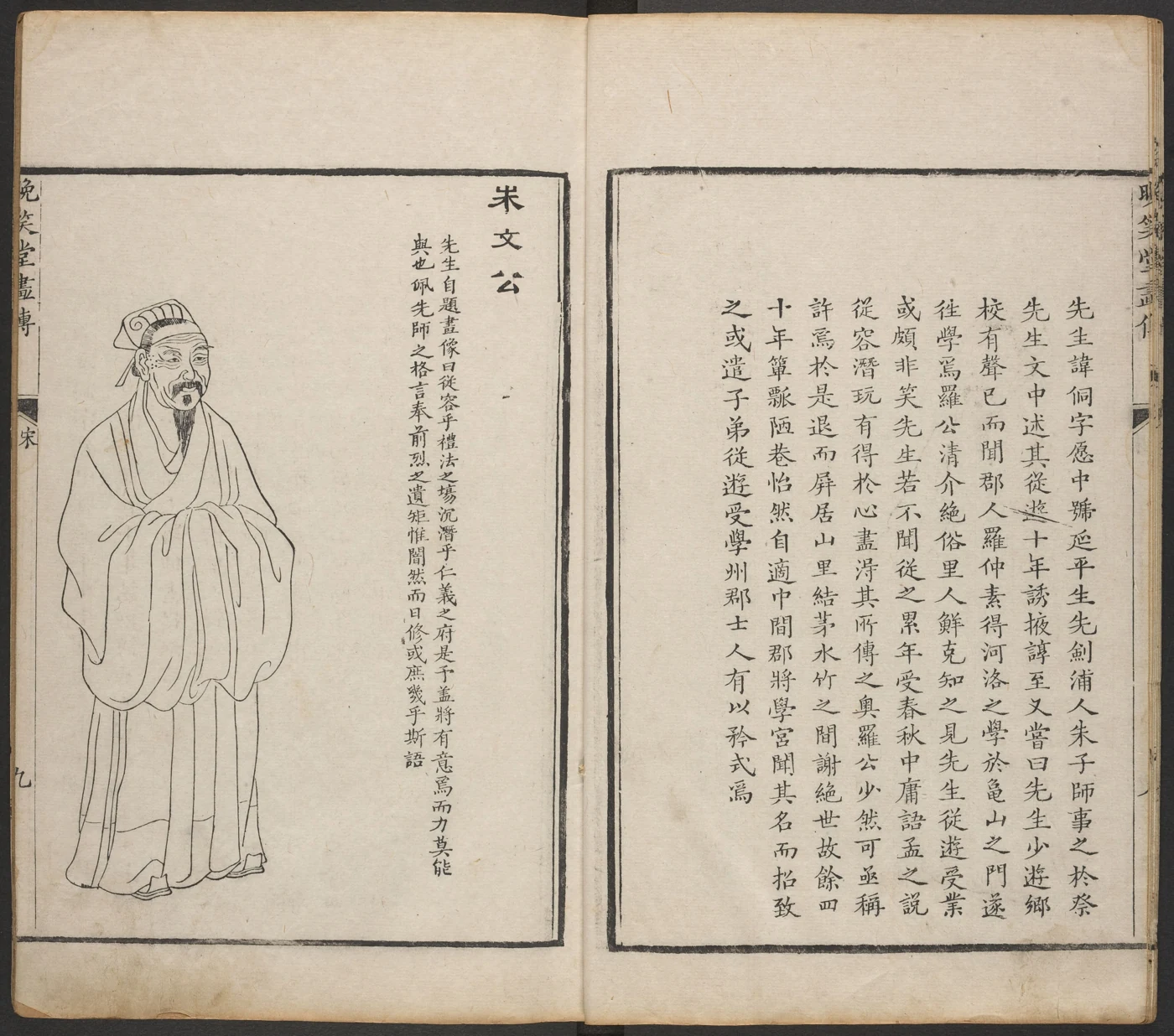
1130 CE–1200 CE
Neo-Confucian philosopherthinkereducatorand official
Zhu Xi
朱熹
Zhu Xi (18 October 1130 – 23 April 1200), courtesy names Yuanhui and Zhonghui, styled Huian and Huweng among others, was born at Youxi in Nanjianzhou to a family of Wuyuan in Huizhou, and became the great synthesizer of Song Neo-Confucianism, as well as a philosopher and educator. A metropolitan graduate of 1148, he held office as registrar of Tong'an in Quanzhou, prefect of Nanjiang, tea and salt commissioner of eastern…
1130 CE–1200 CESouthern Song
PROFILE
Zhu Xi (18 October 1130 – 23 April 1200), courtesy names Yuanhui and Zhonghui, styled Huian and Huweng among others, was born at Youxi in Nanjianzhou to a family of Wuyuan in Huizhou, and became the great synthesizer of Song Neo-Confucianism, as well as a philosopher and educator. A metropolitan graduate of 1148, he held office as registrar of Tong'an in Quanzhou, prefect of Nanjiang, tea and salt commissioner of eastern Zhejiang, prefect of Zhangzhou and of Tanzhou, and served forty-six days at court as edict attendant and lecturer of the Huanzhang Pavilion; he founded or restored the Tong'an school, the Wuyi and Kaoting academies and the White Deer Grotto and Yuelu academies, drawing up their rules and compiling their texts. His philosophy built on the Cheng brothers' doctrine of principle, absorbing Zhou Dunyi on the Supreme Ultimate, Zhang Zai on material force and Buddhist and Daoist ideas, into a system centred on principle or the Supreme Ultimate and articulated through the priority of principle over material force, the investigation of things, the priority of knowledge to action and the twofold theory of human nature; his Collected Annotations on the Four Books became the standard examination text from the Yuan to the Qing. Denounced as the head of "false learning" in the proscription of 1196, he died in 1200 and was gradually rehabilitated, his teaching becoming official philosophy in the Yuan and spreading abroad.
- Alternate names
- courtesy name Yuanhui; style Huian; Master Zhu; Duke Wen Zhu; Master Hui'an; Master Ziyang
- Courtesy name
- Yuanhui; also Zhonghui
- Style
- Huian; later Huiweng
- Period
- Southern Song
- Date of Birth
- October 18, 1130 CE(4th year of the Jianyan era, 9th month, 15th day)
- Date of Death
- April 23, 1200 CE(6th year of the Qingyuan era, 3rd month, 9th day)
- Dynasty/Regime
- Southern Song
- Identity
- Neo-Confucian philosopher, thinker, educator, and official
- Ethnicity
- Han Chinese
- Ancestral home
- Wuyuan County, Huizhou (present-day Wuyuan County, Jiangxi)
- Place of birth
- Youxi County, Nanjian Prefecture (present-day Youxi County, Sanming, Fujian)
- Posthumous name
- Wen
- Major achievements
- Synthesized major Neo-Confucian traditions into a systematic philosophical framework; compiled the Collected Commentaries on the Four Books; promoted academy education, classical interpretation, and practical local governance
LIFE TIMELINE
Death of his father | Following the last instructions of his father Zhu Song, he and his mother depended on Liu Ziyu, and he studied with Hu Xian, Liu Mianzhi, and Liu Zihui.
Passed the imperial examination | Passed the jinshi examination on the Wang Zuo list.
Service in Tong'an | Served as registrar of Tong'an County, Quanzhou, beginning his experience in local administration.
Became a disciple of Li Tong | After exploring Buddhist and Daoist thought, turned to concentrated study of the Neo-Confucian tradition of the Cheng brothers.
Goose Lake Debate | Discussed methods of learning with Lu Jiuyuan and his brother and others, revealing different approaches within Neo-Confucianism.
Prefect of Nankang Military Prefecture | Reorganized local administration, rebuilt the White Deer Grotto Academy, and established its rules.
Famine relief in eastern Zhejiang | Served as intendant for the Changping Granaries, Tea, and Salt in eastern Zhejiang, investigated the disaster, and impeached corrupt officials.
Prefect of Zhangzhou | Reorganized local taxation and education and promoted measures concerning land boundaries and related matters.
Court lecturer | Taught and remonstrated at court early in the reign of Emperor Ningzong, but was soon dismissed because of political conflict.
Qingyuan Proscription | Impeached as the “chief of false learning,” stripped of office and honorary appointments, while disciples and associated officials were also implicated.
Death | Died at Kaoting in Jianyang, aged seventy-one.
Rehabilitation | His official status was restored; he later received the posthumous name Wen, was posthumously appointed Grand Preceptor, and was made Duke of Hui.
Enshrined in the Confucian Temple | His official position in the Confucian canon was further established.
BIOGRAPHY
Biography
Family and Early Studies
Zhu Xi's father, Zhu Song, was registrar of Youxi and had been educated in the Cheng brothers' teaching of principle. The History of Song records that Zhu Xi "was intelligent from childhood, and when he could first speak his father pointed to the sky and said 'that is heaven', to which he asked 'what is above heaven'", a story that shows his early eagerness for knowledge. Li Fangzi's Ziyang nianpu, quoted in Zhen Dexiu's Xishan dushuji, records that he entered the elementary school at five, that on first reciting the Classic of Filial Piety he understood its sense and wrote on it the eight characters "if it is not thus, one cannot become a man", that when playing with other children he would "alone arrange the eight trigrams in sand and study them closely", and that he once asked his father what the sun rested on and, told that it rested on heaven, asked what heaven rested on, at which his father marvelled. At ten, it is recorded, he "set his mind on the learning of the sages", reading the Great Learning, Doctrine of the Mean, Analects and Mencius day and night, and recalled that at ten, reading Mencius to the passage that the sage is of the same kind as ourselves, he was delighted beyond words and resolved to become a sage; he later taught his students that every man must take the sage as his own charge. His father died when he was ten, and his father's friends Liu Zihui, Liu Mianzhi and Hu Xian were all students of the Way, some opposed to Buddhism and some devoted to it, most of them of the latter sort, so that Zhu Xi was drawn both to the learning of the Way and to Buddhist studies; in 1147, at eighteen, he passed the provincial examination, said to have been on the basis of Chan Buddhist doctrine, and the examiner Cai Zi remarked that he had taken a young man whose three essays all concerned the great affairs of the court and who would certainly be no ordinary person.
Official Career and Study under Li Tong
Zhu Xi was born at Youxi in the ninth month of 1130 and became a metropolitan graduate in the spring of 1148. In 1153 he became registrar of Tong'an in Quanzhou and of its school, often lecturing the students on the conduct of sages and good men, proposing the building of a hall of classics and histories to hold books, and in his spare time studying the Confucian classics and exploring Buddhist, Daoist and other philosophical writings. After three years he returned to Mount Wuyi in Chong'an, built the Zhongshan Hall and taught and wrote there, walking to the house of Li Tong, a fellow student of his father, for instruction; in the winter of 1160 he took Li Tong as his master, inheriting the orthodox Luo learning and laying the foundation of his Neo-Confucianism.
In the tenth month of 1163 he was summoned to audience in the Chuigong Hall and presented three memorials to Emperor Xiaozong: the first on rectifying the mind and making the will sincere, on the investigation of things and the extension of knowledge, and against heterodox learning; the second on the great principle of expelling the barbarians and taking vengeance, and against peace; and the third on the way of internal government, and against trusting favourites. Tang Situi was then chief councillor and favoured peace, so his opposition to the peace was not adopted; in the eleventh month the court made him instructor in the military college of the imperial academy, which he declined, asking for a temple post and returning to Chong'an.
The New Doctrine of Equilibrium and Harmony
In 1169 Zhu Xi recognised the errors of his earlier doctrine of equilibrium and harmony and, rereading Cheng Hao and Cheng Yi with the ideas of "reverence" and "double cultivation", worked out a new doctrine from an entirely fresh angle. The event was of epochal significance in the history of scholarship and marks the maturity of his philosophy. In the fifth month of 1171, to deal with the people's livelihood in years of disaster at root, he established a community granary at Wufu, which lent grain to peasants in the lean season at twenty per cent interest, so that they need not borrow from usurers at high rates, halving the interest in a small famine and remitting it in a great one; the measure was connected with the riot of famine victims at Chong'an, after which he and the magistrate Zhuge Tingrui had called on the local rich to sell their stored grain for relief and asked the court to provide six hundred piculs. The system eased the poor, moderated social tension and reduced the pressure on the government, and was imitated elsewhere, though because it hurt the interests of landlords and usurers it was not widely adopted, being carried out only in places such as Jianyang in Fujian and Jinhua in Zhejiang. In the eleventh month of the same year he returned to Youxi and discussed learning in the county school with his friend the magistrate Shi Zizhong, visiting with him the old residence "Weizhai" where his father had lived as registrar of Youxi, and writing the four characters "the old seat of Weizhai" to be cut in stone and displayed. In the seventh month of 1173 he wrote the "Record of the lecture hall of the Qizhou school"; when his friend Li Bojian was appointed to teach at Qizhou he wrote the "Preface for Li Bojian", praising his character and learning and encouraging him that henceforth the scholars of Qi who rose with ardour to learn and understood how to cultivate themselves, order their families, govern the state and pacify the realm would be the proof of his virtue and cultivation. In the ninth month of 1192 he also wrote the "Record of the shrine of the two Cheng masters in the Huangzhou prefectural school"; the two records and the preface are all in his collected works.
The Goose Lake Meeting and the Debate with Lu
In 1175, to reconcile the views of Zhu and Lu, Lü Zuqian proposed a meeting at the Goose Lake Temple in Xinzhou (in present-day Yanshan, Jiangxi) of Zhu Xi, Lu Jiuyuan and Lu Jiuling and several others, to discuss the method of learning; this is the famous Goose Lake Meeting of Chinese intellectual history. In scholarship Zhu Xi held that mind and principle are two distinct things, principle being substance and mind the knower, while the two Lu held that mind and principle are one, taking mind to encompass subject and object; the debate and discussions lasted ten days. The meeting did not unify their thinking, but led each to a deeper understanding of the other's ideas and of their differences, and prompted each to re-examine his own thought. Five years later, in 1180, Lu Jiuyuan came to the White Deer Grotto Academy to visit Zhu Xi and ask him for an epitaph for his brother Lu Jiuling; the two met as old friends, and Zhu Xi not only agreed but invited Lu to lecture to the academy, where his exposition of the Analects on the gentleman understanding righteousness and the petty man profit moved his hearers. The episode shows that despite their differences both behaved with the generosity of gentlemen.
Nanjiang, the White Deer Grotto and Relief in Eastern Zhejiang
In 1178 the court appointed Zhu Xi prefect of Nanjiang with charge of agriculture, and he took up office in the third month of 1179, a year of severe drought; he at once began repairing waterworks, fighting the disaster and relieving famine, asking for the remission of the land tax of Xingzi county so that the victims could live. In the tenth month, inspecting embankments and ponds, he was shown by a woodcutter the ruined site of the White Deer Grotto Academy, and through his efforts the academy was rebuilt by the third month of 1180. The White Deer Grotto was one of the four famous academies of the Song, its site southeast of the Five Old Men Peaks of Mount Lu in Xingzi county, Jiangxi, having once been the retreat of the Tang scholar Li Bo, who kept white deer, whence the name; an academy was founded there in the Southern Tang under the name Lushan National School, and another under the Song. Zhu Xi spared no effort for it, acting as its head himself, inviting famous teachers, enriching its library, obtaining an imperial plaque and autograph, acquiring farm land to support poor students and drawing up its rules himself, the famous "Rules of the White Deer Grotto Academy". These rules stated the aims of education, the programme of training, the order of study and the way of cultivating oneself and governing others, and became not only the model for Chinese academies for centuries but a subject of attention among educators abroad.
In the second month of 1181 Lu Jiuyuan visited Zhu Xi at Nanjiang and lectured at the academy; in the eighth month, with eastern Zhejiang in famine and Zhu Xi's relief work in Nanjiang well known, the chief councillor Wang Huai recommended him for relief work, and he became commissioner of the ever-normal tea and salt administration of eastern Zhejiang. He took several strong measures at once to relieve the victims; afterwards, having impeached the former prefect of Taizhou, Tang Zhongyou, he incurred the hostility of Wang Huai, who was related to Tang by marriage, and left office after nine months. He memorialised six times against Tang Zhongyou's irregularities, pointing directly to the collusion between Wang Huai and Tang; under pressure Wang Huai withdrew Tang's new appointment as judicial commissioner of Jiangxi, and in the whole affair Zhu Xi showed great integrity and moral courage.
Zhangzhou, Tanzhou, the Lecture Bureau and the Proscription
In 1190, at sixty-one, Zhu Xi went to Zhangzhou, where his administration concerned chiefly the rectification of boundaries, the remission of irregular taxes, the improvement of customs and the impeachment of corrupt officials, the rectification of boundaries being its heart. Land was being rapidly engrossed, officials and landlords swallowing the peasants' fields while the assessment did not follow the land, so that "the land tax was unequal" and the dispossessed were more heavily exploited and tension grew. Zhu Xi therefore proposed "rectifying the boundaries", that is verifying the acreage and taxing according to it; the proposal would have lightened the peasants' burden but harmed the great landlords, who opposed it strongly, and it was never carried out. The episode shows that reform in local office depended on the attitude of local magnates and superior authorities rather than on the official's own wishes.
In 1194 the Yao rising under Pu Laishi shook the court and the provincial situation in Hunan became tense. Zhu Xi was appointed at the crisis to be prefect of Tanzhou and pacification commissioner of Jinghu South with the gift of purple robes; with the firmness of a moral philosopher and a strong concern for the state and people, he did not decline but gladly took up the post. In the fifth month he reached Tanzhou, where the Yao had already withdrawn into the mountains and were besieged in their valleys; he adopted a policy of conciliation, sending envoys to win over their leader Pu Laishi. Because the operation was a joint one of Hubei and Hunan, his conciliation was opposed by the Hubei command, and after Pu Laishi was taken to custody Wang Lin urged that he be beheaded to warn others; Zhu Xi had to plead in audience with Emperor Ningzong that good faith with the Yao be kept. In office he built schools, spread instruction, supervised the administration and improved customs, and rebuilt and enlarged the Yuelu Academy below Mount Yuelu at Changsha, teaching there himself in his spare time, so that it became one of the four great academies of the Southern Song. He lectured there with Zhang Shi, thousands coming from all quarters to hear them, and wrote the four characters "loyalty, filial piety, integrity and chastity" in the lecture hall, afterwards adopted as its motto. After two months of lectures he toured Mount Heng with Zhang Shi, the two composing poems as they went, a hundred and forty-nine in all, collected as the Nan Yue changchou ji; after coming down, over the hundred and eighty li from Yuegong to Zhuzhou, they discussed their remaining disagreements, spending three days and nights in a boat on the Doctrine of the Mean without sleeping.
In the eighth month of 1194 Zhu Xi became edict attendant and lecturer of the Huanzhang Pavilion; in the ninth month he memorialised in the temporary hall, first on rectifying the mind and making the will sincere, second on the emperor's reading of the classics and the investigation of principle, and in the third, fourth and fifth on the settlement of Tanzhou. On the fourteenth day of the tenth month he lectured on the Great Learning by imperial order, repeatedly stressing the eight items — the investigation of things, the extension of knowledge, sincerity of will, rectification of the mind, cultivation of the person, ordering of the family, government of the state and pacification of the realm — hoping to restrain the abuse of imperial power by correcting the sovereign's virtue, which displeased Emperor Ningzong and the chief minister Han Tuozhou; he was accordingly dismissed from both offices by an imperial note after only forty-six days at court. His lectures at the lecture bureau took the correction of the sovereign's virtue as their point, contrary to the wishes of the powerful minister of the day, which is why his time at court was so short.
In the twelfth month of 1196 the proscription began: the investigating censor Shen Jizu memorialised against him on "ten great crimes" by a method of innuendo, misattribution and fabrication, and the powerful at court launched an unusually cruel reckoning against the learning of the Way, reviving the device of the Yuanyou proscription of the Northern Song and publishing a list of fifty-nine men as a faction of traitors, all of whom were variously punished. Zhu Xi was denounced as "the head of false learning" and placed fifth on the blacklist, and some even proposed beheading him to end false learning; he was dismissed from office and from his temple post as its chief offender, and his disciples were exiled or imprisoned.
In the spring of 1200 his foot ailment grew severe and his condition worsened; left blind in one eye and almost blind in the other, he worked with greater energy at his unfinished manuscripts, wishing to complete all his writings so that the transmission of the Way would have successors. On the ninth day of the third month, at seventy-one, he died amid the proscription. Believers in the learning of the Way from all quarters resolved to gather at Xinzhou in the eleventh month for a great funeral, which so alarmed those in power that they ordered the local officials to restrain it; in the eleventh month he was buried at Dalingu in Huangkeng, Jianyang county, and the mourners still numbered nearly a thousand. It is recorded that in his last years he inscribed a small portrait with the words "the grey face is already that of ten years ago; taking up the mirror and looking back I am sad; treading on thin ice and standing on the edge I have perhaps little time left, and I shall give my remaining days to these broken manuscripts", signed "written by Zhu Xi on the eighth day of the second month of the gengshen year of Qingyuan"; since he died in the third month of that year, the inscription is his last writing.
The Philosophical System
Zhu Xi's system built on the Cheng brothers' doctrine that principle is fundamental, absorbing Zhou Dunyi's Supreme Ultimate, Zhang Zai's doctrine of material force and Buddhist and Daoist ideas, its central category being "principle", also called the Way or the Supreme Ultimate. Principle is in the first place the basic standard of ethical conduct; in the second place, as the Supreme Ultimate it is the totality of the principles of all things, "the Supreme Ultimate is simply the word principle", and since it contains the principles of all things each thing may embody it, so that "every man has a Supreme Ultimate and every thing has a Supreme Ultimate"; in the third place, principle in man is human nature. Material force is the second category of the system, belonging to what is below form, with feeling, shape and traces, able to condense and to make, the stuff of which things are made, so that all things are the unity of principle and stuff. Principle and material force have an order of priority: "principle produces material force and dwells within it", principle being host, prior and primary, material force guest, posterior and secondary. He explained the division of material force into the myriad things by "one dividing into two", held that opposites unite to make change inexhaustible, treated motion and rest as an infinite continuous process, and distinguished the relative stability and the marked change of motion as "transformation" and "change", in which gradual transformation contains sudden change and sudden change gradual, "gradual transformation accumulating to sudden change".
On the investigation of things and the extension of knowledge, he inherited the Cheng doctrine that "the investigation of things is the exhaustive study of principle" and built a more systematic account, its content being "to exhaust the heavenly principle, to understand human relations, to expound the words of the sages and to master affairs", in which the heavenly principle means chiefly benevolence, righteousness, propriety and wisdom. If one gives up the pursuit of the heavenly principle and spends one's effort only on plants and utensils, he said, one is like a straggler who never returns home, and to hope for results that way is to cook sand and expect rice. He held that "above, to the Ultimate of Non-being and the Supreme Ultimate, and below, to a blade of grass, a tree or an insect, each has its principle; if one book is unread one principle is missing, if one affair is not exhausted one principle is missing, if one thing is not investigated one principle is missing, and one must go through them one by one"; and that heaven above and earth below with all their sun, moon, stars, mountains, rivers, plants, animals and men are things below form, yet each has within it a principle, which is the Way above form, so that to investigate things is to exhaust, in things below form, the principle above form.
On knowledge and action he gave priority to knowledge: since moral practice needs the guidance of ethics, knowledge comes first, and since ethics must not remain empty talk, action is weighty, the two being aspects of moral practice with an inner consistency. From the standpoint of cognition, however, "knowledge first, action after" reverses the order, since knowledge comes from practice and action should be primary; the doctrine of the priority of knowledge is thus mistaken, while the emphasis on the weight of action, though it has its reasonable element, concerns only the personal moral practice of the educated.
On human nature he combined Zhang Zai, who distinguished the nature of heaven and earth from the nature of the material endowment and held that good and evil in human nature came from differences in the material force received, with the Cheng brothers' distinction between the nature of heavenly principle and the nature of material endowment; on these foundations he argued fully for a twofold theory. Principle, before a man is formed, is undifferentiated in the sky, and once he is formed attaches to his body, becoming the benevolence, righteousness, propriety and wisdom endowed a priori in his mind, the innate good nature that all possess, called the nature of the mandate of heaven; when the body is formed it must receive this material force, and because the force differs in fineness, thickness, clarity, turbidity and duration, men differ in good and evil, worth and folly, wealth and poverty, long life and early death and in temperament, this nature being both good and evil and called the nature of the material endowment. The two natures coexist in a man, which is his theory of the duality of human nature.
Education: Elementary and Higher
On the basis of earlier experience and his own practice, and from a preliminary understanding of the physical and mental characteristics of men, Zhu Xi divided education into two linked but distinct stages, the elementary and the higher, with different tasks, contents and methods. From eight to fifteen was the elementary stage, whose task was to produce "the rough jade of a sage"; since children's "knowledge is not yet open" and their powers of thought weak, its content was "to learn affairs", children being led, through concrete conduct in daily life, to understand basic moral rules, form habits of behaviour and acquire elementary cultural knowledge and skills; in method he stressed the first impression and early teaching, sought vividness and interest, and used "what must be known" and "school rules" to form moral habits. From fifteen came the higher stage, whose task was to "add polish" to the rough jade and form men needed by the state; unlike the elementary stage with its "teaching of affairs", it centred on "teaching principle", that is on investigating why things are as they are, and its methods were attention to self-study and the encouragement of exchange between different scholarly views. His ideas on the two stages added something new to the educational thought of antiquity.
The Method of Reading
His disciples summarised his method of reading in six points: proceeding step by step, reading closely and thinking deeply, emptying the mind and steeping oneself, examining oneself in practice, applying oneself with urgency, and dwelling in reverence and holding to the will. Proceeding step by step means reading in due order without reversing the sequence, holding to what one's strength allows, and not swallowing whole or hurrying; reading closely and thinking deeply means both committing the text to memory and thinking it through; emptying the mind means chewing over and savouring the text repeatedly; examining oneself in practice means that reading must issue in action and be carried out in one's own conduct; applying oneself with urgency means seizing the time, forgetting to eat in one's eagerness and refusing slackness; and dwelling in reverence and holding to the will means concentrating the mind and setting a high aim held with persevering strength.
The Natural Sciences
Zhu Xi took a wide interest in natural knowledge. He studied the Mengxi bitan closely, which became one of the sources of his scientific thinking; he wrote an inquiry into the Cantong qi and made actual observations of natural phenomena, for instance studying the change of the earth from shells of snails and mussels found on high mountains, and making a relief map in clay. His disciple Huang Gan said of him that "as to astronomy, geography, the calendar and military matters, he penetrated all their depths", and at sixty-seven he recalled that "from five or six years old I worried about what lies beyond the four sides of heaven and earth; hearing that the four quarters are boundless, I thought there must be a limit, like this wall, and something behind the wall; I thought myself almost ill over it, and to this day I do not know what is behind the wall". In calendrical studies he held that better observation required good instruments, and described in detail an "artificial heaven instrument" of his imagining, a great sphere with the positions of the stars marked inside, into which a man might enter and watch the stars as the sphere turned. He observed with an armillary sphere the angle between the pole star and the ground, and sought to prove the motion of the earth by comparing the height of the pole star in different places and their relation to the central terrace; he noted that "the height of the pole star above the horizon is, as Mr Zhao says, only twenty-four degrees at Fuzhou, yet from Fuzhou to here it differs by four degrees while from here to the terrace only eight". According to modern studies, his "Discourse on the North Star" discusses the northern constellation of the celestial sphere; in his commentary on the Canon of Yao he discusses the precession of the equinoxes and intercalation, and in that on the Canon of Shun the early spherical theory of heaven and the structure of the armillary sphere. He also expressed views on fossils and the denial of creation, the origin of the universe, the geocentric theory, the rotation of the earth, eclipses, tides, the hexagonal crystals of snow, rainbows, the influence of geography on climate, the origin of living things and of man, pulse diagnosis, the structure of agricultural production, the layout of crops and particular techniques. The modern British biologist Joseph Needham, examining the natural system of the Song, held that "the concepts studied by Song philosophers are not different from certain concepts used in modern science", that "at least the worldview of the learning of principle and that of natural science are extremely consistent", and that "Song Neo-Confucianism was in essence scientific, accompanied by an unprecedented flourishing of activity in pure and applied science alike".
Works and Their Canonisation
Zhu Xi's works fall into three groups: commentaries on the classics, of which the Collected Annotations on the Four Books is the most important, with others on the Book of Changes and the Book of Songs and an inquiry into the Cantong qi; collections of writings and conversations, the conversations being recorded by his disciples as the Zhuzi yulei and the writings collected as his collected works, which include the records of the Qizhou lecture hall, the preface for Li Bojian and the record of the Cheng shrine in the Huangzhou school; and family instructions and elementary texts, namely the Zhuzi jiaxun and the texts compiled for the elementary stage. The name of the "Four Books" first appeared in his arrangement of them; he continued to revise the annotations painstakingly, on the day before his death still working on the chapters and sentences of the Great Learning. He made the Four Books the standard of self-cultivation for scholars, and they formed the complete system of his Neo-Confucianism; from the Yuan to the Ming and Qing the Collected Annotations were favoured by successive dynasties as the basis of government and the norm of thought and conduct, becoming the standard textbook of the examinations. The Zhuzi jiaxun sets out the virtues proper to ruler and minister, father and son, elder and younger brother, husband and wife and friends, with the words "do not fail to do a good deed because it is small, nor do an evil one because it is small", "in dealing with the world have no private enmity, in managing the family no private law", "take no wealth that is unjustly gained, follow what is reasonable", and concludes that these are the ways of daily conduct, as necessary as clothes to the body and food to the mouth.
Calligraphy, Poetry and Contacts
His father having been a man of letters, Zhu Xi judged literature fairly within the learning of the Way and wrote poems full of the feeling of life, such as the verse on the pond that must be fed by living water to stay clear, likening the mind to it, and that on the water arriving and the channel forming, expressing the passage from quantity to quality in self-cultivation; because the images express the truths he had grasped in study, they are both instructive and poetical, and the Qing critic Chen Yan judged them to "embody things and explain principle without being stale". In calligraphy he was skilled in running and cursive script, especially large characters, practising all his life, and his surviving pieces are mostly running-script letters, large characters being rare; that his teaching became the official philosophy of China from the Yuan onwards and spread abroad has overshadowed his calligraphy.
Among his contacts, his debate with Lu Jiuyuan was mostly conducted by letter, the Goose Lake Meeting being the exception, while his exchanges with Zhang Shi and Lü Zuqian took the form of lectures and poetic replies: his lectures with Zhang Shi at Yuelu drew thousands, and their tour of Mount Heng produced a hundred and forty-nine poems collected as a volume. After his service at Tong'an he returned to Chong'an, built the Zhongshan Hall and taught and wrote, walking to consult Li Tong and becoming his disciple. It is also recorded that when he met the scholar Zheng Qiao he treated him with courtesy, and that at the meal there was only a dish of ginger and a dish of salt, at which his boy was displeased, Zhu Xi observing that salt comes only from the sea and ginger only from the mountains, so that "using all the mountains and all the seas is a great courtesy"; the story bears out his teaching on sincerity of mind and the simplicity of his own life. A man of wide learning, he studied without satiety and taught without weariness, reading widely in the classics and histories, rigorous in method and rich in writings, achieving much in exegesis, textual criticism and the annotation and arrangement of ancient books, and studying astronomy, geography and the calendar among the natural sciences.
Influence and Appraisal
Zhu Xi's teaching passed from proscription to orthodoxy: denounced as the head of false learning in 1196, dismissed and with his disciples exiled or imprisoned, it became official philosophy in the Yuan and from the Ming and Qing the Collected Annotations on the Four Books was the standard of the examinations, his thought deeply influencing Chinese traditional culture and spreading abroad. In office he upheld the institutions of his time yet showed concern for the people, opposing extortion and the ungenerous rich and daring to contend with corrupt officials and local magnates; in his local posts he carried out relief work and encouraged production, so that later writers held him "a man of integrity and achievement" among the officials of his age and noted that he was also one of the famous educators of Chinese history. Modern scholars differ in their assessment: some hold that he brought Neo-Confucianism to its height and raised philosophical speculation to a high level on a foundation of wide natural knowledge; others stress the process by which his teaching became official and the two-sidedness of its social effects.
Chronological Outline
By year: born at Youxi in the ninth month of 1130, his father then registrar there; at ten resolved on the learning of the sages and, after his father's death, taught by Liu Zihui and others; passed the provincial examination in 1147 and the metropolitan examination in 1148; registrar of Tong'an from 1153, then back to Mount Wuyi to build the Zhongshan Hall and teach, becoming Li Tong's disciple in 1160; presented three memorials in audience in 1163, his views on resistance and on the sovereign's virtue not adopted, declining the military college post and returning home; in 1169 worked out the new doctrine of equilibrium and harmony, marking the maturity of his philosophy; in the fifth month of 1171 founded the community granary at Wufu and in the eleventh month returned to Youxi; the Goose Lake Meeting in 1175, with ten days of debate; prefect of Nanjiang from 1178, in office from the third month of 1179, repairing waterworks and asking remission of the Xingzi tax, finding the ruined White Deer Grotto in the tenth month and rebuilding it by the third month of 1180 with its rules; Lu Jiuyuan's visit in the second month of 1181 and appointment as commissioner in eastern Zhejiang in the eighth month, leaving after six impeachments of Tang Zhongyou; prefect of Zhangzhou in 1190, his rectification of boundaries blocked; prefect of Tanzhou and pacification commissioner in 1194, conciliating the Yao and enlarging Yuelu, made edict attendant and lecturer in the eighth month and dismissed after forty-six days; the proscription from the twelfth month of 1196, with his denunciation as head of false learning; death on the ninth day of the third month of 1200 and burial at Dalingu in the eleventh month.
His Place in the Politics and Thought of His Age
His life was centred on learning and teaching: an official by examination, he held local office without rising high, yet left concrete measures for schools, relief and impeachment at Tong'an, Nanjiang, eastern Zhejiang, Zhangzhou and Tanzhou; at court only forty-six days, his lectures took the rectification of the sovereign's virtue as their point and were not adopted; in his last years, under the proscription, he worked at his manuscripts until the day before his death. His writings, rules and school, and his disciples, made him the representative of Southern Song Neo-Confucianism for centuries after, and gave his teaching official standing from the Yuan onwards. The four threads of his work — the construction of the philosophical system from the Cheng brothers, Zhou Dunyi, Zhang Zai and Buddhist and Daoist ideas; the division of education into two stages with the six points of the method of reading; the relief work and rectification of boundaries of his local administration; and his interest in and observation of natural phenomena — support one another and define his place in intellectual, educational and political history.
Sacrifice and Commemoration
In his last years Zhu Xi lectured at the Confucius Mountain temple school; a later record of his cult relates that his small portrait "was hung especially at the spring and autumn sacrifices, and later the tablet was replaced by a clay image", the image being made in 1787 by workmen following the portrait, which was lost in the Taiping wars, only the inscription surviving: "the grey face is already that of ten years ago; taking up the mirror and looking back I am sad; treading on thin ice and standing on the edge I have perhaps little time left, and I shall give my remaining days to these broken manuscripts", signed "written by Zhu Xi on the eighth day of the second month of the gengshen year of Qingyuan" — his last writing, since he died in the third month of that year. The record shows how long his local cult and sacrifice continued and how the inscription became direct material for later accounts of his last years.
The Transmission and Contested Reception of His Teaching
The transmission of his teaching went together with controversy: denounced as the head of false learning in 1196, with all fifty-nine on the proscription list punished and his disciples exiled or imprisoned; after the proscription was lifted his learning gained weight among scholars and in the Yuan became official philosophy, the Four Books forming the examination programme in the Ming and Qing. The disputes about it centred on two points: the argument with Lu Jiuyuan's line over the method of learning, that is the relative weight of "following inquiry and study" and "honouring the moral nature"; and later assessments of its relation to social institutions once it became official, including discussion of propositions such as "preserve the heavenly principle and remove human desire". Modern research both acknowledges his achievements in philosophical speculation, educational institutions and natural observation and attends to the social consequences of his teaching's use as official ideology; the entry records these judgements as the sources give them without settling on one.
Major Activities
The Intellectual Framework
His system built on the Cheng brothers' doctrine that principle is fundamental, absorbing Zhou Dunyi, Zhang Zai and Buddhist and Daoist ideas, and is articulated in the propositions of principle and material force, the investigation of things and the extension of knowledge, the priority of knowledge to action, the twofold nature and transformation and change, principle in all its particular manifestations being linked with the Supreme Ultimate. On the investigation of things he held that from the Supreme Ultimate down to a blade of grass each has its principle, that one book unread leaves one principle missing, and that to investigate things is to exhaust in things below form the principle above form. On knowledge and action he gave knowledge priority because moral practice needs ethical guidance, while stressing the weight of action because ethics must not remain empty talk. On human nature he argued that the nature of the mandate of heaven is the innate good nature possessed by all, while the nature of the material endowment differs with the force received and accounts for differences of good and evil, worth and folly, wealth and poverty and length of life. On motion he distinguished gradual transformation and sudden change, each containing the other, gradual accumulation issuing in sudden change.
Education, the Method of Reading and the Academies
He divided education into the elementary stage from eight to fifteen, whose task was to form the rough jade of a sage by learning affairs in daily conduct, and the higher stage from fifteen, whose task was to polish that jade by teaching principle and investigating why things are as they are, with attention to self-study and to exchange between different views. His method of reading, summarised by his disciples, comprises proceeding step by step, reading closely and thinking deeply, emptying the mind and steeping oneself, examining oneself in practice, applying oneself with urgency, and dwelling in reverence and holding to the will. He reformed county and prefectural schools, founded the Tong'an school, the Wuyi retreat and the Kaoting academy, rebuilt the White Deer Grotto and Yuelu academies, drew up their rules and compiled the texts for both stages of education, training many scholars and forming a school of his own. The White Deer Grotto, one of the four great academies of the Song, was rebuilt by his efforts from 1179, enriched with books bought up throughout Jiangxi and with farm land for the support of poor students, obtaining an imperial plaque and autograph, its teaching conducted by him in person; its rules, setting out the aims, programme, order of study and the way of cultivating and governing, became the model for academies thereafter and drew the attention of educators abroad. At Tanzhou he enlarged the Yuelu Academy and lectured there himself, writing in its hall the four characters of loyalty, filial piety, integrity and chastity afterwards adopted as its motto.
The Four Books, the Family Instructions and Their Canonisation
The name of the Four Books first appeared in his arrangement, and he continued revising the Collected Annotations until the day before his death, when he was still at work on the Great Learning. He made the Four Books the standard of self-cultivation, and they formed the complete system of his teaching; from the Yuan to the Ming and Qing the Collected Annotations served as the basis of government, the norm of conduct and the standard textbook of the examinations. His collected works and recorded conversations, including the records of the Qizhou lecture hall, the preface for Li Bojian and the record of the Cheng shrine at Huangzhou, preserve his lectures, debates and public business. The Zhuzi jiaxun sets out the virtues of each relation and the maxims "do not fail to do a good deed because it is small, nor do an evil one because it is small" and "in dealing with the world have no private enmity, in managing the family no private law", ending with the thought that these are as necessary as clothes and food.
Natural Knowledge
He studied the Mengxi bitan closely and wrote on the Cantong qi, observed phenomena such as the shells on high mountains and made a relief map in clay; his disciple Huang Gan said that he penetrated astronomy, geography, the calendar and military matters, and he himself recalled from childhood the question of what lies beyond the walls of heaven and earth. He described an "artificial heaven instrument", a sphere with the stars marked within into which a man might enter, measured the angle of the pole star with an armillary sphere and compared its height in different places to argue for the earth's motion, and according to modern studies discussed precession, intercalation and the structure of the armillary sphere in his commentaries; he also expressed views on fossils, the origin of the universe, eclipses, tides, snow crystals, rainbows, climate and agriculture. Needham held that Song Neo-Confucianism was in essence scientific and accompanied by an unprecedented flourishing of pure and applied science.
Poetry, Calligraphy and Contacts
His poems, such as those on the pond fed by living water and on water arriving to form a channel, embody truths grasped in study without losing poetical quality, and the Qing critic Chen Yan judged them to express principle through things without staleness. In calligraphy he was skilled in running and cursive script, especially large characters, practising throughout his life, his surviving pieces being mostly letters. His debate with Lu Jiuyuan was chiefly by letter, the Goose Lake Meeting being the exception, and his exchanges with Zhang Shi and Lü Zuqian took the form of lectures and poems, their tour of Mount Heng producing a hundred and forty-nine verses; after Tong'an he built the Zhongshan Hall at Mount Wuyi and taught there, walking to consult Li Tong and becoming his disciple. It is recorded that at his meeting with Zheng Qiao only ginger and salt were served, at which his boy complained and he observed that salt comes from the sea and ginger from the mountains, so that to use all the mountains and all the seas was a great courtesy — a story that bears out his teaching and the simplicity of his life.
Influence and Later Judgements
From proscription in 1196, when he was denounced as the head of false learning and his disciples exiled or imprisoned, his teaching became official in the Yuan, and from the Ming and Qing the Four Books in his annotation were the examination standard, his thought deeply influencing Chinese culture and spreading abroad. In office he upheld the institutions of his day but showed concern for the people, opposing extortion and daring to impeach corrupt officials and local magnates, and carrying out relief work and measures to encourage production, so that later writers counted him an upright and effective official and one of the famous educators of Chinese history. Modern scholars differ: some hold that he brought Neo-Confucianism to its height on a foundation of wide natural knowledge, others stress the officialisation of his teaching and the two-sidedness of its social effects; the entry records these judgements as the sources give them without settling on one.
The Two Sides of His Teaching
His teaching had two sides. On one hand it systematised the Neo-Confucian discussions of the Northern Song, offering complete arguments on principle and material force, mind and nature, the investigation of things and the stages of education, and making them transmissible through his writings and lectures; on the other, once joined to the examination system from the Yuan onwards it became required reading for scholars, its social influence extending beyond scholarship. Modern research both acknowledges his achievements in philosophy, education and natural observation and discusses the effects of its use as official ideology; the entry records these as the sources give them without a single verdict.
The Daily Round of Teaching and Writing
From the records of his contacts and lectures, his days alternated among discussion, writing and office: at Tong'an he lectured students on the conduct of sages and proposed a hall of classics and histories; at Nanjiang he repaired waterworks and asked remission of the Xingzi tax while seeking out the site of the White Deer Grotto and drawing up its rules; at Tanzhou he lectured in person at Yuelu in the intervals of business. His writings were likewise produced in his posts and places of teaching, the records of the Qizhou lecture hall, the preface for Li Bojian and the record of the Cheng shrine at Huangzhou all being written at the request of schools and officials, a manner of working consistent with his teaching that knowledge and action go together and that learning should be put to use.
Personal Relations
- Zhu Song: father; had a profound influence on Zhu Xi's early intellectual direction.
- Li Tong: Neo-Confucian teacher who directed Zhu Xi toward the intellectual tradition of the Cheng brothers.
- Zhang Shi: friend and intellectual interlocutor; discussed Neo-Confucian learning and practical politics with Zhu Xi.
- Lü Zuqian: co-compiler of Reflections on Things at Hand and organizer of the Goose Lake Debate.
- Lu Jiuyuan: principal interlocutor at the Goose Lake Debate, representing a different path of moral cultivation.
- Han Tuozhou: powerful official during Emperor Ningzong's reign; the Qingyuan Proscription occurred while he was dominant at court.
Historical Assessment
Soon after Zhu Xi's death, the political standing of Neo-Confucianism gradually recovered. He received posthumous titles and enfeoffments in the late Southern Song and became an authoritative figure in official classical learning under the Yuan, Ming, and Qing. Traditional assessments described him as one of the most important Confucian thinkers after Confucius and Mencius. Modern scholarship also examines his intellectual creativity, educational networks, local political activity, and the process through which his thought became orthodox. His teachings profoundly shaped East Asian ethics and educational institutions, while also attracting criticism for reinforcing hierarchical ethics and for the later elevation of his interpretations into authoritative doctrine.
FIGURES ASSOCIATED WITH THIS DYNASTY
Bibliography
- History of Song, “Biography of Zhu Xi.”