Birth in Fenghua
Born into a scholarly family in Guangping, Fenghua, displaying exceptional intellect and moral gravity from childhood.
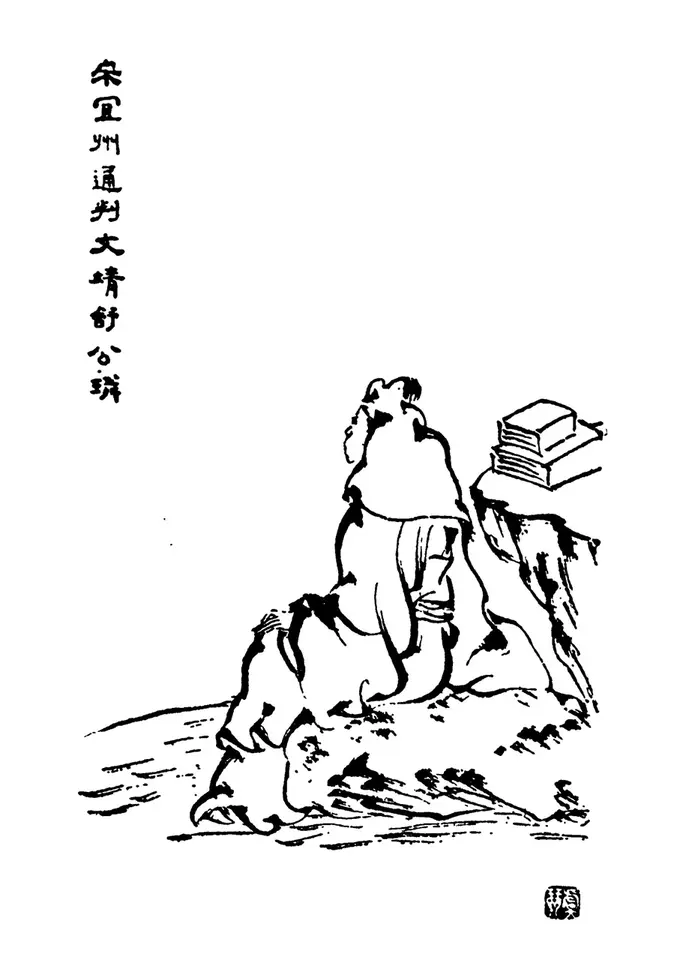
1136 CE–1199 CE
舒璘
Shu Lin (舒璘, 1136–1199), courtesy name Yuanzhi and style name Master Guangping, was a prominent Neo-Confucian thinker, educator, and dedicated civil official of the Southern Song dynasty from Fenghua, Qingyuan Prefecture (modern Ningbo, Zhejiang). Together with Yang Jian, Yuan Xie, and Shen Huan, he is celebrated in Chinese intellectual history as one of the "Four Masters of Chunxi" (or "Four Masters of Yongshang"), serving…
Shu Lin (舒璘, 1136–1199), courtesy name Yuanzhi and style name Master Guangping, was a prominent Neo-Confucian thinker, educator, and dedicated civil official of the Southern Song dynasty from Fenghua, Qingyuan Prefecture (modern Ningbo, Zhejiang). Together with Yang Jian, Yuan Xie, and Shen Huan, he is celebrated in Chinese intellectual history as one of the "Four Masters of Chunxi" (or "Four Masters of Yongshang"), serving as a pivotal figure in the development of the Siming School of Neo-Confucianism. Posthumously, he was awarded the esteemed title Wenjing. Entering the Imperial University (Taixue) in his youth to study the Cheng brothers' Yiluo learning, Shu passed the imperial examinations as a Jinshi in 1172. Philosophically, he became a foremost disciple of Lu Jiuyuan's School of Mind while also traveling long distances on foot to study with Zhu Xi, Lu Zuqian, and Zhang Shi, cultivating a uniquely integrative intellectual outlook. In his initial posting as Educational Instructor of Huizhou, Shu personally led daily lectures, composed Explanations of the Poetry and Rites (Shi Li Jiangjie), and revitalized the scholarly atmosphere, prompting Grand Councilor Liu Zheng to praise him as "the foremost educational instructor of our time." Although he served primarily in local prefectures and counties, including posts in Jiangxi, Pingyang, Xinzhou, and Xuanzhou, Shu maintained an ardent commitment to statecraft and popular welfare. During his tenure as Magistrate of Pingyang, he courageously petitioned the prefectural governor to repeal oppressive exactions and authored profound proposals on tea and salt policies, granary administration, and famine relief that were widely adopted by the court. Known for his "grounded" (pingshi) and "sincere and unfeigning" (dushi buqi) approach to moral cultivate, he rejected abstract metaphysical speculation in favor of ethical practice within daily human relations, leaving an enduring mark on the evolution of Song-Yuan-Ming intellectual thought.
Born into a scholarly family in Guangping, Fenghua, displaying exceptional intellect and moral gravity from childhood.
Enrolled in the Imperial University at Lin'an, immersing himself in the classical texts of the Northern Song Cheng school.
Passed the imperial metropolitan examinations, securing the Jinshi degree and beginning his official career.
Appointed Educational Instructor of Huizhou, compiling Explanations of the Poetry and Rites and transforming the regional academic culture.
Journeyed on foot to Wuzhou to study with Zhu Xi and Lu Zuqian, and later engaged in deep dialogues on mind learning with Lu Jiuyuan.
Assumed office as Magistrate of Pingyang, investigating the grievances of commoners and successfully petitioning to abolish burdensome levies.
Promoted community education and founded the Guangping Academy in his native village to lecture and guide regional disciples.
Appointed Controller-General of Xuanzhou, but succumbed to illness before formally assuming his post, aged sixty-four; later posthumously honored as Wenjing.
Shu Lin was born into a respected scholarly household in Guangping, Fenghua, during the early Shaoxing era. Although his family possessed modest economic means, he exhibited extraordinary intellectual curiosity and quiet moral solemnity from early youth. Influenced by the Yiluo Neo-Confucian teachings of Cheng Hao and Cheng Yi, he dedicated himself to comprehending the fundamental principles of human nature and heavenly mandate. During the Qiandao reign of Emperor Xiaozong, Shu gained admission to the prestigious Imperial University in Lin'an, where he immersed himself in the Confucian classics and ancient political treatises, distinguishing himself among his peers for intellectual rigor and moral rectitude.
In 1172, Shu Lin sat for the civil service examinations and passed as a Jinshi. Rather than resting upon this bureaucratic credential or pursuing superficial courtly rhetoric, he perceived that the contemporary examination literature had degenerated into utilitarian display. Determined to seek authentic moral philosophy, he traveled thousands of miles across southern China. Learning that Zhu Xi and Lu Zuqian were lecturing in Wuzhou, Shu walked on foot through all weather conditions to receive their instruction; he likewise traveled to Hunan and Jiangxi to consult with Zhang Shi and Lu Jiuyuan on the doctrine of the mind.
In these profound intellectual exchanges, Shu demonstrated an inclusive scholarly disposition. While contemporary intellectual circles were increasingly polarized between Zhu Xi's emphasis on the exhaustive investigation of things and Lu Jiuyuan's doctrine of directly recognizing the original mind, Shu Lin transcended factional dogmatism. He embraced Lu's direct, intuitive insight into moral nature while incorporating Zhu Xi's disciplined dedication to classical textual study and Lu Zuqian's broad synthesis of institutional history, laying the foundation for a deeply grounded, practical philosophy.
Upon entering official service, Shu Lin was assigned to serve as Educational Instructor in Huizhou Prefecture. Situated in the mountainous terrain of southern Anhui, Huizhou possessed flourishing lineages and active mercantile networks, but its government schools had fallen into disrepair, with scholars largely viewing classical study merely as an instrument for bureaucratic advancement. Arriving at his post, Shu resolved to revitalize scholarly virtue and make moral education a living reality. He led by personal example, conducting daily lectures regardless of winter cold or summer heat, and engaged students in intimate dialogues concerning filial piety, brotherly affection, and civic duty.
To counter the prevailing tendencies toward abstract metaphysical speculation or superficial memorization, Shu authored Explanations of the Poetry and Rites (Shi Li Jiangjie) as the foundational curriculum for the Huizhou academy. In this work, he translated the poetic emotions of the Classic of Poetry and the behavioral guidelines of the Rites into accessible principles for everyday conduct. For students who were intellectually slower or rigid, he displayed untiring patience, guiding them step by step toward moral clarity and self-discipline.
Within a few years, Huizhou's academic landscape underwent a profound transformation. Scholars throughout the prefecture not only copied and studied his treatises within their families, but also practiced propriety and upright conduct within their local lineages. When Grand Councilor Liu Zheng visited Huizhou on an imperial inspection tour and observed the remarkable discipline of the scholars, he was deeply impressed and submitted an official memorial commending Shu Lin as "the foremost educational instructor of our time," elevating Shu's reputation throughout the empire.
Following his tenure in Huizhou, Shu Lin served in a series of administrative roles, including Administrator of the Jiangxi Fiscal Commission, Magistrate of Pingyang County, and Educational Instructor of Xinzhou. Although he spent his entire career in regional and county administrations without reaching high ministerial offices at court, he never faltered in his devotion to good governance. Wherever he was stationed, he made it his primary duty to conduct firsthand investigations among the common people, examining peasant livelihoods, grain stores, and the true burden of tax obligations.
During his administration as Magistrate of Pingyang, the prefectural governor, eager to meet imperial revenue quotas, imposed harsh extraordinary levies and labor duties upon the county populace. Recognizing that the peasantry was on the brink of ruin, Shu Lin rode directly to the prefectural seat to plead on behalf of the commoners. He confronted the governor with rigorous moral arguments and detailed socio-economic evidence, warning of impending desertion and economic collapse. His fearless integrity and persuasive advocacy moved the governor, who relented and withdrew several oppressive levies, allowing the local population to recover.
Furthermore, drawing upon his administrative experience, Shu authored numerous policy memorials addressing systemic fiscal and social issues. In treatises such as On the Ever-Normal Granary, On Community Charity Granaries, On the Tea and Salt Administration, and Memorial to the Judicial Commissioner, he analyzed the exploitation inherent in state monopolies and the failures of local militia registration, offering concrete remedies. Many of his recommendations were adopted by provincial commissioners and imperial ministries, demonstrating his remarkable statecraft.
Beyond his administrative service, Shu Lin collaborated closely with fellow regional scholars Yang Jian, Yuan Xie, and Shen Huan, forging the influential Siming School (also called the Guangping-Dingchuan School). In his later years, Shu established the Guangping Academy in his native Fenghua, gathering disciples from across eastern Zhejiang, who venerated him as "Master Guangping."
Philosophically, Shu Lin is recognized as one of Lu Jiuyuan's paramount disciples, yet his interpretation of the School of Mind possessed distinct characteristics. Unlike Yang Jian, who emphasized sudden intuitive enlightenment and mystical transcendence, Shu championed "groundedness" (pingshi) and "sincerity without deception" (dushi buqi). He maintained that true learning does not consist in discussing ethereal ontological concepts, but in continuous self-examination through mundane human relationships. He formulated practical methods such as "simplified moral effort" (jianyi gongfu), "stripping away delusive cravings" (baoluo), and "earnest self-reflective reading," urging students to eliminate pride, greed, and vanity to let their original, moral mind manifest naturally.
In 1199, the court appointed Shu Lin as Controller-General of Xuanzhou. However, before he could assume his duties, he passed away from illness at his post at the age of sixty-four. His close friend Yang Jian composed an epitaph mourning his loss. During the Chunyou era, the imperial court honored his legacy by conferring the posthumous title Wenjing. Later, Qing dynasty scholars Huang Zongxi and Quan Zuwang honored Shu Lin and Shen Huan by dedicating the Guangping-Dingchuan Case in the Records of Song and Yuan Confucians, firmly cementing his status as a foundational patriarch of Song Neo-Confucianism.
FIGURES ASSOCIATED WITH THIS DYNASTY