Establishment at Lianchuan
Tufa Wugu fortifies Lianchuan Fortress, proclaims himself King of Xiping and Grand Chanyu, and inaugurates the Taichu era
397 CE–414 CE
南凉
The Southern Liang Dynasty (南凉, 397–414 CE) was a regional Xianbei regime during the Sixteen Kingdoms period in ancient Chinese history, established by Tufa Wugu (秃发乌孤) in the Hexi and Huangshui valleys. Originating from the northern steppes, the Tufa branch of the Xianbei migrated southwestward into the Longyou and Hexi regions during the early Cao Wei period. Following generations of nomadic pastoralism and local ascendancy, Tufa Wugu rebelled against Later Liang rule and established the…
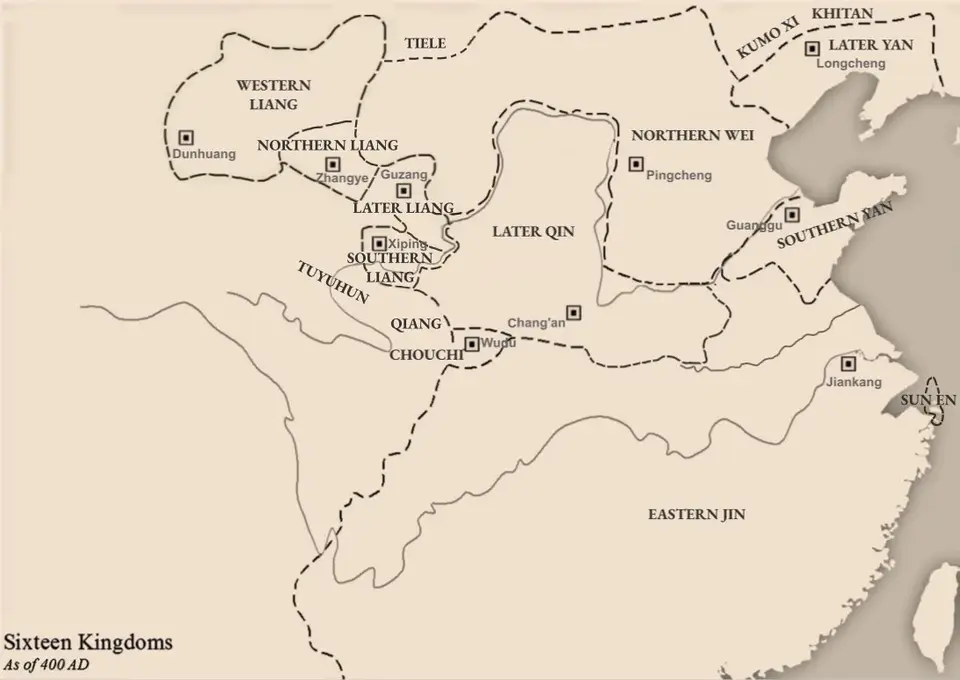
The Southern Liang Dynasty (南凉, 397–414 CE) was a regional Xianbei regime during the Sixteen Kingdoms period in ancient Chinese history, established by Tufa Wugu (秃发乌孤) in the Hexi and Huangshui valleys. Originating from the northern steppes, the Tufa branch of the Xianbei migrated southwestward into the Longyou and Hexi regions during the early Cao Wei period. Following generations of nomadic pastoralism and local ascendancy, Tufa Wugu rebelled against Later Liang rule and established the state in 397 CE at Lianchuan Fortress, adopting the titles of Grand Chanyu and King of Xiping. Subsequent rulers Tufa Lilugu and Tufa Rutan expanded the territory across the Huangshui valley and acquired the strategic Hexi regional capital of Guzang. Southern Liang adopted traditional Chinese institutional practices, establishing commanderies and counties, promoting agriculture among relocated Han farming communities, patronizing Confucian state academies, and granting protection to Buddhist monks such as Master Tanhuo. However, situated amid hostile neighbors including Northern Liang, Western Qin, and Xia, the regime suffered disastrous military defeats under Tufa Rutan at Yangwu and Qiongquan. In 414 CE, while Rutan was campaigning westward against the Yifu tribe, Qifu Chipan of Western Qin captured the capital Ledu, bringing Southern Liang to an end after eighteen years of rule across three sovereigns.
Tufa Wugu fortifies Lianchuan Fortress, proclaims himself King of Xiping and Grand Chanyu, and inaugurates the Taichu era
Southern Liang forces seize five commanderies south of the mountains including Guangwu, Huanghe, Jiaohe, Ledu, and Xiping
Tufa Wugu dies following a riding injury, and his younger brother Tufa Lilugu accedes to the throne and moves the capital to Xiping
Tufa Lilugu settles Han farming families along the Huangshui River, promotes silk and cereal production, and establishes academies
Tufa Lilugu dies, and Tufa Rutan ascends the throne, adopting the title King of Liang and relocating the capital to Ledu
Tufa Rutan presents horses and livestock to Later Qin, receiving military command over Hexi and moving his capital into Guzang
Tufa Rutan refuses an alliance with Helian Bobo of Xia and suffers a devastating defeat at Yangwu, losing most elite commanders
Southern Liang launches an offensive against Northern Liang but suffers tactical repulse by Juqu Mengxun at Junshi
Tufa Rutan leads fifty thousand cavalry against Northern Liang at Qiongquan, suffering total destruction of his army and fleeing alone
While Tufa Rutan campaigns west, Western Qin captures the capital Ledu, forcing Rutan to surrender and extinguishing Southern Liang
The ruling elite of Southern Liang belonged to the Tufa branch of the Xianbei people, who traced their ancestry to the eastern nomadic tribes of the northern steppes. In the early third century during the Cao Wei period, tribal chieftain Tufa Pigu led his followers southwestward into the Longyou region and the eastern Hexi Corridor. Over subsequent generations, the Tufa Xianbei grazed their herds across pasturelands extending from Maitian and Qiantun westward to Shiluowei, and from the Jiaohe river northward to the edge of the desert. During the Western Jin dynasty, tribal leader Tufa Shujineng led a fierce regional uprising against imperial authorities that convulsed northwestern China for a decade. By the late fourth century under Tufa Wugu, the tribe had gathered substantial military strength and political cohesion.
Following the conquest of the Hexi Corridor by Lu Guang of Later Liang, imperial titles were conferred on Tufa Wugu to secure his nominal allegiance. Wugu nevertheless pursued independent strategic autonomy. He constructed the fortified stronghold of Lianchuan Fortress, brought neighboring Qiang and nomadic groups under submission, and accumulated grain and livestock. In 397 CE, taking advantage of internal dynastic strife within Later Liang, Tufa Wugu openly broke ties with Lu Guang, assuming the titles of Grand Commandant, General-in-Chief, Grand Chanyu, and King of Xiping, establishing the Southern Liang state. In 398 CE, Southern Liang seized the strategic commanderies of Guangwu, Huanghe, Jiaohe, Ledu, and Xiping, securing the rich agricultural and pastoral corridor of the Huangshui River.
In 399 CE, Tufa Wugu died following internal injuries sustained in a fall from his horse while intoxicated. His younger brother Tufa Lilugu succeeded him, assuming the title King of Wuwei and relocating the royal seat to Xiping. Recognizing the limits of military plunder, Lilugu shifted policy toward institutional stabilization and economic consolidation. He settled Han farming populations around fortified settlements in the fertile Huangshui valley, distributed farmland and draft oxen, and encouraged sericulture and cereal cultivation. He also established academies to educate royal sons and maintained diplomatic stability with neighboring regional powers.
Upon Lilugu's death in 402 CE, his younger brother Tufa Rutan took the throne, adopting the title King of Liang, changing the reign era to Hongchang, and transferring the capital to Ledu. Rutan possessed broad literary learning, strategic insight, and ambitious imperial aspirations. Seeking control of Guzang, the economic and cultural hub of Hexi, Rutan cultivated diplomatic ties with Emperor Yao Xing of Later Qin. In 406 CE, Rutan dispatched three thousand prime cavalry mounts and thirty thousand sheep to Changan. In response, Later Qin appointed Rutan Commander-in-Chief of Military Affairs in Hexi and Regional Inspector of Liangzhou, granting him administrative custody of Guzang. Rutan moved his court into Guzang, bringing Southern Liang to the zenith of its geopolitical power and prestige.
The acquisition of Guzang proved a mixed blessing, plunging Southern Liang into endless regional rivalries. Tufa Rutan grew overconfident and initiated aggressive multi-front military campaigns. To the north, Southern Liang clashed persistently with Juqu Mengxun of Northern Liang for hegemony over the central corridor. To the east, Rutan rejected a marital alliance proposal from Helian Bobo, the formidable founder of the Xia state, provoking violent retaliatory raids. In 407 CE, Helian Bobo routed Southern Liang armies at Yangwu, wiping out the majority of Rutan's seasoned veteran commanders and nearly capturing the king himself.
Despite severe losses, Rutan refused to rest his exhausted forces. In 408 CE, Southern Liang mounted a massive punitive expedition against Northern Liang, only to be ambushed and routed by Juqu Mengxun at Junshi. In 410 CE, Rutan staked the remaining military resources of the state, gathering fifty thousand elite cavalry to confront Juqu Mengxun at Qiongquan. The battle resulted in complete catastrophe for Southern Liang: encircled and cut down on open ground, almost the entire cavalry force was slaughtered or captured, and Tufa Rutan escaped back to Guzang with only a handful of mounted retainers. The disaster at Qiongquan permanently broke Southern Liang military capability.
In the wake of Qiongquan, Southern Liang found itself defenseless and economically paralyzed. Years of destructive warfare and neglected farming coincided with widespread drought and locust plagues, leaving farmland uncultivated and triggering devastating famine throughout the Hexi and Huangshui basins. As Northern Liang forces repeatedly laid siege to Guzang and Western Qin cavalry raided southern frontiers, Rutan could no longer maintain his position in the north. In 411 CE, he evacuated Guzang, allowing Juqu Mengxun to occupy the metropolis, while the battered Southern Liang court retreated back to its old redoubt at Ledu.
At Ledu, resources remained critically scarce. In a desperate gamble to restock food supplies and livestock, Tufa Rutan personally led his remaining troops west of Qinghai Lake in 414 CE to campaign against the pastoral Yifu Xianbei, leaving Crown Prince Tufa Wutai to garrison Ledu. Although Rutan successfully routed the Yifu and seized over four hundred thousand cattle and sheep, Qifu Chipan of Western Qin exploited the domestic vacuum, launching a rapid strike that stormed Ledu and captured the entire royal family and administration. Deprived of a homeland and surrounded by hostile terrain, Tufa Rutan surrendered to Western Qin. While initially granted honorary rank, Rutan was poisoned to death by Qifu Chipan a year later. Southern Liang was fully absorbed into Western Qin territory after eighteen years of existence.
Southern Liang developed an administrative structure that fused traditional Chinese civil institutions with nomadic tribal authority. At its founding, Tufa Wugu assumed the traditional Han title King of Xiping alongside the title Grand Chanyu, symbolizing supreme leadership over non-Chinese steppe confederations. As the state deepened its administrative integration, the Chanyu title lapsed, and governance was organized around the Department of State Affairs (Shangshu Sheng). Central executive posts included Grand Commandant, Supervisor of the Department of State Affairs, and Left and Right Servants (Puye), which managed imperial policy implementation.
While central offices adhered to standard bureaucratic patterns, supreme military and executive commands remained firmly concentrated within the royal Tufa clan (Tufa Branch of Xianbei). Tufa Rutan appointed his kinsman Juyan as Grand Commandant, while employing Han civil officials Zhao Chao and Guo Xing as Left and Right Servants. Other specialized offices included the Chamberlain for the Palace Guard, Minister of Finance, Erudite Sacrificer, and Director of Historical Records. The late-Qing scholar Miao Quansun compiled the Table of Officials of Southern Liang, documenting the elaborate functional distribution of offices within this regional court.
In territorial administration, Southern Liang discarded nomadic tribal fiefdoms in favor of the traditional commandery and county system. At its maximum territorial reach, the regime governed more than ten commanderies spanning the modern Gansu-Qinghai border, including Xiping, Ledu, Huanghe, Guangwu, Jiaohe, Wuwei, Changsong, and Fanhe. Subordinate county magistrates were appointed to register households, settle land disputes, and collect agrarian taxes.
To protect critical strategic corridors and transit routes, Southern Liang established military protectorships and regional governorships. Regional inspectors and commandery governors oversaw border fortresses and transit passes. In managing surrendered and allied tribal populations, the court maintained the office of Colonel Protecting the Qiang, balancing administrative surveillance with tribal cavalry recruitment.
Recognizing that stable territorial administration required civilian expertise, successive Southern Liang rulers pursued an open policy of patronizing and recruiting Han gentry and prominent regional lineage heads. From Tufa Wugu through Tufa Rutan, the regime actively sought out scholars and experienced administrators from Longyou and the Hexi Corridor.
Prominent Han figures from prominent clans, such as Jin Shisheng, Yang Gui, Yin Xun, Shi Hao, Liang Chang, Jin Shu, and Zhao Zhen, were appointed to key court positions as imperial secretaries, palace attendants, and treasury recorders. Tufa Lilugu placed great trust in Shi Hao to formulate court rituals, while Tufa Rutan relied heavily on Zong Chang to draft imperial rescripts and military dispatches. The participation of Han elites supplied legal coherence, fiscal administrative competence, and political stability to the nomadic-founded court.
The core fighting echelon of the Southern Liang military consisted of Xianbei horsemen from the ruling Tufa tribe, traditionally referred to as State Men (Guoren). Every able-bodied adult male in the tribe was trained in archery and mounted warfare, serving as an elite heavy or light cavalryman during wartime while tending herds in peacetime. Because of their limited numbers, these tribal retainers formed the primary royal bodyguard and spearhead units, and overall command was entrusted almost exclusively to royal princes.
In addition to the Xianbei core, the army incorporated substantial contingents of regional Qiang warriors, surrendered nomadic horsemen, and recruited Han infantry. During the peak campaigns under Tufa Wugu and Tufa Rutan, field armies numbered tens of thousands of combined cavalry and foot soldiers. However, the heavy reliance on the tribal cavalry core meant that catastrophic battlefield casualties among the Xianbei warriors could rapidly cause the entire military structure to collapse.
Military conflict was a continuous reality throughout Southern Liang history. Under Tufa Wugu, offensive action centered on subjugating neighboring nomadic tribes and exploiting the decline of Later Liang to seize strategic frontier commanderies. Wugu utilized mobile cavalry maneuvers combined with mountainous defenses around Lianchuan and Xiping to defeat opposing expeditions.
Under Tufa Rutan, however, military strategy deteriorated into reckless expansion and frequent raids for plunder. Rutan engaged in perpetual campaigns against Northern Liang and Xia without adequate logistical reserves or diplomatic preparation. Overconfidence and inadequate reconnaissance produced fatal battlefield reverses, culminating in the rout at Junshi, the massacre of senior commanders at Yangwu, and the total annihilation of fifty thousand cavalry at Qiongquan. These successive disasters stripped the state of its defensive shielding and left it defenseless before Western Qin.
Geographically hemmed in by Later Liang, Northern Liang, Western Qin, Later Qin, and Xia, Southern Liang relied on flexible and opportunistic diplomacy. Early in his reign, Tufa Wugu followed the counsel of Yang Tong, adopting a strategy of peaceful accommodation with Western Qin and Northern Liang while concentrating military pressure against Later Liang to secure control over Guzang.
Toward the powerful court of Later Qin in Guanzhong, Southern Liang adopted a submissive tributary posture. Tufa Rutan secured administrative possession of Guzang in 406 CE through tributary gifts of horses and livestock to Yao Xing. However, this accommodation unraveled as Later Qin weakened under attack from Helian Bobo. Simultaneously, relations with the Qifu rulers of Western Qin shifted from early wartime cooperation into lethal territorial confrontation, culminating in the opportunistic invasion by Qifu Chipan that extinguished Southern Liang.
Prior to state foundation, the Tufa Xianbei subsisted primarily through pastoral grazing and mounted hunting. Recognizing that regional survival required dependable grain supplies, Tufa Wugu instituted policies to protect farming communities and prohibited his cavalry from ravaging crops.
Tufa Lilugu significantly expanded agricultural encouragement policies to provide sustainable supplies for the army and court. He concentrated large numbers of displaced Han refugees in fertile tracts along the Huangshui River, supplying them with seeds, draft oxen, and iron implements. Under official oversight, extensive irrigation ditches were excavated and uncultivated lands were turned into productive grain fields and mulberry groves, providing essential fiscal revenue for the expanding state.
To bolster border defenses and replenish labor in underpopulated zones, Southern Liang implemented compulsory population relocations. In 406 CE, following the occupation of Guzang, Tufa Rutan forcibly moved more than thirty thousand Qiang households from Xiping and the Huangshui basin to the commanderies of Wuxing, Fanhe, Wuwei, and Changsong to reclaim desolate farmland and secure military supply lines.
Parallel to settled agriculture, pastoral husbandry remained an indispensable economic pillar. The fertile lake basins around Qinghai Lake and the southern foothills of the Qilian Mountains provided prime pasture for immense herds of warhorses, camels, cattle, and sheep. Livestock breeding guaranteed horse mounts for cavalry forces and provided primary tribute goods and trade commodities for diplomatic transactions with central Chinese courts.
Despite agricultural initiatives, the economic foundation of Southern Liang remained inherently vulnerable. Tribal elites frequently reverted to armed plunder to balance court expenses, neglecting the protection of rural labor.
During the final decade under Tufa Rutan, incessant border warfare against Northern Liang severely damaged agrarian cycles, as opposing forces routinely burned and seized crops before harvest. Protracted devastation, compounded by prolonged droughts and insect infestations, brought total economic collapse, leaving farmland untilled for successive seasons. Although minister Meng Kai urged the opening of grain markets to facilitate commercial relief, persistent warfare rendered widespread relief impossible, and severe famine precipitated the final downfall of the dynasty.
The rulers of Southern Liang showed profound admiration for traditional Chinese civilization and regarded Confucian scholarship and formal state education as pillars of governance. During the reign of Tufa Lilugu, an official state academy was established in the capital Xiping to educate sons of civil and military officials. Renowned Han scholars, including Tian Xuanchong and Zhao Dan, were appointed as Erudite Sacrificers to teach classical texts.
In the realm of official historiography, Tufa Wugu instituted the office of Director of Historical Records, appointing the scholar Guo Shao to record court debates and administrative transactions. Guo Shao compiled the Tuoba Liang Lu in ten scrolls, establishing the precedent among non-Han regimes of the Sixteen Kingdoms for compiling an official contemporary dynastic history and providing an invaluable factual foundation for later imperial histories.
During the Sixteen Kingdoms period, the Hexi and Longyou regions served as critical conduits for Buddhist transmission between Central Asia and the Chinese interior. Southern Liang rulers extended generous patronage to eminent monks and treated monastic leaders as spiritual counselors.
During the reigns of Tufa Lilugu and Tufa Rutan, the eminent monk Master Tanhuo journeyed from Henan to Xiping, where he delivered lectures on Mahayana scriptures. Tanhuo won profound devotion from both the royal court and common populace, leading to widespread Buddhist adherence throughout the Huangshui region. The patronage of Buddhism stimulated monastic architecture and cave temple construction, helping alleviate social tensions and soften tribal antagonisms across the multi-ethnic borderland.
Southern Liang society encompassed a diverse demographic mixture of Xianbei, Han, Qiang, Di, and Lushui Hu populations, creating a vibrant milieu of cultural and biological assimilation. The ruling Tufa clan established close marital and military ties with regional Qiang clans while assimilating Chinese administrative and linguistic norms.
Following the fall of Southern Liang in 414 CE, its tribal populations dispersed across the northwest. Tufa Rutan's son Tufa Poqiang led a substantial royal contingent to seek refuge with the burgeoning Northern Wei dynasty. Recognizing their shared Xianbei royal origins, Emperor Taiwu of Northern Wei commended his valor, bestowed upon him the prestigious imperial surname Yuan, and renamed him Yuan He. Yuan He rose to the rank of Grand Commandant and Grand General of the Western Expedition, and his descendants flourished into the illustrious Henan Yuan clan of the Sui and Tang dynasties, symbolizing the enduring legacy of ethnic integration sparked by Southern Liang.
| Temple Name | Posthumous Name | Personal Name | Reign Period | Reign Eras | Tomb | Historical Assessment and Major Events |
|---|---|---|---|---|---|---|
| Liezu | King Wu | Tufa Wugu | 397–399 CE | Taichu | Kangling | Founded the state at Lianchuan, subdued neighboring tribes, and annexed the five southern commanderies from Later Liang |
| Unrecorded | King Kang | Tufa Lilugu | 399–402 CE | Jianhe | Huangling | Moved capital to Xiping, settled Han refugees along Huangshui, expanded farming, and fostered Confucian education |
| Unrecorded | King Jing | Tufa Rutan | 402–414 CE | Hongchang, Jiaping | Jingling | Took control of Guzang and led state to its zenith; ruined army through ceaseless campaigns, resulting in surrender to Western Qin |
In the Book of Jin, the appraisal in the Chronicle of Tufa Wugu states that Tufa Wugu demonstrated outstanding martial resolve in seizing the strategic node of Lianchuan and carving out the five southern commanderies across the fertile Huangshui. Lilugu consolidated this foundation through agricultural promotion, moral governance, and classical scholarship. Rutan carried forward this royal inheritance, entering Guzang and cultivating elegant administrative traditions. Yet Rutan overreached in ambition and relied excessively on warfare, squandering his forces at Junshi and fleeing in isolation from Qiongquan, ultimately bringing about dynastic collapse through ceaseless military adventurism.
In the Spring and Autumn Annals of the Sixteen Kingdoms, Cui Hong observed that the Tufa clan held sway across the Hexi region over three reigns and two decades. With Wugu's vigor, Lilugu's enlightened administration, and Rutan's combined civil and military talents, they established a viable dynastic presence. However, situated in a precarious corridor surrounded by hostile states, Southern Liang exhausted its grain reserves and domestic workforce in unending armed conflicts, meeting a tragic end on the battlefield.
As one of the five Liang dynasties of the Sixteen Kingdoms period, Southern Liang left a lasting imprint on regional development in northwestern China. In terms of geographical development, its rulers settled large Han agrarian populations alongside nomadic tribes in the Huangshui basin of eastern Qinghai, constructing urban centers and defensive outposts such as Ledu, Xiping, and the Hutai inspection platform, which transformed the region into a thriving agricultural-pastoral corridor. Culturally, Southern Liang established Confucian academies, introduced Han-Wei administrative codes, and pioneered contemporary dynastic history compilation with the Tuoba Liang Lu. Following its fall, the integration of its people and the emergence of the aristocratic Henan Yuan lineage in the Northern Wei and Tang dynasties constituted a vital link in the broader historical unification of Chinese ethnic groups.