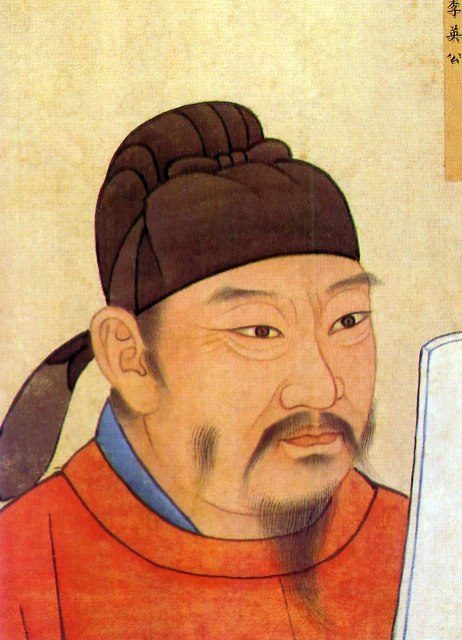
Biography
Family Background and Early Life
Li Ji came from the Shangfang branch of the Xu clan of the Northern Ancestors of Gaoping and was originally a native of Lihu, Caozhou, now Dongming County, Heze, Shandong. In the final years of the Sui dynasty the family moved to Weinan County, Huazhou, in present-day southeastern Xun County, Henan. The Xu household had originally been wealthy; historical sources record that it “had many servants and accumulated several thousand zhong of grain.” Xu Shiji and his father Xu Gai were both charitable and assisted the poor regardless of whether they were close to the family.
By the Daye era of the Sui, the realm was already in disorder. In 611, at age seventeen, Xu saw the turmoil and joined Zhai Rang’s Wagang Army near his home. He advised Zhai: “The surrounding area is your native place and mine; our fellow villagers should not be harmed. Songzhou and Zhengzhou lie near the imperial canal and have many traveling merchants. It is very convenient to seize public and private wealth there.” Zhai approved. The Wagang forces then plundered public and private goods along the canal. With funds available, followers quickly gathered, and before long the force numbered more than 10,000.
Years with the Wagang Army
In 616 the Sui sent the famous general Zhang Xutuo with more than 20,000 troops against the Wagang Army. Zhai Rang was frightened and wanted to flee, but Xu Shiji stopped him. The Wagang forces lured the enemy forward and struck from ambush, destroying the Sui army and killing Zhang Xutuo. Xu Shiji joined Li Mi and Wang Bodang in encircling the Sui troops and earned merit in the battle.
At the time, Li Mi, Duke of Pushan, had participated in Yang Xuangan’s rebellion and fled after its defeat. Xu Shiji and Wang Bodang of Junyi regarded Li Mi as a great hero of the age and jointly urged Zhai Rang to acknowledge him as leader in order to attract support and expand the movement. In 617 Li Mi assumed the title Duke of Wei and distributed offices and ranks widely. Xu was appointed General-in-Chief of the Right Military Guard and placed in command of his own troops.
That same year, the Sui ordered Wang Shichong, acting governor of Jiangdu, and others to campaign against Li Mi. Xu used unusual stratagems and repeatedly defeated Wang on both banks of the Luo River, for which Li Mi enfeoffed him as Duke of Donghai Commandery. Henan and Shandong were then suffering severe flooding and famine, and Sui relief was inadequate; tens of thousands were said to starve each day. Xu advised Li Mi: “The realm is in disorder fundamentally because of hunger. If we capture the state granary at Liyang, our great undertaking can succeed.” Li Mi accepted the proposal and sent Xu with 5,000 men across the Yellow River from Yuanwu to surprise the Sui defenders of the Liyang granary. Xu took it that same day and opened the stores to the people. Within ten days more than 200,000 men had joined his forces.
Internal conflict then erupted in the Wagang Army. Li Mi killed Zhai Rang at a banquet. In the chaos, Xu Shiji was slashed by a soldier and seriously wounded; Wang Bodang quickly intervened and saved him. To stabilize the army, Li Mi personally treated Xu’s wound and sent Shan Xiongxin to pacify Zhai Rang’s former followers, assigning them respectively to Xu Shiji, Shan Xiongxin, and Wang Bodang.
In the third lunar month of 618, Right Garrison General Yuwen Huaji killed Emperor Yang of Sui, Yang Guang, at Jiangdu. In the fifth lunar month Li Mi sent Xu against the rebel Wang Deren to avenge the killing of Fang Yanzao. Xu defeated Wang Deren and forced him to submit to Tang ruler Li Yuan. Xu then defended the Liyang granary. Yuwen Huaji surrounded the city from all directions, creating a severe crisis. Li Mi personally brought 500 cavalry to reinforce it, while Xu had a tunnel dug outward from inside the city and suddenly emerged outside the walls. The two forces attacked from inside and out, decisively defeating Yuwen Huaji and forcing him to lift the siege.
Submission to the Tang and Bestowal of the Imperial Surname
In the tenth lunar month of 618, Li Mi was defeated by Wang Shichong and led his remaining followers to surrender to the Tang. The territories Li Mi had previously controlled were administered by Xu Shiji, extending east to the sea, south to the Yangtze, west to Ruzhou, and north to Wei Commandery.
In 619 Xu told his chief secretary Guo Xiaoke: “The Duke of Wei has already submitted to the Great Tang. The people and lands here belonged to him. If I submit a memorial offering them, I would be profiting from my lord’s defeat, claiming merit for myself, and seeking wealth and rank through it. I regard that as shameful. We should instead record in full the names and numbers of the prefectures and counties and the registered military and civilian households, report everything to the Duke of Wei, and let him present them to the court himself. Then the merit will be his.” Xu therefore sent a messenger with a letter to Li Mi. When the messenger first reached court, Li Yuan was surprised that Xu had sent no memorial and had written only to Li Mi. After learning Xu’s intention, Li Yuan was delighted and said: “Xu Shiji remembers his lord’s kindness and yields the merit; he is truly a pure minister.” Li Yuan appointed him Area Commander of Liyang and Supreme Pillar of State, initially enfeoffed him as Duke of Lai, then additionally appointed him General-in-Chief of the Right Military Guard, changed his title to Duke of Cao, and bestowed the surname Li. He was entered into the imperial clan register and granted fifty qing of good farmland and one first-class residence. From then on Xu Shiji became Li Shiji.
Soon afterward Li Yuan ordered Li Shiji to command forces in Henan and Shandong against Wang Shichong. In the ninth lunar month, the Hebei warlord Dou Jiande attacked Xiangzhou. Li Shentong, Prince of Huaiyang and Pacification Commissioner of the Shandong circuit, retreated to Liyang. In the eleventh lunar month Dou captured Liyang. Li Gai, formerly Xu Gai and now also bearing the Li surname, was captured together with Li Shentong, Wei Zheng, Princess Tong’an, and others. Li Shiji withdrew across the river with several hundred cavalry, but because his father was a captive he had no choice but to return and surrender. Dou held Li Gai as a hostage and left Li Shiji in command of Liyang.
Li wanted to return to the Tang but feared that doing so would endanger his father. After secretly consulting Guo Xiaoke, he decided first to render service to Dou and gain his trust. Soon afterward he attacked Wang Shichong’s forces at Huojia, defeating them and taking many heads and captives, which brought him close to Dou. Once he had gained Dou’s confidence, Li persuaded him to campaign personally in Henan, intending to kill him when the opportunity arose. Dou delayed departure because his wife gave birth. Unable to attack Dou, and after a separate plan to kill Dou’s commander Cao Dan was exposed, Li and Guo Xiaoke fled to the Tang with several dozen cavalrymen.
Pacification Campaigns under Emperor Taizong
After returning to the Tang, Li Shiji followed the Prince of Qin, Li Shimin, in campaigns against Liu Wuzhou, Wang Shichong, Dou Jiande, Liu Heita, Xu Yuanlang, and other regional powers, repeatedly earning distinction. In 623 he followed Li Xiaogong, Prince of Zhao Commandery, and Li Jing in the campaign against Fu Gongshi.
In 625, the eighth year of Wude, Turkic forces invaded and Li Shiji campaigned against them. In 629 he and Li Jing advanced on separate routes and crushed the Eastern Turks, returning with 50,000 captives. He then guarded Bingzhou for sixteen years and became a formidable presence on the northern frontier. In 641 he decisively defeated Xueyantuo at Nuozhen Water, in present-day Ulanqab, Inner Mongolia. In 644 he accompanied Emperor Taizong on the imperial campaign against Goguryeo.
Reign of Emperor Gaozong and Final Years
Late in his reign, Emperor Taizong once told Crown Prince Li Zhi: “Li Ji values gratitude and righteousness. You have shown him no favor, and I fear he may not devote himself fully to assisting you in the future. I shall first send him out of the capital. After I die and you succeed to the throne, summon him back and appoint him vice director. In this way you will have bestowed favor on him, and he will swear loyalty to you unto death.” To secure Li Ji’s loyalty to Li Zhi, Emperor Taizong demoted him to governor of Diezhou, in present-day Diebu, Gansu. After Emperor Gaozong succeeded to the throne, he followed Taizong’s final instructions, restored Li Ji, and successively appointed him Left Vice Director of the Department of State Affairs and Minister of Works.
In 655, the sixth year of Yonghui, Emperor Gaozong asked Li Ji: “I wish to make Lady Wu, the Zhaoyi, empress. What do you think?” Li replied: “This is Your Majesty’s family affair; why ask outsiders?” This answer removed the final obstacle to Gaozong’s installation of Wu Zetian as empress.
In 666, at age seventy-two, Li Ji was appointed commander-in-chief of the Liaodong expeditionary army and again campaigned against Goguryeo. In 668 he led his army to the Yalu River and joined Xue Rengui at Pyongyang. They captured the city, returned in victory, and destroyed Goguryeo. On the wushen day, the third day of the twelfth lunar month of 669, Li Ji died aged seventy-six. Emperor Gaozong suspended court for seven days, posthumously granted him Defender-in-chief and Area Commander-in-Chief of Yangzhou, gave him the posthumous name Zhenwu, and buried him as an attendant tomb at Zhaoling.