Biography
Family Background and Early Life
Xue Rengui belonged to the southern branch of the Hedong Xue clan and was a sixth-generation descendant of the Northern Wei general Xue Andu. His great-grandfather Xue Rong, grandfather Xue Yan, and father Xue Gui successively held office under Northern Wei, Northern Zhou, and the Sui Dynasty. His father died early, however, and the family's fortunes declined. Xue Rengui grew up poor and made his living by farming. When he prepared to relocate his ancestors' graves, his wife, Lady Liu, urged him to wait for an opportunity to display his exceptional ability. The emperor was then personally campaigning in Liaodong and recruiting brave warriors; she advised him to seek merit and fame first and move the graves after attaining wealth and rank. Xue followed her advice, presented himself to General Zhang Shigui, and entered military service.
Enlistment and Campaign against Goguryeo
In 645, the nineteenth year of Zhenguan, Emperor Taizong personally campaigned against Goguryeo. At the Andi battlefield in Liaodong, the officer Liu Junqiong was surrounded by Goguryeo troops. Xue Rengui charged alone into the enemy, killed an opposing officer, hung the man's head from his saddle, and forced the attackers back, rescuing Liu and making his own reputation. In the sixth month the Tang army advanced to Ansi. Yeon Gaesomun sent the generals Go Yeonsu and Go Hyejin with a force said to number 250,000. Xue dressed in white, carried a decorated halberd and two bows, and shouted as he charged. The Goguryeo line broke before him, and the Tang army won a major victory, reportedly taking more than 20,000 heads. Taizong summoned Xue afterward, awarded him two horses, forty bolts of silk, and ten captives, promoted him to Youji General and Guoyi of Yunquan Command, and assigned him long-term service at the northern palace gate. On the return march, Taizong told him that his veteran generals had grown old and that no new warrior surpassed Xue; he was happier, the emperor said, to have gained Xue than to have gained Liaodong. Xue was then promoted to Right General of the Gentlemen of the Leading Guard and placed in charge of Xuanwu Gate.
Protecting the Emperor and Eastern Campaigns
In the summer of 654, the fifth year of Yonghui, Emperor Gaozong visited Wannian Palace with Xue among the guards. On the night of the third day of the intercalary fifth month, heavy rain caused a flash flood that rushed toward Xuanwu Gate. The guards fled. Xue angrily declared that when the Son of Heaven was in danger, no one should dare flee from death. He climbed onto the gate structure and shouted a warning to the palace. Gaozong escaped in time, and the flood soon inundated the sleeping quarters. The emperor thanked Xue, saying that his warning had saved him from drowning and shown him what a loyal minister was, and awarded him an imperial horse.
In 657 Su Dingfang campaigned against the Western Turkic leader Ashina Helu. Xue memorialized the throne recommending that Nishou's family be returned in order to make clear that Helu, rather than the Nishou group, was the enemy. Gaozong accepted the proposal, and the grateful Nishou people asked to serve with the Tang army. In 658 Xue served as deputy to Cheng Mingzhen in a campaign against Goguryeo and defeated Goguryeo troops at Guiduan Fortress, taking three thousand heads. In 659 he fought at Hengshan alongside Liang Jianfang, Qibi Heli, and others against the Goguryeo commander On Samun, riding ahead of the line and reportedly never missing with his arrows. He later captured a skilled Goguryeo archer alive at Shicheng. In the twelfth month he and Xin Wenling defeated the Khitan at Heishan and captured the Khitan king Abugu. For this he was appointed General of the Left Wuwei Guard and Baron of Hedong County.
Three Arrows at Tian Shan
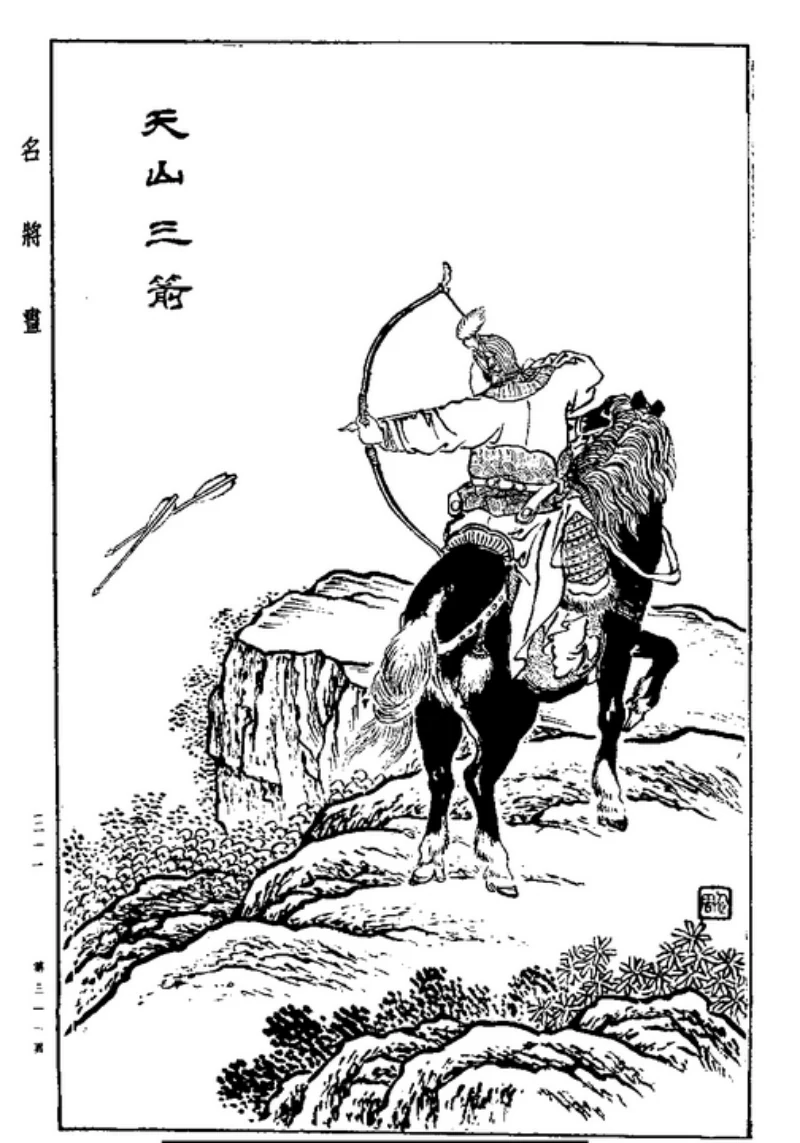
In 661, the first year of Longshuo, the Tiele attacked the frontier. Gaozong appointed Zheng Rentai chief commander and Xue Rengui his deputy against the Nine-Surname Tiele. Before departure, Gaozong held a banquet in the inner palace and ordered Xue to shoot through five layers of armor. Xue pierced them with one arrow, astonishing the emperor, who rewarded him with strong armor. In 662, when the Tang army reached Tian Shan, the Nine-Surname Tiele assembled more than 100,000 men and sent several dozen elite riders to challenge the Tang force. Xue shot three men with three arrows; the other riders dismounted and surrendered. He then pressed the attack, routed the Tiele, killed surrendered troops, pursued the enemy north of the desert, and captured three brothers of a yabghu. A song circulated in the army: “The general with three arrows pacified Tian Shan; the warriors sing long songs as they enter the Han passes.” The Nine Surnames declined thereafter. Zheng Rentai, however, advanced rashly with 14,000 cavalry far across the desert to the Xian'e River, found no enemy, and returned after exhausting his supplies; men and horses reportedly ate one another, and only one in twenty re-entered the frontier. Xue was also impeached for taking a Tiele woman as a concubine and accepting excessive gifts, but his earlier merit spared him punishment.
Conquest of Goguryeo
In 666, the first year of Qianfeng, Yeon Gaesomun died. His son Yeon Namsaeng succeeded him but was driven out by his brothers Yeon Namgeon and Yeon Namsan and fled to Tang for aid. Gaozong sent Qibi Heli, Pang Tongshan, Gao Kan, and others against Goguryeo, with Xue commanding supporting troops. When Pang was attacked at night near Sinseong, Xue came to the rescue and took more than one hundred heads. At Jinshan, Pang's army was defeated, but Xue struck across the enemy line and routed it, reportedly taking more than 50,000 heads. He then captured Namsu, Mokjeo, and Changam fortresses and joined Yeon Namsaeng. Gaozong issued an edict praising him for placing himself at the head of his soldiers, disregarding his own life, attacking in every direction, and meeting no equal. In the eleventh month, Xue led 2,000 men against Buyeo Fortress. Other commanders thought the force too small, but he answered that success depended on how a commander used troops, not on sheer numbers. He routed the defenders, reportedly killed or captured more than 10,000 men, and took the fortress. More than forty settlements in the Buyeo River region then submitted. In 668, Xue joined Li Ji before Pyongyang and Goguryeo fell. The Tang established the Andong Protectorate. Xue and Liu Rengui remained at Pyongyang with 20,000 troops; Xue was appointed General-in-Chief of the Right Weiwei Guard, Duke of Pingyang Commandery, and acting Protector-General of Andong. At Sinseong he cared for orphans, supported the elderly, suppressed banditry, and promoted capable men, winning the acceptance of the local population.
Defeat at Dafei River and Later Years
In 670, the first year of Xianheng, the Tang sought to strike the Tibetan Empire and restore Tuyuhun. Xue Rengui was appointed Grand Chief Manager of the Luoxuo Route, with Ashina Daozhen and Guo Daifeng as deputies, and led 50,000 troops escorting the Tuyuhun ruler back toward Qinghai. Guo Daifeng, son of the famous general Guo Xiaoke, resented serving under Xue and frequently ignored his orders. Xue left Guo to guard the baggage at Dafei River while he led light troops to Wuhai, where he defeated Tibetan forces and captured more than ten thousand cattle and sheep. Guo disobeyed his orders and moved slowly with the baggage. Near Wuhai he encountered a Tibetan army said to number 200,000, was heavily defeated, and lost all supplies. Xue was forced to retreat to Dafei River, where another Tibetan force said to number more than 400,000 attacked and defeated the Tang army. Xue negotiated a settlement with the Tibetan general Gar Tongtsen and was able to withdraw, while Tuyuhun territory was lost. He later lamented that the year was gengwu and the army had marched against the calendrical year, comparing his defeat with Deng Ai's death in Shu. On returning to court he was dismissed to commoner status.
When resistance later revived in former Goguryeo territory, Xue was recalled as Chief Manager of the Jilin Route. During the Shangyuan era he was again convicted of an offense, demoted to Xiangzhou, and returned after an amnesty. In 681, the first year of Kaiyao, Gaozong remembered his former service and summoned him. The emperor recalled that Xue had saved him from the flood at Jiucheng Palace and had campaigned against the Nine Surnames in the north and Goguryeo in the east, bringing the lands north of the Han and Liaodong under Tang influence. He told Xue that past faults could not erase such service and called him back because the western frontier was unsettled and the routes to Gua and Sha were cut. Xue was appointed Chief Clerk of Guazhou and soon promoted to General of the Right Leading Guard and acting Commander of Daizhou.
In 682, the first year of Yongchun, the Turkic leader Ashide Yuanzhen invaded Yunzhou and Xue was ordered to respond. The Turks asked who commanded the Tang force and were told it was Xue Rengui. They reportedly exclaimed that they had heard Xue had died in exile at Xiangzhou and asked how he could have returned to life. Xue removed his helmet to show himself. The Turks were frightened, dismounted and bowed, and began to withdraw. Xue attacked, won a major victory, reportedly took ten thousand heads and 30,000 captives, and captured more than 30,000 camels, horses, cattle, and sheep. He died of illness in 683 at the age of seventy. He was posthumously appointed General-in-Chief of the Left Xiaowei Guard and Commander of Youzhou, and his coffin was escorted back to his home region.
The Disposition of the Campaign of 645 and the Order of Battle at Anshi
On the jia-wu day of the eleventh month of 644 Emperor Taizong made the minister of justice Zhang Liang grand general of the P'yongyang road, with forty thousand troops of Jiang, Huai, Ling and Xia, three thousand men recruited in Chang'an and Luoyang, and five hundred warships, to go by sea from Laizhou toward P'yongyang; and he made Li Shiji, tutor of the heir apparent and guard of the left, grand general of the Liaodong road, with sixty thousand horse and foot and the surrendered barbarians of Lan and He, to march on Liaodong, the two armies to advance together. In the second month of the following year Taizong himself led the armies out of Luoyang. At the battle of Anshi he called his civil and military officers to council by night: Li Shiji with fifteen thousand horse and foot to form on the western ridge, Zhangsun Wuji with eleven thousand picked troops as a surprise force to come out of the ravine north of the hill and strike the enemy's rear, and the emperor himself with four thousand horse and foot, with drums and horns and banners furled, to climb the northern hill and order all the armies to come out with a shout when they heard the drums and horns, while the officers were to pitch a surrender tent beside the court hall. Next day Gao Yanshou and the rest, seeing only Li Shiji's ranks, made ready to fight, when the emperor saw the dust of Zhangsun Wuji's column, ordered the drums and horns sounded and the banners raised, and all the armies advanced with shouts; Gao Yanshou and the others were greatly afraid and would have divided their forces to meet them, but their ranks were already disordered; and it happened that there was thunder and lightning, and Xue Rengui of Longmen, in strange dress, shouting, broke into the ranks and nothing could withstand him, so that the Koguryo troops gave way, the great army following, and the Koguryo army broke utterly with more than twenty thousand heads taken. After this all Koguryo was shaken, and "the later Huang city and Yin city abandoned themselves and fled, so that for several hundred li there were no more inhabitants." Yet Anshi itself could not be taken: its people, seeing the emperor's banners and canopy, would mount the wall and shout, and Taizong in anger heard Li Shiji ask that on the day the town fell every male be buried alive, which made the people of Anshi hold out the harder; and because Liaodong turned cold early, the grass withered and the water froze, and the horses could not stay long with the grain nearly gone, he at last gave the order to withdraw.
The Memorial on Nizhu's Household and the Campaigns of the Xianqing Years
In 657, when Su Dingfang campaigned against Ashina Helu of the Western Turks, Xue Rengui memorialized that he had heard that when troops go out without a just cause the enterprise fails, but that when the enemy is shown to be a brigand he may be subjugated; that Nizhu, relying on his long-standing ability, would not submit to Helu and had been broken by the brigands with his wives and children taken; that among the Chinese troops there were Nizhu's household in the tribes of Helu who were to be reduced to base status, and that they should be collected, sent back to Nizhu and further rewarded, which would both pity him for an undeserved ruin and let the people know that Helu was a brigand and that the emperor's grace reached far. The emperor took his advice, had Nizhu's household collected and sent back, and the Nizhu tribe then asked to follow the army to the death. In the same year he served under Cheng Mingzhen in Liaodong and broke Koguryo at Guiduan city: Cheng Mingzhen crossed the Liao and came up to Koguryo, which, because his force was small, opened six gates and came out across the Guiduan water to fight him, and the rebels were heavily beaten, fled across the water and could not get back into the city, more than a thousand being killed or taken, after which Cheng Mingzhen let his troops burn the outer wall and the villages and returned. The next year he fought the Koguryo general Wenshamen at Hengshan with Liang Jianfang, Qibi Heli and others, Xue Rengui going first on horseback with his bow, so that all he shot fell at the twang of the string; and then at Shicheng, where a Koguryo archer killed more than ten Chinese from the wall and none dared face him, Xue Rengui in anger charged him alone so that the man "lost bow and arrows together and could not raise his hand," and was taken alive. In the twelfth month of the same year he and Xin Wenling, under the grand coordinator Ashide Shubin, defeated the Khitan and the Xi at Heishan: Xin Wenling, marching to win over Koguryo, had been surprised and beaten at the Tuhuzhen water, and Xue Rengui, ordered to manage the eastern barbarians, came up with his troops to his rescue, so that after hard fighting the rebels drew off and the army was preserved, while Wei Daijia, who was with him, took severe wounds and an arrow in the left foot and never spoke of his own merit, being afterwards relieved of office for lameness; and in the end the Khitan king Abugu and the other chiefs were taken and sent to the eastern capital, Xue Rengui being enfeoffed for it as baron of Hedong.
The Details of the Tianshan Campaign and Zheng Rentai's Rash Advance
In 661, when the Tiele raided the frontier, the emperor made Zheng Rentai commander and Xue Rengui his deputy against the nine clans of the Tiele. Before he set out the emperor feasted him in the inner hall and said that the ancients had archers who could pierce seven layers of armour and that he should shoot at five, and Xue Rengui, putting up the armour and taking his bow, shot through five layers at the twang, at which the emperor in amazement had stout armour brought and given him. At Tianshan the nine clans had more than a hundred thousand men and sent several dozen brave riders to challenge; Xue Rengui shot three arrows and killed three, and the rest, in awe of him, dismounted and asked to surrender; and he pressed the victory, broke the Tiele utterly and buried the surrendered men alive, then crossed north of the desert to pacify the remnant and brought back the three brothers of the false yehu, so that the army sang that "the general with three arrows settled Tianshan, and the warriors went home singing to the Han passes." But the other side of the campaign was the failure of the commander: the Tiele clans Sijie and Duolange, who had held Tianshan, surrendered in fear when Zheng Rentai came, and he would not receive them but seized their households and gave them to his troops, so that the enemy fled one after another; and when a scout reported that the enemy's baggage and herds covered the plain and might be taken, Zheng Rentai chose fourteen thousand cavalry, rolled up his armour and galloped across the desert to the Xian'e river, found no enemy and turned back with his grain gone, so that "men devoured one another for hunger, and by the time they entered the passes only one in twenty of the horsemen remained." Xue Rengui himself also took Tiele women of his command as concubines and received many bribes and gifts, and was impeached by the officers, but was pardoned for his services.
The Destruction of Koguryo: The Outbreak of the Civil Strife, the Victory at Jinshan, and the Fall of P'yongyang
In 666, when the Koguryo magnus of state Yeon Gaesomun died, his eldest son Yeon Namsaeng took his place, and at the outset of his administration went on a progress through the cities, leaving his two brothers Yeon Namgeon and Yeon Namsan in charge of the rear; and when someone told the two brothers that Namsaeng hated their pressure on him and meant to destroy them, so that they should act first, they did not believe it, but when someone told Namsaeng that his brothers feared he would take back their power on his return and meant to shut him out, he secretly sent a confidant to P'yongyang to watch them, and the two brothers seized the man and summoned Namsaeng in the king's name; and Namsaeng, afraid, did not dare return, whereupon Namgeon made himself magnus of state, raised troops against him, and Namsaeng fled to another town and sent his son Yeon Namseung to the court to beg for help. In the sixth month the emperor made Qibi Heli, general of the right wing of the brave guards, commissioner for the pacification of Liaodong, and sent him with troops to the rescue, making the son Namseung general of the right wing of the martial guards as a guide, and making Pang Tongshan and Gao Kan grand coordinators to reduce Koguryo together; and in the twelfth month he made Li Shiji grand general of the Liaodong road and commissioner for pacification, with Hao Chujun as his deputy. In the ninth month of 667 Li Shiji took the Koguryo town of Xincheng and left Qibi Heli to hold it — he had said to his generals when first crossing the Liao that Xincheng was the key to the western frontier of Koguryo and that unless it were taken first the other towns would not easily be reduced — and attacking it, the townsmen Shi Fuqiu and others bound their commander and opened the gate to surrender, after which Li Shiji advanced and took sixteen towns. When Pang Tongshan and Gao Kan were still at Xincheng, Yeon Namgeon sent troops to raid their camp by night, and Xue Rengui came up and broke the Koguryo troops, taking several hundred heads; and when Gao Kan advanced to Jinshan and fought without success, the Koguryo, pressing their victory, were struck in flank by Xue Rengui, who cut their army in two and broke it utterly with more than fifty thousand heads, taking Nansu, Mudi and Cangyan, and joining forces with Yeon Namsaeng. The emperor wrote with his own hand to comfort him, saying that at the great battle of Jinshan the wicked host had been numerous, that he had put himself before the officers and men, sparing not his life, striking left and right so that nothing could withstand him, and that the armies had taken courage and so had won; he should go on building merit and preserve that fine name. In the eleventh month he led two thousand men against Buyeo city, and when the generals all said his force was too small he answered that it lay in the commander's using them well and not in numbers (the Comprehensive Mirror giving "troops need not be many, it depends on how they are used"), and putting himself in the van he killed or took more than ten thousand Koguryo and took Buyeo city, whereupon more than forty towns of the Buyeo plain submitted in awe. In the second month of 668 Li Shiji's force also took Buyeo city, and the Tang armies closed round P'yongyang; and after the siege had lasted more than a month the Koguryo king Go Jang sent Yeon Namsan with ninety-eight chiefs carrying white banners to Li Shiji to surrender, who received them with courtesy, while Yeon Namgeon still shut the gate and held out and sent out troops to fight and was beaten again and again, until he entrusted the military to the monk Sinseong, who secretly sent to Li Shiji asking to be an agent within; and five days later Sinseong opened the gate, Li Shiji let his troops mount the wall with shouts and burned the city on all sides, and Yeon Namgeon stabbed himself without dying and was taken, and all Koguryo was pacified. Tang took five divisions, a hundred and seventy-six cities and more than six hundred and ninety thousand households, and divided them into nine commandery headquarters, forty-two prefectures and a hundred counties, setting up the protectorate of Andong at P'yongyang to govern them, promoting such of the Koguryo chiefs as had merit to be commanders, prefects and magistrates and having them administer jointly with Chinese; and Xue Rengui, as general of the right wing of the awe-inspiring guards, was made acting protector of Andong with twenty thousand men to hold and comfort the region, moving his seat to Xincheng, where he "comforted orphans and the aged, employed the capable according to their ability, and commended loyalty, filial piety, integrity and righteousness," so that the Koguryo people were all glad and submitted to his influence.
The Disposition and Failure at Dafeichuan, His Return to Service, and the Victory at Yunzhou
In 670 Xue Rengui, as grand general of the Luosuo road, with the generals Ashina Daozhen and Guo Daifeng, attacked Tibet. Guo Daifeng was the son of Guo Xiaoke and had been in command at Shanzhen, and was unwilling to be under Xue Rengui and repeatedly defied his orders. When the army reached Dafeichuan and was to go on to Wuhai, Xue Rengui told him that Wuhai was perilous and distant, that carts could hardly pass, and that to bring the baggage would lose the moment, since the plan was to break the enemy and return at once and transport again would be a burden; that the country was full of pestilential air and no place to stay long; that the level ground above Dafei ridge would serve for palisades, where twenty thousand men might be left to make two camps with all the baggage inside, while they themselves went light and fast to take the enemy unready and destroy him. He went first himself to the river mouth, met the enemy and broke him, killing or taking almost all, took more than ten thousand cattle and sheep, and returned to Wuhai city to await support; but Guo Daifeng, disobeying him, followed with the baggage, and when he came up to Wuhai the Tibetans came with more than two hundred thousand to relieve it and fell upon him, so that he fled to the hills beaten and the grain and baggage were all taken. Xue Rengui could only withdraw to Dafeichuan, and the Tibetans, reinforced by more than four hundred thousand, came against them and the government army was heavily beaten; and he had no choice but to make peace with the Tibetan general Lun Qinling to get his army away, and Tuyuhun was from that time lost. Afterwards he sighed that the year was a geng-wu year and the army had marched against the year, which was why Deng Ai had died in Shu, and that he knew why he had been defeated. He was stripped of office on his return. Wei Yuanzhong later criticized them, saying that Xue Rengui and Guo Daifeng had been charged with the conduct of a campaign abroad, and in defeat had not turned misfortune to good or won merit by the occasion, but had thrown away their armour, lost their army and fled. In 671, when the Koguryo remnant rebelled, he was called out again as commissioner of the Jilin road to punish those who supported the rebels and coveted Tang territory; before the fifth month of 673 he was in disgrace at Longmen making images for the emperor and empress; and in the Shangyuan years he was banished to Xiangzhou for some fault and returned under an amnesty — the Chinese histories giving no reason, while the records of Silla relate that he was beaten by Sillan ships at Gibeolpo, which some scholars take to be the cause of his banishment. In 681 the emperor, thinking of his old services, summoned him and said that but for him he would have become a fish in the flood at the Jiucheng palace, that he had gone north against the nine clans and east against Koguryo so that Hanbei and Liaodong obeyed the teaching of the court, all by his strength, and that though he had faults they could not be forgotten; that someone had said he had deliberately not attacked the enemy below Wuhai city and so brought about the defeat, and that this was the only matter he regretted; and that with the west unsettled and the roads of Gua and Sha cut, how could he sleep at ease at home and not go and command for him? So he was made long historian of Guazhou and soon after general of the right wing of the leading guards and acting commander of Daizhou. In 682, when the Turk Ashide Yuanzhen raided Yunzhou, Xue Rengui was sent against him; and when the Turks asked who the Tang commander was and heard the name, they cried that they had heard General Xue had died in banishment at Xiangzhou and how could he be alive again, and Xue Rengui, taking off his helmet to show himself, made them look at one another and turn pale and dismount and bow in ranks and slip away; and he attacked and broke them utterly, taking ten thousand heads and thirty thousand prisoners with as many cattle and horses, the victory of Yunzhou. In 683 Xue Rengui died of illness at the age of seventy and was posthumously made general of the left awe-inspiring guards, with a hearse made at government expense and post-horses for his household to return home; his son Xue Ne has a separate biography.