Born on Steppe
Born into the Ashina royal lineage, distant scion of Illig Qaghan; hereditary holder of the Tutun Coor title.
682 CE–691 CE
阿史那·骨咄禄
Ashina Qutlugh (c. 650 – 691), also known as Gudulu or Buzhulu, was a distant scion of Illig Qaghan of the Eastern Turkic Khaganate and the founding monarch of the Second Turkic Khaganate, reigning under the sovereign title Ilterish Qaghan. Following the collapse of the Eastern Turkic state in 630, Turkic tribes had lived as subordinate protectorates under Tang frontier prefectures for half a century. In 682, refusing…
Ashina Qutlugh (c. 650 – 691), also known as Gudulu or Buzhulu, was a distant scion of Illig Qaghan of the Eastern Turkic Khaganate and the founding monarch of the Second Turkic Khaganate, reigning under the sovereign title Ilterish Qaghan. Following the collapse of the Eastern Turkic state in 630, Turkic tribes had lived as subordinate protectorates under Tang frontier prefectures for half a century. In 682, refusing subjugation, Qutlugh assembled seventeen horsemen at Heisha City and raised the banner of restoration, rapidly drawing thousands of nomadic warriors to his cause. During his decade of rule, Qutlugh appointed Tonyukuk (Ashide Yuanzhen) as his primary military and political strategist. He launched repeated mounted incursions against the Tang frontiers of Bingzhou, Daizhou, and Shuozhou, clashing with celebrated Tang commanders including Xue Rengui and Black Tooth Changzhi (Heichi Changzhi). Following the tactical reverse at the Battle of Huanghuadui in 687, Qutlugh redirected his armies toward the Mongolian Plateau. He crushed the Khitan in the east, subdued the Yenisei Kyrgyz in the west, and subjugated the Toquz Oghuz in the north, creating a vast empire extending from the Greater Khingan Mountains to the Altai range. He also oversaw the creation of the Old Turkic runic script, permanently transforming the geopolitical map of early medieval Inner Asia.
Born into the Ashina royal lineage, distant scion of Illig Qaghan; hereditary holder of the Tutun Coor title.
Ashide Wenfu rose against the Tang; Qutlugh traversed the southern steppe, covertly planning national revival.
Entered Heisha City with seventeen horsemen, rallied thousands, and proclaimed himself Ilterish Qaghan.
Raided Bingzhou and the Shanyu Protectorate; repulsed after Tang general Xue Rengui dramatically displayed his armor.
Exploiting political succession turmoil following the death of Emperor Gaozong, raided Weizhou and Shuozhou.
Besieged Shuozhou; repelled by a daring nocturnal counter-attack led by Tang general Heichi Changzhi.
Advanced toward Changping; decisively ambushed and routed by Heichi Changzhi at Huanghuadui, losing ten thousand troops.
Crossed the northern desert, defeating the Toquz Oghuz, Kyrgyz, and Khitans to unite all of Outer Mongolia.
Passed away from illness at his royal encampment in the Otuken Mountains; succeeded by his younger brother Qapaghan Qaghan.
Ashina Qutlugh was a collateral descendant of Illig Qaghan, the last ruler of the first Eastern Turkic Khaganate. Following the collapse of the Turkic state in 630, the scattered nomadic tribes were settled within Tang frontier prefectures along the Ordos Loop and under the Shanyu Protectorate. While the Tang court extended institutional autonomy and administrative ranks, it persistently conscripted Turkic cavalry for distant military campaigns against Goguryeo, the Khitans, and Tibet. Compounded by the extortion of local frontier officials, deep resentment festered among the subjugated nomads, prompting the tribal nobility to secretly nurture dreams of national restoration. This profound conflict of interests eventually erupted into an unstoppable tide of steppe rebellion.
In the winter of 679, tribal leaders Ashide Wenfu and Ashina Fengzhi staged an armed uprising, enthroning Ashina Nishufu as Khagan and drawing hundreds of thousands of nomads from twenty-four prefectures. The Tang court dispatched Minister Pei Xingjian with three hundred thousand troops to suppress the revolt. Pei Xingjian shattered the rebel hosts at Shuozhou and the Black Mountains, capturing Fengzhi while Nishufu was slain by his own followers. In 680, Ashide Wenfu elevated Ashina Funian in a renewed bid for independence, but Pei Xingjian once again outmaneuvered and executed the leadership. The successive military disasters inflicted devastating casualties upon the frontier tribes, leaving them destitute and demoralized.
Amid the ruinous defeat of previous rebellions, young Ashina Qutlugh roamed the desolate frontier borders with his followers. Unwilling to remain a permanent tributary of the Tang, he rallied seventeen surviving warriors and seized the fortress of Heisha City. Possessing extraordinary charismatic leadership and tactical foresight, Qutlugh utilized Heisha as a rallying point to shelter displaced nomads. Scattered tribes wandering the borderlands without leadership rallied eagerly to the Ashina scion. Within a single year, his band swelled to more than five thousand veteran horsemen, emerging as a potent new military force. The spontaneous gathering at Heisha City proved to be the vital spark that reignited the steppe revival.
In 682, Qutlugh formally assumed the supreme title of Ilterish Qaghan, an ancient Turkic honorific signifying the unifier and gatherer of the realm. Recognizing that sound governance depended upon administrative talent, he recruited the astute statesman Ashide Yuanzhen (Tonyukuk), appointing him to the supreme post of Apa Tarqan to oversee grand strategy and field logistics. Qutlugh enforced rigorous discipline across the tribes, instituted regular cavalry training in archery and horsemanship, and organized the warriors into cohesive decimal units. He established his strategic base around the Otuken Mountains, creating an unshakeable territorial heartland. Iron discipline swiftly welded the disparate nomadic bands into a formidable and centralized military empire.
Upon consolidating power, Qutlugh directed his military might southward against the Tang frontier. In the autumn of 682, he led ten thousand cavalry deep into Bingzhou and the Shanyu Protectorate, plundering agricultural settlements and seizing livestock. The Tang court urgently dispatched the veteran general Xue Rengui to Daizhou. When Xue Rengui appeared on the battlefield and removed his helmet to reveal his identity, the Turkic horsemen were struck with dread and dismounted in submission; Xue Rengui seized the moment to charge, inflicting heavy casualties. Although thrown back, Qutlugh was not deterred, but rather refined his tactics to evade fortified strongholds and strike vulnerable garrisons. The legendary Xue Rengui won battlefield laurels, yet could not extinguish the deep-seated resurgence across the northern wastes.
Between 683 and 684, following the passing of Emperor Gaozong and the rise of Empress Wu Zetian to executive dominance, the Tang court was engulfed in severe political instability. Qutlugh and Tonyukuk exploited this domestic turmoil to launch incessant seasonal strikes across Weizhou, Shuozhou, Xinzhou, and Dingzhou, burning relay stations and seizing grain stores. In 686, Qutlugh laid siege to Shuozhou with massive forces. Wu Zetian commissioned the formidable general Heichi Changzhi to counter the offensive. Maneuvering beneath the walls of Shuozhou, Heichi Changzhi staged a daring nighttime assault against the Turkic encampment, routing the vanguard and forcing Qutlugh to pull back beyond the Great Wall. Domestic factional strife within the Tang court provided the steppe horsemen with ideal openings to exploit frontier weaknesses.
In 687, Qutlugh mobilized nearly one hundred thousand mounted warriors for a deep invasion toward Changping and Daizhou. Wu Zetian ordered Heichi Changzhi and Li Duozuo to intercept the invaders. Detecting that the main Turkic host had encamped at Huanghuadui, Heichi Changzhi deployed concealed cavalry in a multi-pronged encirclement. The Tang shock troops charged with overwhelming fury, slaying over ten thousand Turkic soldiers and capturing tens of thousands of horses and sheep. Qutlugh barely escaped the carnage, retreating hastily north of the Gobi Desert. The crushing defeat at Huanghuadui shattered the offensive momentum of the Second Turkic Khaganate, compelling Qutlugh to abandon major incursions into China for several years. Heichi Changzhi's brilliant tactical victory effectively neutralized the nomadic threat along the northern border.
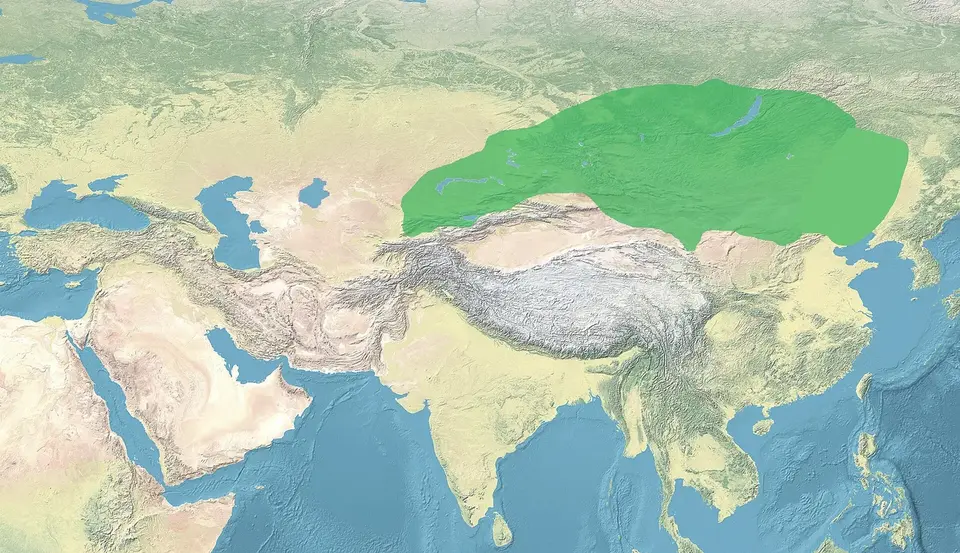
Following the disaster at Huanghuadui, Qutlugh realistically assessed that Tang defensive lines were too resilient to breach. He decisively pivoted his grand strategy toward the northern steppe. Over the subsequent four years, Qutlugh spearheaded relentless campaigns across Outer Mongolia: crushing the Khitan and Xi tribal confederations to the east, crossing the Selenga River to subjugate the Toquz Oghuz tribes to the north, and subduing the Yenisei Kyrgyz and residual Western Turkic elements to the west. Through systematic conquest, he brought dozens of nomadic tribes under his hegemony, creating a vast steppe realm extending from the Greater Khingan Mountains to the Altai. The unification of the northern pastures provided the resurrected Turkic empire with an unassailable strategic rear.
In 690, Wu Zetian formally proclaimed the Zhou dynasty, altering imperial nomenclature and adjusting frontier deployments. Although suffering from chronic battle wounds and declining health, Qutlugh continued to dispatch raiding detachments against Yunzhong and Wuyuan to fix imperial troops in position. In 691, worn down by ceaseless military exertion, Qutlugh passed away at his royal headquarters in the sacred Otuken Mountains. Because his sons Mojilian (Bilge) and Kul Tigin were still young, Qutlugh's ambitious brother Qapaghan Qaghan seized the throne. Qapaghan continued the aggressive expansionist agenda, elevating the Second Turkic Khaganate to its historical zenith during the Wu Zhou era. Qutlugh's premature demise bequeathed an expansive domain to his successor, setting the stage for renewed imperial conflict.
Emperor Qutlugh completely revolutionized the traditional military structure of the steppe nomads. He discarded the obsolete and fractious Ten Arrows (On Oq) confederate system, establishing a highly centralized military-bureaucratic hierarchy governed by princes (tegins), governors (tutuns), and military governors (shads). Nomadic society was divided into standing elite guards and mobilizable tribal levies. In peacetime, herders dispersed across grazing basins; upon the sounding of the royal drums, tens of thousands of armored horsemen could muster within a single day. Qutlugh perfected deep-reconnaissance intelligence networks and long-distance operational strikes, transforming the Second Turkic cavalry into the most lethal field army of the early medieval steppe. This integrated tribal military organization served as the core engine of Turkic steppe supremacy.
Beyond his martial conquests, Qutlugh achieved monumental cultural milestones in preserving national identity. He consciously resisted total sinicization, urging his people to maintain their nomadic equestrian way of life and martial values. Most significantly, he initiated and sponsored the invention and dissemination of the Old Turkic runic alphabet (Orkhon script). In 2022, an international archaeological expedition discovered the Nomgon memorial complex in the Khangai Mountains of Mongolia, unearthing ancient stele inscriptions in both Old Turkic and Sogdian dedicated to Ilterish Qaghan. This confirmed that Qutlugh was the earliest steppe monarch to record imperial genealogy and military deeds in an indigenous script, marking a profound watershed in Central Asian literary history. The rediscovery of these monumental steles offers tangible proof of Qutlugh's heroic military achievements.
Rising from the ashes of dynastic subjugation with a band of merely seventeen mounted companions, Ashina Qutlugh re-established a colossal steppe empire through iron willpower and peerless tactical brilliance. He was not only the Tang dynasty's most formidable northern adversary during the late seventh century, but also the pivotal historical architect who led the Turkic people from tributary dependency back to imperial sovereignty. The political and territorial framework established by Qutlugh endured for generations, profoundly reshaping the geopolitical dynamics between the steppe and the Chinese agricultural heartland. His heroic legacy remains indelibly inscribed upon the sacred stone monuments of the Orkhon Valley, cementing his enduring influence throughout Eurasian history.
FIGURES ASSOCIATED WITH THIS DYNASTY