Birth | Born in Huaiyin County, present-day Huaiyin, Huai'an, Jiangsu
231 BCE–196 BCE
Generalmilitary strategist
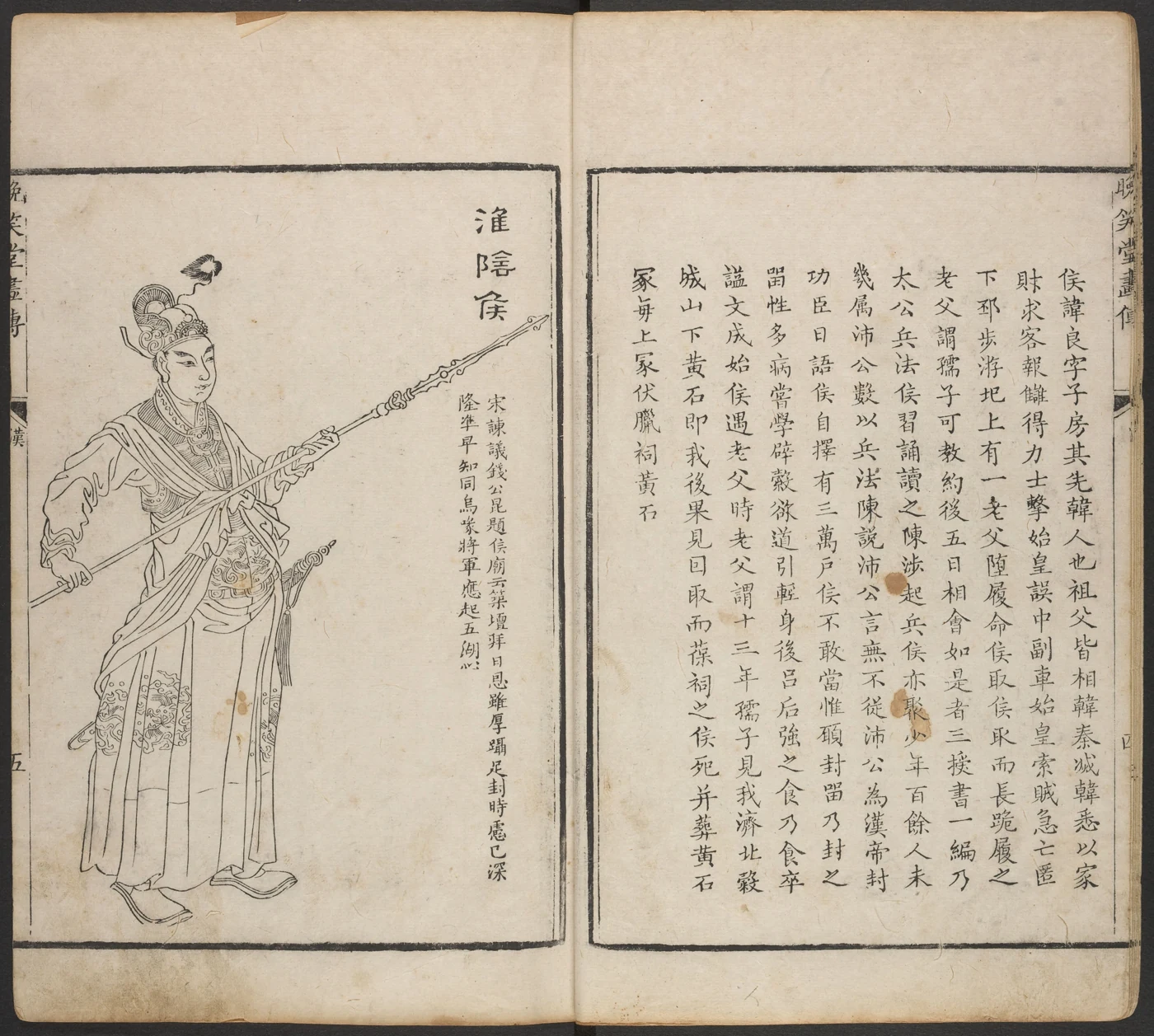
Han Xin
韩信
Han Xin (c. 231 BCE–196 BCE), a native of Huaiyin in present-day Huai'an, Jiangsu, was a founding general and military strategist of the Western Han. Together with Zhang Liang and Xiao He he was later grouped among the “Three Heroes of the Early Han,” and together with Peng Yue and Ying Bu among the “Three Great Generals of the Early Han.” Born a commoner, Han spent his youth in poverty and was famously humiliated when he…
231 BCE–196 BCEWestern Han
PROFILE
Han Xin (c. 231 BCE–196 BCE), a native of Huaiyin in present-day Huai'an, Jiangsu, was a founding general and military strategist of the Western Han. Together with Zhang Liang and Xiao He he was later grouped among the “Three Heroes of the Early Han,” and together with Peng Yue and Ying Bu among the “Three Great Generals of the Early Han.” Born a commoner, Han spent his youth in poverty and was famously humiliated when he crawled between the legs of a local bully. Near the end of the Qin he joined Xiang Liang and later Xiang Yu, but eventually entered Liu Bang's service. Strongly recommended by Xiao He, he was formally appointed General-in-Chief at a raised altar. During the Chu–Han Contention, Han pacified the Three Qins, swept through Wei, Zhao, Dai, Yan, and Qi, and participated in the Battle of Gaixia, which ended with Xiang Yu's suicide. After the Western Han was established, Han was transferred to the kingship of Chu, later demoted to Marquis of Huaiyin, and ultimately killed through a plot involving Empress Lü and Xiao He, after which his three clans were exterminated. Later generations called him the “Immortal of War,” and military thinkers repeatedly praised his methods of command.
- Alternative Names
- Marquis of Huaiyin
- Period
- Western Han
- Date of Birth
- about 231 BCE
- Date of Death
- 196 BCE
- Dynasty/Regime
- Western Han
- Identity
- General; military strategist
- Ethnicity/People
- Not recorded in historical sources
- Ancestral Home
- Huaiyin (present-day Huaiyin, Huai'an, Jiangsu)
- Place of Birth
- Not recorded in historical sources
- Major Achievements
- Rose from poverty in Huaiyin to become Han's General-in-Chief; pacified the Three Qins and defeated the forces of Wei, Zhao, Qi, and Chu; after accumulating extraordinary military merit, he aroused imperial suspicion and was executed.
LIFE TIMELINE
Youth | His mother died; although too poor to provide a proper burial, he chose a high and spacious burial place, reflecting ambitions for future rank
Youth | Endured the humiliation of crawling between the legs of a butcher's son in Huaiyin
Joined an army | Carrying a sword, joined Xiang Liang but remained obscure
Entered Xiang Yu's service | After Xiang Liang died in defeat, Han followed Xiang Yu, served as a palace attendant, and repeatedly offered plans that were not adopted
Pacification of the Three Qins | Liu Bang followed Han's plan, returned by the old route, attacked Zhang Han, and pacified the Three Qins
Battle of Anyi | Crossed the river using wooden vessels, struck the Wei capital Anyi by surprise, captured Wei Bao, and pacified Wei territory
Defeat of Dai | Together with Cao Shen and others defeated Dai and captured its chancellor Xia Yue
Killed | Lured into Changle Palace by Empress Lü and Xiao He, executed in the Bell Chamber, and subjected to extermination of three clans
Demoted to Marquis of Huaiyin | Accused of rebellion and reduced to the rank of Marquis of Huaiyin
Battle of Gaixia | Deployed a five-army formation, defeated Xiang Yu, and contributed to Xiang Yu's suicide at the Wu River
Transferred to Chu | Enfeoffed as King of Chu and established his capital at Xiapi
Pacification of Qi | Captured Qi territory and was established as King of Qi
Battle of Wei River | Used floodwater against the allied Qi–Chu force and killed the Chu commander Long Ju
Battle of Jingxing | Formed his army with its back to the river, decisively defeated Zhao, killed Chen Yu, and captured King Xie of Zhao
Submission of Yan | Followed Li Zuoche's advice and induced Yan to surrender without battle
After the Battle of Pengcheng | After Liu Bang's defeat, Han gathered scattered troops and rejoined him at Xingyang, then defeated Chu forces between Jing and Suo
Joined Han | Left Chu for Han; served in a minor storehouse post, was sentenced to death for an offense but rescued by Xiahou Ying, and was then made a grain administration officer
Appointment as General-in-Chief | Xiao He pursued Han after he deserted; Liu Bang built an altar and formally appointed Han as General-in-Chief
Hanzhong strategy | Analyzed the balance between Chu and Han and proposed an eastward campaign to recover the Three Qins
BIOGRAPHY
Biography
Family Background and Early Life
Han Xin was born in Huaiyin County near the end of the Qin dynasty. The “Biography of the Marquis of Huaiyin” in the Records of the Grand Historian states that Han was a man of Huaiyin who, while still a commoner, was poor and lacked a reputation for good conduct. He could not be selected for office and was unable to support himself through trade. As a young man he was impoverished and often ate at other people's homes, causing many to dislike him. Yet he possessed unusual ambitions. When his mother died, the family was too poor even to arrange an adequate funeral, but Han still selected a high, spacious burial site because he imagined that one day ten thousand households might be settled around it to tend the grave.
Han frequently went to the chief of Nanchang Pavilion for meals over a period of months. The chief's wife resented him and one morning cooked and ate the meal early. When Han arrived at the usual mealtime, nothing had been prepared for him. Understanding the intention, he left angrily and never returned. Later, while fishing below the city wall, he saw a group of women washing silk floss by the river. One elderly woman noticed that he was hungry and gave him food every day for several dozen days until the washing work was finished. Han, delighted, told her that he would repay her richly. She rebuked him, saying that a grown man unable to support himself should not imagine she had fed him in expectation of reward; she had done so only out of pity.
A young man from a butcher's household in Huaiyin once mocked Han, saying that although he was tall and liked to wear a sword, he was in fact a coward. In public he challenged Han: if Han did not fear death, he should stab him; if he did fear death, he should crawl between his legs. Han looked at him carefully, bent down, crawled on the ground between his legs, and continued on his way. People in the street laughed and called him cowardly.
Military Service and Transfer to Han
In 209 BCE, after the uprisings of Chen Sheng and Wu Guang, Xiang Liang secured the Jiangdong region and crossed north over the Huai River. Han, carrying his sword, joined Xiang Liang but remained unknown. In the following year, after Xiang Liang was defeated and killed, Han entered the service of Xiang Liang's nephew Xiang Yu, who made him a palace attendant. Han repeatedly offered strategic proposals, but Xiang Yu did not adopt them.
In the first year of Han, 206 BCE, when Liu Bang, King of Han, moved into Shu, Han left Chu and joined Han. He was assigned to a minor position managing stores and remained unnoticed. Later he committed an offense punishable by death. Thirteen men in the same case had already been executed when Han's turn came. Looking up at Teng Gong Xiahou Ying, Han asked whether the King of Han did not intend to gain the empire and why, if so, he was killing a brave man. Xiahou Ying found the remark extraordinary, was impressed by Han's imposing appearance, spared him, and spoke with him at length. Appreciating his ability, Xiahou Ying recommended him to Liu Bang. Liu Bang appointed Han as an officer in charge of grain supplies, but still did not recognize his exceptional talent.
Han often spoke with Xiao He, who greatly valued him. When Liu Bang moved from Chang'an to Nanzheng, dozens of officers deserted. Han believed that Xiao He and others had repeatedly recommended him to Liu Bang without effect and therefore deserted as well. On hearing this, Xiao He did not even report first to Liu Bang but immediately went after Han. Someone in the army told Liu Bang that his chancellor Xiao He had fled. Liu Bang was furious and felt as though he had lost both arms. A day or two later Xiao returned. Liu Bang, angry yet relieved, demanded to know why he had deserted. Xiao replied that he had not deserted but had gone after a deserter. Asked whom, he answered, Han Xin. Liu Bang cursed him, noting that dozens of generals had deserted and Xiao had pursued none of them, so the story must be a lie. Xiao replied that ordinary generals were easy to obtain, but a talent like Han Xin was unique in the realm. If Liu Bang intended merely to remain King of Hanzhong, he did not need Han; if he intended to contest the empire, Han was the one man with whom such plans could be made. Liu Bang replied that he did intend to return east and could not remain confined there forever. Xiao said that if Liu Bang truly intended an eastern return and gave Han important responsibility, Han would remain; otherwise he would eventually leave. Liu Bang first proposed making Han an ordinary general, but Xiao said even that would not be enough. Liu then agreed to appoint him General-in-Chief. When Liu Bang wanted to summon Han immediately, Xiao objected that the king's habitual arrogance was precisely why Han had left. If Liu truly wished to appoint him as General-in-Chief, he should select an auspicious day, purify himself, build a high altar, and conduct the appointment with full ceremony. Liu Bang agreed. The Han officers all assumed that one of them would receive the honor and were astonished when Han Xin was appointed instead.
Appointment as General and Strategic Plan
After Han's appointment, Liu Bang asked what strategy he could offer, given Xiao He's repeated praise. Han asked whether the opponent competing eastward for control of the empire was not Xiang Yu. Liu Bang agreed. Han then asked Liu Bang to compare his own courage, ferocity, and military strength with Xiang Yu's. After a long silence, Liu admitted that he was inferior. Han bowed twice and agreed that in those respects he too regarded Liu as inferior. But because he had once served Xiang Yu, he explained Xiang Yu's character as he saw it.
Han argued that a single roar from Xiang Yu could make a thousand men tremble, yet Xiang could not entrust able generals with independent authority, so this was merely the courage of a common warrior. Xiang treated people respectfully and kindly, spoke gently, wept when subordinates fell ill, and shared food with them, yet when they earned noble rank he would hold onto the seals until their corners were worn smooth rather than bestow them; this, Han said, was merely a woman's kindness. Although Xiang dominated the realm and compelled the feudal lords to submit, he did not hold the strategic Guanzhong region but made Pengcheng his capital. He violated the agreement made under Emperor Yi and enfeoffed favorites and intimates as kings, arousing the resentment of other lords. When they saw Xiang drive Emperor Yi into the south, they too returned home and displaced their former rulers. Wherever Xiang's armies passed, Han said, there was killing and destruction; the people resented rather than loved him and submitted only to his coercive power. Thus, although he bore the name of hegemon, he had already lost popular support, and strength could quickly turn into weakness.
If Liu Bang did the opposite, Han continued, employed the courageous men of the empire, granted conquered cities to those who earned merit, and led soldiers longing to return east to their homes, there would be no reason the enemy could not be broken. He then discussed the three Qin kings Zhang Han, Dong Yi, and Sima Xin, former Qin generals who had led Qin troops for years, suffered enormous casualties, deceived their subordinates into surrendering to Xiang Yu, and survived when Xiang massacred more than two hundred thousand surrendered Qin soldiers at Xin'an. The people of Qin therefore hated the three men bitterly and did not support them even though Xiang Yu had installed them as kings. By contrast, when Liu Bang entered the Wu Pass he had refrained from plunder, abolished harsh Qin laws, and concluded the Pact of Three Articles with the Qin people. The people therefore wished to support him as king in Guanzhong. Under the original covenant among the lords, Liu Bang should have ruled Guanzhong, and everyone there knew it. When Liu was instead sent to Hanzhong, Qin people resented Xiang Yu. Han concluded that if Liu now marched east against the Three Qins, a single proclamation would be enough to win them. Liu Bang was delighted, regretted that he had discovered Han so late, accepted the plan, and assigned targets to his generals.
Recovery of the Three Qins and the Eastward Advance
In the eighth month of 206 BCE, Liu Bang adopted Han's strategy and returned toward Guanzhong through the old route, attacking Zhang Han, King of Yong. Zhang met the Han army at Chencang but was defeated and withdrew. He fought again at Haozhi and was again defeated, fleeing to Feiqiu. Liu Bang thereby secured Yong territory and advanced east toward Xianyang, surrounded Zhang Han at Feiqiu, and dispatched generals to seize territory, bringing Longxi, Beidi, and Shang commanderies under Han control.
In 205 BCE, the second year of Han, Han forces moved east through the passes and accepted the submission of Wei Bao, King of Wei, and Shen Yang, King of Henan; the King of Han and Sima Ang, King of Yin, also submitted. The Han coalition joined Tian Rong of Qi and King Xie of Zhao against Chu. Liu Bang thereby commanded five allied armies said to total 560,000 men and advanced east against Western Chu. In the fourth month he entered Pengcheng, but Xiang Yu returned rapidly and crushed the Han army. Han Xin gathered the scattered troops, rejoined Liu Bang at Xingyang, and defeated Chu forces between Jing and Suo, preventing Chu from advancing farther west.
Pacification of Wei, Dai, Zhao, and Yan
In the sixth month of 205 BCE, Wei Bao returned to his state on the pretext of visiting his ill mother, closed the river passes, cut Han's route, and abandoned Han in favor of an alliance with Chu. Liu Bang sent Li Yiji to persuade him, but the effort failed. In the eighth month, Han Xin was appointed Left Chancellor and ordered to attack Wei. Wei Bao concentrated his forces at Puban and blocked the Yellow River crossing at Linjin Pass. Han set up a diversion force and displayed ships as if preparing to cross at Linjin, while in fact leading troops across the river from Xiayang in wooden vessels. He struck the Wei capital Anyi by surprise. Wei Bao panicked and led his forces to meet Han, but Han defeated him, pacified Wei territory, captured Wei Bao, and sent him to Xingyang. Liu Bang then established Hedong Commandery in the former Wei territory.
Han and the other generals next defeated Dai and captured its chancellor Xia Yue. In 204 BCE, the third year of Han, Han and Zhang Er led tens of thousands of troops east through Jingxing Pass against Zhao. King Xie of Zhao and Chen Yu, Lord of Cheng'an, gathered a force at the pass said to number two hundred thousand. Li Zuoche, Lord of Guangwu, advised Chen Yu to entrench deeply and send a mobile force to cut Han's supply route, but Chen rejected the plan. When Han learned this, he was delighted. He camped thirty li from Jingxing and at midnight issued orders selecting two thousand light cavalrymen, each carrying a red Han banner. They were to take a hidden route into the hills and observe the Zhao army; when Zhao emptied its camp to pursue Han, they were to rush in, pull down the Zhao banners, and replace them with Han's red flags. Han then sent ten thousand men ahead and deliberately formed them with their backs to the river. The Zhao troops laughed at the deployment.
At dawn Han advanced through Jingxing with the General-in-Chief's flags and drums. The Zhao army opened its camp and attacked, and hard fighting continued for a long time. Han and Zhang Er pretended to abandon drums and standards and withdrew toward the riverside formation. Zhao troops, seeking the Han flags and equipment, emptied their camp to pursue them. Once Han and Zhang reached the troops with their backs to the water, those men fought desperately because there was nowhere to retreat. Meanwhile Han's two thousand hidden cavalry entered the empty Zhao camp, pulled down all Zhao banners, and raised two thousand red Han flags. The Zhao army could not defeat Han and, when it attempted to return to camp, saw the Han flags everywhere and panicked, believing its king and commanders had already been captured. The formation dissolved and fled. Han forces attacked from both sides, decisively defeated Zhao, killed Chen Yu at the Zhi River, and captured King Xie.
After the Battle of Jingxing, Han offered a thousand pieces of gold for the capture of Li Zuoche. When Li was brought to him, Han treated him as a teacher. Li advised him to halt the troops, stabilize Zhao, care for its people, and send a persuasive envoy with a short letter; Yan, he said, would not dare refuse. Han followed this advice, and Yan submitted without battle.
Pacification of Qi and the Battle of Wei River
In 203 BCE, the fourth year of Han, Han led his army east against Qi. Liu Bang had already sent Li Yiji to persuade King Tian Guang of Qi, who believed him and relaxed the kingdom's defenses. Acting on Kuai Tong's advice, Han attacked the Qi army at Lixia and advanced to Linzi. Tian Guang fled to Gaomi and requested aid from Xiang Yu. Xiang sent Long Ju with two hundred thousand troops to aid Qi. Long Ju and Tian Guang joined forces against Han on the Wei River.
At night Han ordered more than ten thousand sacks filled with sand to block the river upstream. He led part of his force across, attacked Long Ju, then pretended to be defeated and withdrew. Long Ju rejoiced, saying that he had always known Han was cowardly, and pursued him across the river. Han then ordered the sandbag dam broken. The rising water cut off most of Long Ju's army from crossing, and Han immediately counterattacked and killed Long Ju. The forces on the eastern bank scattered. Tian Guang fled, but Han pursued him to Chengyang, captured him, and completed the conquest of Qi.
After pacifying Qi, Han sent a messenger to Liu Bang requesting to be made acting king of Qi. Liu Bang was furious, but Zhang Liang and Chen Ping stepped on his foot and whispered to him. Liu understood and sent Zhang Liang to install Han formally as King of Qi and to summon his army against Chu.
The Battle of Gaixia and Kingship
In 202 BCE, the fifth year of Han, Liu Bang joined forces with Han Xin, Peng Yue, and others for the decisive battle against Xiang Yu at Gaixia. Han commanded three hundred thousand men in the vanguard; General Kong held the left, General Fei the right, Liu Bang remained behind them, and Zhou Bo, Marquis of Jiang, and another General Chai formed a further rear line. Xiang Yu's force numbered about one hundred thousand according to the source. Han initially engaged Xiang Yu and gave ground. Generals Kong and Fei then attacked from the flanks; as the Chu army faltered, Han renewed the assault and inflicted a decisive defeat. During the night Xiang Yu heard Chu songs from all sides and believed that the Han had already occupied the whole of Chu. He broke out southward and eventually killed himself at the Wu River.
After Xiang Yu's death, Liu Bang returned to Dingtao, rode suddenly into the camp of Han Xin, then King of Qi, and took control of his army. Han was transferred to become King of Chu with his capital at Xiapi. After arriving in Chu, Han summoned the elderly washerwoman who had fed him in his youth and gave her one thousand pieces of gold. He also summoned the young man who had humiliated him and appointed him to a local military office. Han explained to his officers that the man was in fact courageous: when the youth humiliated him, Han could certainly have killed him, but there would have been no justification, so he had endured the humiliation and thereby reached his later position.
Demotion to Marquis of Huaiyin and Execution
In 201 BCE, the sixth year of Han, someone accused Han of rebellion. Liu Bang followed Chen Ping's plan and pretended to make an imperial tour to Yunmeng, summoning the feudal lords to meet at Chen. Han considered rebelling militarily, yet believed himself innocent and wanted to appear before the emperor while fearing arrest. Someone advised him to kill Zhongli Mo and present his head to Liu Bang. Han hesitated but eventually brought Zhongli Mo's head to Chen. Liu Bang immediately ordered armed men to bind Han and place him in a following carriage. Han then quoted the saying that when the cunning hare dies the good hound is cooked, when the high-flying birds are gone the fine bow is stored away, and when the enemy states are destroyed the planning ministers perish. Since the empire had been settled, he said, he too was bound to be “cooked.” Liu Bang replied only that people had accused him of rebellion. Han was taken in chains to Luoyang, pardoned of the capital charge, and reduced to Marquis of Huaiyin.
Han understood that Liu Bang feared and disliked his abilities. He often claimed illness to avoid court attendance and imperial outings and lived in continuing resentment. Liu Bang once discussed with him how many troops different generals could command and asked how many Liu himself could lead. Han replied that the emperor could manage no more than one hundred thousand. Liu asked how that compared with Han's own capacity. Han answered that for himself, “the more, the better.” Liu laughed and asked how, if Han could command ever more troops, he had nevertheless been captured by Liu. Han replied that the emperor was not especially skilled at commanding soldiers but was skilled at commanding generals, and that this was why Han had been taken. Moreover, he said, Liu's quality was bestowed by Heaven and not attainable by ordinary human effort.
In 197 BCE, the tenth year of Han, Chen Xi rebelled and Liu Bang personally led the campaign against him. Han claimed illness and did not accompany the emperor, while secretly sending a messenger to Chen Xi and entering into a plot with him. In 196 BCE, the eleventh year of Han, one of Han's retainers offended him. Han imprisoned the man and intended to kill him. The retainer's younger brother then reported to the authorities that Han intended rebellion. Empress Lü and Xiao He conspired together. They falsely announced that a messenger had arrived from the emperor reporting Chen Xi's death and that the feudal lords and senior ministers were all coming to congratulate the court. Xiao He deceived Han into attending, saying that even if ill he should force himself to enter the palace to offer congratulations. Once Han entered, Empress Lü had armed men bind him and execute him in the Bell Chamber of Changle Palace. Before his death Han lamented that he regretted not following Kuai Tong's advice and had instead been deceived by women and children, asking whether this was not Heaven's will. His three clans were then exterminated.
His Early Hardship
Han Xin was a man of Huaiyin in the last years of Qin, of common birth and poor in his early years. He was once fishing below the city wall when a group of old women were rinsing silk by the river, and one of them, seeing that Han Xin was hungry, gave him food to eat, and so it went for several tens of days until the rinsing was done; and Han Xin, much pleased, told the old woman that he would surely repay her richly. The old woman said in anger that a grown man who could not feed himself was no concern of hers, and that she had pitied the young fellow and given him food, not hoping for any repayment. Among the butchers of Huaiyin there was a young man who insulted Han Xin, saying that though he was tall and fond of wearing a sword he was in truth a coward, and who publicly insulted him further, telling him to draw his sword and stab him if he did not fear death, and if he feared death to crawl between his legs. Then Han Xin looked him over carefully, bowed down and crawled on the ground between his legs, and all the street laughed at Han Xin and thought him a coward.
His Flight from Chu to Han and His Enthronement as General
When the risings broke out in the last years of Qin, Han Xin first joined Xiang Liang, and after Xiang Liang's defeat he went to Xiang Yu, who made him a gentleman of the interior; and afterwards he joined Liu Bang, and when Liu Bang led his army into Shu Han Xin left the Chu army and came over to the king of Han, becoming a stable officer. Presently, condemned by law to be beheaded, thirteen of his companions having already been executed and it being his turn, Han Xin lifted his eyes and saw Lord Teng, Xiahou Ying, and said, "Does the king not wish to win the realm? Why behead a brave man?" Lord Teng thought his words strange and his appearance noble, released him and did not behead him, and speaking with him was much pleased, and told the king, and the king made him a commissary of grain, not yet thinking him remarkable. Han Xin had spoken with Xiao He several times and Xiao He thought him strange. Coming to Nanzheng, several tens of the generals and officers deserted on the road, and Han Xin, reckoning that Xiao He and the others had several times recommended him to Liu Bang without his being used, deserted too; and Xiao He, hearing of it, had no time to report it but went after him himself. Someone told Liu Bang that the chancellor Xiao He had fled, at which Liu Bang was enraged as if he had lost his right hand. After a day or two Xiao He came to see him, and Liu Bang, both angry and glad, cursed him and asked why he had fled; and Xiao He said that he had not dared to flee but had gone after the deserter; and the king asked whom he had gone after, and the answer was Han Xin; and the king cursed again, saying that several tens of the generals had deserted and Xiao He had followed none, so that pursuing Han Xin was a lie. Xiao He said that the generals were easy to get, but that as for Han Xin, there was no second such statesman in the whole realm; that if the king meant only to be king of Hanzhong for long he had no use for Han Xin, but that if he meant to contend for the realm there was none but Han Xin to plan with him, and that it rested on what the king decided. And when Liu Bang said that he too meant to go east and could not mope in such a place for long, Xiao He said that if the king meant to go east and could use Han Xin, Han Xin would stay, and if not he would go in the end. The king said that for Xiao He's sake he would make him a general; and Xiao He said that even as a general Han Xin would surely not stay; and the king said he would make him commander-in-chief, at which Xiao He said it was most fortunate. And when the king would have summoned Han Xin and enfeoffed him, Xiao He said that the king was always rude and without ceremony and that to enfeoff a commander-in-chief thus was like calling a little boy, which was why Han Xin was leaving; and that if the king would truly enfeoff him he should choose a good day, fast, build an altar and set out the full ceremony. The king agreed; and the generals were all glad, each supposing he would be made commander-in-chief, and when the ceremony came it was Han Xin, and the whole army was astonished.
The Plan for Han and the Settling of the Three Qin
After Han Xin had been enfeoffed the king asked him what counsel he could give, since the chancellor had spoken of him so often; and Han Xin asked whether he who contended eastward for the realm was not the king of Chu, and the king said he was; and Han Xin asked how the king judged his own courage, fierceness, benevolence and strength against the king of Chu, and the king was silent a long while and said he was not his equal. Han Xin bowed twice and agreed that he too thought the king not his equal, but said that he had once served the king of Chu and would speak of his character: that Xiang Yu's angry shout made a thousand men quail, yet he could not employ worthy generals, which was mere courage of a single man; that he was respectful and kind to men and wept and shared his food and drink with the sick, yet when a man had merit and should be enfeoffed he wore the seal smooth in his hand and could not bear to give it, which was the benevolence of a woman; that though he was hegemon and made the princes his subjects, he did not dwell in the passes but made his capital at Pengcheng, and broke the covenant of Emperor Yi and enfeoffed his favourites, at which the princes were displeased; that the princes, seeing him remove Emperor Yi to the south of the river, all went home and drove out their own lords and made themselves kings of good lands; that wherever he passed he destroyed and slaughtered, so that the realm bore him much resentment and the people did not attach themselves to him, but were held only by his might; and that though in name hegemon he had in truth lost the heart of the realm, so that his strength would easily turn to weakness. And he said that if the king could but do the opposite — employ the brave of the realm, and what enemy would not be destroyed; enfeoff the meritorious with the realm's cities, and who would not submit; lead righteous troops with men longing to go home, and who would not scatter. And he said that the three kings of Qin, having been Qin generals and led the sons of Qin for years with losses beyond counting, and having deceived their men into surrendering to the princes, so that at Xin'an Xiang Yu treacherously buried alive more than two hundred thousand surrendered Qin soldiers, only Zhang Han, Sima Xin and Dong Yi escaping, the fathers and elder brothers of Qin hated these three to the marrow; and that now Chu by its might had made them kings, and the people of Qin loved them not at all. But that when the king entered the Wu pass he did no harm in the least, abolished the harsh laws of Qin, and made a covenant of three articles with the people of Qin, so that there was not one of them who did not wish the king to be king of Qin; and that by the covenant of the princes the king should be king in the passes, which the people of the passes all knew; and that when the king lost his place and entered Hanzhong the people of Qin all resented it. And he said that if the king now raised his arms and went east, the three Qin could be settled by a mere proclamation. Liu Bang was greatly pleased and thought he had got Han Xin too late, and following his plan disposed the targets of the several generals. In the eighth month of the first year of Han the king of Han, using Han Xin's plan, returned by the old road and surprised Zhang Han, king of Yong; and Zhang Han met the Han army at Chencang and was beaten and fell back, stood again at Haozhi and was beaten again, and fled to Feiqiu; and the king of Han settled the land of Yong, came east to Xianyang and invested the king of Yong at Feiqiu, sending his generals to settle Longxi, Beidi and Shangjun.
The Breaking of Wei and Dai
After the Han were beaten at Pengcheng, Sima Xin king of Sai and Dong Yi king of Zhai deserted the Han for Chu, and Qi and Zhao too turned against the Han and made peace with Chu. In the sixth month the king of Wei, Wei Bao, having asked leave to go home to see his sick parent, closed the river pass on his arrival and turned against the Han, making peace with Chu; and Liu Bang sent Li Yiji to persuade Wei Bao and could not. In the eighth month Han Xin was made left chancellor against Wei: the king of Wei massed troops at Puban and blocked Linjin, and Han Xin made more of a show of force, drew up boats as if to cross at Linjin, and sent his hidden troops from Xiayang across with wooden jars, surprising Anyi; and the king of Wei, startled, led his troops against Han Xin, who took him and settled Wei as the commandery of Hedong. Liu Bang sent Zhang Er with Han Xin east and north against Zhao and Dai; and in the intercalary ninth month they broke the troops of Dai and took Xia Shuo at Yuyu. In breaking Wei and Dai Han Xin's best troops were taken from him by the king of Han and sent to Xingyang against Chu.
The Breaking of Zhao and the Battle with Their Backs to the Water
Han Xin and Zhang Er with several tens of thousands of troops meant to go east down the Jingxing pass against Zhao. The king of Zhao and Chen Yu, lord of Cheng'an, hearing that the Han would attack, gathered troops at the mouth of the pass, said to number two hundred thousand. Li Zuoche, lord of Guangwu, told Chen Yu that Han Xin had crossed the western river, taken the king of Wei and captured Xia Shuo, and having lately bloodied Yuyu, now with Zhang Er meant to come down on Zhao, and that this was a victorious army far from home whose edge could not be withstood; that he had heard that a thousand li of transport left the soldiers hungry and that cooking after gathering firewood left the army never full; that the road of Jingxing was such that carts could not go abreast nor cavalry in file, and that over several hundred li the food must be behind; and he begged him to give him thirty thousand men by a side road to cut their baggage, while he himself deepened his ditches and raised his walls and did not fight; and that so the enemy could not fight in front nor return behind, and with the side road cutting his rear and nothing to plunder in the fields, within ten days the heads of both generals would be at his standard. Chen Yu, being a scholar, always held that righteous armies did not use treacherous devices, and said that he had heard the art of war: ten to one, surround them; twice their number, fight them; that Han Xin's troops were called several tens of thousands but in truth not more than a few thousand, and having come a thousand li to attack him must be utterly exhausted; that if they now avoided battle and did not fight, should a greater enemy come how should they meet him, and that the princes would call them cowardly and come against them lightly. And in the end he did not use Li Zuoche's plan. Han Xin sent men secretly to learn that his plan was not used and, much pleased, dared to lead his army down; and not thirty li from the mouth of the pass he halted, and at midnight sent out two thousand light horse, each man carrying a red flag, by a side road among the hills to watch the Zhao army, charging them that when the Zhao saw him withdraw they would surely empty their camp to pursue, and that they should then rush into the Zhao camp, pull down the Zhao flags and set up the red flags of Han. He had his subordinate generals issue a meal and said that they would feast that day when Zhao was broken; and the generals, none believing it, answered as if they did. At dawn Han Xin raised the great general's banners and drums and advanced with drums to the mouth of the pass, and Zhao opened their camp and attacked, and the great battle lasted a long while; and then Han Xin and Zhang Er threw away their drums and flags as if beaten and fled to the army at the water, which opened and let them in and fought hard again. Zhao indeed emptied its camp to fight for the Han drums and flags and to pursue Han Xin and Zhang Er; and Han Xin and Zhang Er having entered the army at the water, the men all fought to the death and could not be beaten. And the two thousand horse which Han Xin had sent, waiting until Zhao had emptied its camp in pursuit of gain, galloped into the Zhao camp and pulled down all the Zhao flags and set up two thousand red flags of Han. The Zhao army, unable to win and unable to take Han Xin and the other, wished to return to its camp, and the camp being all red flags of Han they were greatly startled, thinking the Han had already taken the king and generals of Zhao, and their army fell into disorder and fled, and though the Zhao generals beheaded men they could not stop them. Then the Han attacked from both sides and broke and took the Zhao army utterly, beheaded Chen Yu on the Zhi river and took the king of Zhao, Xie. The generals asked how, when the art of war had the right and rear on hills and the left and front on water, the general had had them form with their backs to the water and yet had won; and Han Xin said that this was in the art of war, only they had not observed it: did the art of war not say that to place men in deadly ground was to give them life, and to put them in ground of death was to give them preservation; and that he had not the sort of men who had long been trained by him, but that this was what was called driving men of the market to war, in which case they must be put in deadly ground so that each would fight for himself, for if they were given ground of life they would all run, and how could they then be used to win. And the generals all submitted and said it was beyond them.
The Winning of Yan, the Surprise on Qi, and the Beheading of Long Ju at the Wei River
Then Han Xin asked Li Zuoche how he might succeed in attacking Yan in the north and Qi in the east; and Li Zuoche excused himself, saying that a defeated general might not speak of courage nor a minister of a fallen state plan for survival, and Han Xin said that he had heard that Baili Xi, dwelling in Yu, had seen Yu destroyed, and in Qin had seen Qin become hegemon, not because he was foolish in Yu and wise in Qin, but because of use and no use, hearing and no hearing; and that had Chen Yu heeded his plan Han Xin would long since have been taken, and that it was because he had not been used that Han Xin had come to serve him. And Li Zuoche then gave his plan: that Han Xin had crossed the western river, taken the king of Wei, captured Xia Shuo, taken the Jingxing pass at one stroke and broken two hundred thousand of Zhao's host before the morning was out, killed Chen Yu, and that his name was heard through the realm and his majesty shook the world, so that the farmers all stopped their ploughs and put down their hoes and dressed in fine clothes and ate sweet food and listened with ears inclined for his orders, which was his strength; but that his men were toil-worn and his soldiers exhausted and in truth hard to use, and that if he now led a weary and broken army and halted it under the strong walls of Yan, wishing to fight and fearing that time would make it impossible to take the city, his true state would show and his power be humbled, and with days passing and grain running out the weak Yan would not submit and Qi would surely hold its borders to make itself strong; and that Yan and Qi holding each other and not coming down, the balance between Liu and Xiang would be undecided, which was his weakness; and that the good commander did not strike strength with weakness but struck weakness with strength. He said that for the general's present plans nothing was better than to lay down arms and rest the soldiers, to settle Zhao and comfort its orphans, so that within a hundred li beef and wine came daily to feast the officers and reward the troops, and then to face the road to Yan, and afterwards to send an eloquent man with a foot-long letter to display their strength to Yan, and Yan would not dare not to obey; and that Yan submitting, an eloquent man should be sent east to tell Qi, and Qi would submit with the wind, and though there were wise men they would not know how to plan for Qi. Han Xin said it was good and followed his plan, sending envoys to Yan, and Yan fell with the wind; and he sent envoys to report to the Han and asked that Zhang Er be made king of Zhao to settle and comfort the land, which the king of Han granted.
In the sixth month of the third year of Han Liu Bang came out of Chenggao and crossed the Yellow River east, and with Xiahou Ying alone went to Zhang Er's army at Xiuwu; arriving, he lodged at the post house, and at dawn, calling himself an envoy of Han, galloped into the Zhao camp, and while Zhang Er and Han Xin were still abed he took their seals and tallies from their chamber and summoned the generals with his standard and changed their places; and Han Xin and Zhang Er, rising, learned that the king of Han had come and were much astonished. Liu Bang took the army of both, ordered Zhang Er to guard Zhao, made Han Xin chancellor of state, and gathered the Zhao troops not yet sent to Xingyang to attack Qi. Han Xin led his troops east and had not crossed Pingyuan when he heard that the king of Han had sent Li Yiji to persuade Qi to submit, and he meant to stop; but the eloquent Kuai Tong of Fanyang told him that he had a decree to attack Qi and that the king of Han had merely sent a secret envoy to bring Qi down, and that there was no decree stopping him, and asked how he could refrain; and that Li Yiji was one scholar who, leaning on his carriage rail and wagging a three-inch tongue, had brought down more than seventy cities of Qi, while Han Xin with several tens of thousands of troops had taken only some fifty of Zhao in more than a year, so that a general of several years' standing was not the equal of a shabby scholar's merit. And Han Xin thought it right and followed his plan and crossed the river. Qi had already listened to Li Yiji and so kept him and drank heavily, and slackened its guard against the Han; and Han Xin took the chance to surprise the Qi army at Lixia and came to Linzi; and the king of Qi, Tian Guang, thinking Li Yiji had sold him, boiled him alive and fled to Gaomi, sending envoys to Chu for help. Chu too sent Long Ju with a force said to be two hundred thousand to save Qi; and the king of Qi, Tian Guang, and Long Ju joined their armies to fight Han Xin, but had not yet engaged. Someone advised Long Ju that the Han troops, fighting far from home and to the last, had an edge not to be withstood, while the men of Qi and Chu, fighting at home, would easily scatter; and that it would be better to hold the walls and let the king of Qi send his trusted ministers to win back the lost cities, for the cities, hearing that their king lived and Chu had come, would turn against the Han, and the Han, two thousand li from home in a hostile land, could get no food and would submit without a battle. Long Ju said that he had known Han Xin's character all his life and found him easy to deal with, and that to come to the rescue of Qi and receive its submission without fighting would leave him no merit, whereas by fighting and winning he could get half of Qi, and asked why he should stop. So they fought, Han Xin and Long Ju drawing up across the Wei river; and Han Xin by night had more than ten thousand bags filled with sand and stopped the upper stream, then led half his army across to attack Long Ju and feigned defeat and fled; and Long Ju said in joy that he had known Han Xin was a coward, and pursued him across the water; and Han Xin had the bags broken open and the water came down in flood, so that most of Long Ju's army could not cross, and he attacked at once and killed Long Ju; and the army of Long Ju east of the water scattered, and the king of Qi, Tian Guang, fled, and Han Xin pursued north to Chengyang and took all the Chu soldiers.
His Request to Be King of Qi and Kuai Tong's Advice
In the fourth year of Han, after taking Wei, bringing Zhao to heel, overawing Yan and settling Qi, Han Xin sent a memorial to Liu Bang saying that Qi was crafty and changeable and a state that turned its coat, that it bordered Chu on the south, and that without a temporary king to hold it its situation could not be settled, and that he begged to be made a temporary king. At that time Xiang Yu had Liu Bang closely besieged at Xingyang and the situation was critical; and Liu Bang, reading Han Xin's memorial, was much enraged and cursed him for not coming to the relief of Xingyang and wishing to make himself king. Zhang Liang and Chen Ping trod on Liu Bang's foot and whispered in his ear that with the Han at a disadvantage they could not forbid Han Xin's kingship, and that it was better to make him king and treat him well and let him hold his own, for otherwise there would be trouble. And Liu Bang, understanding, changed his words and cursed, saying that a great man who had settled the princes should be a true king and what use was a temporary one; and he sent Zhang Liang to make Han Xin king of Qi and requisition his troops to attack Chu. Xiang Yu, having lost Long Ju, was much afraid, and sent the man of Xuyi, Wu She, to persuade the king of Qi, Han Xin, that the king of Han could not be trusted, for with Xiang Yu alive Han Xin survived, and that Han Xin's right hand decided the victory of Han and his left the victory of Chu, so that to-day Xiang Yu being destroyed, to-morrow it would be Han Xin's turn; and that Han Xin, having been an old acquaintance of Xiang Yu's, should turn against the Han and league with Chu and divide the realm into three. Han Xin declined, saying that he had served Xiang Yu with no higher office than a gentleman of the interior and no higher place than a halberd-bearer, his words unheeded and his plans unused, and had therefore left Chu for Han; and that the king of Han had given him the seal of commander-in-chief and tens of thousands of men, taking off his own clothes to clothe him and pushing his own food to feed him, hearing his words and using his plans, so that he had come to this; and that he could not turn against one who trusted him so deeply, and would not change even in death. After Wu She had gone, Kuai Tong of Qi, by the art of physiognomy, told Han Xin that his face would bring him no more than the rank of marquis with danger and unease, but that his back portended honour beyond words, and urged him to let both survive and divide the realm into three like the legs of a tripod. Han Xin said that he who rode another's carriage bore that man's troubles, he who wore another's clothes carried that man's sorrows, and he who ate another's food died for that man's business, and asked how he could turn from righteousness for profit. Kuai Tong told him further that the king of Changshan and the lord of Cheng'an had been sworn friends to the death and yet had hunted each other, and that the grandee Zhong and Fan Li had preserved the fallen Yue and made Goujian hegemon, and had then lost their lives, for when the beasts are gone the hunting dog is cooked, and that he whose courage and strategy shake his lord is in danger and he whose merit covers the realm is not rewarded. And Han Xin said that he would think on it; and some days later, when Kuai Tong spoke again, Han Xin wavered and could not bear to turn against the Han, and thinking his merit great and that the Han would never take Qi from him, he thanked Kuai Tong; and Kuai Tong, his words unheeded, went mad in pretence and became a sorcerer.
The Destruction of Chu at Gaixia and the Taking of His Army
In the fifth year of Han, Liu Bang pursued Xiang Yu south of Yangxia and halted, having agreed on a meeting with the marquis of Huaiyin, Han Xin, and the marquis of Jiancheng, Peng Yue, to attack the Chu army; and Han Xin and Peng Yue not coming, Liu Bang again entered his ramparts and deepened his ditches to hold them, and told Zhang Liang that the princes were not keeping their agreement and asked what was to be done; and Zhang Liang said that the Chu army was about to be broken and that Han Xin and Peng Yue had no fiefs, so that their not coming was natural, and that if the king would share the realm with them he could bring them at once. Liu Bang followed him and sent envoys to tell Han Xin and Peng Yue to attack Chu with all their strength, and that when Chu was broken all from Chen eastward to the sea should go to the king of Qi and from Suiyang north to Gucheng to the chancellor Peng; and the envoys arriving, both answered that they would march at once. So at the battle of Gaixia Xiang Yu cut his own throat. After Xiang Yu died Liu Bang again seized Han Xin's army by surprise; and in the sixth year of Han, someone memorialising that Han Xin was plotting rebellion, Liu Bang used Chen Ping's plan and made a progress in disguise to Yunmeng, meeting the princes at Chen; and Han Xin wished to raise troops but judged himself guiltless, and wished to come to audience but feared arrest, and someone advised him to behead Zhongli Mo and come to audience, at which Zhongli Mo said that the reason the Han did not attack Chu was that he himself was with Han Xin, and that if Han Xin wished to take him to flatter the Han, then the day he died Han Xin would follow him at once, and he cursed Han Xin as no man of virtue and cut his own throat. Han Xin came to Liu Bang at Chen with the head, and Liu Bang had his guards bind him and put him in the rear carriage; and Han Xin said that it was as men said, that when the cunning hare died the good dog was cooked, when the high bird was gone the good bow was put away, and when the enemy state was broken the planning minister perished, and that with the realm settled he was naturally to be cooked. Liu Bang said that a man had accused him of rebellion and had him put in irons; and coming to Luoyang he pardoned Han Xin's guilt and made him marquis of Huaiyin. Liu Bang once at leisure spoke with Han Xin of the abilities of the generals, each differing; and the king asked how many troops he himself could command, and Han Xin said no more than a hundred thousand; and being asked how many he himself could command, he said the more the better. And the king laughed and asked how it was that with the more the better he had been taken; and Han Xin said that the king could not command troops but was good at commanding generals, which was why he had been taken by the king, and that the king was given by Heaven and not by human power.
His Death in the Bell Chamber
When Chen Xi was made governor of Julu he took leave of the marquis of Huaiyin; and the marquis took his hand and, sending out those about him, walked with him in the courtyard and sighed to Heaven, asking whether he could speak with him and saying he had something to say. Chen Xi said he would do as the general commanded; and the marquis said that the place he held was where the realm's best troops were and that he was the emperor's trusted favourite, so that if men said he was rebelling the emperor would not believe it, if it were said again he would doubt, and if a third time he would be angry and come himself, and that he would rise within for him and the realm might be taken. Chen Xi had long known his ability and believed him and said he would respectfully follow his teaching. A household officer of Han Xin's having offended him, Han Xin imprisoned him meaning to kill him; and his younger brother memorialised a change and told the empress Lü of Han Xin's intended rebellion. The empress meant to summon him but feared his party would not come, and so plotted with the chancellor of state Xiao He and sent men falsely claiming to have come from Liu Bang with word that Chen Xi had been taken and put to death, and that the marquises and ministers should come to congratulate. And the chancellor of state deceived Han Xin, saying that even if ill he should force himself to come to congratulate; and Han Xin entered, and the empress had the guards bind him and beheaded him in the bell chamber of the Changle palace. As he was being beheaded Han Xin said that he repented not having used Kuai Tong's plan and had been deceived by a woman and a boy, and asked whether it were not Heaven; and his kindred to the third degree were exterminated. Liu Bang, coming from Chen Xi's army, saw that Han Xin was dead and was both glad and grieved, and asked what Han Xin had said in death, and the empress told him Han Xin had said he repented not using Kuai Tong's plan; and Liu Bang said that he was the eloquent man of Qi, and decreed that Qi should arrest Kuai Tong. Kuai Tong being brought, Liu Bang asked whether he had taught the marquis of Huaiyin to rebel, and Kuai Tong said he had and had indeed taught him, and that the fool had not used his plan and so had destroyed himself, and that if he had used it the emperor could not have destroyed him. Liu Bang said in anger that he should be boiled, and Kuai Tong said that the net of Qin had broken and its bonds loosened, that east of the mountains there was great confusion with men of other surnames rising together and the able and brave gathering like crows, that Qin had lost its deer and the realm chased it together so that the man of greatest ability and swiftest feet got it first, and that the dog of Zhi barked at Yao, not because Yao was not benevolent but because the dog barked at one who was not his master; that at that time he knew only Han Xin and not the emperor, and that there were many in the realm sharpening their weapons and wishing to do what the emperor had done, only their strength failing them, so that he could not boil them all. And the emperor said to set him aside and pardoned him.
Major Activities
Military Contributions
Han Xin is regarded as one of the most outstanding military commanders in Chinese history. Later strategists especially praised the ingenuity and flexibility of his operations. He fought dozens of engagements and, according to the source, was almost invariably victorious. His best-known campaigns include:
- Pacification of the Three Qins: In 206 BCE Han presented his Hanzhong strategic assessment, analyzed the balance between Chu and Han, and advised Liu Bang to march east. Liu adopted the plan, returned by the old route, attacked Zhang Han, and rapidly pacified the Three Qins.
- Battle of Anyi: In 205 BCE Han crossed the river in improvised wooden vessels, struck the Wei capital Anyi by surprise, captured Wei Bao, and pacified Wei territory.
- Battle of Jingxing: In 204 BCE Han deliberately formed a line with its back to the river, defeated a much larger Zhao army said to number two hundred thousand, killed Chen Yu, and captured King Xie of Zhao. The battle is one of the most famous episodes of his military career.
- Battle of Wei River: In 203 BCE Han blocked the upstream flow with sandbags, drew Long Ju's army into a partial crossing, released the water, killed the Chu commander, and pacified Qi.
- Battle of Gaixia: In 202 BCE Han deployed a five-army formation, drew Xiang Yu into battle, inflicted a decisive defeat, and contributed to Xiang Yu's suicide.
Han also used political strategy in conjunction with military force. In the Qi campaign he accepted Kuai Tong's advice and struck the Qi army unexpectedly; in dealing with Yan, he followed Li Zuoche's counsel and induced its surrender without fighting.
Political Activities
During the Chu–Han Contention, Han was not only a military commander but also participated in strategic political decisions. His Hanzhong assessment provided Liu Bang with a broad plan for an eastward contest for the empire. After pacifying Qi, Han requested appointment as acting king of Qi. Following advice from Zhang Liang and Chen Ping, Liu Bang instead formally installed him as King of Qi. After the Battle of Gaixia he was transferred to the kingship of Chu. In 201 BCE he was demoted to Marquis of Huaiyin.
Travels and Places of Activity
Han's career ranged across much of China. He began in Huaiyin, present-day Huai'an, Jiangsu; joined Xiang Liang and Xiang Yu in the Jiangdong region; later joined the Han in Hanzhong, present-day Hanzhong, Shaanxi; moved east with Liu Bang to pacify the Three Qins in present-day Shaanxi; advanced to Xingyang in present-day Henan; campaigned north against Wei in present-day Shanxi, Dai in the region of present-day Yu County, Hebei, and Zhao in the region of present-day Handan; moved east to pacify Qi in present-day Shandong; then went south to Gaixia in the region of present-day Lingbi, Anhui. He was later enfeoffed as King of Chu with his capital at Xiapi, in the region of present-day Suining, Jiangsu, and spent his final years in Chang'an, present-day Xi'an, Shaanxi.
Contemporary Relationships
Han had close dealings with Xiao He, Zhang Liang, Xiahou Ying, Liu Bang, Empress Lü, Xiang Yu, Kuai Tong, Zhongli Mo, and others. Xiao He recognized his abilities, famously pursued him after he deserted, and strongly recommended him for appointment as General-in-Chief. Xiahou Ying saved Han when he was about to be executed for an offense. Zhang Liang advised Liu Bang to grant Han the kingship of Qi when Han requested the acting title. Kuai Tong urged Han to divide the empire three ways, advice Han did not follow. Zhongli Mo, a former general of Xiang Yu, was sheltered by Han but was later killed under pressure.
His Art of War
Han Xin, on being made commander-in-chief, at once presented the plan for Han, pointing out that Xiang Yu relied on a single man's courage and practised a woman's benevolence, and that he did not dwell in the passes but made his capital at Pengcheng, broke the covenant of Emperor Yi, and destroyed and slaughtered wherever he passed, so that the realm bore him much resentment, and that though in name hegemon he had in truth lost the heart of the realm and his strength would easily turn to weakness; and on this ground he advised Liu Bang to employ the brave of the realm, to enfeoff the meritorious with the realm's cities, and to lead righteous troops with men longing to go home, and to rise and go east. His use of troops often answered to the art of war: at the battle of Puban he drew up troops at Linjin and crossed at Xiayang, which is to show the near while striking far, taking the Wei capital of Anyi by wooden jars and a feint in the east and a blow in the west; at Jingxing he fought far from home with an edge not to be withstood, which is that deep entry makes men single-hearted, and he had ten thousand men form with their backs to the water, which is to place men in deadly ground and give them life, so that the soldiers all fought to the death and could not be beaten, while he sent two thousand horse by a side road into the Zhao camp to pull down the Zhao flags and set up two thousand red flags of Han, so that the Zhao army, returning to its camp and finding it all red flags, was greatly startled and thought the Han had taken the king and generals of Zhao, and losing its balance utterly fled in confusion, and the Han won by a stroke beyond reckoning; in winning Yan he displayed his strength to Yan so that Yan fell with the wind, which is to subdue the enemy's army without fighting; and at the Wei river he broke the sand bags and killed Long Ju, which is that it is advantageous to strike as they cross. At Gaixia he drew up five armies to lure the enemy and broke Xiang Yu's army, at last forcing Xiang Yu to cut his own throat at the Wu river.
His Books on War and His Ordering of the Military Writings
By the record of the Qinghe county gazetteer of the Xianfeng period, under the heading of letters, of the three chapters of Han Xin its note says that the Han emperor Cheng had Ren Hong arrange the military writings in four classes, and that among the strategists there were the three chapters of Han Xin, which both the earlier and later Han bibliographies record; and that at the rise of Han, Zhang Liang and Han Xin arranged the art of war in a hundred and eighty-one schools, cutting out what was useful and fixing thirty-five schools, which the Lü seized when they held power, this being the most ancient book written by a man of Huaiyin. It is also said that the paper kite, commonly called the wind kite, was the invention of Han Xin: the Origins of Things says that the paper kite is commonly called the wind kite and that tradition has it that it was made by Han Xin, who, when Gaozu went against Chen Xi, plotted to rise from within and so made a paper kite and flew it to measure the distance to the Weiyang palace, meaning to tunnel into it. Men of the Qing held that Han Xin's citation of the art of war to prove the excellence of his manoeuvres, and his writing of three chapters and his arrangement of the several schools into thirty-five, showed the foundation of his daily learning, and that his commanding a million men, winning every battle and taking every city, came of that daily learning and not of trying desperate expedients; and that though his book is lost, judging by the campaigns recorded in his life one may see that he used pure stratagem.
Traditions after His Death
After Han Xin's death there were various traditions that he had descendants. By one, a retainer hid Han Xin's three-year-old son and sought help of Xiao He, who wrote to Zhao Tuo, king of Nanyue, who brought the child up as his son and enfeoffed him by the sea, giving him the surname Wei, which is half of Han. By another, the story of the three ministers changing their surnames, Han Xin's eldest son Han Tianzhen with the grand tutor Tan Sanyao and the grand guardian Mo Weilie became sworn brothers, and after Han Xin was killed the three fled together, Han becoming Wei, Tan becoming Qin and Mo becoming Mo, and moved by degrees to Binzhou in Guangxi, where their descendants became the great clans of Wei, Qin and Mo in western Guangxi, the Wei genealogies of Donglan and Fengshan and the Republican gazetteer of Fengshan adopting this account and taking Wei Tiangang, that is Han Tianzhen, as their founding ancestor. As early as the early Qing Min Xu in his Yue accounts had doubted it, asking whether, the Han law following the cruelty of Qin, Xiao He would have dared correspond with Zhao Tuo in the time of Gaozu; and the 1915 Ciyuan too records the story, which shows how widely it spread. There is also the tradition of the Zhuo surname, found chiefly in the Zhuo genealogies of Jinjiang in Fujian and western Guangdong, which holds that after Han Xin was killed his descendants hid in Nanyue under Xiao He's protection and, to avoid persecution, split the character Han into the two parts Wei and Zhuo. The tradition of the He surname has two branches, one being the ancient one that Han and He are near in sound, and the other an attachment to Han Xin, the Qichun He genealogy in Hubei elaborating that Xiao He saved Han Xin's blood by substituting his own son for the child, and that the Han descendants, grateful, took the surname He. The tradition of the Yi surname holds that Han Xin's descendants were carried out by a nurse, went far to the south of the river and changed the surname to Yi to protect themselves, and one branch of the Yi in Heshan in Guangdong still commemorates Chen Ping's birthday on the second day of the fourth month. The common defect of all these traditions is that they conflict directly with the histories' record of the extermination of Han Xin's kindred to the third degree, and that Xiao He, as the chief agent in luring Han Xin to his death, could by no stretch of reason have saved his descendants. In popular custom Han Xin is also worshipped as the god of gambling, indeed as the god of gambling in the underworld, with proverbs to that effect, and in traditional practice believers may worship the lord Han Xin with betel nuts, dice and gambling gear to improve their luck at play. By Qing notes, a secret history records that when Han Xin was destroyed Xiao He hid his young son, changed his surname to Wei, and secretly sent him among the barbarians of Yunnan and Guizhou, where his descendants flourished and became a clan, receiving office by submission through Tang and Song, and that in Ming times there was a native official of the Wei surname who was of that clan, the change of surname to Wei preserving half of Han.
Personal Relations
- Mother: died early; Han selected a high and spacious burial site for her
- Wife: identity unknown; the source states that Han's household was destroyed when three clans were exterminated after his execution
- Children: the source states that Han had a son or sons who were killed when the three clans were exterminated
- Xiao He: patron who pursued Han after his desertion and strongly recommended him for appointment as General-in-Chief
- Zhang Liang: strategist who advised Liu Bang to make Han King of Qi when Han requested the acting title
- Xiahou Ying: benefactor who saved Han from execution
- Li Zuoche: Zhao strategist whom Han treated as a teacher and whose advice he used to obtain Yan's surrender
- Kuai Tong: strategist who urged Han to divide the empire into three powers, advice Han did not accept
- Liu Bang: Han's sovereign; Liu used Han's strategy to conquer the empire but later grew suspicious and reduced him to Marquis of Huaiyin
- Empress Lü: principal organizer of Han's killing, working with Xiao He to lure him into Changle Palace
- Xiang Yu: Han's former lord, under whom Han had served as a palace attendant before leaving for Han
- Chen Xi: entered into a secret rebellion plot with Han according to the source, contributing to the events preceding Han's death
- Zhongli Mo: former general of Xiang Yu sheltered by Han; Han later presented his head to Liu Bang under pressure
Historical Assessment
Han Dynasty and Contemporary Views
- Xiao He: “Other generals are easy to find. As for Han Xin, he is a peerless talent of the state.” (Records of the Grand Historian, “Biography of the Marquis of Huaiyin”)
- Kuai Tong: described Han as possessing merit second to none and strategy that appeared only once in an age. (Records of the Grand Historian, “Biography of the Marquis of Huaiyin”)
- Liu Bang: “To command an army of a million, win every battle, and take every objective—there I am not the equal of Han Xin.” (Records of the Grand Historian, “Basic Annals of Emperor Gaozu”)
Wei, Jin, and Northern and Southern Dynasties
- He Qufei: “In discussing warfare none surpasses Sun Wu; in employing troops none surpasses Han Xin.” (Heshi Beilun)
- Liu Xie: called Han Xin's army the force of an “immortal of war.” (The Literary Mind and the Carving of Dragons)
Tang and Song Periods
- Li Jing: praised Han Xin's belief that more troops were always better and argued that the transformations in his use of force could not be exhausted by Sun Wu's text. (Questions and Replies Between Emperor Taizong of Tang and Li Weigong)
- Su Shi: described Han Xin's talent as among the great heroic abilities of ancient and modern times. (Dongpo Zhilin)
Ming and Qing Periods
- Wang Fuzhi: “Han Xin's death was a fault of Han, and it was also Han Xin's own fault.” (Du Tongjian Lun)
- Huang Zhen: said Han Xin's use of troops appeared and vanished like spirits and could not be matched by later generations. (Huangshi Richao)
Modern Period
- Mao Zedong: “Han Xin was a military strategist, but not a politician.” (Marginal Notes from Mao Zedong's Reading of Historical and Literary Classics)
- Lü Simian: described Han Xin's use of troops as without equal through the ages. (History of the Qin and Han)
FIGURES ASSOCIATED WITH THIS DYNASTY
Bibliography
- Records of the Grand Historian, Huai Yin Hou Lie Zhuan
- Records of the Grand Historian, Records of the Grand Historian
- Records of the Grand Historian, Records of the Grand Historian
- Book of Han, Han Xin Chuan
- Lü Simian, History of Qin and Han