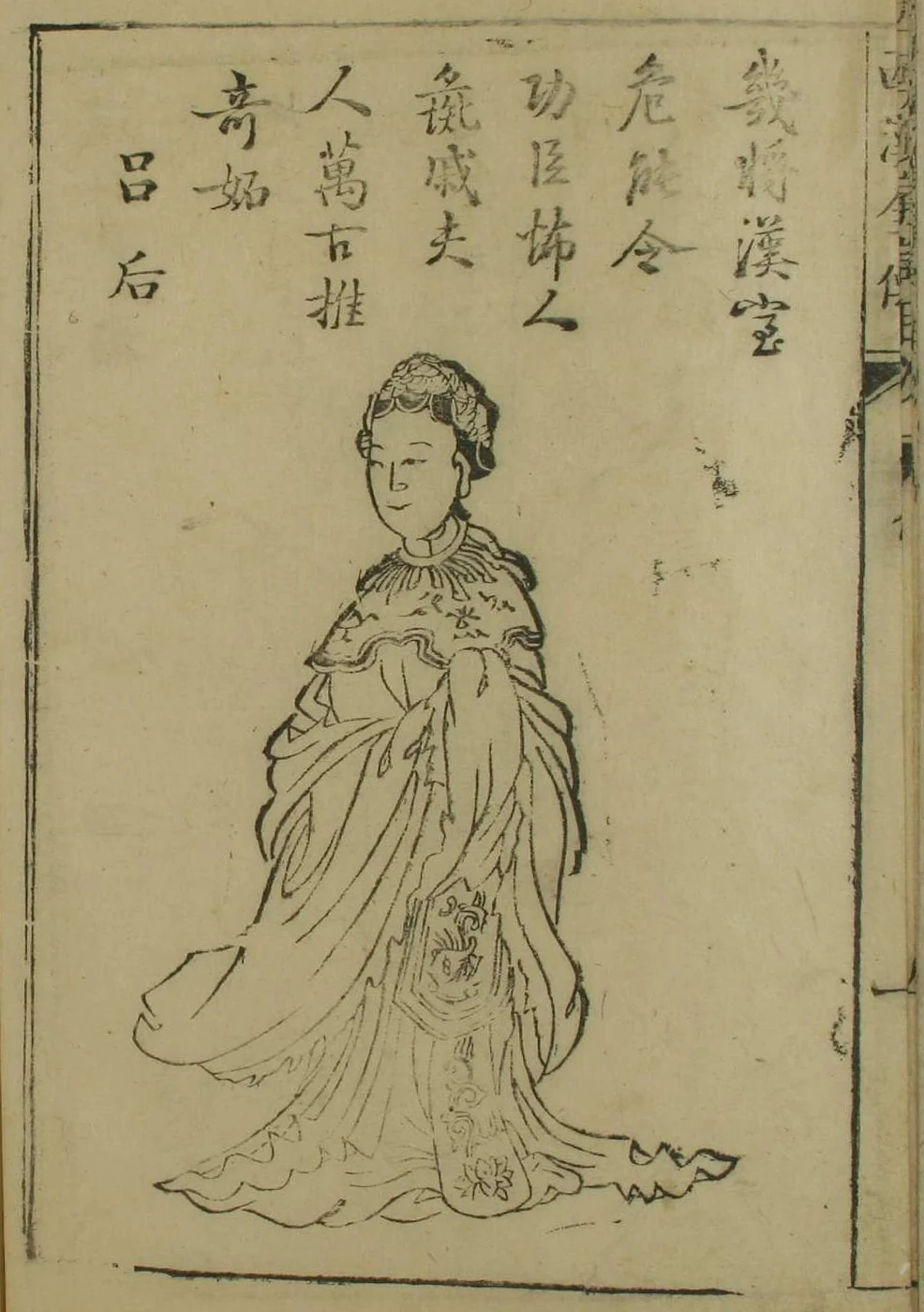
Biography
Family Background and Early Life
Lü Zhi originally lived with her father Lü Gong in Shanfu County, Dang Commandery, present-day Shan County in Heze, Shandong. Lü Gong moved the family to Pei County to avoid an enemy and because he had a close relationship with the local magistrate. When the Lü family settled there, local officials and notable men came to congratulate them. Xiao He, then a senior local clerk, arranged the seating and reportedly placed those who brought gifts of less than one thousand cash in the lower hall. Liu Bang, then a ting head in Sishui and known for treating petty officials dismissively, wrote on his calling card that he offered ten thousand cash though he had brought nothing. Lü Gong personally came to the entrance to receive him, was impressed by Liu Bang's appearance, and seated him in the place of honor. Xiao He warned Lü Gong that Liu often made grand claims and achieved little, but Lü Gong remained impressed. During the banquet he told Liu Bang that he was skilled in physiognomy and had never seen a face of such extraordinary promise and offered his daughter Lü Zhi in marriage. Lü Gong's wife, Lady Lü, protested that her husband had refused to marry their daughter to the Pei magistrate yet now proposed giving her to a mere ting head. Lü Gong insisted and the marriage was concluded.
Lü Zhi was not yet twenty when she married, while Liu Bang was already forty-one and had a son, Liu Fei, born outside the marriage. The source says Lü Zhi did not mistreat Liu Fei and was regarded as diligent and virtuous in her earlier years. Liu Bang was often absent on official business or with companions, and Lü Zhi managed the household, worked in farming and textile production with the children, cared for her parents-in-law, and supported the family. When Liu Bang became a fugitive in the Mang and Dang mountain marshes after releasing transported convicts, Lü maintained the household and at times traveled long distances to bring him clothing and food.
A well-known story relates that while Lü Zhi was weeding with her two children, an old traveler asked for water. She also gave him food. He examined her features and said she was destined for the highest rank, then made similar predictions for Liu Ying and Princess Luyuan. After Liu Bang returned, Lü told him what had happened. Liu pursued the old man, who likewise said Liu's features promised immeasurable nobility. After Liu later became emperor, the old man's whereabouts were unknown.
When Liu Bang hid in the Mang and Dang region after releasing prisoners bound for Mount Li, the authorities arrested Lü Zhi. A jailer behaved improperly toward her, and Ren Ao, a jailer friendly with Liu Bang, became angry and assaulted the man. Lü later visited Liu Bang in the mountains and was said always to find him by following an unusual cloud-like aura over his hiding place, a story that attracted young men from Pei to his following.
Years as a Hostage of Chu
In the tenth month of 209 BCE, the first year of Qin Er Shi, Liu Bang raised troops at Pei and then spent much of his time campaigning. Lü Zhi and the children remained in Pei under the care of the retainer Shen Yiji for three years and ten months. In 206 BCE Liu Bang became King of Han and Lü became his consort, but the family remained in Pei. In the eighth month, Liu sent the generals Wang Xi and Xue Ou through Wuguan to join Wang Ling and retrieve Liu Taigong, Lü Zhi, and other relatives, but Xiang Yu blocked them at Yangxia.
In 205 BCE, the second year of Han, Liu Bang advanced through the regional states and defeated Chu forces at Dingtao, where he acquired the favored Consort Qi. In the fourth month, taking advantage of Xiang Yu's campaign in Qi, the Han army captured the Chu capital Pengcheng. Xiang Yu returned rapidly with cavalry and crushed the Han army at the Sui River. Liu Bang fled with only a few dozen riders and encountered Liu Ying and his sister on the road. He took them into his carriage but, under pressure from pursuit, repeatedly threw them out; Xiahou Ying repeatedly picked them up again. After escaping, Liu Bang searched for Liu Taigong and Lü Zhi but could not find them. Shen Yiji, traveling with Liu Taigong and Lü Zhi by side routes in search of Liu, instead encountered Chu troops, and all were captured. Xiang Yu kept them with the army as hostages.
In 203 BCE, the fourth year of Han, Chu and Han agreed to divide the realm at the Hong Canal, and Xiang Yu released Liu Taigong and Lü Zhi. During Lü's captivity, her father Lü Gong had died. On returning to Han, she found that Liu Bang had become deeply attached to Consort Qi; because Lü was older, she increasingly lost his affection.
Empress and the Elimination of Meritorious Figures
In the second month of 202 BCE, Liu Bang proclaimed himself emperor. Lü Zhi became empress, Liu Ying crown prince, and Princess Luyuan queen to Zhang Ao, King of Zhao. In 201 BCE Lü's elder brothers Lü Ze and Lü Shizhi were enfeoffed as Marquis of Zhoulü and Marquis of Jiancheng.
The source portrays Lü Zhi as politically calculating and capable of cruelty. In 197 BCE, while Liu Bang was away campaigning against Chen Xi, Lü Zhi and Xiao He arranged for Han Xin, Marquis of Huaiyin, to be lured into the palace on charges of supporting Chen Xi's rebellion. Han Xin was executed and his three clans exterminated. Soon afterward, Peng Yue, King of Liang, was stripped of rank and exiled toward Shu. On the road he encountered Lü Zhi and protested his innocence. She outwardly agreed to intercede and brought him back to Xianyang, but then warned Liu Bang that releasing Peng Yue was like releasing a tiger back into the mountains. Peng was retried, killed together with his clan, and his body was reportedly cut into meat paste and distributed to the regional kings.
In 195 BCE Liu Bang became gravely ill and rejected treatment by a skilled physician. Lü Zhi asked him whom she should rely on after his death. Liu answered that Cao Shen could succeed Xiao He; after Cao, Wang Ling could serve but was too blunt and should be assisted by Chen Ping; Chen was intelligent but could not act alone; Zhou Bo was steady though not learned and would be the man to secure the Liu house, so he could be Grand Commandant. When Lü tried to ask further, Liu replied that she would not live to know what came after that.
Emperor Hui's Reign and the "Human Swine" Episode
After Liu Bang's death, Liu Ying succeeded as Emperor Hui and honored Lü Zhi as empress dowager. Lü hated Consort Qi and her son Liu Ruyi, King of Zhao, because Consort Qi had repeatedly urged Liu Bang to replace Liu Ying as crown prince. Lü first imprisoned Qi in the palace labor quarters, shaved her head, put an iron collar around her neck, and forced her to pound grain. Qi sang a lament that her son was a king while she had become a slave and asked who could carry word across the great distance between them. Lü became enraged and summoned Liu Ruyi to the capital. Emperor Hui understood his mother's intention and protected Ruyi personally, eating and sleeping beside him. One morning Hui left early to hunt and the young Ruyi remained behind. Lü seized the opportunity and had him poisoned.
Lü then ordered Consort Qi's hands and feet cut off, her eyes gouged out, her ears damaged, and a drug given to make her unable to speak, after which she was placed in a latrine and called the "human swine." Emperor Hui saw her and wept violently, became ill for more than a year, and thereafter withdrew from active government and indulged in drink and pleasure. During his seven-year reign Lü Zhi effectively dominated government. She also pressured the Liu kings; Liu Fei, King of Qi, escaped danger after formally treating Princess Luyuan as an empress dowager in his own domain. Emperor Hui died in 188 BCE at the age of twenty-three.
Direct Rule and Enfeoffment of the Lü Clan
After Emperor Hui's death, Lü Zhi installed one of his sons, later called the Former Young Emperor, and formally exercised direct rule herself as empress dowager, becoming the first woman in Chinese history recorded as formally ruling in this way. She was conventionally styled Empress Gao. Lü excluded or demoted senior figures such as Wang Ling, promoted her trusted associate Shen Yiji to Left Chancellor, and relied on palace eunuchs. In 187 BCE, the first year of her direct rule, she enfeoffed nephews and other members of the Lü clan, including Lü Tai, Lü Chan, and Lü Lu, as kings, violating the White Horse Covenant attributed to Liu Bang that anyone not of the Liu clan who became a king should be jointly attacked. Wang Ling openly opposed the policy and was nominally promoted to Grand Tutor while effectively stripped of the chancellorship; Chen Ping and Zhou Bo outwardly complied and remained in office.
In 184 BCE, the fourth year of Empress Lü, the Former Young Emperor learned about his birth and reportedly threatened revenge when grown. Lü Zhi deposed and secretly killed him and installed the Later Young Emperor. During her direct rule she continued policies associated with Huang-Lao thought and resting the people, abolished restrictions on private possession of books, encouraged private preservation and presentation of texts, restored older institutions, and more clearly defined rank within the imperial harem. She also presided over revisions of posthumous honors for Emperor Gaozu's mother and siblings, elevating his mother and elder sister from the designation "Lady" to "Empress."
On the thirtieth day of the seventh month in 180 BCE, the eighth year of Empress Gao, Lü Zhi died; one theory attributes the death to rabies. Before dying she appointed Lü Lu Supreme General and Lü Chan Xiangguo and warned members of the Lü clan not to leave their troops. After her death Liu Xiang, King of Qi, raised forces, while Grand Commandant Zhou Bo, Chancellor Chen Ping, Liu Zhang, Marquis of Zhuxu, and others coordinated in the capital. They quickly eliminated the Lü clan, deposed the Later Young Emperor, and enthroned Liu Heng, King of Dai, as Emperor Wen.
The Marriage Chosen by Divination and the Nobleman in the Fields
By the Records of the Grand Historian, old Master Lü "was skilled in reading faces", and when the notables and clerks of Pei heard that the magistrate had an honoured guest they all came to congratulate him, Xiao He presiding over the gifts and announcing that "those whose gifts fall short of a thousand cash shall sit below the hall"; the founder, then a pavilion chief, "always made light of the clerks and so falsely wrote on his card 'a gift of ten thousand cash' while in fact carrying not a coin". When the card was brought in "old Master Lü was greatly astonished, rose and welcomed him at the gate", and, seeing his appearance, "held him in high regard and led him to a seat". Xiao He said that "Liu Ji has always been full of great words and short on deeds", but the founder "made free with the other guests and took the seat of honour, unabashed". When the wine was going round old Master Lü "kept his eye on the founder and detained him", saying that "from my youth I have been skilled in reading faces and have read many, but none like yours; I beg you to take care of yourself. I have a daughter, and I would give her to you as your wife to sweep your floors". When the wine was done old Lady Lü was angry and reproached him, saying that "you always meant to make this daughter remarkable and marry her to a nobleman; the magistrate of Pei was your friend and asked for her and you refused, and now you rashly promise her to Liu Ji", and old Master Lü answered that "this is not a thing women and children can understand", and married her to Liu Ji — this daughter being the Empress Lü, who "bore Emperor Hui and the princess of Lu". Afterwards, when the founder was a pavilion chief he "often asked leave to go to the fields", where the empress with her two children "hoed in the field", and an old man passing by asked for a drink and "the empress fed him"; and the old man, reading her face, said that "the lady is a noblewoman of the world", and reading the two children said of Emperor Hui that "the reason the lady is noble is this boy", and of the princess of Lu likewise that she would be noble; and when the old man had gone and the founder came from a neighbouring field house, the empress told him all, and he caught the old man up and asked him, and the old man said that "just now the lady and her children all resembled you; your face is noble beyond words", and the founder thanked him and said that "if it be as you say I shall not forget your kindness", and when he came to honour "the old man's whereabouts were never known". And when the First Emperor of Qin often said that "there is the air of a Son of Heaven in the southeast" and made an eastern progress to quell it, the founder "suspected himself and fled, hiding among the rocks and marshes of Mount Mang and Dang"; and the empress with others went to seek him and "always found him", and the founder, wondering, asked how, and she answered that "wherever Ji is there is always a cloud above him, so I follow it and always find him", at which the founder was pleased, "and many of the young men of Pei, hearing of it, wished to join him".
The Years as a Prisoner and the Blocking of the Marriage Alliance
In the eighth month of the second year of Han, after the king of Han had recovered the region of Yong by Han Xin's plan, he "sent the generals Xue Ou and Wang Xi out through the Wu pass, and through Wang Ling's troops at Nanyang, to bring back the Grand Duke and the empress from Pei", but "Chu heard of it and sent troops to block them at Yangxia, so that they could not advance". At the defeat at Pengcheng, Xiang Yu "came out from Lu by Huling to Xiao, and fought the great battle with the king of Han at Pengcheng, east of Lingbi on the Sui river, breaking the Han army utterly and killing many soldiers, so that the Sui river was choked with the dead", and "took the king of Han's parents and wife from Pei and kept them in his camp as hostages"; and the Records of Xiang Yu tell how the king of Han, escaping, "wished to pass by Pei and gather his household and go west, but Chu too sent men to Pei to take the Han household, and the household all fled and did not see the king of Han", and he met Emperor Hui and the princess of Lu on the road and took them into his carriage, and "the Chu horse pressed him, and in his haste he pushed Emperor Hui and the princess of Lu from the carriage, and the Duke of Teng always got down and brought them in again, and so three times", saying that "though we are hard pressed, we cannot drive on and abandon them"; and "seeking the Grand Duke and the empress he did not meet them", for Shen Yiji, going with them by side roads to seek the king of Han, "met the Chu army instead", and Chu took them back and reported to the king of Xiang, "who always kept them in his camp". Only when Xiang Yu "made a covenant with the king of Han to divide the world, the west of the Hong Canal to Han and the east to Chu", did he "return the king of Han's parents and wife, and the army all shouted ten thousand years". Two other matters touching the empress belong here: one is the marriage alliance, when the founder, returning from Pingcheng, worried over the strength of the Xiongnu and asked Liu Jing, who advised that "if Your Majesty would truly give the eldest princess to him as wife", and the founder, approving, "wished to send the eldest princess", but the empress "wept day and night", saying that "I have only the heir and one daughter; how can you cast her to the Xiongnu?", so that the founder "could not send the eldest princess after all, but took a girl of the family and called her the eldest princess and gave her to the Shanyu"; and the other is the trial of Zhang Ao, when the conspiracy of Guan Gao and the others was discovered and all the king's household seized, and the empress "said several times that the king of Zhang, for the sake of the princess of Lu, should not have done such a thing", and the founder answered in anger that "if Zhang Ao held the world, would he lack your daughter?", and would not hear her. Moreover the mother of the prince of Huainan had been a favourite of Zhang Ao, king of Zhao, and was with child when the Guan Gao affair broke out and all the king's mothers, brothers and favourites were seized and held at Henei; she told the officers that she had been favoured by the emperor and was with child, and when it was reported the emperor was angry with the king of Zhao and did not attend to her, and her brother Zhao Jian "through the marquis of Piyang spoke to the Empress Lü, but the empress was jealous and would not speak of it, and the marquis of Piyang did not press it", so that when she had borne the prince of Huainan she died in her anger, and the emperor repented and "had the Empress Lü bring him up".
The Killing of the Meritorious and the Saving of the Heir
Of the killing of Han Xin, the Records say that when the younger brother of his retainer denounced him as plotting rebellion, "the empress wished to summon him but feared his party would not come, and so took counsel with the chancellor Xiao He and sent men falsely claiming to have come from the emperor with word that Chen Xi was dead", and all the marquises and ministers offered congratulations, and the chancellor deceived Han Xin into coming to congratulate him "though ill", and when he entered "the empress had the guards bind him and beheaded him in the Bell Chamber of the Changle palace". The founder, returning to Luoyang and hearing of it, was "both pleased and grieved" and asked what Han Xin had said in dying, and the empress answered that "he said he regretted not having used Kuai Che's plan", whereupon the emperor summoned Kuai Che, who answered that "the dog of Zhi barks at Yao — not that Yao was unkind, but a dog barks at him who is not his master; at that time I knew only of Han Xin and knew nothing of Your Majesty", and the emperor said to let him go. Peng Yue's death was of the same kind: being reduced to commoner and exiled to Shu, he met the empress on the road, "wept before her and declared his innocence, asking to be settled in his old Changyi", and the empress promised and "took him east with her to Luoyang", where she told the founder that "the king of Peng is a stout fellow, and to banish him to Shu is to leave a trouble behind; better to put him to death, and I have brought him with me", and so "had his retainers accuse him again of plotting rebellion", and the commandant of justice Wang Tiankai memorialised for the destruction of his clan, "and his clan was destroyed and his state abolished", his head being hung up at Luoyang.
The saving of the heir came from the Four Whiteheads of Mount Shang. When the founder wished to replace the heir with the prince of Zhao, Liu Ruyi, his ministers fought it without success while Shusun Tong contended that "the heir is the root of the world, and if the root shakes the world shakes"; the empress sent the marquis of Jiancheng, Lü Ze, to force Zhang Liang for a plan, and Zhang Liang said that "this cannot be won by words" and advised sending "no spare gold, jade or silk" with "a letter from the heir, humble words and a comfortable carriage, and eloquent men to press the invitation" to bring the four old men, "for if they come and are made guests and follow him into court, the emperor will see them and must wonder and ask". When Ying Bu rebelled and the emperor, being ill, wished to send the heir against him, the four said among themselves that "if the heir leads troops, the matter is dangerous", and advised the marquis of Jiancheng that "you should lose no time in begging the empress to plead with the emperor in tears", and the empress pleaded exactly as they had said, that "Ying Bu is a fierce general of the world... and to have the heir lead these men is no different from having a sheep lead wolves"; and the emperor said that "I thought the boy would not do; I shall go myself", and went east with the army himself, granting Zhang Liang's request that "the heir be made general to guard the troops within the passes". Afterwards the emperor, returning from breaking Ying Bu, grew more gravely ill and wished the more to change the heir, and Zhang Liang's remonstrance was unheeded and Shusun Tong contended to the death, and the emperor consented in seeming but still meant to change him; but when a banquet was held and the heir attended with the four old men following him, "all over eighty, with white brows and beards and very noble dress", the emperor asked who they were and they named themselves "Lord East Garden, Master Jiaoli, Jili Ji and Lord Xiahuang", and to his question how it was that, "having sought them for years while they hid from him, they now followed his son of their own will", they answered that "Your Majesty makes light of scholars and is given to abuse, and we, unwilling to suffer insult, hid for fear; but we have heard that the heir is benevolent and filial, respectful and a lover of scholars, so that the world all cranes its neck to die for him, and so we have come". When they had drunk and gone the emperor followed them with his eyes and, calling Lady Qi, pointed them out and said that "I wished to change him, but these four support him and his wings are formed; it is hard to move him now — the Empress Lü is truly your mistress", and he made Lady Qi dance a Chu dance while he sang a Chu song, that "the great swan flies high, a thousand li at one flight; its feathers are grown and it crosses the four seas... though there were arrows and cords, where should they be used?", and after several stanzas, "in the end he did not change the heir, and it was through Zhang Liang's summoning these four". Of Zhou Chang's contention at court it is recorded that he stuttered and, being very angry, answered that "my mouth cannot speak, but I know it most certainly cannot be; though Your Majesty wish to depose the heir, I most certainly will not receive the edict", at which the emperor laughed happily; and the empress, "listening with her ear at the eastern chamber, seeing Zhou Chang, knelt and thanked him, saying that 'but for you the heir would almost have been deposed'".
Four Days without Mourning and the Fate of Lady Qi and the Prince of Zhao
For four days after the founder's death no mourning was announced, the empress and Shen Yiji plotting that "the generals were once commoners with the emperor, and now they are our subjects in the north, their hearts ever sullen; to make them serve a young lord, unless we destroy their clans the world will not be at peace". This coming to the ears of the general Li Shang, he told Shen Yiji that "it is said the emperor died four days ago and no mourning is announced because you wish to kill the generals; if this be so the world is in danger, for Chen Ping and Guan Ying hold a hundred thousand at Xingyang and Fan Kuai and Zhou Bo two hundred thousand in Yan and Dai, and if they hear the emperor is dead and the generals are to be killed they will join their armies and turn home to attack the passes; with ministers in revolt within and lords in rebellion without, ruin can be awaited on tiptoe", whereupon Shen Yiji reported it and mourning was announced on the day Dingwei with a general amnesty. Of Fan Kuai there is the fear of Chen Ping: when someone said that Fan Kuai was in league with the Lü house and would lead troops to kill Lady Qi and the prince of Zhao after the emperor's death, the founder in anger ordered Chen Ping and Zhou Bo to behead him in the camp, and Chen Ping, "thinking that the emperor wished to kill Fan Kuai only in a moment of anger" and fearing the empress, only arrested him to bring him back; and on the road, hearing that the founder had died, Chen Ping "feared that the Empress Lü and Lü Xu would slander him in anger, and galloped on ahead", and receiving an edict to camp with Guan Ying at Xingyang he "at once galloped back to the palace, wept bitterly and reported before the coffin", and the empress, grieving, made him master of the palace household "to instruct Emperor Hui", "and after that Lü Xu's slanders could not take effect", and when Fan Kuai arrived he "was pardoned and restored to his rank and fief".
The affair of Lady Qi and the prince of Zhao best shows her cruelty. By the Records of the Grand Historian the empress "hated Lady Qi and her son the prince of Zhao most, and had Lady Qi imprisoned in the Long Alley and the prince of Zhao summoned"; three times envoys went and the chancellor of Zhao, Zhou Chang, said that "the late emperor entrusted the prince of Zhao to me, and he is young... I dare not send the king", so that the empress in anger summoned Zhou Chang instead, and when he came she cursed him saying that "do you not know my hatred of the Qi house? And why would you not send the prince of Zhao?", and Zhou Chang being summoned, the prince of Zhao came "and after more than a month at Chang'an drank poison and died", Zhou Chang "pleading illness and refusing to attend court, and dying three years later"; while the Han History records that she "shaved and shackled her and put her in red clothing and set her to hull grain", and Lady Qi as she hulled sang that "my son is a king, his mother a slave, all day hulling until dusk, ever in the company of death... three thousand li apart, who shall be sent to tell you?", at which the empress in great anger said "would you lean on your son?" Emperor Hui, being kindly, "went himself to meet the prince of Zhao at Bashang and brought him into the palace, taking him in his own company in food and lodging", so that the empress could find no opening to kill him; but in the twelfth month of the first year of Emperor Hui's reign, when the emperor went out at dawn to shoot and the prince of Zhao, being young, could not rise early, the empress, hearing that he was alone, "sent men with poisoned wine to give him", and by full dawn, when Emperor Hui returned, the prince of Zhao was dead. Afterwards the empress "had Lady Qi's hands and feet cut off, her eyes put out, her ears smoked, and a dumb-making drug given her, and had her put in the privy, calling her 'the human swine'", and after some days summoned Emperor Hui to look at her; and Emperor Hui, seeing and asking and learning that it was Lady Qi, wept greatly and was ill for more than a year, sending word to the empress that "this is not what a man would do; I, being the empress's son, can never govern the world", and from that time "drank daily and gave himself to pleasure, not attending to government". The affair of the prince of Liu Fei of Qi was of the same kind: when in the second year of Emperor Hui the prince of Chu and the prince of Qi came to court, and Emperor Hui sat the prince of Qi above him at the banquet as an elder brother "after the manner of a private household", the empress in anger "had two cups of poisoned wine set before them" and bade the prince of Qi rise and drink the emperor's health, and when the prince of Qi rose Emperor Hui rose too and took up the cup to drink with him, so that the empress, in fear, "rose herself and struck the cup from Emperor Hui's hand", and the prince of Qi, wondering, dared not drink and feigned drunkenness and went out, and learning that it had been poison was greatly afraid; and his inner secretary advised that "if the king would present a commandery to the empress as a bathing-fief for the princess, the empress will surely be pleased", and so the prince of Qi "presented the commandery of Chengyang and honoured the princess as queen dowager", and the empress was pleased and feasted him at the Qi residence and let him go home.
Holding Court and the Enfeoffing of the Lü
At Emperor Hui's death, when mourning was announced, "the empress wept but no tears fell", and Zhang Biqiang, son of the marquis of Liu and a palace attendant of fifteen, told the chancellor Chen Ping that "the empress had only Emperor Hui, and now that he is dead she weeps without grief; do you know why?", adding that "the emperor left no grown son, and the empress fears you; you should now ask that Lü Tai, Lü Chan and Lü Lu be made generals to hold the northern and southern armies and that the Lü all enter the palace to manage affairs within, and so the empress will be at ease and you will escape calamity", which the chancellor did, and "the empress was pleased and her weeping grew bitter", and "the power of the Lü house began from this"; a general amnesty followed, and in the ninth month the burial, and the heir took the throne, "and in the first year all orders came from the empress dowager". When the empress held court and wished to make the Lü princes, she asked the right chancellor Wang Ling, who said that "the late emperor made a pact on a white horse that 'whoever is king and not of the Liu house, the world shall join to smite him'; to make the Lü kings now is against the covenant", at which the empress was displeased; and asking the left chancellor Chen Ping and the marquis of Jiang, Zhou Bo, they answered that "the late emperor settled the world and made his sons and brothers kings, and now the empress dowager holds court and makes her brothers of the Lü house kings, which is in no way improper", at which the empress was pleased and dismissed the court. Wang Ling reproached them that "at the blood-oath with the late emperor, were you not there? ... with what face will you meet the late emperor below?", and they answered that "to face the court and contend to his face, we are not your equals; but to preserve the altars of state and settle the house of Liu after him, you are not ours", and Wang Ling had no answer; and in the eleventh month the empress, wishing to be rid of him, "made him grand tutor to the emperor and took away the chancellorship", and Wang Ling retired on grounds of illness, Chen Ping becoming right chancellor and the marquis of Piyang, Shen Yiji, left chancellor, "the left chancellor doing no business but set over the palace like a master of the household"; and Shen Yiji, "who had long enjoyed the empress's favour and often managed affairs, so that all the ministers decided matters through him", and the father of the marquis of Li was posthumously honoured as king Dao of Wu "as a gradual step to making the Lü kings". Then came the affair of Liu You, prince of Zhao: in the first month of the seventh year the empress summoned him, and he, having a Lü woman as his consort whom he did not love, loving another concubine, was slandered by the Lü woman to the empress with the false charge that "how should the Lü be kings? When the empress dies I shall attack them", and the empress in anger summoned him, "refusing to see him at his lodging and setting guards about it and giving him no food", so that the prince of Zhao, starving, made a song that "the Lü hold power and the Liu are in peril; the princes are constrained and a consort forced upon me... the Lü have cut off all reason; I call on Heaven for vengeance", and "died in confinement, buried with the rites of a commoner among the common graves of Chang'an". Liu Hui, prince of Liang, moved to Zhao, "was unhappy at heart", and the empress gave him a daughter of Lü Chan as his queen, "whose retinue were all Lü, usurping power and spying on him", so that when he had a beloved concubine the queen had her poisoned, and the prince made four stanzas of song and had musicians sing them, and "in grief killed himself in the sixth month", and the empress, "holding that the prince had abandoned the rites of the ancestral temple for a woman, abolished his succession". As to Nanyue, because "in the empress's time the officials asked to forbid the trade in iron at the Yue passes", Zhao Tuo said that "now the empress dowager listens to slanderers and makes distinctions against the barbarians, cutting off goods, and this must be the plan of the king of Changsha", and so styled himself emperor of the Southern Yue and attacked the Changsha frontier, taking several counties against which the empress sent the general the marquis of Longlü, who "in the heat and damp lost many men to plague and could not cross the ridge", and after more than a year the empress died and the army was withdrawn.
The Final Testament and the Destruction of the Lü
In the middle of the seventh month, being gravely ill, the empress "made Lü Lu, prince of Zhao, general of the upper army over the northern army, and Lü Chan, prince of Lü, over the southern army", and warned them that "the late emperor settled the world and made a covenant with the ministers that 'whoever is king and not of the Liu, the world shall smite him'; now the Lü are kings and the ministers are not at ease. When I die, the emperor being young, the ministers may make trouble; you must hold the troops and guard the palace, and be careful not to follow the funeral, lest you be controlled by others." On the day Xinsi the empress died, her testament giving each of the princes a thousand in gold and all the generals, chancellors, marquises and clerks gifts according to rank, with a general amnesty, making Lü Chan chancellor and Lü Lu's daughter empress; and the Han History says that "the empress held the world eight years and died of a dog's curse", recording that in her illness she made Lü Lu general of the upper army over the northern army and Lü Chan chancellor over the southern. After her death "the grand commandant Zhou Bo, the chancellor Chen Ping and Liu Zhang, marquis of Zhuxu, put Lü Chan and Lü Lu to death, and seized all the Lü men and women, sparing neither young nor old". The Records tell how, "the Lü managing affairs and usurping power and wishing to rebel but fearing the late emperor's old ministers, the marquises of Jiang and Guan, they did not dare move", while the marquis of Zhuxu's wife, a daughter of Lü Lu, "secretly knew their plan and, fearing to be killed, secretly sent word to her brother the prince of Qi, wishing him to raise troops in the west to destroy the Lü and set up a new ruler", and the prince of Qi raised troops, and the chancellor Lü Chan sent the marquis of Yingyin, Guan Ying, against him, who at Xingyang reasoned that "the Lü hold troops in the passes and would endanger the Liu house and set themselves up; if I break Qi and report it, that will only add to the Lü's strength", and so "stayed at Xingyang and sent envoys to league with the prince of Qi and the other lords, awaiting the Lü's move to destroy them together"; and Lü Lu and Lü Chan, wishing to raise rebellion in the passes, "feared within them the marquis of Jiang and the marquis of Zhuxu, and without the armies of Qi and Chu, and feared Guan Ying would turn against them, and so hesitated". The great ministers plotted among themselves that "the young emperor and the princes of Liang, Huaiyang and Changshan are not truly the sons of Emperor Hui; the Empress Lü took other men's sons by a trick and killed their mothers and reared them in the palace, making Emperor Hui call them his own and setting them up as heirs and princes to strengthen the Lü", and that "it is better to look among the princes and set up the worthiest"; and when some proposed the prince of Qi, the ministers objected that his mother's family, the Si, were wicked men, "and if the prince of Qi is set up we shall have another Lü house", and the prince of Huainan was too young and his mother's family also wicked, and they agreed on the prince of Dai, "who is the late emperor's surviving son and the eldest, benevolent and filial and generous, and whose mother's family, the Bo, are careful and good; and to set up the eldest is in accord with order, and he is known through the world for benevolence"; so they secretly summoned the prince of Dai, who twice declined before coming by post, and the ministers all went to greet him, offering him the imperial seals and setting him up as Son of Heaven. Liu Xingju, marquis of Dongmou, asked to "clear the palace" as his share of the merit, and with the grand coachman the marquis of Yingyin, Duke Teng, entered the palace and told the young emperor that "you are not of the Liu house and should not be set up", waving the halberdiers away, and Duke Teng had the imperial carriage bring the young emperor out, and afterwards "the officials put to death by divisions the princes of Liang, Huaiyang and Changshan and the young emperor at their lodgings".
Two matters after her death remain to be told. The first is the desecration of her tomb, the Later Han History recording that the Red Eyebrows "opened the imperial tombs and took their treasures, and outraged the corpse of the Empress Lü", all the tombs they opened containing bodies "as if alive" because of the jade cases. The second is the removal of her place in the sacrifices, when Emperor Guangwu "sent the minister of works to announce in the temple of the late emperor that 'the Emperor Gao covenanted with his ministers that none but the Liu should be kings; the Empress Dowager Lü wickedly slew the three princes of Zhao and made kings of the Lü alone, and but for the spirit of the altars of state, Lu and Chan would not have been executed and the mandate of Heaven would have fallen; she should not be associated in the sacrifices of the temple of Gao nor share the highest honours; the Empress Dowager Bo was kindly and virtuous by nature and Emperor Wen ruled wisely, so that his descendants have enjoyed blessing to this day; let the Empress Dowager Bo be given the honoured title of Empress Gao and be associated with the sacrifices to the Earth; let the tablet of the Empress Dowager Lü be moved to her garden and sacrifices offered there at the four seasons'". Of her native place it is recorded that the village was once called Lü Gu and also Lü Gu village, and that after her death, when Liu and Lü contended and the Lü were destroyed, her clansmen, fearing to be involved, moved the village about a li to the southeast and renamed it Pan village after the surname of her father's mother; and that the Lü descendants built there an Empress Lü shrine, a family temple and a Lü Gu temple, remade her image and restored a broken stele. The stele set up in the third month of the thirty-seventh year of Wanli begins with the position and prospects of her home, saying that "thirty li east of the seat of Shan county runs a road called the Zouma road... the old road where the Han founder galloped, and the birthplace of the Empress Lü, a place of ancient beauty".
Empress Zhang of Hui and the Setting Up and Deposing of the Two Young Emperors
By the Han History's life of the empresses, "Empress Zhang of Emperor Hui was a daughter of the marquis of Xuanping, Zhang Ao, who married the emperor's elder sister the princess of Lu. On Emperor Hui's accession the Empress Dowager Lü, wishing for a double alliance, gave the princess's daughter to the emperor as his empress." And wishing her to bear a son, "when by every means she had none, she had her feign pregnancy and took a son of a palace beauty and called him hers, killed his mother and set up the so-called son as heir. Emperor Hui died and the heir took the throne; in the fourth year he came to know that he was not the empress's son and said openly that 'how could the empress dowager have killed my mother and called me hers? When I am grown I shall do as I please'. The empress dowager, hearing it, was troubled and, fearing he would make trouble, imprisoned him in the Long Alley, giving out that the emperor was gravely ill so that none of those about him could see him; she issued an edict deposing him, as recorded in the annals of the empress, and he died in confinement, and the prince of Hengshan, Liu Hong, was set up as emperor instead, with a daughter of Lü Lu as empress." These are the two young emperors, the first set up as a son of Emperor Hui and deposed and done to death when he learned his origin, and the second, Liu Hong, set up in his place with a daughter of Lü Lu as empress. When the Lü were destroyed, the ministers used exactly this, that these two and the princes of Liang, Huaiyang and Changshan "are not truly the sons of Emperor Hui; the Empress Lü took other men's sons by a trick and killed their mothers and reared them in the palace, making Emperor Hui call them his own", to depose the later young emperor and bring in the prince of Dai, Liu Heng.
The Posthumous Honours and Titles of the Lü
By Xu Guang's note quoted in the Records, the empress's father, old Master Lü, "was marquis of Linsi in the first year of Han and died in the fourth, and in the first year of the empress dowager was posthumously named king Xuan of Lü"; and afterwards "the father of the marquis of Li was posthumously honoured as king Dao of Wu", as a gradual step towards making the Lü kings. Her elder brothers Lü Ze and Lü Shizhi were both enfeoffed as marquises for military merit, as marquis of Zhou-Lü and marquis of Jiancheng; and her younger sister Lü Xu was married to Fan Kuai, marquis of Wuyang, so that the Lü house was bound both by consort kinship and by marriage to the meritorious, and its power grew daily.