About his thirties | Chen Sheng and Xiang Liang rose in revolt; Peng Yue remained in the Juye marshes and did not immediately respond
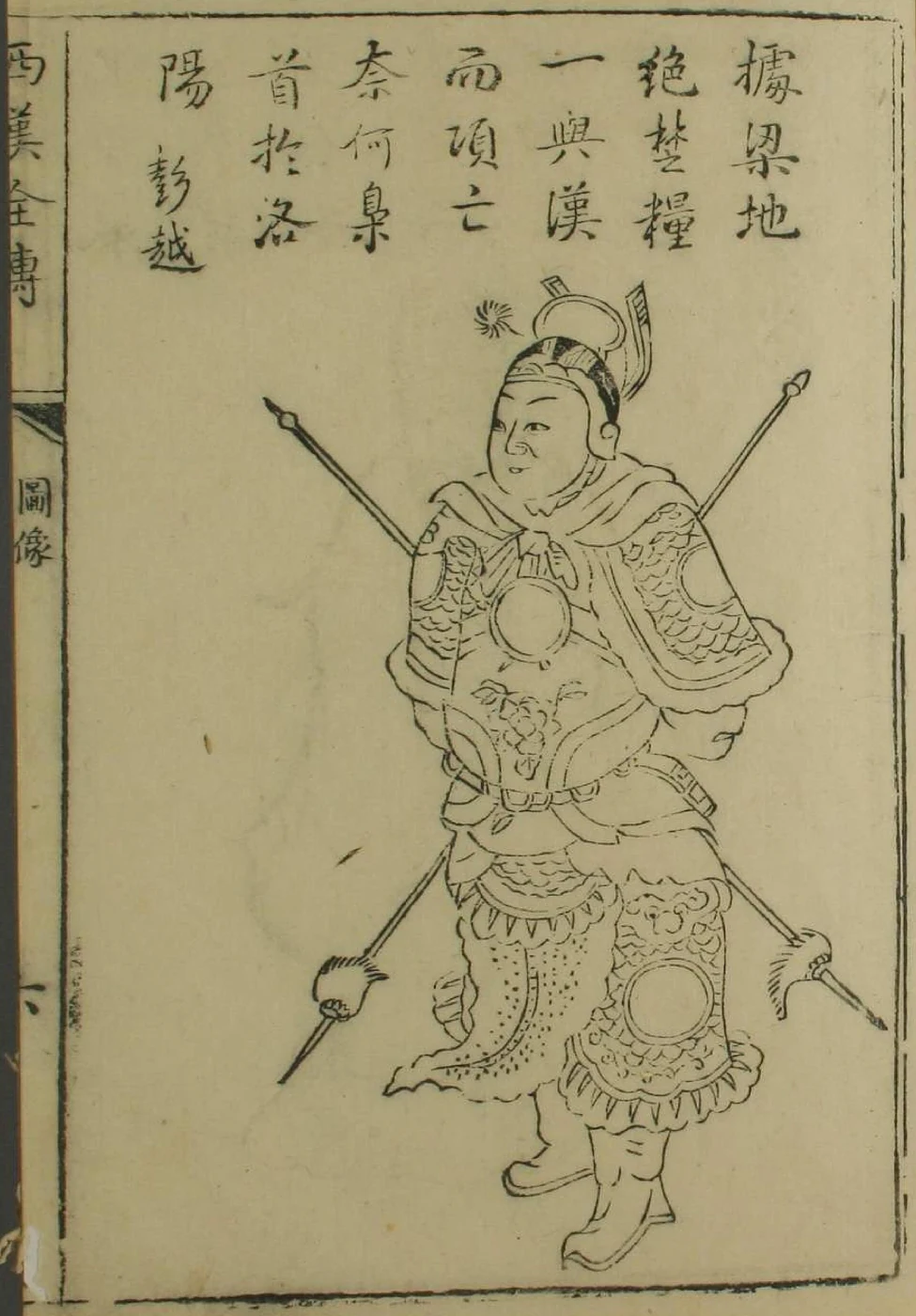
约前?–196 BCE
General
Peng Yue
彭越
Peng Yue was a major commander who operated across the Liang region during the Chu–Han Contention. He helped Liu Bang defeat Xiang Yu and was afterward enfeoffed as King of Liang. He was later accused of plotting rebellion and was executed by mincing.
约前?–196 BCEWestern Han
PROFILE
Peng Yue was a major commander who operated across the Liang region during the Chu–Han Contention. He helped Liu Bang defeat Xiang Yu and was afterward enfeoffed as King of Liang. He was later accused of plotting rebellion and was executed by mincing.
- Other Names
- King of Liang; Peng Yue, King of Wei
- Courtesy Name
- Zhong
- Period
- Western Han
- Dynasty / Regime
- Western Han
- Identity
- General
- Ethnicity / Group
- Han Chinese
- Native Place
- Changyi, Dang Commandery (present-day Juye, Heze, Shandong)
- Date of Birth
- Birth year unknown
- Place of Birth
- Place of birth unknown
- Date of Death
- 196 BCE
- Place of Death
- Place of death unknown
- Highest Office
- See Biography and Major Activities
- Major Achievements
- Major commander active across the Liang region during the Chu–Han Contention; helped Liu Bang destroy Xiang Yu and was enfeoffed as King of Liang; later accused of treason and executed by mincing
LIFE TIMELINE
About forty | More than one hundred youths from the marshes chose him as their leader; he established discipline by ordering the execution of the last latecomer and gathered more than a thousand scattered soldiers
About forty | Liu Bang marched north from Dang County to attack Changyi; Peng Yue assisted him, but after the city did not fall Liu continued west while Peng remained in the Juye marshes and absorbed dispersed Wei troops
About forty | After Xiang Yu divided the empire among the feudal lords, Peng's force of more than ten thousand had no assigned allegiance; in autumn, Tian Rong, king of Qi, rebelled against Chu, gave Peng a general's seal, and Peng badly defeated the Chu commander Xiao Gongjiao at Jiyin
About forty-one | In spring, led more than thirty thousand men to join Liu Bang at Waihuang; appointed Chancellor of Wei, retained independent command, and pacified the Liang region; after Liu Bang's defeat at Pengcheng, Peng abandoned his captured cities and withdrew north toward the Yellow River
About forty-two | Conducted mobile attacks through Liang, severed Chu supply lines, and captured seventeen cities including Suiyang and Waihuang; Xiang Yu campaigned east against him, and Peng withdrew north to Gucheng
About forty-three | In autumn, after Xiang Yu moved south to Yangxia, captured more than twenty cities around Changyi and obtained over one hundred thousand hu of grain for the Han army; Tian Heng, after defeat, fled to Peng; Peng at this point maintained a shifting position between Han and Chu
About forty-four | Liu Bang, following Zhang Liang's advice, promised Peng a kingdom extending from north of Suiyang to Gucheng; Peng brought his entire army to Gaixia, contributing to Xiang Yu's final defeat; in spring Liu Bang enfeoffed him as King of Liang with his capital at Dingtao
About forty-five | Went to Chen County to attend Liu Bang
About forty-seven to forty-eight | Appeared at court in Chang'an on both occasions
About forty-eight | Chen Xi rebelled in Dai; Liu Bang ordered the King of Liang to supply troops, but Peng claimed illness and only sent a general to Handan; Liu became angry and sent a rebuke; Peng's Master of the Imperial Carriages fled and accused Peng and Hu Zhe of plotting rebellion
About forty-nine | Liu Bang sent an envoy who seized Peng by surprise and imprisoned him in Luoyang; officials found the accusation of rebellion established, but Liu commuted the penalty to demotion as a commoner and exile to Qingyi in Shu; at Zheng County Peng encountered Empress Lü and returned with her to Luoyang; Empress Lü caused a retainer to accuse him again of rebellion, the Commandant of Justice Wang Tiankai requested extermination of his clan, and Peng was executed, his clan destroyed, his kingdom abolished, and his body subjected to mincing
BIOGRAPHY
Biography
Family Background and Early Years
Peng Yue, courtesy name Zhong, was from Changyi in Dang Commandery. Changyi had belonged to Wei during the Warring States period and was placed under Dang Commandery after Qin unification. Peng came from a humble background. In his early years he often fished in the Juye marshes and joined a group engaged in banditry. When Chen Sheng and Xiang Liang rose in revolt at the end of the Qin, young men urged Peng to follow their example. He replied that “the two dragons have only just begun to fight; it is better to wait.” More than a year later, over one hundred youths of the marshes gathered and asked him to become their leader. Peng initially refused but eventually agreed after repeated requests.
Peng ordered everyone to assemble at sunrise the next day and announced that latecomers would be executed. More than ten were late, with the last arriving at noon. Peng said that, although he was old and they had insisted on making him leader, he could not execute everyone who was late and would therefore kill only the last man. His followers laughed and protested that there was no need and that they would not be late again. Peng nevertheless had the last arrival beheaded, made a sacrificial offering, and issued orders to the group. The others were shocked and afraid to look up at him. He then led them to seize territory and gathered dispersed soldiers of the feudal lords until his force numbered more than a thousand.
Joining Han and Pacifying the Liang Region
When Liu Bang marched north from Dang County against Changyi, Peng assisted him. The city did not fall, and Liu continued west while Peng remained with his followers in the Juye marshes and absorbed scattered Wei soldiers. By the time Xiang Yu entered the passes and divided the empire among the lords, Peng had more than ten thousand men but no formal place in the new settlement.
In autumn 206 BCE, Tian Rong proclaimed himself king of Qi and rebelled against Xiang Yu. He sent Peng Yue a general's seal and ordered him to attack Chu forces at Jiyin. Xiang Yu sent Xiao Gongjiao to meet him, but Peng inflicted a severe defeat.
In spring 205 BCE, while Liu Bang, Wei Bao, and the allied lords advanced east against Chu, Peng brought more than thirty thousand followers to Waihuang and submitted to the King of Han. Liu Bang stated that General Peng had recovered more than ten cities in the former territory of Wei and was eager to establish a descendant of the Wei royal house; since Wei Bao was a cousin of the former king Wei Jiu and a genuine descendant of Wei, Liu appointed Peng Chancellor of Wei, allowing him to command his own forces independently and pacify Wei territory. After Liu Bang's defeat at Pengcheng and retreat west, Peng lost the cities he had taken and withdrew alone to the north bank of the Yellow River.
Harassing Chu
In 204 BCE, Peng moved through Liang in support of the King of Han, attacking Chu forces and cutting their rear supply lines. That winter, while Xiang Yu and Liu Bang confronted one another around Xingyang, Peng captured seventeen cities including Suiyang and Waihuang. Xiang Yu then left Cao Jiu to guard Chenggao and personally marched east to recover the cities, forcing Peng to retreat north toward Gucheng.
In autumn 203 BCE, after Xiang Yu moved south toward Yangxia, Peng again captured more than twenty cities around Changyi and seized over one hundred thousand hu of grain, which he supplied to Han. After Liu Bang suffered another reverse, he summoned Peng to combine forces against Chu. Peng replied that Wei territory had only just been pacified and remained afraid of Chu, so he could not come. Liu pursued Xiang Yu and was defeated at Guling. Zhang Liang then advised Liu to promise Peng and Han Xin territorial kingdoms after victory. Liu agreed to grant Peng the territory north of Suiyang as far as Gucheng. When the envoy arrived, Peng brought his entire army to Gaixia, joined Liu Bang, and helped defeat Chu. Xiang Yu ultimately took his own life.
Enfeoffment and Death
In spring 202 BCE, Liu Bang enfeoffed Peng Yue as King of Liang, with his capital at Dingtao. In 201 BCE Peng attended Liu at Chen County, and he later appeared at court in Chang'an in 198 and 197 BCE.
In autumn 197 BCE, Chen Xi rebelled in Dai. Liu Bang personally led an army to Handan and ordered Peng to provide troops. Peng claimed illness and sent only a general with soldiers. Liu was enraged and sent an envoy to rebuke him. Frightened, Peng considered going personally to apologize. His subordinate Hu Zhe warned that because he had refused to go at first, appearing only after being rebuked would lead to arrest and urged rebellion instead. Peng refused and continued to claim illness. He also became angry with his Master of the Imperial Carriages and planned to kill him. The officer fled to Liu Bang and accused Peng and Hu Zhe of plotting rebellion. Liu sent an envoy who surprised Peng and arrested him, imprisoning him at Luoyang.
After the responsible officials investigated, they concluded that the elements of a rebellion were established and requested punishment under the law. Liu Bang instead pardoned Peng from death, reduced him to commoner status, and exiled him to Qingyi County in Shu. While traveling west, Peng reached Zheng County just as Empress Lü was traveling from Chang'an to Luoyang. Peng wept before her, protested his innocence, and asked to be sent back to his home at Changyi. Empress Lü agreed and took him east to Luoyang. She then told Liu Bang that Peng was a formidable man and that exiling him to Shu merely left a future danger, arguing that it would be better to kill him. She caused one of Peng's retainers to accuse him of renewed plans for rebellion. The Commandant of Justice Wang Tiankai submitted a request that Peng's clan be exterminated, and Liu approved it. Peng was executed, his clan destroyed, his kingdom abolished, and his body minced; the resulting flesh was distributed to the other kings as a warning.
Major Activities
Mobile Warfare and Disruption of Chu
During the Chu–Han Contention, Peng used highly mobile operations to attack Chu's rear and cut supply routes, forcing Xiang Yu to face pressure from several directions. Moving repeatedly through Liang, he captured seventeen cities including Suiyang and Waihuang and compelled Xiang Yu to divert troops eastward, reducing the pressure on Liu Bang at Xingyang. Later writers referred to this method as “Peng Yue harassing Chu,” although the source notes that this was a retrospective label rather than a fixed expression in the standard histories. Peng's mobile warfare played a key part in the Chu–Han struggle, but describing him as “the earliest master of guerrilla warfare in Chinese history” lacks direct support in the primary sources and is a later assessment.
Battle of Gaixia
In 202 BCE, Liu Bang followed Zhang Liang's advice and promised Peng Yue the territory from north of Suiyang to Gucheng as a kingdom. Peng therefore led his entire army to Gaixia, where he joined Han Xin, Ying Bu, and the other Han forces in defeating Xiang Yu. Luan Bu later declared that without the King of Peng at Gaixia, the Xiang clan would not have been destroyed, emphasizing Peng's importance in the final campaign.
Governance of Liang
After being enfeoffed as King of Liang, Peng established his capital at Dingtao and controlled the Liang territory extending from north of Suiyang to Gucheng. Having operated in Liang for years, he knew the region well. As king he governed the territory and repeatedly appeared at Liu Bang's court. Under Peng, Liang became one of the important feudal kingdoms of the early Western Han.
Relationship with Tian Heng
In 203 BCE, after defeat, Tian Heng fled into former Wei territory and sought refuge with Peng. At that time Peng occupied the region and maintained a shifting political position, at times aiding Han and at times Chu. After Peng eventually submitted fully to Han and became King of Liang, Tian Heng could not remain with him because of Liu Bang and ultimately took his own life.
Personal Relations
Family
- Peng Yue himself, courtesy name Zhong
- Peng Yue's clan, which was exterminated
Ruler–Official Relations
- Liu Bang: Peng submitted to Liu, was enfeoffed as King of Liang, later came under suspicion during the Chen Xi rebellion, and was ultimately executed
- Empress Lü: Peng appealed to her during his exile, but she instead arranged the circumstances leading to his execution
Colleagues
- Han Xin: one of the three celebrated generals of the early Han, like Peng a major contributor to Liu Bang's victory and later killed
- Ying Bu: another of the three celebrated generals; after Peng's death he rebelled and reportedly said that among Liu's generals he had feared only Han Xin and Peng Yue, both of whom were now dead
- Zhang Liang: advised Liu Bang to promise Peng the Liang territory as a kingdom, which brought Peng to the Gaixia campaign
- Luan Bu: old associate of Peng; after Peng's execution he collected his remains, and although Liu Bang intended to boil him alive, Luan's remonstrance led to his release
Subordinates
- Hu Zhe: Peng's subordinate, who urged him to rebel; Peng refused, and Hu was later implicated
- Wei Qu: Peng's subordinate, who led troops in support of Liu Bang during the Chen Xi rebellion
Adversaries
- Xiang Yu: Peng repeatedly attacked Chu's rear and cut its supplies during the Chu–Han Contention, contributing significantly to Xiang Yu's defeat
- Tian Rong: gave Peng a general's seal during his rebellion against Xiang Yu; their connection ended after Peng later joined Han
Historical Assessment
Han / Contemporary
- Empress Lü called Peng “a formidable man” and argued that exile to Shu would leave a danger behind. — Records of the Grand Historian, vol. 90
- Luan Bu argued that while Liu Bang had been trapped at Pengcheng and defeated around Xingyang and Chenggao, Xiang Yu had been unable to move west precisely because Peng occupied Liang and coordinated with Han against Chu. He further said that without Peng at Gaixia, the Xiang clan would not have fallen. — Records of the Grand Historian, vol. 90
- Ying Bu reportedly judged that Liu Bang was old and weary of war and that, among the other generals, only Han Xin and Peng Yue had truly worried him; both were already dead. — Records of the Grand Historian, vol. 91
- Sima Qian observed that although Wei Bao and Peng Yue had risen from low status, they swept across a thousand li and became rulers facing south, but when they were defeated they did not die fighting and instead were captured and executed; he attributed their rise to extraordinary strategic intelligence but suggested that they lacked the personal qualities needed to secure themselves. — Records of the Grand Historian, vol. 90
Wei, Jin, Sui, and Tang Periods
- Ban Gu grouped Peng with the other non-Liu kings rewarded for their contributions to Gaozu's conquest, describing them as men who seized the opportunities of the age, gained territories through force and stratagem, but later became objects of suspicion and ultimately perished. — Book of Han, vol. 34
- Lu Ji praised Peng for observing the times, concealing his strength, displaying martial power, and committing himself to the King of Han.
- Sima Zhen's appraisal of the Records of the Grand Historian summarized Peng's rise at Changyi, submission to Han at Waihuang, repeated logistical support, failure to answer a later levy of troops, and grisly death.
- Zhang Yue compared the bravery and decisiveness of another commander to Peng Yue and Wu Han. — Quan Tangwen, vol. 223
Song, Yuan, Ming, and Qing Periods
- Su Xun distinguished between “virtuous generals” and “talented generals,” placing Han Xin, Ying Bu, and Peng Yue among the latter and arguing that where truly virtuous commanders are rare, capable commanders should still be employed.
- Chen Yuanliang praised Peng as a powerful king who followed the founder of Han, fought through the upheaval, destroyed Qin and Xiang forces, rose from Juye, and received the territory of Liang. — Shilin Guangji, Later Collection
- In 782, the third year of the Jianzhong era, ritual official Yan Zhenqing recommended that sixty-four famous ancient generals receive temple sacrifices; “Peng Yue, King of Liang of Han” was among them. In 1123, the fifth year of the Xuanhe era under Song, the court established temples to seventy-two generals following Tang precedent, again including Peng Yue.
Modern Period
- Modern historians generally regard Peng Yue as an important commander in the Chu–Han Contention whose mobile attacks and disruption of supply lines were critical to Liu Bang's eventual victory over Xiang Yu. Regarding the charge of treason, many modern assessments view the case as part of Liu Bang and Empress Lü's elimination of powerful non-Liu kings and do not consider Peng to have mounted an actual rebellion.
- Peng Yue's tomb is recorded in Qingyuan County, Baoding, Hebei, and in 1982 was listed as a protected cultural relic site of Hebei Province.
FIGURES ASSOCIATED WITH THIS DYNASTY
Bibliography
- Sima Qian, Records of the Grand Historian, vol. 90, “Biographies of Wei Bao and Peng Yue”
- Ban Gu, Book of Han, vol. 34
- Sima Zhen, appraisal to the Records of the Grand Historian
- Cai Xiangyang, Sun Dong, and Ai Jiakai, eds., Comprehensive Classified Dictionary of Chinese Idioms, Hubei Dictionary Press, 2008