Birth | Birth; the place is not recorded; general
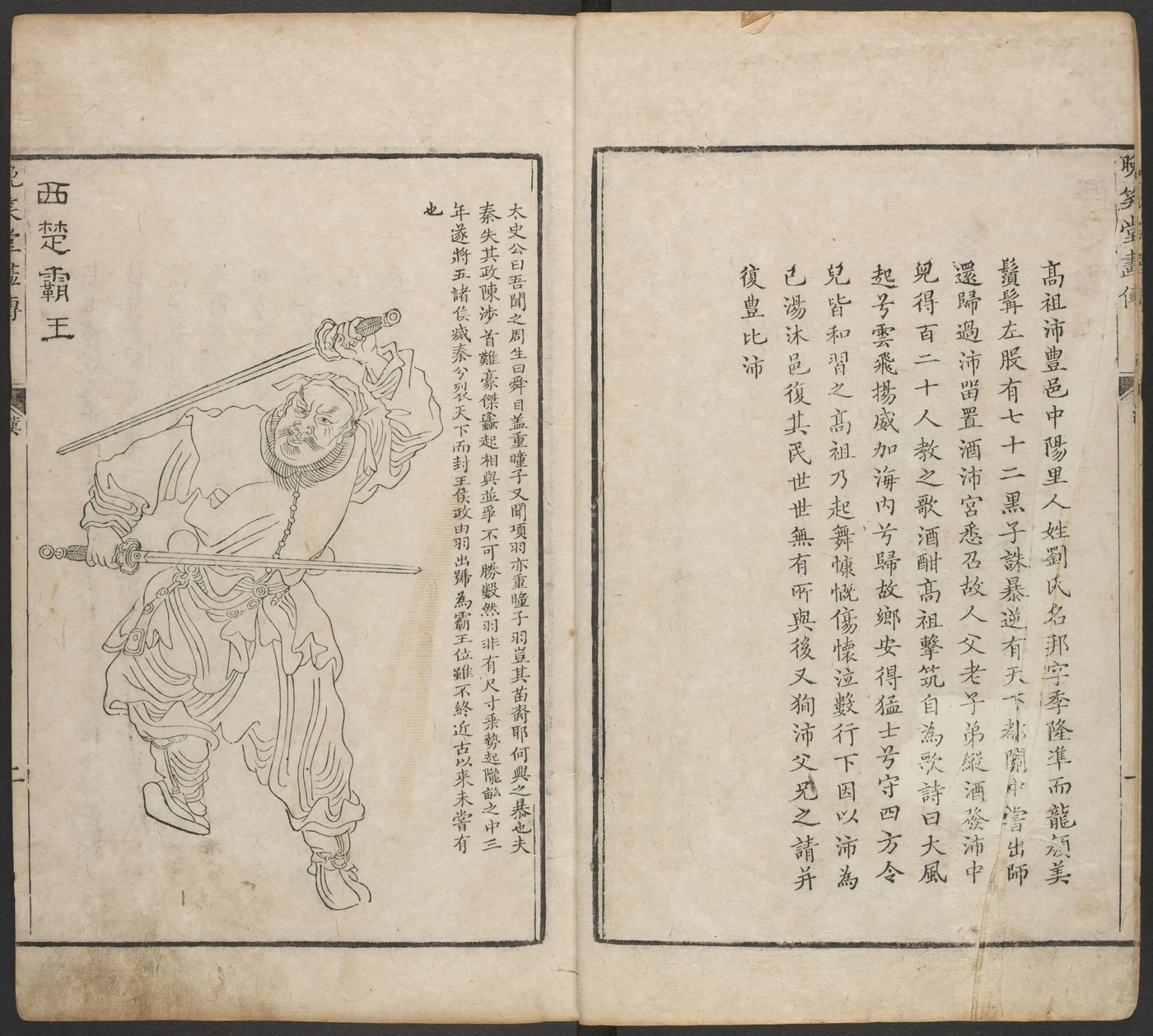
232 BCE–202 BCE
General
Xiang Yu
项羽
Xiang Yu (232–202 BCE), personal name Ji and courtesy name Yu, was generally known by his courtesy name. He was from Xiaxiang County in Sishui Commandery, in present-day Suqian, Jiangsu. A political and military leader at the end of the Qin dynasty, he was the grandson of the famous Chu general Xiang Yan. As a youth he made little progress in the study of writing or swordsmanship but harbored strong anti-Qin ambitions. In the…
232 BCE–202 BCEQin Dynasty
PROFILE
Xiang Yu (232–202 BCE), personal name Ji and courtesy name Yu, was generally known by his courtesy name. He was from Xiaxiang County in Sishui Commandery, in present-day Suqian, Jiangsu. A political and military leader at the end of the Qin dynasty, he was the grandson of the famous Chu general Xiang Yan. As a youth he made little progress in the study of writing or swordsmanship but harbored strong anti-Qin ambitions. In the ninth lunar month of 209 BCE, the first year of Qin Ershi, he joined his uncle Xiang Liang in raising troops at Wu County in Kuaiji Commandery in response to the uprising of Chen Sheng and Wu Guang. After Chen Sheng's death, Xiang Liang became a principal leader of the anti-Qin forces and enthroned Xiong Xin, a grandson of King Huai of Chu, as king. When Qin general Zhang Han defeated and killed Xiang Liang and then attacked Zhao, Xiang Yu was ordered by King Huai to serve as second-in-command under Song Yi in an army sent to relieve Zhao. Because Song Yi remained inactive, Xiang Yu killed him in his tent, took command, advanced to Julu, “broke the cauldrons and sank the boats,” and decisively defeated the main Qin forces. He later accepted Zhang Han's surrender, killed more than two hundred thousand surrendered Qin soldiers, and marched into Guanzhong.
- Other names
- Xiang Ji; Hegemon-King of Western Chu
- Courtesy name
- Yu
- Period
- Qin
- Date of Birth
- 232 BCE
- Date of Death
- 202 BCE
- Dynasty / polity
- Qin
- Identity
- General
- Ethnicity / group
- Not recorded in historical sources
- Ancestral home
- Xiaxiang County, Sishui Commandery (present-day Suqian, Jiangsu)
- Birthplace
- Not known
- Principal achievements
- Grandson of the Chu general Xiang Yan; defeated Qin forces at the Battle of Julu, styled himself Hegemon-King of Western Chu after Qin's fall, and later killed himself at the Wu River after defeat.
LIFE TIMELINE
His grandfather Xiang Yan was defeated and killed himself during Qin's conquest of Chu. | His grandfather Xiang Yan was defeated and killed himself during Qin's conquest of Chu.
Age 22 | Watched Qin Shi Huang on imperial tour with Xiang Liang and said, “He can be replaced.”
Age 24 | Raised troops at Wu County in Kuaiji with Xiang Liang; killed administrator Yin Tong and served as a subordinate general in campaigns.
Age 25 | Xiang Liang was killed at Dingtao; Xiang Yu withdrew to Pengcheng and was enfeoffed as Duke of Lu and Marquis of Chang'an.
Age 26 | Killed Song Yi and seized command; at Julu “broke the cauldrons and sank the boats” and defeated the Qin army, overawing the other lords.
Age 26 | Killed more than two hundred thousand surrendered Qin soldiers at Xin'an.
Age 27 | Allowed Liu Bang to leave the Feast at Hong Gate; sacked Xianyang, killed Ziying, partitioned the realm, and proclaimed himself Hegemon-King of Western Chu.
Age 28 | At the Battle of Pengcheng, defeated Liu Bang's coalition of 560,000 with thirty thousand elite troops.
Age 29 | Fought Liu Bang in prolonged campaigns around Xingyang and Chenggao.
Age 30 | Reached the Hong Canal agreement dividing the realm, but Liu Bang later broke the agreement and pursued him.
Age 31 | Defeated at Gaixia, broke through the encirclement, and killed himself at the Wu River.
BIOGRAPHY
Biography
Family Background and Early Life
Xiang Yu came from a Chu military family whose members had served as generals for generations. According to the Genealogical Compilation of the Yuanhe Era, the Xiang clan traced descent from the Ji surname and the royal house of the Zhou through the feudal state of Xiang; after Xiang was destroyed by Lu in the Spring and Autumn period, its descendants adopted the state name as their surname. Sima Qian's Records of the Grand Historian states that the Xiang family had long served as generals of Chu and had received a fief at Xiang, from which the surname derived. Xiang Yu's personal name was Ji and courtesy name Yu; he was generally known by the latter. He was a grandson of the Chu general Xiang Yan and a son of Xiang Liang's elder brother.
In 223 BCE, during Qin's conquest of Chu, Xiang Yan was defeated by Qin general Wang Jian and killed himself. After Chu's fall, Xiaxiang County became part of Sishui Commandery. As a youth Xiang Yu failed to make progress in reading and writing and then turned to swordsmanship, in which he also failed to excel. Xiang Liang became angry. Xiang Yu responded that reading was useful only for remembering names and swordsmanship only for fighting a single opponent; if he were to learn, he wanted to learn how to fight ten thousand men. Xiang Liang therefore taught him military methods. Xiang Yu was delighted but learned only the broad outlines and refused to study them fully.
After Xiang Liang killed a man, he fled with Xiang Yu to Wu County, the seat of Kuaiji Commandery. In 210 BCE Qin Shi Huang toured Kuaiji and crossed the Zhejiang River, the modern Qiantang River, in a large vessel. Xiang Yu and Xiang Liang watched. Xiang Yu said, “He can be replaced.” Xiang Liang covered his mouth and warned that reckless speech could exterminate the clan, but thereafter regarded him differently. The source says Xiang Yu stood eight chi and two cun, approximately 1.89 meters, and had enough strength to lift a heavy bronze cauldron; even the young men of Wu feared his courage and power.
Raising Troops against Qin
In the seventh lunar month of 209 BCE, Chen Sheng and Wu Guang rose at Daze Township. In the ninth lunar month, Yin Tong, administrator of Kuaiji, told Xiang Liang that everyone west of the Yangzi had rebelled, that Heaven intended Qin to perish, and that he wished to raise troops with Xiang Liang and Huan Chu as generals. Huan Chu was in hiding among marshes. Xiang Liang said that only Xiang Yu knew his location. He went outside, instructed Xiang Yu to wait with a sword, returned to sit with Yin Tong, and asked that Xiang Yu be summoned. Once Yin Tong agreed, Xiang Yu killed him at Xiang Liang's signal. Carrying Yin Tong's head and wearing his official seal, Xiang Yu killed nearly one hundred of Yin's men amid the confusion. The entire commandery office, according to the source, fell prostrate in fear.
Xiang Liang gathered powerful local men and officials, explained the case for rebellion, and mobilized soldiers in Wu County. He sent men to take control of the subordinate counties of Kuaiji and obtained eight thousand picked soldiers. Xiang Liang became administrator of Kuaiji, while Xiang Yu served as a subordinate general and campaigned through the counties. Xiang Yu was twenty-four.
After Chen Sheng's defeat, his subordinate Zhao Ping crossed the Yangzi and falsely claimed to carry Chen Sheng's order asking Xiang Liang to move west against Qin. Xiang Liang crossed the river with eight thousand men and absorbed the forces of Chen Ying, Ying Bu, General Pu, and others. He defeated Qin Jia and Jing Ju and was later joined by Liu Bang, Zhang Liang, and others. During this period Xiang Liang sent Xiang Yu against Xiangcheng. The city resisted for a long time; after taking it, Xiang Yu killed the population and reported back.
Enthronement of King Huai and Xiang Liang's Death
In the sixth lunar month of 208 BCE, Xiang Liang convened a meeting at Xue County. Fan Zeng of Juchao advised that an anti-Qin movement could not endure if Xiang Liang failed to raise a descendant of the Chu royal house. Xiang Liang located Xiong Xin, a grandson of King Huai of Chu, then living as a shepherd, and enthroned him. To conform to popular Chu sentiment he continued to call him “King Huai of Chu.” Chen Ying became Upper Pillar of State and received a five-county fief, accompanying King Huai to establish his court at Xuyi. Xiang Liang served as General-in-Chief and styled himself Lord Wuxin. Xiang Bo, Xiang Yu, other Xiang relatives, and independent commanders including Liu Bang, Ying Bu, General Pu, and Lü Chen all took part in supporting the new king.
In the seventh lunar month of 208 BCE, after learning that Tian Rong was besieged at Dong'e, Xiang Liang marched to assist him, accompanied by Liu Bang and Xiang Yu. Xiang Liang attacked Kangfu, while Liu Bang and Xiang Yu joined Tian Rong, Sima Longju, Chai Wu, and others in defeating the Qin army below Dong'e. Zhang Han retreated west and Xiang Liang pursued. Xiang Liang then sent Liu Bang and Xiang Yu separately to attack Chengyang; after taking the city, they destroyed it. Moving west, they defeated Zhang Han east of Puyang. In the eighth lunar month Liu Bang and Xiang Yu turned against Dingtao but failed to capture it, then advanced west to Yongqiu, where they defeated Qin forces and killed Li You, administrator of Sanchuan Commandery.
In the ninth lunar month Xiang Liang, made overconfident by repeated victories, was surprised by Zhang Han after Qin reinforcements arrived and was defeated and killed. Xiang Yu and Liu Bang were moving from Waihuang toward Chenliu when they received the news. They judged that Xiang Liang's death had frightened the soldiers and lowered morale, so they withdrew east together with Lü Chen. Lü Chen camped east of Pengcheng, Xiang Yu west of the city, and Liu Bang at Dang County.
The Battle of Julu and Seizure of Command
After Xiang Liang's death, King Huai of Chu left Xuyi for Pengcheng, combined the armies of Xiang Yu and Lü Chen under his own command, and moved his capital there. He reorganized the government, made Liu Bang chief of Dang Commandery with the title Marquis of Wu'an, and placed him over Dang's troops. Xiang Yu was made Duke of Lu and Marquis of Chang'an. Lü Qing became chief minister, his son Lü Chen became Minister over the Masses, and Xiang Bo and Gong Ao were among the central officials.
After the intercalary ninth month of 208 BCE, Zhao, besieged by Qin, repeatedly appealed to Chu for aid. King Huai promoted Song Yi to commander of the army with the title “Champion of the Ministers” and made an agreement with his commanders that whoever first entered and pacified Guanzhong would rule there as king. After the defeats of Chen Sheng and Xiang Liang, most Chu generals doubted that they could enter Guanzhong first. Xiang Yu alone, enraged by Xiang Liang's death, wanted to march west with Liu Bang. Veteran Chu officers, however, regarded Xiang Yu as fierce and destructive, citing the killing at Xiangcheng. King Huai therefore sent Liu Bang west, while appointing Song Yi supreme general, Xiang Yu second general, and Fan Zeng third general to lead the relief army north toward Zhao, with Ying Bu, General Pu, and the separate commands subordinated to Song Yi.
In the tenth lunar month of Qin Ershi's third year, in the winter spanning 208–207 BCE, Song Yi reached Anyang and remained there for forty-six days. Xiang Yu urged an immediate crossing of the Yellow River and a joint attack with Zhao, predicting certain victory. Song Yi replied that if Qin defeated Zhao its troops would be exhausted and could then be struck, while if Qin were defeated the Chu army could march west and destroy it. He boasted that strategic planning while seated was superior to Xiang Yu's ability. He issued severe orders against disobedience and sent his son Song Xiang to Qi as chancellor, personally accompanying him to Wuyan and holding a banquet. Cold rain fell and the soldiers suffered hunger and exposure. Xiang Yu denounced Song Yi before the army for delaying action, neglecting the soldiers, and pursuing private interests. The next day Xiang Yu killed Song Yi in his tent and claimed to have acted on a secret royal order against treason. The other commanders, overawed, made Xiang Yu acting supreme general. He sent men into Qi to kill Song Xiang and dispatched Huan Chu to report to King Huai. The king was forced to confirm Xiang Yu as supreme general over Ying Bu, General Pu, and the other commands.
In the eleventh lunar month Xiang Yu marched to Julu. The source gives Song Yi and Xiang Yu's army as fifty thousand, while Wang Li and Zhang Han had four hundred thousand elite Qin troops. After killing Song Yi, Xiang Yu's reputation spread among Chu and the other lords. He first sent Ying Bu and General Pu with twenty thousand men across the Zhang River. They won several small engagements and repeatedly cut Qin supply corridors, reducing Wang Li's provisions. In the twelfth lunar month Xiang Yu crossed with the whole army, broke the cooking cauldrons, sank the boats, and carried only three days of dry food to demonstrate a determination to die rather than retreat. The Chu army encircled Wang Li, fought nine engagements, cut the Qin supply corridors, defeated the Qin army, and killed Su Jiao. In the first lunar month Wang Li was captured, while She Jian refused to surrender and burned himself to death.
The source describes the Chu army as the strongest among the allied states. The other lords had built more than ten fortified camps around Julu, but none dared fight. When the Chu soldiers attacked, the other commanders watched from their walls. Chu troops fought with extraordinary intensity and shouting, terrifying the allies. Xiang Yu defeated Zhang Han and forced him to retreat; only then did the allied armies dare attack the Qin troops around Julu, completing the defeat. After victory Xiang Yu summoned the lords' commanders. They entered his camp gate on their knees and did not dare look up at him. His military prestige made him commander-in-chief of the allied lords, and their armies came under his authority.
Accepting Zhang Han's Surrender and Killing the Qin Captives
In the first lunar month of 207 BCE, Xiang Yu destroyed Wang Li's army at Julu. In the second month Zhang Han was again driven back and camped at Jiyuan, while Xiang Yu remained south of the Zhang River. After repeated defeats, Zhang Han sent Sima Xin to the Qin court for aid, but Hu Hai and Zhao Gao instead rebuked and suspected him. Zhao Gao sought to kill Sima Xin, who escaped back to the front and informed Zhang Han. Sima Xin and Dong Yi urged Zhang Han to surrender. Zhang Han hesitated and secretly sent the military official Shicheng to Xiang Yu's camp to negotiate. In the sixth lunar month Xiang Yu initially offered terms but then resumed attacks, sending General Pu rapidly across Sanhu Ford to camp south of the Zhang. The Chu army defeated Qin again, after which Xiang Yu attacked at the Wu River and won another major victory.
In the seventh lunar month Zhang Han again sent an envoy to seek an agreement. Because Xiang Yu's supplies were declining, he accepted. Xiang Yu and Zhang Han met at the ruins of Yin south of the Huan River and concluded an alliance. Zhang Han wept as he described Zhao Gao's conduct. Xiang Yu promised to make him King of Yong and kept him within the Chu camp.
In the eleventh lunar month Xiang Yu's army reached Xin'an. Many soldiers of the allied lords had previously performed forced labor in Qin territory and suffered humiliation from Qin troops. Now they treated the surrendered Qin soldiers as servants and abused them, causing resentment. The Qin captives feared that Zhang Han had deceived them into surrendering and that if Qin were not overthrown their families at home might be executed. When these discussions were reported to Xiang Yu, he consulted Ying Bu and others. Believing that the large body of Qin prisoners might become dangerous if they refused orders after entering Guanzhong, Xiang Yu had more than two hundred thousand surrendered Qin soldiers killed south of Xin'an in a single night, leaving only Zhang Han, Sima Xin, Dong Yi, and a few principal commanders to continue west.
The Feast at Hong Gate and Partition of the Realm
As Xiang Yu advanced into Guanzhong, he reached Hangu Pass and found it defended. Liu Bang had entered Xianyang first and stationed troops at Hangu Pass to prevent the Chu army from entering. Ying Bu led the Chu vanguard through the pass. Liu Bang, frightened, withdrew from Xianyang and camped at Bashang. Cao Wushang, Left Army Marshal under Liu Bang, sent word to Xiang Yu claiming that Liu Bang intended to rule Guanzhong as king, make Ziying chancellor, and keep all the treasures. Xiang Yu became furious. The source gives his army as four hundred thousand and Liu Bang's as one hundred thousand. Fan Zeng urged him to eliminate Liu Bang. Xiang Yu therefore invited Liu Bang to a banquet at Hong Gate, in present-day Lintong, Xi'an. Fan Zeng had Xiang Zhuang perform a sword dance as a pretext for assassination, giving rise to the saying “Xiang Zhuang performs the sword dance, but his aim is the Duke of Pei.” Xiang Bo intervened to shield Liu Bang, while Zhang Liang brought Fan Kuai in to argue on Liu Bang's behalf. Liu Bang was allowed to leave safely. The banquet became known as the Feast at Hong Gate.
In 206 BCE, after entering Xianyang, Xiang Yu killed the Qin king Ziying and burned the Qin palaces; the source says the fires lasted three months and left devastation along his route. A man surnamed Han urged him to remain in Guanzhong, arguing that he could establish hegemony there. Xiang Yu had no intention of staying. Seeing the Qin palaces already burned and longing to return east, he said that attaining wealth and honor without returning home was like wearing embroidered clothes at night, unseen by anyone. This became associated with later idioms about returning home in glory and wearing fine clothes by night. Han then mocked the Chu people as “monkeys wearing caps.” Xiang Yu heard of it, became angry, and had him boiled alive.
Xiang Yu sent a message to King Huai asking how the lands should be distributed. King Huai replied, “As agreed,” meaning that Liu Bang, first to enter Guanzhong, should be king there. Xiang Yu refused. He elevated King Huai as Emperor Yi of Chu while preparing to make himself king. In the second lunar month of 206 BCE Xiang Yu partitioned the realm among commanders and lords. He proclaimed himself Hegemon-King of Western Chu, ruled nine commanderies in the Liang and Chu regions, and made Pengcheng his capital. He divided the former Qin lands among anti-Qin leaders, assigning Guanzhong to the surrendered Qin generals Zhang Han, Sima Xin, and Dong Yi, while sending Liu Bang to Hanzhong, Ba, and Shu as King of Han. Around this time Han Xin, then a low-ranking guard under Xiang Yu, left because his advice was ignored and joined Liu Bang, later becoming a decisive figure in the Chu–Han War.
Xiang Yu soon exiled Emperor Yi to Chen County in the Changsha kingdom and secretly ordered Ying Bu to kill him on the journey. In the same year Tian Rong, chancellor of Qi, rebelled and proclaimed himself King of Qi, and sent troops to help Chen Yu defeat Zhang Er, King of Changshan, restoring Zhao Xie as King of Zhao.
The Chu–Han War
In the eighth lunar month of 206 BCE, while Xiang Yu was fighting Tian Rong in Qi, Liu Bang, King of Han, emerged from Hanzhong and attacked the Three Qins in Guanzhong. He defeated Chu-aligned forces; Sima Xin and Dong Yi surrendered, Zhang Han was besieged at Feiqiu, and Han took control of Guanzhong. Han Xin, King of Han, meanwhile captured more than ten cities in the Han region and was made King of Han in the eleventh lunar month. With Guanzhong and Han secured, Liu Bang prepared to advance east.
In the third lunar month of 205 BCE, Liu Bang denounced Xiang Yu for killing Emperor Yi, formed a coalition of five states, and advanced in two columns with a total force stated as 560,000. They captured Pengcheng and seized its treasures and women, spending the nights in celebration. Xiang Yu left subordinates in Qi and personally led thirty thousand elite troops south. After examining the situation, he moved around to the west of Pengcheng and struck from the direction where Liu Bang's defenses were weakest. Moving with great speed, he first defeated Fan Kuai near Lu County before Lü Ze could return. From early morning until noon he smashed the main Han army, drove it toward the Gu and Si rivers, and killed more than one hundred thousand men. The Chu army recovered Pengcheng and pursued to the Sui River, where more than another one hundred thousand Han soldiers were driven into the water and drowned; the source says the river was blocked by bodies. Chu forces surrounded Liu Bang in three layers, but a sudden northwesterly gale raised sand and stones and plunged the battlefield into darkness. The Chu formation was thrown into confusion, allowing Liu Bang to escape with a few dozen horsemen. His father, known as the Grand Duke, and his wife Lü were captured. The source presents the battle as a famous victory in which Xiang Yu's thirty thousand defeated a coalition of 560,000. The Han army suffered severe losses, lost much of its previous strategic advantage, and withdrew toward Xingyang.
Liu Bang regrouped troops, while Xiao He sent old and young men from Guanzhong to reinforce Xingyang. Han then defeated Xiang Yu's pursuing forces at Jingsuo and stabilized its position. Chu was unable to break through the Han defenses into Guanzhong, and the war settled into prolonged fighting around Xingyang and Chenggao.
In 204 BCE Liu Bang sought to break the stalemate. He ordered Jin Xi to cut Chu's supply line from Xingyang to Xiangyi and Guan Ying to cut the route from Yangwu to Xiangyi, while other forces attacked Lu, Chu's secondary base. Zhou Ke suspected that Wei king Bao would surrender to Xiang Yu and killed him. Xiang Yu then captured Xingyang and boiled Zhou Ke alive. He took Chenggao and advanced to Gong County, threatening Luoyang. Liu Bang, after completely pacifying Lu, learned of the losses and ordered Jin Xi, Ding Fu, and others to attack the Chu rear independently; Ding Fu defeated Long Ju at Pengcheng. Liu Bang and Guan Ying returned to Luoyang and blocked Xiang Yu at Gong County. Xiang Yu attacked Luoyang and Aocang. Liu Bang ordered Guan Ying to Handan to bring back Han Xin's troops to defend Aocang and appointed Guan Ying Censor-in-Chief.
The Hong Canal Agreement and Defeat at Gaixia
By 203 BCE the Chu and Han armies had faced one another for a long time around Xingyang and Chenggao. Xiang Yu's supply lines were increasingly strained; Han Xin had pacified Qi, and Ying Bu had deserted Chu for Han. Liu Bang sent Lu Jia, Marquis Hou, and others to negotiate. The two sides finally agreed to divide the realm along the Hong Canal, with territory west of it assigned to Han and the east to Chu. Xiang Yu returned Liu Bang's father and wife and began marching east.
Liu Bang initially planned to return west, but Zhang Liang and Chen Ping urged him to break the agreement and pursue Xiang Yu as he withdrew. Liu Bang followed the advice and chased him to Guling. Han Xin and Peng Yue had not yet arrived, however, and Xiang Yu defeated Liu Bang, forcing him behind fortified defenses. At Zhang Liang's suggestion, Liu Bang promised kingships to Han Xin and Peng Yue, and both then brought their forces to join him.
In the twelfth lunar month of 202 BCE Han Xin joined Liu Bang with three hundred thousand troops, while Peng Yue, Ying Bu, and others also arrived. The combined Han army, stated in the source as roughly six hundred thousand, came under Han Xin's unified command and faced Xiang Yu at Gaixia, in present-day Anhui. Han Xin first engaged with the center and then ordered the left and right wings to envelop the Chu army. Xiang Yu was defeated and withdrew into his camp. That night Han troops sang Chu songs on all sides. Xiang Yu, believing that Chu had already entirely fallen to Han, exclaimed that there seemed to be an enormous number of Chu men in the Han army. He rose and sang in his tent: “My strength uprooted mountains and my spirit overshadowed the world; the times are against me and my horse Zhui will not run. If Zhui will not run, what can I do? Yu, Yu, what am I to do with you?” Yu Ji sang and danced in response and, according to the source, killed herself.
Xiang Yu broke out by night with more than eight hundred cavalry, pursued by five thousand Han horsemen. After crossing the Huai River he had only a little more than one hundred riders left. At Yinling he lost his way and asked a farmer for directions. The farmer deceived him by telling him to turn left, leading him into marshland and allowing the pursuers to catch up.
At Dongcheng, southeast of present-day Dingyuan in Anhui, Xiang Yu had only twenty-eight riders, with thousands of Han troops close behind. Believing escape impossible, he told his men that in eight years of campaigning he had fought more than seventy battles, defeated every opponent, and never suffered defeat until now; he therefore insisted that Heaven was destroying him, not any failure in battle. He proposed to prove it by winning three final engagements, breaking the encirclement, killing a commander, and cutting down a banner. He divided the twenty-eight riders into four groups, attacked in four directions, killed a Han general and a commandant and dozens to more than a hundred soldiers, while losing only two of his own riders.
Xiang Yu's remaining men reached the Wu River, northeast of present-day He County in Anhui. The local pavilion chief came with a boat and urged him to cross back into Jiangdong, saying that although the region was small, with a thousand li of territory and hundreds of thousands of people it was enough to rule, and that his was the only boat available before the Han army arrived. Xiang Yu laughed and said that if Heaven intended his destruction there was no reason to cross. He had led eight thousand sons of Jiangdong west and not one had returned; even if their fathers and elder brothers pitied him and made him ruler again, how could he face them? Even if they said nothing, would he not be ashamed in his own heart? He gave his horse Zhui to the pavilion chief, ordered his riders to dismount, and fought on foot with short weapons. The source says Xiang Yu personally killed several hundred Han soldiers and suffered more than ten wounds. He then recognized the Han cavalry marshal Lü Matong and asked if he was not an old acquaintance. Lü avoided looking directly at him and pointed him out to Wang Yi, saying, “That is King Xiang.” Xiang Yu said that he had heard Han had offered a thousand jin of gold and ten thousand households for his head and that he would do Lü a favor. He then cut his own throat. Wang Yi took his head, while other Han soldiers fought over the body, killing dozens among themselves. Yang Xi, Lü Matong, Lü Sheng, Yang Wu, and another officer obtained different portions of the body and were jointly enfeoffed.
After Xiang Yu's death, the Chu territories surrendered to Han except Lu. Because Xiang Yu had once held the title Duke of Lu, Liu Bang buried him at Gucheng, in present-day Dongping, Shandong, with the rites due a duke, personally mourned him, and departed in tears.
The Deadlock at Xingyang and Chenggao: Ji Xin's Ruse, the Death of Zhou Ke, and the Struggle over the Grain Roads
After the battle of Pengcheng, Liu Bang gathered his scattered men, and with Xiao He sending the old and weak of Guanzhong to help at Xingyang he beat the pursuing Chu army at Jing and Suo, so that the Han army steadied itself, while the Chu could not break through the Han line to enter Guanzhong, and from that time the two sides were locked in a long struggle about Xingyang and Chenggao. In 204 Liu Bang, to break the deadlock at Xingyang, ordered Jin Xie to cut the Chu grain road from Xingyang to Xiangyi and Guan Ying to cut that from Yangwu to Xiangyi, and himself left Xingyang to attack the Lu city in the Chu rear, so that the Chu army, its grain roads cut, was in difficulty. When Xingyang was in danger, Liu Bang's officer Ji Xin contrived that two thousand women in armour be let out of the eastern gate of Xingyang to draw the Chu troops to surround and attack them, while Ji Xin, disguised as Liu Bang, sat in a carriage and came out to surrender, so that Liu Bang escaped, leaving Zhou Ke, Zong Gong and Wei Bao to hold the city. Zhou Ke, thinking that the king of Wei, Bao, might surrender to Xiang Yu, killed him; and Xiang Yu, having stormed Xingyang, boiled Zhou Ke alive, then broke Chenggao and advanced to Gong county, threatening Luoyang. Liu Bang, having wholly reduced the Lu city, learned that Xingyang and Chenggao were lost and Xiang Yu approaching Luoyang, and sent Jin Xie, Ding Fu and others separately against the Chu rear, where Ding Fu beat Long Ju at Pengcheng; he himself with Guan Ying returned to Luoyang to hold Xiang Yu, and stopped him at Gong county so that he could not go west. Afterwards Xiang Yu attacked Luoyang and the Ao granary with vigour, and Liu Bang sent Guan Ying to Handan to bring back Han Xin's army to hold the Ao granary, making Guan Ying censor-in-chief in succession to the office.
Chen Ping's Stratagem and the Departure of Fan Zeng; Han Xin's Conquest of Qi and the Fall of Long Ju
In 204, when Liu Bang was short of grain and in alarm sued for peace, proposing to divide the territory with Xingyang as the line and the west to Han, Xiang Yu would have agreed, but Fan Zeng spoke against it, and Xiang Yu pressed the siege of Xingyang the harder. Liu Bang, deeply troubled, used Chen Ping's stratagem to divide Xiang Yu from Fan Zeng: when Xiang Yu's envoy came, a rich banquet of beef, mutton and pork was first made ready to be set before him, but on seeing the Chu envoy the servers pretended astonishment and said that they had thought it was the envoy of the "secondary father" (Fan Zeng), and took the food away, giving the Chu envoy coarse fare instead. The envoy reported it on his return, and Xiang Yu suspected Fan Zeng of dealings with the Han and gradually took away his power. Fan Zeng was furious and said that the situation of the empire was now broadly settled and the king must look to himself, and asked that his body be returned to him that he might become a common soldier; and Xiang Yu consented, and Fan Zeng departed, dying on the road back to Pengcheng of a poisoned sore on his back. In the tenth month of the winter of 203 Han Xin took Qi, and Xiang Yu, hearing of it, sent the great general Long Ju to its relief, and Long Ju was beaten and killed; in the second month of the following spring Liu Bang made Han Xin king of Qi and called up his troops against Chu. Someone went to persuade Han Xin, now king of Qi, to divide the empire into three, and was refused. At this time the Han had many troops and plenty of grain, while Xiang Yu knew that his support was daily diminishing, that his grain was nearly gone and that Han Xin was moving against him, and was therefore greatly troubled; and so he came to terms with Liu Bang to divide the empire at the Honggou canal, returned the grand duke and Lady Lü, and withdrew his army eastward.
The Defeat at Guling, the Order of Battle at Gaixia, and His Destruction
Liu Bang had meant to go west, but on Zhang Liang's and Chen Ping's advice sent troops after the Chu army; yet the king of Qi, Han Xin, and the chancellor of Wei, Peng Yue, did not come to join him as agreed, and Xiang Yu turned on him and heavily defeated the Han army, so that Liu Bang again held his walls and strengthened his defence, and on Zhang Liang's advice marked out fiefs for Han Xin and Peng Yue, after which the two brought out their troops. In the twelfth month of 202 Liu Bang with the armies of all the roads joined battle with Xiang Yu at Gaixia, with Han Xin leading three hundred thousand as the vanguard, General Kong on the left, General Fei on the right, Liu Bang behind and the marquis of Jiang, Zhou Bo, and General Chai formed up behind him; and Xiang Yu led out a hundred thousand, first fighting Han Xin in a great battle, in which Han Xin's troops fell back, then had his two wings close in on the Chu army, which could not withstand it and drew back, whereupon Han Xin turned and struck and the Chu army was heavily beaten and fell back into its camp. The Han army sang the songs of Chu on all four sides by night, and Xiang Yu, thinking that all Chu was in Han hands, cried out in amazement that Han had taken all of Chu and asking why there were so many men of Chu; and rising in the night he sang in his tent: "My strength uprooted mountains, my spirit covered the age; the time was against me and my steed would not gallop on. If my steed will not gallop, what is to be done? Yu, oh Yu, what is to become of you?" Lady Yu sang in answer and danced and killed herself. Xiang Yu broke out southward by night with more than eight hundred horse, the Han pursuing with five thousand; and after crossing the Huai he had only a hundred-odd riders, and losing his way at Yinling he asked an old farmer, who lied to him and told him to go left, so that he fell into a great marsh and was overtaken by the Han. Falling back on Dongcheng with only twenty-eight riders while the Han pursuers numbered thousands, and knowing he could not escape, he told his riders that he had risen eight years before and fought more than seventy battles, that all he faced he broke and all he attacked submitted, that he had never been beaten and had become lord of the empire, and that now he was trapped, which was heaven's destruction of him and not a fault of war; that this day he would die, but would fight a swift battle for them and win three victories, breaking the ring, killing a general and cutting down a banner, so that they should know that heaven destroyed him and not war. He divided the twenty-eight into four troops and charged in four directions, killing a Han general and then a commandant and several score or hundred men, while the Chu lost only two riders. Falling back to the Wu river, where the ferryman of Wujiang was waiting with his boat and urged him to cross, saying that though Jiangdong was small it was a thousand li square with several hundred thousand people and enough to be a king, and that he alone had a boat and the Han could not cross, Xiang Yu laughed and said that heaven was destroying him and what should he cross for; that he had crossed west with eight thousand sons of Jiangdong and not one had returned, and that though the elders of Jiangdong should pity him and make him king, with what face could he see them, and though they said nothing, would he not be ashamed in his heart? He gave his black steed to the ferryman and had his riders dismount and fight on foot with short weapons, and he himself killed several hundred of the Han, receiving more than ten wounds. Seeing the Han cavalry commander Lü Matong, he asked whether he was not an old acquaintance, and Lü Matong, not daring to look at him, pointed him out to Wang Yi and said that this was the king of Chu; and Xiang Yu said that he had heard the Han had set a thousand in gold and a fief of ten thousand households on his head, and that he would do him the favour, and cut his own throat. Wang Yi took his head, and the rest of the Han fought and trampled one another for the body, several dozen killing each other, until at last the cavalry commander Yang Xi, the cavalry adjutant Lü Matong and the gentlemen Lü Sheng and Yang Wu each got part of it, and the five shared in the enfeoffments.
Major Activities
Military Achievements
Battle of Julu: In 207 BCE Xiang Yu led fifty thousand Chu troops north to relieve Julu against the Qin forces of Wang Li and Zhang Han, described as four hundred thousand. He first sent Ying Bu and General Pu with twenty thousand men across the Zhang River to threaten Qin supply lines, then crossed with the whole army, broke the cauldrons, sank the boats, and carried only three days of food. Chu fought nine engagements and won, while the other lords watched from their fortified camps. Afterward their commanders entered Xiang Yu's gate on their knees. The battle established Xiang Yu as commander-in-chief of the allied lords and helped determine the fall of Qin.
Battle of Pengcheng: In 205 BCE Liu Bang took advantage of Xiang Yu's campaign in Qi and occupied Pengcheng with a coalition said to number 560,000. Xiang Yu left troops in Qi and led thirty thousand elite cavalry south, attacked from the west where Han defenses were weakest, destroyed large parts of the Han army from morning until noon, and pursued them to the Sui River. The source portrays the battle as a classic victory of a small force over a much larger one and as evidence of Xiang Yu's cavalry mobility and tactical command.
Breakout from Gaixia: In 202 BCE Xiang Yu was surrounded at Gaixia by the large Han coalition. After hearing Chu songs from all sides, he broke out with eight hundred cavalry; only a little over one hundred remained after crossing the Huai, and just twenty-eight reached Dongcheng. He nevertheless divided them into four groups, broke through attacks, killed enemy officers, and eventually fought on foot near the Wu River, killing many Han soldiers before taking his own life after suffering numerous wounds. The source presents this as the final display of his courage and tragic heroism.
Political Activities
After Qin's fall Xiang Yu directed the reconstruction of the political order. In 206 BCE he elevated King Huai as Emperor Yi, partitioned the realm among eighteen lords, proclaimed himself Hegemon-King of Western Chu, and established his capital at Pengcheng. The source notes that his partition abandoned Qin's commandery-county system in favor of a feudal arrangement reminiscent of the Warring States, but contained serious problems. Liu Bang was sent to the remote Hanzhong region; the former Qin heartland was divided among the surrendered Qin generals Zhang Han, Sima Xin, and Dong Yi in an effort to contain Liu Bang; and descendants of the old Six States received territories without balancing the interests of powerful men such as Tian Rong and Chen Yu, who rebelled when dissatisfied or excluded. Xiang Yu's secret order to kill Emperor Yi also cost him political legitimacy and later supplied Liu Bang with a justification for war.
Other strategic errors identified in the source include abandoning Guanzhong for Pengcheng, executing the adviser who urged him to remain in Guanzhong, and distributing fiefs in ways that triggered repeated rebellions, forcing him to fight on multiple fronts during the Chu–Han War.
Travels and Campaigns
Xiang Yu's movements ranged across much of eastern and central China. He was born at Xiaxiang in Sishui Commandery and as a youth moved with Xiang Liang to Wu County in Kuaiji. After raising troops he crossed the Yangzi and campaigned through Guangling and Xiapi, moved north to Xue County, and participated in enthroning King Huai. He later fought at Xiangcheng, Chengyang, Puyang, Dingtao, Yongqiu, and Waihuang. After Julu he marched west through Xin'an, where the Qin prisoners were killed, forced Hangu Pass, entered Guanzhong, camped at Hong Gate, and sacked Xianyang. After the partition he made Pengcheng his capital, fought Liu Bang around Xingyang and Chenggao, and finally retreated through Gaixia and Dongcheng to the Wu River, where he died.
Relations with Contemporaries
Xiang Yu's relationships with major contemporaries were complex. Xiang Liang was his closest elder relative, mentor in rebellion, and political guide; Xiang Yu's anger after Xiang Liang's death strongly shaped his desire for vengeance. Fan Zeng was both adviser and quasi-teacher, honored as “Second Father.” He repeatedly offered strategic advice, but Xiang Yu did not follow his recommendation to kill Liu Bang at Hong Gate and later became suspicious of him because of Liu Bang's divisive tactics. Fan Zeng left in anger and died on the journey, an episode the source treats as one of Xiang Yu's greatest failures in using talent.
Liu Bang's relationship with Xiang Yu changed from wartime ally to principal rival. The source interprets Xiang Yu's decision to let Liu Bang leave Hong Gate as one of the steps leading to his own destruction. Han Xin had served Xiang Yu as a low-ranking guard and repeatedly offered advice without gaining attention; he defected to Liu Bang and later became a decisive commander against Xiang Yu. Ying Bu began as Xiang Yu's fierce subordinate and was made King of Jiujiang, but later secretly joined Han and became an important ally of Liu Bang.
Men and Legitimacy: His Structural Weakness in the Later Stages of the Chu-Han Struggle
In the later stages of the struggle Xiang Yu's military talent remained, but his structural weakness in politics and in the use of men grew plainer. As to men, Han Xin, who had been under his command, left Chu for Han because he was not employed, Chen Ping also left Chu for Han and supplied the stratagem that divided Fan Zeng from him, and Ying Bu, enfeoffed king of Jiujiang, also went secretly over to Han out of dissatisfaction; and Fan Zeng, the most important counsellor since Xiang Liang's death, was at the critical moment around the Honggou suspected by Xiang Yu, through Chen Ping's trick, of dealings with the Han, and had his power taken from him step by step, so that he left in anger and died on the road — the gravest loss of talent on the Chu side in the decisive stage. As to legitimacy and men's hearts, the killing of Emperor Yi deprived Xiang Yu of his claim in the political order, and it was precisely in the name of "Xiang Yu's murder of Emperor Yi of Chu" that Liu Bang, with the five states, attacked Pengcheng; thereafter the murder remained a standing charge against him. As to the consequences of the enfeoffments, Xiang Yu's method of carving up the territory of the old rulers for the generals who had entered the passes enabled him to make himself hegemon of Western Chu and nominal head of the princes, but it inflamed the contradiction between the rulers of each state and the commanders sent out to the passes, and took no account of men of real power in the war against Qin such as Chen Yu and Peng Yue: Chen Yu, resenting that "Zhang Er and I have equal merit, yet Zhang Er is a king and I only a marquis," urged Tian Rong to rise, and Peng Yue, with more than ten thousand men and no master, was given a general's seal by Tian Rong and sent down to Jiyin to attack Chu. Zang Tu, once enfeoffed, drove Han Guang out to Liaodong, and when Han Guang would not go, killed him at Wuzhong and annexed his land. Thereafter Tian Rong rose in Qi, Chen Yu in Zhao, and the king of Jiujiang refused to answer the summons, so that although the Chu won again and again in the field, they were long caught in war on several fronts. As to the campaign, after 203 Xiang Yu's supply of grain from his rear was difficult and his army's food nearly gone, while Han Xin had settled Qi and Ying Bu had gone over to Han, so that the Han, with many troops and much grain, gained the strategic advantage, and at last bought a breathing space by the treaty of the Honggou only to be surrounded at Gaixia.
Personal Relations
- Grandfather: Xiang Yan, famous Chu general defeated and killed during Qin's conquest of Chu.
- Uncle: Xiang Liang, who led Xiang Yu into the anti-Qin rebellion and was killed at Dingtao.
- Older clansman: Xiang Bo, protected Liu Bang at Hong Gate and later joined Han and received the Liu surname.
- Clansman: Xiang Zhuang, performed the sword dance at Hong Gate with the intention of killing Liu Bang.
- Younger clansmen: Xiang Ta and Xiang Xiang, Xiang relatives later enfeoffed under Han and granted the Liu surname.
- Favorite woman: Yu Ji, who, according to the source, killed herself during the encirclement at Gaixia.
- Fan Zeng: principal adviser, honored as “Second Father”; later estranged through suspicion and died after leaving.
- Han Xin: formerly a low-ranking guard under Xiang Yu; left because he was not employed and became a key Han commander.
- Ying Bu: fierce Chu subordinate, made King of Jiujiang, later defected to Han.
- General Pu: subordinate who participated in the Battle of Julu.
- Long Ju: major general under Xiang Yu, later killed at the Battle of the Wei River.
- Xiong Xin, King Huai of Chu: ruler whom Xiang Yu helped enthrone, later elevated as Emperor Yi and secretly killed on Xiang Yu's orders.
- Song Yi: supreme general of Chu, killed by Xiang Yu, who seized command.
- Zhang Han: Qin general who surrendered after Julu and was made King of Yong.
- Sima Xin: Qin official who advised Zhang Han to surrender and was made King of Sai.
- Dong Yi: Qin commandant who advised Zhang Han to surrender and was made King of Di.
- Liu Bang: from ally to the central opponent of the Chu–Han War.
- Tian Rong: chancellor of Qi who rebelled after dissatisfaction with the partition.
- Chen Yu: Zhao commander who rebelled after receiving no fief.
- Zhao Gao: powerful Qin official whose conduct indirectly contributed to Zhang Han's surrender.
Historical Assessment
Han / Contemporary
- Sima Qian's Records of the Grand Historian famously praised Xiang Yu's extraordinary courage but also criticized him for boasting of his own military achievements, relying on private judgment rather than learning from antiquity, trying to govern the realm through force, and finally attributing his defeat to Heaven rather than his own failures.
- After Xiang Yu's death, Liu Bang explained his own success by saying that he was inferior to Zhang Liang in strategy, Xiao He in administration, and Han Xin in commanding armies, but that he could employ all three. Xiang Yu, by contrast, had Fan Zeng alone and could not use him; Liu Bang therefore identified failure to employ talent as a central cause of Xiang Yu's defeat.
- Han Xin described Xiang Yu as terrifying enough to silence a thousand men but unable to entrust worthy generals with authority, calling this mere personal courage. He also said Xiang Yu could be respectful and compassionate toward individuals yet hesitate to grant earned titles and seals, characterizing this as “the benevolence of a woman.”
Wei, Jin, and Northern and Southern Dynasties
- Western Jin writer Lu Ji mentioned Xiang Yu together with Cao Cao, praising his exceptional military talent but saying he lacked the measure of an emperor.
- Pei Yin's Southern Dynasties Collected Explanations of the Records of the Grand Historian cited earlier praise of Xiang Yu as a man who rose without inherited territory, destroyed Qin with the forces of five lords in only three years, partitioned the realm, and exercised decisive power even though his rule did not last.
- Liu Xie of Liang referred to Xiang Yu in The Literary Mind and the Carving of Dragons, praising the soaring, vivid force of his lament beginning “My strength uprooted mountains and my spirit overshadowed the world” as a model of tragic literature.
Tang and Song Periods
- Du Mu's “Written at the Wu River Pavilion” lamented Xiang Yu's suicide and suggested that a military man should endure shame and that the talented men of Jiangdong might have allowed him to make a comeback.
- Wang Anshi's poem “Wu River Pavilion” replied that Xiang Yu's troops were exhausted after repeated battles and that, even if the men of Jiangdong remained, they might not have followed him again.
- Li Qingzhao's “Summer Day Quatrain” praised Xiang Yu as a hero in life and a heroic spirit in death and admired his refusal to cross back to Jiangdong.
- Zhu Xi's Outline of the Comprehensive Mirror argued that Xiang Yu's defeat was caused by human failures rather than Heaven despite his overwhelming personal courage.
Ming and Qing Periods
- Li Zhi's Book to Be Hidden repeated the praise that Xiang Yu rose from the countryside, destroyed Qin within three years, partitioned the realm, and exercised hegemonic authority unmatched in recent antiquity, even though his position did not endure.
- Wang Fuzhi, in Reflections on Reading the Comprehensive Mirror, argued that Xiang Yu failed because he relied on himself, rejected lessons from antiquity, and indulged his power.
- Zhao Yi, in Critical Notes on the Twenty-Two Histories, said Xiang Yu's courage was unparalleled but distinguished his ability to command troops from the higher ability to command capable commanders.
- Pu Songling's famous self-encouraging couplet used Xiang Yu's breaking of the cauldrons and sinking of the boats as a symbol of determination.
Modern Assessments
- Mao Zedong's poem “The People's Liberation Army Captures Nanjing” invoked Xiang Yu's decision at Hong Gate as a warning against seeking a reputation for generosity instead of pressing a defeated opponent.
- Qian Mu, in Outline of National History, described Xiang Yu as possessing the spirit of a hero but lacking the measure of an emperor and argued that his defeat resulted not only from fate but from human strategy.
- Lü Simian, in History of the Qin and Han, attributed Xiang Yu's defeat to inability to employ, tolerate, and trust talented people, contrasting Fan Zeng's departure with Han Xin's rise under Han.
- Japanese historical writer Shiba Ryotaro described Xiang Yu as one of Chinese history's most tragic heroes, arguing that his failure came not from lack of ability but from an uncompromising character unable to accept political calculation and compromise.
FIGURES ASSOCIATED WITH THIS DYNASTY
Bibliography
- Sima Qian, Records of the Grand Historian, “Basic Annals of Xiang Yu,” Zhonghua Book Company punctuated edition.
- Ban Gu, Book of Han, “Biographies of Chen Sheng and Xiang Ji,” Zhonghua Book Company punctuated edition.
- Sima Qian, Records of the Grand Historian, “Basic Annals of Gaozu,” Zhonghua Book Company punctuated edition.
- Sima Qian, Records of the Grand Historian, “Biography of the Marquis of Huaiyin,” Zhonghua Book Company punctuated edition.
- Sima Guang, Comprehensive Mirror for Aid in Government, vols. 7–11, Zhonghua Book Company punctuated edition.
- Qian Mu, Outline of National History, Commercial Press.
- Lü Simian, History of the Qin and Han, Shanghai Classics Publishing House.
- Wang Liqun, Wang Liqun Reads the Records of the Grand Historian: Xiang Yu, China Youth Press.