范增
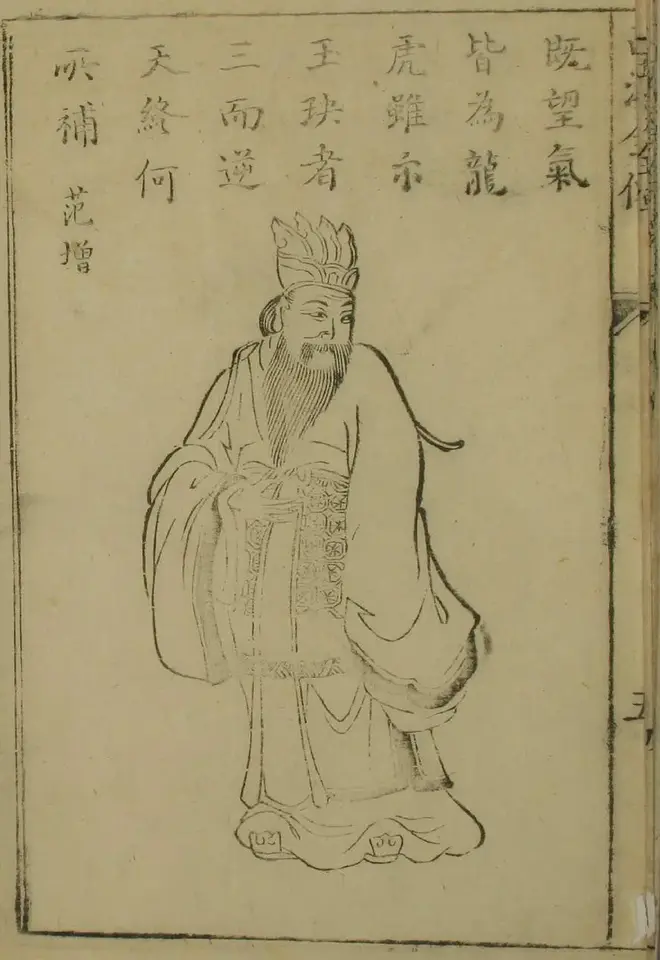
Historical portrait of Fan Zeng
Image credits鍾 惺, 1574-1624 · Public domainImage source

277 BCE–204 BCE

Renowned statesmanmilitary strategistand chief counselor to Xiang Yu during the fall of Qin and the Chu-Han Contention

Fan Zeng (范增)

范增

Fan Zeng (范增, 277 BCE – 204 BCE), a native of Juchao County, Jiujiang Commandery (modern-day Chaohu City, Hefei, Anhui Province), was a prominent statesman and military strategist of the late Qin Dynasty and the Chu-Han Contention, serving as the chief counselor to Hegemon-King Xiang Yu of Western Chu, who honored him as Yafu ("Second Father"). Living in seclusion in his hometown for seventy years, Fan Zeng was celebrated…

277 BCE–204 BCEQin Dynasty (秦朝)

PROFILE

Fan Zeng (范增, 277 BCE – 204 BCE), a native of Juchao County, Jiujiang Commandery (modern-day Chaohu City, Hefei, Anhui Province), was a prominent statesman and military strategist of the late Qin Dynasty and the Chu-Han Contention, serving as the chief counselor to Hegemon-King Xiang Yu of Western Chu, who honored him as Yafu ("Second Father"). Living in seclusion in his hometown for seventy years, Fan Zeng was celebrated for his erudition and ingenious stratagems. In 208 BCE (2nd year of Qin Er Shi), when Xiang Liang crossed the Yangtze River westward with eight thousand youths from Guiji, the seventy-year-old Fan Zeng traveled to Xue County to join him. Analyzing why Chen Sheng had fallen so quickly for failing to restore the royal house of Chu, Fan Zeng persuaded Xiang Liang to heed the popular prophecy that "even if Chu has only three households left, it will be Chu that destroys Qin," locating Xiong Xin—grandson of the late King Huai of Chu—and enthroning him as King Huai of Chu to rally anti-Qin forces under the Chu banner. Subsequently appointed Rear General of the Chu expeditionary force sent to relieve Zhao, Fan Zeng supported Xiang Yu in seizing supreme command from Song Yi and crushing the main Qin armies at the Battle of Julu. After the fall of Qin, Fan Zeng astutely perceived Liu Bang's imperial ambitions when Liu entered Guanzhong without touching its wealth or women. At the Feast at Swan Goose Gate (Hongmen), Fan Zeng repeatedly urged Xiang Yu to execute Liu Bang and instructed Xiang Zhuang to assassinate him during a sword dance; when Liu Bang escaped, Fan Zeng helped devise the eighteen-principality settlement that confined Liu Bang to the remote region of Bashu and Hanzhong. During the Chu-Han Contention, Fan Zeng directed the siege of Xingyang that pushed Liu Bang to the brink of collapse, until Chen Ping's counter-espionage ploy in 204 BCE caused the suspicious Xiang Yu to strip Fan Zeng of his authority. Resigning in fury to return home, Fan Zeng died of a virulent carbuncle on his back before reaching Pengcheng.

Honorific Title
Yafu (亚父, "Second Father")
Dynasty
Qin Dynasty and Western Chu (秦朝、西楚)
Era
Late Qin Dynasty and Chu-Han Contention
Birthplace
Juchao County, Jiujiang Commandery (modern-day Chaohu City, Hefei, Anhui Province)
Birth and Death
277 BCE (22nd year of King Qingxiang of Chu) – 204 BCE (3rd year of Emperor Gaozu of Han); aged 73 (74 sui)
Highest Office
Chief Strategist of Western Chu (honored as Yafu, "Second Father")
Major Offices
Rear General of the Chu Army Relieving Zhao, Chief Military Strategist to Hegemon-King Xiang Yu of Western Chu
Noble Titles
Marquis of Liyang (历阳侯)
Identity
Renowned statesman, military strategist, and chief counselor to Xiang Yu during the fall of Qin and the Chu-Han Contention

LIFE TIMELINE

Relationship graph

BIOGRAPHY

Chronology

  • 277 BCE (22nd year of King Qingxiang of Chu) | Birth | Born in Juchao in the state of Chu (modern-day Chaohu City, Anhui Province), spending seven decades studying military strategy in seclusion.
  • 208 BCE (6th month, 2nd year of Qin Er Shi) | Counsel at Xue County | At seventy sui, met Xiang Liang at Xue County and persuaded him to enthrone Xiong Xin as King Huai of Chu to unite the anti-Qin uprising.
  • 208 BCE (9th month, 2nd year of Qin Er Shi) | March to Relieve Zhao | Following Xiang Liang's death at Dingtao, appointed Rear General alongside Upper General Song Yi and Deputy General Xiang Yu to relieve Zhao.
  • 207 BCE (3rd year of Qin Er Shi) | Victory at Julu | Backed Xiang Yu in executing Song Yi at Anyang and routing the main Qin army across the Zhang River; honored by Xiang Yu as "Second Father" (Yafu).
  • 206 BCE (12th month, 1st year of Han) | Feast at Hongmen | Urged Xiang Yu to eliminate Liu Bang; raised his jade pendant three times at the Hongmen banquet and ordered Xiang Zhuang's sword dance, though Liu Bang escaped.
  • 206 BCE (2nd month, 1st year of Han) | Enfeoffment Settlement | Assisted Xiang Yu in dividing the empire into eighteen kingdoms, confining Liu Bang to Hanzhong and Bashu behind the Three Qin kings.
  • 204 BCE (3rd year of Han) | Siege of Xingyang | Persuaded Xiang Yu to reject Liu Bang's peace overtures and cut the Han grain corridors, trapping Liu Bang inside Xingyang.
  • 204 BCE (4th month, 3rd year of Han) | Resignation and Death | Alienated from Xiang Yu by Chen Ping's sow-discord stratagem, resigned in anger and died of a back ulcer on the road to Pengcheng.

Biography

Seventy Years in Seclusion and the Xue County Strategy

Fan Zeng was a native of Juchao County, Jiujiang Commandery (modern-day Chaohu City, Hefei, Anhui Province). Well-versed in Warring States diplomacy and military art, he remained in seclusion in his home village throughout the Qin unification, taking no official post yet gaining wide renown for his love of extraordinary stratagems until he reached the age of seventy sui.

In 208 BCE (2nd year of Qin Er Shi), after the "Rising Chu" (Zhang Chu) regime of Chen Sheng and Wu Guang was crushed by the Qin general Zhang Han, Xiang Liang—son of the famed Chu general Xiang Yan—led eight thousand soldiers west across the Yangtze River and convened a grand council of rebel leaders, including Liu Bang and Ying Bu, at Xue County (southeast of modern Tengzhou, Shandong). Seeing his opportunity, the seventy-year-old Fan Zeng traveled to Xue County to offer his counsel to Xiang Liang.

Meeting Xiang Liang, Fan Zeng pinpointed the fundamental flaw that had doomed Chen Sheng's uprising. Among the six states destroyed by Qin, he explained, the people of Chu nursed the deepest grievance over the tragic death of King Huai of Chu (Xiong Huai) in Qin captivity, giving rise to the saying of Master Nan of Chu: "Even if Chu has only three households left, it will be Chu that destroys Qin." Chen Sheng had failed because he proclaimed himself king instead of restoring the royal lineage of Chu, thereby alienating Chu loyalists; by contrast, rebel commanders across the Yangtze-Huai region flocked to Xiang Liang precisely because the Xiang family had served as Chu generals for generations and was expected to restore the Chu state. Deeply convinced, Xiang Liang dispatched men to locate Xiong Xin, a grandson of King Huai who had been herding sheep among the common people, and enthroned him at Xuyi in the 6th month of 208 BCE as King Huai of Chu (later Emperor Yi of Chu). From that moment, Fan Zeng served as the chief strategist of the Xiang leadership.

Marching North to Relieve Zhao and Backing Xiang Yu

In the 9th month of 208 BCE, Xiang Liang underestimated theQin forces at Dingtao and was defeated and killed by Zhang Han, who then crossed the Yellow River to besiege the Zhao city of Julu (southwest of modern Pingxiang County, Hebei). Seeking to curb the power of the Xiang clan while answering Zhao's plea for help, King Huai of Chu appointed Song Yi as Upper General, named Xiang Yu (Duke of Lu) as Deputy General, and appointed the veteran counselor Fan Zeng as Rear General to lead the main Chu army north, while sending Liu Bang westward toward Guanzhong.

Upon reaching Anyang (southeast of modern Cao County, Shandong), Song Yi feared the strength of the Qin army and halted for forty-six days, feasting while waiting for Qin and Zhao to exhaust each other. In the 11th month of 207 BCE (3rd year of Qin Er Shi), Xiang Yu entered the command tent at dawn and decapitated Song Yi for treasonous inaction. As the senior elder in the army, Fan Zeng threw his full support behind Xiang Yu's assumption of supreme command, helping him rally the officers, cross the Zhang River, sink their boats and smash their cooking pots, and annihilate the main Qin armies in nine consecutive engagements at Julu. Following this triumph, Xiang Yu treated Fan Zeng with the utmost reverence, addressing him as Yafu ("Second Father") and enfeoffing him as Marquis of Liyang.

The Feast at Hongmen and Containing Liu Bang in Hanzhong

In the 10th month of 206 BCE (1st year of Han), while Xiang Yu was subduing the remaining Qin forces in Hebei, Liu Bang broke through Wu Pass, entered the Qin heartland of Guanzhong, and accepted the surrender of the last Qin ruler Ziying. Following the advice of Zhang Liang and Fan Kuai, Liu Bang sealed the Qin palaces and treasuries, withdrew his troops to Bashang, proclaimed a simple Three-Article Law code to win the hearts of the Guanzhong populace, and stationed troops at Hangu Pass to block Xiang Yu's entrance. In the 12th month, Xiang Yu stormed Hangu Pass with four hundred thousand troops and encamped at Hongmen (east of modern Lintong District, Xi'an, Shaanxi). When Liu Bang's Left Marshal Cao Wushang secretly informed Xiang Yu that Liu Bang intended to make himself King of Guanzhong, Fan Zeng urgently warned Xiang Yu: "When the Duke of Pei (Liu Bang) lived east of the mountains, he was greedy for wealth and fond of women. Now that he has entered the pass, he takes not a single coin of treasure and touches not a single woman—this shows his ambition is no small matter. Moreover, I have had a diviner observe the vapors above his camp: they take the shapes of dragons and tigers in five colors, which is the aura of a Son of Heaven. Strike him at once and do not miss this chance!"

Alerted during the night by Xiang Yu's uncle Xiang Bo, who wished to save his old friend Zhang Liang, Liu Bang won Xiang Bo over with solemn pledges of marriage alliance and rode to Hongmen the next morning with little more than a hundred horsemen to apologize in person. Mollified, Xiang Yu retained Liu Bang for a banquet. During the feast, Fan Zeng sat facing south and repeatedly signaled Xiang Yu with his eyes, raising his jade pendant (jue) three times to urge Xiang Yu to give the order for Liu Bang's execution, but Xiang Yu remained silent. Rising from his seat, Fan Zeng summoned Xiang Yu's cousin Xiang Zhuang and instructed him to enter the tent, offer a sword dance for entertainment, and strike Liu Bang dead on his mat. However, Xiang Bo also drew his sword and danced, constantly shielding Liu Bang with his own body until Fan Kuai burst into the tent and Liu Bang slipped away on the pretext of visiting the latrine. When Zhang Liang presented Liu Bang's gifts of a pair of white jade discs to Xiang Yu and a pair of jade dippers to Fan Zeng, Fan Zeng cast the jade dippers to the ground and shattered them with his sword, crying out in rage: "Ah! One cannot plot great affairs with a brat! The man who will seize King Xiang's empire is surely the Duke of Pei—we shall all become his captives now!"

In the 2nd month of 206 BCE, when Xiang Yu presided over the enfeoffment of eighteen vassal kings, Fan Zeng and Xiang Yu devised a geographical containment strategy against Liu Bang. Bound nominally by King Huai's promise that whoever entered Guanzhong first should rule it, they declared that the remote region of Ba and Shu also counted as part of Guanzhong, investing Liu Bang as King of Han over Ba, Shu, and Hanzhong. At the same time, they partitioned the fertile Guanzhong plain among three surrendered Qin generals—Zhang Han as King of Yong, Sima Xin as King of Sai, and Dong Yi as King of Di—to bolt the northern mountain passes against any breakout by Liu Bang.

Siege of Xingyang, Counter-Espionage, and Death

In the 8th month of 206 BCE, Liu Bang broke out of Hanzhong and conquered the Three Qin, advancing east the following year to seize the Western Chu capital of Pengcheng (modern Xuzhou, Jiangsu) while Xiang Yu was campaigning in Qi. After Xiang Yu routed the Han coalition at the Battle of the Sui River, the two sides locked horns around the strategic granary hub of Xingyang and Ao Granary. Fan Zeng directed Chu cavalry squadrons to sever the walled grain corridors linking Ao Granary to Xingyang, reducing Liu Bang's army to desperate starvation.

In early 204 BCE (3rd year of Emperor Gaozu), a hard-pressed Liu Bang sent envoys offering to cede all territory east of Xingyang in exchange for peace. While the battle-weary Xiang Yu was inclined to accept, Fan Zeng firmly objected, arguing that the Han army was now easy to crush and that sparing Liu Bang would bring certain ruin later. Heeding Fan Zeng, Xiang Yu launched relentless assaults on Xingyang.

In this crisis, Liu Bang adopted the stratagem of his counselor Chen Ping, providing forty thousand catties of gold to spread rumors among the Chu officers that Fan Zeng and general Zhongli Mo resented Xiang Yu for withholding land grants and were plotting with Han to divide Xiang Yu's realm. Growing suspicious, Xiang Yu sent an envoy to the Han camp at Xingyang. Chen Ping ordered attendants to bring out a sumptuous banquet of the highest protocol; upon looking closely at the envoy, the attendants feigned shock, exclaiming, "We thought you were the envoy of Second Father (Fan Zeng)—it turns out you are only King Xiang's envoy!" They immediately removed the fine delicacies and served the envoy coarse fare in a separate room. When the envoy reported this humiliation to Xiang Yu, Xiang Yu became convinced that Fan Zeng was secretly colluding with Liu Bang and gradually stripped him of military authority. Outraged by Xiang Yu's distrust, Fan Zeng declared, "The affairs of the empire are already settled; Your Majesty may manage them yourself! Pray grant me leave to return my aged bones to the ranks of the common people." Xiang Yu granted his resignation, and as Fan Zeng journeyed eastward, a malignant carbuncle erupted on his back, causing his death before he reached Pengcheng at the age of 73 (74 sui).
Major Achievements

Championing the Restoration of King Huai of Chu to Unite the Anti-Qin Uprising

Following the collapse of Chen Sheng's regime, the anti-Qin rebellion lacked a unifying political banner. At Xue County, Fan Zeng formulated the master strategy of restoring the royal house of Chu by enthroning Xiong Xin as King Huai of Chu. By aligning the Xiang clan's military strength with the deep-seated nostalgia of the Chu populace, Fan Zeng enabled Xiang Liang and Xiang Yu to claim legitimate leadership over the anti-Qin coalition and rally insurgent forces across the empire.

Penetrating Insight at Hongmen and the Strategic Encirclement of Xingyang

Throughout the struggle between Chu and Han, Fan Zeng consistently identified Liu Bang as the sole existential threat to Xiang Yu's hegemony. From recognizing the political calculation behind Liu Bang's restraint in Guanzhong to orchestrating the Hongmen assassination attempt and designing the Three Qin buffer zone, Fan Zeng sought to eliminate Liu Bang before his power could mature. During the protracted stalemate at Xingyang, his strategy of severing the Han grain corridors brought Liu Bang's forces to the verge of total defeat, making Fan Zeng's removal the decisive turning point of the Chu-Han Contention.

Historical Relations

Lords and Colleagues

  • Xiang Liang: Rebel commander and son of Xiang Yan; accepted Fan Zeng's counsel at Xue County to enthrone King Huai of Chu and relied on him as chief advisor.
  • Xiang Yu: Hegemon-King of Western Chu; revered Fan Zeng as Yafu ("Second Father") and enfeoffed him as Marquis of Liyang, yet repeatedly ignored his warnings at Hongmen and ultimately fell for Chen Ping's counter-espionage plot at Xingyang.
  • Xiang Zhuang: Cousin of Xiang Yu; instructed by Fan Zeng to perform a sword dance at the Hongmen banquet in an attempt to assassinate Liu Bang.
  • Xiang Bo: Uncle of Xiang Yu; leaked Fan Zeng's plan to Zhang Liang and shielded Liu Bang during Xiang Zhuang's sword dance, foiling Fan Zeng's plot.

Adversaries

  • Liu Bang (Emperor Gaozu of Han): Founder of the Han Dynasty; recognized by Fan Zeng as Xiang Yu's mortal rival, and later credited Xiang Yu's inability to trust Fan Zeng as the key reason for Han's victory.
  • Zhang Liang: Chief strategist to Liu Bang; neutralized Fan Zeng's assassination plot at Hongmen by winning over Xiang Bo.
  • Chen Ping: Strategist to Liu Bang; devised the two-tier banquet deception at Xingyang that alienated Xiang Yu from Fan Zeng and drove Fan Zeng to resign.

Historical Evaluations

  • *Emperor Gaozu of Han (Liu Bang), in Sima Qian, Records of the Grand Historian (Shiji), Volume 8, Basic Annals of Gaozu: "In devising strategies within the command tent to secure victory a thousand li* away, I am not equal to Zifang (Zhang Liang); in pacifying the state, soothing the common people, supplying provisions, and keeping the grain routes unbroken, I am not equal to Xiao He; in marshaling a million troops so that every battle is won and every attack succeeds, I am not equal to Han Xin. These three are all heroes among men, and because I was able to employ them, I captured the empire. Xiang Yu had a single Fan Zeng yet could not use him—that is why he was captured by me."
  • *Chen Shou, Records of the Three Kingdoms (Sanguozhi), Volume 14, Biography of Liu Ye (quoting Fuzi)*: "In ancient times, Xiang Yu turned his back on the counsels of Fan Zeng, and thereby lost his kingly enterprise."
  • *Su Shi, Collected Works of Dongpo (Dongpo Quanji), Essay on Fan Zeng*: "Fan Zeng first advised Xiang Liang to establish Emperor Yi, and the feudal lords submitted on that account. That Emperor Yi was murdered midway was not Fan Zeng's wish.... Even so, Fan Zeng was the man whom Emperor Gaozu feared; as long as Fan Zeng did not depart, Xiang Yu would not perish. Alas, Fan Zeng too was a hero among men!"

Related Entries

  • Xiang Yu
  • Xiang Liang
  • Liu Bang
  • Zhang Liang
  • Chen Ping
  • Feast at Swan Goose Gate

FIGURES ASSOCIATED WITH THIS DYNASTY

Bibliography

  • Sima Qian, Records of the Grand Historian (Shiji), Volume 7, Basic Annals of Xiang Yu; Volume 8, Basic Annals of Gaozu; Volume 56, Hereditary House of Chancellor Chen.
  • Ban Gu, Book of Han (Han Shu), Volume 31, Biographies of Chen Sheng and Xiang Ji; Volume 40, Biographies of Zhang, Chen, Wang, and Zhou.
  • Su Shi, Collected Literary Works of Su Shi (Su Shi Wenji), Volume 4, Essay on Fan Zeng.