Birth in Hejian
Born in Lecheng, Hejian; inherited the hereditary title of Marquis of Jieduting.
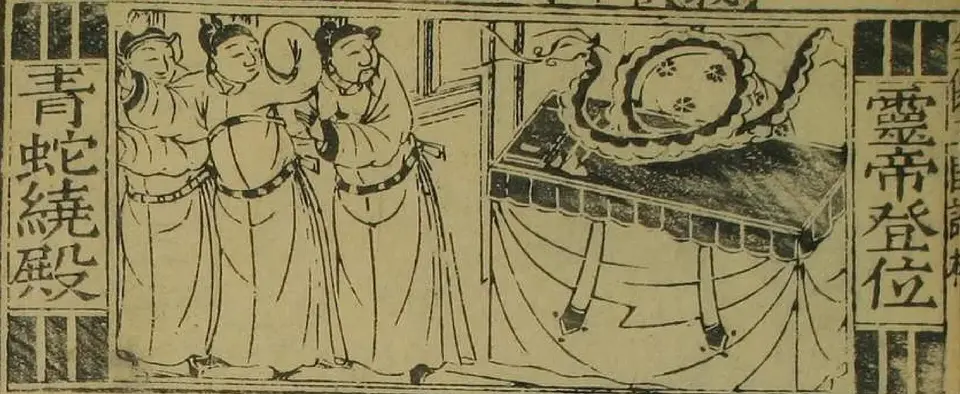
168 CE–189 CE
刘宏
Liu Hong (刘宏, 157–May 13, 189), posthumously honored as Emperor Xiaoling of Han (汉灵帝), was the twelfth sovereign of the Eastern Han dynasty, reigning from 168 to 189. A great-great-grandson of Emperor Zhang of Han and hereditary Marquis of Jieduting in the princely realm of Hejian, he was selected at the age of twelve by Empress Dowager Dou and Grand General Dou Wu to succeed the childless Emperor Huan. His twenty-two-year…
Liu Hong (刘宏, 157–May 13, 189), posthumously honored as Emperor Xiaoling of Han (汉灵帝), was the twelfth sovereign of the Eastern Han dynasty, reigning from 168 to 189. A great-great-grandson of Emperor Zhang of Han and hereditary Marquis of Jieduting in the princely realm of Hejian, he was selected at the age of twelve by Empress Dowager Dou and Grand General Dou Wu to succeed the childless Emperor Huan. His twenty-two-year reign witnessed the utter collapse of the Eastern Han central administration, the bloody ascendancy of palace eunuchs, the catastrophic Yellow Turban Rebellion, and the descent of the empire into warlord fragmentation. Upon his enthronement, imperial authority was instantly seized by the eunuch cabal led by Cao Jie and Wang Fu, who launched the Palace Coup of September 168 to slaughter Grand Tutor Chen Fan and Grand General Dou Wu, while placing the Empress Dowager under house arrest. As Liu Hong matured, he developed a profound dependency on eunuch retainers, infamously addressing Zhang Rang as his father and Zhao Zhong as his mother. In 178, Liu Hong inaugurated the institutional sale of public offices in the Western Garden, establishing fixed tariffs for ministerial posts, commanderies, and magistracies to amass private fortunes in his inner treasury. Simultaneously, he indulged in lavish palaces, private markets, and the notorious Hundred-Chambered Hall of Nudity, while maintaining oppressive bans against Confucian scholar-officials in the Second Disaster of the Partisan Prohibitions. Although he patronized the carving of the Xiping Stone Classics and founded the Hongdu Gate Academy, his cultural initiatives were deeply entangled with autocratic factionalism. The outbreak of the Yellow Turban Rebellion in 184 fractured imperial authority, and his subsequent establishment of regional governors (zhoumu) empowered autonomous commanders who ultimately dismantled the Han Empire following his demise in 189.
Born in Lecheng, Hejian; inherited the hereditary title of Marquis of Jieduting.
Emperor Huan died without male heirs; Dou Wu and Empress Dowager Dou selected Liu Hong.
Enthroned in Luoyang; eunuchs Cao Jie and Wang Fu executed Chen Fan and Dou Wu.
Massive purges against scholar-officials resulted in the arrest and execution of hundreds.
Empress Dowager Dou died in isolation; Liu Hong welcomed his birth mother Lady Dong to court.
Imperial decree ordered Cai Yong and scholars to engrave canonical Confucian texts onto stele.
Three-pronged expedition against Tanshihuai suffered utter annihilation beyond the northern frontier.
Public market for buying imperial ranks and bureaucratic appointments instituted in Western Garden.
Zhang Jiao launched a massive rebellion; Liu Hong revoked partisan prohibitions and dispatched generals.
Created the Eight Colonels of Western Garden; appointed imperial kinsmen as autonomous regional governors.
Passed away in Jiade Hall of Southern Palace at thirty-three; interred in Wenling Mausoleum.
Liu Hong belonged to a collateral branch of the Eastern Han imperial lineage. His direct forebears descended from Emperor Zhang of Han through Prince Xiao of Hejian, Liu Kai. Following the premature death of his father Liu Chang, the young Liu Hong inherited the hereditary peerage of Marquis of Jieduting, residing quietly with his mother Lady Dong in their regional domain. At the imperial capital of Luoyang, governance had already fallen into extreme turbulence under decades of consort kinsmen domination and eunuch intrigue.
In late January 168, Emperor Huan passed away in the Deyang Front Hall of the Southern Palace without leaving any biological sons to inherit the throne. Empress Dowager Dou, holding supreme authority as regent, consulted with her father Dou Wu, the Colonel of the City Gates. Intent on preserving Dou familial ascendancy by placing a compliant minor on the throne, Dou Wu conferred secretly with Minister of the Imperial Clan Liu Tiao, who recommended the twelve-year-old Marquis of Jieduting for his compliant youth and impeccable lineage.
Imperial envoys accompanied by elite guards were dispatched to Hejian to escort Liu Hong to Luoyang. On February 17, 168, the boy arrived at the northern gates of the capital and was received at the imperial stables before performing purification rituals. The following day, Liu Hong was formally enthroned as Emperor of the Great Han, declaring a general amnesty and adopting the era name Jianning. His deceased father was posthumously elevated to Emperor Xiaoren, while his mother Lady Dong was proclaimed Worthy Consort of the Shen Garden.
During the initial months of his reign, imperial administrative power was exercised jointly by Empress Dowager Dou and Grand General Dou Wu. Acknowledging the crucial assistance provided by Grand Tutor Chen Fan during her own elevation to empress, Dou Dowager entrusted Chen Fan with direct control over the Imperial Secretariat. Both Chen Fan and Dou Wu were determined to eradicate eunuch interference in imperial governance, restoring upright scholar-officials who had suffered during the initial partisan purges of Emperor Huan.
Prominent scholars such as Li Ying, Du Mi, and Yin Xun were appointed to pivotal posts including Colonel Director of Retainers, Palace Attendant, and Henan Intendant. However, the Empress Dowager retained deep personal affection for palace eunuchs who had served her household, vehemently shielding chief eunuchs Cao Jie and Wang Fu from execution. In September 168, lower palace official Zhu Yu discovered Dou Wu secret memorial demanding the extermination of all palace eunuchs and alerted his masters.
Realizing that their survival hung in the balance, Cao Jie and Wang Fu executed a swift and lethal pre-emptive strike. Gathering over a hundred armed eunuchs, they forged imperial decrees, seized the physical person of the boy emperor at swordpoint, and placed Empress Dowager Dou under tight confinement in the Southern Palace. When Dou Wu mobilized several thousand Northern Army troops at the capital, the eunuchs misled returning border commander Zhang Huan into attacking Dou Wu forces. Dou Wu was driven to suicide, Chen Fan was murdered in prison, and the Dou lineage was exterminated or exiled. Twelve-year-old Liu Hong was thoroughly intimidated by the display of eunuch violence, beginning his lifelong subjection to palace favorites.
With Dou Wu and Chen Fan eliminated, Cao Jie and Wang Fu exercised absolute mastery over the imperial court, unleashing a merciless campaign against sympathetic scholar-officials. In early 169, chief eunuch Hou Lan returned to his ancestral home in Shanyang to conduct an extravagant funeral, where his kin seized vast tracts of private farmland. Upright local magistrate Zhang Jian strictly enforced the law, demolishing Hou Lan unauthorized family tombs and arresting predatory eunuch retainers.
Enraged by this defiance, Hou Lan instigated a false indictment claiming that Zhang Jian and twenty-four prominent scholars had formed a subversive political faction aimed at overthrowing the dynasty. When the juvenile emperor inquired about these accusations, Cao Jie seized the opportunity to exaggerate the menace posed by Confucian scholars and university students. Liu Hong sanctioned a nationwide manhunt, triggering the devastating Second Disaster of the Partisan Prohibitions.
Hundreds of upright officials and students were dragged into the imperial dungeons of Luoyang. Du Mi took his own life rather than face desecration, Li Ying was tortured to death, and university leader Fan Pang bade farewell to his aged mother before walking serenely to execution. Over seven hundred scholars suffered capital punishment, banishment, or permanent exclusion from civil office. When Empress Dowager Dou died in isolation in 172, anonymous placards denouncing eunuch tyranny appeared on palace towers, prompting Liu Hong to imprison more than a thousand imperial academy students. In 176, the partisan ban was made hereditary, completely severing the link between the imperial throne and the intellectual elite.
Following the demise of Empress Dowager Dou in 172, Liu Hong summoned his biological mother Lady Dong to the imperial palace, honoring her as Empress Dowager Dong. Having lived in modest circumstances in Hejian, Lady Dong developed an insatiable greed for riches, routinely selling offices and accepting lavish bribes in collusion with eunuch leaders. Her indulgence profoundly encouraged Liu Hong own avarice.
In 171, the fourteen-year-old emperor had taken Lady Song as his formal empress under eunuch arrangement. Empress Song was gentle and virtuous but lacked charming eloquence, failing to capture the emperor affections. In 178, the favored Consort He, sister of future Grand General He Jin, gave birth to Prince Liu Bian. Ambitious and ruthless, Consort He conspired with palace eunuchs to frame Empress Song for practicing witchcraft and curses against the throne.
Without conducting any impartial investigation, the gullible emperor stripped Empress Song of her imperial seals and consigned her to the penal chambers, where she starved herself to death in grief and despair. Her father and brothers were promptly executed. In 178, Consort He was installed as Empress. When another favored consort, Lady Wang, gave birth to Prince Liu Xie in 181, the jealous Empress He poisoned Lady Wang to death. Stricken with sorrow, Liu Hong composed elegies for Lady Wang and entrusted the orphaned infant Liu Xie to Empress Dowager Dong, setting the stage for a bitter succession dispute between the two princes.
Throughout Liu Hong reign, imperial frontiers suffered incessant ravages that emptied the central treasury. Along the northern borders, the charismatic Xianbei chieftain Tanshihuai unified the disparate nomadic tribes into an expansive confederation, launching relentless seasonal incursions against Bingzhou, Youzhou, and Liangzhou.
In 177, frontier officers Xia Yu, Tian Yan, and Zang Min bribed eunuch Wang Fu to lobby for an ambitious offensive against the Xianbei. Despite impassioned warnings from scholar Cai Yong that nomadic cavalry possessed supreme mobility across open steppes, Liu Hong authorized a grand three-pronged expedition comprising over thirty thousand elite cavalry. Tanshihuai lured the Han forces deep into the grasslands before enveloping them near the Tanhan Mountains. The expedition was catastrophically routed, losing over seventy percent of its men and abandoning all baggage trains, while the commanders escaped with only dozens of horsemen.
Simultaneously, chronic unrest plagued the western borders. In late 184, non-Han auxiliaries in Liangzhou united with local Han military elites including Han Sui and Bian Zhang to ignite a massive regional insurrection. The rebels slaughtered provincial officials and pushed their vanguard toward the imperial tombs of Chang-an. For over five years, imperial armies under Huangfu Song, Zhang Wen, and Dong Zhuo were bogged down in costly campaigns. The intractable western crisis drained imperial resources, nurtured independent warlords, and effectively severed central authority over the northwestern regions.
As military expenditures mounted alongside lavish court spending, the imperial treasury faced severe exhaustion. Rather than curbing palace expenditures or reducing agrarian burdens, Liu Hong implemented a shocking economic policy in 178: the institutional sale of public offices through an imperial bureau established in the Western Garden.
A comprehensive price list was officially established: regional commanderies cost twice as much as central ministerial posts; the Three Excellencies were priced at ten million copper coins, the Nine Ministers at five million coins, and marquisates at five million coins. Candidates could pay upfront in bullion or take offices on credit, repaying the palace with interest by extracting wealth from their assigned locales. Upright integrity was completely discarded in favor of monetary solvency.
Even illustrious scholar-bureaucrats felt compelled to purchase appointments to preserve their family status. Cui Lie, scion of an eminent northern clan, paid five million coins through eunuch intermediaries to secure the office of Minister over the Masses, only for Liu Hong to lament openly at court that he had sold the position too cheaply. When the upright official Sima Zhi was assigned as Administrator of Julu and ordered to pay three million coins, he committed suicide at the Yellow River crossing rather than fleece commoners. Undeterred, Liu Hong mandated that all newly promoted officials prepay one-third of their anticipated stipends directly into his private treasury, turning imperial governance into an engine of extortion.
Outside formal court ceremonies, Liu Hong surrendered entirely to personal indulgences and eccentric diversions within the pleasure grounds of Luoyang. He maintained an unnatural fascination with urban commerce, constructing a mock commercial bazaar within the palace where concubines and eunuchs operated wine shops, butcher stalls, and tea houses, while the emperor strolled among them dressed as a common merchant, haggling and brawling over copper coins.
He also developed an obsession with driving donkey carts, personally handling the reins of four prize donkeys through the imperial thoroughfares. When this novelty became known outside the palace, princes, nobles, and high ministers frantically copied the imperial behavior, causing donkey prices in Luoyang to surge dramatically. He further favored barbarian folding chairs and exotic foreign garments, altering traditional sitting etiquette across the capital.
In 186, Liu Hong expended enormous sums to construct the Thousand-Chamber Hall of Nudity in the Western Garden. Channels diverted from the Luo River were lined with Southern water lilies, where dozens of youthful palace maidens were forced to row boats unclad while the emperor indulged in protracted nocturnal drinking bouts. To alleviate summer heat and road dust, palace mechanic Bi Lan was commissioned to cast bronze hydraulic toads that sprayed water along major processional avenues. For over a decade, Liu Hong seldom attended to formal state affairs, leaving empire-wide policy entirely in the hands of his eunuch favorites.
The convergence of rampant corruption, punitive taxation, and catastrophic climatic disasters drove the agrarian populace into desperation. In Julu commandery, Zhang Jiao established the Daoist movement known as the Way of Great Peace, dispatching disciples across eight provinces to organize over three hundred thousand followers into thirty-six military divisions.
In early 184, after a traitorous disciple revealed the impending plot to the court, Zhang Jiao launched a premature imperial-wide insurrection, declaring that the Yellow Sky had replaced the Azure Sky. Wearing yellow kerchiefs, the rebels overran government offices, torched estates, and paralyzed provincial communication within weeks. Terrified by the scale of the uprising, Liu Hong convened emergency council meetings where Grand Tutor Yang Ci and eunuch Lv Qiang urged him to repeal the partisan bans, warning that desperate scholar-officials might join forces with the insurrectionists.
Conceding to existential panic, Liu Hong issued a general amnesty pardoning all partisan scholars and restoring their civil liberties, while commanding the aristocracy to contribute private horses and wealth for defense. Imperial commanders Huangfu Song, Zhu Jun, and Lu Zhi were dispatched at the head of Northern Army regulars to confront the rebels in Yingchuan and Jizhou. Employing decisive fire attacks and siege warfare, Huangfu Song crushed the main rebel forces, beheading over a hundred thousand insurgents. Although the central leadership was annihilated within ten months, remnant groups continued guerrilla warfare, fundamentally shattering the administrative prestige and financial vitality of the dynasty.
Recognizing that military control had gravitated toward Grand General He Jin and regional field commanders, Liu Hong attempted to forge an autonomous military force loyal solely to his private household. In the autumn of 188, he established the Eight Colonels of the Western Garden, appointing his trusted eunuch Jian Shuo as Supreme Colonel with ultimate command over aristocratic officers including Yuan Shao and Cao Cao.
In October 188, Liu Hong orchestrated a magnificent military review at Pingguan Park, erecting twelve-tier viewing platforms lined with glittering banners and armored guards. Dressing in golden armor and mounted on a warhorse, Liu Hong bestowed upon himself the martial title of Supreme General, forcing Grand General He Jin to take a subordinate seat. However, this attempt to balance military authority only intensified factional friction between the palace inner court and the military establishment.
Simultaneously, with local banditry continuing unabated, imperial kinsman Liu Yan proposed abolishing weak provincial inspectors and replacing them with high-ranking regional governors endowed with absolute military, civil, and fiscal jurisdiction. Liu Hong imprudently approved the proposal, dispatching Liu Yan to Yizhou, Huang Wan to Yuzhou, and Liu Yu to Youzhou. These powerful regional governors immediately amassed private armies and intercepted local grain revenues, effectively converting their jurisdictions into feudal fiefdoms and setting the stage for the destructive warlord conflicts of the Three Kingdoms era.
By early 189, decades of unchecked debauchery, alcohol abuse, and acute nervous strain had completely shattered Liu Hong health, confining the thirty-three-year-old monarch to his bedchamber in the Southern Palace. On his deathbed, the succession question precipitated intense palace confrontation. Prince Liu Bian, born to Empress He, was viewed by Liu Hong as frivolous and lacking dignity, whereas nine-year-old Prince Liu Xie, raised by Dowager Dong, exhibited precocious wisdom and poise.
Liu Hong earnestly wished to designate Liu Xie as crown prince, but feared the military strength wielded by Grand General He Jin. In early May 188, Liu Hong summoned Supreme Colonel Jian Shuo to his bedside, privately charging him to execute He Jin and ensure Liu Xie succession. On May 13, 189, Emperor Ling passed away in Jiade Hall at the age of thirty-three.
Jian Shuo ambush against He Jin failed when an imperial officer leaked the plot. Backed by Yuan Shao and Northern Army troops, He Jin swiftly enthroned seventeen-year-old Liu Bian and installed Empress Dowager He as regent. In the immediate aftermath, He Jin executed Jian Shuo and expelled Dowager Dong, but his vacillation regarding the total extermination of palace eunuchs led to his assassination by Zhang Rang at the palace gates. In response, Yuan Shao slaughtered over two thousand eunuchs, plunging Luoyang into chaos. Frontier general Dong Zhuo seized this opportunity to enter the defenseless capital, dethroning Liu Bian, elevating Liu Xie as Emperor Xian, and setting fire to Luoyang palaces. Liu Hong reign thus served as the direct catalyst for the total extinction of the Eastern Han Empire.
During his twenty-two years on the imperial throne, Liu Hong fundamentally dismantled the merit-based civil examination and administrative auditing systems refined by his predecessors. The open monetization of public offices converted the imperial bureaucracy into an unvarnished marketplace, eradicating traditional Confucian moral ethics and breeding rampant corruption across every tier of central and local government.
In administrative architecture, Liu Hong elevated the power of inner court eunuchs to an unprecedented zenith. He expanded the roster of Regular Attendants to twelve, granting figures like Zhang Rang and Zhao Zhong unconstrained authority to formulate imperial decrees and manipulate judicial cases. Their relatives were appointed administrators and magistrates across the provinces, where they enriched themselves through merciless extortion without fear of imperial oversight.
To prevent regional coalitions among aristocratic families, Liu Hong instituted the Mutual Exclusion Law (Sanhufa), which prohibited individuals from holding office in their ancestral provinces or in regions connected by marital ties. This draconian regulation created chronic administrative vacuums in distant commanderies, exacerbating bureaucratic decay and alienating competent intellectuals from serving the state. His subsequent militarization of eunuchs through the Western Garden Army further institutionalized factional warfare between palace retainers and military generals.
In striking contrast to his political misrule, Liu Hong demonstrated a genuine personal passion for literary composition, calligraphy, and cultural enterprises. His reign produced two monumental undertakings that exerted profound and enduring influences on Chinese intellectual history.
The first was the engraving of the Xiping Stone Classics in 175. Prompted by Cai Yong, Liu Hong authorized the definitive standardization of seven canonical Confucian texts in ancient, seal, and clerical scripts to eliminate corrupt variants that had proliferated in imperial archives. The texts were carved upon forty-six colossal stone steles erected outside the Imperial Academy in Luoyang. The Xiping Stone Classics established the historical precedent for state-sponsored canonical lithic editions, standardizing Chinese orthography and providing an inspirational prototype for the subsequent development of block printing.
The second major initiative was the establishment of the Hongdu Gate Academy in 178. Conceived to break the intellectual monopoly maintained by conservative Confucian families over the Imperial Academy, Hongdu Gate enrolled talented individuals from humble and plebeian backgrounds, focusing on poetic composition, calligraphy, and literary arts. While the academy functioned as the earliest collegiate institution for creative arts in world history, Liu Hong political intention was to cultivate a loyal corps of literary retainers to counterbalance defiant outer court scholar-officials. The rapid bureaucratic elevation of Hongdu scholars provoked bitter resentment from traditional elites, rendering Liu Hong cultural policies an intriguing historical paradox.
Fan Ye, Book of the Later Han (Hou Hanshu): The historian remarked that Emperor Ling conducted governance through bribery, while the empire decayed and public offices were auctioned in the Western Garden, culminating in the rise of the Yellow Turbans and the dissolution of dynastic order.
Sima Guang, Comprehensive Mirror for Aid in Government (Zizhi Tongjian): Sima Guang noted that Emperor Xiaoling abandoned statecraft to inner menials, fostering extortionate sales of office and boundless decadence that disenfranchised the realm and laid the direct foundation for the extinction of the Han.
Zhuge Liang, Memorial on Taking the Field (Chushi Biao): Zhuge Liang recorded that Emperor Zhaolie (Liu Bei) never ceased to heave deep sighs of lamentation and sorrowful indignation whenever discussing the disastrous misrule of Emperors Huan and Ling.
FIGURES ASSOCIATED WITH THIS DYNASTY