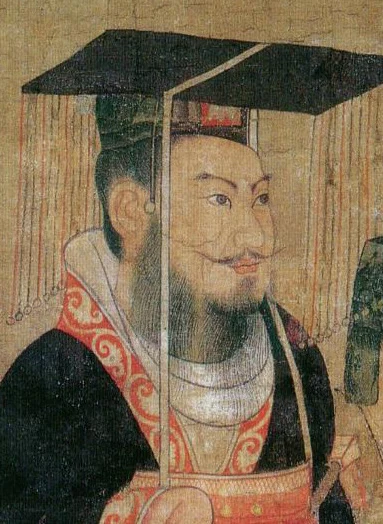
Biography
Family Background and Early Years
Liu Xiu was a ninth-generation descendant of Liu Bang, Emperor Gaozu of Han, through Liu Fa, Prince Ding of Changsha and a son of Emperor Jing of Han. Because this branch followed the principle of the Decree of Extending Favor, its hereditary rank declined over successive generations from that of marquis. Liu Fa's son Liu Mai was enfeoffed as Marquis Jie of Chongling, with his fief in Caiyang County, Nanyang Commandery (present-day Zaoyang, Hubei). Later ancestors included Liu Wai, Administrator of Yulin; Liu Hui, Commandant of Julu; and Liu Qin, Magistrate of Nandun. By the generation of Liu Xiu's father, the family held only comparatively minor offices such as magistrate of Jiyang County. Liu Xiu's mother, Fan Xiandu, came from a prominent local family.
On the jiazi day of the twelfth month in the first year of the Jianping era of the Western Han (January 15, 5 BCE), Liu Xiu was born in the county offices at Jiyang in Chenliu Commandery (present-day Lankao County, Henan; another account places it in present-day Dongming County, Shandong). Historical records state that a red light illuminated the entire room at his birth. His father Liu Qin found this strange and summoned the merit officer Shi Chonglan, sending him to consult someone skilled in divination. The diviner Wang Changsun cast a prognostication and declared the event highly auspicious. That year, at a place in front of Liu Qin's residence where stonecrop had been planted, an extraordinary stalk of grain grew with nine ears, one or two chi taller than ordinary grain. His father therefore named him “Xiu.”
As Liu Xiu grew up, he was described as seven chi and three cun tall, with handsome eyebrows and beard, a broad mouth, prominent nose, full forehead, and striking appearance. In 3 (the third year of the Yuanshi era), Liu Qin died while serving as magistrate of Nandun County. Liu Xiu, only nine years old, and his siblings became orphans and were raised by their uncle Liu Liang in Caiyang County, Nanyang Commandery, living as commoners. Liu Xiu worked diligently at farming, whereas his elder brother Liu Yan cultivated a reputation for chivalry and gathering retainers and often mocked Liu Xiu, comparing him to Liu Bang's brother Liu Xi. At the same time, Liu Xiu also sheltered fugitives, and local officials did not dare come to his house to question him.
During the Tianfeng era of the Xin dynasty (14–19), Liu Xiu went to Chang'an to study at the Imperial Academy. He studied the *Book of Documents* under the renowned scholar Xu Ziwei and acquired a general understanding of its main principles. While in Chang'an, he became acquainted with Deng Yu and Zhu You, both of whom were later counted among the 28 generals of the Cloud Terrace and became part of Liu Xiu's founding circle. While in Xinye County, Liu Xiu heard of Yin Lihua's beauty and became enamored of her. Later, in Chang'an, after seeing the magnificent carriages and cavalry of the Bearer of the Gilded Mace, he sighed: “If I enter official service, I should become Bearer of the Gilded Mace; if I marry, I should marry Yin Lihua.”
Rising against Wang Mang
Liu Xiu came of age during Wang Mang's replacement of the Han with the Xin dynasty. Wang Mang's reforms were blindly antiquarian and impractical, affecting the interests of both powerful families and ordinary people. Repeated floods and droughts added to the crisis, leaving much of the Central Plains devastated. During the Tianfeng era, dozens of peasant armies, including the Red Eyebrows, Lülin, and Tongma groups, rose in rebellion, while many powerful landlords also took advantage of the disorder to oppose Wang Mang.
In 22 (the third year of the Dihuang era), famine struck Nanyang. Retainers of Liu Yan robbed others, and Liu Xiu fled the authorities to the home of his brother-in-law Deng Chen in Xinye. That autumn Liu Xiu went to Wan to sell grain, where he plotted an uprising with the local man Li Tong and Li Tong's cousin Li Yi. Li Tong planned to rise on the day of the military examination of the local cavalry and instructed Li Yi and Liu Xiu to raise troops at Chongling. In the tenth month, Liu Yan formally proclaimed the slogan “restore the enterprise of Gaozu and settle the fortunes of ten thousand generations” and decided to rebel. He sent close retainers to notify Deng Chen to rise at Xinye. Liu Xiu, Li Tong, Li Yi, and others rose at Wan, while Liu Yan himself led seven to eight thousand men in revolt at Chongling, styled himself “Pillar of Heaven Commander of the Capital Division,” and joined with the Xinshi and Pinglin contingents of the Lülin forces.
In the eleventh month, Liu Xiu led his retainers from Wan to Chongling. At first, when Liu Yan raised troops, members of the clan were frightened and fled. Only when they saw the normally cautious and honest Liu Xiu dressed as a general did they exclaim that “even this cautious and honest man has joined in,” and they finally became reassured. The forces of the Liu brothers and the Nanyang clansmen were known as the Chongling Army. They initially had few soldiers and poor weapons; Liu Xiu even rode an ox into battle before obtaining a warhorse after killing the commandant of Xinye in combat. They soon captured Jiyang, but then suffered defeat at Xiao Chang'an at the hands of the Xin troops under Zhen Fu and Liangqiu Ci. Liu Xiu escaped alone on horseback and rescued his younger sister Liu Boji on the way. His elder sister Liu Yuan, however, refused to mount because she feared slowing him down and was ultimately killed by the Xin army together with her three daughters.
After this defeat, the Xinshi and Pinglin forces planned to abandon support for the Chongling Army. Liu Xiu accompanied Liu Yan and Li Tong to Yiqiu to meet Wang Chang, leader of the Xiajiang forces, and persuaded him to join them. The Xinshi, Pinglin, Xiajiang, and Chongling forces then fought together and in the first month of the following year defeated the Xin army at Bishui, Yuyang, and elsewhere, killing the Xin commanders Zhen Fu and Liangqiu Ci.
The Battle of Kunyang and the Death of His Elder Brother
In the second month of 23 (the first year of the Gengshi era), Liu Xuan, a member of the Western Han imperial clan, was proclaimed emperor by the principal Lülin commanders and adopted the era name Gengshi. He became known as the Gengshi Emperor. Liu Yan was appointed Grand Minister over the Masses, and Liu Xiu was appointed Junior General under the Grand Master of Ceremonies. The establishment of the Gengshi regime and its restoration of Han banners shocked the Xin court. Wang Mang therefore ordered Grand Minister of Works Wang Yi and Grand Minister over the Masses Wang Xun to mobilize 420,000 elite troops from the provinces and commanderies against the Kunyang-Wan front.
In the fifth month, Wang Yi and Wang Xun joined Yan You and Chen Mao, forcing Liu Xiu's forces to withdraw from Yangguan to Kunyang. The Han defenders at Kunyang numbered only about nine thousand, and many feared they could not resist and wanted to abandon the city and retreat toward the former Jingzhou region. Liu Xiu persuaded the commanders to defend Kunyang, arguing that they still had a chance if united but could not survive if scattered. With the Xin army already approaching from the north, Liu Xiu led thirteen cavalrymen out of the city by night to mobilize reinforcements from Dingling and Yan counties, later returning with seventeen thousand elite troops.
On the first day of the sixth month, Liu Xiu personally led more than one thousand elite troops in the vanguard, repeatedly charging and killing dozens of Xin soldiers. The other commanders exclaimed: “General Liu usually seems timid before a small enemy, yet now he is brave before a great enemy. How extraordinary!” Han morale rose sharply. Liu Xiu then led three thousand picked troops around the enemy rear, secretly crossed the Kun River, and launched a direct assault on Wang Yi's headquarters. Wang Yi underestimated them and ordered the other camps not to move without authorization, while he and Wang Xun led ten thousand men to meet the attack. Wang Xun was killed. Seeing the Han forces winning outside the walls, the Kunyang garrison attacked as well. The Xin army collapsed and fled in disorder, trampling one another until corpses covered the ground. A sudden gale then sent roof tiles flying, and torrential rain caused the Zhi River to rise sharply; more than ten thousand Xin soldiers drowned while crossing, and the river was said to be blocked by bodies. The Battle of Kunyang ended in a victory by a much smaller force and destroyed the main Xin army.
After Kunyang, the prestige of Liu Yan and Liu Xiu rose greatly, arousing the suspicion of the Gengshi Emperor Liu Xuan. Liu Xiu sensed the danger, but Liu Yan did not take it seriously. Soon afterward Liu Xuan found a pretext to have Liu Yan killed; their clansman Liu Ji was executed with him. Liu Xiu was also in danger. He voluntarily went to Wan to apologize to the Gengshi Emperor, did not publicly mourn his brother, and continued eating, drinking, speaking, and laughing as usual. Liu Xuan felt ashamed and appointed Liu Xiu General Who Defeats the Caitiffs and Marquis Wuxin.
Building Power in Hebei and Proclaiming Himself Emperor
In 23 (the first year of the Gengshi era), Gengshi forces captured Chang'an and the Xin dynasty collapsed. Wang Lang then rose in Hebei, and the Gengshi Emperor sent Liu Xiu to inspect the region north of the Yellow River, allowing Liu Xiu to escape the dangerous court environment. In Hebei, he accumulated power and grew steadily stronger. In 24 (the second year of the Gengshi era), Liu Xiu and his generals, including Wu Han and Deng Yu, continued to defeat the Tongma and other separatist forces in the north. People west of the passes called him the “Tongma Emperor.” The Gengshi Emperor enfeoffed him as Prince of Xiao, but Liu Xiu had already begun to separate himself from the Gengshi regime.
In the sixth month of 25 (the third year of the Gengshi era), the Red Eyebrows installed Liu Penzi as a puppet emperor. On the twenty-second day of the same month, the jiwei day (August 5, 25), Liu Xiu proclaimed himself emperor at Haocheng (present-day Baixiang County, Xingtai, Hebei), adopted the era name Jianwu, and retained Han as the dynastic name; the regime is known to history as the Eastern Han. In the ninth month, the Red Eyebrows defeated Liu Xuan and the Gengshi Emperor surrendered; he was killed in the twelfth month. Because the Han was associated with the virtue of fire, Liu Xiu established his capital at Luoyang and changed the character used to write the first syllable of the city's name to an alternative form, while retaining the pronunciation Luoyang.
Reunification of the Realm
After proclaiming himself emperor, Liu Xiu successively eliminated the Red Eyebrows and the separatist powers of Liu Yong, Zhang Bu, Peng Chong, Wei Xiao, Gongsun Shu, and others. In 27 (the third year of Jianwu), the Red Eyebrows surrendered. In 30 (the sixth year of Jianwu), Liu Xiu began his campaign against Wei Xiao, and in 34 (the tenth year of Jianwu) he pacified Longyou. In 35 (the eleventh year of Jianwu), he began the campaign against Gongsun Shu. In the eleventh month of 36 (the twelfth year of Jianwu), Wu Han captured Chengdu, ending Gongsun Shu's Chengjia regime, and the Eastern Han reunified China. Lu Fang, who controlled Wuyuan, Shuofang, and other regions, could not be defeated in repeated campaigns. His own commanders later forced him toward submission to Han, and Lu Fang abandoned his army and fled to the Xiongnu.
Government and Death
Liu Xiu was diligent in government. He held court every morning and did not stop until late in the day, frequently summoning high ministers, court officials, and generals to discuss administrative affairs, often staying awake until midnight. During his reign, he repeatedly issued edicts freeing enslaved people and prohibiting their mistreatment, reducing the number of poor people forced to sell themselves into slavery. He consolidated commanderies and counties and reduced the bureaucracy, abolishing or merging more than four hundred counties and retaining roughly one official in ten. His reign has historically been called the Guangwu Restoration and has also been described as the Jianwu-era rule.
In 39 (the fifteenth year of Jianwu), Liu Xiu issued the land-survey order to investigate cultivated land and registered households throughout the empire, provoking resistance from local powerful families and temporarily obstructing the survey. In 41 (the seventeenth year of Jianwu), he deposed Empress Guo and made Yin Lihua empress. In 43 (the nineteenth year of Jianwu), he deposed Crown Prince Liu Qiang and made Liu Yang crown prince; Liu Yang was later renamed Liu Zhuang.
In 51 (the twenty-seventh year of Jianwu), Marquis of Langling Zang Gong and Marquis of Yangxu Ma Wu memorialized the throne, asking to take advantage of the division of the Xiongnu and weakness of the Northern Xiongnu to launch a campaign. Liu Xiu refused in an edict: “The state now has no good government, disasters and strange events do not cease, and the people cannot preserve themselves. Why should we again undertake distant affairs beyond the frontier? It is better to let the people rest.” In 52 (the twenty-eighth year of Jianwu), he used a pretext to arrest retainers of kings and marquises; several thousand were condemned to death, and private faction-building was strictly prohibited.
In 57 (the second year of Jianwuzhongyuan), the Na state of Wa sent an envoy bearing tribute. Liu Xiu granted its ruler the title “King of the Na state of Wa” and bestowed a gold seal, the seal later excavated with the inscription “King of the Na state of Wa under Han.” On the wuxu day, the sixth day of the intercalary second month (March 29, 57), Liu Xiu died in the Front Hall of the Southern Palace at Luoyang, aged sixty-two, after thirty-two years on the throne. On the dingmao day of the third month (April 27), he was buried at Yuanling (near present-day Tiexie Village, Mengjin County, Henan). His temple name was Shizu and his posthumous name Emperor Guangwu. His son, Emperor Ming of Han, Liu Zhuang, later had portraits of the twenty-eight men who had contributed most to the wars of reunification displayed in the Cloud Terrace Pavilion; they became known as the 28 generals of the Cloud Terrace.
Liu Xiu, styled Wenshu, was a native of Caiyang in Nanyang, in what is now the Zaoyang region of Hubei, and a ninth-generation descendant of the Han founder Liu Bang through Liu Fa, prince Ding of Changsha, son of Emperor Jing. Liu Fa was followed by Liu Mai, marquis Jie of Chongling; Liu Wai, governor of Yulin; Liu Hui, commandant of Julu; and Liu Qin, magistrate of Nandun, the father of Liu Xiu. By the rule of diminishing inheritance this branch had descended from marquis to county magistrate in his father's generation. Liu Xiu was born in the official lodging of Jiyang county on the jiazi day of the twelfth month of 5 BCE, and the sources say that red light filled the room; his father, puzzled, sent his aide Chong Lan to consult the diviner Wang Zhangsun, who dismissed his attendants and said that the omen was too auspicious for words. That year three stalks of millet grew where the sedum had been planted before his father's house, each with one stalk and nine ears and a foot or two taller than ordinary grain, and they were taken for a sign of good harvest, so that his father named him Xiu, "the flourishing". Of his appearance the histories say he stood seven chi three cun, with fine beard and eyebrows, a large mouth, a high nose and a ridge on the forehead.
His father died when he was nine, and he and his brothers and sisters, left orphans, were raised by their uncle Liu Liang as ordinary commoners. He was diligent in farming, and his elder brother Liu Yan, fond of bravado and of keeping retainers, used to mock him and compare him to the founder's elder brother Liu Zhong. Yet Liu Xiu also sheltered fugitives from the law, so that officials dared not come to his door. In the Tianfeng years of Wang Mang, between 14 and 19, he went to Chang'an and entered the imperial academy, studying the Book of Documents and grasping its general sense; there he made friends with Deng Yu and others, most of whom were later numbered among the twenty-eight generals of the Cloud Terrace and became the cadre of his enterprise. In the disorders at the end of the Xin dynasty, when the Green Forest and Red Eyebrows and other risings multiplied, he and his brother Liu Yan rose at Chongling in 22 and joined forces with the Green Forest; the next year the Green Forest set up Liu Xuan as emperor with the era name Gengshi, and Liu Xiu was made a general. In the sixth month of 23, at the battle of Kunyang, he defeated more than four hundred thousand of Wang Mang's troops with a far smaller force, winning sudden fame and making the engagement decisive for the collapse of the Xin.
In the last years of the Xin dynasty the empire suffered year after year of famine and locusts and the bandits swarmed. Wang Mang's reforms, antiquarian and impracticable, offended great families and commoners alike, and with drought and flood unrelenting the central plains lay waste; dozens of peasant armies, the Red Eyebrows among them, rose, and many local magnates turned against him, so that the realm fell apart. Liu Xiu, though of the imperial line, belonged to a distant collateral branch, and his temper differed from his elder brother Liu Yan's: Liu Yan, careless of the family property and ruinously generous, made friends of every bold man in the empire and, with the young men of Nanyang, meant to rise and seize the day; Liu Xiu was a man of stratagem and extremely cautious, and only after long thought, once he was sure the empire was indeed in chaos, decided to rise. In 22, when Nanyang starved and the retainers of the great houses turned to petty robbery, he took refuge from the law at Deng Chen's house in Xinye, his own retainers having robbed, and there plotted the rising.
Li Shou of Wan, devoted to astrology and prophecy, had told his son Li Tong that the Liu would rise and the Li assist them, and when the Green Forest and Pinglin bands rose and Nanyang was in turmoil, Li Tong's cousin Li Yi urged him to join the brothers Liu. Taking the occasion of Liu Xiu's coming to Wan to sell grain, Li Tong sent Li Yi to meet him, swore an agreement with him and fixed the plan: on the day of the autumn review of the mounted officers they would seize the commandant Zhen Fu and the assistant Liangqiu Ci and so command the masses, sending Li Yi and Liu Xiu back to Chongling to raise troops in concert. In the tenth month Liu Yan raised the slogan of restoring the founder's work and settling the age for ten thousand generations, sent his retainers to raise Deng Chen at Xinye and Liu Xiu, Li Tong and Li Yi at Wan, and himself led seven or eight thousand sons of Chongling under the style of the Pillar of Heaven command, joining the Green Forest and Pinglin forces. Liu Xiu was then twenty-eight. Returning to Chongling in the eleventh month, he found his brother already in arms; the kinsmen had at first fled in fear, but seeing Liu Xiu in crimson robes and the tall cap of a general, they marveled that even the careful and solid man had joined, and were somewhat steadied.
The troops of the Liu brothers and the Nanyang kinsmen were called the Chongling army. Few in number and poorly armed, Liu Xiu in the early days rode an ox into battle and got a horse only after killing the commandant of Xinye. He killed the commandant of Huyang soon after; and when at Tangzi township the spoils were divided unequally and the angry soldiers threatened to turn on the Lius, Liu Xiu gathered all that his clansmen had taken and gave it to the others, and they were content. Pressing on they took Jiyang, but at Xiaochang'an they were routed by Wang Mang's commanders Zhen Fu and Liangqiu Ci and fell back on Jiyang; Liu Xiu fled alone on horseback and, meeting his sister Boji, rode with her; coming upon his elder sister Liu Yuan he urged her to mount, but she waved him off, saying he must go, that she could not be saved and there was no purpose in both dying, and when the pursuers came she and her three daughters were killed. After the defeat, when the Green Forest and Pinglin meant to abandon the Chongling army, Liu Xiu went with his brother and Li Tong to Yiqiu to persuade the leader of the Xiajiang band to join, so that Green Forest, Pinglin, Xiajiang and Chongling fought together and in the first month of the next year broke Zhen Fu and Liangqiu Ci at the Bi river and, defeating the armies of Yan You and Chen Mao, laid siege to Wan.
In the first month of 23 the Han forces broke and killed Zhen Fu and Liangqiu Ci west of the Bi river, and Liu Yan defeated Wang Mang's generals Yan You and Chen Mao at Yuyang and laid siege to Wan. In the second month the leading generals of the allied forces set up Liu Xuan as emperor with the era name Gengshi; the Liu kinsmen of Nanyang were much displeased but, being within the alliance and with the Green Forest strong and a powerful enemy before them, let the matter rest. Liu Yan became minister of education as grand minister, and Liu Xiu was made a general. The new regime's reuse of the Han name shook Wang Mang, who called out four hundred and twenty thousand picked troops from the provinces against the Kunyang line to destroy it at a blow. In the fifth month Wang Yi and Wang Xun marched west from Luoyang, forcing Liu Xiu's troops back from Yangguan. The Kunyang garrison numbered only nine thousand, and the officers, fearing they could not hold, wished to abandon the city and retire to Jingzhou; Liu Xiu persuaded them that united they might yet win and divided they could not survive, and they stood fast.
With the enemy already close to the north of the city, Liu Xiu rode out at night with thirteen horsemen to gather reinforcements and brought back seventeen thousand horse and foot. Wang Yi and his fellows, confident in their strength, swore that a million troops destroyed all before them and that they would slaughter the city and march on dancing through the blood; they attacked with tunnels and siege towers, but the garrison, having no way out, held, and the weary besiegers lost their edge. On the first day of the sixth month Liu Xiu came up with more than ten thousand horse and foot, led a thousand picked men himself as van, charged again and again and killed several dozen of the enemy. The officers marveled that the general who had seemed timid before small forces was bold before a great one, and were encouraged; Liu Xiu pressed on, the enemy gave way, and the whole army took up the pursuit, killing many hundreds and thousands. He then took three thousand braves round to the enemy's rear, crossed the Kun river by stealth and fell on Wang Yi's headquarters. Wang Yi, still contemptuous, forbade the camps to move without orders and met him with ten thousand men; his troops were worsted, Wang Xun was killed and no camp dared come to the rescue. The garrison sallied out, the Xin army dissolved in flight, trampling one another, and a great wind tore the roof tiles away as rain fell in torrents and the Zhi river rose, drowning more than ten thousand and leaving the river choked with bodies. Wang Yi, Yan You and Chen Mao crossed on the dead and escaped; the stores, armor, chariots and treasures taken were beyond reckoning. The main army of the Xin, said to be a million, was destroyed below Kunyang; in the ninth month the Green Forest took Chang'an and Wang Mang died in the fighting, and the Xin dynasty ended.
It was while Liu Xiu was marching south taking cities that his elder brother, the grand minister Liu Yan, was killed by the Gengshi emperor. It was a crushing blow, but he restrained his grief, hid his abilities and bore it: he hurried back to Wan to apologize to the emperor, avoided private contact with his brother's officers, made no claim to the credit of Kunyang, said that his brother had offended and that he too was at fault, and dared not go into mourning for him, eating, drinking and talking as usual — only when alone abstaining from wine and meat, his mat and pillow often wet with tears. When his officer Feng Yi urged him to grieve openly he told him to say no such thing. The Gengshi emperor, who had killed Liu Yan for refusing to acknowledge his authority, was embarrassed by such humility, and instead of punishing Liu Xiu made him a general and marquis of Wuxin. Soon after, at Wan, he married the lady Yin Lihua of Xinye, whom he had long admired.
Liu Xiu understood that even if he set the Gengshi emperor's suspicions to rest for a time, he might in the end come to the same end as his brother, since his fame was wide and his service overshadowed the throne. After Wang Mang's fall the provinces north of the Yellow River were waiting to see how things turned, among them Wang Lang's rising, which grew fast, the three princes of Hebei and the bands of Bronze Horse and Youlai. Deng Yu told Liu Xuan that Liu Xiu was the best man to pacify Hebei, indeed that only he could do it, and that the fate of the Gengshi regime hung on settling Hebei; a rhyme current in the south said that success or failure lay in Hebei. But the generals of Green Forest origin, Zhu Wei at their head, opposed his going — not because he lacked ability but because he had too much. Liu Xuan was torn, since the objections were reasonable: to send him was to risk his growing too strong, not to send him was to risk failing in Hebei. While he hesitated, Feng Yi advised Liu Xiu to win over the left chancellor Cao Jing and his son, the secretary Cao Xu, which he did with lavish attentions, and through Cao Xu's help he was at last sent north.
In the tenth month of 23 the Gengshi emperor sent him across the Yellow River to reassure the provinces of Hebei. On the road his close friend Deng Yu followed him north on foot and told him that Liu Xuan would certainly fail, that the empire's troubles were only beginning, and that he should gather heroes, win the people's hearts, restore the founder's work and save the people — with such aims, the empire could not but be settled; and Liu Xiu was delighted. Not long after his arrival, Liu Lin, son of the former prince of Zhao, set up a certain Wang Lang as emperor at Handan, and another kinsman, Liu Jie, rose in support, so that Liu Xiu's position was difficult and he even thought of leaving Hebei; he was saved by the support of the two commanderies of Yuyang and Shanggu, whose governor's son Geng Yan told him boldly that those two commanderies could furnish ten thousand horsemen and that Handan was not worth worrying about — whereupon Liu Xiu, delighted, called him the host of his northern road. With the help of Xie Gong, sent by the Gengshi emperor as president of the secretariat, he soon took Handan and killed Wang Lang. To seal an alliance with the prince of Zhending, Liu Yang, he went to his residence in person and married his niece Guo Shengtong with full ceremony, less than a year after marrying Yin Lihua at Wan.
Seeing him grow strong in Hebei, the Gengshi emperor grew uneasy and sent an envoy to make him prince of Xiao and require him to hand over his troops and come to Chang'an for reward, while ordering Xie Gong to watch him and take command of the troops of Youzhou. Liu Xiu refused on the ground that Hebei was not yet pacified, and from that time began to stand apart from Gengshi. He then set about clearing the various forces of Hebei: he broke the Bronze Horse, Gaohu and Chonglian bands and absorbed their men, his army swelling to several hundred thousand, so that men called him the emperor of the Bronze Horse; and he destroyed the Youlai, Daqiang and Wufan bands at Yuanshi and Beiping, clearing the region of separatist and refugee armies one by one. In the sixth month of 25 he took the imperial title at Haocheng in what is now Baixiang in Hebei, with the era name Jianwu and the dynastic name Han, becoming Emperor Guangwu; he afterward made Luoyang his capital, and the dynasty is known as the Eastern Han.
The Gengshi emperor's governor of Youzhou, Miao Zeng, and the governors Wei Shun and Cai Yun of Shanggu were likewise destroyed by Wu Han and Geng Yan, and from that time Liu Xiu stood openly apart from the Gengshi regime. He had earlier had his generals Wu Han and Cen Peng seize Yecheng while Xie Gong was defeated in the field, killing him and absorbing his troops, so that Gengshi's power in Hebei was cleared away. Meanwhile he sent Wu Han north to raise troops in ten commanderies; Miao Zeng refused and Wu Han killed him and took his men. In the autumn he attacked the Bronze Horse band at Qiao, and though they challenged him repeatedly he held his camps and would not fight, striking at their foragers and cutting their supply road, until after more than a month they fled by night, and he caught and broke them at Guantao. Before all had surrendered, the Gaohu and Chonglian bands came from the southeast and joined the remnant, and he fought and broke them at Puyang and took their surrender, enfeoffing their chiefs as marquises. The surrendered men were still uneasy; knowing it, Liu Xiu ordered them back to their camps and rode in person on a light horse through their ranks, whereupon they said to one another that the prince of Xiao put his own heart into other men's breasts and how could they not die for him, and they were content. Distributing them among his generals, he had several hundred thousand men, and the men of the west called him the emperor of the Bronze Horse.
He made dispositions on two fronts at once: judging that the Red Eyebrows would destroy Chang'an and meaning to seize Guanzhong in the confusion, he made Deng Yu general of the forward army with twenty thousand picked troops of his own command to go west into the passes, allowing him to choose his own subordinates; and with Zhu Wei, Li Yi, Tian Li and Chen Qiao holding Luoyang with a nominal three hundred thousand men together with the governor of Henan, he made Feng Yi general of Mengjin with the troops of Wei and Henei on the river to hold Luoyang in check. He escorted Deng Yu in person to Yewang, and after Deng Yu went west he led his own army north, while Kou Xun brought up grain and equipment so that the army, though far afield, never went short.
In 25, when Feng Yi and Kou Xun reported victories outside Luoyang, the generals took the occasion to propose the imperial title; Liu Xiu refused and went back to Ji to destroy the Youlai band. Marching south after that, he again and again refused the urgings of his ministers, until Geng Chun pointed out that the officials and gentry who had left their families and their land to follow him through arrows and stones had done so hoping to cling to the dragon's scales and the phoenix's wings and fulfill their ambitions, and that if he delayed and defied them, their hopes would fail and the host, once scattered, could not be gathered again. Liu Xiu, much moved, said he would think of it. At Haocheng he called Feng Yi to ask how matters stood, and Feng Yi answered that Gengshi was sure to fail and that the ancestral temple's care lay with him, so that he should follow the general opinion. Just then the scholar Qiang Hua came from Guanzhong with the Red-Fulu talisman, whose prophecy ran that Liu Xiu would raise troops to seize the wicked, that the four barbarians would gather like clouds and dragons fight in the fields, and that at the meeting of the four and seven the fire would rule; and on this the ministers petitioned again, and Liu Xiu consented. On the jiwei day of the sixth month he took the throne at the Wucheng path by the Qianqiu pavilion south of Hao, sacrificed to heaven, the six honored spirits and the host of gods, and in his prayer recounted that his subjects with one voice demanded it and the prophecy declared it, and that after refusing twice and thrice he dared not disobey the great charge of heaven; he then proclaimed the era name Jianwu, declared an amnesty and renamed Hao as Gaoyi. To show his purpose of restoring the Han he kept Han as his dynastic name — the Later Han, called the Eastern Han because its capital Luoyang lay in the east — and he is the Emperor Guangwu, Shizu of the Han.
After taking the throne he reached Heyang in the eighth month of 25 and sent Wu Han and others to invest Zhu Wei in Luoyang. Zhu Wei, who had shared in the killing of Liu Yan and had advised against Liu Xiu's northern mission, knew his guilt and would not surrender for months; Liu Xiu sent Cen Peng to argue it with him, saying that a man who undertakes great things does not brood on small grudges and that if Zhu Wei submitted his rank and fief were safe, swearing by the Yellow River that he would not break his word. Zhu Wei then came out bound and was released by the emperor himself, made a general and marquis of Fugou, and afterward a minister, his fief passing down for generations. In the tenth month Liu Xiu entered Luoyang and made it his capital.
With Luoyang as his capital, Liu Xiu's first business was the Red Eyebrows and the situation in Guanzhong. After the fall of the Gengshi regime the Red Eyebrows pressed on Guanzhong with three hundred thousand men; the Gengshi generals who met them were beaten with heavy losses and the three metropolitan commanderies were shaken, and Gengshi himself surrendered, was made prince of Changsha and afterward strangled by them. Hearing that the Green Forest and Red Eyebrows had fallen out, Liu Xiu had sent Deng Yu west to watch events. Guanzhong was then starving, men eating one another, the towns empty and bones covering the fields; the Red Eyebrows, with several hundred thousand in Chang'an and no grain, left the city westward to find food, were beaten by Wei Ao of Longyou, and in bitter winter, with snow filling the gullies and many dying of cold, came back east to Chang'an, defeated Deng Yu's army there and drove it out — but at heavy cost to themselves. Seeing Deng Yu's campaign fail, Liu Xiu put Feng Yi in command. Deng Yu joined Feng Yi and fought again and was again beaten, fleeing to Yiyang while Feng Yi escaped on foot; gathering his scattered men and emptying the countryside, Feng Yi waited, then fought the Red Eyebrows at Xiaodi, both sides putting in their whole strength until the sun declined. He had beforehand picked strong men disguised as Red Eyebrows and hidden them along the road, and when both armies were spent they burst out, so that the Red Eyebrows broke and were forced to surrender, more than eighty thousand of them.
Broken again and out of grain, the Red Eyebrows turned southeast to find food and men. Liu Xiu, expecting them to move east or south, had Hou Jin with troops at Mianchi and the general Geng Yan at Yiyang to block those roads; learning that Feng Yi had broken them at Xiaodi and that their main force of more than a hundred thousand was moving south to Yiyang, he brought his own army to join Geng Yan and drew up in six columns, Wu Han's picked troops in front, the center behind, the light horse and armored men on either flank. The Red Eyebrows, weary, without grain and with their spirit at its lowest, came south from Guanzhong into Yiyang and found Liu Xiu's masses before them and Feng Yi's army behind, with no way back to Guanzhong; at the end of their resources they surrendered at Yiyang, presenting the imperial seals they had taken from Gengshi and his seven-foot sword. Their weapons and armor, piled west of the city, rose as high as the Xiong'er mountain nearby; and so the Red Eyebrows, who had risen at the end of Wang Mang's time and ravaged Shandong for more than ten years, were destroyed.
While Guanzhong was being fought over, Liu Xiu was also at work east of the pass. Liu Yong, prince of Liang and eighth-generation descendant of the Han prince Xiao of Liang, whose family had held Liang for generations and were famous in the region, had seen his father killed by Wang Mang for connections with the family of Emperor Ping; restored as prince of Liang by Gengshi, he rose when that regime fell into disorder, made his brother his general-in-chief, drew in local strongmen, took twenty-eight cities and allied with Zhang Bu and Dong Xian, holding the east. After Gengshi's fall he styled himself son of heaven, and as the strongest force near at hand, at Suiyang within reach of Luoyang, he was the greatest threat to Liu Xiu. From 26 Liu Xiu sent Gai Yan and the general Geng Yan against Liu Yong at Suiyang and against Zhang Bu, the fighting being savage enough that the ditches of the city were filled and the dead lay for eighty or ninety li end to end; he also campaigned in person against Dong Xian, prince of Haixi, and won a great victory. By the beginning of 30 the east of the pass was largely his: in 27 he had made Fu Jun a general and with Cen Peng broken the separatist Qin Feng and then pacified Yangzhou, and in 29 he sent Cen Peng and Fu Jun against Tian Rong, routing him at Jin township in Jiangling.
From 25 to the beginning of 30, after nearly six years of campaigning in every direction, Liu Xiu held most of the central plains outside Longyou and Ba-Shu, facing Wei Ao in the northwest. In the fourth month of 30 he went to Chang'an and announced that he would send seven generals under Geng Yan from Longxi against Shu; Wei Ao objected and posted his general Wang Yuan at Longdi, cutting timber to block the road. The Han army, climbing Mount Long from the Wei plain, was badly beaten in its frontal attack; Wang Yuan pursued, and only Ma Wu's picked cavalry in the rear brought the army off. Liu Xiu left Geng Yan at Qi county, Feng Yi at Xunyi and Ji Zun at Yi county, and brought Wu Han west from Luoyang to concentrate at Chang'an; Wei Ao sent columns against Xunyi and Qian, and both were driven back. Dou Rong, holding the Hexi, had come over to Liu Xiu and attacked Jincheng, breaking the Qiang chiefs who supported Wei Ao, so that Wei Ao was threatened front and rear; his general Ma Yuan also came over, and Liu Xiu gave him five thousand picked cavalry to win over Wei Ao's officers and the Qiang chiefs and split him from within. Wei Ao's memorial of friendship proved a mere delaying device and failed, and he sent an envoy to declare himself a vassal of Gongsun Shu. In the eighth month of 34 Geng Yan and Kou Xun took the first town of Gaoping; in the tenth month Lai Xi and Gai Yan broke Luomen, Wang Yuan fled alone to Gongsun Shu and Wei Chun surrendered, and Longxi was pacified.
After Longxi, Liu Xiu attacked Ba-Shu from north and south at once. In the third month of 35 Wu Han brought sixty thousand Jingzhou troops and five thousand horses to join Cen Peng at Jingmen and go up the Yangtze into Shu, while Lai Xi and Gai Yan came down from Longxi through Hechi. Cen Peng forced Jingmen, took Cheng Xun prisoner and killed Ren Man; Tian Rong fell back on Jiangzhou while Cen Peng went through the gorges into the Jiang pass and on toward Chengdu; in the sixth month Lai Xi broke Wang Yuan and Huan An in the north and pushed into Shu. Jiangzhou being strong and well provisioned, Cen Peng left troops to blockade it and led his main force to Dianjiang and Pingqu; Gongsun Shu posted his generals at Guanghan and Zizhong with another force at Huangshi. Cen Peng left Zang Gong to hold the Shu main body and turned back to Jiangzhou, went upriver, surprised Huangshi, marched more than two thousand li by double stages, worked round the middle Min river, took Wuyang and attacked Guangdu; Gongsun Shu had him assassinated, and Liu Xiu sent Wu Han with thirty thousand men to replace him.
In the first month of 36 Wu Han beat the Shu at Yufu ferry, invested Wuyang, destroyed five thousand relieving troops and, going west, broke Guangdu and closed on Chengdu. Overeager, he attacked the city with twenty thousand horse and foot and was beaten; he then changed his method, withdrew secretly by night across the river to join his deputy Liu Shang, and turned defeat into victory. Thereafter, following Liu Xiu's principle of attacking only when the enemy was spent, he fought the Shu between Chengdu and Guangdu, destroying much of their strength, and in the eleventh month Zang Gong took Fan and Pi and joined him in investing Chengdu. Gongsun Shu raised five thousand desperadoes under Yan Cen for a decisive battle; Yan Cen beat Wu Han at Shiqiao, and Wu Han hid his best troops and feigned weakness to draw him on; Gongsun Shu attacked rashly, his army was routed and he died of his wounds, and Yan Cen, seeing all was lost, surrendered the garrison. From 25 to 36, twelve years, Liu Xiu completed the pacification and united again a China divided and at war since the end of Wang Mang.
Nearly twenty years of disorder had cost the population beyond counting, so that after the reunification only two parts in ten remained. To restore the exhausted plains he knew that the empire was worn out and wished for rest, and after Longxi and Shu were subdued he never spoke of war again unless the emergency was pressing. In 40 the Trung sisters rose in Jiaozhi and took more than sixty cities, one of them declaring herself queen; in 42 Liu Xiu made Ma Yuan general of the wave-taming host, and he went by sea, cutting roads through the mountains for a thousand li, and in the first month of the following year beheaded the two sisters and sent their heads to Luoyang. In 51 the veterans Zang Gong and Ma Wu memorialized for a campaign to destroy the Xiongnu while they were divided and weak, winning merit to be carved in stone for ten thousand generations; Liu Xiu replied that with no good government in the state, disasters unceasing and men unable to protect themselves, it was no time to attend to matters beyond the frontier, and that the people must be let rest, citing the saying that the yielding masters the hard and the weak the strong, and that he who seeks wide territory reaps ruin while he who seeks wide virtue grows strong — after which no general dared speak of war again.
Two matters in the tribute relations of the northeast and overseas deserve note. One is the Xianbei: in 54 their chief came to Luoyang with his people to offer congratulations and formally submit, and the emperor made one a king and another a marquis. The other is Japan: Liu Xiu was the first Chinese emperor to receive envoys from Japan; the envoys asked to be vassals of the Han and for a name, and the emperor, finding them short of stature, gave them the name Wo and presented the gold seal of the king of the Wo slaves of Han, and on their further request made their ruler king of Wo. The Japanese for their part wished to use vassalage to the Han to establish their own authority, and the whole country rejoiced; this is the earliest record yet found of exchanges between China and Japan. In 1784 a farmer named Heibei on Shikano island in Fukuoka found a gold seal with the five characters "king of the Wo slaves of Han", the seal recorded in the History of the Later Han as given by Liu Xiu — the token of the Wo state's status as a vassal, given with a snake-handled seal and the standing of a feudal king, which shows how much weight the Han gave to the embassy and to relations with the Japanese islands.
In the south and southwest two matters concluded the period: the submission of the frontier peoples, whose chief Liu Xiu made "lord of the hamlet that has returned to Han", the next year bringing white pheasants and white hares from beyond the southern frontier; and the pacification of Jiaozhi, where the Trung woman rebelled, attacked the towns, and with the peoples of Jiuzhen, Rinan and Hepu who joined her took sixty-five cities and made herself queen — the Queen Trung of the histories — leaving the inspector and governors barely able to hold their own. Liu Xiu ordered Changsha, Hepu and Jiaozhi to provide boats and carts, build roads and bridges, clear the streams and store grain, and in 42 sent Ma Yuan and the tower-ship general Duan Zhi with more than ten thousand troops of four commanderies; in the fourth month of the following year the rebellion was put down, the two Trung sisters and their officers killed and the rest surrendered. The Ailao and other peoples also submitted to the governor of Yuexi and asked to come within the frontier, and Liu Xiu made their chiefs lords, after which the Ailao sent tribute every year.