Defending Wancheng
Served as magistrate of Jiyang and held Wancheng for months; spared by Liu Yan after surrender and created Marquis of Guide.
35 CE
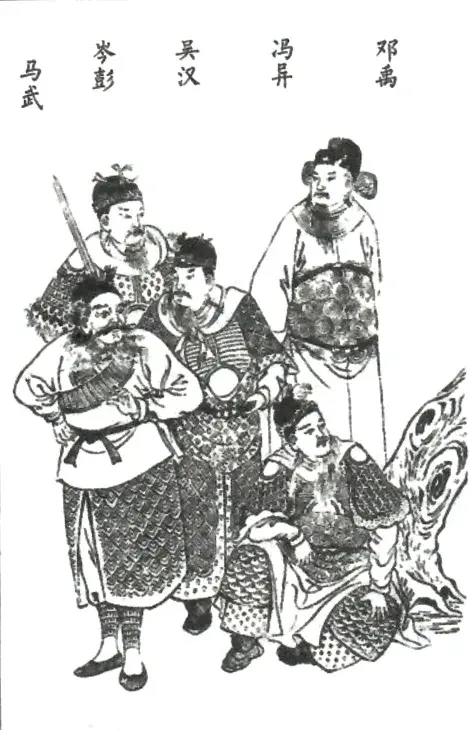
岑彭
Cen Peng (岑彭, ?–35 CE), courtesy name Junran (君然), a native of Jiyang County in Nanyang Commandery (present-day northeast of Xinye County, Henan Province), was an outstanding founding general, military commander, and strategist of the Eastern Han dynasty, ranking sixth among Emperor Guangwu's renowned Twenty-Eight Generals of Yuntai. At the end of the Xin dynasty, Cen Peng served as the acting magistrate of Jiyang. When the…
Cen Peng (岑彭, ?–35 CE), courtesy name Junran (君然), a native of Jiyang County in Nanyang Commandery (present-day northeast of Xinye County, Henan Province), was an outstanding founding general, military commander, and strategist of the Eastern Han dynasty, ranking sixth among Emperor Guangwu's renowned Twenty-Eight Generals of Yuntai. At the end of the Xin dynasty, Cen Peng served as the acting magistrate of Jiyang. When the Xin regime collapsed, he defended the commandery seat of Wancheng for several months against the besieging Lülin forces. Only after the garrison was completely exhausted of provisions did he surrender to the rebel commander Liu Yan. Liu Yan admired Cen Peng's unyielding loyalty and steadfast character, sparing his life despite intense opposition from other rebel leaders and having him enfeoffed as the Marquis of Guide. Following the murder of Liu Yan, Cen Peng was successively assigned under the command of Grand Minister of War Zhu Wei and Han Xin, the Administrator of Henei. In 24 CE, as Liu Xiu pacified the regions north of the Yellow River and advanced toward Henei, Cen Peng astutely recognized the geopolitical trend, persuaded Han Xin to surrender peacefully, and entered Liu Xiu's service. He was appointed General Who Investigates Villainy, subsequently aiding in the capture of Ye and the elimination of the unstable director Xie Gong, rendering indispensable services to Liu Xiu's pacification of Hebei. Following Emperor Guangwu's accession in 25 CE, Cen Peng was elevated to Minister of Justice and concurrently exercised supreme military command. During the siege of Luoyang, he personally persuaded the senior rebel general Zhu Wei to surrender through his unwavering fidelity and moral integrity, securing the peaceful capitulation of the imperial capital. In 26 CE, Cen Peng was promoted to General Who Conquers the South and took charge of southern military campaigns. He suppressed the rebellion of Deng Feng and spent several years eradicating the entrenched southern warlords Qin Feng and Tian Rong across the Jingxiang region. Following these victories, he dispatched diplomatic proclamations south of the Yangtze River, bringing Jiaozhi and distant southern commanderies into submission, for which he was enfeoffed as the Marquis of Wuyin. In 32 CE, Cen Peng accompanied Emperor Guangwu on the western campaign against Wei Xiao in Longyou, achieving extraordinary breakthroughs that prompted the Emperor's famous commendation of having subdued Long and aspiring toward Shu. In 35 CE, Cen Peng commanded an amphibious expeditionary force up the Yangtze River into Sichuan, shattering the massive river barriers constructed by Gongsun Shu and advancing directly toward Chengdu while strictly preserving civilian life. In the tenth month of that year, Cen Peng was assassinated in his camp at Pengwang by an infiltrator sent by Gongsun Shu. Emperor Guangwu was deeply grieved and posthumously conferred upon him the title of Marquis Zhuang.
Served as magistrate of Jiyang and held Wancheng for months; spared by Liu Yan after surrender and created Marquis of Guide.
Persuaded Han Xin of Henei to surrender, was appointed General Who Investigates Villainy, and helped Liu Xiu pacify Hebei.
Promoted to Minister of Justice and convinced Zhu Wei to surrender Luoyang peacefully, securing the imperial capital.
Elevated to General Who Conquers the South, enfeoffed as Marquis of Wuyin, and launched campaigns to pacify Jingzhou.
Defeated Qin Feng repeatedly around Liqiu, killed rebel general Cai Hong, and tightened the encirclement.
Captured Qin Feng, routed Tian Rong, pacified Jingxiang, and dispatched diplomatic edicts to secure southern commanderies.
Guarded Jiangling against Gongsun Shu, maintained strict military discipline, and stabilized the southern borders.
Accompanied Emperor Guangwu against Wei Xiao, captured Wating, and secured overland supply corridors.
Commanded river forces to burn Gongsun Shu's pontoon barriers at Jingmen, swept into Sichuan, and captured Wuyang.
Assassinated at Pengwang by a covert agent dispatched by Gongsun Shu, mourned by the Emperor, and posthumously honored as Marquis Zhuang.
Cen Peng was born into a prominent family in Nanyang Commandery, acquiring extensive literary learning and strategic acumen in his youth. During the chaotic final years of Wang Mang's Xin dynasty, Cen Peng was appointed acting magistrate of Jiyang County on account of his stern administrative competence. When the Lülin rebel armies rose in Nanyang, their forward elements rapidly approached Jiyang. Knowing that an isolated county town could not withstand the overwhelming rebel tide, Cen Peng evacuated his clan and county magistrates to Wancheng, the capital of Nanyang, joining forces with Xin generals Zhen Fu and Liangqiu Ci to defend the commandery walls.
In 23 CE, Lülin forces laid siege to Wancheng for several months. Food supplies within the walls were completely exhausted, and the defenders were reduced to eating human flesh, yet Cen Peng displayed remarkable tactical resilience and loyalty, refusing to yield. Only after Zhen Fu fell in battle and all provisions were depleted did Cen Peng lead the garrison to surrender. The rebel commanders harbored intense resentment against the garrison and demanded that Cen Peng be executed immediately. Liu Yan, the elder brother of Liu Xiu and paramount commander of the Han forces, intervened forcefully: "Cen Peng was a regional official who fulfilled his duty steadfastly even in mortal peril. Such unyielding integrity is rare in the realm. As we strive to pacify all under heaven, we must attract worthy men rather than slaughtering righteous officials." Liu Yan personally unbound Cen Peng and memorialized Emperor Gengshi to create him Marquis of Guide.
Shortly thereafter, Liu Yan was murdered in a palace conspiracy orchestrated by Emperor Gengshi and Grand Minister of War Zhu Wei. Devastated and powerless, Cen Peng was reassigned as a colonel under Zhu Wei's command. In 24 CE, Zhu Wei dispatched Cen Peng to accompany Han Xin to Henei Commandery, where Han Xin assumed office as Administrator and Cen Peng served as Chief Commandant. When Liu Xiu advanced northward across the Yellow River and crushed the remnants of Wang Lang, his prestige soared, and his vanguard approached the county of Huai in Henei. Relying on the solid fortifications of the city, Han Xin planned to shut the gates and resist Liu Xiu's forces.
Cen Peng recognized Liu Xiu's exceptional leadership and remembered Liu Yan's life-saving grace. He sternly admonished Han Xin: "The Gengshi court is plagued by internal betrayal, whereas Prince Xiao possesses unmatched virtue and majesty. Those who align with him prosper, while those who defy him court utter destruction. To resist now is to invite total ruin." Persuaded by this lucid analysis, Han Xin abandoned his defense and opened the city gates to surrender. When Liu Xiu entered Henei and learned that Han Xin had initially contemplated armed resistance, he ordered his immediate execution in great fury. Cen Peng stepped forward and remonstrated vigorously, saving Han Xin's life and laying out a grand geopolitical strategy for uniting the empire. Delighted, Liu Xiu appointed Cen Peng as General Who Investigates Villainy. Cen Peng subsequently accompanied Liu Xiu northward to capture Ye and executed the deceitful director Xie Gong at Qingyang, absorbing tens of thousands of veteran soldiers and establishing Liu Xiu's decisive base in Hebei.
In 25 CE, Liu Xiu ascended the imperial throne at Hao in Hebei, formally establishing the Eastern Han dynasty. While the Gengshi regime collapsed, its leading minister Zhu Wei continued to hold the imperial capital of Luoyang with tens of thousands of elite troops. Emperor Guangwu dispatched Minister of Justice Cen Peng alongside Grand General Wu Han to invest Luoyang for several months, yet the city walls stood firm and resisted repeated assaults. Knowing that he had orchestrated the assassination of Liu Yan, Zhu Wei was consumed with terror and resolved to fight to the death.
Emperor Guangwu summoned Cen Peng and instructed him: "Although Zhu Wei participated in the murder of my elder brother, he once showed you favor. Go to the walls of Luoyang and negotiate his surrender. Tell him that in contending for the realm, past grievances are wiped clean. I swear by the waters of the Baishui River that no harm shall befall him." Cen Peng rode alone to the western gates of Luoyang and called up to Zhu Wei on the ramparts. Zhu Wei sighed: "I plotted the death of Liu Yan and obstructed the Prince from crossing the river. My crimes are immense, how can I hope for survival?" Cen Peng conveyed the Emperor's solemn pledge with profound sincerity. Moved by Cen Peng's integrity and Guangwu's magnanimity, Zhu Wei lowered a rope to draw Cen Peng into the fortress for private talks and opened the gates to surrender. The peaceful capitulation of Luoyang secured the imperial center without bloodshed, and the Emperor promoted Cen Peng to General Who Conquers the South.
In 26 CE, southern China was engulfed in widespread warlord insurrections. Dong Xin, a regional strongman in Nanyang, revolted at Wancheng and expelled the commandery administrator. Emperor Guangwu dispatched Cen Peng, Wu Han, and Geng Yan to quell the uprising. Deng Feng, a former officer under Liu Xiu, was outraged when Wu Han's undisciplined troops plundered his hometown of Xinye. In retaliation, Deng Feng rebelled, ambushed Wu Han's columns, captured extensive imperial baggage, and allied with Dong Xin at Duyang. Cen Peng found himself isolated at the front lines of Duyang, facing a numerically superior enemy force. He fought tenaciously day and night, suffering multiple wounds while maintaining firm discipline, thereby preserving the army's position.
Deng Feng then formed an alliance with Qin Feng, the self-styled King of Chuli at Liqiu, and Tian Rong of Yiling, repeatedly defeating several Han divisions. Confronting this grave crisis, Cen Peng demonstrated exceptional composure. He strictly enforced military discipline, forbidding his troops from mistreating local inhabitants. The civilians of Nanyang were profoundly moved and brought provisions to support his army. In 27 CE, Emperor Guangwu arrived at the front lines near Ye to assume direct command. Cen Peng and Geng Yan launched a coordinated counteroffensive, crushing the combined forces of Dong Xin and Deng Feng at the Battle of Xiaochang'an, compelling Deng Feng to surrender. In recognition of his valor, Emperor Guangwu enfeoffed Cen Peng as the Marquis of Wuyin and appointed him supreme commander over the southern campaigns against Qin Feng.
Qin Feng had entrenched himself east of the Han River for years, commanding over one hundred thousand troops from his stronghold at Liqiu and deploying defenses around Deng County. Arriving at the battlefront, Cen Peng refrained from costly direct assaults, employing a deceptive feint instead. He openly assembled warships at the western crossing of Jiangjin, broadcasting an imminent assault on Qin Feng's rear positions, which lured the rebel king to rush his elite forces westward. Cen Peng then led his core cavalry and infantry across the eastern shoals of Huanglongtan by night, shattering the defenses of Qin Feng's general Cai Hong, slaying thousands of defenders, and severing the enemy's line of retreat to Liqiu.
Caught off guard, Qin Feng hurried back to confront Cen Peng. Positioning his troops with tactical precision, Cen Peng enveloped and crushed the rebel field army. Rebel general Zhang Sheng surrendered with his forces, while Qin Feng retreated behind the walls of Liqiu. When the Yiling warlord Tian Rong brought tens of thousands of troops to relieve the siege, Cen Peng ambushed and routed them at Chengshan, sending Tian Rong fleeing back to Yiling. Cen Peng entrusted the ongoing siege of Liqiu to Zhu You while pursuing Tian Rong down the Han River, crushing his remnants at Jinxiang and pacifying Yiling. In 29 CE, with all supplies exhausted, Qin Feng surrendered. Cen Peng's authority resonated throughout the south. Envoys dispatched by Cen Peng carried edicts across the southern provinces, leading administrators of distant commanderies such as Jiaozhi and Yulin to submit, extending Han sovereign authority to the South China Sea.
In 32 CE, the northwestern warlord Wei Xiao revolted and entered an alliance with Gongsun Shu in Sichuan, threatening Han positions in the west. Emperor Guangwu personally commanded the main armies to march into Longxi, summoning Cen Peng to lead elite southern divisions to join the campaign at Qi County. Wei Xiao's commanders Wang Yuan and Xing Xun fortified strategic mountain defiles, temporarily stalling the imperial advance. Cen Peng spearheaded the assault, carving roads through rugged mountains and seizing the strategic stronghold of Wating, striking Wei Xiao's rear and capturing sixteen counties across Tianshui Commandery.
Wei Xiao's army collapsed, and the warlord fled to Xicheng. Operating deep inside arid northwestern terrain across a supply line spanning hundreds of miles, the imperial armies faced acute logistical challenges. Recognizing that supply lines were the lifeblood of warfare, Cen Peng supervised the construction of fortified military roads and organized logistical networks linking Nanyang and Guanzhong, ensuring steady deliveries of grain and provisions. Impressed by his flawless command, Emperor Guangwu wrote an imperial edict to Cen Peng: "Once these two strongholds fall, you may lead troops south to attack the Shu rebels. Man is never satisfied; having conquered Long, one still gazes toward Shu! With each campaign, my hair turns white." This gave rise to the enduring idiom of gazing toward Shu after subduing Long. Cen Peng's mastery secured the western frontier and laid the foundation for the final conquest of Sichuan.
Following the pacification of Longyou, Gongsun Shu remained the last independent monarch opposing the unified Han dynasty. Relying on the steep gorges of the Yangtze River, Gongsun Shu constructed floating pontoon bridges and iron chains between Jingmen and Huya, creating a seemingly impenetrable defensive barrier. In the spring of 35 CE, Cen Peng was appointed Regional Governor of Yizhou and given full command of a massive amphibious assault force.
Gongsun Shu's generals Ren Man and Tian Rong defended the Jingmen fortifications with heavy forces. Recognizing the danger of a direct naval charge, Cen Peng exploited a favorable downstream wind, loading fast assault vessels with dry reeds and oil. The flaming assault boats crashed into the enemy's water barriers, turning the floating bridges into a sea of fire. Cen Peng led his troops forward amid thunderous war drums, killing Ren Man, taking thousands of prisoners, and forcing Tian Rong to flee into Jiangzhou.
Having breached the Yangtze barriers, Cen Peng split his forces: he dispatched general Zang Gong along the Fu River while leading the main force toward Ba Commandery and Wuyang. Cen Peng strictly forbade his soldiers from looting, winning the hearts of the local populace, who welcomed his armies with open gates. His forward cavalry swept to Pengwang, a mere short distance from Chengdu. Terrified by his unstoppable momentum, Gongsun Shu hired desperate assassins to infiltrate the imperial camp. That night, an assassin penetrated the commander's tent and struck down Cen Peng. Emperor Guangwu was overwhelmed with sorrow upon hearing the news, conferring upon him the posthumous title of Marquis Zhuang, while the people of Sichuan wept openly for the fallen hero.
During the critical juncture when the Gengshi regime was disintegrating, Cen Peng displayed extraordinary foresight by convincing Han Xin, the Administrator of Henei, to abandon resistance and submit peacefully. This decisive action preserved Henei's fertile agricultural base as an unassailable logistics hub for Liu Xiu. Serving subsequently as General Who Investigates Villainy, Cen Peng enforced strict military discipline, assisted in capturing Ye, and eliminated the unreliable Xie Gong, allowing Liu Xiu to consolidate tens of thousands of elite soldiers and build an enduring base for imperial unification.
In the decisive confrontation over Luoyang, the imperial stronghold was heavily garrisoned by Zhu Wei, who feared retribution for his role in Liu Yan's death. Cen Peng demonstrated exceptional moral courage and integrity by riding unarmed to the city walls. Leveraging his personal bond and Emperor Guangwu's solemn pledge, he persuaded Zhu Wei to open the city gates. This strategic breakthrough preserved the ancient capital of Luoyang intact, providing the Eastern Han with an immediate and prestigious imperial center without catastrophic destruction.
Entrusted with supreme command over southern operations as General Who Conquers the South, Cen Peng conducted a masterclass in counterinsurgency. Confronting a dense web of hostile warlords including Deng Feng, Qin Feng, and Tian Rong, he balanced military pressure with benevolent governance. His tactical brilliance at Huanglongtan and the protracted siege of Liqiu extinguished rebellions that had afflicted Jingzhou for a decade, securing the southern half of the empire and extending Han control to the maritime frontiers.
During the arduous western campaign against Wei Xiao in 32 CE, imperial divisions had to sustain operations across hundreds of miles of rugged terrain. Beyond his battlefield victories at Wating and the conquest of sixteen counties, Cen Peng organized and protected extensive supply corridors. He supervised road construction, mobilized civilian transport from Nanyang and Guanzhong, and erected fortified relay stations, guaranteeing an uninterrupted flow of grain that sustained imperial forces through prolonged warfare.
Following the pacification of Jingxiang, Cen Peng shunned brute subjugation, adopting an enlightened policy of mutual trust and administrative benevolence. Stationed at Jiangling, he enforced rigorous codes forbidding military looting and treated local chieftains and southern ethnic groups with respect. His reputation for unwavering honor convinced regional governors across Jiaozhi, Yulin, and the Cangwu territories to send tribute and formally acknowledge imperial authority, integrating vast southern regions peacefully into the Han realm.
Confronting the formidable natural ramparts of the Yangtze Gorges and Gongsun Shu's fortified pontoon defenses at Jingmen, Cen Peng displayed masterful naval leadership. Utilizing incendiary assault tactics, he obliterated the enemy's water defenses, routed tens of thousands of defenders, and penetrated deep into the Sichuan basin. His swift advance to Wuyang and strict preservation of civilian life dismantled the natural advantage of Sichuan, clearing the primary military obstacle to the final unification of the empire.
FIGURES ASSOCIATED WITH THIS DYNASTY