Birth in Yuanshi
Born at Yuanshi palace as the fourth son of Emperor Guangwu and Lady Yin Lihua.
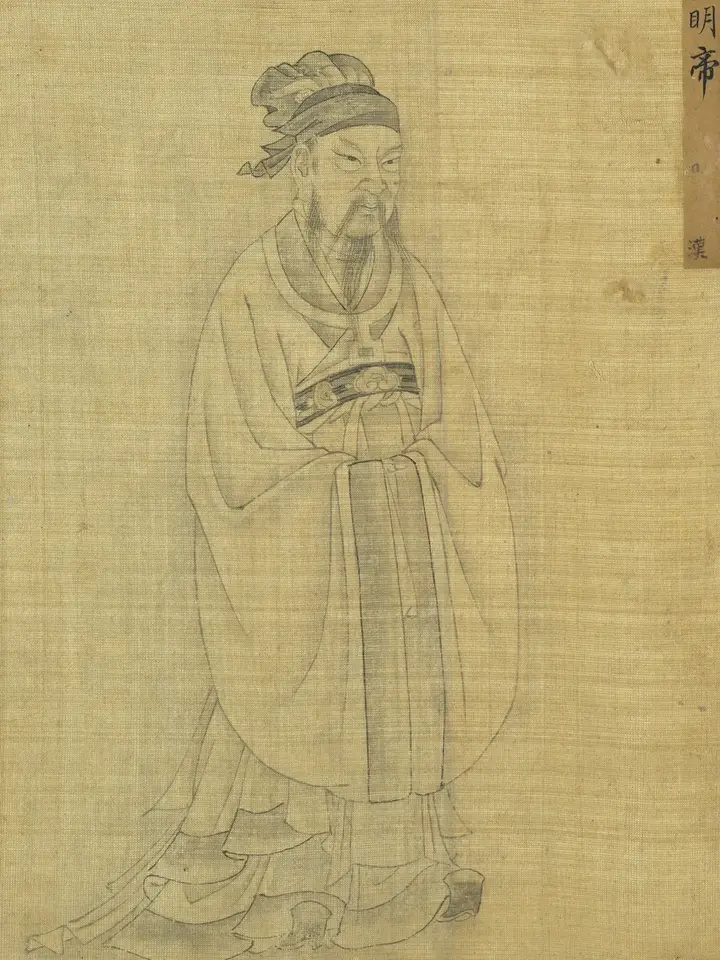
57 CE–75 CE
刘庄
Emperor Ming of Han (汉明帝, June 15, 28 – September 5, 75), personal name Liu Zhuang (刘庄), originally Liu Yang (刘阳), courtesy name Zili (子丽), was the second emperor of the Eastern Han dynasty, reigning from 57 to 75. The fourth son of Emperor Guangwu (Liu Xiu) and Empress Yin Lihua, he was renowned from childhood for his penetrating intelligence and mastery of the Confucian classics. Following his appointment as Crown Prince in…
Emperor Ming of Han (汉明帝, June 15, 28 – September 5, 75), personal name Liu Zhuang (刘庄), originally Liu Yang (刘阳), courtesy name Zili (子丽), was the second emperor of the Eastern Han dynasty, reigning from 57 to 75. The fourth son of Emperor Guangwu (Liu Xiu) and Empress Yin Lihua, he was renowned from childhood for his penetrating intelligence and mastery of the Confucian classics. Following his appointment as Crown Prince in 43, he was educated by premier scholars such as Huan Rong. Upon ascending the throne in 57, he initiated eighteen years of rigorous, transformative governance characterized by administrative vigilance, cultural flourishing, and territorial resurgence. During his reign, Emperor Ming maintained iron discipline over imperial administration, suppressing consort clans and curb-checking unruly imperial princes. He restored ancient classical court attire (mianfu), presided over grand state rituals at the Mingtang and Biyong, and welcomed foreign royal scions to state academies. In 65, prompted by a vision of a radiant golden deity, he dispatched envoys to India, subsequently constructing China's first Buddhist sanctuary, the White Horse Temple. He mobilized massive labor forces under engineer Wang Jing to tame the Yellow River, securing agricultural safety for nine centuries. Terminating earlier isolationist frontier policies, he dispatched Dou Gu and Geng Bing to shatter Northern Xiongnu power, commissioned Ban Chao to re-establish Han hegemony across the Silk Road, and absorbed the Ailao kingdom to create Yongchang Commandery. Under his rule, registered households soared from twenty-one to thirty-four million, establishing the golden era celebrated in historiography as the Rule of Ming and Zhang.
Born at Yuanshi palace as the fourth son of Emperor Guangwu and Lady Yin Lihua.
Created Duke of Donghai; identifies fraudulent tax returns in the nationwide land audit.
Promoted to Prince of Donghai, demonstrating intellectual maturity and martial insight.
Devises strategic plan to crush the Yuanwu rebellion; invested as Crown Prince under Huan Rong.
Ascends the imperial throne at Luoyang following Emperor Guangwu's death; institutes Yongping era.
Codifies ancient imperial regalia; executes corrupt frontier general Dou Lin to restrain consort power.
Dispatches imperial envoys Cai Yin and Qin Jing westward to India in search of Buddhist scriptures.
Founds academy for elite consort lineages; enforces annual bureaucratic evaluations for commanderies.
Welcomes Indian monks Kasyapa Matanga and Dharmaratna; erects White Horse Temple at Luoyang.
Annexes the Ailao kingdom; appoints Wang Jing to direct massive flood-control dyke projects.
Crushes Prince of Chu Liu Ying's treasonous plot, purging aristocratic factions with firm justice.
Deploys four expeditionary armies into northern steppes; sends Ban Chao on epic Western Regions mission.
Defeats Northern Xiongnu at Lake Barkol; re-institutes the Protectorate of the Western Regions.
Passes away at the Eastern Palace at age forty-eight; interred with modest rites at Xiejie Mausoleum.
Emperor Ming of Han was born on June 15, 28 (Jianwu 4), at the imperial temporary residence in Yuanshi County, Changshan Commandery. Initially named Liu Yang, he was the fourth son of Emperor Guangwu and his revered consort Yin Lihua. Ancient annals recorded that the young prince possessed an exceptionally imposing physique and dignified demeanor, accompanied by profound intellectual acuity. Emperor Guangwu frequently summoned him to the imperial couch to discuss intricate state affairs, admiring his rapid comprehension and strategic depth. At age ten, he had completely mastered the Spring and Autumn Annals, astouding contemporary scholars.
In 39, the twelve-year-old prince was created Duke of Donghai. That same year, Emperor Guangwu launched a nationwide audit of arable lands and demographic rolls to curtail gentry tax evasion. When officials from Chenliu submitted their registers, a confidential memorandum was discovered stating: "Yingchuan and Hongnong may be audited; Henan and Nanyang must not be investigated." When the emperor angrily questioned the messenger, the official feigned ignorance. Standing behind the palace screens, the twelve-year-old Liu Zhuang stepped forward and explained that Henan was the capital district while Nanyang was the imperial ancestral home; both regions were saturated with imperial relatives whose extensive estates grossly violated land ceilings. A subsequent interrogation confirmed the young prince's deductive brilliant deduction, elevating his father's esteem.
In 41, he was elevated to Prince of Donghai. Two years later, bandits led by Shan Chen seized Yuanwu citadel, taking municipal magistrates hostage. General Zang Gong besieged the stronghold for months, suffering appalling casualties. While grand court ministers clamored for reckless assaults, seventeen-year-old Liu Zhuang urged a looser encirclement, arguing that starving rebels facing certain execution would fight to the death, whereas an apparent escape route would induce them to disperse, permitting an effortless cavalry ambush. His tactical prediction proved entirely accurate. In 43, following the abdication of Crown Prince Liu Jiang, Liu Zhuang was proclaimed Crown Prince. Renowned Confucian scholar Zhang Yi was appointed Grand Tutor and Huan Rong as Junior Tutor, under whose tutelage the prince mastered the Classic of History.
In the second month of 57, Emperor Guangwu passed away. The thirty-year-old Crown Prince ascended the throne at the Southern Palace in Luoyang, establishing the Yongping era. From the outset of his eighteen-year reign, Emperor Ming rigidly enforced Guangwu's institutional precedents, directing unforgiving vigilance against overweening consort families and aristocratic clans. Early in his reign, General Dou Lin, a member of the preeminent Dou consort clan, abused his frontier authority through embezzlement and imperial deception. Emperor Ming immediately cast him into prison to be executed, subsequently demoting and cashiering clan patriarch Dou Rong. When Dou Rong's son Dou Mu forged imperial decrees to force an aristocratic divorce, the entire Dou lineage was banished under armed surveillance, terminating consort dominance.
Emperor Ming established a bedrock constitutional doctrine forbidding consort lineages from receiving princely enfeoffments or exercising executive statecraft. When his elder sister, Grand Princess Guantao, personally petitioned for her son to be granted a court gentleman appointment, Emperor Ming flatly rejected the request, presenting her with ten million cash instead while admonishing ministers that imperial offices existed exclusively to protect the people, not to indulge family affection. Similarly, when the talented scholar Yan Zhang, whose sister was an imperial concubine, demonstrated exceptional administrative capabilities, Emperor Ming deliberately refused him high promotion to preserve the institutional firewall between palace consorts and civil governance. When commissioning the famous portraits of the Twenty-Eight Cloud Platform Generals honoring his father's comrades, he consciously excluded his own father-in-law, General Ma Yuan, to avert any semblance of personal favoritism.
Toward rebellious imperial princes, Emperor Ming showed uncompromising resolve. His younger brother Liu Jing, Prince of Shanyang, conspired repeatedly to incite civil war and allied with hostile Qiang tribes; after multiple pardons failed to curb his treason, Liu Jing committed suicide in fear of imperial retribution. Prince of Chu Liu Ying fabricated golden tortoises and esoteric prophecies to assemble an armed insurrection; Emperor Ming revoked his princely title and exiled him to Danyang, where he killed himself. When Prince of Huaiyang Liu Yan orchestrated a coup alongside Grand Minister Xing Mu, the imperial court thoroughly unmasked the network and executed the conspirators. These ruthless judicial purges dismantled factional threats, cementing the undivided authority of the throne.
Emperor Ming placed exceptional weight upon administrative purity, earning renown throughout Chinese history for his penetrating surveillance over the civil bureaucracy. In 66, he enacted formal annual performance review regulations, commanding commandery inspectors and the Metropolitan Censorate to evaluate local magistrates every three years, promoting model administrators while ruthlessly dismissing corrupt officials. He maintained an unrelenting vigilance over cabinet documents, personally reviewing administrative ledgers. Bureaucratic grandees caught falsifying reports or dallying in duties were regularly flogged before the throne, inspiring salutary dread across the capital.
Yet his discipline was counterbalanced by sincere magnanimity and institutional empathy. When a junior scribe erroneously recorded imperial silk donations to surrendered nomads as one hundred bolts instead of ten, Emperor Ming flew into a rage, ordering the clerk beaten. Chief Secretary Zhongli Yi threw himself before the throne, arguing that clerical oversights were natural human errors, and that as executive director, he alone deserved punishment. Moved by this courageous display of official responsibility, Emperor Ming rescinded the sentence and restored Zhongli Yi's honors. In another instance, when the impoverished secretary Yao Song was discovered sleeping on bare floorboards without blankets while toiling late into the night, Emperor Ming personally inspected his quarters, praised his fidelity, and promulgated imperial rescripts providing warm bedding, nighttime rations, and personal attendants for all palace secretarial staff.
The crowning domestic accomplishment of Emperor Ming's reign was the permanent pacification of the Yellow River. Since the late Western Han dynasty, recurrent catastrophic dyke breaches had inundated vast agricultural plains across modern Henan and Shandong, displacing millions of farming families. While earlier administrations lacked the resources for reclamation, Emperor Ming resolved in 69 to initiate a definitive engineering solution. He summoned renowned hydraulic engineer Wang Jing and river master Wang Wu to court, questioning them rigorously regarding water currents and topographical gradient. Impressed by Wang Jing's sophisticated technical proposals, the emperor allocated massive state treasuries and conscripted several hundred thousand workers.
Wang Jing executed an unprecedented feat of environmental engineering. He surveyed regional riverbeds, cleaved rocky defiles, and erected an unbroken flood embankment extending over one thousand leagues from Xingyang to the ocean inlet at Qiancheng. Critically, he engineered hydraulic sluice gates at ten-league intervals, allowing reciprocal flood diversion between the Yellow River and the Bian Canal. This monumental system extinguished nine centuries of devastating river course alterations, revitalizing the agricultural economy of the Central Plains. Concurrently, Emperor Ming frequently remitted agrarian land taxes during droughts, practiced ceremonial plowing to inspire farming, and enforced palace frugality, causing the empire's registered population to surge from twenty-one million to thirty-four million within two decades.
In foreign policy, Emperor Ming demonstrated strategic patience. As Crown Prince, he had dissuaded his father from concluding tributary peace pacts with the Northern Xiongnu, warning that appeasing predatory nomads would alienate the newly allied Southern Xiongnu confederation. Once three decades of domestic peace restored Eastern Han treasuries, Emperor Ming decisively abandoned Guangwu's non-interventionist doctrine, resolving to deploy imperial armies to dismantle Northern Xiongnu dominance across Central Asia.
In the spring of 73, Emperor Ming unleashed a coordinated four-column military offensive against the Northern Xiongnu. Veteran general Dou Gu marched out of Jiuquan, ambushing and crushing the army of the Xiongnu Huyan Prince along the slopes of the Heavenly Mountains (Tianshan), securing the strategic bastion of Yiwu. Simultaneously, Dou Gu dispatched an advance diplomatic detachment led by Assistant Commander Ban Chao. With thirty-six comrades, Ban Chao executed a daring nocturnal strike that annihilated the Northern Xiongnu mission at Shanshan, rallying the Tarim Basin kingdoms of Shanshan and Khotan to the Han fold.
In 74, Dou Gu and Geng Bing pressed their advantage northward, routing the nomadic forces around Lake Barkol and capturing the kingdom of Jushi. Having shattered the Northern Xiongnu control over Central Asia, Emperor Ming officially reconstituted the Protectorate of the Western Regions and the Wuji Command, re-establishing imperial oversight over the Silk Road after six decades of severance. In the southwest, King Liumao of the immense Ailao confederation submitted voluntarily to Han suzerainty in 69 along with seventy-seven tribal rulers and over five hundred and fifty thousand subjects. Emperor Ming established Yongchang Commandery to administer this vast territory, integrating rich mineral resources into the empire and prompting court poet Ban Gu to celebrate the era as an apex of universal civilization.
Emperor Ming was a seminal architect of Chinese imperial ritual. In 59, observing that traditional court vestments had languished in confusion since the fall of the Qin dynasty, he studied classical Zhou and Han canons to resurrect the formal imperial crown (mian) and robes (mianfu). He mandated the twelve-tasseled imperial crown adorned with white jade beads, scarlet footwear, and embroidered cosmic emblems for state sacrifices. He personally presided over the Mingtang ancestral veneration, surveyed the constellations from the Lingtai observatory, and performed the venerable Three Elders and Five Experienced Rites at the Biyong academy.
A passionate champion of Confucian scholarship, Emperor Ming delivered classical lectures at the Biyong before tens of thousands of scholars, civil officials, and visiting nomadic dignitaries. He established an exclusive academy for the scions of the four premier consort families (Fan, Guo, Yin, and Ma), enforcing universal study of the Classic of Filial Piety. In religious history, Emperor Ming is venerated for introducing Buddhism into China. Following an auspicious dream in 65 depicting a radiant golden deity, he dispatched court envoys Cai Yin and Qin Jing to India. In 67, they returned to Luoyang alongside Indian Buddhist masters Kasyapa Matanga and Dharmaratna, bearing sacred scriptures and iconographic images on white horses. Emperor Ming ordered the construction of the White Horse Temple outside the western gates of Luoyang, commissioning the translation of the Sutra of Forty-Two Chapters and erecting the Qiyun Stupa, establishing the monumental foundation of Chinese Buddhism.
In his private life, Emperor Ming exemplified filial devotion and deep reverence for scholars. Following his imperial coronation, he treated his former preceptor Huan Rong with the deference due to a private master, setting up special honorific seating in the ministry and addressing him as "Great Master." When Huan Rong fell gravely ill, the emperor visited his bedside in person, weeping openly and presenting royal furnishings. Following Huan Rong's death, Emperor Ming wore mourning robes at the funeral and promoted his disciples to ministerial ranks, setting an enduring standard for imperial decorum.
In the first month of 74, upon visiting the Yuanling mausoleum of his parents, the emperor awoke weeping from a dream of his deceased mother. Ascending the tumulus with his grandees, he knelt before his mother's dressing table, overcome with uncontrollable grief. In his domestic quarters, he was supported by the virtuous Empress Ma, daughter of General Ma Yuan, whose wisdom, personal frugality, and strict refusal to promote her own kinsmen won his lifelong admiration. Falling fatally ill in the eighth lunar month of 75, Emperor Ming issued strict instructions for a modest burial at Xiejie Mausoleum: prohibiting elaborate temples, restricting the stone coffin to minimal dimensions, and commanding four seasonal offerings of plain grain and water, personifying the virtue of imperial austerity.
Emperor Ming fundamentally reconstituted the ritual and moral architecture of the Eastern Han state. By reviving classical ceremonial attire in 59, he restored symbolic dignity to the monarchy. His performance of the Three Halls (Mingtang, Lingtai, and Biyong) rituals institutionalized the moral duty of the Son of Heaven to honor ancestors, monitor cosmic alignments, and care for aged sages. At the Biyong, he personally debated the Five Classics with leading academicians before tens of thousands of spectators. He created the Sixian Academy to educate aristocratic youths and mandated Classic of Filial Piety training across palace guards, turning Luoyang into an intellectual magnet that drew princely hostages from Central Asia and the Eurasian steppe.
Emperor Ming occupies a landmark position in world religious history as the first sovereign to sponsor Buddhism in China. Inspired by his vision of a golden figure radiating solar light, he dispatched an official embassy across the Pamir Mountains to India between 65 and 67. The mission returned with Indian patriarchs Kasyapa Matanga and Dharmaratna, along with Buddhist relics and sacred texts. By founding the White Horse Temple and erecting the Qiyun Stupa in Luoyang, Emperor Ming established the cradle of East Asian Buddhism, facilitating the translation of foundational sutras and inaugurating an epochal cultural dialogue between Chinese and Indian civilizations.
To rescue the Central Plains from chronic inundation, Emperor Ming commissioned hydraulic engineer Wang Jing in 69 to execute the most comprehensive river diversion program in antiquity. Utilizing advanced topographic measurements, Wang Jing directed hundreds of thousands of workers to erect an unbroken dike network stretching over one thousand leagues from Xingyang to the Bohai Sea. By integrating reciprocal floodgates between the river and the Bian Canal, this engineering masterpiece stabilized river courses, ending major flooding for over nine hundred years and securing agrarian stability for millions of farming households.
Breaking decisively with the passive foreign policy of the early Eastern Han, Emperor Ming launched a grand continental counter-offensive in 73. His commanders crushed Northern Xiongnu armies at Mount Tianshan, while his legendary envoy Ban Chao mobilized thirty-six warriors to subjugate Shanshan and Khotan. By subsequently overrunning Jushi and re-establishing the Protectorate of the Western Regions, Emperor Ming shattered nomadic dominance over the Eurasian trade corridors, ensuring the safety of international commerce and cross-cultural exchange.
In the southwestern borderlands, Emperor Ming extended imperial sovereignty over the vast Ailao kingdom in 69. When King Liumao submitted with over half a million subjects, the Han court consolidated their domains into Yongchang Commandery. By carving roads through the rugged Bonan Mountains and spanning the Lancang River, the administration integrated vast deposits of precious metals, iron, timber, and exotic goods into the national economy, cementing Chinese administrative presence across modern Yunnan.
Emperor Ming's domestic governance was characterized by relentless inspection of the civil service and strict prohibition of consort interference. By enforcing systematic annual reviews, he eradicated corruption and ensured that provincial governors prioritized famine relief, irrigation, and sericulture. Supported by broad agrarian tax remissions, the empire experienced an unprecedented economic boom, with registered households expanding by over sixty percent during his eighteen-year reign, providing the material wealth that sustained the Rule of Ming and Zhang.
The reign of Emperor Ming achieved a rare balance between legalist administrative rigor and Confucian moral governance. His uncompromising defense of imperial prerogatives against consort factions averted the clan crises that plagued later dynasties, while his patronage of water control, universal schooling, and classical scholarship enriched the cultural life of the common people. Alongside his son Emperor Zhang, his reign represents the zenith of Eastern Han civilization, remembered as an era of domestic tranquility, martial splendor, and cultural brilliance.
FIGURES ASSOCIATED WITH THIS DYNASTY