Birth in Liwu
Born in Liwu, Jizhou, as the eldest son of Marquis Liu Yi and Lady Yan.
146 CE–168 CE
刘志
Liu Zhi (刘志, 132 – January 25, 168), historically known as Emperor Huan of Han, was the eleventh emperor of the Eastern Han dynasty (reigned 146–168). A great-grandson of Emperor Zhang and eldest son of Liu Yi (Marquis of Liwu), Liu Zhi inherited his father's noble marquisedom in early youth and gained a reputation for physical elegance, musical skill, and scholarly aptitude. Following the untimely death of eight-year-old…
Liu Zhi (刘志, 132 – January 25, 168), historically known as Emperor Huan of Han, was the eleventh emperor of the Eastern Han dynasty (reigned 146–168). A great-grandson of Emperor Zhang and eldest son of Liu Yi (Marquis of Liwu), Liu Zhi inherited his father's noble marquisedom in early youth and gained a reputation for physical elegance, musical skill, and scholarly aptitude. Following the untimely death of eight-year-old Emperor Zhi in August 146, the fifteen-year-old Liu Zhi was selected by Empress Dowager Liang Na and Generalissimo Liang Ji to ascend the imperial throne in Luoyang. During the first thirteen years of his reign, supreme political and military authority rested entirely with the Liang consort clan. Generalissimo Liang Ji exercised tyrannical control over court appointments, accumulating vast private estates and executing remonstrating ministers. In September 159, Emperor Huan conspired in the palace latrine with five trusted eunuchs—Shan Chao, Xu Huang, Ju Yuan, Zuo Guan, and Tang Heng—to execute a lightning coup d'état. Deploying imperial tiger tallies, they mobilized thousands of imperial guards to surround Liang Ji's compound, compelling the generalissimo to commit suicide and confiscating his enormous wealth, which totaled over three billion copper coins. Following the extermination of the Liang clan, Emperor Huan enfeoffed the five eunuchs as marises, plunging the central government into unchecked eunuch ascendancy. When scholar-officials and Imperial Academy students led by Li Ying and Chen Fan mobilized public opinion to denounce eunuch corruption, Emperor Huan retaliated ruthlessly in 166 by launching the first Disaster of the Partisan Prohibitions, arresting and proscribing hundreds of prominent Confucian literati. Furthermore, to curb regional clan factionalism, he instituted the Sanhu Law of administrative avoidance. Emperor Huan died of illness in Dexian Hall in January 168 at age thirty-seven and was entombed in Xuanling Mausoleum.
Born in Liwu, Jizhou, as the eldest son of Marquis Liu Yi and Lady Yan.
Inherited the ancestral title Marquis of Liwu following the death of his father.
Selected by Empress Dowager Liang; enthroned in the Southern Palace of Luoyang on August 1.
Invested Empress Dowager Liang's younger sister Liang Nüying as imperial empress.
Empress Dowager Liang returned nominal authority before her death; Liang Ji retained absolute control.
Allies with Shan Chao and four palace eunuchs to surround Liang Ji's residence, compelling the regent to commit suicide.
Enfeoffs Shan Chao, Xu Huang, Ju Yuan, Zuo Guan, and Tang Heng as marquises on the same day, ushering in eunuch dominance.
Promulgated the Sanhu Law regulating administrative geographic avoidance for provincial magistrates.
Launched the First Partisan Prohibition, arresting and proscribing over two hundred Confucian scholars.
Dispatched general Duan Jiong to suppress Western Qiang rebellions across Liangzhou.
Passed away on January 25 in Dexian Hall, aged thirty-seven; entombed in Xuanling.
Liu Zhi was born in 132 into the imperial branch line of Hejian. His grandfather Liu Kai was the revered Prince Xiao of Hejian, and his father Liu Yi was invested as Marquis of Liwu. In 145, upon Liu Yi's demise, the fourteen-year-old Liu Zhi succeeded to the noble title, studying classical texts under scholar Zhou Fu in Ganling.
In early 146, Empress Dowager Liang Na summoned Liu Zhi to the capital Luoyang to marry her younger sister Liang Nüying. In July of that year, the child Emperor Zhi was poisoned by Generalissimo Liang Ji after calling him an arrogant general. Seeking a pliant, young monarch to maintain clan supremacy, Liang Ji and Empress Dowager Liang bypassed the elder Prince of Qinghe and installed Liu Zhi as emperor on August 1, 146. For the next several years, Empress Dowager Liang conducted state affairs from behind the court curtain, while Liang Ji consolidated dictatorial authority across the military commands.
Even after Empress Dowager Liang's death in 150, Liang Ji's despotism expanded unchecked. He monopolized imperial appointments, seized land from ordinary subjects, and constructed palatial gardens spanning hundreds of li. Imperial censors and loyalist ministers who dared to impeach him, such as Li Gu and Du Qiao, were systematically imprisoned and executed. Meanwhile, Empress Liang Nüying monopolized the inner palace, poisoning pregnant consorts until her death in 159.
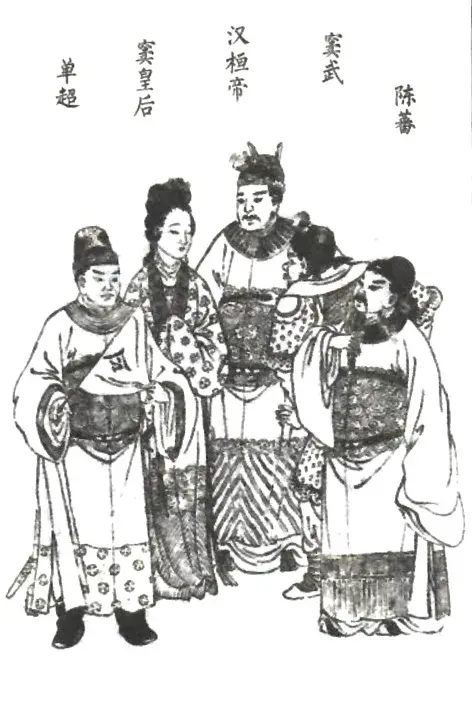
Pushed to desperation by round-the-clock surveillance, Emperor Huan resolved to eliminate the consortium. In the eighth month of 159, while in the imperial latrine, he summoned eunuch Shan Chao and questioned him regarding who among the attendants was genuinely hostile to Liang Ji. Forming an alliance with Shan Chao, Xu Huang, Ju Yuan, Zuo Guan, and Tang Heng, Emperor Huan bit Shan Chao's arm to seal their blood oath.
Deploying imperial credentials, the conspirators mobilized palace guard commander Ju Yuan and dispatched over a thousand armored troops to surround Liang Ji's residence. Stripped of his generalissimo seal, Liang Ji committed suicide by swallowing poison, and dozens of his family members were executed. The confiscated wealth of the Liang clan was auctioned for over three billion copper coins, allowing Emperor Huan to remit half of the empire's annual taxes.
The downfall of the Liang clan did not lead to political enlightenment. Emperor Huan rewarded his five eunuch confederates by enfeoffing them as marises with astronomical tax revenues on the same day, earning them the historical moniker of the Five Marquises. Eunuch relatives were rapidly appointed to provincial governorships and magistrate posts, where they practiced ruthless extortion and bribery.
Outraged by palace corruption, Confucian literati, regional governors like Li Ying and Du Mi, and thousands of students from the Imperial Academy formed an outspoken political coalition. In late 166, when eunuch elements fabricated charges that the scholars were forming subversive cliques to defame the sovereign, Emperor Huan ordered the nationwide arrest of over two hundred prominent scholars. Although pardoned from execution the following year through the intervention of imperial general Dou Wu, the scholars were permanently barred from holding public office, inaugurating the catastrophic Disasters of the Partisan Prohibitions.
The execution of the Yanxi coup in 159 was the most decisive imperial counter-offensive against overweening consort clans in Eastern Han history. By orchestrating a clandestine palace strike, Emperor Huan dismantled a tyrannical monopoly that had controlled three successive emperors for two decades.
The recovery of vast confiscated properties restored substantial revenue to the state treasury and provided immediate fiscal relief to taxpayers across the empire, temporarily arresting the disintegration of central imperial prestige.
In 165, Emperor Huan promulgated the Sanhu Law, an innovative institutional statute regulating official appointment avoidance. Recognizing that local magnates and consort families frequently intermarried across commanderies to build impenetrable political monopolies, the law prohibited officials from holding office in their ancestral provinces or in areas connected through maternal and marital kinship.
Although the regulation eventually impeded the recruitment of talent during the late Han decline, it represented a pioneering institutional attempt to dismantle regional oligarchic cliques and assert metropolitan control over provincial governance.
During the Yuanjia era, Generalissimo Liang Ji entered the imperial palace wearing a sword in violation of court protocol, prompting Gentleman of the Masters of Writing Zhang Ling to courageously reprimand him and demand his impeachment.
Throughout Emperor Huan's reign, recurring Qiang rebellions and Yellow River floods strained state finances, while rapid successions of empresses—from Liang Nüying to Deng Mengnü and Dou Miao—destabilized the inner court.
In January 168, Emperor Huan passed away without a surviving son at Dexian Hall in the Northern Palace at age thirty-seven and was buried at Xuanling Mausoleum in southeast Luoyang.
In 166, acting on eunuch accusations against Li Ying and Imperial Academy scholars, Emperor Huan ordered the arrest of over two hundred upright literati and barred them for life from official service.
Facing widespread Qiang insurrections across the northwestern frontier, Emperor Huan relied on renowned generals Huangfu Gui, Zhang Huan, and Duan Jiong to pacify Liangzhou and Bingzhou through combined military and pacification strategies.
Under intense pressure from Grand Commandant Yang Bing and upright censors, Emperor Huan occasionally dismissed or executed egregiously corrupt eunuch relatives such as Zuo Quan and Ju Yuan's associates, though eunuch power remained entrenched.
The Threefold Avoidance Law required officials from marriage-linked clans and neighboring provinces such as Youzhou and Jizhou to avoid serving in each other's jurisdictions, curbing local nepotism at the cost of administrative flexibility.
Eastern Han commentators including Cai Yong and Fan Ye recognized Emperor Huan's decisive courage in overthrowing Liang Ji while lamenting his subsequent reliance on palace eunuchs and persecution of Confucian scholars.
Historians of the Three Kingdoms and Jin eras frequently paired Emperors Huan and Ling as the twin sovereigns whose alienation of upright literati precipitated the collapse of Eastern Han imperial authority.
In the Zizhi Tongjian, Sima Guang famously observed that Emperor Huan eliminated one tiger in Liang Ji only to unleash five wolves in the Five Eunuch Marquises, driving righteous scholars into fatal confrontation.
Modern institutional historians examine Emperor Huan's reign as a pivotal turning point in the three-way struggle among imperial power, consort clans, and scholar-officials during the second century CE.
FIGURES ASSOCIATED WITH THIS DYNASTY