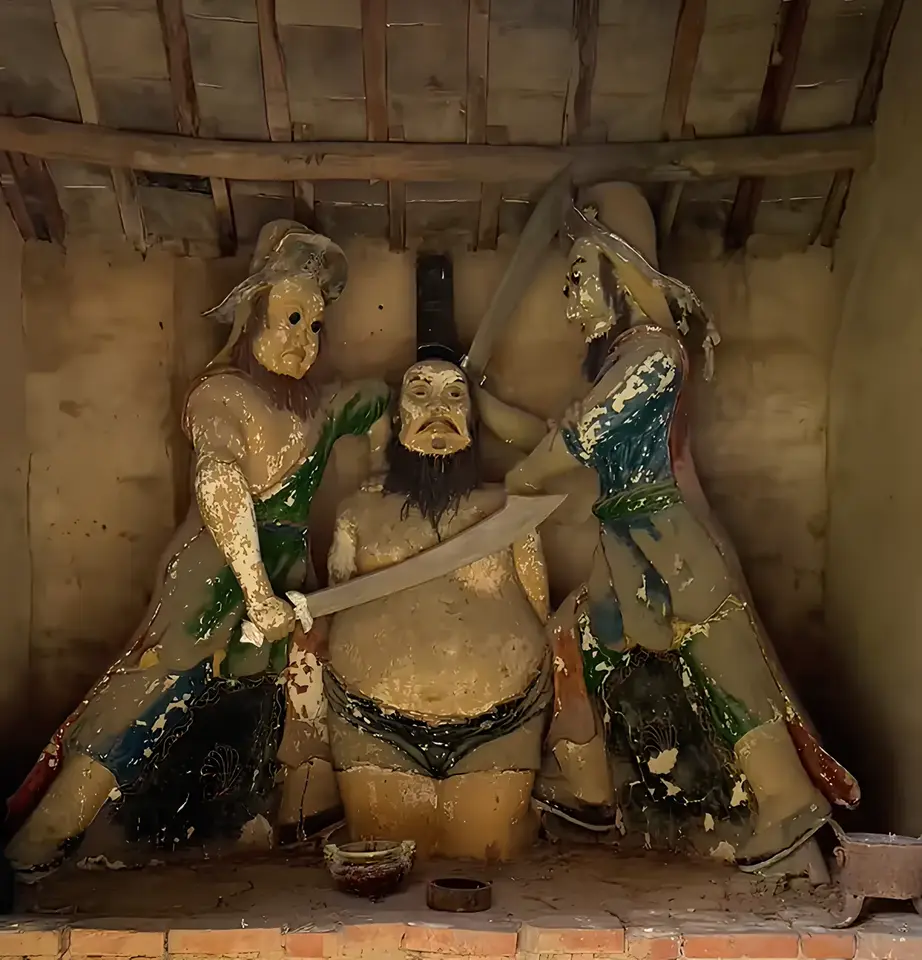
Wang Mang Accepts Imperial Abdication
Wang Mang deposes Ruzi Ying, ascends the imperial throne, proclaims the Xin dynasty, and renames Chang'an to Chang'an.
9 CE–23 CE
新朝
The Xin Dynasty (新朝; 8–23 AD) was a short-lived unified imperial dynasty established by the Western Han imperial in-law Wang Mang, lasting for fifteen years. During the late Western Han period, intensive land annexation, acute social stratification, and the erosion of imperial authority created severe structural crises. Leveraging his moral reputation for filial piety, frugality, and deep mastery of Confucian texts, Wang Mang ascended rapidly under the patronage of Grand Empress Dowager Wang…
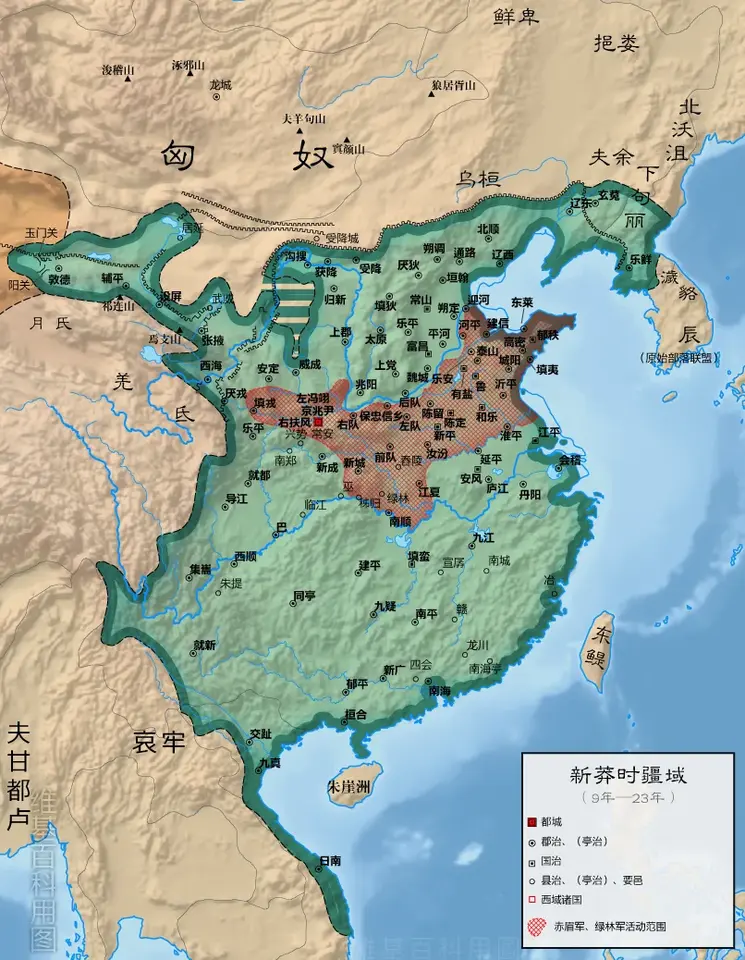
The Xin Dynasty (新朝; 8–23 AD) was a short-lived unified imperial dynasty established by the Western Han imperial in-law Wang Mang, lasting for fifteen years. During the late Western Han period, intensive land annexation, acute social stratification, and the erosion of imperial authority created severe structural crises. Leveraging his moral reputation for filial piety, frugality, and deep mastery of Confucian texts, Wang Mang ascended rapidly under the patronage of Grand Empress Dowager Wang Zhengjun, ultimately serving as Commander-in-Chief (Da Sima) and Duke of Anhan. In December 8 AD, utilizing extensive apocryphal omens and prophecies, Wang Mang accepted the abdication of the child sovereign Ruzi Ying, establishing the Xin dynasty with its capital at Chang'an. Upon ascending the throne, Wang Mang launched a sweeping program of archaic state socialist reforms aimed at recreating the idealized societal blueprint found in the Confucian classic Rites of Zhou. He instituted the Wangtian system to nationalize all agricultural land and outlaw the trade of private slaves, established the Five Equalizations and Six Monopolies to nationalize key industrial sectors and stabilize commodity prices, repeatedly reformed the currency with complex denominations, and unilaterally demoted peripheral foreign rulers, provoking catastrophic border conflicts. These rigid, impractical measures severely exacerbated existing agrarian distress, catalyzing the massive Green Forest and Red Eyebrows peasant insurrections. Following the catastrophic annihilation of the imperial field army at the Battle of Kunyang in 23 AD, insurgent forces breached the capital, culminating in Wang Mang's death and the dynasty's immediate collapse.
Wang Mang deposes Ruzi Ying, ascends the imperial throne, proclaims the Xin dynasty, and renames Chang'an to Chang'an.
The court decrees all agricultural land as state-owned Wangtian, bans slave transactions, and initiates price controls.
Catastrophic flooding inundates the Central Plains, displacing millions and severely exacerbating nationwide famines.
Severe famine in Jingzhou drives Wang Kuang and Wang Feng to assemble agrarian rebels in Mount Lülin, sparking nationwide revolt.
Future Emperor Guangwu Liu Xiu annihilates Wang Yi's 420,000-strong imperial army with elite insurgent cavalry outside Kunyang.
Green Forest Army storm Xuanping Gate; Wang Mang is slain atop the Jiantai terrace in Weiyang Palace.
During the middle and late Western Han dynasty, beginning with Empress Wang Zhengjun's ascension during Emperor Yuan's reign, the consort Wang clan systematically monopolized central political authority. Empress Wang's brothers, including Wang Feng, Wang Yin, Wang Shang, and Wang Gen, successively assumed supreme administrative and military commands as Grand Generals and Commanders-in-Chief, with over ten clan members enfeoffed as imperial marquises. While most aristocratic youths indulged in ostentatious luxury, Wang Mang distinguished himself through rigorous personal austerity, profound Confucian erudition, and exemplary filial conduct.
Having lost his father at an early age, Wang Mang lived in modest circumstances with his widowed mother and sister-in-law. Outside his domestic duties, he immersed himself in the Confucian classics, studying ritual texts under prominent scholars and cultivating friendships with upright literati. When his uncle Wang Feng fell gravely ill, Wang Mang attended him devotedly for months, personally testing medicines and preparing broth without loosening his robes, which deeply moved the Grand General.
In 22 BC, on his deathbed, Wang Feng fervently recommended Wang Mang to Emperor Cheng. The court appointed Wang Mang as Gentleman of the Yellow Gate and later Commandant of Archery. Throughout his official service, Wang Mang remained remarkably humble, redistributing imperial gifts, carriages, and robes to retainers and impoverished scholars while maintaining no personal surplus. His sterling reputation for incorruptibility spread nationwide, rapidly eclipsing the prestige of his elder relatives.
In 16 BC, through the memorials of his uncle Wang Shang and senior ministers, Emperor Cheng enfeoffed Wang Mang as Marquis of Xindu with an estate of one thousand households, concurrently appointing him Cavalry Commandant, Imperial Household Grandee, and Palace Attendant. Stationed at the inner court, he discharged his palace guard duties with meticulous rectitude. In 8 BC, as Commander-in-Chief Wang Gen prepared to retire due to severe illness, he recommended Wang Mang as his successor. Emperor Cheng duly appointed the thirty-eight-year-old Wang Mang as Commander-in-Chief, entrusting him with the empire's supreme military and civil administration.
After serving as Commander-in-Chief for slightly over a year, Emperor Cheng died abruptly, and Emperor Ai ascended the throne. The maternal clans of Emperor Ai—the Fu and Ding families—quickly seized inner court dominance. Consort Dowager Fu demanded honors and court status equal to Grand Empress Dowager Wang Zhengjun. Wang Mang vigorously defended orthodox Han ancestral protocol, even ordering the removal of Consort Fu's seat during an imperial banquet, incurring her fierce enmity.
Recognizing the shift in political fortunes, Wang Mang resigned his post as Commander-in-Chief in 5 BC and retreated to his private fiefdom in Xindu (modern Xinye, Henan), where he closed his gates and lived in strict seclusion. When his second son Wang Huo killed a household servant, Wang Mang severely rebuked him and compelled him to commit suicide to uphold justice, a display of unyielding impartiality that electrified the realm.
During Wang Mang's rural seclusion, hundreds of court dignitaries, scholars, and local magistrates submitted petitions praising his monumental merits and demanding his recall. Under immense public pressure, Emperor Ai recalled Wang Mang to Chang'an in 2 BC with privileged imperial status, though withholding executive administrative power.
In 1 BC, the twenty-five-year-old Emperor Ai died suddenly without an heir, leaving the imperial seal in the hands of his favorite, Dong Xian. Grand Empress Dowager Wang Zhengjun swiftly entered the palace, seized the imperial regalia, and summoned Wang Mang to take charge of state affairs. Wang Mang acted decisively, compelling Dong Xian to commit suicide and securing command of the imperial guard. He was reappointed Commander-in-Chief and director of the imperial secretariat, subsequently installing the nine-year-old Emperor Ping as sovereign.
Following Emperor Ping's enthronement, Wang Mang eliminated remaining rivals from the Ding and Fu clans and purged dissenting officials while promoting venerable Confucian masters such as Kong Guang and Zhen Han. To prevent maternal interference, he barred Emperor Ping's biological mother Lady Wei and her relatives from entering the imperial capital.
In 1 AD, emissaries from Yuechang presented rare white pheasants, prompting courtiers to compare Wang Mang's virtuosic governance to the Duke of Zhou. The Grand Empress Dowager granted Wang Mang the title Duke of Anhan with an additional estate of 28,000 households. Wang Mang ostentatiously declined the territorial revenues, accepting only the honorary title while petitioning for the expansion of public academies and stipends for scholars.
In 3 AD, Wang Mang's eldest daughter was consecrated as Emperor Ping's empress. By 4 AD, over 480,000 officials and commoners submitted petitions requesting supreme honors for Wang Mang, leading the court to bestow the exalted rank of Chancellor-Director (Zaiheng) and the Nine Bestowals. When Emperor Ping died prematurely in 5 AD, Wang Mang bypassed mature imperial princes and selected the infant Ruzi Ying as imperial heir, formally assuming the title of Acting Emperor (Jia Huangdi) and adopting the era name Jushe.
Wang Mang's assumption of imperial prerogatives catalyzed immediate armed resistance from loyalist Han aristocrats. Liu Chong, Marquis of Anzhong, rebelled in Nanyang, while Zhai Yi, Governor of Dong Commandery, raised an army in Puyang. Both uprisings were swiftly suppressed by veteran imperial forces.
Following the suppression of provincial rebellions, auspicious omens and apocryphal prognostications multiplied across the empire. In late 8 AD, literate charlatans presented engraved stones and golden caskets proclaiming that the cosmic mandate of Han had expired and that Heaven had transferred the sovereign imperium to Wang Mang.
In January 9 AD, armed with these prophetic texts, Wang Mang confronted Grand Empress Dowager Wang Zhengjun, demanding the physical transfer of the state seal. Grief-stricken and furious, the Grand Empress Dowager hurled the jade seal onto the palace floor, chipping one corner, which was subsequently repaired with pure gold. Unmoved, Wang Mang ascended the imperial throne at Weiyang Palace, proclaimed the establishment of the Xin dynasty, renamed Chang'an to Chang'an, and adopted the reign title Shijianguo.
Wang Mang's governance was characterized by an unwavering conviction that ancient institutions recorded in the Rites of Zhou offered definitive remedies for contemporary socio-economic ills. He enacted sweeping decrees: private land ownership was abolished under the Wangtian system, slave transactions were forbidden, and five regional price-regulating bureaus were established.
However, the Wangtian system encountered intractable resistance from powerful agrarian magnates and gentry clans, while corrupt local officials used land registration to extort independent freeholders. Facing universal hostility, Wang Mang was forced to rescind the ban on land sales in 12 AD, acknowledging the collapse of his agrarian policy.
Concurrently, disastrous monetary reforms threw urban commerce into complete disarray. In rapid succession, the court issued four distinct currency systems featuring dozens of complex, highly overvalued denominations. Counterfeiting flourished, commodity prices escalated uncontrollably, and urban commerce ceased functioning. Internationally, Wang Mang's unilateral demotion of nomadic titles alienated the Xiongnu and Western Regions city-states, sparking border warfare that required the continuous mobilization of hundreds of thousands of conscript laborers.
Compounding these human errors, severe ecological disasters engulfed northern China. In 11 AD, the Yellow River ruptured its dikes at Yuancheng, inundating vast swaths of the Central Plains. Because ancestral tombs of the Wang clan were located in the flood zone, Wang Mang refused to repair the breaches, fearing disruption of his geomantic fortune. Millions of displaced peasants roamed the countryside facing starvation and pestilence.
By 17 AD, catastrophic famine in the southern province of Jingzhou drove starving peasants to forage for wild roots. Wang Kuang and Wang Feng rallied these desperate refugees in Mount Lülin, establishing the Green Forest army. Concurrently, in Shandong, Fan Chong organized over a hundred agrarian rebels in Mount Tai, painting their eyebrows red to distinguish themselves during combat, thus founding the Red Eyebrows insurrection.
Wang Mang dispatched imperial field armies to suppress the rebels, but the undisciplined imperial troops plundered local populations ruthlessly, driving hundreds of thousands of civilians directly into insurgent ranks. In 22 AD, the Red Eyebrows annihilated an imperial army of 100,000 men at Chengchang, slaying General of Renewal Lian Dan.
In the south, descendants of the Western Han imperial house, including brothers Liu Yan and Liu Xiu, mobilized private retainers at Chunling and merged their forces with the Green Forest coalition. In February 23 AD, Green Forest commanders enthroned imperial scion Liu Xuan as the Gengshi Emperor, establishing an official imperial rival to Xin rule.
Alarmed by the fall of Kunyang and the siege of Wancheng, Wang Mang mobilized his final strategic reserves. In May 23 AD, he appointed Grand Minister of Works Wang Yi and Grand Minister of Education Wang Xun to lead an overwhelming field army of 420,000 veteran troops, accompanied by armored war wagons, exotic predators, and military specialists from sixty-three distinct tactical schools.
Arriving at Kunyang, Wang Yi surrounded the walled city with dense rings of siege towers, undermining walls and launching continuous assaults against a garrison of fewer than 10,000 defenders. Future Emperor Guangwu Liu Xiu broke through the siege lines under cover of darkness with thirteen elite cavalrymen, securing reinforcements from neighboring garrisons.
On July 7, 23 AD, Liu Xiu spearheaded a daring counterattack with 3,000 vanguard shock troops, crossing the Zhi River and assaulting Wang Yi's command encampment. Wang Xun was slain during the initial clash, precipitating mass panic throughout the imperial ranks. Simultaneously, the Kunyang garrison surged outward, trapping the imperial army between two fronts. A violent thunderstorm accompanied by torrential downpours caused the Zhi River to overflow, drowning tens of thousands of fleeing imperial soldiers and obliterating Xin's military core.
The catastrophe at Kunyang shattered the Xin regime's administrative and military control. Across the realm, provincial governors and regional magnates executed Xin magistrates and declared allegiance to the Gengshi regime. In autumn 23 AD, Gengshi armies advanced in two columns: Wang Kuang marched on Luoyang, while Li Song and Shentu Jian advanced through Wu Pass into Guanzhong.
Local gentry and impoverished civilians in the capital region rose in spontaneous rebellion, cutting down Xin officials and welcoming the insurgent forces. On October 4, 23 AD, Li Song's vanguard breached the Xuanping Gate of Chang'an amid raging fires set by sympathetic residents.
Wang Mang and a dwindling circle of senior dignitaries retreated to the Jiantai terrace within Weiyang Palace, completely surrounded by deep defensive waters. On October 6, insurgent soldiers stormed the terrace after arrow supplies were exhausted. Wang Mang was slain by soldier Du Wu, and his head was severed by merchant Gongbin Jiu. The fifteen-year Xin dynasty collapsed amidst fire and sword.
Wang Mang's administrative reforms sought to overhaul Western Han institutions by implementing idealized structures drawn from the Rites of Zhou. He dismantled the traditional Chancellor, Imperial Counsellor, and Grand Commandant system, creating an archaic central cabinet consisting of the Four Aides, Three Excellencies, and Four Generals.
In regional governance, he reorganized the Western Han thirteen inspectorates into twelve classical provinces mentioned in the Book of Documents. Furthermore, driven by apocryphal numerology, he repeatedly altered the administrative designations of over 1,500 commanderies and counties across the empire. This constant renaming created administrative chaos, rendering official records indecipherable and paralyzing provincial administration.
Promulgated in 9 AD, the Wangtian decree represented an ambitious attempt to eradicate agrarian inequality by declaring all arable land to be state-owned property, legally prohibiting private sales. Households with fewer than eight male members possessing land exceeding 900 mou were compelled to redistribute surplus holdings to clan members and neighbors. Concurrently, household slaves were designated as private retainers (sishu) and barred from commercial markets.
However, the policy directly threatened the economic survival of landowning magnates, who mounted widespread passive and active resistance. Simultaneously, predatory local magistrates used land audits to dispossess vulnerable freeholders. Recognizing the complete failure of enforcement, Wang Mang rescinded the ban on land alienation in 12 AD.
To enforce his ideological agenda, Wang Mang instituted an exceptionally severe legal code. Citizens concealing ancient Five-Zhu coins, trafficking in gold, or criticizing imperial policies faced mandatory execution or frontier exile, with collective liability extended to ten neighboring families. As insurrections mounted, secret denunciation networks flourished, and imperial prisons overflowed with hundreds of thousands of convicts condemned to forced labor.
Wang Mang was profoundly obsessed with the cosmological framework of Yin-Yang, the Five Phases, and omen-based apocrypha, elevating them into the supreme foundation for statecraft and imperial decision-making. He established specialized bureaus dedicated to inspecting and manufacturing auspicious signs of Heaven's mandate. Officials and court occultists who fabricated mystical portents were rewarded with noble titles, while candid ministers pointing out governance crises were imprisoned. This superstition-driven political climate compromised regular administrative discipline, turning the imperial court into an echo chamber of flattering occultism while critical state affairs fell into disarray.
To conform with cosmological predictions, Wang Mang launched nationwide renaming campaigns between the Shijianguo and Dihuang eras. Over one hundred commanderies and more than one thousand five hundred counties had their official names altered repeatedly, with some jurisdictions renamed up to five times within several years. Official correspondence became illegible due to shifting administrative nomenclature, causing government dispatches to stall for years. Civic records, tax registers, and land documentation suffered catastrophic dislocation, bringing grassroots imperial administration to a virtual standstill.
While early Xin military organization mirrored Han commandery garrisons and palace guards, Wang Mang subordinated tactical flexibility to apocryphal divination, forcing commanders to consult astrological texts prior to troop movements. The catastrophic defeat at Kunyang stripped the empire of its central professional infantry and elite cavalry, rendering the regime helpless against regional rebellions.
In foreign affairs, Wang Mang's insistence on absolute tributary subordination ruptured decades of peaceful frontier diplomacy. In 9 AD, he forcibly confiscated the official imperial gold seal of Xiongnu Chanyu Wuzhuliu and replaced it with a demoted seal, prompting the Xiongnu to sever relations and devastate northern border garrisons. Similar demotions alienating the Western Regions and southwestern indigenous chieftains triggered multi-front border warfare, exhausting imperial treasuries and military reserves.
In the northeastern frontier, Wang Mang's militaristic decrees similarly provoked devastating border hostilities. In 12 CE, planning an extensive northern offensive against the Xiongnu, Wang Mang forcibly conscripted Goguryeo troops as vanguard expeditionary forces. Unwilling to embark on a distant desert march far from their homeland, Goguryeo soldiers defected and resisted along their routes. Enraged by the defiance, Wang Mang ordered imperial frontier forces to execute defectors and dispatched General Yan You to lure and execute the Goguryeo chieftain Zou, sending his severed head to the capital Chang'an.
Rather than appeasing the regional populace, Wang Mang issued imperial decrees demoting the King of Goguryeo to a degraded noble title, publicizing the humiliation across imperial records. Infuriated by this disgrace, Goguryeo severed all allegiance to the Xin court and launched retaliatory raids against frontier fortifications across Liaodong. Concurrently, northern nomadic Wuhuan confederacies, unable to endure extortion by Xin border officials, defected en masse to the Xiongnu. The northeastern defensive line collapsed entirely, severing central control over the strategic Liaodong corridor.
To repel relentless nomadic incursions, the Xin administration undertook massive fortifications across border commanderies. The court conscripted hundreds of thousands of laborers to garrison beacon towers and mountain passes in frontier outposts such as Yanmen, Wuyuan, and Shuofang. However, border garrisons suffered chronic shortages of grain and military equipment, leading to pervasive demoralization and unrest. Command generals routinely falsified battlefield reports to conceal frontier collapses, blinding the imperial center while border defense systems disintegrated completely.
In 10 AD, the court enacted the Five Equalizations and Six Monopolies (Wujun Liuguan) to establish state control over urban commerce and credit. Five Equalization bureaus were instituted in six commercial metropolises to regulate commodity prices through buffer-stock purchases and provide state credit for ancestral sacrifices and artisanal enterprises. Concurrently, the state monopolized salt production, iron smelting, alcohol distillation, copper coinage, and forestry taxes. In practice, corrupt merchants appointed to manage these bureaus colluded with officials to extort local traders, stifling commercial productivity.
Wang Mang enacted four radical currency reforms that destabilized private commerce. Beginning in 7 AD with the issuance of overvalued knife and disk coins, he subsequently abolished Five-Zhu coinage in 9 AD. In 10 AD, he introduced the bewildering Baohuo system comprising twenty-eight distinct denominations of gold, silver, copper, tortoise shell, and cowrie shells. The rampant inflation and valuation chaos paralyzed retail commerce, forcing the populace to revert to primitive barter using grain and textiles.
In 11 CE, the Yellow River suffered a catastrophic breach at Yuancheng in Wei Commandery, unleashing torrential floodwaters across dozens of commanderies and transforming fertile plains into vast waterlogged wastelands. Because Yuancheng was the ancestral seat of Wang Mang's lineage, the emperor feared that repairing the breaches or constructing dikes would disrupt the geomantic harmony of his ancestral tombs. Consequently, the imperial government forbade local authorities from sealing the breach, leaving the river uncontained for decades. Millions of farming households were displaced, devastating the agricultural backbone of the Central Plains.
Amid recurring natural calamities, Wang Mang enforced unprecedentedly harsh taxation and fiscal requisitions. The state reinstituted an agrarian tithe while imposing a ten percent commercial levy on artisans, merchants, silk weavers, fishermen, and itinerant practitioners. Household sericulture and land reclamation were strictly audited, with non-compliant families condemned to penal servitude. Onerous taxation combined with ceaseless military conscription drove bankrupt yeomen into vagrancy, ultimately fueling massive peasant uprisings including the Greenwood and Red Eyebrows insurgencies.
Under Wang Mang's patronage, Old Text Confucianism achieved unprecedented institutional dominance. Rejecting the esoteric New Text school, the court established imperial chairs for the Rites of Zhou, Zuo Zhuan, and Mao Shi, appointing master scholar Liu Xin as State Preceptor. In 4 AD, the imperial academy in Chang'an was expanded to accommodate over 10,000 students, establishing monumental ceremonial structures including the Biyong, Bright Hall, and Lingtai observatory.
Imperial political legitimacy rested upon a synthesized theology of apocryphal prophecies (chenwei) and the cyclical Five Elements doctrine. Wang Mang utilized hundreds of manufactured omens, including white pheasants and inscribed stone tablets, to substantiate his heavenly mandate. However, recurrent environmental catastrophes were interpreted by rebels as incontrovertible signs of Heaven's displeasure, turning the regime's theological foundation into an instrument of its delegitimation.
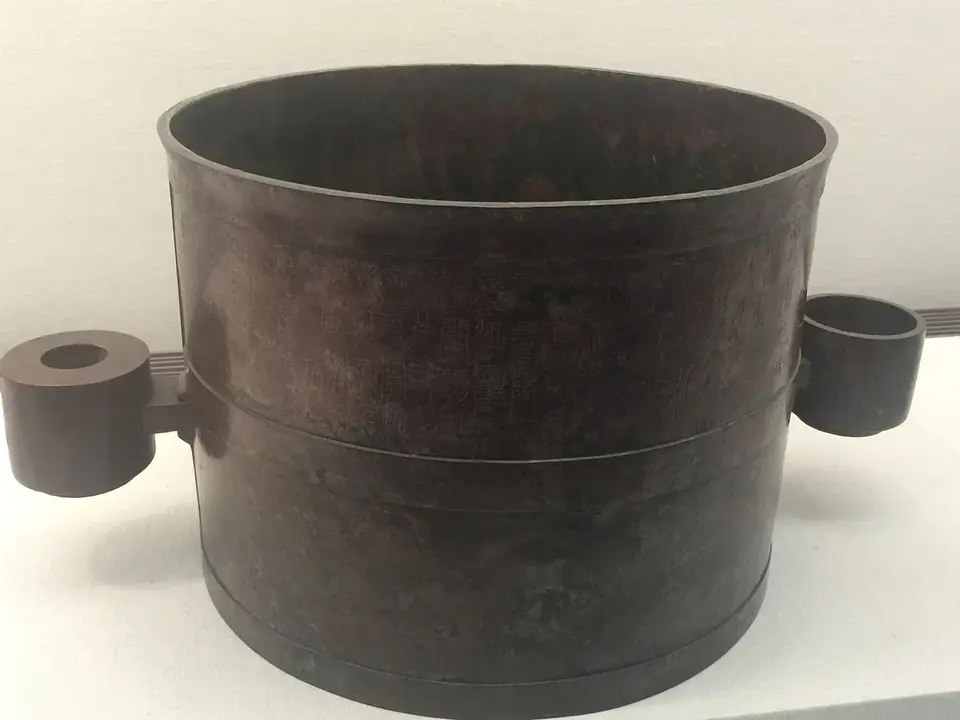
Despite political turbulence, the Xin period fostered significant technological advancements. Master scholar Liu Xin standardized imperial metrology by designing the bronze Jialiang vessel, integrating five standard volume units into a single calibrated instrument. Furthermore, the excavated Xin bronze caliper demonstrated an adjustable vernier design preceding European equivalents by sixteen centuries. In mechanical experimentation, the court sponsored early human gliding trials in Chang'an, recording aviators attempting flight using feathered wings.
The Xin period witnessed notable academic advancements in the fields of philology, linguistics, and lexicography. Leading scholars such as Liu Xin and Yang Xiong played pivotal roles in court compilation projects. Yang Xiong devoted decades to collecting regional dialect terms across the realm, ultimately compiling the renowned linguistic treatise Fangyan, which systematically recorded and annotated regional vocabularies from the late Western Han to the Xin era, laying the foundation for historical linguistic geography in imperial China.
Simultaneously, Yang Xiong composed the Xunzhuan Pian, modeling it after ancient lexicographical traditions to standardize official script orthography. The elegant suspended needle seal script utilized on Xin coinage and standard measuring vessels reflected both reverence for classical calligraphy and dynamic typographic innovation, exerting a lasting conceptual influence on later philologists such as Xu Shen in compiling the seminal dictionary Shuowen Jiezi.
Traditional Chinese historiography, exemplified by Ban Gu's Book of Han, condemned Wang Mang as an exemplar of tyrannical usurpers whose fanatical adherence to archaic models destroyed public welfare. Sima Qian's commentators and Song dynasty historian Sima Guang similarly analyzed his reign as a cautionary example of doctrinaire moralism detached from political reality.
In twentieth-century scholarship, historians such as Hu Shih reinterpreted Wang Mang as an early state socialist who anticipated planned economic intervention and land redistribution. Contemporary analyses view his administration as an ambitious yet structurally flawed attempt by the Han bureaucratic elite to resolve systemic socioeconomic crises through ancient institutional precedents that contradicted contemporary economic developments.
Thirtieth Monarch of Silla
Kim Beopmin (金法敏, 626–681 AD), posthumously revered as King Munmu of Silla (新罗文武王), was the thirtieth monarch of Silla and the unifier of the southern and central Korean Peninsula. The eldest son of King Muyeol (Kim Chunchu) and nephew of General Kim Yusin, he was motivated in his youth by the fall of Daeya Fortress to avenge his sister's death by subjugating Baekje. Traveling to Chang'an, he forged a military alliance with the Tang dynasty. In 660 AD, he coordinated naval operations with Tang general Su Dingfang to destroy Baekje. Ascending the throne in 661 AD, he defeated Baekje restoration armies and Yamato fleets at the Battle of Baekgang, subsequently partnering with Tang commander Li Ji to capture Pyongyang and overthrow Goguryeo in 668 AD. Opposing Tang plans to establish direct imperial rule over the peninsula, Munmu fought the Silla-Tang War from 670 to 676 AD, repelling Tang forces at Maesoseong and Gibeolpo before renewing tributary diplomacy with Tang, establishing Unified Silla south of the Taedong River. On his deathbed in 681 AD, he requested cremation and underwater burial at Daewangam in the East Sea, vowing to transform into a sea dragon to guard Silla from piracy.
 Xin Dynasty (新朝)
Twenty-Seventh Monarch of Silla (First Reigning Queen)
Queen Seondeok (金德曼) (c. 606–647), personal name Kim Deokman, was the twenty-seventh monarch of the Silla kingdom and the first reigning queen in Korean history, governing for sixteen years from 632 to 647. She was the eldest daughter of King Jinpyeong and belonged to the elite "Sacred Bone" (Seonggol) aristocratic caste. Ascending the throne in 632 due to the absence of direct male royal heirs, Queen Seondeok displayed profound administrative benevolence, political prescience, and acute strategic judgment. During her reign, Silla was confronted by an existential military crisis as King Uija of Baekje and the militarist Generalissimo Yeon Gaesomun of Goguryeo formed an offensive alliance to partition Silla and sever its maritime communications with China. Following the catastrophic fall of the frontier stronghold Daeya Castle in 642, Queen Seondeok instituted the defining grand strategy of early Korean history: forging an iron military alliance with Tang China while executing comprehensive institutional Sinicization. In 635, Emperor Taizong of Tang formally invested her as Pillar of State and King of Lelang Commandery. Partnering with her diplomatic nephew Kim Chunchu (the future King Muyeol) and her military commander Kim Yu-sin, she sent auxiliary troops to support Emperor Taizong's campaigns against Goguryeo in 645. Domestically, she erected Cheomseongdae (the oldest surviving astronomical observatory in Asia) and constructed the monumental nine-story wooden pagoda at Hwangnyongsa to inspire national resilience. In early 647, shortly after crushing an aristocratic rebellion led by the nobleman Bidam, Queen Seondeok passed away, bequeathing a stable, Tang-allied state that culminated in the unification of the Three Kingdoms.
Founding general
Ma Yuan (马援, 14 BCE – 49 CE), courtesy name Wenyuan, was an eminent founding general and military strategist of the Eastern Han Dynasty from Maoling in Youfufeng. A descendant of the renowned Warring States general Zhao She (Lord of Mafu), Ma Yuan initially engaged in border livestock grazing, formulating his celebrated maxim that a true gentleman should become firmer in adversity and more heroic in old age. During the chaotic interregnum between the Xin and Han dynasties, he served the western warlord Kui Xiao, saw through the pretenses of Gongsun Shu in Sichuan, and formally allied with Emperor Guangwu (Liu Xiu) in Luoyang. During the suppression of Kui Xiao, Ma Yuan pioneered the three-dimensional terrain sand table by heaping rice on the imperial table to illustrate topographic choke points, leading Han forces to a crushing victory. As Grand Administrator of Longxi for six years, he pacified and integrated the Qiang tribes through combined military fortitude and enlightened civil works. Appointed General of the Wave-Quelling, he mounted a maritime expedition to suppress the rebellion of the Trưng sisters in Jiaozhi, erected the frontier Bronze Pillars, and was enfeoffed as Marquis of Xinxi. Returning to the capital, he famously proclaimed that a soldier should die on the frontier and be buried wrapped in horsehide. At the age of sixty-two, he volunteered to lead forty thousand troops against the Wuling indigenous insurgents, perishing of camp pestilence at Mount Hutou. Despite posthumous slander by imperial son-in-law Liang Song, his marquisate and honor were fully exonerated under Emperor Zhang with the posthumous title Zhongcheng.
 Western Han, Xin Dynasty
Imperial kinsman of the Western Han (fifth-generation descendant of King Yuan of Chu)
Liu Xin (刘歆, ?–23 CE), courtesy name Zijun, later renamed Liu Xiu (字颖叔), was a native of Pengcheng, Chu State, whose family had resided in Chang'an for generations. He was a fifth-generation descendant of Liu Jiao (King Yuan of Chu, younger brother of Emperor Gaozu of Han) and the son of the renowned imperial scholar Liu Xiang. Liu Xin was an epochal classical scholar, bibliographic systematizer, astronomer, and mathematician of the late Western Han and Xin dynasties, revered as the foundational architect of the Old Text (Guwen) classical school. In 26 BCE, Liu Xin was commissioned by Emperor Cheng of Han to assist his father Liu Xiang in the comprehensive collation of imperial archives in the secret palace repositories. Following Liu Xiang's death, Liu Xin succeeded him as Colonel of the Central Ramparts, synthesizing decades of archival collation into the monumental seven-volume Qi Lue (Seven Summaries)—China's earliest comprehensive classified bibliographic catalog. The work established the definitive categories and methodology for Chinese descriptive bibliography and classical philology, and was adopted in its entirety by Ban Gu as the foundation for the Treatise on Literature (Yiwen Zhi) in the Book of Han. In classical studies, Liu Xin challenged the institutional monopoly of the New Text (Jinwen) school, submitting a famous memorial urging the court to establish academic chairs for the Old Text canons, including the Zuo Zhuan, Mao Shi, Yi Li, and Old Text Book of Documents, precipitating the profound two-thousand-year Old Text versus New Text intellectual debate. During the Xin Dynasty, Wang Mang, who had long cultivated Liu Xin's patronage, appointed him State Master and enfeoffed him as the Duke of Jiaxin. Liu Xin formulated institutional rituals, standardized weights and measures (including the celebrated "Xin Mang Standard Measure"), and devised the mathematically sophisticated San Tong Li (Triple Concordance Calendar), computing an accurate approximation of pi (3.1547). However, as Wang Mang's radical reforms collapsed into social chaos and three of Liu Xin's sons were executed during political purges, Liu Xin conspired in 23 CE with General Wang She and Grand Marshall Dong Zhong to stage a coup against Wang Mang. When the plot was betrayed, Liu Xin committed suicide in his residence. His classical scholarship and bibliographic methodology laid the bedrock for traditional Chinese evidentiary scholarship through the Qing dynasty.
Tuogu Gaizhi (托古改制, institutional reform under the guise of antiquity; also known as Wang Mang's Reforms) was a sweeping top-down socio-economic and political reorganization launched from 9 to 23 CE by Emperor Wang Mang of the Xin Dynasty, using the Confucian classic *Rites of Zhou* (*Zhouli*) as its ideological blueprint. In the late Western Han period, monopolistic land enclosure by powerful clans had dispossessed millions of smallholders, creating a severe crisis of landlessness, debt slavery, and peasant revolts. After seizing the imperial throne through apocalyptic prophecy and abdication rituals, Wang Mang sought to eradicate systemic ills by thoroughly restoring the idealized institutional order of the Western Zhou. The reform enacted the "King's Field System" (*Wangtian*), nationalizing all agricultural land and prohibiting land sales, while converting private slaves into non-tradable "private dependents" (*sisu*). Wang Mang also created the "Five Equalizations" to stabilize commodity prices, instituted the "Six Controls" to monopolize profitable industries such as salt, iron, alcohol, and minting, and restructured the monetary system four times within eight years. However, these rigid measures alienated powerful landed magnates, impoverished commoners through predatory currency devaluation, and paralyzed imperial administration with incessant renaming of official titles and geographical jurisdictions. In 23 CE, insurgent armies stormed Chang'an and killed Wang Mang, bringing the revivalist experiment to a disastrous conclusion.
全国(以常安为中心,涵盖中原、关中、江淮、齐鲁等郡县)
The Establishment of the Gengshi Regime in the Dihuang Era of Xin (新莽地皇建立更始政权) was a transformative historical event in 23 (the 4th year of Wang Mang's Dihuang era) during which the Green Forest rebels and the Han imperial clan overthrew the Xin Dynasty and re-established Han dynastic authority. Wang Mang's retrogressive institutional reforms, compound currency debasements, and the catastrophic flooding of the Yellow River sparked widespread agrarian unrest across northern China. In 22, the Chongling forces under Han clansmen Liu Yan and Liu Xiu merged with the Green Forest rebel branches. Following decisive victories across Nanyang, the allied commanders sought to legitimize their cause under a single emperor. Apprehensive of Liu Yan's commanding prestige, Green Forest generals Wang Kuang and Zhu Wei insisted on crowning the submissive clansman Liu Xuan. In March 23 (Dihuang 4), Liu Xuan ascended the imperial throne on the shores of the Yu River, proclaiming the Gengshi reign of the revived Han (termed Xuanhan by historians). In June, imperial general Liu Xiu scored an overwhelming victory against Wang Mang's 420,000-strong army at the Battle of Kunyang. By October, insurgent divisions captured Chang'an and executed Wang Mang, dissolving the Xin Dynasty. However, the regime fell into factional fratricide, murdered Liu Yan, and succumbed to internal rot, collapsing within two years before the Chimei (Red Eyebrows) army. The Gengshi regime served as an indispensable transition that eradicated the Xin Dynasty and enabled Liu Xiu's foundation of the Eastern Han.
Shores of the Yu River (modern Nanyang, Henan), Wancheng (Nanyang, Henan), Luoyang, Chang'an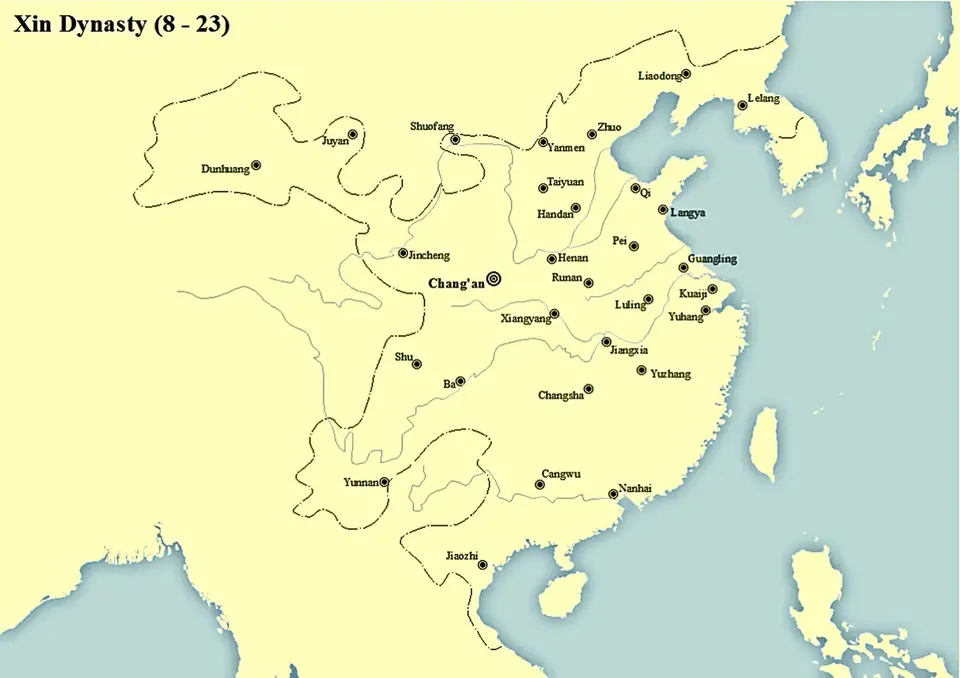
The Reform of the King's Fields Land System in the Dihuang Era of Xin (新莽地皇改革土地王田制) was a radical state land nationalization policy enacted by the Xin Dynasty emperor Wang Mang to address rampant land consolidation and peasant pauperization by imitating the well-field system of the *Rites of Zhou*. In the late Western Han, unrestrained estate annexation concentrated wealth in aristocratic hands, leaving impoverished tenants destitute. In 9 CE (the inaugural year of Shijianguo), Wang Mang proclaimed the King's Fields system (*Wangtian*), nationalizing all arable lands and outlawing the private purchase or sale of land and bondservants, who were re-designated as "private dependents" (*sishu*). The state capped household holdings at nine hundred mou for families with fewer than eight males, requiring excess land to be surrendered to clan neighbors while guaranteeing one hundred mou per peasant couple under pain of exile. However, this policy collided directly with centuries of entrenched private property relations, provoking fierce defiance from powerful gentry and corrupt bureaucratic sabotage. Within three years, thousands were condemned to border exile while rural economies collapsed. In 12 CE, Wang Mang was compelled to rescind the transaction ban, and during the Dihuang era, widespread famines and peasant insurrections abolished the system entirely. This utopian reform isolated the regime from all social strata, dramatically accelerating the collapse of the Xin Dynasty.
Throughout the Xin Dynasty (Centralized in Chang'an and Central Plains agricultural zones)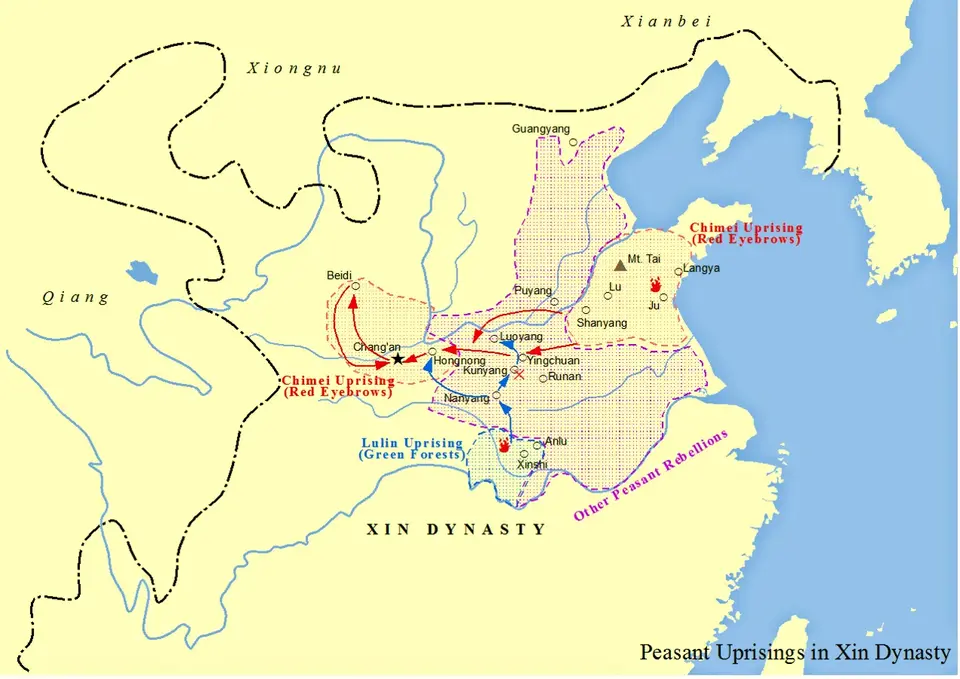
The Peasant Wars at the End of the Xin Dynasty (新莽末年农民战争) were a monumental ten-year popular revolutionary conflict spanning from 17 to 27 CE that overthrew Wang Mang's Xin Dynasty and enabled the founding of the Eastern Han, led by the twin insurgent forces of the Green Forest (*Lulin*) and Red Eyebrows (*Chimei*). In the late Western Han, severe land concentration sparked deep systemic unrest. Wang Mang's radical reforms—nationalizing land under the King's Fields, imposing state trade monopolies, and altering currencies—devastated commerce, while major dyke breaches along the Yellow River submerged entire commanderies under catastrophic floods and famine. In 17 CE, Wang Kuang and Wang Feng rallied starving refugees in the Green Forest Mountains of Hubei, while in 18 CE, Fan Chong launched the Red Eyebrows rebellion in Shandong. In 22 CE, Han imperial clansmen Liu Yan and Liu Xiu raised the Chongling forces in Nanyang and merged with the Green Forest army, enthroning Liu Xuan as Emperor Gengshi in 23 CE. In June 23, Liu Xiu scored a decisive tactical triumph at the Battle of Kunyang, annihilating Wang Mang's 420,000-strong army; by October, rebel troops breached Chang'an and executed Wang Mang, dissolving the Xin Dynasty. Subsequently, the Red Eyebrows marched west, capturing Chang'an and terminating the degenerate Gengshi regime. Ascending the throne in Hebei, Liu Xiu founded the Eastern Han Dynasty, eventually encircling and accepting the surrender of the Red Eyebrows at Yiyang in 27 CE. This protracted peasant war eradicated Wang Mang's regime, restrained feudal servitude, and inaugurated two centuries of Eastern Han rule.
Green Forest Mountains (Hubei), Juxian (Shandong), Kunyang, Luoyang, Chang'an, Yiyang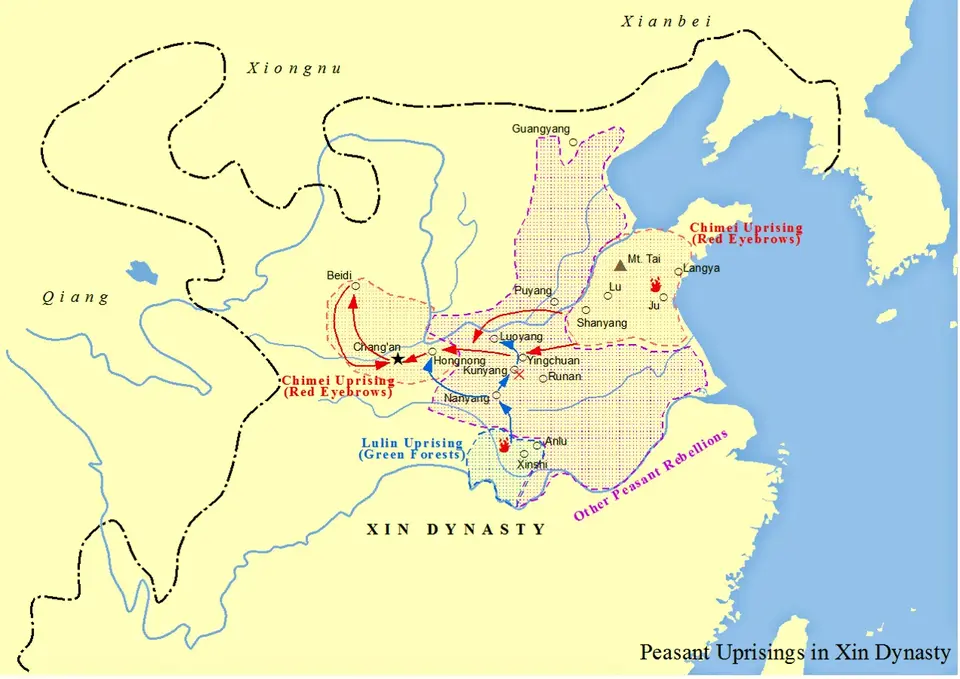
The Battle of Kunyang (昆阳之战) was a climactic military engagement in 23 CE (the 4th year of Wang Mang's Dihuang era / 1st year of Gengshi) in which rebel forces of the revived Han Dynasty annihilated the main grand army of the Xin Dynasty at Kunyang (modern Yexian, Henan), standing as one of the most celebrated asymmetric victories in ancient military history. Following the enthronement of Emperor Gengshi in Nanyang, insurgent columns captured Kunyang and neighboring strongholds, imperiling Luoyang and Chang'an. In response, Wang Mang appointed Grand Minister of Works Wang Yi and Grand Minister of Education Wang Xun to lead 420,000 imperial troops to crush the rebellion. Encircled by overwhelming forces, the eight-thousand-man garrison at Kunyang fell into panic. General Liu Xiu persuaded commanders to hold firm, staging an audacious nocturnal breakout with thirteen horsemen to rally reinforcements from Dingling and Yanxian. In July 23, Liu Xiu spearheaded an elite shock force of three thousand warriors across the Zhi River, striking directly into the enemy command post and slaying Wang Xun. Assisted by sudden torrential rainstorms, hurricane winds, and flash floods along the Zhi River, the garrison sallied out, routing the vast imperial host into catastrophic stampedes. The triumph at Kunyang destroyed Wang Mang's military foundation, precipitating the fall of the Xin Dynasty and establishing the martial prestige of Liu Xiu.
Kunyang Fortress and Zhi River Basin (modern Yexian, Henan)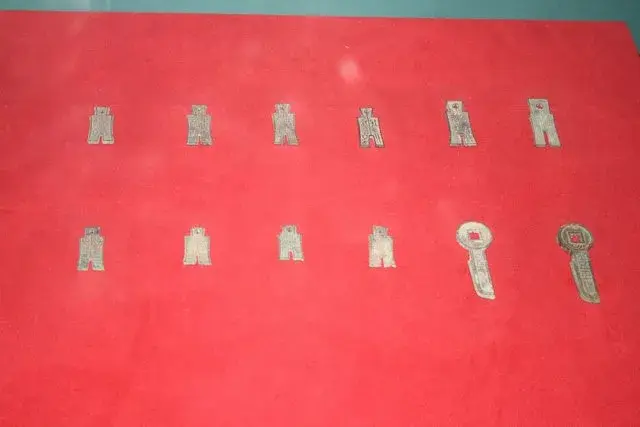
The event in which Wang Mang Replaces Han to Found the Xin Dynasty (王莽代汉建国) occurred in late 8 to early 9 CE (Jushe 3 to Shijianguo 1), marking a seminal peaceful dynastic transition in Chinese imperial history. During the late Western Han, monopolistic land accumulation, rural impoverishment, and administrative corruption provoked severe social instability. Concurrently, Confucian apocrypha and the Five Elements cosmological doctrine fostered a widespread intellectual consensus that the dynastic destiny of the Han was exhausted and that a new sage-ruler was destined to emerge. Rising through the preeminent consort clan while maintaining a reputation for austere personal virtue, classical scholarship, and philanthropy, Wang Mang came to be venerated across the empire as a reincarnation of the Duke of Zhou. After serving as regent and Acting Emperor (She Huangdi), Wang Mang orchestrated a nationwide campaign of manufactured celestial portents and dynastic omens. In the winter of 8 CE, a scholar named Ai Zhang submitted an alleged prophetic casket containing imperial mandates from Emperor Gaozu of Han, proclaiming that the Mandate of Heaven had formally passed to Wang Mang. Wang Mang formally accepted the mandate, entered the Han ancestral temple, reclaimed the Heirloom Seal of the Realm from Grand Empress Dowager Wang Zhengjun, and received the abdication of the infant sovereign Ruzi Ying. In the first month of 9 CE, Wang Mang ascended the imperial throne at the Weiyang Palace in Chang'an, promulgating the dynastic title "Xin" (New) and the reign era "Shijianguo" (Beginning of the State's Establishment), thereby inaugurating an unprecedented era of archaizing statecraft.
Chang'an (modern Xi'an, Shaanxi)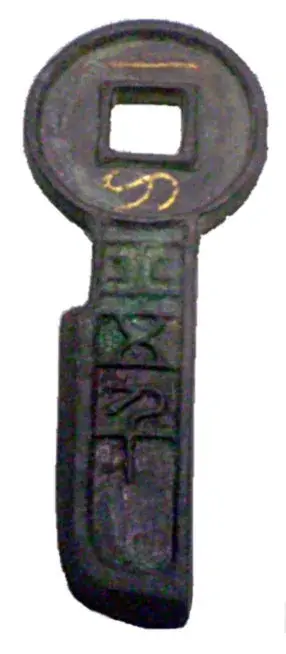
Wang Mang's Monetary Reforms and the Five Levelings and Six Controls (王莽更制货币与五均六筦) represented a sweeping state monopoly and economic control program implemented throughout the Xin dynasty between 7 and 23 CE (Jushe 2 to Dihuang 4). Following his seizure of power and the subsequent establishment of the Xin dynasty, Wang Mang sought to resolve deepening imperial fiscal crises and realize the classical Confucian socioeconomic ideals described in the *Rites of Zhou*. Through mandatory administrative fiat, his administration intervened extensively in commodity distribution, commodity price regulation, credit lending, and the exploitation of natural resources to suppress private merchant cartels. In the monetary sphere, Wang Mang implemented four radical, successive currency upheavals: introducing fiat nominal currencies like the Daqian Wushi, Qidao, and Cuodao in 7 CE; replacing the standardized five-zhu coin with the convoluted Twenty-Eight Precious Currencies system in 10 CE; and finally introducing Huobu and Huoquan in 14 CE. The resulting debasements and arbitrary exchanges shattered commercial confidence and brought markets to a standstill. Concurrently, the Five Levelings and Six Controls policy established price-regulation directors in six major commercial metropolises, created state lending bureaus, and monopolized salt, iron, liquor, coinage, and natural resource taxes. Placed in the hands of merchant-bureaucrats, these policies degenerated into predatory extortion, precipitating nationwide hyperinflation, widespread bankruptcy, and the eventual downfall of the Xin regime.
Chang'an (modern Xi'an, Shaanxi), Luoyang, Linzi, Wan, Handan, Chengdu, and commandery market centers