Green Forest Uprising
Wang Kuang and Wang Feng raise an insurgent banner in the Green Forest Mountains of Hubei.
Xin Dynasty (新朝) · HISTORICAL EVENT
新莽末年农民战争
The Peasant Wars at the End of the Xin Dynasty (新莽末年农民战争) were a monumental ten-year popular revolutionary conflict spanning from 17 to 27 CE that overthrew Wang Mang's Xin Dynasty and enabled the founding of the Eastern Han, led by the twin insurgent forces of the Green Forest (Lulin) and Red Eyebrows (Chimei). In the late Western Han, severe land concentration sparked deep systemic unrest. Wang Mang's radical reforms—nationalizing land under the…
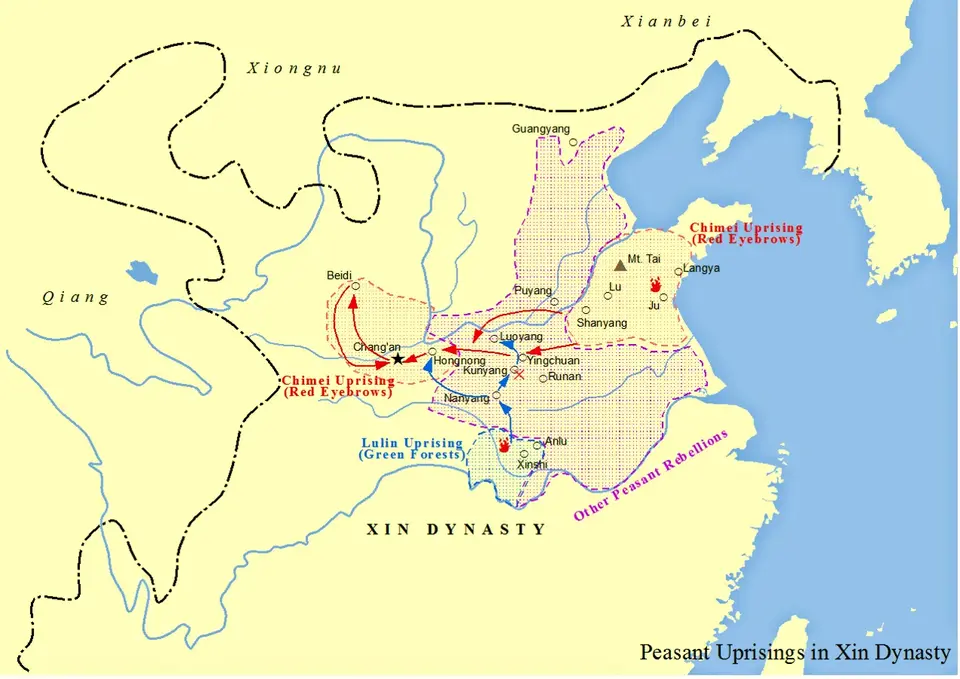
The Peasant Wars at the End of the Xin Dynasty (新莽末年农民战争) were a monumental ten-year popular revolutionary conflict spanning from 17 to 27 CE that overthrew Wang Mang's Xin Dynasty and enabled the founding of the Eastern Han, led by the twin insurgent forces of the Green Forest (Lulin) and Red Eyebrows (Chimei). In the late Western Han, severe land concentration sparked deep systemic unrest. Wang Mang's radical reforms—nationalizing land under the King's Fields, imposing state trade monopolies, and altering currencies—devastated commerce, while major dyke breaches along the Yellow River submerged entire commanderies under catastrophic floods and famine. In 17 CE, Wang Kuang and Wang Feng rallied starving refugees in the Green Forest Mountains of Hubei, while in 18 CE, Fan Chong launched the Red Eyebrows rebellion in Shandong. In 22 CE, Han imperial clansmen Liu Yan and Liu Xiu raised the Chongling forces in Nanyang and merged with the Green Forest army, enthroning Liu Xuan as Emperor Gengshi in 23 CE. In June 23, Liu Xiu scored a decisive tactical triumph at the Battle of Kunyang, annihilating Wang Mang's 420,000-strong army; by October, rebel troops breached Chang'an and executed Wang Mang, dissolving the Xin Dynasty. Subsequently, the Red Eyebrows marched west, capturing Chang'an and terminating the degenerate Gengshi regime. Ascending the throne in Hebei, Liu Xiu founded the Eastern Han Dynasty, eventually encircling and accepting the surrender of the Red Eyebrows at Yiyang in 27 CE. This protracted peasant war eradicated Wang Mang's regime, restrained feudal servitude, and inaugurated two centuries of Eastern Han rule.
Wang Kuang and Wang Feng raise an insurgent banner in the Green Forest Mountains of Hubei.
Fan Chong initiates guerrilla attacks in Shandong, painting his soldiers' eyebrows red.
The Green Forest army annihilates a twenty-thousand-man provincial expeditionary force.
The Red Eyebrows obliterate a one-hundred-thousand-strong imperial army, slaying General Lian Dan.
Liu Yan and Liu Xiu raise peasant troops in Chongling, allying with Green Forest branches.
Green Forest generals crown Liu Xuan as Emperor Gengshi along the shores of the Yu River.
Liu Xiu leads vanguard shock troops to destroy Wang Mang's 420,000-man grand army.
Rebel forces storm Chang'an and execute Wang Mang on the Jiantai, ending the Xin Dynasty.
Liu Xiu ascends the throne as Emperor Guangwu in Hebei, while the Red Eyebrows crown Liu Penzi.
The Red Eyebrows capture Chang'an and execute Liu Xuan, extinguishing the Xuanhan regime.
Imperial Han forces surround the starving Red Eyebrows at Yiyang, concluding the ten-year peasant wars.
During the reigns of Western Han emperors Yuan, Cheng, and Ai, imperial consort cliques and great merchant families monopolized fertile agricultural lands, driving hundreds of thousands of independent smallholders into debt peonage and agricultural tenancy. In 8 CE, high-ranking official Wang Mang usurped the Han throne and founded the Xin Dynasty, attempting to remedy this polarization through dogmatic Confucian social engineering modeled on the ancient Rites of Zhou.
Wang Mang enacted the King's Fields decree to nationalize land and prohibit slave trade, established the Five Equalizations and Six Monopolies to cartelize liquor, salt, and metallurgy under state bureaus, and issued four volatile currency reforms that wiped out private capital. Defying natural economic laws, these policies bankrupted agrarian smallholders, crippled artisan commerce, and antagonized both regional gentry and destitute tenant peasants, alienating all sectors of the empire.
Administrative mismanagement was exacerbated by unprecedented environmental catastrophes. In the Tianfeng era, the Yellow River breached its dikes in Weijun Commandery, permanently shifting course and submerging dozens of commanderies across the North China Plain under massive floodwaters. Millions of displaced refugees were cast onto the roads without food or shelter.
A protracted regional drought accompanied by swarms of locusts followed, consuming vegetation and driving desperate populations in the north and central valleys to widespread starvation. Instead of opening state granaries for relief, regional officials enforced tax collection and imposed draconian criminal penalties, sentencing tens of thousands to penal bondage. Facing imminent death by starvation or judicial execution, desperate peasants organized armed bands, igniting the nationwide peasant conflagration.
In 17 CE (Tianfeng 4), severe famine devastated southern Henan and northern Hubei. Hundreds of starving peasants scavenging for wild water chestnuts in marshlands frequently fought over meager food scraps. Local leaders Wang Kuang and Wang Feng mediated these disputes, earning popular trust. They gathered hundreds of impoverished peasants in the Green Forest Mountains (modern Dahong Mountains, Hubei), constructing fortified mountain redoubts to repel county constables.
Within months, thousands of runaway peasants joined the stronghold. Wang Kuang dispatched mobile raiding columns against surrounding government storehouses to redistribute captured grain. In 21 CE, Wang Mang deployed a provincial army of twenty thousand troops to exterminate the base. Wang Kuang and Wang Feng ambushed the Xin column at Yundu, annihilating the vanguard and capturing regional county seats, expanding their forces to over fifty thousand combatants.
In 22 CE, an epidemic struck the mountain base, killing nearly half the rebels. The leaders divided their forces: Wang Chang and Cheng Dan led the Xiajiang column westward into Nan Commandery, while Wang Kuang, Wang Feng, and Zhu Wei led the Xinshi column northward into Nanyang. Concurrently, Chen Mu organized the Pinglin column in Sui County, surrounding the fertile Nanyang basin with three synchronized rebel forces.
Simultaneously, a massive peasant uprising erupted across Shandong and Jiangsu. In 18 CE (Tianfeng 5), severe drought gripped Juxian, prompting Fan Chong to organize several hundred starving farmers in the foothills of Mount Tai, waging guerrilla strikes against local tax offices.
As other regional chieftains—Pang An, Xu Xuan, Xie Lu, and Yang Yin—merged with Fan Chong, the insurgent army expanded to over one hundred thousand men. In 22 CE, Wang Mang dispatched Grand Preceptor Wang Kuang and General Lian Dan at the head of one hundred thousand imperial soldiers to suppress the eastern rebellion. To prevent chaotic fratricide against corrupt imperial soldiers disguised as commoners, Fan Chong ordered all his men to paint their eyebrows bright red with vermilion, christening the legendary Red Eyebrows (Chimei).
The opposing armies fought a pitched battle at Chengcang (modern Dongping, Shandong). The Red Eyebrows routed the imperial host, slaying General Lian Dan while Grand Preceptor Wang Kuang fled in disgrace. The Red Eyebrows swept across the Central Plains, expanding past three hundred thousand combatants and becoming the most formidable military force in northern China.
In late 22 CE, Han imperial descendants Liu Yan and Liu Xiu initiated the Chongling uprising in southern Henan, forging alliances with local Nanyang scholar-gentry. Recognizing that family levies could not overcome imperial armies, Liu Yan concluded a military coalition with the Xinshi, Pinglin, and Xiajiang divisions of the Green Forest army.
The allied insurgents won sweeping victories at Cishui and Tangzixiang, capturing stores of grain and siege weaponry before investing the commandery capital at Wancheng. To consolidate diplomatic legitimacy, Green Forest commanders enthroned imperial descendant Liu Xuan as Emperor Gengshi in March 23 CE along the shores of the Yu River, restoring the Han dynastic banner and founding the Xuanhan regime.
The news of Liu Xuan's enthronement prompted Wang Mang to mount an all-out counter-offensive. In May 23, Wang Mang mobilized 420,000 elite troops under Grand Minister of Works Wang Yi and Grand Minister of Education Wang Xun, advancing with war beasts to crush the rebels at Kunyang (modern Yexian, Henan).
General Liu Xiu organized an audacious nocturnal breakout with thirteen horsemen, rallying thousands of regional reinforcements. Heading three thousand elite shock cavalry, Liu Xiu spearheaded a devastating river assault against the command tents of Wang Xun and Wang Yi. As battle raged, a colossal thunderstorm provoked sudden flash floods along the Zhi River, causing panic across the vast imperial army. Kunyang's defenders sallied from the gates, annihilating the imperial host. Wang Xun was slain, and Wang Yi fled in ruins.
The victory at Kunyang triggered the collapse of Xin provincial authority. In September 23, insurgent divisions forced Wu Pass and stormed Chang'an, while urban citizens torched the Weiyang Palace. Wang Mang retreated to the Jiantai terrace, where he was slain on October 6, terminating the fifteen-year Xin Dynasty.
Following Wang Mang's demise, Emperor Gengshi relocated the court to Chang'an. However, the regime deteriorated into debauchery and factional purges, executing military leader Liu Yan and permitting warlords to plunder the capital.
Concurrently, the three-hundred-thousand-strong Red Eyebrows army faced starvation in eastern provinces and marched westward into Guanzhong. In June 25, the Red Eyebrows enthroned adolescent shepherd Liu Penzi as emperor in Huayin, declaring war on the Gengshi court. In October 25, the Red Eyebrows breached Chang'an, forcing Liu Xuan's surrender and later strangling him, dissolving the Gengshi regime.
As Chang'an fell into ruin, Liu Xiu pacified Hebei, winning over regional gentry and absorbing the peasant Tongma armies. In July 25, Liu Xiu ascended the throne at Gaocheng, adopting the reign title Jianwu and establishing the Eastern Han Dynasty.
In Chang'an, severe grain shortages undermined Red Eyebrows discipline. In early 27, Fan Chong attempted to lead his starving army eastward back to Shandong. General Feng Yi ambushed the retreating column at the Battle of Xiaodi, while Emperor Guangwu deployed the main imperial army to seal the bottleneck pass at Yiyang. Surrounded and out of supplies, Fan Chong and twenty thousand officers surrendered to Liu Xiu. With the surrender at Yiyang, the ten-year peasant war concluded, allowing the Eastern Han to reunify China.
The peasant wars at the end of the Xin Dynasty completely overthrew Wang Mang's fifteen-year regime and demolished his utopian reform statutes. The Green Forest army destroyed the central imperial army and executed Wang Mang at Chang'an, while the Red Eyebrows broke the short-lived Gengshi regime. While the conflict inflicted staggering devastation on northern populations, Liu Xiu's consolidation of peasant forces and gentry elites culminated in the re-establishment of a unified imperial dynasty under the Eastern Han.
This popular conflict constituted one of the most consequential peasant wars in imperial Chinese history. It shattered the decaying consort aristocracies and powerful estate owners of the late Western Han, liberating millions of bonded agricultural tenants. This profound socioeconomic restructuring permitted Emperor Guangwu to enact land-surveying policies, emancipate slaves, reduce tax rates, and launch the prosperous Guangwu Middle Flourishing that sustained the Eastern Han for nearly two centuries.
Modern historians evaluate the peasant wars at the end of the Xin Dynasty as a massive popular revolution against retrogressive feudal autocracy. The courage of the Green Forest and Red Eyebrows dealt an irreversible blow to archaic social structures, demonstrating the capacity of the agrarian population to reshape imperial history and enabling the transition into the stabilized classical era of the Eastern Han.