Proliferation of Omens
Regional officials report auspicious stones and seals; Liu Xin and scholars advocate abdication
Xin Dynasty (新朝) · HISTORICAL EVENT
王莽代汉建国
The event in which Wang Mang Replaces Han to Found the Xin Dynasty (王莽代汉建国) occurred in late 8 to early 9 CE (Jushe 3 to Shijianguo 1), marking a seminal peaceful dynastic transition in Chinese imperial history. During the late Western Han, monopolistic land accumulation, rural impoverishment, and administrative corruption provoked severe social instability. Concurrently, Confucian apocrypha and the Five Elements cosmological doctrine fostered a…
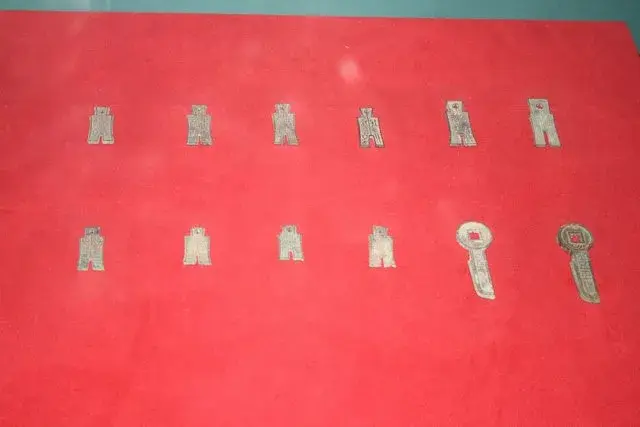
The event in which Wang Mang Replaces Han to Found the Xin Dynasty (王莽代汉建国) occurred in late 8 to early 9 CE (Jushe 3 to Shijianguo 1), marking a seminal peaceful dynastic transition in Chinese imperial history. During the late Western Han, monopolistic land accumulation, rural impoverishment, and administrative corruption provoked severe social instability. Concurrently, Confucian apocrypha and the Five Elements cosmological doctrine fostered a widespread intellectual consensus that the dynastic destiny of the Han was exhausted and that a new sage-ruler was destined to emerge. Rising through the preeminent consort clan while maintaining a reputation for austere personal virtue, classical scholarship, and philanthropy, Wang Mang came to be venerated across the empire as a reincarnation of the Duke of Zhou. After serving as regent and Acting Emperor (She Huangdi), Wang Mang orchestrated a nationwide campaign of manufactured celestial portents and dynastic omens. In the winter of 8 CE, a scholar named Ai Zhang submitted an alleged prophetic casket containing imperial mandates from Emperor Gaozu of Han, proclaiming that the Mandate of Heaven had formally passed to Wang Mang. Wang Mang formally accepted the mandate, entered the Han ancestral temple, reclaimed the Heirloom Seal of the Realm from Grand Empress Dowager Wang Zhengjun, and received the abdication of the infant sovereign Ruzi Ying. In the first month of 9 CE, Wang Mang ascended the imperial throne at the Weiyang Palace in Chang'an, promulgating the dynastic title "Xin" (New) and the reign era "Shijianguo" (Beginning of the State's Establishment), thereby inaugurating an unprecedented era of archaizing statecraft.
Regional officials report auspicious stones and seals; Liu Xin and scholars advocate abdication
Literati and officials submit joint petitions urging Wang Mang to formalize his role as emperor
Ai Zhang presents the forged bronze casket at the Han ancestral temple, claiming divine mandate
Wang Mang secures the chipped Heirloom Seal and accepts the abdication of toddler Ruzi Ying
Wang Mang ascends the throne at Weiyang Palace, inaugurating the Xin dynasty and Shijianguo era
Wang Mang creates the Four Helpers, Three Excellencies, and enfeofs Liu Ying as Duke of Ding'an
Wang Mang issues decrees nationalizing land into King's Land and banning slave commerce
Following the reigns of Emperors Zhao and Xuan, the Western Han dynasty experienced steady administrative degeneration. Successive emperors—Yuan, Cheng, and Ai—proved weak, enabling consort clans to dominate the executive branch. Powerful landed magnates aggressively annexed smallholder farmland, driving millions of peasant freeholders into bonded servitude, tenant peonage, or displaced vagrancy. Peasant insurrections erupted intermittently amidst recurring floods and droughts.
Simultaneously, Confucian classical learning fused deeply with prophetic prognostication (chenwei) and the cyclical Five Phases (Wuxing) cosmology. Educated elites and the populace embraced the notion that every dynasty was governed by a cosmic phase with a finite allotment of celestial favor. The Han dynasty, associated with the phase of Fire, was widely perceived to have exhausted its mandate. Figures like Sui Hong and Gan Zhongke openly advocated that the House of Liu should seek a virtuous sage to receive an orderly abdication. Despairing of bureaucratic paralysis, the empire collectively yearned for an incorruptible sage to establish moral and socioeconomic order.
Wang Mang belonged to the supreme consort clan of the Western Han, the family of Empress Wang Zhengjun. In contrast to his profligate relatives, Wang Mang practiced strict frugality, devoted himself to studying the Rites of Zhou and other Confucian classics, and lived a life of filial devotion. As a court official, he distributed his wealth and land stipends to impoverished scholars and starving commoners, living in modest attire. While serving as Minister of War (Da Sima), he financed the expansion of the Imperial Academy at Chang'an, providing housing for ten thousand Confucian students.
When his sons committed moral infractions, Wang Mang forced them to commit suicide, projecting an image of unyielding moral righteousness that won universal adulation among the gentry. Following the death of Emperor Ping, Wang Mang elevated Liu Ying, a two-year-old descendant of Emperor Xuan known as Ruzi Ying, to the crown, while he himself assumed the role of Acting Emperor modeled after the Duke of Zhou's regency for King Cheng, exercising supreme executive authority over the realm.
Throughout his regency, Wang Mang scrupulously adhered to the Confucian philosophical framework requiring demonstrable proof that Heaven had bestowed its mandate through merit. In 6 CE (Jushe 1), a white stone bearing vermilion inscriptions proclaiming "Announce to Duke Anhan, Wang Mang, that he shall become Emperor" was discovered in Chang'an. Subsequently, provincial governors and literati flooded the capital with reports of auspicious portents, including white pheasants, golden dragons, and miraculous springs.
Leading scholar-bureaucrats such as Liu Xin systematically aligned classical genealogical lore to prove that Wang Mang descended from the legendary Emperor Shun. Through Five Phases succession logic, the Fire virtue of the Han dynasty naturally yielded to the Earth virtue embodied by Shun's lineage. Court ministers, provincial inspectors, local notables, and foreign tributary delegates submitted petitions imploring Wang Mang to yield to the will of Heaven and assume the throne, elevating political anticipation to a fervent pitch.
In the winter of 8 CE (Jushe 3), Ai Zhang, an ambitious student from Zitong, forged a bronze casket sealed with the inscription "Chart of the Heavenly Emperor's Seal in the Gold Casket." Inside were two inscribed wooden documents titled "Testamentary Ordinance of the Red Emperor Gaozu of Han" and "Sealed Mandate of the Yellow Emperor." These texts fabricated celestial decrees from Liu Bang and the supreme heavens, stating that the Mandate of Heaven was formally transferred to Wang Mang and naming eleven designated high ministers of the new dynasty.
Donning ceremonial robes at dawn on the Jiazi day of the eleventh month, Ai Zhang presented the bronze casket at the Han ancestral temple in Chang'an. Wang Mang seized the moment, proclaiming that the ultimate sign had appeared. He immediately proceeded in full imperial regalia to the temple of Emperor Gaozu, accepted the divine casket before the civil and military court at Weiyang Palace, and declared his tearful submission to the eternal will of Heaven and the ancestral spirits.
On the Wuyin day of the eleventh month, Wang Mang initiated the formal abdication ceremony. He sent his trusted advisor Wang Shun to Changle Palace to demand the surrender of the Heirloom Seal of the Realm from Grand Empress Dowager Wang Zhengjun. Although Wang Mang's aunt, the Empress Dowager was outraged by the betrayal of the Liu house. Rebuking Wang Shun bitterly, she hurled the precious jade seal against the stone floor, chipping one of its corners (which was later repaired with gold).
With the sacred seal in hand, Wang Mang presided over the abdication ceremony in the front hall of Weiyang Palace. Stroking the head of the toddler Ruzi Ying, Wang Mang lamented: "In antiquity, the Duke of Zhou acted as regent and returned power when the sovereign came of age; today, Heaven's supreme command cannot be refused, and I am compelled to ascend the throne!" Wang Mang demoted Liu Ying to Duke of Ding'an with a ten-thousand-household estate, granting him the privilege of maintaining Han imperial rituals and ancestral sacrifices within his domain. Wang Mang then conducted solemn sacrifices to Heaven, Earth, and the dynastic spirits, concluding Han rule.
On the first day of the twelfth month of 8 CE (designated the first month of 9 CE), Wang Mang issued his foundational imperial manifesto to the empire. The decree declared that the dynastic fortune of the Han had expired and that the celestial mandate had descended upon the descendant of Emperor Shun. Wang Mang proclaimed himself True Emperor, establishing the dynastic name "Xin" (New), signifying renewal and moral purification.
The new sovereign promulgated the era name "Shijianguo" (Beginning of the State's Establishment) for the year 9 CE, declared a nationwide general amnesty, and distributed ranks, wine, and oxen to civilian households across the provinces. He posthumously honored his father Wang Man, elevated Empress Dowager Wang Zhengjun as Dowager Mother of Heaven, appointed his wife as Empress, and named his son Wang An as Heir Apparent. Civil and military officials prostrated themselves shouting praises of longevity, formally cementing the birth of the Xin dynasty.
Upon ascending the throne, Wang Mang reconstructed the bureaucratic apparatus in accordance with the Five Phases doctrine and the Rites of Zhou. He declared that the Xin dynasty ruled through the virtue of Earth, adopting yellow as the ceremonial imperial color and five as the official cosmological number. He appointed Ai Zhang and other collaborators to supreme advisory posts, establishing the Four Helpers and Three Excellencies to direct imperial administration.
Furthermore, Wang Mang issued sweeping decrees altering administrative nomenclature: renaming Chang'an to "Chang'an" (Eternal Peace, using an alternative ideograph) and changing prefectural and county names to reflect ancient classical references. Crucially, he promulgated the Wangtian (King's Land) decree nationalizing private estates and the Sishu decree prohibiting slave trafficking, launching a monumental archaizing reform program aimed at recreating the idealized well-field egalitarian order of the Western Zhou.
Wang Mang's replacement of the Han dynasty concluded two hundred and fourteen years of Western Han dynastic rule through a peaceful, bloodless abdication ceremony. Wang Mang successfully established the Xin dynasty, erecting an administrative order founded upon classical Confucian models and the Five Phases cosmological system. The deposed infant sovereign was spared execution and granted an autonomous estate to preserve ancestral offerings, and the broader Han nobility was not subjected to immediate extermination. Riding a wave of immense academic popularity and public expectation, Wang Mang commenced his sovereign rule with undisputed authority across the realm.
The event established a monumental institutional precedent in the evolution of Chinese dynastic changes. Wang Mang translated the mythic Confucian ideal of "abdication" (shanrang) into concrete institutional reality, creating an elaborate liturgical template—encompassing fabricated omens, prophetic memorials, ancestral temple notifications, formal surrenders of the jade seal, and solemn imperial proclamations—that was subsequently imitated by Cao Pi replacing Han, Sima Yan replacing Wei, and Liu Yu replacing Jin over the ensuing millennium. However, the utopian, dogmatic reforms implemented by Wang Mang upon his accession ignored prevailing socioeconomic conditions, precipitating severe currency disruptions, administrative paralysis, and widespread peasant rebellions (the Green Forest and Red Eyebrow uprisings) that completely destroyed the Xin dynasty after merely fifteen years.