The Grand Host Assembled
Wang Mang mobilizes 420,000 imperial troops under Wang Yi and Wang Xun to exterminate the Han rebellion.
Xin Dynasty (新朝) · HISTORICAL EVENT
昆阳之战
The Battle of Kunyang (昆阳之战) was a climactic military engagement in 23 CE (the 4th year of Wang Mang's Dihuang era / 1st year of Gengshi) in which rebel forces of the revived Han Dynasty annihilated the main grand army of the Xin Dynasty at Kunyang (modern Yexian, Henan), standing as one of the most celebrated asymmetric victories in ancient military history. Following the enthronement of Emperor Gengshi in Nanyang, insurgent columns captured Kunyang and…
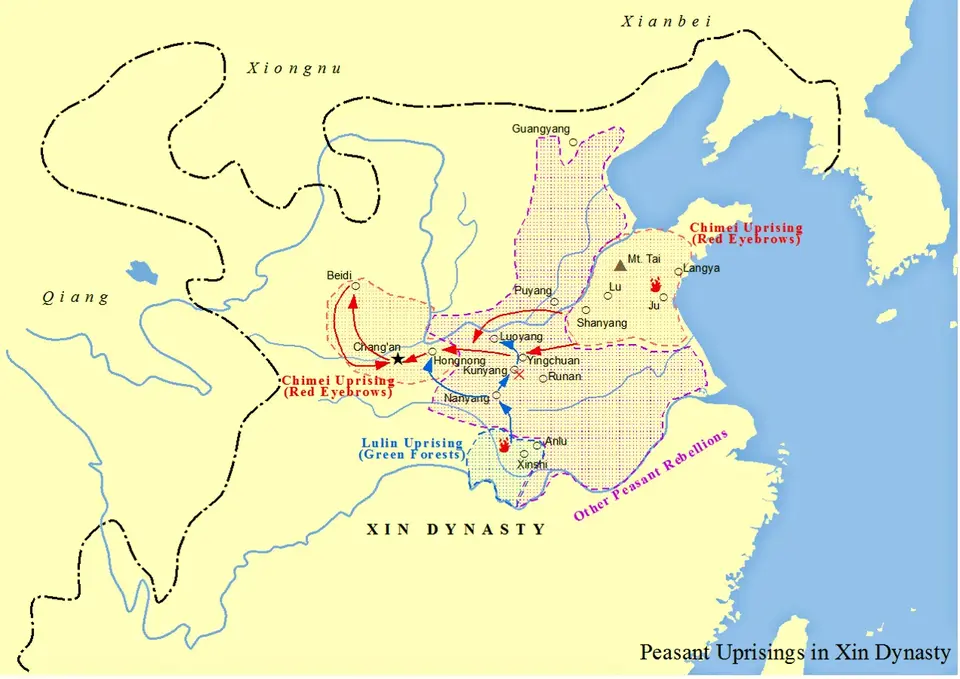
The Battle of Kunyang (昆阳之战) was a climactic military engagement in 23 CE (the 4th year of Wang Mang's Dihuang era / 1st year of Gengshi) in which rebel forces of the revived Han Dynasty annihilated the main grand army of the Xin Dynasty at Kunyang (modern Yexian, Henan), standing as one of the most celebrated asymmetric victories in ancient military history. Following the enthronement of Emperor Gengshi in Nanyang, insurgent columns captured Kunyang and neighboring strongholds, imperiling Luoyang and Chang'an. In response, Wang Mang appointed Grand Minister of Works Wang Yi and Grand Minister of Education Wang Xun to lead 420,000 imperial troops to crush the rebellion. Encircled by overwhelming forces, the eight-thousand-man garrison at Kunyang fell into panic. General Liu Xiu persuaded commanders to hold firm, staging an audacious nocturnal breakout with thirteen horsemen to rally reinforcements from Dingling and Yanxian. In July 23, Liu Xiu spearheaded an elite shock force of three thousand warriors across the Zhi River, striking directly into the enemy command post and slaying Wang Xun. Assisted by sudden torrential rainstorms, hurricane winds, and flash floods along the Zhi River, the garrison sallied out, routing the vast imperial host into catastrophic stampedes. The triumph at Kunyang destroyed Wang Mang's military foundation, precipitating the fall of the Xin Dynasty and establishing the martial prestige of Liu Xiu.
Wang Mang mobilizes 420,000 imperial troops under Wang Yi and Wang Xun to exterminate the Han rebellion.
The grand army surrounds Kunyang; Liu Xiu persuades the eight-thousand-man garrison to hold firm.
Liu Xiu leads thirteen horsemen through enemy lines to rally reinforcements from Dingling and Yanxian.
Liu Xiu arrives with ten thousand troops, slaying enemy officers and circulating reports of Wancheng's fall.
Liu Xiu leads three thousand shock troops across the Zhi River, slaying Grand Minister of Education Wang Xun.
As Kunyang's garrison charges, sudden hurricanes and flash floods drown tens of thousands of fleeing Xin soldiers.
Rebel armies enter Chang'an and execute Wang Mang, terminating the Xin Dynasty.
In 9 CE, imperial relative Wang Mang usurped the Han throne and founded the Xin Dynasty, enacting sweeping archaic reforms. His nationalization of land, state industrial cartels, and frequent currency devaluations, combined with catastrophic floods along the Yellow River and severe droughts, threw the empire into widespread starvation. Popular rebellions erupted across the Central Plains, dominated by the southern Green Forest and eastern Red Eyebrows armies.
In late 22 CE, Han imperial descendants Liu Yan and Liu Xiu initiated the Chongling uprising in southern Henan, combining forces with Green Forest divisions to defeat Xin frontier armies and lay siege to Wancheng. In March 23, allied insurgent commanders enthroned Liu Xuan as Emperor Gengshi along the shores of the Yu River, restoring the Han dynastic banner and rallying anti-Xin forces nationwide.
Following the proclamation of the Gengshi reign, rebel armies launched a dual offensive: Liu Yan maintained the siege of Wancheng, while Liu Xiu, Wang Feng, and Wang Chang led vanguard forces northward, rapidly capturing Xiangcheng, Kunyang, Dingling, and Yanxian. Positioned at the strategic bottleneck connecting the Funiu Mountains to the Central Plains, Kunyang commanded the vital corridor linking the imperial capitals of Luoyang and Chang'an with southern China.
Terrified by the threat to his capital, Wang Mang mobilized the entire military reserves of his empire. In May 23, Wang Mang appointed Grand Minister of Works Wang Yi and Grand Minister of Education Wang Xun as supreme commanders, mobilizing 420,000 troops and deploying exotic war beasts to terrify the insurgents, marching south to exterminate the rebel forces at Kunyang.
In June 23, Wang Mang's grand army advanced south into Henan, their columns spanning hundreds of miles. Outnumbered rebel outposts fell back into the fortress of Kunyang, where only eight to nine thousand Han troops were garrisoned. Outside, the immense Xin army encircled the citadel in continuous fortified rings.
Confronting the terrifying host, Green Forest commanders Wang Feng and Li Yi panicked, proposing to abandon the city and scatter to protect their families. At this critical juncture, Liu Xiu stepped forward and rebuked them: "Our rations are scarce while the enemy is immense. If we stand united, we may prevail; if we scatter, none will survive. Wancheng has not fallen, and if Kunyang falls, all our forces will be annihilated within days. Why hoard private wealth when total destruction looms?"
Moved by his strategic conviction, the commanders agreed to defend the walls. Liu Xiu pledged: "You hold the fortress while I break out to summon reinforcements from Dingling and Yanxian; striking inside and out, victory is assured!"
On the dark, moonless night of June 18, 23, while imperial pickets sounded watchtowers across the lines, Liu Xiu selected thirteen elite cavalrymen, including Li Tong and Zong Bao, and slipped through the southwestern sector of the enemy encirclement. Overcoming enemy patrols, they galloped toward Dingling and Yanxian.
Arriving at the rear bases, regional commanders were reluctant to commit their garrisons. Liu Xiu appealed to their ambition: "If we crush the enemy today, boundless wealth and immortal honor will be ours! If Kunyang falls, we are all doomed—what use is hoarded silver then?" Convinced by his vision, the commanders entrusted their divisions to Liu Xiu, assembling over ten thousand veteran infantry and cavalry to march on Kunyang.
Meanwhile, Kunyang's defenders endured intense assaults. Wang Yi constructed mobile siege towers to fire arrows down into the streets and tunneled beneath the ramparts. The garrison drew water with shields overhead. When Wang Feng attempted to negotiate surrender, Wang Yi arrogantly refused, demanding unconditional slaughter, which galvanized the defenders into desperate resistance.
On July 7, 23, Liu Xiu's relief army approached Kunyang. Understanding that open confrontation was impossible, Liu Xiu spearheaded a vanguard of one thousand shock cavalry, slaying dozens of enemy soldiers personally and shattering frontline enemy morale.
Simultaneously, Liu Xiu staged psychological warfare: hearing that Wancheng had fallen, he deliberately dropped letters reporting that vast Han armies were advancing north. Finding these letters, Xin soldiers were demoralized, while Kunyang's defenders rejoiced.
On the morning of July 9, Liu Xiu selected three thousand elite shock troops and maneuvered stealthily across the upper Zhi River to strike directly into the rear of Wang Yi and Wang Xun's command pavilion. Arrogant and complacent, Wang Yi commanded other camps to hold positions, attempting to repel the assault with only ten thousand guards.
This blunder paralyzed the massive Xin army. Liu Xiu's shock troops smashed through the headquarters, slaying Grand Minister of Education Wang Xun in close combat. Seeing their general fall, the central imperial command collapsed into chaos.
As the command pavilion burned, Kunyang's defenders threw open the city gates. Wang Chang and Wang Feng led thousands of defenders charging into the disorganized enemy rear, pinning the Xin host between two fires.
At that precise moment, a violent tempest struck: black clouds engulfed the sky, thunder crashed, and torrential rain accompanied by gale-force winds blew roof tiles into the air. Disorganized and terrified by the storm, 420,000 Xin soldiers panicked and stampeded.
Fleeing south, tens of thousands plunged into the swollen Zhi River. Contemporary chronicles record that the drowning corpses choked the river waters until it ceased to flow. Grand Minister of Works Wang Yi abandoned his war-chariot and official seals, escaping across the bodies with only a handful of guards back to Luoyang. The Han forces captured boundless supplies, wagons, and weapons, ending the military threat.
The Battle of Kunyang permanently broken the military back of the Xin Dynasty. Within three months, insurgent armies stormed Chang'an and executed Wang Mang. The prestige gained at Kunyang elevated Liu Xiu into a national hero, paving the way for his pacification of the realm and the foundation of the Eastern Han Dynasty.
The Battle of Kunyang resulted in the total annihilation of the 420,000-man grand army of the Xin Dynasty. Grand Minister of Education Wang Xun was slain, vast stockpiles of imperial arms were captured, and Wang Mang lost his final strategic reserve. Within three months, insurgent columns took Chang'an and slew Wang Mang, extinguishing the Xin Dynasty.
Standing as one of the premier asymmetric victories in Chinese annals, the Battle of Kunyang shattered the archaic reforms of Wang Mang and restored dynastic legitimacy to the Han name. Crucially, it established the unrivaled military reputation of Liu Xiu, providing the political capital and military authority required to pacify Hebei and inaugurate the two-century-long Eastern Han Dynasty.
Modern military historians analyze the Battle of Kunyang as an exquisite synthesis of defense, mobile maneuver, psychological warfare, and precision decapitation strikes. Liu Xiu demonstrated supreme strategic endurance in holding the fortress, leveraged intelligence to paralyze enemy command, and executed a decisive strike against the enemy command post, producing one of the greatest asymmetric triumphs in world military history.