First Currency Reform
Wang Mang issues Daqian Wushi, Qidao, and Cuodao, creating extreme fiat valuations and provoking rampant illicit minting
Xin Dynasty (新朝) · HISTORICAL EVENT
王莽更制货币与五均六筦
Wang Mang's Monetary Reforms and the Five Levelings and Six Controls (王莽更制货币与五均六筦) represented a sweeping state monopoly and economic control program implemented throughout the Xin dynasty between 7 and 23 CE (Jushe 2 to Dihuang 4). Following his seizure of power and the subsequent establishment of the Xin dynasty, Wang Mang sought to resolve deepening imperial fiscal crises and realize the classical Confucian socioeconomic ideals described in the *Rites…
Wang Mang's Monetary Reforms and the Five Levelings and Six Controls (王莽更制货币与五均六筦) represented a sweeping state monopoly and economic control program implemented throughout the Xin dynasty between 7 and 23 CE (Jushe 2 to Dihuang 4). Following his seizure of power and the subsequent establishment of the Xin dynasty, Wang Mang sought to resolve deepening imperial fiscal crises and realize the classical Confucian socioeconomic ideals described in the Rites of Zhou. Through mandatory administrative fiat, his administration intervened extensively in commodity distribution, commodity price regulation, credit lending, and the exploitation of natural resources to suppress private merchant cartels. In the monetary sphere, Wang Mang implemented four radical, successive currency upheavals: introducing fiat nominal currencies like the Daqian Wushi, Qidao, and Cuodao in 7 CE; replacing the standardized five-zhu coin with the convoluted Twenty-Eight Precious Currencies system in 10 CE; and finally introducing Huobu and Huoquan in 14 CE. The resulting debasements and arbitrary exchanges shattered commercial confidence and brought markets to a standstill. Concurrently, the Five Levelings and Six Controls policy established price-regulation directors in six major commercial metropolises, created state lending bureaus, and monopolized salt, iron, liquor, coinage, and natural resource taxes. Placed in the hands of merchant-bureaucrats, these policies degenerated into predatory extortion, precipitating nationwide hyperinflation, widespread bankruptcy, and the eventual downfall of the Xin regime.
Wang Mang issues Daqian Wushi, Qidao, and Cuodao, creating extreme fiat valuations and provoking rampant illicit minting
Wang Mang ascends the throne, abolishes Han wuzhu coins, and confiscates private gold reserves
Promulgation of the Twenty-Eight Grades currency system, causing commercial paralysis and black-market wuzhu circulation
Market bureaus established across six major metropolises to regulate commodity prices and state loans
Monopolies on salt, iron, liquor, minting, and resource taxes placed under Lu Kuang's direction
Abolition of the Baohuo system; new currencies succumb to rapid hyperinflation and barter reversion
Rural impoverishment and predatory bureaucratic extortion catalyze the outbreak of the Green Forest Rebellion
Insurgent forces seize Chang'an and execute Wang Mang, terminating all Xin regulatory apparatuses
Since Emperor Wu of Han introduced the standardized wuzhu (five-zhu) bronze cash coin, it had circulated across the empire for over a century as a reliable and stable metallic currency. However, during the mid-to-late Western Han, unrestrained land concentration and the expansion of the slave trade concentrated vast wealth in the hands of aristocratic lineages and merchant monopolists. Wealthy merchant syndicates hoarded grain, manipulated wholesale commodity prices, and charged predatory interest on agricultural loans, driving independent freeholders into insolvency and vagrancy.
Simultaneously, illicit private minting flooded urban markets with debased, light coins cast from lead and tin. The imperial treasury suffered chronic deficits due to military expenditures on frontier defenses and recurring outlays for drought and flood relief. The central government urgently required new fiscal revenues to break private financial monopolies and replenish the national treasury.
Wang Mang was an ardent adherent of Confucian Old Text classics, firmly believing that the ancient institutions described in the Rites of Zhou—specifically the Offices of Springs and Market Directors—represented the ultimate blueprint for social harmony. He maintained that the state had an absolute moral obligation to monopolize mineral wealth, forests, waterways, and currency issuance, using state market bureaus to stabilize consumer prices and extend affordable credit to curb commercial profiteering.
Furthermore, Wang Mang believed that classical royal mints utilized cowries, tortoise shells, and mixed precious metals to represent moral hierarchy. He also harbored superstitious animosity toward the traditional wuzhu coin because the character zhu contained the radical for metal (jin), which formed part of the ideograph for the Han royal surname Liu (written with components mao, jin, and dao). Driven by dogmatic archaism and symbolic paranoia, Wang Mang unleashed a series of disruptive, counterproductive economic fiats.
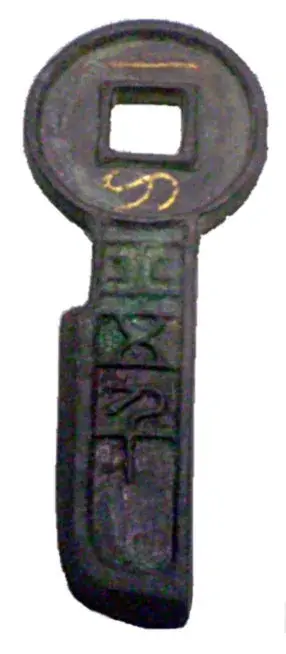
In the fifth month of 7 CE (Jushe 2), while serving as acting regent, Wang Mang initiated his first monetary restructuring under the pretext of reviving ancient blade currency. Alongside the existing five-zhu coins, he mandated three new token currencies: the Daqian Wushi (Large Coin Fifty), weighing twelve zhu but given an arbitrary legal value equal to fifty standard five-zhu coins; the Qidao Wubai (Inscribed Knife Five Hundred), valued at five hundred wuzhu coins; and the Yidao Pingwuqian (One Knife Equal to Five Thousand), a composite knife coin with its head inlaid with gold characters, arbitrarily valued at five thousand wuzhu coins.
The primary objective of these extreme fiat valuations was to strip bullion and wuzhu coins from wealthy families and commoners into the imperial treasury at minimal cost. However, because their nominal face value wildly exceeded their intrinsic metallic worth, commercial markets rejected them. Counterfeiters immediately seized upon the massive profit margins, producing inferior illicit cash across the empire. The court responded with draconian punishments, enslaving entire households caught minting false coins, which severely destabilized the imperial monetary system.
In 9 CE (Shijianguo 1), upon formally usurping the throne and establishing the Xin dynasty, Wang Mang banned the traditional wuzhu coin alongside the Qidao and Cuodao knives, deeply paranoid over the symbolic presence of the Han surname. Only the Daqian Wushi and newly minted Xiaoqian Jingliu (Small Coin Diameter Six) were permitted to circulate. Millions of citizens who held wuzhu savings saw their wealth erased overnight. Wang Mang also prohibited private possession of gold bullion, ordering all gold surrendered to the imperial treasury in exchange for debased fiat coins, effectively confiscating private reserves.
In 10 CE (Shijianguo 2), seeking to replicate the legendary primeval currency system, Wang Mang promulgated the Baohuo (Precious Currency) decree, introducing an absurdly complex monetary matrix known as the Five Materials, Six Categories, and Twenty-Eight Grades (Wuwu Liuming Ershiba Pin). The system encompassed gold, silver, tortoise shells, cowrie shells, and bronze cash across twenty-eight distinct denominations. Values ranged from 2,160 bronze cash for a supreme tortoise shell down to three cash for a juvenile cowrie.
The Baohuo system paralyzed empire-wide commerce. Neither illiterate peasants nor experienced urban merchants could calculate the intricate, shifting exchange ratios between different shell, silver, and copper denominations. Trade halted completely, and the public abandoned Xin currency, turning to black markets to conduct business exclusively in illicit Han wuzhu coins. Enraged, Wang Mang enacted collective liability laws: any merchant or household found using or concealing wuzhu coins was sentenced to military exile, along with four neighboring families. Hundreds of thousands of citizens were condemned, filling prisons to capacity and destroying urban commerce.
Acknowledging that the Baohuo system had brought economic activity to an absolute standstill, Wang Mang abolished both the precious currency grades and the Daqian coins in 14 CE (Tianfeng 1), launching his fourth monetary upheaval. He introduced two simplified coinages: the Huobu (Spade Currency), weighing twenty-five zhu and valued at twenty-five basic units; and the Huoquan (Coin Spring), weighing five zhu and valued at one basic cash, designated as the universal standard currency.
Wang Mang ordered that all older Daqian coins be devalued to two cash and redeemed within six years. However, seven years of arbitrary devaluations and administrative reversals had obliterated state financial credibility. Although the Huobu and Huoquan were cast with elegant calligraphy and fine metallurgy, the imperial treasury resorted to reckless debasement to finance foreign wars against the Xiongnu and manage internal disasters. Hyperinflation spiraled out of control; private merchants refused paper valuations, and the populace abandoned coinage entirely, reverting to primitive barter using grain and raw bolts of silk.
Parallel to his monetary decrees, Wang Mang enacted the Five Levelings (Wujun) policy in 10 CE (Shijianguo 2) to control prices across the empire. He established Five Levelings Market Directors (Wujun Shishi) in the six paramount commercial centers: the capital Chang'an, Luoyang, Handan, Linzi, Wan, and Chengdu.
The Five Levelings mechanism functioned through three official mandates: first, quarterly price evaluations, where market directors recorded commercial rates during the second decade of each season to fix fair baseline prices for grain, textiles, and essential goods; second, price equalization (pingzhun), where the state purchased surplus goods at fair prices when market values fell below baseline, and sold government reserves at baseline prices when shortages drove prices upward; and third, state credit (shedai), where the government provided interest-free loans to impoverished families for funeral and sacrificial expenses, and commercial loans to artisans and traders at an annual interest rate of merely three percent to eliminate private usury.
Simultaneously, Wang Mang promulgated the Six Controls (Liuguan) decree, establishing absolute state monopolies over six critical economic sectors: first, the salt monopoly, prohibiting private brine boiling; second, the iron monopoly, placing iron smelting and agricultural tool manufacturing under state control; third, the liquor monopoly, nationalizing commercial distillation; fourth, the absolute monopoly over coinage and copper minting; fifth, natural resource taxation, levying a mandatory ten percent income tax on all miners, fishermen, loggers, silk weavers, and trappers operating on public mountains, rivers, and lakes; and sixth, the exclusive administration of credit lending through the Five Levelings offices.
To execute this complex regulatory apparatus, Wang Mang appointed Lu Kuang, a prominent merchant from Chang'an, as Minister of Agriculture (Xihe), and staffed local market bureaus with wealthy merchants and their sons. These private monopolists conspired with corrupt imperial magistrates, using administrative power to amass private fortunes. Official bureaus undervalued private goods brought for state purchase and sold defective grain mixed with gravel during shortages. State loans were hoarded by bureaucrats and re-lent at extortionate rates, creating an inescapable web of exploitation.
The confluence of monetary destabilization and the Six Controls dismantled the agrarian economy and free trade that had sustained the Han empire for two centuries. Destitute peasants who gathered firewood or caught fish to survive were enslaved when unable to pay resource taxes. State-manufactured iron plowshares were brittle, poorly forged, and sold at prohibitive prices, forcing impoverished farmers to cultivate fields with primitive wooden spades, triggering a catastrophic collapse in agricultural yields.
Across the six major metropolises, market bureaus squeezed household revenues into the central treasury. Commercial exchange broke down, independent workshops closed, and the agrarian middle class was pushed into destitution. Countless refugees starved along major transport routes amidst nationwide famine. When the Yellow River breached its dikes and floods ruined the eastern plains, the economic devastation sparked the massive Green Forest and Red Eyebrow rebellions during the Tianfeng and Dihuang eras, reducing Wang Mang's utopian state capitalism to ashes.
Wang Mang's currency experiments and the Five Levelings and Six Controls concluded in unprecedented economic devastation and the violent collapse of his dynasty. Over sixteen years, four radical currency restructurings demolished commercial confidence, forcing society to abandon metallic money in favor of primitive barter. The Five Levelings and Six Controls, conceived under the idealistic banner of curbing wealth disparity and extending benevolent credit, degenerated into corrupt bureaucratic exploitation. Independent commerce ceased across major metropolises, and millions of freeholder households fell into ruin. The systemic economic breakdown triggered nationwide peasant uprisings, leading directly to the capture of Chang'an, Wang Mang's death, and the total eradication of Xin administrative institutions.
The failure of Wang Mang's economic policies produced profound lessons in Chinese fiscal history, monetary theory, and statecraft. In monetary history, coins such as the Yidao Pingwuqian, Huobu, and Huoquan achieved unsurpassed aesthetic and calligraphic perfection, yet their catastrophic failure demonstrated the peril of detaching legal nominal values from intrinsic metallic worth, providing the earliest historical case of state-engineered hyperinflation. In macroeconomic administration, the Five Levelings and Six Controls represented the first systematic attempt by an imperial dynasty to establish a totalitarian command economy. Its failure proved that top-down administrative fiat cannot substitute for natural market forces without generating rampant corruption. Upon establishing the Eastern Han, Emperor Guangwu (Liu Xiu) reversed all Xin economic interventions, abolished state monopolies, restored the wuzhu coin, and adopted laissez-faire governance to revive the national economy.