Early Land Cap Proposal
Shi Dan drafts proposals to limit private land and slaves, which are shelved due to consort clan opposition.
Xin Dynasty (新朝) · HISTORICAL EVENT
新莽地皇改革土地王田制
The Reform of the King's Fields Land System in the Dihuang Era of Xin (新莽地皇改革土地王田制) was a radical state land nationalization policy enacted by the Xin Dynasty emperor Wang Mang to address rampant land consolidation and peasant pauperization by imitating the well-field system of the Rites of Zhou. In the late Western Han, unrestrained estate annexation concentrated wealth in aristocratic hands, leaving impoverished tenants destitute. In 9 CE (the…
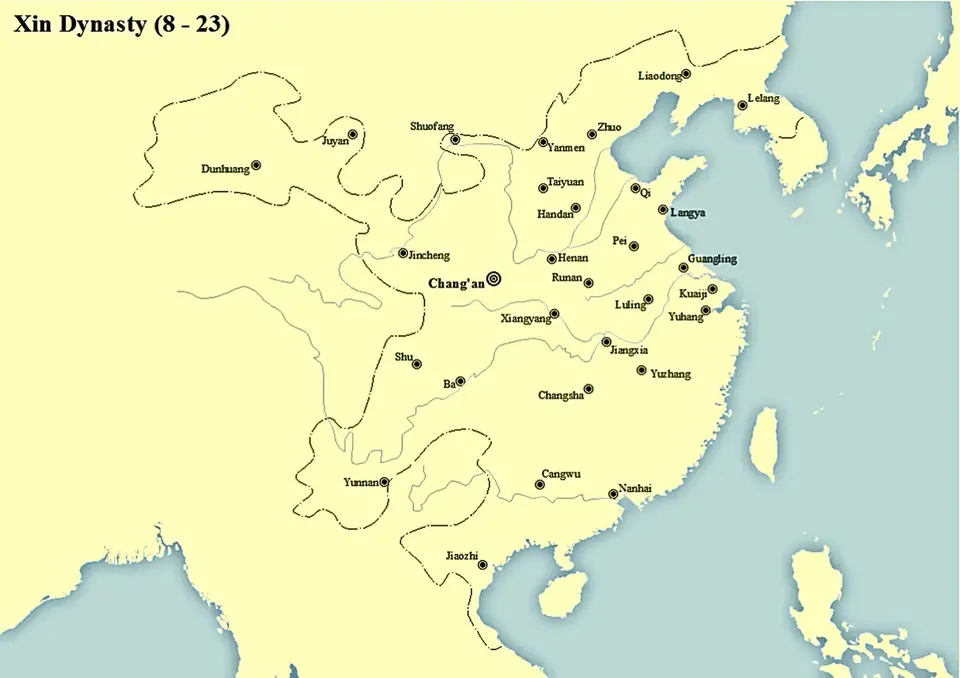
The Reform of the King's Fields Land System in the Dihuang Era of Xin (新莽地皇改革土地王田制) was a radical state land nationalization policy enacted by the Xin Dynasty emperor Wang Mang to address rampant land consolidation and peasant pauperization by imitating the well-field system of the Rites of Zhou. In the late Western Han, unrestrained estate annexation concentrated wealth in aristocratic hands, leaving impoverished tenants destitute. In 9 CE (the inaugural year of Shijianguo), Wang Mang proclaimed the King's Fields system (Wangtian), nationalizing all arable lands and outlawing the private purchase or sale of land and bondservants, who were re-designated as "private dependents" (sishu). The state capped household holdings at nine hundred mou for families with fewer than eight males, requiring excess land to be surrendered to clan neighbors while guaranteeing one hundred mou per peasant couple under pain of exile. However, this policy collided directly with centuries of entrenched private property relations, provoking fierce defiance from powerful gentry and corrupt bureaucratic sabotage. Within three years, thousands were condemned to border exile while rural economies collapsed. In 12 CE, Wang Mang was compelled to rescind the transaction ban, and during the Dihuang era, widespread famines and peasant insurrections abolished the system entirely. This utopian reform isolated the regime from all social strata, dramatically accelerating the collapse of the Xin Dynasty.
Shi Dan drafts proposals to limit private land and slaves, which are shelved due to consort clan opposition.
Wang Mang decrees the nationalization of land as King's Fields and re-designates slaves as Private Dependents, barring all sales.
Severe decrees impose exile on critics of the land system, sending hundreds of thousands to distant frontiers.
Court official Qu Bo warns the emperor that the ancient well-field model cannot function in a densely populated private economy.
Paralyzed by gentry defiance and socioeconomic turmoil, Wang Mang officially lifts the prohibition on buying and selling land.
Complex property taxes are introduced as agrarian transactions spin out of control, leaving the system functionally dead.
Insurgents storm Chang'an and execute Wang Mang, terminating the Xin Dynasty and the King's Fields experiment.
Following Shang Yang's legalist reforms in the Qin state during the Warring States period, the ancient well-field communal system was abolished, legally establishing private landownership and commercial transactions. By the late Western Han during the reigns of Emperor Yuan and Emperor Cheng, this unregulated market dynamic generated catastrophic socioeconomic polarization. Imperial consort clans, founding nobility, and merchant magnates amassed colossal estates spanning thousands of fertile acres, exploiting tax exemptions to amass fortune while driving smallholder peasants into debt bondage, tenancy, and slavery.
During Emperor Ai's reign, Chancellor Kong Guang and Grand Minister of Works Shi Dan drafted a land and slave limitation proposal, suggesting a ceiling of thirty qing (approx. three thousand mou) of land and strict limits on private slaves according to aristocratic ranks. However, this proposal was fiercely obstructed by the ruling consort cliques—the Wang, Fu, and Ding families—and was quickly shelved, leaving systemic agrarian crises unchecked.
Ascending to supreme power under the guise of Confucian restoration, Wang Mang attributed the social decay of the late Western Han to the abandonment of ancient Zhou Dynasty well-field statutes. Steeped in the Rites of Zhou, Wang Mang maintained that only total land nationalization by sovereign authority could eliminate private greed and restore social harmony.
In January 9 CE, Wang Mang inaugurated the Xin Dynasty. Determined to legitimate his dynastic mandate through radical social engineering, he made agrarian property relations the primary battleground. Overriding pragmatic counsel and citing omens, Wang Mang deployed imperial decrees to nationalize land and labor, launching the King's Fields reform across China.
In May 9 CE (Shijianguo 1), Wang Mang promulgated the historic reform edict, lamenting that unrestricted land commerce allowed the wealthy to feed grain to hounds and horses while the destitute starved on chaff. The decree proclaimed: "In antiquity, eight families cultivated a well-field unit, with one hundred mou granted per couple. The Qin abolished the well-fields, unleashing rampant annexation. Today, all land in the realm shall be renamed King's Fields, and all slaves shall be renamed Private Dependents; neither shall be bought or sold."
This decree legally confiscated all private land titles, vesting sole ownership in the emperor. Landed estates and peasant smallholdings were stripped of commodity status and converted into state-assigned usufruct tenements. Simultaneously, the ban on slave trafficking reclassified domestic bondservants as personal dependents to suppress aristocratic private armies.
Wang Mang enacted explicit land redistribution formulas: households possessing fewer than eight adult males but owning more than one well-field unit (nine hundred mou) were legally obligated to distribute the surplus land free of charge to extended clan members or landless village neighbors. The administration promised landless peasant couples state allotments of one hundred mou.
To enforce compliance, Wang Mang imposed draconian criminal penalties: anyone criticizing the King's Fields system or violating property and slave transaction prohibitions was sentenced to capital punishment or permanent exile to distant border marshes.
The reform encountered immediate, insurmountable resistance. Having functioned under private property rights for over three centuries, regional magnates and scholar-gentry lineages viewed land as the core foundation of ancestral wealth. Gentry families openly concealed landholdings, forged household registers, and resisted surrendering surplus acres.
Compounding this resistance, local magistrates—who came predominantly from gentry households—sabotaged enforcement through extortion. Instead of distributing estates to impoverished tenants, officials confiscated smallholder plots for private embezzlement. Destitute peasants received no land, while the prohibition on land commerce prevented distressed families from selling holdings to survive emergencies. Thousands of families were falsely accused, clogging imperial prisons and overwhelming exile corridors toward frontier border garrisons.
Facing widespread unrest and escalating rural rebellion, internal debate fractured the Xin court. Court academician Qu Bo submitted a courageous memorial pointing out that the well-field system was designed for ancient times when populations were sparse. With populations now multiplied a hundredfold, forcing an obsolete model onto complex commercial society would inevitably precipitate nationwide turmoil.
In 12 CE (Shijianguo 4), after only three years of chaotic enforcement, Wang Mang capitulated before mounting gentry insurrections and economic collapse. He issued an edict acknowledging widespread popular distress, declaring that the prohibition on buying and selling King's Fields and private dependents was officially rescinded. This retreat marked the definitive operational failure of Wang Mang's signature land reform.
Despite legalizing land commerce, Wang Mang persisted with erratic fiscal meddling throughout the Dihuang era (20-23 CE), introducing confusing graduated property levies and four successive currency re-denominations. In practice, local magistrates ignored imperial edicts, and the King's Fields framework survived solely as a nominal legal relic.
From 22 to 23 CE, severe droughts and catastrophic floods along the Yellow River triggered the Green Forest and Red Eyebrows peasant rebellions. Regional landlords fortified private manors and allied with insurgent armies to overthrow Xin garrisons. In October 23, rebel forces breached Chang'an and slew Wang Mang on the Jiantai, permanently extinguishing the Xin Dynasty and burying the King's Fields experiment.
The King's Fields reform collapsed within three years under universal opposition from regional landowners, rural smallholders, and imperial bureaucrats. Lifting the ban on transactions failed to restore stability, as currency debasements and arbitrary property extortions plunged agriculture into ruin. Millions of peasants and middle-class households were driven into bankruptcy, fueling widespread rebellions that destroyed the regime.
The King's Fields reform represented the earliest nationwide state-directed land nationalization experiment in imperial Chinese history. It demonstrated the impossibility of imposing ancient communal models onto an established private agrarian economy by administrative decree. By alienating the landed gentry while failing to alleviate peasant misery, the reform united both elite and popular forces in armed rebellion, becoming a fatal catalyst for the fall of the Xin Dynasty.
Modern economic historians analyze Wang Mang's King's Fields reform as a classic example of voluntaristic economic adventurism. While accurately diagnosing the crisis of late Western Han land concentration, Wang Mang applied an archaic, retrogressive prescription. Infringing upon private property without providing genuine relief to landless tenants, the reform catalyzed the peasant rebellions that extinguished his short-lived empire.