Biography
Family Background and Early Years
Liu Yuan was born into the Xiongnu clan recorded in the Chinese sources as the Xulianti clan, also written the Luandi clan. His distant ancestor was Modu Chanyu of the early Han period. Modu Chanyu married a woman of the Han imperial Liu clan and entered into a relationship of sworn brotherhood with Emperor Gaozu of Han, Liu Bang; later descendants consequently adopted Liu as a Han-style surname. The Tuge group to which Liu Yuan belonged was a branch of the Southern Xiongnu whose court had been established at Left State City, northeast of present-day Lishi in Shanxi, during the Eastern Han. His grandfather, Yufuluo, declared himself Chanyu of the Southern Xiongnu in the late Han. His father Liu Bao was appointed commander of the Left Division when Cao Cao reorganized the Southern Xiongnu into five divisions. The Left Division comprised more than ten thousand households, was based in Zishi County in Taiyuan, southeast of present-day Fenyang, and was the largest of the five divisions.
Liu Yuan's mother, Lady Huyan, came from the Xiongnu aristocracy. She gave birth to Liu Yuan around 252 (the fourth year of the Jiaping era of Cao Wei), or in 253 according to another account. Liu Yuan was intelligent from childhood. When his mother died while he was seven, he wept without cease, and his grief moved those around him. Members of his clan and tribe praised his filial conduct, and Wang Chang, then Minister over the Masses, even sent funeral gifts to commend him.
Because Liu Yuan's Xiongnu community had long lived in Han regions, it had undergone considerable cultural assimilation. From childhood, Liu Yuan studied under Cui You, a scholar from Shangdang. He read Confucian works including the *Mao Commentary on the Book of Odes*, the *Jing Family Changes*, and the *Ma Family Book of Documents*, and he was especially fond of the *Zuo Tradition of the Spring and Autumn Annals* and the military writings of Sun and Wu, much of which he could recite. He also read widely in the *Records of the Grand Historian*, the *Book of Han*, and the writings of the various philosophical schools. He once told his fellow students Zhu Ji and Fan Long that whenever he read the biographies in the *Book of Han*, he looked down on Sui He and Lu Jia for lacking military achievement, and on Zhou Bo and Guan Ying for lacking civil accomplishments; great enterprises, he said, depended on people capable of both carrying on the past and opening the future, and it was a disgrace for a gentleman not to be broadly learned. He therefore also trained in military arts, becoming highly skilled in combat, archery, and physical exertion.
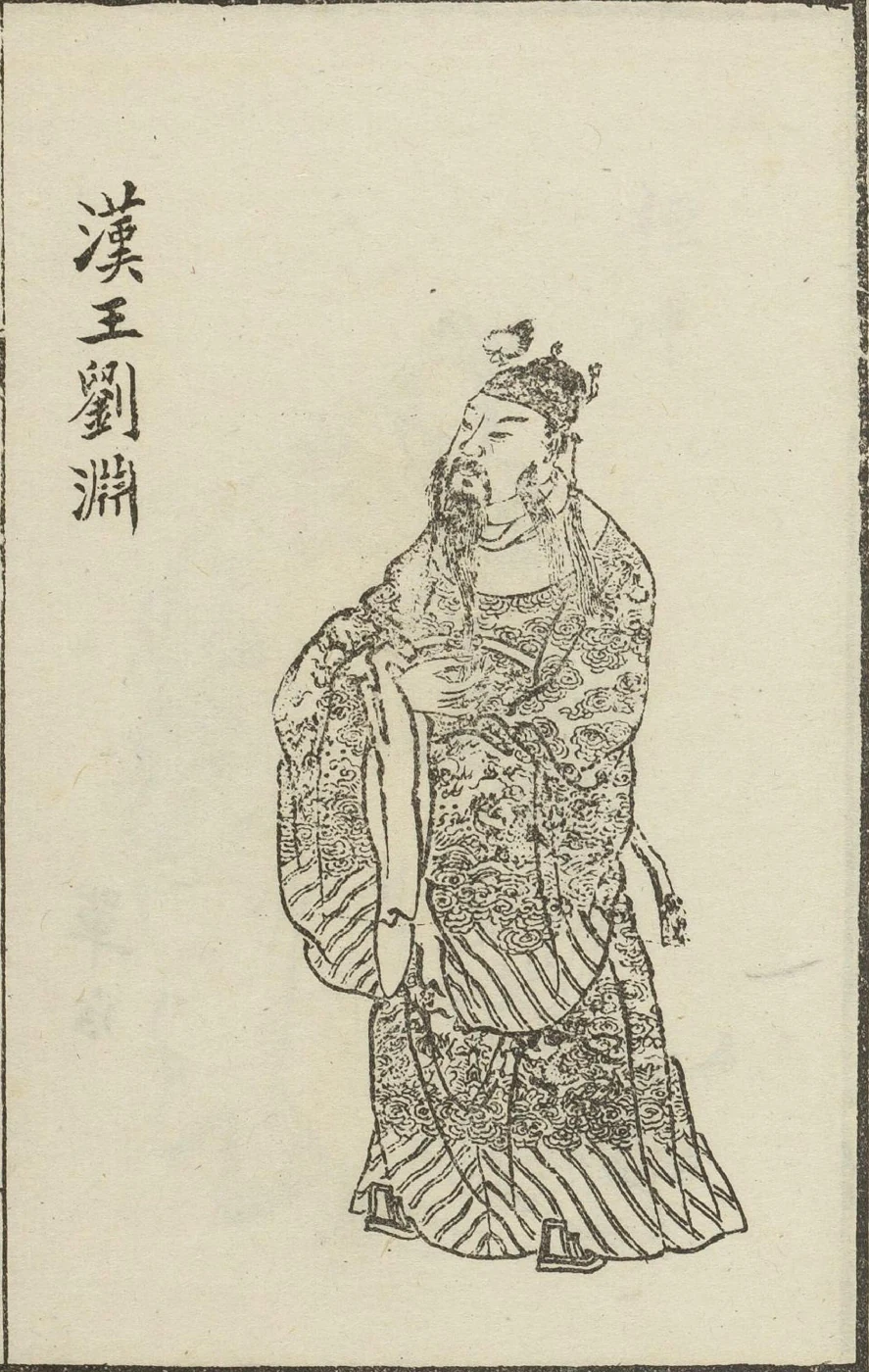
As an adult, Liu Yuan was said to stand eight chi and four cun tall, with a beard more than three chi long and an imposing build. Cui Yizhi of Tunliu and Gongshi Yu of Xiangling, both known for physiognomy, were astonished when they saw him and reportedly said that they had never before encountered such an extraordinary appearance. Wang Hun of the Wang clan of Taiyuan also befriended Liu Yuan on equal terms and ordered his son Wang Ji to pay his respects to him.
Period as a Hostage-Son in Luoyang
During the Xianxi era of Cao Wei (264–265), Liu Yuan lived in Luoyang as a Xiongnu hostage-son and received courteous treatment from Sima Zhao, who controlled the Cao Wei government. After the establishment of the Western Jin, Wang Hun repeatedly recommended Liu Yuan to Emperor Wu of Jin, Sima Yan. When the emperor summoned Liu Yuan, he was greatly pleased and told Wang Ji that Liu Yuan's appearance was so impressive that even You Yu and Jin Midi could not compare with him. Wang Ji replied that Liu Yuan's appearance was indeed as the emperor said, but that his civil and military abilities far exceeded those of the two men; if entrusted with the conquest of Sun Wu, he might quickly pacify the south. Emperor Wu strongly agreed.
Kong Xun and Yang Yao, however, remonstrated that Liu Yuan's abilities were probably unmatched in their time. If given only a small force, they argued, he would not be able to conquer Wu; if granted real military authority, he might seize Jiangnan after the conquest and cease to submit. They invoked the saying that “those not of our kind are sure to have different intentions,” and warned that even allowing Liu Yuan to command his own people was dangerous, much less placing the defensible lands of Jiangnan in his hands. Emperor Wu fell silent, and the proposal was abandoned.
During the Xianning era (275–280), the rebellion of Tufa Shujineng broke out in the Guanzhong-Gansu region, and the Jin court repeatedly failed to suppress it. Li Xi, Supervisor of the Masters of Writing, proposed mobilizing the Five Xiongnu Divisions and granting Liu Yuan a general's title so that he could lead them westward. Kong Xun again objected, arguing that if Liu Yuan pacified Liang Province and killed the rebel leader, Liang Province itself would become the true danger, because Liu Yuan would be like a flood dragon that, once given clouds and rain, would no longer remain confined to a pond. Emperor Wu accepted this warning and again did not employ Liu Yuan.
Having twice been prevented from advancing in office, Liu Yuan was deeply frustrated. Later, when the Donglai adventurer Wang Mi was leaving Luoyang for home, Liu Yuan held a farewell gathering for him by the Jiuqu River and wept. He said that Wang Hun and Li Xi, being his fellow provincials, had often praised and recommended him to the emperor, and that slander had followed as a result. He had never sought office, Wang Mi alone knew this, yet he had suffered because of it; he feared that he would die in Luoyang and never see Wang Mi again. He then sighed, drank heavily, and gave a long, impassioned cry, moving those present to tears. Sima You, Prince of Qi, who was also at Jiuqu, heard of the incident and rode over. He later warned Emperor Wu that unless Liu Yuan were eliminated, Bing Province might never remain secure. Wang Hun protested that Liu Yuan was loyal and trustworthy and that he was willing to guarantee him. Moreover, he argued, the Jin had only just proclaimed that it would win over the realm through virtue; killing a Xiongnu hostage-son on groundless suspicion would hardly demonstrate broad imperial virtue. Emperor Wu agreed with Wang Hun and did not follow Sima You's proposal.
Succeeding to His Father's Following and Managing the Five Divisions
In 279, Liu Bao died, and Emperor Wu ordered Liu Yuan to succeed him as commander of the Left Division. Liu Yuan thus ended his life as a hostage and returned to Bing Province. In his jurisdiction, he displayed administrative ability: he clarified laws and punishments, prohibited wrongdoing, treated wealth lightly, gave generously, and dealt sincerely with others. As a result, outstanding men from all five Xiongnu divisions came to him, and even noted scholars and talented men from distant You and Ji provinces were attracted to his circle. This laid a strong foundation for his later rise as the principal leader of the Xiongnu.
In 289, the Western Jin replaced the commanders of the five divisions with commandants, and Liu Yuan became Commandant of the Northern Division. During Yang Jun's regency, he was additionally appointed General Who Establishes Might and Grand Commander of the Five Divisions and was enfeoffed as Marquis of Hanguang Township, formally recognizing his leadership among the Five Xiongnu Divisions. Near the end of the Yuankang era (291–299), he was dismissed because members of his people had fled beyond the frontier. At about this time, Sima Ying, Prince of Chengdu, who was stationed at Ye, recommended Liu Yuan as Acting General Who Pacifies the North and Supervisor of the Military Affairs of the Five Divisions, separating him from direct command of the five divisions and keeping him in office at Ye.
The dismissal of Liu Yuan and his retention at Ye reflected the Western Jin government's fear of a powerful non-Han leader and its effort to limit his influence. This policy aroused dissatisfaction among upper-ranking Xiongnu nobles who had long felt excluded and suppressed by the Central Plains dynasties.
Rising in Rebellion and Founding the State of Han
The War of the Eight Princes was then at its height. Jin princes fought one another, rebels rose in many places, and the dynasty's ability to control the various peoples greatly weakened. Liu Xuan, formerly Commandant of the Northern Division and Left Xian King and a collateral elder relative of Liu Yuan, convened leading nobles of the Five Xiongnu Divisions. They secretly agreed to support Liu Yuan as Grand Chanyu and sent Huyan You to Ye to inform him. Liu Yuan then told Sima Ying that he wished to return to his people to attend a funeral, but Sima Ying refused. With no other option, Liu Yuan had Huyan You return first, instructing Liu Xuan and the others to gather the five divisions and recruit other groups around Yiyang. Publicly they claimed that they would assist Sima Ying in suppressing his enemies, but in fact they were preparing for a future uprising.
In 304, after Sima Ying defeated Sima Ai and became Imperial Heir, he appointed Liu Yuan Colonel of the Garrison Cavalry. Soon afterward, Sima Yue, Prince of Donghai, and others accompanied Emperor Hui in a campaign against Sima Ying, who then appointed Liu Yuan General Who Assists the State and charged him with supervising the defense of the northern city. After Emperor Hui's army was defeated at Dangyin and the emperor was taken to Ye, Sima Ying promoted Liu Yuan to General Who Champions the Army and enfeoffed him as Count of Lunu. Not long after the Battle of Dangyin, Sima Teng, Duke of Dongying, and Wang Jun, General Who Pacifies the North, rose against Sima Ying. Liu Yuan seized the opportunity to propose returning to the Five Xiongnu Divisions to mobilize his people in Sima Ying's support. Sima Ying agreed, appointing Liu Yuan Northern Chanyu and Participant in the Military Affairs of the Chancellor.
After Liu Yuan returned to Left State City, Liu Xuan conferred on him the title Grand Chanyu. Within twenty days he gathered 50,000 men and established his base at Lishi. Liu Yuan was later defeated by Sima Teng's allies Tuoba Yituo and Tuoba Yilu. At the same time, Sima Ying, unable to withstand Wang Jun's advancing army, abandoned Ye and fled back to Luoyang with Emperor Hui. Despite Sima Ying's predicament, Liu Yuan, over Liu Xuan's objections, ultimately decided not to aid him. He moved back to Left State City, where tens of thousands more people joined him.
In November 304, Liu Yuan claimed that his ancestors had been linked to the Han imperial Liu clan through sworn brotherhood and intermarriage and proclaimed himself “King of Han.” He founded a state named Han, later known as Han-Zhao, and adopted the Yuanxi era name. He posthumously honored Liu Shan, the Later Ruler of Shu Han, as Emperor Xiaohuai. He also established ancestral tablets for eight emperors of Western Han, Eastern Han, and Shu Han, including Liu Bang, Emperor Gaozu of Han; Liu Xiu; and Liu Bei, presenting himself as an heir to the Han imperial tradition. At the same time, he created his own official establishment, formally founding an independent regime.
Expansion and Assumption of the Imperial Title
After Liu Yuan proclaimed himself king, Sima Teng, Inspector of Bing Province, sent the general Nie Xuan against him. Liu Yuan defeated Nie Xuan at Daling. Alarmed, Sima Teng led more than 20,000 households from Bing Province southward toward the Shandong region. Liu Yuan sent Liu Yao, who successively captured Taiyuan, Xuanshi, Tunliu, Zhangzi, Zhongdu, and other places, expanding Han territory. In the following year, 305, Liu Qin, another of Liu Yuan's commanders, again defeated a punitive force sent by Sima Teng. A severe famine then struck Bing Province and affected Lishi as well, so Liu Yuan moved his seat to Liting.
By 307, Liu Yuan had taken most commanderies and counties of Bing Province and sent forces against the newly appointed Inspector Liu Kun. Liu Kun defeated the Han army and successfully retained his headquarters at Jinyang. After the battle, Liu Kun worked to strengthen Bing Province and induced various non-Han groups under Liu Yuan to defect or submit to him, frustrating Han expansion toward northern Bing Province. Liu Yuan therefore accepted proposals from Palace Attendant Liu Yin and Wang Yu to attack other provinces and commanderies and push south toward Chang'an and Luoyang. At the same time, several independent military forces—including Ji Sang, Shi Le, Wang Mi, the Xianbei leader Lu Zhuyan, and the Di chieftain Grand Chanyu Shan Zheng—successively submitted to Liu Yuan. He appointed and enfeoffed them in turn, greatly strengthening the Han regime.
In 308, Liu Yuan captured Puban in Hedong Commandery and Pingyang city in Pingyang Commandery, then moved his capital to Puzi. Fortified positions throughout the two commanderies that had resisted him all surrendered. On the jiashu day of the tenth lunar month (November 2, 308), Liu Yuan assumed the imperial title and changed the era name to Yongfeng. In 309, the Grand Astrologer Xuanyu Xiuzhi argued that the rugged location of Puzi could not serve as a stable long-term capital and recommended moving to Pingyang. Liu Yuan accepted the proposal, immediately transferred the capital to Pingyang, and adopted the Herui era name. He then sent Liu Cong, Wang Mi, and others against Huguan. They first defeated reinforcements sent by Liu Kun and then beat a relief force sent by Sima Yue, Prince of Donghai, at Changping, thereby taking Huguan. Liu Yuan subsequently sent Liu Cong and others against Luoyang twice, in the eighth and tenth lunar months of that year, but Jin forces defeated both assaults and he had to withdraw.
In 310, Liu Yuan became gravely ill. He summoned imperial kinsmen and senior ministers, including Grand Preceptor Liu Huanle and Grand Tutor Liu Yang, to receive his final instructions and assist the government. Liu Yuan died on the jimao day of the seventh lunar month, recorded here as August 19. Crown Prince Liu He succeeded him. He was buried at Yongguang Mausoleum on the xinwei day of the ninth lunar month (October 20), received the posthumous title Emperor Guangwen, and was given the temple name Gaozu.
Liu Yuan, courtesy name Yuanhai, came of the Xiongnu clan of Xulianti and was a descendant of Modu. The founder of the Han had given a princess of the imperial house to Modu in marriage and sworn brotherhood with him, and his descendants accordingly took Liu as their Chinese surname. Early in the Eastern Han the son of the chanyu Wuzhuliuruodi, the day-by-day king Bi of You'aojian, made himself southern chanyu and settled at Meiji on the Xihe, and the Zuoguocheng at Lishi was where the chanyu afterward moved his court. In the Zhongping years the chanyu Qiangqu sent his son Yufuluo with troops to help the Han against the Yellow Turbans, and when Qiangqu was killed by his own people Yufuluo stayed with his followers in Han territory and made himself chanyu; on his death his brother Huchuquan succeeded and made Yufuluo's son Liu Bao king of the left, the wise prince — and Liu Bao was Liu Yuan's father. Cao Cao divided the southern Xiongnu into five parts, making Liu Bao commander of the left and giving the other commands likewise to men of the Liu clan. The left had more than ten thousand households about Zishi in Taiyuan, the largest of the five. The five parts kept the tribal organisation in form, but were in fact closely controlled by the Chinese state; the Lius, though divided among the five, all lived along the Fen about Jinyang.
Liu Yuan's mother, née Huyan, was also a Xiongnu. She bore him about 252 or 253. It is told that at Longmen she prayed for a son and dreamed that a fish she had seen turned into a man who gave her the essence of the sun, saying that taking it she would bear a noble son; and that she gave birth thirteen months later, the child having what seemed to be his name in the lines of his left hand, whence his name. Quick and clever from childhood, at seven when his mother died he wailed like a grown man, and the sound of his grief moved the neighbours, so that his clan and tribe marvelled; and the minister of works Wang Chang, hearing of it, sent offerings for the funeral in praise of his filial piety.
The Xiongnu among whom Liu Yuan lived had been long in Chinese territory and were much sinicised, and so from boyhood he studied the classics under a teacher of Shangdang — the Spring and Autumn, the Documents of the Ma school and the rest. He was fondest of the Zuo Commentary and of the military writings of Sun Wu, whose contents he could largely recite, and beyond these he read the Records of the Grand Historian, the History of the Han and the philosophers. He told his fellow students Zhu Ji and Fan Long that reading the books of history he always thought little of Sui He and Lu Jia for want of military skill, and of the marquis of Jiang and Guan Ying for want of letters, that the way is carried on by men and that for a gentleman not to know a single thing is a disgrace; and so he took up the arts of war and excelled in them, a man of both letters and arms.
Grown, Liu Yuan held office under the Western Jin as commandant of the north, general of martial might and commander-in-chief of the five parts, and stood high among the five Xiongnu. When the wars of the eight princes broke out, the prince of Chengdu, Sima Ying, to win his people's support, sent him back to Bingzhou to raise Xiongnu cavalry; returning to Zuoguocheng, he was urged by Liu Xuan and others to serve the Jin no longer, and was acclaimed great chanyu with tens of thousands about him. He said that emperors were not of one kind alone, that the Great Yu came from the western Rong and King Wen was born among the eastern Yi and that only virtue was asked of them; that with more than a hundred thousand men, each a match for ten Jin soldiers, he might at the highest repeat the work of the founder of the Han and at the lowest be as the Wei; and that being a nephew of the Han house, sworn brothers with it, he might as younger brother continue an elder, so that he took the name of Han and honoured the last sovereign of Shu Han, to gather men's hopes.
In 304 he took the title king of Han at Zuoguocheng, changing the era to Yuanxi, and in 308 he took the imperial title and made Pingyang his capital. Han armies then attacked Luoyang and Bingzhou year after year and their power spread fast. In 310 Liu Yuan died of illness; his son Liu He succeeded and was soon killed by his brother Liu Cong, who made himself emperor and in 311 took Luoyang and captured Emperor Huai. Liu Yuan's rising and founding of a state was an important beginning of the non-Chinese dynasties in the central plains; the Han state he made, later called the Former Zhao, set the pattern for the Sixteen Kingdoms to come, and his career is commonly cited to show how the Xiongnu tribes passed from settlement within China in the late Han and Wei to founding a state of their own.
The state Liu Yuan founded set the pattern for the Sixteen Kingdoms that followed: built on the Xiongnu tribal order while adopting Chinese offices and era names and relying on Chinese scholars for documents and institutions. Under Liu Cong and Liu Yao the state took the name Zhao, known in history as the Former Zhao, and its territory came to take in wide parts of the central plains and the region within the passes. Later historians treat Liu Yuan as one of the earliest non-Chinese rulers to found a state in the central plains in the Sixteen Kingdoms period, and the situation he opened bore directly on the changes of regime in the north over the following century. The Jin History places him among the hereditary records, dwelling on his standing among the five Xiongnu parts and on the founding of his state, and later discussion of the troubles of Yongjia commonly takes his rising as its starting point.